AI

AI Is Reshaping Hacking. No One Agrees How Fast (axios.com) 18

"Several cybersecurity companies debuted advancements in AI agents at the Black Hat conference last week," reports Axios, "signaling that cyber defenders could soon have the tools to catch up to adversarial hackers." - Microsoft shared details about a prototype for a new agent that can automatically detect malware — although it's able to detect only 24% of malicious files as of now.

- Trend Micro released new AI-driven "digital twin" capabilities that let companies simulate real-world cyber threats in a safe environment walled off from their actual systems.

- Several companies and research teams also publicly released open-source tools that can automatically identify and patch vulnerabilities as part of the government-backed AI Cyber Challenge.

Yes, but: Threat actors are now using those AI-enabled tools to speed up reconnaissance and dream up brand-new attack vectors for targeting each company, John Watters, CEO of iCounter and a former Mandiant executive, told Axios.

The article notes "two competing narratives about how AI is transforming the threat landscape." One says defenders still have the upper hand. Cybercriminals lack the money and computing resources to build out AI-powered tools, and large language models have clear limitations in their ability to carry out offensive strikes. This leaves defenders with time to tap AI's potential for themselves. [In a DEF CON presentation a member of Anthropic's red team said its Claude AI model will "soon" be able to perform at the level of a senior security researcher, the article notes later]

Then there's the darker view. Cybercriminals are already leaning on open-source LLMs to build tools that can scan internet-connected devices to see if they have vulnerabilities, discover zero-day bugs, and write malware. They're only going to get better, and quickly...

Right now, models aren't the best at making human-like judgments, such as recognizing when legitimate tools are being abused for malicious purposes. And running a series of AI agents will require cybercriminals and nation-states to have enough resources to pay the cloud bills they rack up, Michael Sikorski, CTO of Palo Alto Networks' Unit 42 threat research team, told Axios. But LLMs are improving rapidly. Sikorski predicts that malicious hackers will use a victim organization's own AI agents to launch an attack after breaking into their infrastructure.

Open Source

Remember the Companies Making Vital Open Source Contributions (infoworld.com) 22

Matt Asay answered questions from Slashdot readers in 2010 as the then-COO of Canonical. Today he runs developer marketing at Oracle (after holding similar positions at AWS, Adobe, and MongoDB).

And this week Asay contributed an opinion piece to InfoWorld reminding us of open source contributions from companies where "enlightened self-interest underwrites the boring but vital work — CI hardware, security audits, long-term maintenance — that grassroots volunteers struggle to fund." [I]f you look at the Linux 6.15 kernel contributor list (as just one example), the top contributor, as measured by change sets, is Intel... Another example: Take the last year of contributions to Kubernetes. Google (of course), Red Hat, Microsoft, VMware, and AWS all headline the list. Not because it's sexy, but because they make billions of dollars selling Kubernetes services... Some companies (including mine) sell proprietary software, and so it's easy to mentally bucket these vendors with license fees or closed cloud services. That bias makes it easy to ignore empirical contribution data, which indicates open source contributions on a grand scale.
Asay notes Oracle's many contributions to Linux: In the [Linux kernel] 6.1 release cycle, Oracle emerged as the top contributor by lines of code changed across the entire kernel... [I]t's Oracle that patches memory-management structures and shepherds block-device drivers for the Linux we all use. Oracle's kernel work isn't a one-off either. A few releases earlier, the company topped the "core of the kernel" leaderboard in 5.18, and it hasn't slowed down since, helping land the Maple Tree data structure and other performance boosters. Those patches power Oracle Cloud Infrastructure (OCI), of course, but they also speed up Ubuntu on your old ThinkPad. Self-interested contributions? Absolutely. Public benefit? Equally absolute.

This isn't just an Oracle thing. When we widen the lens beyond Oracle, the pattern holds. In 2023, I wrote about Amazon's "quiet open source revolution," showing how AWS was suddenly everywhere in GitHub commit logs despite the company's earlier reticence. (Disclosure: I used to run AWS' open source strategy and marketing team.) Back in 2017, I argued that cloud vendors were open sourcing code as on-ramps to proprietary services rather than end-products. Both observations remain true, but they miss a larger point: Motives aside, the code flows and the community benefits.

If you care about outcomes, the motives don't really matter. Or maybe they do: It's far more sustainable to have companies contributing because it helps them deliver revenue than to contribute out of charity. The former is durable; the latter is not.

There's another practical consideration: scale. "Large vendors wield resources that community projects can't match."

Asay closes by urging readers to "Follow the commits" and "embrace mixed motives... the point isn't sainthood; it's sustainable, shared innovation. Every company (and really every developer) contributes out of some form of self-interest. That's the rule, not the exception. Embrace it." Going forward, we should expect to see even more counterintuitive contributor lists. Generative AI is turbocharging code generation, but someone still has to integrate those patches, write tests, and shepherd them upstream. The companies with the most to lose from brittle infrastructure — cloud providers, database vendors, silicon makers — will foot the bill. If history is a guide, they'll do so quietly.
AI

Google Releases Pint-Size Gemma Open AI Model (arstechnica.com) 12

An anonymous reader quotes a report from Ars Technica: Google has announced a tiny version of its Gemma open model designed to run on local devices. Google says the new Gemma 3 270M can be tuned in a snap and maintains robust performance despite its small footprint. [...] Running an AI model locally has numerous benefits, including enhanced privacy and lower latency. Gemma 3 270M was designed with these kinds of use cases in mind. In testing with a Pixel 9 Pro, the new Gemma was able to run 25 conversations on the Tensor G4 chip and use just 0.75 percent of the device's battery. That makes it by far the most efficient Gemma model.

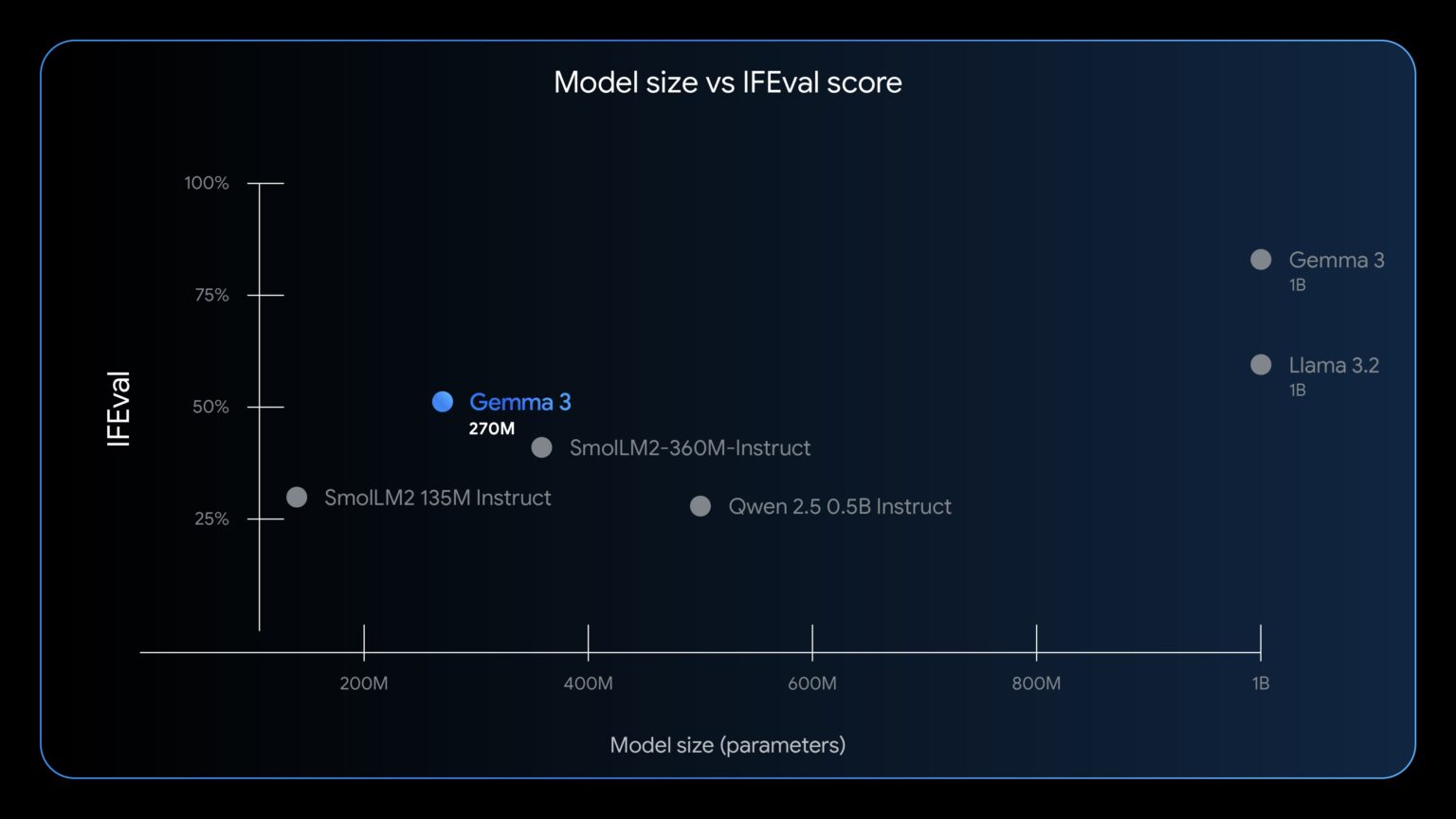
Developers shouldn't expect the same performance level of a multi-billion-parameter model, but Gemma 3 270M has its uses. Google used the IFEval benchmark, which tests a model's ability to follow instructions, to show that its new model punches above its weight. Gemma 3 270M hits a score of 51.2 percent in this test, which is higher than other lightweight models that have more parameters. The new Gemma falls predictably short of 1 billion-plus models like Llama 3.2, but it gets closer than you might think for having just a fraction of the parameters.

Google claims Gemma 3 270M is good at following instructions out of the box, but it expects developers to fine-tune the model for their specific use cases. Due to the small parameter count, that process is fast and low-cost, too. Google sees the new Gemma being used for tasks like text classification and data analysis, which it can accomplish quickly and without heavy computing requirements. You can download the new Gemma for free, and the model weights are available. There's no separate commercial licensing agreement, so developers can modify, publish, and deploy Gemma 3 270M derivatives in their tools.
You can download Gemma 3 270M from Hugging Face and Kaggle in both pre-trained and instruction-tuned versions.
The Almighty Buck

Fintech, Crypto CEOs Urge US President To Block Banks' Data-Access Fees 23

Top fintech and crypto executives urged the Trump administration to block US banks from charging fees for access to customer data, levies that strike at the heart of their business models. From a report: Klarna, Robinhood and crypto exchange Gemini were among a long list of companies, investors and lobbying groups that signed a letter sent Wednesday to President Donald Trump, arguing that the proposed fees would "cripple" innovation and "may cause small businesses and financial tools to shut down entirely."

JPMorgan Chase has told fintechs and the data aggregators they rely on that the bank's customer account information will no longer be accessible without a charge. JPMorgan, the biggest US bank, views the data aggregators as freeloaders of sorts who access data without paying and then charge their fintech clients for it. PNC Financial Services is considering charging similar fees.

"We urge you to use the full power of your office and the broader administration to prevent the largest institutions from raising new barriers to financial freedom," they said in the letter. "We cannot allow the most powerful, entrenched banks to close the door on a more open and modern financial system."
Open Source

China's Lead in Open-Source AI Jolts Washington and Silicon Valley (msn.com) 89

China has established a lead in the field of open-source AI, a development that is reportedly sending jolts through both Washington and Silicon Valley. The nation's progress has become a significant event for American policymakers in the U.S. capital. The advancement has registered as a shock within Silicon Valley, the hub of the American technology industry. From the report: The overall performance of China's best open-weight model has surpassed the American open-source champion since November, according to research firm Artificial Analysis. The firm, which rates the ability of models in math, coding and other areas, found a version of Alibaba's Qwen3 beat OpenAI's gpt-oss.

However, the Chinese model is almost twice as big as OpenAI's, suggesting that for simpler tasks, Qwen might consume more computing power to do the same job. OpenAI said its open-source model outperformed rivals of similar size on reasoning tasks and delivered strong performance at low cost.

Social Networks

Threads Now Has More Than 400 Million Monthly Active Users 45

Meta's Threads has surpassed 400 million monthly active users, adding 50 million in the last quarter and closing the gap with rival X in mobile daily usage. "As of a few weeks ago [there are] more than 400 million people active on Threads every month," said Instagram head Adam Mosseri. "It's been quite the ride over the last two years. This started as a zany idea to compete with Twitter, and has evolved into a meaningful platform that fosters the open exchange of perspectives. I'm grateful to all of you for making this place what it is today. There's so much work to do from our side, more to come." TechCrunch reports: X, meanwhile, has north of 600 million monthly active users, according to previous statements made by its former CEO, Linda Yaccarino. Recent data from market intelligence provider Similarweb showed that Threads is nearing X's daily app users on mobile devices. In June 2025, Threads' mobile app for iOS and Android saw 115.1 million daily active users, marking a 127.8% increase compared to the previous year. On the other hand, X reached 132 million daily active users, reflecting a 15.2% year-over-year decline.

However, Similarweb found that X's worldwide daily web visits are well ahead of Threads, as the [...] social network saw 145.8 million average daily web visits worldwide in June, while Threads had just 6.9 million.
Science

Physicists Create Quantum Radar That Could Image Buried Objects (technologyreview.com) 28

An anonymous reader quotes a report from MIT Technology Review: Physicists have created a new type of radar that could help improve underground imaging, using a cloud of atoms in a glass cell to detect reflected radio waves. The radar is a type of quantum sensor, an emerging technology that uses the quantum-mechanical properties of objects as measurement devices. It's still a prototype, but its intended use is to image buried objects in situations such as constructing underground utilities, drilling wells for natural gas, and excavating archaeological sites. [...] The glass cell that serves as the radar's quantum component is full of cesium atoms kept at room temperature. The researchers use lasers to get each individual cesium atom to swell to nearly the size of a bacterium, about 10,000 times bigger than the usual size. Atoms in this bloated condition are called Rydberg atoms.

When incoming radio waves hit Rydberg atoms, they disturb the distribution of electrons around their nuclei. Researchers can detect the disturbance by shining lasers on the atoms, causing them to emit light; when the atoms are interacting with a radio wave, the color of their emitted light changes. Monitoring the color of this light thus makes it possible to use the atoms as a radio receiver. Rydberg atoms are sensitive to a wide range of radio frequencies without needing to change the physical setup... This means a single compact radar device could potentially work at the multiple frequency bands required for different applications.

[Matthew Simons, a physicist at the National Institute of Standards and Technology (NIST), who was a member of the research team] tested the radar by placing it in a specially designed room with foam spikes on the floor, ceiling, and walls like stalactites and stalagmites. The spikes absorb, rather than reflect, nearly all the radio waves that hit them. This simulates the effect of a large open space, allowing the group to test the radar's imaging capability without unwanted reflections off walls.The researchers placed a radio wave transmitter in the room, along with their Rydberg atom receiver, which was hooked up to an optical table outside the room. They aimed radio waves at a copper plate about the size of a sheet of paper, some pipes, and a steel rod in the room, each placed up to five meters away. The radar allowed them to locate the objects to within 4.7 centimeters. The team posted a paper on the research to the arXiv preprint server in late June.

AI

LLMs' 'Simulated Reasoning' Abilities Are a 'Brittle Mirage,' Researchers Find (arstechnica.com) 238

An anonymous reader quotes a report from Ars Technica: In recent months, the AI industry has started moving toward so-called simulated reasoning models that use a "chain of thought" process to work through tricky problems in multiple logical steps. At the same time, recent research has cast doubt on whether those models have even a basic understanding of general logical concepts or an accurate grasp of their own "thought process." Similar research shows that these "reasoning" models can often produce incoherent, logically unsound answers when questions include irrelevant clauses or deviate even slightly from common templates found in their training data.

In a recent pre-print paper, researchers from the University of Arizona summarize this existing work as "suggest[ing] that LLMs are not principled reasoners but rather sophisticated simulators of reasoning-like text." To pull on that thread, the researchers created a carefully controlled LLM environment in an attempt to measure just how well chain-of-thought reasoning works when presented with "out of domain" logical problems that don't match the specific logical patterns found in their training data. The results suggest that the seemingly large performance leaps made by chain-of-thought models are "largely a brittle mirage" that "become[s] fragile and prone to failure even under moderate distribution shifts," the researchers write. "Rather than demonstrating a true understanding of text, CoT reasoning under task transformations appears to reflect a replication of patterns learned during training." [...]

Rather than showing the capability for generalized logical inference, these chain-of-thought models are "a sophisticated form of structured pattern matching" that "degrades significantly" when pushed even slightly outside of its training distribution, the researchers write. Further, the ability of these models to generate "fluent nonsense" creates "a false aura of dependability" that does not stand up to a careful audit. As such, the researchers warn heavily against "equating [chain-of-thought]-style output with human thinking" especially in "high-stakes domains like medicine, finance, or legal analysis." Current tests and benchmarks should prioritize tasks that fall outside of any training set to probe for these kinds of errors, while future models will need to move beyond "surface-level pattern recognition to exhibit deeper inferential competence," they write.

Social Networks

Reddit Will Block the Internet Archive (theverge.com) 111

Reddit says that it has caught AI companies scraping its data from the Internet Archive's Wayback Machine, so it's going to start blocking the Internet Archive from indexing the vast majority of Reddit. From a report: The Wayback Machine will no longer be able to crawl post detail pages, comments, or profiles; instead, it will only be able to index the Reddit.com homepage, which effectively means Internet Archive will only be able to archive insights into which news headlines and posts were most popular on a given day.

"Internet Archive provides a service to the open web, but we've been made aware of instances where AI companies violate platform policies, including ours, and scrape data from the Wayback Machine," spokesperson Tim Rathschmidt tells The Verge.

Crime

It's Steve Wozniak's 75th Birthday. Whatever Happened to His YouTube Lawsuit? (cbsnews.com) 98

In 2020 a YouTube video used video footage of Steve Wozniak in a scam to steal bitcoin. "Some people said they lost their life savings," Wozniak tells CBS News, explaining why he sued YouTube in 2020 — and where his case stands now: Wozniak's lawsuit against YouTube has been tied up in court now for five years, stalled by federal legislation known as Section 230. Attorney Brian Danitz said, "Section 230 is a very broad statute that limits, if not totally, the ability to bring any kind of case against these social media platforms."

"It says that anything gets posted, they have no liability at all," said Wozniak. "It's totally absolute."

Google responded to our inquiry about Wozniak's lawsuit with a statement from José Castañeda, of Google Policy Communications: "We take abuse of our platform seriously and take action quickly when we detect violations ... we have tools for users to report channels that are impersonating their likeness or business." [Steve's wife] Janet Wozniak, however, says YouTube did nothing, even though she reported the scam video multiple times: "You know, 'Please take this down. This is an obvious mistake. This is fraud. You're YouTube, you're helping dupe people out of their money,'" she said.

"They wouldn't," said Steve...

Today is Steve Wozniak's 75th birthday. (You can watch the interview here.) And the article includes this interesting detail about Woz's life today: Wozniak sold most of his Apple stock in the mid-1980s when he left the company. Today, though, he still gets a small paycheck from Apple for making speeches and representing the company. He says he's proud to see Apple become a trillion-dollar company. "Apple is still the best," he said. "And when Apple does things I don't like, and some of the closeness I wish it were more open, I'll speak out about it. Nobody buys my voice!"

I asked, "Apple listen to you when you speak out?"

"No," Wozniak smiled. "Oh, no. Oh, no."

Wozniak answered questions from Slashdot readers in 2000 and again in 2012.

And he dropped by Slashdot on his birthday to leave this comment for Slashdot's readers...
Python

How Python is Fighting Open Source's 'Phantom' Dependencies Problem (blogspot.com) 33

Since 2023 the Python Software Foundation has had a Security Developer-in-Residence (sponsored by the Open Source Security Foundation's vulnerability-finding "Alpha-Omega" project). And he's just published a new 11-page white paper about open source's "phantom dependencies" problem — suggesting a way to solve it.

"Phantom" dependencies aren't tracked with packaging metadata, manifests, or lock files, which makes them "not discoverable" by tools like vulnerability scanners or compliance and policy tools. So Python security developer-in-residence Seth Larson authored a recently-accepted Python Enhancement Proposal offering an easy way for packages to provide metadata through Software Bill-of-Materials (SBOMs). From the whitepaper: Python Enhancement Proposal 770 is backwards compatible and can be enabled by default by tools, meaning most projects won't need to manually opt in to begin generating valid PEP 770 SBOM metadata. Python is not the only software package ecosystem affected by the "Phantom Dependency" problem. The approach using SBOMs for metadata can be remixed and adopted by other packaging ecosystems looking to record ecosystem-agnostic software metadata...

Within Endor Labs' [2023 dependencies] report, Python is named as one of the most affected packaging ecosystems by the "Phantom Dependency" problem. There are multiple reasons that Python is particularly affected:

- There are many methods for interfacing Python with non-Python software, such as through the C-API or FFI. Python can "wrap" and expose an easy-to-use Python API for software written in other languages like C, C++, Rust, Fortran, Web Assembly, and more.

- Python is the premier language for scientific computing and artificial intelligence, meaning many high-performance libraries written in system languages need to be accessed from Python code.

- Finally, Python packages have a distribution type called a "wheel", which is essentially a zip file that is "installed" by being unzipped into a directory, meaning there is no compilation step allowed during installation. This is great for being able to inspect a package before installation, but it means that all compiled languages need to be pre-compiled into binaries before installation...


When designing a new package metadata standard, one of the top concerns is reducing the amount of effort required from the mostly volunteer maintainers of packaging tools and the thousands of projects being published to the Python Package Index... By defining PEP 770 SBOM metadata as using a directory of files, rather than a new metadata field, we were able to side-step all the implementation pain...

We'll be working to submit issues on popular open source SBOM and vulnerability scanning tools, and gradually, Phantom Dependencies will become less of an issue for the Python package ecosystem.

The white paper "details the approach, challenges, and insights into the creation and acceptance of PEP 770 and adopting Software Bill-of-Materials (SBOMs) to improve the measurability of Python packages," explains an announcement from the Python Software Foundation. And the white paper ends with a helpful note.

"Having spoken to other open source packaging ecosystem maintainers, we have come to learn that other ecosystems have similar issues with Phantom Dependencies. We welcome other packaging ecosystems to adopt Python's approach with PEP 770 and are willing to provide guidance on the implementation."
Programming

'Hour of Code' Announces It's Now Evolving Into 'Hour of AI' (hourofcode.com) 35

Last month Microsoft pledged $4 billion (in cash and AI/cloud technology) to "advance" AI education in K-12 schools, community and technical colleges, and nonprofits (according to a blog post by Microsoft President Brad Smith). But in the launch event video, Smith also says it's time to "switch hats" from coding to AI, adding that "the last 12 years have been about the Hour of Code, but the future involves the Hour of AI."

Long-time Slashdot reader theodp writes: This sets the stage for Code.org CEO Hadi Partovi's announcement that his tech-backed nonprofit's [annual educational event] Hour of Code is being renamed to the Hour of AI... Explaining the pivot, Partovi says: "Computer science for the last 50 years has had a focal point around coding that's been — sort of like you learn computer science so that you create code. There's other things you learn, like data science and algorithms and cybersecurity, but the focal point has been coding.

"And we're now in a world where the focal point of computer science is shifting to AI... We all know that AI can write much of the code. You don't need to worry about where did the semicolons go, or did I close the parentheses or whatnot. The busy work of computer science is going to be done by the computer itself.

"The creativity, the thinking, the systems design, the engineering, the algorithm planning, the security concerns, privacy concerns, ethical concerns — those parts of computer science are going to be what remains with a focal point around AI. And what's going to be important is to make sure in education we give students the tools so they don't just become passive users of AI, but so that they learn how AI works."

Speaking to Microsoft's Smith, Partovi vows to redouble the nonprofit's policy work to "make this [AI literacy] a high school graduation requirement so that no student graduates school without at least a basic understanding of what's going to be part of the new liberal arts background [...] As you showed with your hat, we are renaming the Hour of Code to an Hour of AI."

Security

Google Says Its AI-Based Bug Hunter Found 20 Security Vulnerabilities (techcrunch.com) 17

"Heather Adkins, Google's vice president of security, announced Monday that its LLM-based vulnerability researcher Big Sleep found and reported 20 flaws in various popular open source software," reports TechCrunch: Adkins said that Big Sleep, which is developed by the company's AI department DeepMind as well as its elite team of hackers Project Zero, reported its first-ever vulnerabilities, mostly in open source software such as audio and video library FFmpeg and image-editing suite ImageMagick. [There's also a "medium impact" issue in Redis]

Given that the vulnerabilities are not fixed yet, we don't have details of their impact or severity, as Google does not yet want to provide details, which is a standard policy when waiting for bugs to be fixed. But the simple fact that Big Sleep found these vulnerabilities is significant, as it shows these tools are starting to get real results, even if there was a human involved in this case.

"To ensure high quality and actionable reports, we have a human expert in the loop before reporting, but each vulnerability was found and reproduced by the AI agent without human intervention," Google's spokesperson Kimberly Samra told TechCrunch.

Google's vice president of engineering posted on social media that this demonstrates "a new frontier in automated vulnerability discovery."
AI

Initiative Seeks AI Lab to Build 'American Truly Open Models' (ATOM) (msn.com) 20

"Benchmarking firm Artificial Analysis found that only five of the top 15 AI models are open source," reports the Washington Post, "and all were developed by Chinese AI companies...."

"Now some American executives, investors and academics are endorsing a plan to make U.S. open-source AI more competitive." A new campaign called the ATOM Project, for American Truly Open Models, aims to create a U.S.-based AI lab dedicated to creating software that developers can freely access and modify. Its blueprint calls for access to serious computing power, with upward of 10,000 of the cutting-edge GPU chips used to power corporate AI development. The initiative, which launched Monday, has gathered signatures of support from more than a dozen industry figures. They include veteran tech investor Bill Gurley; Clement Delangue, CEO of Hugging Face, a repository for open-source AI models and datasets; Stanford professor and AI investor Chris Manning; chipmaker Nvidia's director of applied research, Oleksii Kuchaiev; Jason Kwon, chief strategy officer for OpenAI; and Dylan Patel, CEO and founder of research firm SemiAnalysis...

The lack of progress in open-source AI underscores the case for initiatives like ATOM: The U.S. has not produced a major new open-source AI release since Meta's launch of its Llama 4 model in April, which disappointed some AI experts... "A lot of it is a coordination problem," said ATOM's creator, Nathan Lambert, a senior research scientist at the nonprofit Allen Institute for AI who is launching the project in a personal capacity... Lambert said the idea was to develop much more powerful open-source AI models than existing U.S. efforts such as Bloom, an AI language model from Hugging Face, Pythia from EleutherAI, and others. Those groups were willing to take on more legal risk in the name of scientific progress but suffered from underfunding, said Lambert, who has worked at Google's DeepMind AI lab, Facebook AI Research and Hugging Face.

The other problem? The hefty cost of top-performing AI. Lambert estimates that getting access to 10,000 state-of-the-art GPUs will cost at least $100 million. But the funding must be found if American efforts are to stay competitive, he said.

The initiative's web page is seeking signatures, but also asks visitors to the site to "consider how your expertise or resources might contribute to building the infrastructure America needs."
The Internet

Net Neutrality Advocates Won't Appeal Loss (arstechnica.com) 96

Advocacy groups have decided not to appeal a federal court ruling striking down Biden-era net neutrality rules, citing the FCC's current Republican majority and a Supreme Court they view as hostile to the issue. Instead, they plan to push for open internet protections through Congress, state laws, and future court cases, while noting California's net neutrality law remains in effect. Ars Technica reports: "Trump's election flipped the FCC majority back to ideologues who've always taken the broadband industry's side on this crucial issue. And the justices making up the current Supreme Court majority have shown hostility toward sound legal reasoning on this precise question and a host of other topics too," said Matt Wood, VP of policy and general counsel at Free Press. [...] "The 6th Circuit's decision earlier this year was spectacularly wrong, and the protections it struck down are extremely important. But rather than attempting to overcome an agency that changed hands -- and a Supreme Court majority that cares very little about the rule of law -- we'll keep fighting for Internet affordability and openness in Congress, state legislatures and other court proceedings nationwide," Wood said.

Besides Free Press, groups announcing that they won't appeal are the Benton Institute for Broadband & Society, New America's Open Technology Institute, and Public Knowledge. "Though the 6th Circuit erred egregiously in its decision to overturn the FCC's 2024 Open Internet order, there are other ways we can advance our fight for consumer protections and ISP accountability than petitioning the Supreme Court to review this case -- and, given the current legal landscape, we believe our efforts will be more effective if focused on those alternatives," said Raza Panjwani, senior policy counsel at the Open Technology Institute. Net neutrality could still reach the Supreme Court in another case. Andrew Jay Schwartzman, senior counselor of the Benton Institute for Broadband & Society, said that "the 6th Circuit decision makes bad policy as well as bad law. Because it is at odds with the holdings of two other circuits, we expect to take the issue to the Supreme Court in a future case."

Technology

ThinkPad Designer David Hill Spills Secrets, Designs That Never Made It (theregister.com) 39

alternative_right shares an interview from The Register with David W. Hill, who served as lead designer for ThinkPad from 1995 to 2017. Here are some excerpts from the wide-ranging interview: Hill revealed that he tried several times to introduce additional laptops that had the famous "butterfly keyboard" found on the ThinkPad 701C. [...] Hill told The Register that he had wanted to make more ThinkPads with butterfly keyboards and had tried at least three times to make it happen -- in one case there was a prototype where only half of the keyboard moved -- but was never able to get there. Eventually, screens became big enough that there was no need to have a keyboard that expanded. However, Hill said, he thought about putting a butterfly keyboard on a netbook when they were a viable product category in the late aughts. [...]

One of the features Hill is most proud of developing is the ThinkLight, an overhead light located above the screen that lit up the entire keyboard and deck. Though the advent of keyboard backlights has made the ThinkLight redundant -- Lenovo discontinued it in 2013 -- it offers capabilities that backlights do not. If you want to place a paper on top of your keyboard, the LED will light it up, allowing you to see more than just your key legends. ... When designing the 25th anniversary ThinkPad, which came out in 2017, Hill brought back the ThinkLight, but he actually wanted to have -- for the first time -- two LEDs instead of one. The dual lights would have eliminated shadows and provided even better illumination, but unfortunately, this effort proved too costly to make it into the final product. [...]

When I asked Hill about products he wanted to come out with but never got to, he talked about an idea for portable workstations that would fold up like a laptop but have a separate keyboard and screen like a desktop when you put them on your desk. He collaborated with butterfly keyboard creator John Karidis on this concept, but couldn't make it ready for market. "We did a lot of experimentation with laptops that sort of unfolded to be more like a desktop: things where the display elevated or the keyboard would remove so you could use them like a workstation, rather than just being a clamshell with a hinge, you open and close," Hill recalled. "We did a lot of experimentation with that and got close a few times, but never could completely sell it. I always thought it was an opportunity to create a new category."

Intel

US President Calls on Intel CEO To Resign Over China Ties (msn.com) 193

President Trump on Thursday called on Intel's CEO to resign because of his past ties to China, the latest challenge for the troubled chip maker. From a report: "The CEO of INTEL is highly CONFLICTED and must resign, immediately. There is no other solution to this problem," Trump wrote in a post on Truth Social Thursday. The president appeared to be referencing Intel CEO Lip-Bu Tan's past business dealings in China, which Sen. Tom Cotton (R., Ark.) called out in a letter to the company's board earlier this week.

On Tuesday, Cotton wrote an open letter to Intel's board questioning Tan's ties to the Chinese government, including apparent connections to the country's military and investments in other semiconductor companies. "The new CEO of @intel reportedly has deep ties to the Chinese Communists," Cotton wrote in a post on X accompanying the letter. "U.S. companies who receive government grants should be responsible stewards of taxpayer dollars and adhere to strict security regulations. The board of @Intel owes Congress an explanation."

China

Nvidia Rejects US Demand For Backdoors in AI Chips 78

Nvidia's chief security officer has published a blog post insisting that its GPUs "do not and should not have kill switches and backdoors." From a report: It comes amid pressure from both sides of the Pacific, with some US lawmakers pushing Nvidia to grant the government backdoors to AI chips, while Chinese officials have alleged that they already exist.

David Reber Jr.'s post seems pointedly directed at US lawmakers. In May a bipartisan group introduced the Chip Security Act, a bill that would require Nvidia and other manufacturers to include tracking technology to identify when chips are illegally transported internationally, and leaves the door open for further security measures including remote kill switches. While Nvidia is expecting to be granted permits to once again sell certain AI chips in China, its most powerful hardware is still under strict US export controls there and elsewhere.
AI

Perplexity Says Cloudflare's Accusations of 'Stealth' AI Scraping Are Based On Embarrassing Errors (zdnet.com) 96

In a report published Monday, Cloudflare accused Perplexity of deploying undeclared web crawlers that masquerade as regular Chrome browsers to access content from websites that have explicitly blocked its official bots. Since then, Perplexity has publicly and loudly announced that Cloudflare's claims are baseless and technically flawed. "This controversy reveals that Cloudflare's systems are fundamentally inadequate for distinguishing between legitimate AI assistants and actual threats," says Perplexity in a blog post. "If you can't tell a helpful digital assistant from a malicious scraper, then you probably shouldn't be making decisions about what constitutes legitimate web traffic."

Perplexity continues: "Technical errors in Cloudflare's analysis aren't just embarrassing -- they're disqualifying. When you misattribute millions of requests, publish completely inaccurate technical diagrams, and demonstrate a fundamental misunderstanding of how modern AI assistants work, you've forfeited any claim to expertise in this space."
AI

OpenAI Releases First Open-Weight Models Since GPT-2 (openai.com) 30

OpenAI has released two open-weight language models, marking the startup's first such release since GPT-2 in 2019. The models, gpt-oss-120b and gpt-oss-20b, can run locally on consumer devices and be fine-tuned for specific purposes. Both models use chain-of-thought reasoning approaches first deployed in OpenAI's o1 model and can browse the web, execute code, and function as AI agents.

The smaller 20-billion-parameter model runs on consumer devices with 16 GB of memory. Gpt-oss-120B model will require about 80 GB of memory. OpenAI said the 120-billion-parameter model performs similarly to the company's proprietary o3 and o4-mini models. The models are available free on Hugging Face under the Apache 2.0 license after safety testing that delayed their March announcement.

Slashdot Top Deals