Communications

Telcos Draw Up Proposal To Charge Big Tech for EU 5G Rollout (reuters.com) 45

Big tech companies accounting for more than 5% of a telecoms provider's peak average internet traffic should help fund the rollout of 5G and broadband across Europe, according to a draft proposal by the telecoms industry. From a report: The proposal is part of feedback to the European Commission which launched a consultation into the issue in February. The deadline for responses is Friday. Alphabet's Google, Apple, Facebook-owner Meta, Amazon, Netflix and TikTok would most likely be hit with fees, according to industry estimates. Google, Apple, Meta, Netflix, Amazon and Microsoft together account for more than half of data internet traffic.

The document, which was reviewed by Reuters and has not been published, was compiled by telecoms lobbying groups GSMA and ETNO. They represent 160 operators in Europe, including Deutsche Telekom, Orange, Telefonica and Telecom Italia. Telecom operators have lobbied for years for leading technology companies to help foot the bill for 5G and broadband roll-out, saying that they create a huge part of the region's internet traffic. This is the first time they have tried to define a threshold for who should pay.

Television

Startup Plans To Give Away 500,000 Free 4K TVs. The Catch? The Sets Have a Second Screen That Constantly Shows Ads (variety.com) 190

Ilya Pozin made a bunch of money when Viacom bought Pluto TV, the free video-streaming company he co-founded, for $340 million four years ago. Since exiting Pluto about a year after that deal closed, Pozin has been working on another startup venture -- one he thinks will be a much bigger deal. From a report: On Monday, Pozin's brainchild, Telly, comes out of stealth after two years in development. Telly wants to ship out thousands (and eventually millions) of free 4K HDTVs, which would cost more than $1,000 at retail, according Pozin. The 55-inch main screen is a regular TV panel, with three HDMI inputs and an over-the-air tuner, plus an integrated soundbar. The Telly TVs don't actually run any streaming apps that let you access services like Netflix, Prime Video or Disney+; instead, they're bundled with a free Chromecast with Google TV adapter.

What's new and different: The unit has a 9-inch-high second screen, affixed to the bottom of the set, which is real estate Telly will use for displaying news, sports scores, weather or stocks, or even letting users play video games. And, critically, Telly's second screen features a dedicated space on the right-hand side that will display advertising -- ads you can't skip past and ads that stay on the screen the whole time you're watching TV... and even when you're not.

Businesses

Netflix Plans To Cut Spending by $300 Million in 2023 (wsj.com) 56

Netflix plans to reduce its spending by $300 million this year, WSJ reported Friday, citing people familiar with the matter, as the streaming giant continues its push to improve profitability in a competitive market. From a report: The company is looking to cut costs, in part, because its plans to crack down on password sharing broadly in the U.S. and elsewhere were pushed back from the first quarter to the second quarter, the people said. That change is expected to generate new revenue. In an internal meeting earlier this month, company leaders urged staffers to be judicious with their spending, including in relation to hiring, but said there would be no hiring freeze or additional layoffs, the people said.
Piracy

DAZN Joins Anti-Piracy Coalition To Crack Down on Bootleg Sports Streams (theverge.com) 40

International online sports broadcasting company DAZN has joined a global task force that aims to shut down pirated and unauthorized sports streaming operations worldwide. The new group is operated by the Alliance for Creativity and Entertainment (ACE), which counts giants like Amazon, Apple, NBC Universal, Netflix, Disney, Sony, and Warner Bros. among its members. From a report: Unauthorized streaming sources can often be the only available option for people to watch certain teams and matches subject to complicated broadcasting deals, locked into high-priced bundles, and blackouts. With more tech and entertainment companies using sports as a sweetener for their services (NFL Sunday Ticket on YouTube, MLS / MLB for Apple TV Plus, and Thursday Night Football on Amazon Prime are a few examples), they have more reasons to collectively take issue with anyone popping up a free stream.

ACE as a whole had previously taken down IPTV-based service NitroTV, which allegedly charged users $20 per month in the US for a collection of unlicensed streaming content. ACE was first formed in 2017 as the anti-piracy arm of the Motion Picture Association (formerly known as the MPAA until it dropped the second A in 2019). Now with DAZN, it consists of 53 big media companies.

The Internet

Starlink Nixes Plan To Impose 1TB Data Cap and Per-Gigabyte Overage Fees (arstechnica.com) 45

In a policy reversal, Starlink no longer plans to charge data overage fees to standard residential users who exceed 1TB of monthly usage. Ars Technica reports: When SpaceX's Starlink division first announced the data cap in November 2022, it said that residential customers would get 1TB of "priority access data" each month. After using 1TB, customers could keep accessing the Internet at slower (but unspecified) speeds or pay $0.25 per gigabyte for "additional priority access." This was originally supposed to take effect in December, but Starlink delayed the change to February and then to April.

But now, Starlink's list of support FAQs no longer mentions the residential data cap and the current version of the fair use policy says that standard service plan users have unlimited data. The previous version of the Starlink fair use policy described the 1TB residential cap and optional $0.25-per-gigabyte overage fees. Starlink sent an email to users that said, "Good news! Your Starlink subscription will remain unlimited and will no longer be deprioritized after 1TB of data use." Nathan Owens, a Netflix engineer who frequently tweets about Starlink, posted a screenshot of the email yesterday.

AI

Hollywood Writers Strike Over Pay Disputes with Streaming Giants, AI Concerns (gizmodo.com) 101

The Writers Guild of America, the union that bargains on behalf of Hollywood's screenwriters, has called a strike after negotiations with major studios failed to produce a favorable contract this week. From a report: The strike, which is the first involving WGA to occur in 15 years, seeks to bring firms to the table on a host of issues, including higher pay and better working conditions. But some of the issues are quite unique in the annals of modern labor disputes and have to do with technological changes currently disrupting the entertainment industry -- such as the role artificial intelligence may play in future screenwriting projects. "Though our Negotiating Committee began this process intent on making a fair deal, the studios' responses have been wholly insufficient given the existential crisis writers are facing," the WGA tweeted late Monday evening. "Picketing will begin Tuesday afternoon."

Negotiations between WGA and the Alliance of Motion Picture and Television Producers -- the trade organization that represents the movie and streaming studios in contract negotiations -- have been ongoing for the past month but the deadline for a new contract was midnight on Tuesday morning. In its own statement, the AMPTP claimed that it had presented a "comprehensive package proposal" to the Guild and that it had been willing to "improve that offer" but claimed that the "magnitude of other proposals" that the union had made were untenable. "The AMPTP member companies remain united in their desire to reach a deal that is mutually beneficial to writers and the health and longevity of the industry," said the organization, which represents the likes of Netflix, Disney, Apple, Amazon, Sony and other entertainment giants.
The New York Times adds: The dispute has pitted 11,500 screenwriters against the major studios, including old guard entertainment companies like Universal and Paramount as well as tech industry newcomers like Netflix, Amazon and Apple.
Social Networks

48% of People Under 42 Spend More Time Socializing Online Than Off (zdnet.com) 37

An anonymous reader quotes a report from ZDNet: When you think of digital entertainment, your mind might turn first to online video-streaming services, such as Sling TV or YouTube TV, and video-on-demand services, including Netflix or Acorn TV. However, consultant Deloitte's 17th annual "Digital Media Trends" survey suggests traditional television shows and movies are no longer the only forms of entertainment. Younger generations, often called Gen Zs and Millennials, are increasingly turning to user-generated content (UGC) -- which relies on unpaid contributors rather than traditional media professionals -- and video games to find personal fulfillment, value, and meaning. These younger users are creating a vibrant, immersive, and social tapestry of experiences with UGC, video games, music, and social media all playing significant roles. And that move towards UGC and gaming could have big implications for everyone.

Deloitte's survey found that about a third (32%) of consumers view online experiences as meaningful substitutes for in-person interactions, with that proportion increasing to 50% among Gen Zs and Millennials. Almost half (48%) of these younger generations engage more with others on social media than in the physical world, and 40% of them socialize more in video games than offline. Of course, it's not only younger people who view online experiences as meaningful substitutes for in-person interactions. [...] Yet those born after 1981, the usual dividing line between Generation X and Millennials, are much more inclined to live their lives online.

Television

Netflix Loses 1 Million Spanish Users Over Password Policing (bloomberg.com) 119

Netflix lost more than one million users in Spain in the first three months of 2023 according to market research group Kantar, a sign that the streaming giant's crackdown on password-sharing could backfire. From a report: In early February, Spain became one of Netflix's first markets to introduce a monthly fee for users who shared their log-in details with another household and technical measures to detect such sharing. The move was linked to a fall in users of more than a million, two thirds of whom were using someone else's password, according to Kantar's research, which is based on surveys of household streaming habits.

"It's clear this steep drop is due to the crackdown," said Dominic Sunnebo, global insight director at Kantar's Worldpanel Division, adding that the loss of a million users, even if most weren't paid subscribers, would be a blow to Netflix in terms of word of mouth recommendation for its shows and service. Subscription cancellations in the first quarter tripled compared to the previous period, according to Kantar's research. Of all remaining Netflix subscribers in Spain, one-tenth said they planned to unsubscribe in the second quarter. Spanish subscribers are charged $6.57 a month to add members outside their household. A similar fee was introduced in Portugal, Canada and New Zealand after a roll-out in several Latin American countries.

Movies

Redbox Owner Interested In Buying Netflix's DVD Business (hollywoodreporter.com) 56

Redbox CEO Bill Rouhana told The Hollywood Reporter that he'd like to buy the business, saying: "I wish Netflix would sell me that business instead of shutting it down." From the report: Redbox is already the biggest DVD rental company in the U.S., with a network of some 32,000 red DVD kiosks across the country. Just this week, it announced plans to add another 1,500 kiosks at Dollar General stores (Rouhana says the Dollar General kiosks are some of the company's most profitable). While the DVD business kickstarted Netflix's meteoric rise, in recent years it has been on the decline. In 2022, it had $146 million in revenue, down $40 million from the year prior. Q1 had revenue of $32 million, suggesting a further decline this year.

And Rouhana says he has reached out to Netflix over the years expressing a desire to acquire the DVD business, to no avail. "I have tried like three or four times to reach out to the corporate development people about it but just got rebuffed each time," Rouhana says. "So when I saw it being closed, I thought, 'Well, maybe they'll do it now.'" A Netflix source tells THR that the company is winding down the business, and not selling it. (As for what happens to those warehouses full of DVDs that fueled Netflix's red envelope business, they seem to be in limbo for now.)

Even if that is the case, Rouhana says he believes Netflix's decision to shutter the service will benefit his company. "This could be a great boon to us because now there are a whole bunch of people who are going to look for a new place to get their DVDs, and we're close to 90 percent of them based on where our kiosks are located," he says. And, he notes, he does not expect the DVD business to go away anytime soon. "We believe in it, and we believe it's going to be around for a while. Like most legacy things, it's a lot harder to kill them than people say, I believe," he adds.

In fact, he believes the DVD business is in a position for growth over the next few years, thanks to a larger slate of movies hitting theaters and a desire from studios to reengage with windowing strategies. "We programmed our business plan for us to get back to about 30 percent of the 2019 level," Rouhana says. "I feel that's pretty conservative, I think we'll be better than that. But, you know, that's how we built the business plan that we've articulated. So people can decide for themselves whether they think that's overly optimistic or overly pessimistic."

Privacy

Netflix Password Sharing Crackdown To Expand To US In Q2 2023 (macrumors.com) 111

Netflix is planning a "broad rollout" of the password sharing crackdown that it began implementing in 2022, the company said today in its Q1 2023 earnings report (PDF). MacRumors reports: The "paid sharing" plan that Netflix has been testing in a limited number of countries will expand to additional countries in the second quarter, including the United States. Netflix said that it was "pleased with the results" of the password sharing restrictions that it implemented in Canada, New Zealand, Spain, and Portugal earlier this year. Netflix initially planned to start eliminating password sharing in the United States in the first quarter of the year, but the company said that it had learned from its tests and "found opportunities to improve the experience for members." There is a "cancel reaction" expected in each market where paid sharing is implemented, but increased revenue comes later as borrowers activate their own Netflix accounts and existing members add "extra member" accounts.

In Canada, paid sharing resulted in a larger Netflix membership base and an acceleration in revenue growth, which has given Netflix the confidence to expand it to the United States. When Netflix brings its paid sharing rules to the United States, multi-household account use will no longer be permitted. Netflix subscribers who share an account with those who do not live with them will need to pay for an additional member. In Canada, Netflix charges $7.99 CAD for an extra member, which is around $6. [...] Netflix claims that more than 100 million households are sharing accounts, which is impacting its ability to "invest in and improve Netflix" for paying members.

Movies

Netflix Will End Its DVD-By-Mail Service After 25 Years (netflix.com) 77

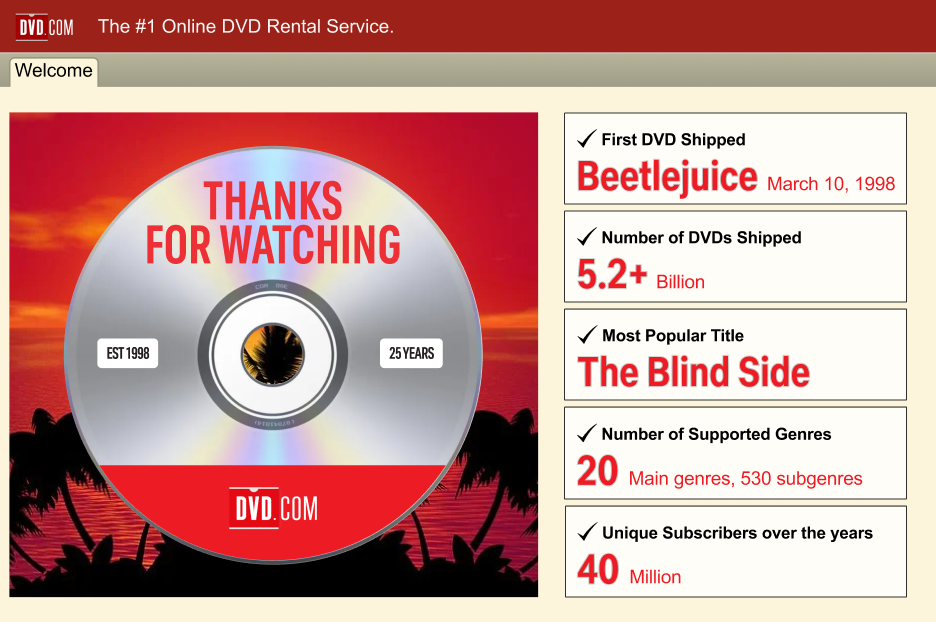
Slashdot reader mpercy shares an email they received from Netflix announcing the shut down of its original business of delivering DVDs by mail: Just received an email from Netflix: "For 25 years, it's been our extraordinary privilege to mail movie nights to our members all across America. On September 29th, 2023, we will ship our final iconic red envelope. While times have changed since our first shipment in March 1998, our goal has remained the same: to provide you with access to the broadest collection of movies and shows possible, delivered directly to your door, with no due dates or late fees. As the DVD business continues to shrink, it's going to become increasingly difficult to achieve that goal. In our final season, we'll continue providing you the best service possible, all the way to the very last shipment." Here's an infographic the company shared in its post:
Netflix DVD Rental Service Stats
Businesses

Apple's $165 Billion Cash Hoard Creates Mergers and Acquisitions Mirages (bloomberg.com) 55

Apple's slowing growth and cash-rich balance sheet are again fueling speculation that the world's most valuable company should make a big acquisition. From a report: Entertainment giant Disney recently joined a long list of potential acquisition targets that over the years has grown to include Netflix, Tesla, Peloton and Sonos. They all have one thing in common: Anyone betting that Apple would buy them has so far been sorely disappointed. "You're probably missing the value of the business if you think the key catalyst for investment is a major acquisition," said Kevin Walkush, portfolio manager at Jensen Investment Management. "It's a low-probability bet." Apple is famous for eschewing splashy acquisitions in contrast with peers like Microsoft and Amazon, which have continued to make deals despite increasing scrutiny by regulators. Instead, Apple favors buying small startups to augment its home-grown pushes into new markets even if those efforts take many years to bear fruit.
Social Networks

France Bans 'Recreational Apps' From Government Staff Phones (apnews.com) 42

France announced Friday it is banning the "recreational" use of TikTok, Twitter, Instagram and other apps on government employees' phones because of concern about insufficient data security measures. Reuters reports: The French Minister for Transformation and Public Administration, Stanislas Guerini, said in a statement that ''recreational" apps aren't secure enough to be used in state administrative services and "could present a risk for the protection of data." The ban will be monitored by France's cybersecurity agency. The statement did not specify which apps are banned but noted that the decision came after other governments took measures targeting TikTok.

Guerini's office said in a message to The Associated Press that the ban also will include Twitter, Instagram, Netflix, gaming apps like Candy Crush and dating apps. Exceptions will be allowed. If an official wants to use a banned app for professional purposes, like public communication, they can request permission to do so. Case in point: Guerini posted the announcement of the ban on Twitter.

Facebook

Meta Slams Telco Fee Proposal, Says ISPs Should Pay Their Own Network Costs (arstechnica.com) 37

Proposals to pay for broadband networks by imposing new fees on Big Tech companies "are built on a false premise," Meta executives wrote in a blog post today. From a report: "Network fee proposals do not recognize that our investments in content drive the business model of telecom operators," Meta executives Kevin Salvadori and Bruno Cendon Martin wrote. Meta's comments came a few weeks after Netflix co-CEO Greg Peters spoke out against the proposal being reviewed by European regulators. Meta executives said telecom operators and content application providers (CAPs) "are symbiotic businesses, occupying different but complementary roles in the digital ecosystem. Every year, Meta invests tens of billions of euros in our apps and platforms -- such as Facebook, Instagram, and Quest -- to facilitate the hosting of content. Billions of people go online every day to access this content, creating the demand that allows telecom operators to charge people for Internet access. Our investment in content literally drives the revenue and business model of telecom operators."

Internet service providers in the EU argue that Big Tech companies should pay a "fair share" toward network-building costs. In the US, Federal Communications Commission Republican Brendan Carr claims that "Big Tech has been enjoying a free ride on our Internet infrastructure while skipping out on the billions of dollars in costs needed to maintain and build that network." Big Tech companies don't actually get free access to the Internet, though. Anyone distributing content over the Internet pays their own providers, builds their own network infrastructure, or does some combination of the two. For extremely large companies like Netflix and Meta, investments include building their own content-delivery networks. "Over the last decade, CAPs have collectively invested over $880 billion in global digital infrastructure, including approximately $120 billion a year from 2018 to 2021," Meta's blog post today said. "These infrastructure contributions made by technology companies save telecom operators around $6 billion per year."

Games

Netflix Plans To Release 40 More Games This Year, Will Add Monument Valley in 2024 (techcrunch.com) 24

Netflix has announced that it has 40 games slated for launch this year and has 70 in development with its partners. The company also has 16 games currently being developed by its in-house game studios. Netflix launched games in November 2021 and has released 55 titles since then. From a report: The streaming service says it's committed to building out its games portfolio and will be bringing Ustwo's Monument Valley franchise to its platform, starting with Monument Valley 1 and Monument Valley 2, with more to come. In a briefing with reporters, Ustwo CEO Maria Sayans confirmed that the Netflix versions of the games won't be different than the current available versions, and that they will include all paid in-app purchases.

The streaming service also announced that Mighty Quest: Rogue Palace, a rogue-lite game set in the universe some may remember from The Mighty Quest for Epic Loot, will be launching in April 18. The game, which is from Ubisoft, features an improved formula, deepened narrative and upgraded frantic action gameplay. The launch is part of Netflix's partnership with Ubisoft, and is the second of three exclusive games from the developer to be released on Netflix. The first exclusive game, Valiant Hearts: Coming Home, launched in January.

Google

Google's Cloud Gaming Ambitions Died With Stadia, Exec Says (theverge.com) 45

An anonymous reader shares a report: Two years ago, I wrote a reasonably prescient editorial about how the writing was on the wall for Google's cloud gaming service Stadia -- and how the company was now hoping to sell its white label streaming technology to other companies instead of building out its own Netflix of games. But it seems that, when Google killed off Stadia, it threw away that technology, too. Google executive Jack Buser has now admitted that the company is no longer offering the white label version of Stadia that allowed companies like AT&T and Capcom to let anyone try games like Batman: Arkham Knight, Control, and a demo of Resident Evil Village for free over the internet, not to mention the first game from Peloton.

"We are not offering that streaming option, because it was tied to Stadia itself," he told Axios' Stephen Totilo. "So unfortunately, when we decided to not move forward with Stadia, that sort of offering could no longer be offered as well." Google called the white label version "Immersive Stream for Games" and sometimes "Google Stream" and, to my knowledge, it was only ever used in experiments like the ones I link above. In AT&T's case, they were limited to its own internet subscribers. Maybe they weren't that successful? When we spoke to AT&T about cloud gaming following those experiments, the carrier didn't seem that bullish about serving up more games itself.

AI

Want To Impress Wall Street? Just Add Some AI (hollywoodreporter.com) 42

As media executives look to pop the stock of flagging publicly traded companies, tech advances are becoming the new gimmick to wow (even temporarily) the investing class. From a report: When Endeavor CEO Ari Emanuel opened his company's earnings call with prepared remarks Feb. 28, a casual listener hearing him tout the UFC and WME might have missed the most interesting part: Emanuel wasn't speaking at all. Well, he sort of was. The words were his, and the voice was his, but rather than Emanuel speaking into a microphone (opening remarks on earnings calls are often pretaped), the comments were the product of a generative artificial intelligence firm calledâSpeechify. Indeed, artificial intelligence has been hard to avoid for Wall Street watchers this year. And it's easy to understand why: AI news has led to share price surges at companies like BuzzFeed (which uses it and saw its stock price more than double) and Microsoft (whose rise was in the high singleâdigits).

After the public release of OpenAI's large language model (LLM) chatbot ChatGPT (and the stock bounce it gave to Microsoft, which is OpenAI's tech partner), it seems that every company wants a piece of the AI action, or at least wants to send the message that it's thinking about it. Companies with close ties to media and entertainment are no exception. In his first letter to creators as CEO of YouTube, Neal Mohan wrote March 1 that "the power of AI is just beginning to emerge in ways that will reinvent video and make the seemingly impossible possible," and that it will be a priority for him. Spotify, led by CEO Daniel Ek, released on Feb. 22 what it is calling an "AI DJ," powered by technology from OpenAI. The DJ takes the music a Spotify user listens to and combines it with recommendations from music experts and an AI-generated voice to create a totally personalized radio show. Snap, run by Evan Spiegel, released an assistant called "My AI," based on ChatGPT, bringing the capabilities of that LLM to Snapchat+ users.

And at small digital publishers like the Jonah Peretti-led BuzzFeed and Arena Group Holdings (the owner of Sports Illustrated), AI is being touted as a fount of new types of storytelling that "can create enterprise value for our brands and partners," per Arena Group CEO Ross Levinsohn. To be sure, AI's potential for transforming business is real (in a March 2 research report, Morgan Stanley called it a "$6 trillion opportunity"), but it remains just that: an opportunity, rather than today's reality. Wall Street is still very bullish on AI in the long term, with Bank of America's Haim Israel and Martyn Briggs writing in a Feb. 28 thematic report that AI is "at a defining moment -- like the internet in the '90s," but the consensus is that while big tech firms like YouTube owner Alphabet, Amazon and Apple will reap the rewards at some point, what it means for smaller companies in the present is less clear. For entertainment companies, the potential is obvious, even if the business models are not. The Morgan Stanley report noted the logic in AI recommendations on streaming services like Spotify and Netflix (Spotify's DJ is a first step in that direction), and it isn't a stretch to think that content itself can be made faster and at less cost with generative technology (applications could include special effects, which are labor intensive and costly). For companies like Endeavor and CAA, generative voice technology (like that from Speechify) and deepfake tech (like Deep Voodoo, a deepfake company from the creators of South Park that counts the CAA-affiliated Connect Ventures as an investor), could mean new opportunities for old actors (see Robert Zemeckis' upcoming movie Here, which will use AI from Metaphysic to de-age Tom Hanks).

Microsoft

Microsoft Edge is Getting a Video Upscaler To Make Blurry Old Videos Look Better (tomshardware.com) 39

Microsoft has unveiled Video Super Resolution (VSR) -- an "experimental" video upscaling feature for its Edge web browser that uses machine learning to increase the resolution of low-quality video. From a report: Announced on the Edge Insiders blog, Microsoft's VSR technology can "remove blocky compression artifacts" and improve text clarity for videos on platforms such as YouTube. The feature is still in testing and availability is currently restricted to half of the users running the Canary channel of Edge in Microsoft's Insider program. If you want to try it for yourself, there are a few stipulations: Microsoft VSR will only work on video resolutions of 720p or lower (provided both the height and width of the video exceeds 192 pixels), and the video itself can't be protected with digital rights management (DRM) technology like PlayReady or Widevine, which makes frames inaccessible to the browser for processing. That particular restriction could impact what content you can upscale with the feature, as most popular streaming platforms like Netflix, Hulu, and HBO Max all leverage DRM tech for copyright protection. Unlike Nvidia's RTX Super Resolution, Microsoft's Video Super Resolution feature supports both Nvidia and AMD GPUs.
The Almighty Buck

Netflix Fights Attempt To Make Streaming Firms Pay For ISP Network Upgrades 38

An anonymous reader quotes a report from Ars Technica: Netflix co-CEO Greg Peters spoke out against a European proposal to make streaming providers and other online firms pay for ISPs' network upgrades. "Some of our ISP partners have proposed taxing entertainment companies to subsidize their network infrastructure," Peters said in a speech Tuesday at Mobile World Congress in Barcelona (transcript). The "tax would have an adverse effect, reducing investment in content -- hurting the creative community, hurting the attractiveness of higher-priced broadband packages, and ultimately hurting consumers," he argued. [...] "ISPs claim that these taxes would only apply to Netflix. But this will inevitably change over time as broadcasters shift from linear to streaming," Peters said at MWC. Sandvine data suggests that nearly half of global Internet traffic is sent by Facebook, Amazon, Google, Apple, Netflix, and Microsoft. Online video accounts for 65 percent of all traffic, and Netflix recently passed YouTube as the top video-traffic generator.

Peters cited Nielsen data showing that "Netflix accounts for under 10 percent of total TV time" in the US and UK while "traditional local broadcasters account for over half of all TV time." Live sports account for much of that. "As broadcasters continue the shift away from linear to streaming, they will start to generate significant amounts of Internet traffic too -- even more than streamers today based on the current scope and scale of their audiences," Peters said. "Broadband customers, who drive this increased usage, already pay for the development of the network through their subscription fees. Requiring entertainment companies -- both streamers and broadcasters -- to pay more on top would mean ISPs effectively charging twice for the same infrastructure." Telcos that receive new payments wouldn't be expected to lower the prices charged to home Internet users, Peters said. "As the consumer group BEUC has pointed out, there is no suggestion these levies would be passed onto consumers in the form of 'lower prices or better infrastructure,'" he said.

Peters said Netflix's "operating margins are significantly lower than either British Telecom or Deutsche Telekom. So we could just as easily argue that network operators should compensate entertainment companies for the cost of our content -- exactly as happened under the old pay-TV model." While telcos claim companies like Netflix don't pay their "fair share," Peters pointed out that Netflix has spent a lot building its own network that reduces the amount of data sent over traditional telecom networks. "We've spent over $1 billion on Open Connect, our own content delivery network, which we offer for free to ISPs," he said. "This includes 18,000 servers with Netflix content distributed across 6,000 locations and 175 countries. So when our members press play, instead of the film or TV show being streamed from halfway around the world, it's streamed from around the corner -- increasing efficiency for operators while also ensuring a high-quality, no-lag experience for consumers." Peters also touted Netflix's encoding technology that cut bit rates in half between 2015 and 2020. While Internet traffic has increased about 30 percent a year, "ISPs have managed this increased consumer usage efficiently while their costs have remained stable," Peters said. "Regulators have highlighted this, too, calling out that infrastructure costs are not sensitive to traffic and that growing consumption will be offset by efficiency gains."
Youtube

Nvidia's Latest GPU Drivers Can Upscale Old Blurry YouTube Videos (theverge.com) 36

Nvidia is releasing new GPU drivers today that will upscale old blurry web videos on RTX 30- and 40-series cards. The Verge reports: RTX Video Super Resolution is a new AI upscaling technology from Nvidia that works inside Chrome or Edge to improve any video in a browser by sharpening the edges of objects and reducing video artifacts. Nvidia will support videos between 360p and 1440p up to 144Hz in frame rate and upscale all the way up to 4K resolution.

This impressive 4K upscaling has previously only been available on Nvidia's Shield TV, but recent advances to the Chromium engine have allowed Nvidia to bring this to its latest RTX 30- and 40-series cards. As this works on any web video, you could use it to upscale content from Twitch or even streaming apps like Netflix where you typically have to pay extra for 4K streams.

Slashdot Top Deals