Android

Even New Phones Are No Longer Guaranteed To Have the Latest Version of Android (theverge.com) 158

Vlad Savov, writing for The Verge: The OnePlus 5T and Razer Phone are two fundamentally different devices, which are nonetheless united by one unfortunate downside: both of them are going on sale this month without the latest version of Android on board. OnePlus will tell you that this issue is down to its extremely stringent testing process, while Razer offers a similar boilerplate about working as fast as possible to deliver Android Oreo. But we're now three months removed from Google's grand Oreo launch, timed to coincide with this summer's total eclipse, and all of these excuses are starting to ring hollow. Why do Android companies think they can ship new devices without the latest and best version of the operating system on board? The notorious fragmentation problem with Android has always been that not every device gets the latest update at the same time, and many devices get stuck on older software without ever seeing an update at all. What's changed now is that the "one version behind the newest and best" phenomenon is starting to infect brand new phones as well. The 5T and Razer Phone are just two examples; there's also Xiaomi, which just launched its Mi Mix 2 in Spain with 2016's Android Nougat as the operating system.
AI

'We Can't Compete': Universities Are Losing Their Best AI Scientists (theguardian.com) 268

The Guardian shares the story of a PhD student at Imperial College London who abruptly stopped coming to the facility, even as he had one-year of studies left. From the story: Eventually, the professor called him. He had left for a six-figure salary at Apple. "He was offered such a huge amount of money that he simply stopped everything and left," said Maja Pantic, professor of affective and behavioural computing at Imperial. "It's five times the salary I can offer. It's unbelievable. We cannot compete." It is not an isolated case, the report says. Adding: Across the country, talented computer scientists are being lured from academia by private sector offers that are hard to turn down. According to a Guardian survey of Britain's top ranking research universities, tech firms are hiring AI experts at a prodigious rate, fuelling a brain drain that has already hit research and teaching. One university executive warned of a "missing generation" of academics who would normally teach students and be the creative force behind research projects. The impact of the brain drain may reach far beyond academia. Pantic said the majority of top AI researchers moved to a handful of companies, meaning their skills and experience were not shared through society. "That's a problem because only a diffusion of innovation, rather than its concentration into just a few companies, can mitigate the dramatic disruptions and negative effects that AI may bring about."
Social Networks

TechCrunch Argues Social Media News Feeds 'Need to Die' (techcrunch.com) 154

"Feeds need to die because they distort our views and disconnect us from other human beings around us," argues TechCrunch's Romain Dillet: At first, I thought I was missing out on some Very Important Content. I felt disconnected. I fought against my own FOMO. But now, I don't feel anything. What's going on on Instagram? I don't care. Facebook is now the worst internet forum you can find. Twitter is filled with horrible, abusive people. Instagram has become a tiny Facebook now that it has discouraged all the weird, funny accounts from posting with its broken algorithm. LinkedIn's feed is pure spam.

And here's what I realized after forgetting about all those "social" networks. First, they're tricking you and pushing the right buttons to make you check your feed just one more time. They all use thirsty notifications, promote contrarian posts that get a lot of engagement and play with your emotions. Posting has been gamified and you want to check one more time if you got more likes on your last Instagram photo. Everything is now a story so that you pay more attention to your phone and you get bored less quickly -- moving pictures with sound tend to attract your eyes... [F]inally, I realized that I was missing out by constantly checking all my feeds. By putting my phone on 'Do Not Disturb' for days, I discovered new places, started conversations and noticed tiny little things that made me smile.

He concludes that technology has improved the way we learn, communicate, and share information, "But it has gone too far...

"Forget about your phone for a minute, look around and talk with people next to you."
Programming

Why Do Web Developers Keep Making The Same Mistakes? (hpe.com) 335

An anonymous reader quotes HPE Insights: Software developers and testers must be sick of hearing security nuts rant, "Beware SQL injection! Monitor for cross-site scripting! Watch for hijacked session credentials!" I suspect the developers tune us out... The industry has generated newer tools, better testing suites, Agile methodologies, and other advances in writing and testing software. Despite all that, coders keep making the same dumb mistakes, peer reviews keep missing those mistakes, test tools fail to catch those mistakes, and hackers keep finding ways to exploit those mistakes. One way to see the repeat offenders is to look at the Open Web Application Security Project Top 10, a sometimes controversial ranking of the 10 primary vulnerabilities, published every three or four years by the Open Web Application Security Project... It boggles the mind that a majority of top 10 issues appear across the 2007, 2010, 2013, and draft 2017 OWASP lists...

It's sad that eight out of 10 of the issues from 2013 are still top security issues in 2017. In fact, if you consider that the draft 2017 list combined two of the 2013 items, it's actually nine out of 10. Ouch... What can you do? Train everyone better, for starters. Look at coding and test tools that can help detect or prevent security vulnerabilities, but don't consider them silver bullets. Do dynamic application security testing, including penetration testing and fuzz testing. Ensure admins do their part to protect applications. And finally, make sure you establish a culture of security-aware programming and deployment.

KDE

Linux Mint Is Killing the KDE Edition (betanews.com) 141

BrianFagioli quotes a report from BetaNews: While both the Cinnamon and Mate versions of Linux Mint are decent choices for computer users, there was one version that was always utterly bizarre -- the KDE Edition. Don't get me wrong, KDE is a fine environment, but Kubuntu already exists. Having a version of Mint using KDE was redundant and confusing. Thankfully, today, the Linux Mint team announces it is finally killing the KDE edition. "In continuation with what's been done in the past, Linux Mint 18.3 will feature a KDE edition, but it will be the last release to do so. I would like to thank Kubuntu for the amazing work they have done. The quality of Plasma 5 in Xenial made backports a necessity. The rapid pace of development upstream from the KDE project made this very challenging, yet they managed to provide a stable flow of updates for us and we were able to ship good KDE editions thanks to that. I don't think this would have been possible without them," says Clement Lefebvre, Linux Mint.

Lefebvre further says, "KDE is a fantastic environment but it's also a different world, one which evolves away from us and away from everything we focus on. Their apps, their ecosystem and the QT toolkit which is central there have very little in common with what we're working on. We're not just shipping releases and distributing upstream software. We're a product distribution and we see ourselves as a complete desktop operating system. We like to integrate solutions, develop whatâ(TM)s missing, adapt what's not fitting perfectly, and we do a great deal of that not only around our own Cinnamon desktop environment but also thanks to cross-DE frameworks we put in place to support similar environments, such as MATE and Xfce."

Crime

Dutch Police Build a Pokemon Go-Style App For Hunting Wanted Criminals (csoonline.com) 62

"How can the police induce citizens to help investigate crime? By trying to make it 'cool' and turning it into a game that awards points for hits," reports CSO. mrwireless writes: Through their 'police of the future' innovation initiative, and inspired by Pokemon Go, the Dutch police are building an app where you can score points by photographing the license plates of stolen cars. When a car is reported stolen the app will notify people in the neighbourhood, and then the game is on! Privacy activists are worried this creates a whole new relationship with the police, as a deputization of citizens blurs boundaries, and institutionalizes 'coveillance' -- citizens spying on citizens. It could be a slippery slope to situations that more resemble the Stasi regime's, which famously used this form of neighborly surveillance as its preferred method of control.
CSO cites Spiegel Online's description of the unofficial 189,000 Stasi informants as "totally normal citizens of East Germany who betrayed others: neighbors reporting on neighbors, schoolchildren informing on classmates, university students passing along information on other students, managers spying on employees and Communist bosses denouncing party members."

The Dutch police are also building another app that allows citizens to search for missing persons.
Businesses

Real Moviegoers Don't Care About Rotten Tomatoes 173

In a recent essay published on the Hollywood Reporter, Martin Scorsese inveighs against two conjoined trends -- the widespread reporting of box-office results and the grading of movies by consumers on CinemaScore and by critics on Rotten Tomatoes -- and blames it for "a tone that is hostile to serious filmmakers." In particular, he contends that this hostile environment is worsening "as film criticism written by passionately engaged people with actual knowledge of film history has gradually faded from the scene." Richard Brody, a movie critic at the New Yorker, thinks Scorsese is missing the mark. He writes: I think that film criticism is, over all, better than ever, because, with its new Internet-centrism, it's more democratic than ever and many of the critics who write largely online are more film-curious than ever. Anyone who is active on so-called Film Twitter -- who sees links by critics, mainly younger critics, to his or her work -- can't help but be impressed by the knowledge, the curiosity, and the sensibility of many of them. Their tastes tend to be broader and more daring than those of many senior critics on more established publications. And, even if readers of the wider press aren't reading these more obscure critics, the critics whom general readers read are often reading those young critics (and if they're not, it shows). This is, of course, not universally so, any more than it ever was. The Internet is democratic in all directions -- it's also available to writers of lesser knowledge, duller taste, and dubious agendas, and it may be their work that's advertised most loudly -- but the younger generation of critics is present online and there for the finding. [...] What Scorsese doesn't exactly say, but what, I think, marks a generation gap in movie thinking that his essay reflects, is the appearance of an increasing divide between artistically ambitious films and Hollywood films -- the gap between the top box-office films and the award winners. For filmmakers ready to work on lower budgets, the gap is irrelevant. The filmmakers whose conceptions tend toward the spectacular are the ones whose styles may, literally, be cramped by shrinking budgets -- filmmakers such as Scorsese and Wes Anderson, whose work has both an original and elaborate sense of style and a grand historical reach.
Science

Half the Universe's Missing Matter Has Just Been Finally Found (newscientist.com) 247

An anonymous reader shares a report: The missing links between galaxies have finally been found. This is the first detection of the roughly half of the normal matter in our universe -- protons, neutrons and electrons -- unaccounted for by previous observations of stars, galaxies and other bright objects in space. You have probably heard about the hunt for dark matter, a mysterious substance thought to permeate the universe, the effects of which we can see through its gravitational pull. But our models of the universe also say there should be about twice as much ordinary matter out there, compared with what we have observed so far. Two separate teams found the missing matter -- made of particles called baryons rather than dark matter -- linking galaxies together through filaments of hot, diffuse gas. "The missing baryon problem is solved," says Hideki Tanimura at the Institute of Space Astrophysics in Orsay, France, leader of one of the groups. The other team was led by Anna de Graaff at the University of Edinburgh, UK. Because the gas is so tenuous and not quite hot enough for X-ray telescopes to pick up, nobody had been able to see it before.
Science

Why Is There No Nobel Prize In Technology? (qz.com) 148

An anonymous reader quotes a report from Quartz: As the world focuses its attention on this year's recipients of the planet's most prestigious prize, the Nobel, it feels like something's missing from the list: technology. Swedish inventor Alfred Nobel established the prizes more than century ago with the instruction that his entire estate be used to endow "prizes to those who, during the preceding year, shall have conferred the greatest benefit to mankind." The categories laid out in his will -- physics, chemistry, physiology or medicine, and peace -- have remained the basis of the awards, and a prize for economics was added in 1968. So, what gives? Why only those five original fields? Nobel didn't say, revealing only that he made his choices "after mature deliberation."

One way of looking at it is that when he was designing his categories, he wanted the prizes to only reflect advances in fundamental science. In this view, "lesser" sciences such as biology, geology, or computer science -- or technology-driven fields such as engineering or robotics -- don't qualify. As genome-sequencing pioneer Eric Lander once said, "You don't get a Nobel Prize for turning a crank." But what then of literature and peace, or the newer prize for economics (an applied science at best, and a pseudoscience at worst)? Technology isn't the only field to get the cold shoulder. Mathematics -- the international language, the foundation of so many scientific pursuits, and arguably the most fundamental theoretical discipline of all -- doesn't have a Nobel Prize, either. Mathematicians have complained about this for decades. One story suggests that Nobel disliked the Finnish mathematician Rolf Nevanlinna, and assumed that he would be the first winner of the mathematics prize, if he decided to award one. Alternatively, math undergraduates are often told that Nobel was jealous of a Swedish mathematician who had an affair with his wife (though this story is ruined by the fact that Nobel didn't actually have a wife).

Science

The Absurdity of the Nobel Prizes in Science (theatlantic.com) 186

An anonymous reader shares an article: Every year, when Nobel Prizes are awarded in physics, chemistry, and physiology or medicine, critics note that they are an absurd and anachronistic way of recognizing scientists for their work. Instead of honoring science, they distort its nature, rewrite its history, and overlook many of its important contributors. There are assuredly good things about the prizes. Scientific discoveries should be recognized for the vital part they play in the human enterprise. The Nobel Prize website is an educational treasure trove, full of rich historical details that are largely missing from published papers. And it is churlish to be overly cynical about any event that, year after year, offers science the same kind of whetted anticipation that's usually reserved for Oscar or Emmy nominees. But the fact that the scientific Nobels have drawn controversy since their very inception hints at deep-rooted problems. [...] The wider problem, beyond who should have received the prize and who should not, is that the Nobels reward individuals -- three at most, for each of the scientific prizes, in any given year. And modern science, as Ivan Oransky and Adam Marcus write in Stat, is "the teamiest of team sports." Yes, researchers sometimes make solo breakthroughs, but that's increasingly rare. Even within a single research group, a platoon of postdocs, students, and technicians will typically be involved in a discovery that gets hitched to a single investigator's name. And more often than not, many groups collaborate on a single project. The paper in which the LIGO team announced their discovery has an author list that runs to three pages. Another recent paper, which precisely estimated the mass of the elusive Higgs boson, has 5,154 authors.
Android

Google Is Latest Company To Ditch Headphone Jack In Its Newest Smartphones (cultofmac.com) 391

When launching its original Pixel smartphone, Google mocked the iPhone 7's missing headphone jack in its marketing material. According to Cult of Mac, Google won't be doing the same for the Pixel 2. "The company has decided to remove the aging port from its latest handsets," reports Cult of Mac. "A new leak reveals that the lineup will rely solely on USB-C for wired connectivity." From the report: Incredibly reliable leaker Evan Blass has published pictures and details of Google's upcoming Pixel 2 smartphones on VentureBeat. He has also confirmed that neither device will feature a headphone jack, which means users will have to rely on a USB-C adapter or Bluetooth. It also means Google will no longer be able to put out Pixel ads that take sly swipes at the iPhone's missing port. Blass says both Pixel handsets will be powered by a Snapdragon 835 chipset -- the same one found in the Galaxy S8, the LG V30, and other 2017 flagships -- not a faster Snapdragon 836 processor as originally planned. Other features are said to include 12-megapixel cameras, 4GB of RAM, and 64GB or 128GB storage options. The smaller Pixel will pack a 5-inch 1080p display with a 16:9, while its larger sibling will pack a 6-inch Quad HD display with an 18:9 aspect ratio. Is the lack of a headphone jack a deal-breaker, or do you think the Pixel's other features, like stock Android and front-facing stereo speakers, will make up for it?
Communications

Red Cross Asks For 50 Ham Radio Operators To Fly To Puerto Rico (arrl.org) 121

Bruce Perens writes: The red cross has asked for 50 ham radio operators to fly to Puerto Rico and be deployed there for up to three weeks. This is unprecedented in the 75-year cooperation between Red Cross and ARRL, the national organization of ham radio operators for the U.S. The operators will relay health-and-welfare messages and provide communications links where those are missing and are essential to rescue and recovery. With much infrastructure destroyed, short-wave radio is a critical means of communicating from Puerto Rico to the Mainland at this time.
Android

PSA: Google Will Delete Your Android Backups If Your Device Is Inactive For Two Months (vernonchan.com) 166

New submitter Vernon Chan writes: It was discovered that Google will automatically schedule to delete your Android device backups if it is inactive for more than two months. The issue was discovered by a Reddit user after his Nexus 6P was sent for a refund claim. He was using an old iPhone while he waited for an Android replacement device. When he glanced at his Google Drive Backup folder, he freaked out when he noticed his Nexus 6P backup was missing. He then stumbled upon this Google Drive help document regarding backup expirations: "Your backup will remain as long as you use your device. If you don't use your device for 2 weeks, you may see an expiration date below your backup. For instance: 'Expires in 54 days.'" Once a backup is deleted, there is zero chance for recovery.
Android

Android Oreo's Rollback Protection Will Block OS Downgrades (androidpolice.com) 119

jbernardo writes: Google is using the boiling frog method to exclude power users and custom ROMs from android. A new feature in Android 8.0 Oreo, called "Rollback Protection" and included in the "Verified Boot" changes, will prevent a device from booting should it be rolled back to an earlier firmware. The detailed information is here. As it rejects an image if its "rollback index" is inferior than the one in "tamper evident storage," any attempts to install a previous version of the official, signed ROM will make the device unbootable. Much like iOS (without the rollback grace period) or the extinct Lumias. It is explained in the recommended boot workflow and notes below, together with some other "smart" ideas.

Now, this might seem like a good idea at first, but let's just just imagine this on a PC. It would mean no easy rollback from windows 10 to 7 after a forced installation, and doing that or installing linux would mean a unreasonably complex bootloader unlocking, with all your data wiped. Add safetynet to the mix, and you would also be blocked from watching Netflix or accessing your banking sites if you dared to install linux or rollback windows. To add insult to injury, unlocked devices will stop booting for at least 10 seconds to show some paternalist message on how unlocking is bad for your health: "If the device has a screen and buttons (for example if it's a phone) the warning is to be shown for at least 10 seconds before the boot process continues." Now, and knowing that most if not all android bootloaders have vulnerabilities/backdoors, how can this be defended, even with the "security/think of the children" approach? This has no advantages other than making it hard for users to install ROMs or to revert to a previous official ROM to restore missing functionality.

Displays

Sharp Announces 8K Consumer TVs Now That We All Have 4K (theverge.com) 285

Thuy Ong reports via The Verge: Now that you've upgraded to a shiny new 4K TV, Sharp has revealed its latest screen to stoke your fear of missing out: a 70-inch Aquos 8K TV. That 8K (7,680 x 4,320) resolution is 16 times that of your old Full HD (1920 x 1080) TV. Sharp calls it "ultimate reality, with ultra-fine details even the naked eye cannot capture," which doesn't seem like a very good selling point. Keep in mind that having a screen with more pixels doesn't buy you much after a certain point, because those pixels are invisible from a distance -- while an 8K panel would be beneficial as a monitor, where you're sitting close, it won't buy you much when leaning back on the couch watching TV. HDR, however, is something else entirely, and fortunately, Sharp's new 8K set is compatible with Dolby Vision HDR and BDA-HDR (for Blu-ray players). The lack of available 8K HDR content is also a problem. But there is some content floating around. The TV will be rolling out to China and Japan later this year, and then Taiwan in February 2018. Sharp is repurposing its 70-inch 8K TV as an 8K monitor (model LV-70X500E) for Europe, which will be on sale in March. There is no news about a U.S. release.
Math

Ancient Tablet Reveals Babylonians Discovered Trigonometry (sciencemag.org) 83

An anonymous reader quotes a report from Science Magazine: Trigonometry, the study of the lengths and angles of triangles, sends most modern high schoolers scurrying to their cellphones to look up angles, sines, and cosines. Now, a fresh look at a 3700-year-old clay tablet suggests that Babylonian mathematicians not only developed the first trig table, beating the Greeks to the punch by more than 1000 years, but that they also figured out an entirely new way to look at the subject. However, other experts on the clay tablet, known as Plimpton 322 (P322), say the new work is speculative at best. Consisting of four columns and 15 rows of numbers inscribed in cuneiform, the famous P322 tablet was discovered in the early 1900s in what is now southern Iraq by archaeologist, antiquities dealer, and diplomat Edgar Banks, the inspiration for the fictional character Indiana Jones.

Now stored at Columbia University, the tablet first garnered attention in the 1940s, when historians recognized that its cuneiform inscriptions contain a series of numbers echoing the Pythagorean theorem, which explains the relationship of the lengths of the sides of a right triangle. (The theorem: The square of the hypotenuse equals the sum of the square of the other two sides.) But why ancient scribes generated and sorted these numbers in the first place has been debated for decades. Mathematician Daniel Mansfield of the University of New South Wales (UNSW) realized that the information he needed was in missing pieces of P322 that had been reconstructed by other researchers. He and UNSW mathematician Norman Wildberger concluded that the Babylonians expressed trigonometry in terms of exact ratios of the lengths of the sides of right triangles, rather than by angles, using their base 60 form of mathematics, they report today in Historia Mathematica.

News

We Can't Stop Checking the News Either. Welcome to the New FOMO (wired.com) 111

An anonymous reader shares an article: Countless studies have shown that social-driven FOMO (fear of missing out) stems from a person's primitive desire to belong to a group, with each snap, tweet, or post a reminder of what separates you from them. This other type of FOMO, the all-news, all-the-time kind, is new enough that nobody has really studied it much, yet of the half-dozen experts in sociology, anthropology, economics, and neurology I spoke to, all quickly recognized what I was describing, and some even admitted to feeling it themselves. "We scroll through our Twitter feeds, not seeking anything specific, just monitoring them so we don't miss out on anything important," says Shyam Sundar, a communications researcher at Pennsylvania State University. This impulse could stem from the chemical hits our brains receive with each news hit, but it could also derive from a primitive behavioral instinct -- surveillance gratification-seeking, or the urge that drove our cave-dwelling ancestors to poke their heads out and check for predators. In times of perceived crisis, our brains cry out for information to help us survive. Maybe this alarm stems from steady hits of @realDonaldTrump. Maybe it's triggered by left-wing Resistance types. Or could it be #FakeNews, ISIS, guns, police violence, or street crime, all propagated through our social media bubbles with headlines that are written specifically to grab our attention? This feels like a processing problem. "One thing we learn about human beings: We're meaning-making machines," Kross says. And social mania may be ideal for mainlining breaking news, but it's not great at providing meaning and context.
Software

Slashdot Asks: What Are Your Favorite Android Oreo Features? (thehackernews.com) 277

Yesterday, Android O officially became Android Oreo and started rolling out to Pixel and Nexus devices. While there are many new features available in the new OS, we thought we'd ask you: what are your favorite Android Oreo features? The Hacker News highlights eleven of the new features "that make Android even better" in their report: 1. No More 'Install From Unknown Sources' Setting: Prior to Android Oreo, third-party app installation requires users to enable just one setting by turning on "Install from unknown sources" -- doesn't matter from where the user has downloaded an APK file, i.e. from a browser, Bluetooth, transferred from a computer via USB or downloaded using another app. Android 8.0 Oreo has completely changed the way this feature works, bringing a much smarter and safer system called "Install other apps," in which a user has to manually permit 3rd-party app installation from different sources.
2. Autofill API Framework: Android 8.0 Oreo brings a built-in secure AutoFill API that allows users-chosen password manager to store different types of sensitive data, such as passwords, credit card numbers, phone numbers, and addresses -- and works throughout the entire system.
3. Picture-in-Picture: With Android Oreo, you can view a YouTube video while reading through a report in Word or be chatting on WhatsApp on your Android device -- thanks to Picture-in-Picture (PIP) feature.
4. Google Play Protect: Play Protect helps in detecting and removing harmful applications with more than 50 billion apps scanned every day.
5. Wi-Fi Aware (Neighborhood Aware Networking -- NAN): Android Oreo has added support for a new connectivity feature called Wi-Fi Aware, also known as Neighborhood Aware Networking (NAN), which allows apps and devices to automatically find, connect to, and share data with each other directly without any internet access point or cellular data.
6. Android Instant Apps: With Android 8.0 Oreo, you can now access a range of Instant Apps without downloading them.
7. Battery-Saving Background Limits: Google has blocked apps from reacting to "implicit broadcasts" and carrying out certain tasks when they are running in the background in an effort to enhance the battery life of Android device. Besides this, Android Oreo will also limit some background services and location updates when an app is not in use.
8. AI-based Smart Text Selection: Android Oreo brings the 'Smart Text Selection' feature, which uses Google's machine learning to detect when something like physical addresses, email addresses, names or phone numbers is selected, then automatically suggests the relevant information on other apps.
9. Notification Dots (Limit notifications): Oreo introduces Notification Dots that offers you to manage each app individually with "fine-grained control," allowing you to control how many notifications you see and how they come through.
10. Find my Device: Google has introduced a new feature, called Find my Device, which is a similar feature to Apple's Find my iPhone and allows people to locate, lock and wipe their Android devices in the event when they go missing or get stolen.
11. New Emoji and Downloadable Fonts: Android Oreo introduces 60 new emoji and a redesign of the current "blob" characters. The update also offers new color support to app developers and the ability to change or animate the shape of icons in their apps.

Security

Fourth US Navy Collision This Year Raises Suspicion of Cyber-Attacks (thenextweb.com) 397

An anonymous reader quotes a report from The Next Web: Early Monday morning a U.S. Navy Destroyer collided with a merchant vessel off the coast of Singapore. The U.S. Navy initially reported that 10 sailors were missing, and today found "some of the remains" in flooded compartments. While Americans mourn the loss of our brave warriors, top brass is looking for answers. Monday's crash involving the USS John McCain is the fourth in the area, and possibly the most difficult to understand. So far this year 17 U.S. sailors have died in the Pacific southeast due to seemingly accidental collisions with civilian vessels.

Should four collisions in the same geographical area be chalked up to coincidence? Could a military vessel be hacked? In essence, what if GPS spoofing or administrative lockout caused personnel to be unaware of any imminent danger or unable to respond? The Chief of Naval Operations (CNO) says there's no reason to think it was a cyber-attack, but they're looking into it: "2 clarify Re: possibility of cyber intrusion or sabotage, no indications right now...but review will consider all possibilities," tweeted Adm. John Richardson. The obvious suspects -- if a sovereign nation is behind any alleged attacks -- would be Russia, China, and North Korea, all of whom have reasonable access to the location of all four incidents. It may be chilling to imagine such a bold risk, but it's not outlandish to think a government might be testing cyber-attack capabilities in the field.

Transportation

New MH370 Analysis Again Suggests Plane Came Down Outside Search Area (theregister.co.uk) 88

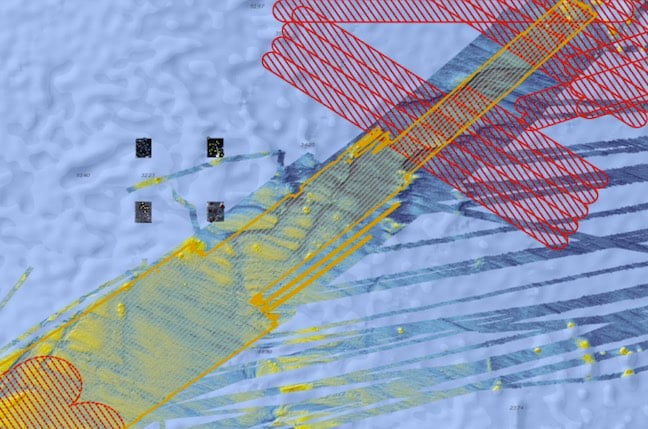
An anonymous reader shares a report: New analysis of images thought to depict wreckage from missing Malaysian Airlines flight MH 370 suggest the Boeing 777 came down to the north of the area searched during efforts to find the plane. A new document [PDF] released yesterday by Geoscience Australia (GA) detailed analysis of four images captured by the PLEIADES 1A Earth-imaging satellite on March 23rd, 2014, not long after the March 8th disappearance of the plane. The images were provided to GA by the French Ministry of Defence. The images depict an area to the north and east of the area searched by underwater survey, and in-between areas where search and rescue operations were conducted in the wake of the plane's disappearance. The image displays the areas covered by underwater survey in yellow and the search and rescue zones in red. Extensive manual analysis of the images -- there was not enough data to use machine learning -- yielded a dozen objects that researchers were happy to classify as "probably not natural." Several of those objects were clustered in the northern parts of the areas depicted in the photos. The document is at pains to point out that it is not possible to identify the objects as airplane debris. The new analysis referred back to drift pattern analysis made on debris known to have come from MH370 and released in December 2016. That analysis suggested the search area be extended by 25,000km2. More detailed drift analysis released in April 2017 also called for a new search to the north, as did a July talk by scientists from Australia's Commonwealth Scientific and Industrial Research Organisation.

Slashdot Top Deals