Education

Celebrate the 200th Birthday of George Boole With Logic (i-programmer.info) 63

mikejuk writes: November 2nd 2015 is the bicentenary of George Boole, dubbed the forefather of modern information technology. To mark the event 55,000 school students globally will be learning about Boolean Logic. Free lesson plans, puzzles and worksheets have been made available in English, Irish and Mandarin and schools in over 30 countries have signed up. According to the George Boole 200 website set up by University College Cork (UCC), the Irish university where he was the first Professor of Mathematics in the mid-19th century, Boole is an unsung hero of the digital age who deserves to be recognized as the forefather of the Information Age. An hour-long documentary, The Genius of George Boole, will be released on November 2 and available to view online until November 16. Although Boole did briefly encounter Charles Babbage during his lifetime he wasn't responsible for bringing together binary arithmetic and what we now call Boolean logic. That achievement is down to Claude Shannon who recognised the relevance for engineering of Boole's symbolic logic. As a result of Shannon's work Boole's thinking became the practical foundation of digital circuit design and the theoretical grounding of the the digital age.
Math

Machine Learning Could Solve Economists' Math Problem 157

An anonymous reader writes: Noah Smith argues that the field of economics frequently uses math in an unhealthy way. He says many economists don't use math as a tool to describe reality, but rather as an abstract foundation for whatever theory they've come up with. A possible solution to this, he says, is machine learning: "In other words, econ is now a rogue branch of applied math. Developed without access to good data, it evolved different scientific values and conventions. But this is changing fast, as information technology and the computer revolution have furnished economists with mountains of data. As a result, empirical analysis is coming to dominate econ. ... [Two economists pushing this change] stated that machine learning techniques emphasized causality less than traditional economic statistical techniques, or what's usually known as econometrics. In other words, machine learning is more about forecasting than about understanding the effects of policy. That would make the techniques less interesting to many economists, who are usually more concerned about giving policy recommendations than in making forecasts."
Open Source

Debian Founder: How I Came To Find Linux 136

An anonymous reader writes: Ian Murdock has pretty solid open source cred: in 1993 he founded Debian, he was the CTO of Progeny and the Linux Foundation, and he helped pave the way for OpenSolaris. He has published a post about how he initially joined the Linux ecosystem. Quoting: "[In 1992], I spent most evenings in the basement of the MATH building basking in the green phosphorescent glow of the Z-29 terminals, exploring every nook and cranny of the UNIX system upstairs. ... I was also accessing UNIX from home via my Intel 80286-based PC and a 2400-baud modem, which saved me the trek across campus to the computer lab on particularly cold days. Being able to get to the Sequent from home was great, but I wanted to replicate the experience of the ENAD building's X terminals, so one day, in January 1993, I set out to find an X server that would run on my PC. As I searched for such a thing on Usenet, I stumbled across something called 'Linux.'" How did you come to find Linux?
Education

Learn-to-Code Program For 10,000 Low-Income Girls 473

theodp writes: In a press release Tuesday, the National Center for Women & Information Technology (NCWIT) announced it was teaming with Lifetime Partner Apple and the U.S. Department of Housing and Urban Development (HUD) on its Clinton Global Initiative (CGI) Commitment to engage 10,000 girls in learning computing concepts. "Currently, just 25 states and the District of Columbia allow computer science to count as a math or science graduation requirement," explained the press release. "Because boys get more informal opportunities for computing experience outside of school, this lack of formal computing education especially affects girls and many youth of color." HUD, the press release added, has joined the Commitment to Action to help extend the program's reach in partnership with public housing authorities nationwide and provide computing access to the 485,000 girls residing in public housing. "In this Information Age, opportunity is just a click on a keyboard away. HUD is proud to partner with NCWIT to provide talented girls with the skills and experiences they need to reach new heights and to achieve their dreams in the 21st century global economy," said HUD Secretary Julian Castro, who coincidentally is eyed as a potential running mate for Hillary Clinton, whose daughter Chelsea is the Clinton Foundation's point-person on computer science. Last year, Chelsea Clinton gave a keynote speech at the NCWIT Summit and appeared with now-U.S. CTO Megan Smith to help launch Google's $50 million girls-only Made With Code initiative.
Education

Clinton Foundation: Kids' Lack of CS Savvy Threatens the US Economy 208

theodp writes: As the press digs for details on Clinton Foundation donations, including a reported $26+ million from Microsoft and Bill Gates, it's probably worth noting the interest the Clintons have developed in computer science and the role they have played — and continue to play — in the national K-12 CS and tech immigration crisis that materialized after Microsoft proposed creating such a crisis to advance its 'two-pronged' National Talent Strategy, which aims to increase K-12 CS education and the number of H-1B visas. Next thing you know, Bill is the face of CS at the launch of Code.org. Then Hillary uses the Clinton Global Initiative (CGI) conference to launch a Facebook, Microsoft, and Google initiative to boost the ranks of female and students of color in CS, and starts decrying woeful CS enrollment. Not to be left out, Chelsea keynotes the NCWIT Summit and launches Google's $50M girls-only Made With Code initiative with now-U.S. CTO Megan Smith. And last December, the Clinton Foundation touted its initiatives to engage middle school girls in CS, revamp the nation's AP CS program, and retrain out-of-work Americans as coders. At next month's CGI America 2015, the conference will kick off with a Beer Bust that CGI says "will also provide an opportunity to learn about Tech Girls Rock, a CGI Commitment to Action launched by CA Technologies in partnership with the Boys & Girls Clubs of America that helps girls discover an interest in tech-related educational opportunities and careers." On the following days, CGI sessions will discuss tech's need for a strong and diverse talent pipeline for computer and information technology jobs, which it says is threatened by "the persistent poor performance of American students in science, technology, engineering, and math," presenting "serious implications for the long-term competitiveness of the U.S. economy." So what's the long-term solution? Expanding CS education, of course!
Education

Is the New "Common Core SAT" Bill Gates' Doing? 273

theodp writes "'I want to explain why Common Core is among the most important education ideas in years,' wrote Bill Gates in a USA Today op-ed last month that challenged the "dangerous misconceptions" of those who oppose the initiative (pretty confident for a guy who conceded there wasn't much to show for his earlier $5B education reform effort!). 'The Gates Foundation helped fund this process,' acknowledged Gates in quite an understatement of his influence. Receiving $6.5M in Gates Grants was Student Achievement Partners, whose founder David Coleman was dubbed the 'Architect of the Common Core.' So it's not too surprising that at last week's SXSWedu, Coleman — now President and CEO of The College Board (no stranger to Gates money itself) — announced a dramatic overhaul of the SAT that includes a new emphasis on evidence-based reading and writing and evidence analysis, which the AJC's Maureen Downey calls 'reflective of the approach of the Common Core State Standards.'" (Read more, below.)

"Shark Tank" Competition Used To Select Education Tech 57

theodp writes "With support from the Bill & Melinda Gates Foundation and the tech billionaire-backed NewSchools Venture Fund, the Silicon Valley Education Foundation used a competition based on the reality show Shark Tank to determine which educational technology entrepreneurs would win the right to have teachers test their technology on students for the rest of the year. 'Ten companies, selected from 80 original applicants,' reports Mercury News columnist Mike Cassidy, 'had three minutes to convince a panel of educators and then a panel of business brains that their ideas would be a difference maker in middle school math classes.' The winners? Blendspace, which helps teachers create digital lessons using Web-based content; Front Row Education, which generates individual quizzes for students and tracks their progress as they work through problems; LearnBop, which offers an automated tutoring system with content written by math teachers; and Zaption, which lets teachers use existing online videos as lessons by adding quizzes, discussion sections, images and text."
United States

25% of Charter Schools Owe Their Soul To the Walmart Store 233

theodp writes "Among the billionaires who helped Bill Gates pave the way for charter schools in WA was Walmart heiress Alice Walton. The Walton Family Foundation spent a whopping $158+ million in 2012 on what it calls 'systemic K-12 education reform,' which included $60,920,186 to 'shape public policy' and $652,209 on 'research and evaluation.' Confirming the LA Times' speculation about its influence, the Walton Foundation issued a press release Wednesday boasting it's the largest private funder of charter school 'startups,' adding that it has supported the opening of 1 in 4 charter schools in the U.S. since 1997 through its 1,500 'investments.' But as some charter school kids have learned the hard way, what the rich man giveth, he can also taketh away. For the time being, though, it looks like America's going to continue to depend on the tax-free kindness of wealthy strangers to educate its kids. For example, while it was nice to see the value of Shop Class recognized, the White House on Monday called on businesses, foundations and philanthropists to fund proposed 'Maker Spaces' in schools and libraries. Hey, when the U.S. Secretary of Education turns to corporate sponsors and auctions to fund his Mother's afterschool program for kids of low-income families in the President's hometown, don't look for things to change anytime soon."
Programming

Putting the Wolfram Language (and Mathematica) On Every Raspberry Pi 99

An anonymous reader writes "Working with the Raspberry Pi Foundation, effective immediately, there's a pilot release of the Wolfram Language — as well as Mathematica—that will soon be bundled as part of the standard system software for every Raspberry Pi computer. Quite soon the Wolfram Language is going to start showing up in lots of places, notably on the web and in the cloud."
Education

Why Organic Chemistry Is So Difficult For Pre-Med Students 279

Hugh Pickens DOT Com writes "Science writer and 42-year old pre-med student Barbara Moran writes in the NY Times that organic chemistry has been haunting pre-meds since 1910, when the Carnegie Foundation for the Advancement of Teaching released a landmark report calling for tougher admission standards to medical school and for medical training based on science. "The organic chemistry on the MCAT is chemistry that students need to know to succeed in medical school," says Karen Mitchell, senior director of the MCAT Program. Basically, orgo examines how molecules containing carbon interact, but it doesn't require equations or math, as in physics. Instead, you learn how electrons flow around and between molecules, and you draw little curved arrows showing where they go. This "arrow pushing" is the heart and soul of orgo. "Learning how to interpret the hieroglyphics is pretty easy. The hard part is learning where to draw the little arrows," writes Moran. "After you draw oxygen donating electrons to a positive carbon a zillion times, it becomes second nature." But the rules have many exceptions, which students find maddening. The same molecule will behave differently in acid or base, in dark or sunlight, in heat or cold, or "if you sprinkle magic orgo dust on it and turn around three times." You can't memorize all the possible answers — you have to rely on intuition, generalizing from specific examples. This skill, far more than the details of every reaction, may actually be useful for medicine. "It seems a lot like diagnosis," says Logan McCarty. "That cognitive skill — inductive generalization from specific cases to something you've never seen before — that's something you learn in orgo." This takes a huge amount of time, for me 20 to 30 hours a week writes Moran. This is one thing that orgo is testing: whether you have the time and desire to do the work. "Sometimes, if a student has really good math skills, they can slide through physics, but you can't do that in orgo," says McCarty ."
Math

A Math Test That's Rotten To the Common Core 663

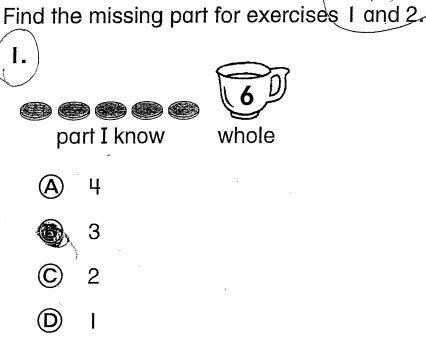
theodp writes " The Common Core State Standards Initiative," explains the project's website, ""is a state-led effort that established a single set of clear educational standards for kindergarten through 12th grade in English language arts and mathematics that states voluntarily adopt." Who could argue with such an effort? Not Bill Gates, who ponied up $150 million to help git-r-done. But the devil's in the details, notes Washington Post education reporter Valerie Strauss, who offers up a ridiculous Common Core math test for first graders as Exhibit A, which also helps to explain why the initiative is facing waning support. Explaining her frustration with the intended-for-5-and-6-year-olds test from Gates Foundation partner Pearson Education, Principal Carol Burris explains, "Take a look at question No. 1, which shows students five pennies, under which it says 'part I know,' and then a full coffee cup labeled with a '6' and, under it, the word, 'Whole.' Students are asked to find 'the missing part' from a list of four numbers. My assistant principal for mathematics was not sure what the question was asking. How could pennies be a part of a cup?" The 6-year-old first-grader who took the test didn't get it either, and took home a 45% math grade to her parents. And so the I'm-bad-at-math game begins!"
AMD

LibreOffice Calc Set To Get GPU Powered Boost From AMD 211

darthcamaro writes "We all know that the open source LibreOffice Calc has been slow — forever and a day. That's soon going to change thanks to a major investment made by AMD into the Document Foundation. AMD is helping LibreOffice developers to re-factor Calc to be more performance and to be able to leverage the full power of GPUs and APUs. From the article: '"The reality has been that Calc has not been the fastest spreadsheet in the world," Suse Engineer Michael Meeks admitted. "Quite a large chunk of this refactoring is long overdue, so it's great to have the resources to do the work so that Calc will be a compelling spreadsheet in its own right."'" Math operations will be accelerated using OpenCL, unit tests are being added for the first time, and the supposedly awful object oriented code is being rewritten with a "modern performance oriented approach."
The Almighty Buck

Five predictions for (Bit)coin 179

Contributor Tom Geller writes: "I recently wrote an article about Bitcoin and the law for Communications of the Association for Computing Machinery. In researching it I ran into plenty of wishful thinkers, ridiculous greedheads, and out-and-out nutbags promising a rosy future. I also found the expected blowback from vehement naysayers who think the best way to combat crazy is with more crazy. But despite that, I walked away believing that Bitcoin — or a decentralized cryptocurrency like it (let's call it "Coin") — is here to stay. As an interested outsider to the Coin economy, and a long-time technology commentator, here's what I think its future holds." Read on for Tom's predictions.
Open Source

Why Freeloaders Are Essential To FOSS Project Success 86

dp619 writes "Outercurve Foundation technical director Stephen Walli has written a blog post arguing that attracting users is fundamental to the ability of open source projects to recruit 'new blood' and contributors who are willing to code. 'So in the end, it's all about freeloaders, but from the perspective that you want as many as possible. That means you're "doing it right" in developing a broad base of users by making their experience easy, making it easy for them to contribute, and ultimately to create an ecosystem that continues to sustain itself,' he wrote."
Education

Khan Academy Will Be Ready For Its Close-Up In Idaho 102

theodp writes "Education officials with Northwest Nazarene University and the J.A. and Kathryn Albertson Foundation say they are arranging to have Khan Academy classes tested in about two dozen public schools next fall in Idaho, where state law now requires high school students to take online courses for two of their 47 graduation credits. 'This is the first time Khan Academy is partnering to tackle the math education of an entire state,' said Khan Academy's Maureen Suhendra. Alas, the Idaho Press-Tribune reports (alas, behind a paywall) that next fall would be too late for film director and producer Davis Guggenheim (Waiting for Superman, An Inconvenient Truth), who will be in Idaho in January filming The Great Teacher Project, a documentary which will highlight positives of education, like the Khan Academy pilot in Idaho. Not to worry. For the film, a few teachers will implement Khan Academy in day-to-day teaching starting in January, before the entire pilot program launches in fall 2013."
Education

Estonia To Teach Programming In Schools From Age 6 307

An anonymous reader writes "With the launch of the Raspberry Pi, computers are becoming affordable again for the younger generations. Now what we need is kids learning about computers in greater detail, including what the hardware is inside the box, and how to create rather than just use software. Estonia looks to be the pace-setter in this regard, and has just announced that it is introducing computer programming learning for all children attending school. By all, I mean from grades 1 through to 12, meaning children as young as 6 will be writing their own code and producing software. The program is called 'ProgeTiiger' and is being introduced by the Estonian Tiger Leap Foundation as a pilot scheme to some Estonian schools this year. Next year the program will expand, adding programming groups for older kids who want to carry on activities outside of the classroom. Eventually it looks as though ProgeTiiger will become just another standard part of the curriculum, just like math and language studies are."
Books

Book Review: Why Does the World Exist? 304

eldavojohn writes "For quite some time humans have struggled to answer the question why there is anything rather than nothing. Jim Holt's Why Does the World Exist? tackles such questions in the form of a journey. After laying a brief groundwork, Holt travels from leading prominent philosopher to curmudgeonly physicist to reserved theologian, visiting each and relaying the juiciest parts of his transcripts to the reader. In doing so, this book takes on an interesting form with a meaty dense center to each chapter (the actual dialogues) surrounded by the light and fluffy bread of Holt's expert writing about the settings, weather and food of his travels. While this consequently lacks the characteristics of a heady hard hitting original philosophical work, these sandwiches should prove quite palatable for most readers. Why Does the World Exist? criss-crosses the etymological, epistemological, theological and philosophical aspects of its title while remaining a fairly easy read." Keep reading for the rest of eldavojohn's review.
Math

Mathematician Predicts Wave of Violence In 2020 397

ananyo writes "In a feature that recalls Asimov's Foundation series and 'psychohistory', Nature profiles mathematician Peter Turchin, who says he can see meaningful cycles in history. Worryingly, Turchin predicts a wave of violence in the United States in 2020. Quoting from the piece: 'To Peter Turchin, who studies population dynamics at the University of Connecticut in Storrs, the appearance of three peaks of political instability at roughly 50-year intervals is not a coincidence. For the past 15 years, Turchin has been taking the mathematical techniques that once allowed him to track predator-prey cycles in forest ecosystems, and applying them to human history. He has analyzed historical records on economic activity, demographic trends and outbursts of violence in the United States, and has come to the conclusion that a new wave of internal strife is already on its way. The peak should occur in about 2020, he says, and will probably be at least as high as the one in around 1970. 'I hope it won't be as bad as 1870,' he adds." We recently discussed similar research into predicting violence in the short term.
Image

Book Review: The Logic of Chance Screenshot-sm 44

eldavojohn writes "The Logic of Chance: The Nature and Origin of Biological Evolution is a comprehensive snapshot of the latest research of biological evolution. The text is written by Eugene V. Koonin, an editor for a journal and researcher at NCBI. The book, although lacking in foundational knowledge and often foregoing explanation of research, presents a comprehensive and well-referenced view of modern evolutionary research. It is heavily laden with acronyms and jargon specific to biology and evolution. As a result, reading it requires either prior knowledge or a high tolerance for looking up these advanced topics with the reward of it being an extremely eye opening and enjoyable read worthy of your time." Keep reading for the rest of eldavojohn's review.

Slashdot Top Deals