Games

Amazon Luna Ends Its Support for Purchased Games and Third-Party Subscriptions (engadget.com) 8

Amazon's Luna cloud gaming service is making some changes, reports Engadget: It's no longer possible to buy Ubisoft+ and Jackbox Games subscriptions or standalone games through Luna. Amazon will automatically cancel any active subscriptions bought through Luna at the end of customers' next billing cycle. If you have a Ubisoft+ subscription that you bought directly from Ubisoft instead, you'll still be able to access games on that service through Luna until June 10. The Bring Your Own Library option — which allows users to play games they own on the likes of EA, GOG and Ubisoft on Luna — is going away too. You won't be able to access games from those storefronts via Amazon's streaming service after June 3.

If you bought any games outright on Luna, you'll still be able to play them there until June 10. Unlike Google did when it shut down Stadia, Amazon isn't offering refunds for those purchases. However, you'll still have access to them through the respective third-party platform that's linked to your account, be it the EA App, GOG Galaxy or Ubisoft Connect. That doesn't exactly help folks who don't have powerful-enough systems to play more demanding games and were relying on Luna.

For those users, Kotaku complains, "you'll essentially lose access to your purchased games in June unless you buy some hardware to play games like Star Wars Outlaws or set up a different streaming option..."

They describe Luna as Amazon's "barely talked about, struggling game streaming service"... On April 10, Amazon announced that it is "always looking for ways to better serve our players" and that "feedback" has made it "clear" that gamers who use Luna want "easy access to great games." And because more of that content is now offered via Amazon Prime, the company has decided that the best way to "serve" you and other users is to rip out most of Luna's gaming options and remove access to paid games you bought in the past. Do you feel better served...?

Launched in 2020, Amazon Luna has never been much of a big hit for the company, which has struggled to even figure out what to do with it. Initially, it was offered up as a Stadia competitor, providing access to big and small third-party games. This apparently didn't work out for Amazon. So in 2025, Amazon officially announced plans to pivot Luna to a service focused on Jackbox-like casual games. This latest shake-up for Luna further focuses the service on these kinds of games and will put everything available on the service behind different sub tiers, similar to Game Pass.

Their conclusion? "This is all just a great reminder to never, ever, ever, ever buy a video game through a streaming service. At least you can download digital games offline and make backups for later."
Games

Are Split Spacebars the Next Big Gaming Keyboard Trend? (pcgamer.com) 58

"There are countless upgrades you could make to your gaming setup," writes PC Gamer's Jacob Ridley. "A wireless this, a bigger that, a faster thing. But how do you know what's going to be a genuine upgrade worth investing in? Personally, I think it might be split spacebars." His argument centers on the fact that spacebars take up a "greedy" amount of keyboard space -- space that could instead be divided into multiple keys for different actions, such as voice chat or melee attacks. From the report: While it's often very easy to reprogram your spacebar to do a different action via your keyboard's software, it's a lot harder to reprogram your brain to hit any other key when you try to jump in game. Spacebar makes you jump. Everyone knows that; it's practically etched onto your brain if you're a long-time mouse and keyboard player. So, why does a split spacebar help with that? It comes down to this: once you know which side of a spacebar you tend to thwack with your thumb, you can program the other side to do whatever you want. I hit the right-side of my spacebar every time when I'm typing. Therefore, when I started using a Wooting 60HE v2 with a split spacebar, I set the left-side to be the delete key; the keyboard lacking a dedicated delete key for its 60% size.

Though for gaming, the split spacebar offers much more varied purpose. People do strange things with the WASD keys that I won't litigate here, but I'm pretty sure most gamers use their left thumb to strike the spacebar for gaming. Right? Right. If you fall into this category, you have the option of using the right-side spacebar for things like a chunky melee key, or, my personal favorite, an in-game voice chat key.

Earth

'Pokemon Go' Players Unknowingly Trained Delivery Robots With 30 Billion Images 57

More than 30 billion images captured by Pokemon Go players have helped train a visual mapping system developed by Niantic. The technology is now being used to guide delivery robots from Coco Robotics through city streets where GPS often struggles. Popular Science reports: This week, Niantic Spatial, part of the team behind Pokemon Go, announced a partnership with Coco Robotics, a company that makes short-distance delivery robots for food and groceries. Soon, those robot couriers will scoot around sidewalks using Niantic's Visual Positioning System (VPS)-- a navigation tool that can reportedly pinpoint location down to a few centimeters just by looking at nearby buildings and landmarks. Niantic trained that VPS model on more than 30 billion images captured by Pokemon Go users, and claims it will help robots operate in areas where GPS falls short. [...]

Instead of helping users navigate the way that GPS does, VPS determines where someone is based on their surroundings. That makes Pokemon Go particularly useful as a data source, because players had to physically travel to specific locations and point their phones at various angles. That mapping effort got a significant boost in 2020, when the app added what it called "Field Research," a feature prompting players to scan real-world statues and landmarks with their cameras in exchange for in-game rewards. A portion of the data also reportedly came from areas known as "Pokemon battle arenas." Whether players knew it or not, those scans were creating 3D models of the real world that would eventually power the Niantic model. More data means better accuracy, and because Niantic was collecting images of the same locations from many different users, it could capture the same spots across varying weather conditions, lighting, angles, and heights. [...]

The idea is that Coco's robots can use VPS and four cameras mounted around the machine to get a far more precise read on their surroundings. In turn, the well-equipped robot will deliver food on time. On a broader level, Niantic says its partnership with Coco Robotics is part of a longer-term effort to build a "living map" of the world that updates as new data becomes available. Once VPS-equipped delivery robots hit the streets, they will collect even more info that can be fed back into the model to bolster its accuracy further. This kind of continuous, real-world data collection is already central to how self-driving vehicle companies like Waymo and Tesla operate, and is a large part of why that technology has improved so significantly in recent years.
Sony

Sony Pulls Back From PlayStation Games on PC 42

Sony is reportedly abandoning its recent push to bring major PlayStation games to PC and will instead keep most single-player titles exclusive to the PlayStation 5. According to Bloomberg, the shift back toward console exclusivity may be driven by weaker PC sales and concerns about diluting the PlayStation brand. From the report: Online games such as Marathon and Marvel Tokon will still be released across multiple platforms, but single-player titles such as last year's samurai hit Ghost of Yotei and the upcoming action game Saros will remain exclusive to PlayStation 5, said the people, who asked not to be identified because they weren't authorized to talk publicly about the company's strategy.

The people cautioned that things could change in the future due to the unpredictable nature of the video-game industry and that Sony's plans are constantly shifting. But in recent weeks PlayStation scrapped plans to bring Ghost of Yotei and other internally developed games to PC. Two games made by external developers but published by PlayStation, Death Stranding 2 and the upcoming Kena: Scars of Kosmora, are still planned for release on PC this year.
AI

AI Mistakes Are Infuriating Gamers as Developers Seek Savings (bloomberg.com) 31

The $200 billion video game industry is caught between studios eager to cut ballooning development costs through AI and a player base that has grown openly hostile to the technology after a string of visible blunders.

As Bloomberg News reports, Arc Raiders, a surprise hit from Stockholm-based Embark Studios that sold 12 million copies in three months, was briefly vilified online for its robotic-sounding auto-generated voices -- even as CEO Patrick Soderlund insists AI was only used for non-essential elements. EA's Battlefield 6 and Activision's Call of Duty: Black Ops 7 both drew gamer anger this winter over thematically mismatched or poorly generated graphics, and Valve's Steam has added labels to flag games made using AI.

Some 47% of developers polled by research house Omdia said they expect generative AI to reduce game quality, and PC gamers -- now facing inflated hardware prices from AI-driven demand for graphics chips -- have turned reflexively antagonistic.
Windows

GameHub Will Give Mac Owners Another Imperfect Way To Play Windows Games (arstechnica.com) 8

An anonymous reader quotes a report from Ars Technica: For a while now, Mac owners have been able to use tools like CrossOver and Game Porting Toolkit to get many Windows games running on their operating system of choice. Now, GameSir plans to add its own potential solution to the mix, announcing that a version of its existing Windows emulation tool for Android will be coming to macOS. Hong Kong-based GameSir has primarily made a name for itself as a manufacturer of gaming peripherals -- the company's social media profile includes a self-description as "the Anti-Stick Drift Experts." Early last year, though, GameSir rolled out the Android GameHub app, which includes a GameFusion emulator that the company claims "provides complete support for Windows games to run on Android through high-precision compatibility design."

In practice, GameHub and GameFusion for Android haven't quite lived up to that promise. Testers on Reddit and sites like EmuReady report hit-or-miss compatibility for popular Steam titles on various Android-based handhelds. At least one Reddit user suggests that "any Unity, Godot, or Game Maker game tends to just work" through the app, while another reports "terrible compatibility" across a wide range of games. With Sunday's announcement, GameSir promises a similar opportunity to "unlock your entire Steam library" and "run Win games/Steam natively" on Mac will be "coming soon." GameSir is also promising "proprietary AI frame interpolation" for the Mac, following the recent rollout of a "native rendering mode" that improved frame rates on the Android version.
There are some "reasons to worry" though, based on the company's uneven track record. The Android version faced controversy for including invasive tracking components, which were later removed after criticism. There were also questions about the use of open-source code, as GameSir acknowledged referencing and using UI components from Winlator, even while maintaining that its core compatibility layer was developed in-house.
Open Source

Four More Tech Bloggers Are Switching to Linux (escapistmagazine.com) 197

Is there a trend? This week four different articles appeared on various tech-news sites with an author bragging about switching to Linux.

"Greetings from the year of Linux on my desktop," quipped the Verge's senior reviews editor, who finally "got fed up and said screw it, I'm installing Linux."

They switched to CachyOS — just like this writer for the videogame magazine Escapist: I've had a fantastic time gaming on Linux. Valve's Windows-to-Linux translation layer, Proton, and even CachyOS' bundled fork have been working just fine. Of course, it's not perfect, and there's been a couple of instances where I've had to problem-solve something, but most of the time, any issues gaming on Linux have been fixed by swapping to another version of Proton. If you're deep in online games like Fortnite, Call of Duty, Destiny 2, GTAV or Battlefield 6, it might not be the best option to switch. These games feature anti-cheats that look for versions of Windows or even the heart of the OS, the kernel, to verify the system isn't going to mess up someone's game....

CachyOS is thankfully pre-packed with Nvidia drivers, meaning I didn't have to dance around trying to find them.... Certain titles will perform worse than their counterparts, simply due to how the bods at Nvidia are handling the drivers for Linux. This said, I'm still not complaining when I'm pushing nearly 144fps or more in newer games. The performance hit is there, but it's nowhere near enough to stave off even an attempt to mess about with Linux.

Do you know how bizarre it is to say it's "nice to have a taskbar again"? I use macOS daily for a lot of my work, which uses a design baked back in the 1990s through NeXT. Seeing just a normal taskbar that doesn't try to advertise to me or crash because an update killed it for some reason is fantastic. That's how bad it is out there right now for Windows.

"I run Artix, by the way," joked a senior tech writer at Notebookcheck (adding "There. That's out of the way...") I dual-booted a Linux partition for a few weeks. After a Windows update (that I didn't choose to do) wiped that partition and, consequently, the Linux installation, I decided to go whole-hog: I deleted Windows 11 and used the entire drive for Linux...

Artix differs from Arch in that it does not use SystemD as its init system. I won't go down the rabbit hole of init systems here, but suffice it to say that Artix boots lightning quick (less than 10 seconds from a cold power on) and is pretty light on system resources. However, it didn't come "fully assembled..." The biggest problem I ran into after installing Artix on the [MacBook] Air was the lack of wireless drivers, which meant that WiFi did not work out of the box. The resolution was simple: I needed to download the appropriate WiFi drivers (Broadcom drivers, to be exact) from Artix's main repository. This is a straightforward process handled by a single command in the Terminal, but it requires an internet connection... which my laptop did not have. Ultimately, I connected a USB-to-Ethernet adapter, plugged the laptop directly into my router, and installed the WiFi drivers that way. The whole process took about 10 minutes, but it was annoying nonetheless.

For the record, my desktop (an AMD Ryzen 7 6800H-based system) worked flawlessly out-of-the-box, even with my second monitor's uncommon resolution (1680x1050, vertical orientation). I did run into issues with installing some packages on both machines. Trying to install the KDE desktop environment (essentially a different GUI for the main OS) resulted in strange artifacts that put white text on white backgrounds in the menus, and every resolution I tried failed to correct this bug. After reverting to XFCE4 (the default desktop environment for my Artix install), the WiFi signal indicator in the taskbar disappeared. This led to me having to uninstall a network manager installed by KDE and re-linking the default network manager to the runit services startup folder. If that sentence sounds confusing, the process was much more so. It has been resolved, and I have a WiFi indicator that lets me select wireless networks again, but only after about 45 minutes of reading manuals and forum posts.

Other issues are inherent to Linux. Not all games on Steam that are deemed Linux compatible actually are. Civilization III Complete is a good example: launching the game results in the map turning completely black. (Running the game through an application called Lutris resolved this issue.) Not all the software I used on Windows is available in Linux, such as Greenshot for screenshots or uMark for watermarking photos in bulk. There are alternatives to these, but they don't have the same features or require me to relearn workflows... Linux is not a "one and done" silver bullet to solve all your computer issues. It is like any other operating system in that it will require users to learn its methods and quirks. Admittedly, it does require a little bit more technical knowledge to dive into the nitty-gritty of the OS and fully unlock its potential, but many distributions (such as Mint) are ready to go out of the box and may never require someone to open a command line...

[T]he issues I ran into on Linux were, for the most part, my fault. On Windows or macOS, most problems I run into are caused by a restriction or bug in the OS. Linux gives me the freedom to break my machine and fix it again, teaching me along the way. With Microsoft's refusal (either from pride or ignorance) to improve (or at least not crapify) Windows 11 despite loud user outrage, switching to Linux is becoming a popular option. It's one you should consider doing, and if you've been thinking about it for any length of time, it's time to dive in.

And tinkerer Kevin Wammer switched from MacOS to Linux, saying "Linux has come a long way" after more than 30 years — but "Windows still sucks..."
Games

Call of Duty Co-Creator, Respawn Co-Founder, and EA Exec Vince Zampella Killed In Car Accident (ign.com) 24

Vince Zampella, the co-creator of Call of Duty and co-founder of Infinity Ward and Respawn Entertainment, died at 55 in a single-car accident in Los Angeles. According to NBC Los Angeles, "The single-car crash was reported at about 12:45 p.m. on the scenic road north of Los Angeles in the San Gabriel Mountains. The southbound car veered off the road, hit a concrete barrier and a passenger was ejected, the California Highway Patrol said. The driver was trapped in the ensuing car fire, the CHP said. The driver died at the scene and the passenger died at a hospital, authorities told NBC4 Investigates." IGN reports: Zampella was an incredibly talented game developer who changed the industry with Call of Duty, a franchise he co-created with Jason West in 2003 at Infinity Ward, the studio he co-founded with West, after previously serving as the lead designer for EA's Medal of Honor: Allied Assault. Zampella was at the center of a high-profile lawsuit against Activision that alleged that the publisher owed Zampella and the Infinity Ward team millions of dollars in unpaid Call of Duty royalties. The bitter professional divorce led to Zampella and West taking a substantial number of the Infinity Ward team with them to EA, where they co-founded Respawn Entertainment, a studio that has produced nothing but critically acclaimed hits: Titanfall, Titanfall 2, Apex Legends, Star Wars Jedi: Fallen Order, and Star Wars Jedi: Survivor. Respawn's success under Zampella led to him getting promoted twice, eventually overseeing the Battlefield franchise within his role as Group General Manager at EA.
Sci-Fi

Why Does So Much New Technology Feel Inspired by Dystopian Sci-Fi Movies? (nytimes.com) 111

In a recent article published in the New York Times, author Casey Michael Henry argues that today's tech industry keeps borrowing dystopian sci-fi aesthetics and ideas -- often the parts that were meant as warnings -- and repackages them as exciting products without recognizing that they were originally cautionary tales to avoid. "The tech industry is delivering on some of the futuristic notions of late-20th-century science fiction," writes Henry. "Yet it seems, at times, bizarrely unaware that many of those notions were meant to be dystopian or satirical -- dismal visions of where our worst and dumbest habits could lead us." Here's an excerpt from the report: You worry that someone in today's tech world might watch "Gattaca" -- a film that features a eugenicist future in which people with ordinary DNA are relegated to menial jobs -- and see it as an inspirational launching point for a collaboration between 23andMe and a charter school. The material on Sora, for instance, can feel oddly similar to the jokes about crass entertainment embedded in dystopian films and postmodern novels. In the movie "Idiocracy," America loved a show called "Ow! My Balls!" in which a man is hit in the testicles in increasingly florid ways. "Robocop" imagined a show about a goggle-eyed pervert with an inane catchphrase. "The Running Man" had a game show in which contestants desperately collected dollar bills and climbed a rope to escape ravenous dogs. That Sora could be prompted to imagine a game show in which Michel Foucault chokeslams Ronald Reagan, or Prince battles an anaconda, doesn't feel new; it feels like a gag from a 1990s writer or a film about social decay.

The echoes aren't all accidental. Modern design has been influenced by our old techno-dystopias -- particularly the cyberpunk variety, with its neon-noir gloss and "high tech, low life" allure. From William Gibson novels to films like "The Matrix," the culture has taken in countless ruined cityscapes, all-controlling megacorporations, high-tech body modifications, V.R.-induced illnesses, deceptive A.I. paramours, mechanical assassins and leather-clad hacker antiheroes, navigating a dissociative cyberspace with savvily repurposed junk-tech. This was not a world many people wanted to live in, but its style and ethos seem to reverberate in the tech industry's boldest visions of the future.

Games

'Grand Theft Auto' Studio Says Fired Employees Were Leaking Information (msn.com) 32

Rockstar Games, the company behind the hit Grand Theft Auto franchise, said that the dozens of employees it fired last week were leaking company secrets, disputing allegations by labor leaders that it was disrupting workers' attempt to unionize. From a report: The employees had been sharing company information in a forum that included non-employees, a Rockstar spokesperson said in a statement to Bloomberg on Wednesday. "Last week, we took action against a small number of individuals who were found to be distributing and discussing confidential information in a public forum, a violation of our company policies," the spokesperson said. "This was in no way related to people's right to join a union or engage in union activities." The company, part of Take-Two Interactive Software, fired between 30 and 40 employees across offices in the UK and Canada for what it said was "gross misconduct." The Independent Workers' Union of Great Britain, the first to organize video-game workers in the UK, told Bloomberg that the employees had all been involved with union efforts at Rockstar, calling the firings "one of the most blatant and ruthless acts of union busting in the history of the games industry."
Microsoft

Microsoft Demands 30% Profit Margins from Struggling Xbox Division (bloomberg.com) 91

Microsoft has set a 30% profit margin goal for its Xbox gaming division, Bloomberg reported Thursday, well above the video game industry's average of 17% to 22%. The target, implemented in fall 2023 by CFO Amy Hood, represents a sharp departure from Xbox's previous approach of allowing developers to focus on making quality games without specific financial constraints. Xbox historically maintained profit margins between 10% and 20% and reported a 12% margin for the first nine months of Microsoft's 2022 fiscal year.

The division has responded by canceling several projects that had been in development for more than seven years, including Everwild, Perfect Dark and Project Blackbird. It has also eliminated thousands of jobs and raised prices. In 2024, Xbox began releasing most of its games on rival Nintendo and Sony platforms. The heightened scrutiny comes as Microsoft prioritizes investment in generative AI while overseeing a gaming division that has struggled despite spending $76.5 billion on acquisitions.
Robotics

MLB Approves Robot Umps In 2026 For Challenges (espn.com) 22

MLB has approved the use of robot umpires in the 2026 season. According to ESPN, the system will give teams two challenges per game for balls and strikes where hitters, pitchers, and catchers can request reviews. From the report: Hitters, pitchers and catchers will be the only ones allowed to trigger the system by tapping their head, and if a challenge is successful -- the pitch will be shown on in-stadium videoboards -- teams will retain it. While the vote in favor of the automated ball-strike challenge system was not unanimous -- some of the four players on the 11-man committee voted no, according to sources -- the vote was a fait accompli, with MLB owners all in favor and in possession of a six-seat majority on the committee.

The ABS system uses similar technology to the line-calling system in tennis, with 12 cameras in each ballpark tracking the ball with a margin of error around one-sixth of an inch. The ABS zone will be a two-dimensional plane in the middle of the plate that spans its full width (17 inches). The zone's top will be 53.5% of a player's height and the bottom 27%. Teams that run out of challenges over the first nine innings will be granted an extra challenge in the 10th inning, while those that still have unused challenges will simply carry them into extras. If a team runs out of challenges in the 10th, it will automatically receive another in the 11th -- a rule that extends for any extra inning.

During the league's spring training test this season, teams combined to average around four challenges per game and succeeded 52.2% of the time, according to the league. Catchers, whose value in framing pitches outside the zone to look like strikes could take a hit due to the new rule, were the most successful at a 56% overturn rate, while hitters were correct 50% of the time and pitchers 41%. MLB's minor league testing, which started in 2021, led to Triple-A players in 2023 using ABS challenge three days a week and a full ABS system, with every pitch adjudicated by computer, the other three.

Games

Hollow Knight Sequel 'Silksong' Crashed Game Stores, as $20 Price Irks Competitors (screenrant.com) 58

Last week Steam and other major storefronts crashed, reports the Guardian, including Nintendo's eShop, PlayStation Store and Microsoft Store. They were all "unable to cope with the demand for Hollow Knight: Silksong, the long-awaited sequel to the critically acclaimed 2017 indie hit Hollow Knight." (which had sold 15 million copies): SilkSong's release triggered widespread outages, with thousands of users reporting issues trying to buy the game in the first few hours of its release. Many were unable to complete purchases, with error messages persisting for almost three hours after the launch... Despite the technical hiccups, within 30 minutes of going live Steam reported more than 100,000 active players, suggesting many had managed to secure their copies.
Aftermath says the "bug-tastic" phenomenon displaced everything except Counter-Strike 2 and Dota 2 on Steam's list of most-played games. The Guardian notes that "At least seven other new games have delayed their launch in the past two weeks to avoid a clash..."

"People have been spamming the chat and the comments of every single game showcase or news event with the words 'Where's Silksong?' for years," writes the Guardian's video games editor: I've never seen another indie game achieve this level of notoriety before it was even released... As VGC points out, Atari released a similar game on the same day as Silksong (Adventure of Samsara) and it had only 12 concurrent players on Steam.
They add that "the hype is justified". Eurogame called Silksong "beautiful, thrilling and cruel." PC Game said Silksong "glows with a level of precision and imagination that's hard to find anywhere else" and "will beat you, burn you, rub your face in the dirt, and then dazzle you with another piece of a haunted clockwork world."

But at least some of the demand also came from the game's low price of $20 in the U.S., suggests Slashdot reader UnknowingFool (with variable regional pricing). "At 5.2M wishes, it was the most wish listed game on Steam. In Brazil, the local price was 74.95 Brazil Real or 13.94 USD." In the age of $70+ AAA games with additional costs, not everyone celebrated the consumer friendly price. Some independent game developers have expressed concern that their games may not sell as well compared to Silksong and cannot afford to charge less.
From ScreenRant: Hollow Knight: Silksong's unbelievably low price point of just $19.99 is exceptionally good value for the consumer. It is an incredibly lengthy game that is only marginally more expensive than its predecessor... it is proving to be a source of controversy for other indie developers who believe it will distort players' expectations.
Businesses

Electronic Arts Tries (Once More) To End Its Football Addiction (ft.com) 47

Electronic Arts faces a familiar challenge as it prepares to launch Battlefield 6 on October 10: breaking its dependence on the FIFA franchise, now called EA Sports FC, which drives roughly 70% of company profits despite disappointing sales this year.

The company has poured unprecedented resources into Battlefield 6, treating it as a platform built for user-generated content rather than a traditional game release. Early signs appear promising -- the trailer hit nearly 5 million YouTube views in a week and shares climbed 5% after beta testing began -- but analysts remain cautious after last year's Dragon Age flop gutted subsidiary BioWare.
Movies

Comic-Con Peeks at New 'Alien' and 'Avatar' Series, Plus 'Predator' and 'Coyote vs. Acme' Movies (cnet.com) 29

At this weekend's Comic-Con, "Excitement has been high over the sneak peeks at Tron: Ares and Predator: Badlands," reports CNET. (Nine Inch Nails has even recorded a new song for Tron: Ares .)

A few highlights from CNET's coverage:
  • The Coyote vs. Acme movie will hit theaters next year "after being rescued from the pile of scrapped ashes left by Warner Bros. Discovery," with footage screened during a Comic-Con panel.
  • The first episode of Alien: Earth was screened before its premiere August 12th on FX.
  • A panel reunited creators of the animated Avatar: The Last Airbender for its 20th anniversary — and discussed the upcoming sequel series Avatar: Seven Havens.

To capture some of the ambience, the Guardian has a collection of cosplayer photos. CNET notes there's even booths for Lego and Hot Wheels (which released toys commemorating the 40th anniversary of Back to the Future and the 50th anniversary of Jaws).

But while many buildings are "wrapped" with slick advertisements, SFGate notes the ads are technically illegal, "with penalties for each infraction running up to $1,000 per day," (according to the San Diego Union-Tribune). "Last year's total ended up at $22,500."

The Union-Tribune notes that "The fines are small enough that advertisers clearly think it is worth it, with about 30 buildings in the process of being wrapped Monday morning."


Sony

Sony is Fighting Climate Change By Scaling Back PS5 Performance (polygon.com) 41

An anonymous reader shares a report: Sony is testing a Power Saver mode for the PlayStation 5, explaining in a new PlayStation Blog update that the option will permit games to run with lower power consumption. While the upcoming feature was revealed as part of the system update beta, the feature will not be available during the beta phase. However, when the feature does hit your console, players will gain access to a new option called Power Saver.

With Power Saver enabled, "supported PS5 games will scale back performance and will allow your PS5 to reduce its power consumption," explained Shuzo Kikuchi, VP of product management at Sony Interactive Entertainment. "If not enabled, or if games do not support the feature, the performance will not be scaled back and power consumption will not be reduced."

As for what scaled-back performance actually means, SIE indicates that VR mode will be unavailable and that "some gameplay features may be limited." So that's one very clear change, and one vague, game-specific change.

Games

'Stop Killing Games' Consumer Movement Hits Major Milestones (gamingonlinux.com) 49

The "Stop Killing Games" movement, led by YouTuber Accursed Farms, has gained serious momentum as it pushes back against the practice of game publishers shutting down access to titles consumers have paid for. Recent milestones include a UK petition surpassing 100K signatures and an EU initiative nearing its 1 million goal. GamingOnLinux reports: In the UK, the newer petition has flown past the 100K signatures (126,066 at time of writing) needed for it to be considered for a debate in Parliament. That doesn't mean it will happen, just that it now needs to be considered by the UK government to potentially have it mentioned. A good step though, with signatures still flowing in until July 14th, showing there's demand for change.

On the EU side, things are also going well there now too. Against the needed 1 million signatures, it's now hit 977,864 (at time of writing). According to the official Accursed Farms X account, they've had reports of "non-citizens spoofing signatures on the EU initiative" so it may be a little inflated.

Windows

Games Run Faster On SteamOS Than Windows 11, Ars Testing Finds (arstechnica.com) 102

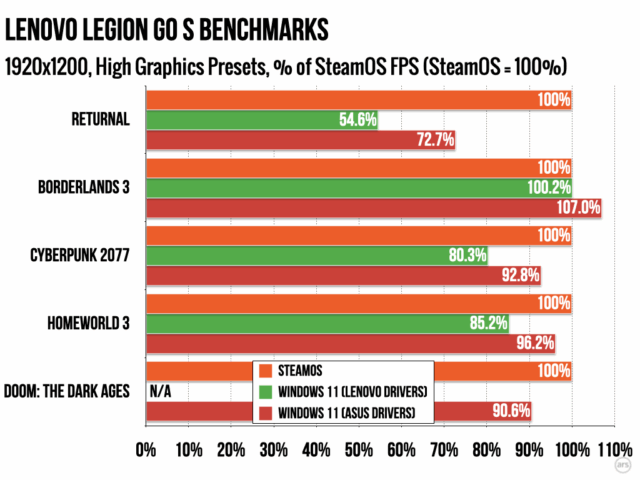
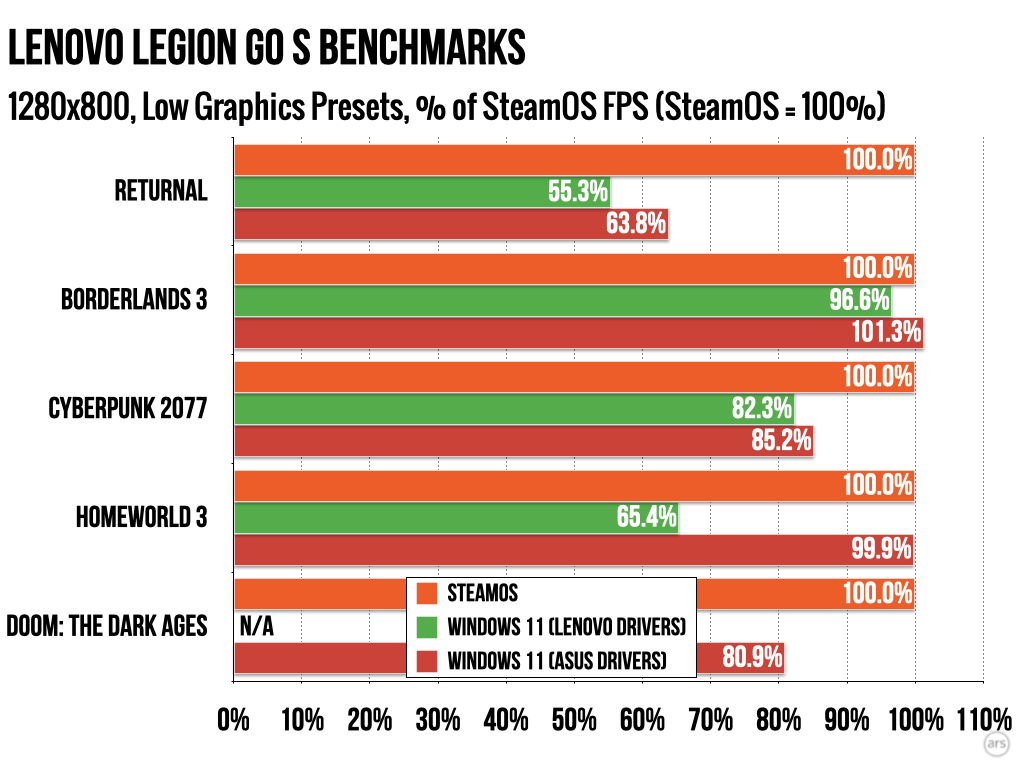
An anonymous reader quotes a report from Ars Technica: Nearly a decade ago, Ars testing found that Valve's "Steam Machines"-era version of SteamOS performed significantly worse than Windows when SteamOS's Linux game ports were tested on the same hardware as their Windows counterparts. Today, though, Ars testing on the Lenovo Legion Go S finds recent games generally run at higher frame rates on SteamOS 3.7 than on Windows 11. [...]

As you can see in the included charts, SteamOS showed noticeable frame rate improvements in four of the five games tested. Only Borderlands 3 showed comparable performance across both operating systems, with Windows eking out ever-so-slightly higher frame rates in that game's benchmarks. For the other four tested games, the stock Lenovo Windows drivers were sometimes significantly worse than those included with SteamOS. When playing Returnal at "High" graphics presets and 1920x1200 resolution, for instance, changing from Lenovo's Windows drivers to SteamOS meant the difference between a hard-to-take 18 FPS average and a downright decent 33 FPS average. Sideloading the updated Asus drivers showed a noticeable improvement in Windows performance across all tested games and even brought Homeworld 3's "Low" graphics benchmark test to practical parity with SteamOS. In all other cases, though, even these updated drivers resulted in benchmark frame rates anywhere from 8 percent to 36 percent lower than those same benchmarks on SteamOS.

These results might seem a bit counterintuitive, considering that games running on SteamOS must go through a Proton translation layer for every native Windows instruction in a game's code. But Valve has put in consistent work over the years to make Proton as efficient and cross-compatible as possible; not to mention its continued work on Linux's Mesa graphics drivers seems to be paying dividends for SteamOS graphics performance. Running SteamOS also means eliminating a lot of operating system overhead that the more generalist Windows uses by default. Microsoft seems aware of this issue for gamers and has recently announced that the upcoming "Xbox Experience for Handheld" will "minimize background activity and defer non-essential tasks" to allow for "more [and] higher framerates" in games.

First Person Shooters (Games)

New 'Doom: The Dark Ages' Already Adjusted to Add Even More Dangerous Demons (windowscentral.com) 23

Doom: The Dark Ages just launched on May 15. But it's already received "difficulty" balance changes "that have made the demons of Hell even more dangerous than ever," writes Windows Central: According to DOOM's official website Slayer's Club, these balance adjustments are focused on making the game harder, as players have been leaving feedback saying it felt too easy even on Nightmare Mode. As a result, enemies now hit harder, health and armor item pick-ups drop less often, and certain enemies punish you more severely for mistiming the parry mechanic.
It reached three million players in just five days, which was seven times faster than 2020's Doom: Eternal," reports Wccftech (though according to analytics firm Ampere Analysis (via The Game Business), more than two million of those three million launch players were playing on Xbox, while only 500K were playing on PS5.") "id Software proves it can still reinvent the wheel," according to one reviewer, "shaking up numerous aspects of gameplay, exchanging elaborate platforming for brutal on-the-ground action, as well as the ability to soar on a dragon's back or stomp around in a giant mech."

And the New York Times says the game "effectively reinvents the hellish shooter with a revamped movement system and deepened lore" in the medieval goth-themed game... Double jumping and dashing are ditched and replaced with an emphasis on raw power and slow, strategic melee combat. Doom Slayer's arsenal features a brand-new tool, the powerful Shield Saw, which Id Software made a point to showcase across its "Stand and Fight" trailers and advertisements. Used for absorbing damage at the expense of speed, the saw also allows players to bash enemies from afar and close the gap on chasms too wide to jump across. While previous titles allowed players to quickly worm their way through bullet hell, The Dark Ages expects you to meet foes head on. "If you were an F-22 fighter jet in Doom Eternal, this time around we wanted you to feel like an Abrams tank," Hugo Martin, the game's creative director, has told journalists.

And Doom Slayer's beefy durability and unstoppable nature does make the gameplay a refreshing experience. The badassery is somehow ratcheted to new heights with the inclusion of a fully controllable mech, which has only a handful of attacks at its disposal, and actual dragons. Flight in a Doom game is entirely surprising and fluid, and the dragons feel relatively easy to maneuver through tight spots. They can also engage in combat more deliberately with the use of dodges and mounted cannons...

One of my favorite additions is the skullcrusher pulverizer. Equal parts heinous nutcracker and demonic woodchipper, the gun lodges skulls into a grinder and sends shards of bones flying at enemies. The animation is both goofy and satisfying.

Another special Times article notes that Doom's fans "resurrect the original game over and over again on progressively stranger pieces of hardware: a Mazda Miata, a NordicTrack treadmill, a French pharmacy sign." But what many hard-core tech hobbyists want to know is whether you can play it on a pregnancy test. The answer: positively yes. And for the first time, even New York Times readers can play Doom within The Times's site [after creating a free account]...

None of this happened by accident, of course. Ports were not incidental to Doom's development. They were a core consideration. "Doom was developed in a really unique way that lent a high degree of portability to its code base," said John Romero, who programmed the game with John Carmack. (In our interview, he then reminisced about operating systems for the next 14 minutes.) Id had developed Wolfenstein 3D, the Nazi-killing predecessor to Doom, on PCs. To build Doom, Carmack and Romero used NeXT, the hardware and software company founded by Steve Jobs after his ouster from Apple in 1985. NeXT computers were powerful, selling for about $25,000 apiece in today's dollars. And any game designed on that system would require porting to the more humdrum PCs encountered by consumers at computer labs or office jobs.

This turned out to be advantageous because Carmack had a special aptitude for ports. All of Id's founders met as colleagues at Softdisk, which had hired Carmack because of his ability to spin off multiple versions of a single game. The group decided to strike out on its own after Carmack created a near-perfect replica of the first level of Super Mario Bros. 3 — Nintendo's best-selling platformer — on a PC. It was a wonder of software engineering that compensated for limited processing power with clever workarounds. "This is the thing that everyone has," Romero said of PCs. "The fact that we could figure out how to make it become a game console was world changing...."

Romero founded a series of game studios after leaving Id in 1996 and is working on a new first-person shooter, the genre he and Carmack practically invented. He has no illusions about how it may stack up. "I absolutely accept that Doom is the best game I'll ever make that has that kind of a reach," he said. "At some point you make the best thing." Thirty years on, people are still making it.

And in related news, PC Gamer reports... As part of a new "FPS Fridays" series on Twitch, legendary shooter designer John Romero streamed New Blood's 2018 hit, Dusk, one of the first and most influential indie "boomer shooters" in the genre's recent revitalization. The short of it? Romero seems to have had a blast.
Graphics

Nvidia's RTX 5060 Review Debacle Should Be a Wake-Up Call (theverge.com) 67

Nvidia is facing backlash for allegedly manipulating the review process of its GeForce RTX 5060 GPU by withholding drivers, selectively granting early access to favorable reviewers, and pressuring media to present the card in a positive light. As The Verge's Sean Hollister writes, the debacle "should be a wake-up call for gamers and reviewers." Here's an excerpt from the report: Nvidia has gone too far. This week, the company reportedly attempted to delay, derail, and manipulate reviews of its $299 GeForce RTX 5060 graphics card, which would normally be its bestselling GPU of the generation. Nvidia has repeatedly and publicly said the budget 60-series cards are its most popular, and this year it reportedly tried to ensure it by withholding access and pressuring reviewers to paint them in the best light possible.

Nvidia might have wanted to prevent a repeat of 2022, when it launched this card's predecessor. Those reviews were harsh. The 4060 was called a "slap in the face to gamers" and a "wet fart of a GPU." I had guessed the 5060 was headed for the same fate after seeing how reviewers handled the 5080, which similarly showcased how little Nvidia's hardware has improved year over year and relies on software to make up the gaps. But Nvidia had other plans. Here are the tactics that Nvidia reportedly just used to throw us off the 5060's true scent, as individually described by GamersNexus, VideoCardz, Hardware Unboxed, GameStar.de, Digital Foundry, and more:

- Nvidia decided to launch its RTX 5060 on May 19th, when most reviewers would be at Computex in Taipei, Taiwan, rather than at their test beds at home.
- Even if reviewers already had a GPU in hand before then, Nvidia cut off most reviewers' ability to test the RTX 5060 before May 19th by refusing to provide drivers until the card went on sale. (Gaming GPUs don't really work without them.)
- And yet Nvidia allowed specific, cherry-picked reviewers to have early drivers anyhow if they agreed to a borderline unethical deal: they could only test five specific games, at 1080p resolution, with fixed graphics settings, against two weaker GPUs (the 3060 and 2060 Super) where the new card would be sure to win.
- In some cases, Nvidia threatened to withhold future access unless reviewers published apples-to-oranges benchmark charts showing how the RTX 5060's "fake frames" MFG tech can produce more frames than earlier GPUs without it.

Some reviewers apparently took Nvidia up on that proposition, leading to day-one "previews" where the charts looked positively stacked in the 5060's favor [...]. But the reality, according to reviews that have since hit the web, is that the RTX 5060 often fails to beat a four-year-old RTX 3060 Ti, frequently fails to beat a four-year-old 3070, and can sometimes get upstaged by Intel's cheaper $250 B580. And yet, the 5060's lackluster improvements are overshadowed by a juicier story: inexplicably, Nvidia decided to threaten GamersNexus' future access over its GPU coverage. Yes, the same GamersNexus that's developed a staunch reputation for defending consumers from predatory behavior, and just last month published a report on "GPU shrinkflation" that accused Nvidia of misleading marketing. Bad move! [...]

Nvidia is within its rights to withhold access, of course. Nvidia doesn't have to send out graphics cards or grant interviews. It'll only do it if it's good for business. But the unspoken covenant of product reviews is that the press, as a whole, gets a chance to warn the public if a movie, video game, or GPU is not worth their money. It works both ways: the media also gets the chance to warn that a product is so good you might want to line up in advance. That unspoken rule is what Nvidia is trampling here.

Slashdot Top Deals