Google

Google Maps' New Color Scheme Draws Criticism Online (sfgate.com) 92

Google Maps has added "a fresh color scheme, including a different look for parks and city blocks," writes SFGate. "But it's the changes to the app's all-important road maps that are rankling online commentators..." Previously, highways and freeways were depicted in bright yellow, which stood out against a stark white grid. Now, the app shows every road in various shades of gray, with major thoroughfares like Interstate 80 and Highway 1 showing up darker and thicker than other roadways. Raynell Cooper, an employee at the San Francisco Municipal Transportation Agency, called the new look "cartographically disappointing" in a Monday post to X, formerly known as Twitter. He added, "major local roads and limited-access highways (freeways) are basically indistinguishable."
TechRadar has a side-by-side comparison of the old and new color schemes, quoting one Reddit who says the new one is a bit harder to read quickly. "The toned down look is cute but not practical." And the Evening Standard shares more negative reactions, including one user who complained the new color scheme is "shockingly bad." "Hate it hate it hate it hate it. Yellow roads were so good, and everything was bright and cheery," states another person on Reddit. "Now it's depressing and the roads are hard to see when not fairly zoomed in, they just don't pop like the yellow did.
One Reddit user offered another complaint. "I think the water is a fairly significant change, it's a much closer shade to the green of the land which makes it a little harder to differentiate at a quick glance."

And another criticism came from a post on X. "15 years ago, I helped design Google Maps..." wrote designer Elizabeth Laraki. "Last week, the team dramatically changed the map's visual design. I don't love it." It feels colder, less accurate and less human. But more importantly, they missed a key opportunity to simplify and scale... Google Maps should have cleaned up the crud overlaying the map. So much stuff has accumulated on top of the map. Currently there are ~11 different elements obscuring it.
Tech blogger John Gruber writes, "This is a very long way of saying that Google Maps's app design should be like Apple Maps."
Security

Fusus' AI-Powered Cameras Are Spreading Across the United States 33

An anonymous reader quotes a report from 404 Media: Spread across four computer monitors arranged in a grid, a blue and green interface shows the location of more than 50 different surveillance cameras. Ordinarily, these cameras and others like them might be disparate, their feeds only available to their respective owners: a business, a government building, a resident and their doorbell camera. But the screens, overlooking a pair of long conference tables, bring them all together at once, allowing law enforcement to tap into cameras owned by different entities around the entire town all at once. This is a demonstration of Fusus, an AI-powered system that is rapidly springing up across small town America and major cities alike. Fusus' product not only funnels live feeds from usually siloed cameras into one central location, but also adds the ability to scan for people wearing certain clothes, carrying a particular bag, or look for a certain vehicle.

404 Media has obtained a cache of internal emails, presentations, memos, photos, and more which provide insight into how Fusus teams up with police departments to sell its surveillance technology. All around the country, city councils are debating whether they want to have a system that qualitatively changes what surveillance cameras mean for a town's residents and public agencies. While many have adopted Fusus, others have pushed back, and refused to have the hardware and software installed in their neighborhoods. In some ways, Fusus is deploying smart camera technology that historically has been used in places like South Africa, where experts warned about it creating an ever present blanket of surveillance. Now, tech with some of the same capabilities is being used across small town America.

Rather than selling cameras themselves, Fusus' hardware and software latches onto existing installations, which can include government-owned surveillance cameras as well as privately owned cameras at businesses and homes. It turns dumb cameras into smart ones. "In essence, the Fusus solution puts a brain into every camera connected with the system," one memorandum obtained by 404 Media reads.
In addition to integrating with existing surveillance installations, Fusus' hardware, called SmartCORE, can turn cameras into automatic license plate readers (ALPRs). It can reportedly offer facial recognition features, too, although Fusus hasn't provided clear clarification on this matter.

The report says the system has been adopted by numerous police departments across the United States, with approximately 150 jurisdictions using Fusus. Orland Park police have called it a "game-changer." It's also being used internationally, launching in the United Kingdom.

Here's what Beryl Lipton, investigative researcher at the Electronic Frontier Foundation (EFF), had to say about it: "The lack of transparency and community conversation around Fusus exacerbates concerns around police access of the system, AI analysis of video, and analytics involving surveillance and crime data, which can influence officer patrols and priorities. In the absence of clear policies, auditable access logs, and community transparency about the capabilities and costs of Fusus, any community in which this technology is adopted should be concerned about its use and abuse."
United States

Silicon Valley Billionaires Reveal First Renderings for Planned City in California (sfchronicle.com) 132

"Silicon Valley billionaires behind a secretive $800 million land-buying spree in Northern California have finally released some details about their plans for a new green city," reports the Associated Press, "but they still must win over skeptical voters and local leaders." After years of ducking scrutiny, Jan Sramek, the former Goldman Sachs trader spearheading the effort, launched a website Thursday about "California Forever." The site billed the project as "a chance for a new community, good paying local jobs, solar farms, and open space" in Solano, a rural county between San Francisco and Sacramento that is now home to 450,000 people. He also began meeting with key politicians representing the area who have been trying unsuccessfully for years to find out who was behind the mysterious Flannery Associates LLC as it bought up huge swaths of land, making it the largest single landholder in the county...

[T]o build anything resembling a city on what is now farmland, the group must first convince Solano County voters to approve a ballot initiative to allow for urban uses on that land, a protection that has been in place since 1984. Local and federal officials still have questions about the group's intentions... California is in dire need of more housing, especially affordable homes for teachers, firefighters, service and hospitality workers. But cities and counties can't figure out where to build as established neighborhoods argue against new homes that they say would congest their roads and spoil their quiet way of life.

In many ways, Solano County is ideal for development. It is 60 miles northeast of San Francisco and 35 miles southwest of California's capital city of Sacramento. Solano County homes are among the most affordable in the San Francisco Bay Area, with a median sales price of $600,000 last month. But Princess Washington, mayor pro tempore of Suisun City, said residents deliberately decided to protect open space and keep the area around Travis Air Force Base free of encroachment given its significance. She's suspicious that the group's real purpose is "to create a city for the elite" under the guise of more housing.

The web site for "California Forever" acknowledges they've purchased 50,000 acres — about 78 squares miles — "strategically located" in Northern California's Solano County with access to water and low fire risk.

Speculative illustrations on the site "evoke a cityscape with a dreamy white stucco and red rooftop Mediterranean vibe that might be found in a Greek or Italian village," writes the San Francisco Chronicle. There are hillside neighborhoods stepping down to what must be the banks of the Sacramento River, kayakers tooling through lily pads and anglers fishing from the riverbank at sunrise... The website also names an investor who has not been named previously — venture capitalist John Doerr of Kleiner Perkins, an early investor in Google, Slack and other companies...

While California Forever may have billions to invest in the project, it will face staunch opposition from some ranchers who argue that the city would disrupt the economy of a county that is 62% farmland.

The San Francisco Chronicle's urban design critic writes "OK, this is something new — an elevator pitch for a whole new city..." But the website launched Thursday by California Forever offers no real details, such as the projected population or precise location. Instead, there are renderings of cuddly townscapes and soothing talk of building "a remarkable place for Solano residents." Oh, and an earnest promise to "begin the phase of our work that matters most: our conversation with you." Let the eye-rolling commence. It's impossible to critique the vision of the investors, because what was unfurled is so innocuous as to be an insult...

The website also refers to how this will be a center of "economic opportunity" and "new employers." Great! But only two of the 12 renderings show people at work, including one where three men install solar panels while the sun sets in the west. Let's hope they're being paid overtime... The Bay Area needs housing and jobs. It also needs honest approaches to making this happen. Let's hope when California Forever 2.0 launches, there is less fluff and more facts.

United States

Whistleblower Tells Congress the US Is Concealing 'Multi-Decade' Program That Captures UFOs (apnews.com) 244

The U.S. is concealing a longstanding program that retrieves and reverse engineers unidentified flying objects, a former Air Force intelligence officer testified Wednesday to Congress. The Pentagon has denied his claims. Associated Press: Retired Maj. David Grusch's highly anticipated testimony before a House Oversight subcommittee was Congress' latest foray into the world of UAPs -- or "unidentified aerial phenomena," which is the official term the U.S. government uses instead of UFOs. While the study of mysterious aircraft or objects often evokes talk of aliens and "little green men," Democrats and Republicans in recent years have pushed for more research as a national security matter due to concerns that sightings observed by pilots may be tied to U.S. adversaries.

Grusch said he was asked in 2019 by the head of a government task force on UAPs to identify all highly classified programs relating to the task force's mission. At the time, Grusch was detailed to the National Reconnaissance Office, the agency that operates U.S. spy satellites. "I was informed in the course of my official duties of a multi-decade UAP crash retrieval and reverse engineering program to which I was denied access," he said. Asked whether the U.S. government had information about extraterrestrial life, Grusch said the U.S. likely has been aware of âoenon-humanâ activity since the 1930s.
The Pentagon has denied Grusch's claims of a coverup. In a statement, Defense Department spokeswoman said investigators have not discovered "any verifiable information to substantiate claims that any programs regarding the possession or reverse-engineering of extraterrestrial materials have existed in the past or exist currently." The statement did not address UFOs that are not suspected of being extraterrestrial objects, AP reported.
Privacy

Footage From Amazon's In-Van Surveillance Cameras Is Leaking Online (vice.com) 25

An anonymous reader quotes a report from Motherboard: A phone-recorded video posted to Reddit shows a wooden desk strewn with various office supplies. On a monitor on the desk, a video begins to play: an Amazon delivery driver, being recorded by a driver-facing camera in their van, leans out of their window to talk to a customer. Though the video is cute, the setup is not: The camera's AI tracks their movements, surrounding them with a bright green box. Below them on the monitor's screen, a yellow line marks the length of the clip sent to the driver's dispatcher. Above them sits a timecode and a speed marker of "0 MPH." The driver opens their door, and moments later, a small French bulldog leaps into the van, tail wagging. The driver is delighted. The person behind the camera laughs a little. [...] The desk set-up looks consistent with that of an Amazon delivery service partner (DSP), the small-business contractors responsible for Amazon's door-to-door deliveries. The DSPs usually operate out of Amazon delivery warehouses, where they are given a desk like the one in the video, in a small area of the warehouse, out of which they select routes, dispatch drivers, and monitor their actions on the road with the help of the cameras.

The video is one of a slew of in-van surveillance videos recently posted to Reddit, a phenomenon which hasn't frequently been seen on the site before. Over the past two weeks, many users in the Amazon delivery service partner drivers subreddit (r/AmazonDSPDrivers) have shared video footage from the cameras, either directly or by recording it on their phone from a monitor within the warehouse. It is clear that many of the videos are not being posted by the subject of the video themselves, and highlights the fact that Amazon drivers, who already have incredibly difficult jobs, are being monitored at all times.

When Motherboard first wrote about the "Biometric Consent" form drivers had to sign that allows them to be monitored while on the job, Amazon insisted that the program was about safety only, and that workers shouldn't be worried about their privacy: "Don't believe the self-interested critics who claim these cameras are intended for anything other than safety," a spokesperson told us at the time. But this video, and a rash of others that have recently become public, shows that access to the camera feeds is being abused. [...] It's not clear why there has been a sudden spate of videos being posted publicly. One current Amazon delivery driver said that the drivers themselves did not have access to the videos -- only Amazon, Netradyne, and the relevant DSPs did.

Network

Brave Aims To Curb Practice of Websites That Port Scan Visitors (arstechnica.com) 49

An anonymous reader quotes a report from Ars Technica: The Brave browser will take action against websites that snoop on visitors by scanning their open Internet ports or accessing other network resources that can expose personal information. Starting in version 1.54, Brave will automatically block website port scanning, a practice that a surprisingly large number of sites were found engaging in a few years ago. According to this list compiled in 2021 by a researcher who goes by the handle G666g1e, 744 websites scanned visitors' ports, most or all without providing notice or seeking permission in advance. eBay, Chick-fil-A, Best Buy, Kroger, and Macy's were among the offending websites.

Some sites use similar tactics in an attempt to fingerprint visitors so they can be re-identified each time they return, even if they delete browser cookies. By running scripts that access local resources on the visiting devices, the sites can detect unique patterns in a visiting browser. Sometimes there are benign reasons a site will access local resources, such as detecting insecurities or allowing developers to test their websites. Often, however, there are more abusive or malicious motives involved.

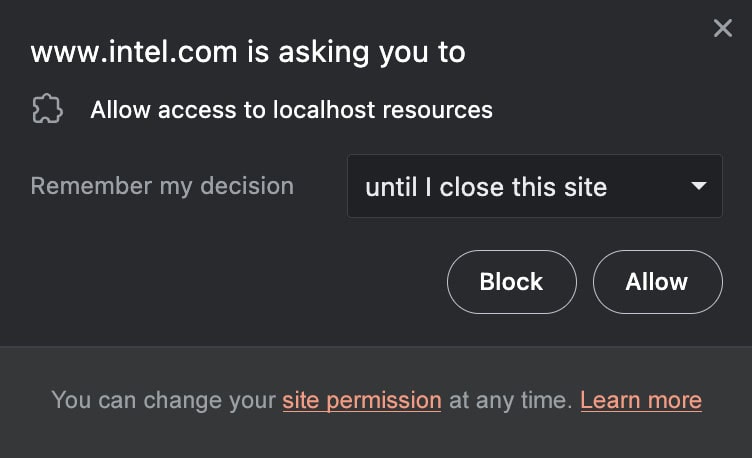
The new version of Brave will curb the practice. By default, no website will be able to access local resources. More advanced users who want a particular site to have such access can add it to an allow list. The interface will look something like the screenshot displayed [here]. Brave will continue to use filter list rules to block scripts and sites known to abuse localhost resources. Additionally, the browser will include an allow list that gives the green light to sites known to access localhost resources for user-benefiting reasons.
"Brave has chosen to implement the localhost permission in this multistep way for several reasons," developers of the browser wrote. "Most importantly, we expect that abuse of localhost resources is far more common than user-benefiting cases, and we want to avoid presenting users with permission dialogs for requests we expect will only cause harm."

"As far as we can tell, Brave is the only browser that will block requests to localhost resources from both secure and insecure public sites, while still maintaining a compatibility path for sites that users trust (in the form of the discussed localhost permission)" the Brave post said.
Government

Judge Clears Massachusetts to Finally Enforce Its Right-to-Repair Law (boston.com) 67

An anonymous reader shared this report from Boston.com. On Thursday, Massachusetts Attorney general Andrea Campbell "began enforcing the state's new right-to-repair law following years of bitter debate and a wildly expensive ballot initiative that was approved by voters in 2020." In a nutshell, the law requires automakers selling cars in the state to provide customers and independent repair businesses with access to a type of information called "telematics." The term refers to information that is first detected by a car and then transmitted wirelessly elsewhere. This information can be used to easily ascertain problems with a vehicle...

Now, new car dealers must tell buyers what kind of data is being collected by a car's telematics system and provide them with a way to access that data. It must also be accessible to independent auto repair shops. If this does not happen, car owners and repairs shops can sue carmakers either triple damages or $10,000, whichever is greater. Manufacturers must equip vehicles starting with model year 2022 with a standardized platform for telematics data that owners can access through a mobile application. Owners can then make this information available to independent repair shops and dealers...

The lawsuit has yet to be resolved, and last week carmakers asked US District Judge Douglas Woodlock to issue a temporary restraining order that would prevent Campbell from enforcing the law. In a hearing Woodlock took issue with the law, calling its goal "likely unattainable" and that its enforcement could harm carmakers, according to the Globe. But ultimately Woodlock said that he would not block enforcement.

"The people have voted on this and that's the result," he said. "I am loath to impose my own views on the initiative."

Android

Google's New Pixel Tablet Is a $500 Slate For the Home (theverge.com) 81

Google has announced the Pixel Tablet after teasing it during last year's Google I/O conference. The Verge reports: The Pixel Tablet is designed from the ground up to be good at what people typically use tablets for: watching video or playing games in the comfort of their own home. It is not, however, making any statements about the future of computing. The looks of the Pixel Tablet are relatively generic. It has an 11-inch, 16:10, 2560 x 1600 pixel LCD display, even bezels all around, and a matte back. It comes in three colors: white, dark green, and light pink, with the dark green model featuring a black bezel. Though it looks like plastic from a distance, the Pixel Tablet has an aluminum frame with a nanotexture coating, not unlike what Google did with the Pixel 5 smartphone.

Bundled in the box with the Pixel Tablet is a magnetic speaker dock. This serves multiple purposes and is meant to prevent the dreaded "dead tablet in a drawer" syndrome: it's a place to store the Pixel Tablet when it's not in use; it charges the battery; and it has a louder, fuller speaker better suited for communal listening than the speakers that are built into the tablet. If you're playing music or watching a video on the tablet when you put it on the dock, it will seamlessly transfer the audio to the dock's speaker. Pull the tablet off the dock while something is playing, and it will instantly switch to the tablet's speakers.

When mounted on the speaker dock, the Pixel Tablet looks an awful lot like the Nest Hub Max, a $250 smart display that Google released back in 2019. But make no mistake, the Pixel Tablet is an Android tablet and not a smart display -- it runs completely different software and has different capabilities compared to the Nest Hub. That said, when the tablet is docked on the speaker, it can show a slideshow of images from your Google Photos albums just like the Nest Hub. It also has a quick access button to the Google Home app so you can control smart home devices, and it can accept voice commands from a distance for hands-free Google Assistant queries. The lock screen won't show any personal information like notifications -- for that, you'll have to unlock the tablet to access the accounts that are set up on it.
The $499 slab is available for preorder starting today, and will begin shipping on June 20th.
Crime

Finland's Most-Wanted Hacker Nabbed In France (krebsonsecurity.com) 17

An anonymous reader quotes a report from KrebsOnSecurity: Julius "Zeekill" Kivimaki, a 25-year-old Finnish man charged with extorting a local online psychotherapy practice and leaking therapy notes for more than 22,000 patients online, was arrested this week in France. A notorious hacker convicted of perpetrating tens of thousands of cybercrimes, Kivimaki had been in hiding since October 2022, when he failed to show up in court and Finland issued an international warrant for his arrest. [...] According to the French news site actu.fr, Kivimaki was arrested around 7 a.m. on Feb. 3, after authorities in Courbevoie responded to a domestic violence report. Kivimaki had been out earlier with a woman at a local nightclub, and later the two returned to her home but reportedly got into a heated argument. Police responding to the scene were admitted by another woman -- possibly a roommate -- and found the man inside still sleeping off a long night. When they roused him and asked for identification, the 6 3 blonde, green-eyed man presented an ID that stated he was of Romanian nationality. The French police were doubtful. After consulting records on most-wanted criminals, they quickly identified the man as Kivimaki and took him into custody.

Kivimaki initially gained notoriety as a self-professed member of the Lizard Squad, a mainly low-skilled hacker group that specialized in DDoS attacks. But American and Finnish investigators say Kivimaki's involvement in cybercrime dates back to at least 2008, when he was introduced to a founding member of what would soon become HTP. Finnish police said Kivimaki also used the nicknames "Ryan", "RyanC" and "Ryan Cleary" (Ryan Cleary was actually a member of a rival hacker group -- LulzSec -- who was sentenced to prison for hacking). Kivimaki and other HTP members were involved in mass-compromising web servers using known vulnerabilities, and by 2012 Kivimaki's alias Ryan Cleary was selling access to those servers in the form of a DDoS-for-hire service. Kivimaki was 15 years old at the time. In 2013, investigators going through devices seized from Kivimaki found computer code that had been used to crack more than 60,000 web servers using a previously unknown vulnerability in Adobe's ColdFusion software.

Multiple law enforcement sources told KrebsOnSecurity that Kivimaki was responsible for making an August 2014 bomb threat against former Sony Online Entertainment President John Smedley that grounded an American Airlines plane. That incident was widely reported to have started with a tweet from the Lizard Squad, but Smedley and others said it started with a call from Kivimaki. Kivimaki also was involved in calling in multiple fake bomb threats and "swatting" incidents -- reporting fake hostage situations at an address to prompt a heavily armed police response to that location.

Games

Epic Is Cutting the Servers For 17 Older Online Games (kotaku.com) 85

Fortnite developer Epic Games announced today that it will no longer provide online service or servers for 17 older games, including six from the Unreal series dating back as far as 1998, and it will end access to some additional games entirely. The shutdowns are already starting to be enacted, but won't be completed until January 24, 2023. Kotaku reports: According to its announcement blog post, Epic described its decision to quit servicing some online games as part of its move toward "solely [supporting] Epic Online Services with its unified friends system, voice chat features, parental controls, and parental verification features." The full list of affected games is as follows: 1000 Tiny Claws, Dance Central 1, Dance Central 2, Dance Central 3, Green Day: Rock Band, Monsters (Probably) Stole My Princess, Rock Band 1, Rock Band 2, Rock Band 3, The Beatles: Rock Band, Supersonic Acrobatic Rocket-Powered Battle-Cars, Unreal Gold, Unreal II: The Awakening, Unreal Tournament 2003, Unreal Tournament 2004, Unreal Tournament 3, and Unreal Tournament: Game of the Year Edition.

And the last Band-Aid: though you can play those previous games if you own them, Epic is performing a few total shutdowns. Players will lose access to the following titles on their specified removal dates: Battle Breakers (December 30), Unreal Tournament: Alpha (January 24), Rock Band Blitz (January 24), Rock Band Companion (January 24), and SingSpace (January 24).

Patents

Meta Ordered To Pay $175 Million For Copying Green Beret Veteran's App (militarytimes.com) 36

Meta, the parent company of Facebook and Instagram, was found by a federal jury in Austin, Texas, to have infringed on two patents held by Voxer, a walkie talkie messaging app founded by a former Army Green Beret. The social media giant was ordered to pay nearly $175 million in damages. Military Times reports: Voxer launched the app in 2011, which was named Best Overall App in the First Annual Silicon Valley Business App Awards in 2013. In 2012, Facebook approached Voxer about a potential collaboration that led to Voxer sharing its patents and proprietary information with the company. "When early meetings did not result in an agreement, Facebook identified Voxer as a competitor although Facebook had no live video or voice product at the time," court filings read. "Facebook revoked Voxer's access to key components of the Facebook platform and launched Facebook Live in 2015 followed by Instagram Live in 2016. Both products incorporate Voxer's technologies and infringe its patents."

The Texas jury found that Facebook Live and Instagram Live incorporated two pieces of Voxer's technologies that involve streaming media over networks. Meta countered in court filings that "Facebook has prioritized live video messaging since the launch of Facebook Live and Instagram Live, with one report identifying Facebook Live as Facebook's 'top priority.'"
In a statement to TechCrunch, Meta said the social media company will continue to press the issue through the courts. "We believe the evidence at trial demonstrated that Meta did not infringe Voxer's patents," Meta's spokesperson said in the statement. "We intend to seek further relief, including filing an appeal."
Power

All 50 States Get Green Light To Build EV Charging Stations (cnbc.com) 133

The U.S. Transportation Department on Tuesday said it approved electric vehicle charging station plans for all 50 states, Washington, D.C., and Puerto Rico covering roughly 75,000 miles of highways. CNBC reports: Earlier this year, the Biden administration allocated $5 billion to states to fund EV chargers over five years along interstate highways as part of the bipartisan infrastructure package. Under the plan, entitled the National Electric Vehicle Infrastructure Formula Program, states provided their EV infrastructure deployment proposals to the Joint Office of Energy and Transportation. States are now approved to construct a network of EV charging stations along designated alternative fuel corridors on the national highway system and have access to more than $1.5 billion to help build the chargers.

It's unclear how many charging stations the funds will support, and states have not yet shared specific charger locations. Transportation Department officials have said that states should install stations every 50 miles and ensure each station is located within one mile of an interstate highway. "We have approved plans for all 50 States, Puerto Rico and the District of Columbia to help ensure that Americans in every part of the country -- from the largest cities to the most rural communities -- can be positioned to unlock the savings and benefits of electric vehicles," Transportation Secretary Pete Buttigieg said in a statement.

AI

Runway Teases AI-Powered Text-To-Video Editing Using Written Prompts (arstechnica.com) 10

An anonymous reader quotes a report from Ars Technica: In a tweet posted this morning, artificial intelligence company Runway teased a new feature of its AI-powered web-based video editor that can edit video from written descriptions, often called "prompts." Runway's "Text to Video" demonstration reel shows a text input box that allows editing commands such as "import city street" (suggesting the video clip already existed) or "make it look more cinematic" (applying an effect). It depicts someone typing "remove object" and selecting a streetlight with a drawing tool that then disappears (from our testing, Runway can already perform a similar effect using its "inpainting" tool, with mixed results). The promotional video also showcases what looks like still-image text-to-image generation similar to Stable Diffusion (note that the video does not depict any of these generated scenes in motion) and demonstrates text overlay, character masking (using its "Green Screen" feature, also already present in Runway), and more.

Video generation promises aside, what seems most novel about Runway's Text to Video announcement is the text-based command interface. Whether video editors will want to work with natural language prompts in the future remains to be seen, but the demonstration shows that people in the video production industry are actively working toward a future in which synthesizing or editing video is as easy as writing a command. [...] Runway is available as a web-based commercial product that runs in the Google Chrome browser for a monthly fee, which includes cloud storage for about $35 per year. But the Text to Video feature is in closed "Early Access" testing, and you can sign up for the waitlist on Runway's website.

The Almighty Buck

Web3 DNS Provider Could Lose Its Domain. The Only Person Who Can Renew It is In Jail (coindesk.com) 43

"When members of the ENS DAO community go to its eth.link website, all they'll see now is an empty page with a green domain expiration notice banner at the top," reports CoinDesk.

"That's because the only person with the authority to renew the domain, Virgil Griffith, is serving a 63-month prison sentence for helping North Koreans use cryptocurrencies to circumvent sanctions and has been unable to renew the domain from prison." According to a notice domain registrar GoDaddy published on its website late Friday, eth.link expired on July 26 and is set to return to a domain registry on Sept. 5, where it will be up for grabs for anyone who is able to take it.

ENS DAO is a decentralized autonomous organization (DAO) that governs the Ethereum Name Service protocol, a Web3 version of a Domain Name Service provider. ENS is the protocol behind the numerous .eth names that have popped up throughout the Ethereum community. Users have bought .eth names as a way to own their own domains. ENS names can then be tied to your wallet address, making it easier for users to send and receive crypto (instead of having to type out a long, complex Ethereum address).... The DAO relied on the eth.link site to provide access to information about all ENS names.

ENS DAO is already advising its users to switch over to eth.limo, another community operated domain.

AI

GM's Cruise so Far: A Crash, and 60 RoboTaxis 'Disabled' After Losing Server Contact (thedrive.com) 146

On June 2nd California approved General Motors' Cruise robotaxi service. The Drive describes an accident that happened the next day: The autonomous car made an unprotected left turn and was hit by a Toyota Prius on June 3, though the accident wasn't reported until Wednesday. When reached for comment by The Drive, the San Francisco Police Department explained that the Cruise vehicle had three passengers, all in the backseat, while the Prius had two occupants in total.... According to the incident report Cruise filed with the California DMV, the Cruise taxi was making a green light left turn from Geary Boulevard onto Spruce Street in downtown San Francisco. It began the turn and stopped in the middle of the intersection, presumably noticing the Toyota headed for it. The Prius then hit the right rear of the Chevy Bolt.

Cruise explained that afterward, "occupants of both vehicles received medical treatment for allegedly minor injuries." GM's incident report points out the Prius was speeding at the time of the accident, and was in the right turn lane before heading straight and hitting the Bolt. SFPD told The Drive that "no arrest or citation was issued at the time of the initial investigation," which is still ongoing. The National Highway Traffic Safety Administration has opened up a special crash investigation into the accident, but there are no public results yet.

Wired reports: In response to that crash, Cruise temporarily reprogrammed its vehicles to make fewer unprotected left turns, according to internal messages seen by WIRED. At an internal meeting Jeff Bleich, Cruise's chief legal officer, said the company was investigating the incident, according to a recording reviewed by WIRED. He also warned employees not working on that investigation to try and tune out crashes or related news reports, saying they were unavoidable and would increase in frequency as the company scaled up its operations. "We just have to understand that at some point this is now going to be a part of the work that we do, and that means staying focused on the work ahead," he said.
Wikipedia's entry for Cruise notes a few other incidents: In April 2022, the San Francisco Police Department stopped an empty (operating without any human safety attendants) Cruise AV for driving at night without its headlights on.... Also in April 2022, an empty Cruise AV blocked the path of a San Francisco Fire Department truck responding to a fire.
But Wired also reports on a more troubling incident that happened "around midnight" on June 28th: Internal messages seen by WIRED show that nearly 60 vehicles were disabled across the city over a 90-minute period after they lost touch with a Cruise server. As many as 20 cars, some of them halted in crosswalks, created a jam in the city's downtown in an incident first reported by the San Francisco Examiner and detailed in photos posted to Reddit....

The June 28 outage wasn't Cruise's first. On the evening of May 18, the company lost touch with its entire fleet for 20 minutes as its cars sat stopped in the street, according to internal documentation viewed by WIRED. Company staff were unable to see where the vehicles were located or communicate with riders inside. Worst of all, the company was unable to access its system which allows remote operators to safely steer stopped vehicles to the side of the road.

A letter sent anonymously by a Cruise employee to the California Public Utilities Commission that month, which was reviewed by WIRED, alleged that the company loses contact with its driverless vehicles "with regularity," blocking traffic and potentially hindering emergency vehicles. The vehicles can sometimes only be recovered by tow truck, the letter said. Images and video posted on social media in May and June show Cruise vehicles stopped in San Francisco traffic lanes seemingly inexplicably, as the city's pedestrians and motorists navigate around them.

China

Chinese Officials Are Weaponizing COVID Health Tracker To Block Protests 74

Chinese bank depositors planning a protest about their frozen funds saw their health code mysteriously turn red and were stopped from traveling to the site of a rally, confirming fears that China's vast COVID-tracking system could be weaponized as a powerful tool to stifle dissent. Motherboard reports: A red health code designated the would-be protesters as suspected or confirmed COVID-19 patients, limiting their movement and access to public transportation. Their rallies in the central Henan province this week were thwarted as some were forced into quarantine and others detained by police. A 38-year-old software engineer was among hundreds who could not access their savings at four rural banks since mid-April. She had planned to travel from her home in Jiangxi province to Zhengzhou, Henan's capital city, to join a group petition this week to demand her money back. But her health code turned from green to red shortly after she bought a train ticket on Sunday. She said a nucleic test for COVID she took the night before came back negative and her hometown has not reported any infection recently.

"Henan authorities targeted the health code of bank depositors in order to stop us from defending our rights," she told VICE World News, speaking on condition of anonymity to avoid government reprisal. She eventually managed to reach Zhengzhou using her green health code on a different app, but was daunted by the sight of police officers out in force. More than 200 bank depositors from all over the country saw their health codes turned red over the past week, which effectively foiled a planned protest outside the Henan branch of China's banking regulator. Chinese activists and dissidents have reported similar experiences in the past, but the latest crackdown appears to be the most brazen example of how the authorities could exploit the supposed COVID-19 measure for political purposes.
Science

Signs Are Not Enough To Save Beachgoers from Deadly Currents (hakaimagazine.com) 130

Keeping people out of rip currents is more about reading human behavior than reading warning signs. From a report: Worldwide, rips cause hundreds of drownings and necessitate tens of thousands of rescues every year. In Australia, where 85 percent of the population lives within an hour's drive of the coast, rips cause more fatalities than floods, cyclones, and shark attacks combined. In 1938, one of the country's most popular beaches, Sydney's Bondi Beach, was the site of an infamous rip-current tragedy: within minutes, roughly 200 swimmers were swept away by a rip, leaving 35 people unconscious and five dead. More often, however, rips take one life at a time, garnering little media attention. For many casual beach visitors, the toll of rip currents goes unnoticed. [...] Although almost three-quarters of beach users said they knew what a rip current is, only 54 percent could correctly define it. In addition, only half of the people she surveyed remembered seeing either the warning signs or the colored flags denoting surf conditions that were posted on or near the main access point to each beach. An even smaller percentage could recall what color the flags had been -- green for calm, yellow for moderate, or red for dangerous conditions. "I was genuinely shocked," Locknick says.

[...] Part of the challenge of preventing rip-related drownings stems from the lack of a simple method to escape them. Rip currents form when waves pile water near the shoreline. The water then gushes back out to sea, taking the path of least resistance. It might flow along channels carved in between sandbars or next to solid structures, such as jetties or rocky headlands. These types of rips can stick around year after year. Others are more erratic, creating fleeting bursts of seaward-flowing water on smooth, open beaches. People often mislabel rip currents as undertows or rip tides. Rip currents are not caused by tides, however, and undertows are a different, weaker current, formed when water pushed onto the beach moves back offshore along the seabed. Some telltale signs of a rip include a streak of churned-up, sandy water or a dark, flat gap between breaking waves.

It's not surprising that rip currents are often misunderstood by the public because, for decades, beach-safety experts also had an oversimplified perception of their mechanics. In some of the earliest research on rips in the mid-20th century, American scientists watched sticks, pieces of kelp, and volleyballs float out to sea and described lanes of flowing water extending more than 300 meters offshore. This work formed the basis for the popular view of rip currents as jets flowing perpendicular to the beach, shooting out past the surf. To escape the river of current, experts recommended that bathers swim parallel to the beach -- a message once broadcast through education campaigns and warning signs in the United States and Australia. As it turns out, that approach may not always work.

Bitcoin

Robinhood Releases Crypto Wallet To 2 Million Users, Plans Integration With Bitcoin Lightning Network (coindesk.com) 10

Robinhood Markets (HOOD) said Thursday it has activated its crypto wallet for 2 million "eligible" customers, making digital asset transfers broadly possible in the long-firewalled investments app. CoinDesk reports: Chief Product Officer Aparna Chennapragada made the announcement on stage at the Bitcoin 2022 conference in Miami. Only a handful of wallet beta testers could move bitcoin (BTC), ether (ETH), dogecoin (DOGE) and a handful of other traded coins in and out of Robinhood's walled garden before. Now, all waitlisted customers outside of regulatory no-go zones Nevada, New York and Hawaii can do so. Additionally, she said Robinhood will add support for bitcoin transactions on the Lightning Network, the speedy, low-cost settlement layer for Bitcoin. "For the larger community this is a fantastic way" to access bitcoin cheaply and in a green way, she said, adding that BTC is the top recurring buy on the app.

Still, Robinhood's multi-asset wallet falls short of true functionality. It cannot plug into Ethereum-based services as MetaMask does. It cannot accept ERC-20 tokens, non-fungible tokens (NFT) or any asset outside of Robinhood's trading list. Tokens generated by airdrops and forks won't work either. "Any NFTs sent to a Robinhood Ethereum address may be lost and unrecoverable," the FAQ page said. Staking also appears to be off-limits for now. Tenev has previously acknowledged customers' desire for the yield-earning feature and said during last quarter's earnings call that Robinhood was investing in the necessary tech. A staking service would have to be "compliant," he said.

Users won't be charged for moving their Robinhood-based crypto into wallets that have such abilities. The company said it will apply estimated gas fees but not withdrawal fees to requested outbound transfers. There's a $5,000 daily cap on outbound transfers and newly acquired crypto stays put until the transaction settles, the web page said. Further, users must undergo an identity check and enable two-factor authentication to access the wallet.

Cellphones

Samsung To Provide Smartphone Parts, Tools, and Repair Guides Starting This Summer (fastcompany.com) 11

Starting this summer, Samsung says it will sell genuine parts and tools to customers needed to repair its Galaxy S20 and Galaxy S21 smartphones, along with its Galaxy Tab S7+ tablet. Fast Company reports: The company, which is partnering with device repair resource iFixit on the initiative, will also provide access to step-by-step repair guides, and it plans to support more devices and repairs over time. The program is similar to one that Apple announced last fall, allowing users to repair the display, battery, and camera on their iPhones. Samsung says it's launching the program to "promote a circular economy and minimize e-waste," though it's just as likely responding to regulatory pressure. Last year, the Federal Trade Commission (FTC) said it would crack down on illegal repair restrictions, and iFixit expects dozens of states to introduce right-to-repair laws this year. [...]

But while phone makers may now feel compelled to supply repair parts and guides to consumers, that doesn't mean the repairs themselves will be any easier. According to iFixit's Galaxy S21 teardown, some repairs involve work that's "unnecessarily sticky and complicated," requiring a heat gun to pry open the display panel and an isopropyl alcohol bath to loosen the "tar pit" around the battery. At least customers brave enough to make those repairs won't have any trouble getting the parts and tools they need.

Microsoft

Microsoft Builds New Green Data Centers in Wyoming, Invests in Wifi, Education, Roads (microsoft.com) 43

This week a Microsoft blog post announced they're opening two new data centers in Cheyenne, "built with sustainable design and operations in mind, contributing to Microsoft's commitment to being carbon negative." Our current and new datacenters will use adiabatic cooling, which uses outside air instead of water for cooling when temperatures are below 85 degrees Fahrenheit. This process uses less electricity and up to 90 percent less water than other water-based cooling systems. We've already invested over $500K in sustainability grants to local organizations that help preserve Wyoming's natural environment including Crow Creek Revival that aims to promote, enhance, restore, and revitalize the region's key watershed.
Building the data centers will also create 700 jobs "during peak construction," Microsoft adds. And they're also "investing in new water, sewer, and road infrastructure to create easier access to Bison Business Park, which will also support the growth of new businesses in Wyoming."

Long-time Slashdot reader theodp shares more details: "I appreciate Microsoft's commitment to Wyoming and thank them for the benefits they have brought to multiple sectors of our economy," said Wyoming Governor Mark Gordon. "The incentives that set this train in motion are working."

Sergio Loureiro, VP of Core Operations for Microsoft's Datacenters, suggested that Wyoming's children are also benefiting from the incentives and data center tax exemptions: "We've partnered with the Wyoming Department of Education to host ongoing computer science training for more than 30 school districts across the state," Loureiro explained, "impacting more than 60,000 K-12 students.

"We're also collaborating with [Microsoft-backed] Code.org and the University of Wyoming to build the capacity of hundreds of K12 teachers to offer computer science education to thousands of students across the state. Microsoft's TEALS high school computer science program has also partnered with six Wyoming high schools to build high-quality computer science education for approximately 500 students in Laramie, Gillette, Douglas, Casper, and Buffalo."

Microsoft also says they're investing over $350,000 to launch free WiFi at key community locations "helping more than 100,000 visitors and residents annually stay connected" — plus over a million dollars to launch three adult upskilling programs.

Slashdot Top Deals