Science

Quantum Radar Has Been Demonstrated For the First Time (technologyreview.com) 37

An anonymous reader quotes a report from MIT Technology Review: Shabir Barzanjeh at the Institute of Science and Technology Austria and a few colleagues have used entangled microwaves to create the world's first quantum radar. Their device, which can detect objects at a distance using only a few photons, raises the prospect of stealthy radar systems that emit little detectable electromagnetic radiation. The device is simple in essence. The researchers create pairs of entangled microwave photons using a superconducting device called a Josephson parametric converter. They beam the first photon, called the signal photon, toward the object of interest and listen for the reflection. In the meantime, they store the second photon, called the idler photon. When the reflection arrives, it interferes with this idler photon, creating a signature that reveals how far the signal photon has traveled. Voila -- quantum radar!

The researchers go on to compare their quantum radar with conventional systems operating with similarly low numbers of photons and say it significantly outperforms them, albeit only over relatively short distances. That's interesting work revealing the significant potential of quantum radar and a first application of microwave-based entanglement. But it also shows the potential application of quantum illumination more generally. A big advantage is the low levels of electromagnetic radiation required. Then there is the obvious application as a stealthy radar that is difficult for adversaries to detect over background noise. The researchers say it could be useful for short-range low-power radar for security applications in closed and populated environments.
The researchers detail their findings in a paper on arXiv.org.
Social Networks

Instagram Hides Like Counts In Leaked Design Prototype (techcrunch.com) 35

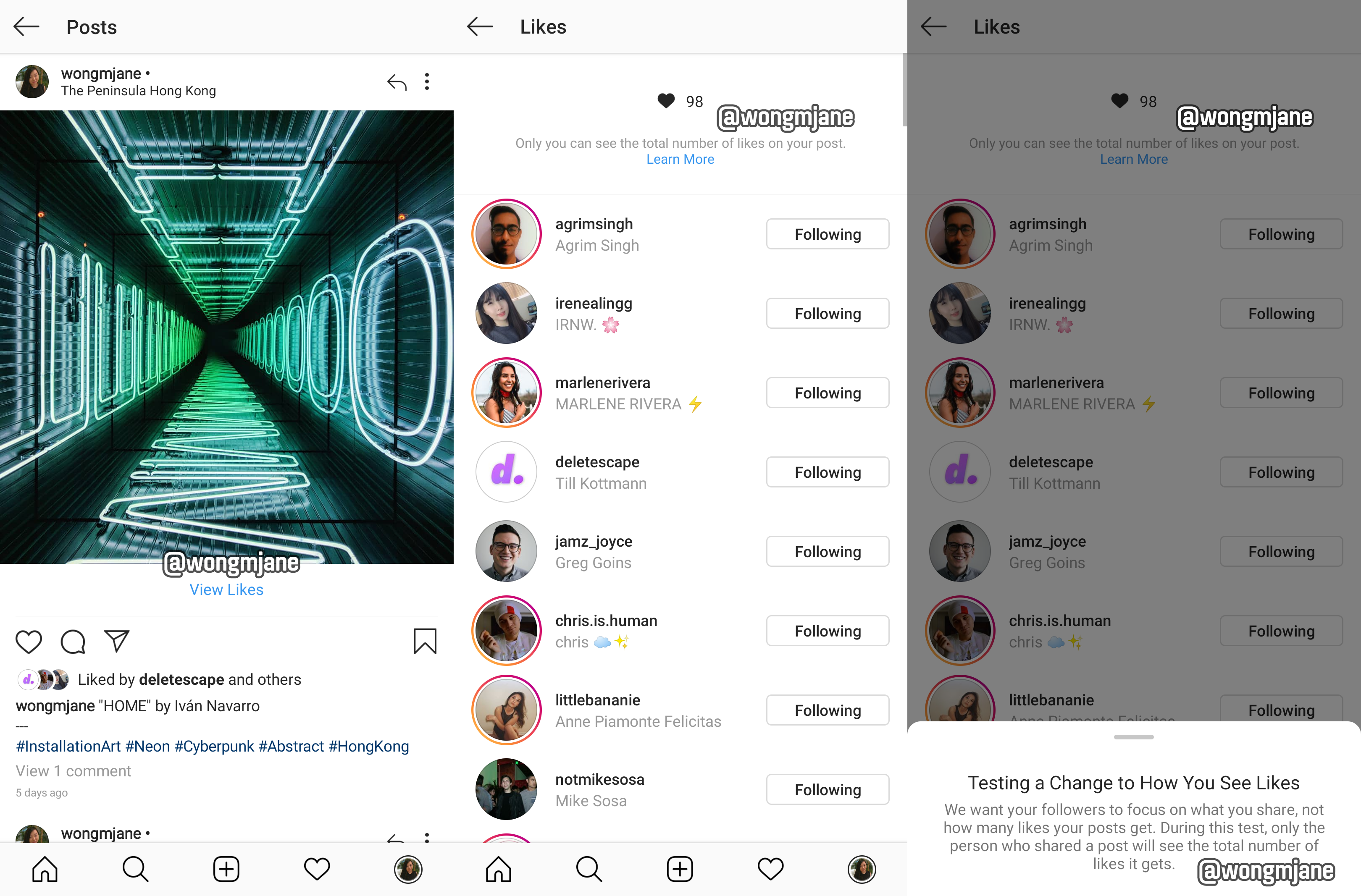
Instagram's Android code is hiding a design change that hides the number of likes your posts get. "During this test, only the person who shares a post will see the total number of likes it gets," the company says. TechCrunch reports on the seemingly small design change test and the massive potential impact it'll have on users' well-being: Hiding Like counts could reduce herd mentality, where people just Like what's already got tons of Likes. It could reduce the sense of competition on Instagram, since users won't compare their own counts with those of more popular friends or superstar creators. And it could encourage creators to post what feels most authentic rather than trying to rack up Likes for everyone to see.

You can see [in a leaked screenshot] on the left that the Instagram feed post lacks a Like count, but still shows a few faces and a name of other people who've Liked it. Users are alerted that only they will see their post's Like counts, and anyone else won't. Many users delete posts that don't immediately get "enough" Likes or post to their fake "Finstagram" accounts if they don't think they'll be proud of the hearts they collect. Hiding Like counts might get users posting more because they'll be less self-conscious. It appears there's no plan to hide follower counts on user profiles, which are the true measure of popularity, but also serve a purpose of distinguishing great content creators and assessing their worth to marketers. Hiding Likes could just put more of a spotlight on follower and comment counts. And even if users don't see Like counts, they still massively impact the feed's ranking algorithm, so creators will still have to battle for them to be seen.

Facebook

Facebook Uses Machine Learning To Remove 8.7 Million Child Exploitation Posts (techcrunch.com) 210

Facebook announced today in a blog post that it has removed 8.7 million posts last quarter that violated its rules against child exploitation. The company said it used new AI and machine learning technology to remove 99 percent of those posts before anyone reported them. TechCrunch reports: The new technology examines posts for child nudity and other exploitative content when they are uploaded and, if necessary, photos and accounts are reported to the National Center for Missing and Exploited Children. Facebook had already been using photo-matching technology to compare newly uploaded photos with known images of child exploitation and revenge porn, but the new tools are meant to prevent previously unidentified content from being disseminated through its platform. The technology isn't perfect, with many parents complaining that innocuous photos of their kids have been removed. Davis addressed this in her post, writing that in order to "avoid even the potential for abuse, we take action on nonsexual content as well, like seemingly benign photos of children in the bath" and that this "comprehensive approach" is one reason Facebook removed as much content as it did last quarter. The tech isn't always right though. In 2016, it was criticized for removing content like the iconic 1972 photo of Phan Thi Kim Phuc, known as the "Napalm Girl," fleeing naked after suffering third-degree burns in a South Vietnamese napalm attack on her village. COO Sheryl Sandberg apologized for it at the time.
Open Source

Interviews: Christine Peterson Answers Your Questions 79

You asked questions, we've got the answers!

Christine Peterson is a long-time futurist who co-founded the nanotech advocacy group the Foresight Institute in 1986. One of her favorite tasks has been contacting the winners of the institute's annual Feynman Prize in Nanotechnology, but she also coined the term "Open Source software" for that famous promotion strategy meeting in 1998.

Christine took some time to answer questions from Slashdot readers.
Cellphones

Pokemon Go Led To Increase In Traffic Deaths and Accidents, Says Study (arstechnica.com) 80

A new study from Purdue University uses detailed local traffic accident reports to suggest that Pokemon Go caused a marked increase in vehicle damages, injuries, and even deaths due to people playing the game while driving. Ars Technica reports: In the provocatively titled "Death by Pokemon Go" (which has been shared online but has yet to be peer-reviewed), Purdue professors Mara Faccio and John J. McConnell studied nearly 12,000 accident reports in Tippecanoe County, Indiana, in the months before and after Pokemon Go's July 6, 2016 launch. The authors then cross-referenced those reports with the locations of Pokestops in the county (where players visit frequently to obtain necessary in-game items) to determine whether the introduction of a Pokestop correlated with an increase in accident frequency, relative to intersections that didn't have them. While the incidence of traffic accidents increased across the county after Pokemon Go's introduction, that increase was a statistically significant 26.5 percent greater at intersections within 100 meters of a Pokestop, compared to those farther away. All told, across the county, the authors estimate 134 extra accidents occurred near Pokestops in the 148-day period immediately after the game came out, compared to the baseline where those Pokestops didn't exist. That adds up to nearly $500,000 in vehicle damage, 31 additional injuries, and two additional deaths across the county, based on extrapolation from the accident reports.

The study uses a regression model to account for potential confounding variables like school breaks and inclement weather, which could cause variation separate from Pokemon Go. The model also compares Pokestops to Pokegyms (where it was nearly impossible to play while driving) to account for the possibility that generally increased traffic to Pokemon Go locations was leading to more accidents, even among drivers who stopped and parked before playing. In all cases, though, being able to compare to intersections without a Pokestop and to the same dates the year before, helped provide natural control variables for the study.

Facebook

Facebook Fights Fake News With Links To Other Angles (techcrunch.com) 157

Facebook is rolling out "Related Articles" that appear below news links to stories lots of people are posting about on Facebook, or that are suspected to be false news and have been externally fact checked by Facebook's partners. "Appearing before someone reads, Related Articles will surface links to additional reporting on the same topic to provide different view points, and to truthiness reports from the fact checkers," reports TechCrunch. From the report: If users see drastically different angles when they compare a story to its Related Articles, they might deem it suspicious and skip it, be less likely to believe or share it, or could click through the Related Articles and make up their own mind. That could reduce the spread and impact of false news without Facebook itself having to be the honesty police. Related Articles could also balance out some of the radical invective that can subtly polarize the populace. Pre-click Related Articles are rolling out in the U.S., Germany, France, and Nederlands today. These countries were chosen to get the roll out first because Facebook has established fact checking partnerships there. "We don't want to be and are not the arbiters of the truth. The fact checkers can give the signal of whether a story is true or false" says Facebook News Feed integrity product manager Tessa Lyons. Meanwhile, Facebook's machine learning algorithm has improved its accuracy and speed, so the social network will now have it send more potential hoaxes to fact checkers.
Databases

Vermont DMV Caught Using Illegal Facial Recognition Program (vocativ.com) 109

schwit1 quotes a report from Vocativ: The Vermont Department of Motor Vehicles has been caught using facial recognition software -- despite a state law preventing it. Documents obtained by the American Civil Liberties Union of Vermont describe such a program, which uses software to compare the DMV's database of names and driver's license photos with information with state and federal law enforcement. Vermont state law, however, specifically states that "The Department of Motor Vehicles shall not implement any procedures or processes that involve the use of biometric identifiers." The program, the ACLU says, invites state and federal agencies to submit photographs of persons of interest to the Vermont DMV, which it compares against its database of some 2.6 million Vermonters and shares potential matches. Since 2012, the agency has run at least 126 such searches on behalf of local police, the State Department, FBI, and Immigrations and Customs Enforcement.
Businesses

Instant Messaging App Snapchat-Maker Snap's IPO Opened Trading At $24 a Share, Making the Company Worth $33 Billion (recode.net) 66

Snap, the company behind instant messaging app Snapchat, went public this morning at price that values the loss-making tech company at $33 billion. Here's how the investors are valuing the company: At $33 billion, investors are saying Snap is worth 35 times what it's estimated to generate in sales this year, or about $936 million, according to eMarketer. Compare that with Facebook, which is currently worth about 10.5 times its estimated 2017 revenue. In other words, investors, for the moment, think Snap has three times more potential value than Facebook. That's a big bet. Snap lost $514 million last year on $404 million in revenue. Compare that with Twitter, which lost $79 million the year before its IPO, while Facebook made $1 billion in profit. Snap has 158 million daily active users. Facebook at its IPO had 845 million monthly active users and 483 million daily active users.
Perl

The Slashdot Interview With Larry Wall 167

You asked, he answered!

Perl creator Larry Wall has responded to questions submitted by Slashdot readers. Read on for his answers...
Media

Genetic Studies Prove Cuckolded Fathers Are Rare In Human Populations 282

HughPickens.com writes: A common urban myth is that many fathers are cuckolded into raising children that genetically are not their own -- a fear fueled by the paternity tests that have become a standard staple of gossip magazines, talk shows, and TV series. Now, Carl Zimmer reports at the New York Times that our obsession with cuckolded fathers is seriously overblown as a number of recent genetic studies have challenged the notion that mistaken paternity is commonplace. It wasn't until DNA sequencing emerged in the 1990s that paternity tests earned the legal system's confidence. Labs were able to compare DNA markers in children to those of their purported fathers to see if they matched. As the lab tests piled up, researchers collated the results and came to a startling conclusion: 10 percent to 30 percent of the tested men were not the biological fathers of their children. There's only one problem with these previous studies: the results didn't come from a random sample of people. The people who ordered the tests already had reason to doubt paternity.

In a 2013 study, Dr. Maarten H.D. Larmuseau used Belgium's detailed birth records to reconstruct large family genealogies reaching back four centuries. Then the scientists tracked down living male descendants and asked to sequence their Y chromosomes. Y chromosomes are passed down in almost identical form from fathers to sons. Men who are related to the same male ancestor should also share his Y chromosome, providing that some unknown father didn't introduce his own Y [chromosome] somewhere along the way. Comparing the chromosomes of living related men, Larmuseau came up with a cuckoldry rate of less than 1 percent. Similar studies have generally produced the same low results in such countries as Spain, Italy and Germany, as well as agricultural villages in Mali. "The observed low EPP rates challenge the idea that women routinely 'shop around' for good genes by engaging in extra-pair copulations," concludes Larmuseau . "The (potential) genetic benefits of extra-pair children are unlikely to be offset by the (potential) costs of being caught, particularly in such a long-lived species as humans with heavy offspring dependence and massive parental investment."
AI

Researchers Propose Neural Network To Assess Your State of Mind From Your Voice (thestack.com) 37

An anonymous reader writes: Researchers in Australia have proposed a system to analyse a user's voice and recognise how they are feeling, long term. The system uses a Deep Neural Network (DNN) to compare the user's tone of voice to those that he or she is talking to, in order to build up long-term data about potential cyclic changes in mood, rather than attempting to recognise whether someone is happy or sad in a particular moment.
Government

City of Johannesburg Leaks Personal Bills Online, Threatens Flaw Finder 46

An anonymous reader writes "A major security hole in the City of Johannesburg's online billing system has meant that customer invoices have been visible on the open web with a bit of simple parameter phishing. Change a digit in the URL for your bill, and someone else's appears. Including major corporations like the roads agency, SANRAL (which is R55 000 in arrears, apparently). Neighboring Ekhuruleni had a similar problem too. Both problems were discovered by regular visitors at a local IT forum, and it's interesting to compare the two cities reactions. Ekhuruleni quietly and quickly fixed the problem, while Joburg has threatened legal action against the user — who tried to raise the issue with the city IT team several times before going public. Legal experts say there's a potential case for a class action."
Encryption

Seeking Fifth Amendment Defenders 768

Bennett Haselton writes with his take on a case going back and forth in U.S. courts right now about whether a defendant can be ordered to decrypt his own hard drives when they may incriminate him. "A Wisconsin defendant in a criminal child-pornography case recently invoked his Fifth Amendment right to avoid giving the FBI the password to decrypt his hard drive. At the risk of alienating fellow civil-libertarians, I admit I've never seen the particular value of the Fifth Amendment right against self-incrimination. So I pose this logical puzzle: come up with a specific, precisely defined scenario, where the Fifth Amendment makes a positive difference." Read on for the rest of Bennett's thoughts.
Image

Book Review: A Practical Guide To Linux Commands, Editors, and Shell Programming Screenshot-sm 81

Rambo Tribble writes "This new, third edition of Sobell's book brings enhancements that add to the text's value as both a learning tool and a reference. This has always been a foundation book for those wanting a professional level of familiarity with Linux. The addition of chapters to introduce the Python language and MySQL database serves to offer the reader practical insights into additional Linux-related technologies." Read below for the rest of Rambo's review.
Science

Paleontologist Jack Horner Answers Your Questions 36

A few weeks ago you had the chance to ask Jack Horner about dinosaurs, science funding, and extinction level events. He's sent back his responses and commented: "Very impressive audience you have!" Read below for more flattery and his answers to your questions.
Image

Book Review: A Gift of Fire Screenshot-sm 52

benrothke writes "In the 4th edition of A Gift of Fire: Social, Legal, and Ethical Issues for Computing Technology, author Sara Baase takes a broad look at the social, legal and ethical issues around technology and their implications. Baase notes that her primary goal in writing the book is for computer professionals to understand the implications of what they create and how it fits into society. The book is an interesting analysis of a broad set of topics. Combined with Baase's superb writing skills, the book is both an excellent reference and a fascinating read." Read below for the rest of Ben's review.
Security

Interviews: Eugene Kaspersky Answers Your Questions 82

Last week, you asked questions of Eugene Kaspersky; below, find his answers on a range of topics, from the relationship of malware makers to malware hunters, to Kasperky Labs' relationship to the Putin government, as well as whitelisting vs. signature-based detection, Internet ID schemes, and the SCADA-specific operating system Kaspersky is working on. Spoiler: There are a lot of interesting facts here, as well as some teases.
Patents

Does Recent Goodwill Undo Years of Patent Trolling For Intellectual Ventures? 90

CowboyNeal writes "Controversial patent-holding company Intellectual Ventures has been covered on Slashdot before, but a recent CNET article takes a look inside the company, at how they work, and what they have planned for the future. Read below to find out if they are merely a patent-troll, or if their shrewd tactics belie a more noble master plan?"

Slashdot Top Deals