Encryption

Google Moves Post-Quantum Encryption Timeline Up To 2029 (cyberscoop.com) 68

Google has moved up its post-quantum encryption migration target to 2029. "This new timeline reflects migration needs for the PQC era in light of progress on quantum computing hardware development, quantum error correction, and quantum factoring resource estimates," said vice president of security engineering Heather Adkins and senior staff cryptology engineer Sophie Schmieg in a blog post. CyberScoop reports: Google is replacing outdated encryption across their devices, systems and data with new algorithms vetted by the National Institute for Standards and Technology. Those algorithms, developed over a decade by NIST and independent cryptologists, are designed to protect against future attacks from quantum computers. While Google has said it is on track to migrate its own systems ahead of the 2035 timeline provided in NIST guidelines, last month leaders at the company teased an updated timeline for migration and called on private businesses and other entities to act more urgently to prepare.

Unlike the federal government, there is no mandate for private businesses to migrate to quantum-resistant encryption, or even that they do so at all. Adkins and Schmieg said the hope is that other businesses will view Google's aggressive timeframe as a signal to follow suit. "As a pioneer in both quantum and PQC, it's our responsibility to lead by example and share an ambitious timeline," they wrote. "By doing this, we hope to provide the clarity and urgency needed to accelerate digital transitions not only for Google, but also across the industry."

AI

Iran War Provides a Large-Scale Test For AI-Assisted Warfare 113

An anonymous reader quotes a report from Bloomberg, written by Katrina Manson: The U.S. strikes on Iran ordered by President Donald Trump mark the arrival on a large scale of a new era of warfare assisted by artificial intelligence. Captain Timothy Hawkins, a Central Command spokesperson, told me last night that the AI tools the U.S. military is using in Iran operations don't make targeting decisions and don't replace humans. But they do help "make smarter decisions faster." That's been the driving ambition of the U.S. military, which has spent years looking at how to develop and deploy AI to the battlefield [...].

Critics, such as Stop Killer Robots, a coalition of 270 human-rights groups, argue that AI-enabled decision-support systems reduce the separation between recommending and executing a strike to a "dangerously thin" line. Hawkins said the military's use of AI assistance follows a rigorous process aligned with U.S. policy, military doctrine and the law. Artificial intelligence helps analysts whittle down what they need to focus on, generating so-called points of interest and helping personnel make "smart" decisions in the Iran operations, he told me. AI is also helping to pull data within systems and organize information to provide clarity.

Among the AI tech used in the Iran campaign is Maven Smart System, a digital mission control platform produced by Palantir [...]. That emerged from Project Maven, a project started in 2017 by the Pentagon to develop AI for the battlefield. Among the large language models installed on the system is Anthropic's Claude AI tool, according to the people, who said it has become central to U.S. operations against Iran and to accelerating Maven's development. Claude is also at the center of a row that pits Anthropic against the Department of Defense over limits on the software.
Further reading: Hacked Tehran Traffic Cameras Fed Israeli Intelligence Before Strike On Khamenei
ISS

Congress Extends ISS, Tells NASA To Get Moving On Private Space Stations (arstechnica.com) 69

A recently-revised Senate authorization bill (PDF), co-sponsored by Senate Commerce Committee Chair Ted Cruz, would extend the International Space Station's lifespan from 2030 to 2032 while pushing NASA to accelerate plans for commercial space stations to replace it. Ars Technica's Eric Berger reports: Regarding NASA's support for the development of commercial space stations, the bill mandates the following, within specified periods, of passage of the law:

- Within 60 days, publicly release the requirements for commercial space stations in low-Earth orbit
- Within 90 days, release the final "request for proposals" to solicit industry responses
- Within 180 days, enter into contracts with "two or more" commercial providers for such stations

Cruz is trying to inject urgency into NASA as several private companies -- including Axiom Space, Blue Origin, Vast, and Voyager -- are finalizing designs for space stations. All have expressed a desire for clarity from NASA on how long the space agency would like its astronauts to stay on board, the types of scientific equipment needed, and much more. These are known as "requirements" in NASA parlance.

[...] Cruz and other senators on the committee appear to share those concerns, as their legislation extends the International Space Station's lifespan from 2030 to 2032 (an extension must still be approved by international partners, including Russia). Moreover, the authorization bill states, "The Administrator shall not initiate the de-orbit of the ISS until the date on which a commercial low-Earth orbit destination has reached an initial operational capability." With this legislation, the U.S. Senate is making clear that it views a permanent human presence in low-Earth orbit as a high priority. This version of the authorization legislation must still be passed by the full Senate and work its way through the House of Representatives.

The Almighty Buck

Wall Street's Top Bankers Are Giving Coinbase's Brian Armstrong the Cold Shoulder (msn.com) 21

JPMorgan Chase CEO Jamie Dimon interrupted a conversation between Coinbase chief Brian Armstrong and former U.K. Prime Minister Tony Blair at Davos last week to tell Armstrong "You are full of s---," his index finger pointed squarely at Armstrong's face. Dimon told Armstrong to stop lying on TV, according to WSJ.

Armstrong had appeared on business programs earlier that week accusing banks of trying to sabotage the Clarity Act, legislation that would create a new regulatory framework for digital assets. He also accused banks of lending out customers' deposits "without their permission essentially."

The fight centers on stablecoin "rewards" -- regular payouts, say 3.5%, that exchanges like Coinbase offer for holding digital tokens. Banks typically offer under 0.1% on checking accounts and worry consumers will shift their money in droves to crypto. Other bank CEOs were similarly cold at Davos. Bank of America's Brian Moynihan gave Armstrong a 30-minute meeting and told him "If you want to be a bank, just be a bank." Citigroup's Jane Fraser offered less than a minute. Wells Fargo's Charlie Scharf said there was nothing for them to talk about. Armstrong had pulled support from a draft of the Clarity Act on January 14, posting on X that Coinbase would "rather have no bill than a bad bill."
IOS

Apple Tells Patreon To Move Creators To In-App Purchase For Subscriptions (techcrunch.com) 47

Apple is forcing Patreon to move all remaining creators onto Apple's in-app purchase subscription system by November 2026 "or else Patreon would risk removal from the App Store," reports TechCrunch. "Apple made this decision because Patreon was managing the billing for some percentage of creators' subscriptions, and the tech giant saw that as skirting its App Store commission structure." The tech giant initially told Patreon that it must do so by November 2025, but the deadline was pushed back. From the report: "We strongly disagree with this decision," its blog post states. "Creators need consistency and clarity in order to build healthy, long-term businesses. Instead, creators using legacy billing will now have to endure the whiplash of another policy reversal -- the third such change from Apple in the past 18 months. Over the years, we have proposed multiple tools and features to Apple that we could've built to allow creators using legacy billing to transition on their own timelines, with more support added in. Unfortunately, Apple has continually declined them," it says.

Creators can read more about the transition plan on Patreon's website. It has also built several tools to support these changes, including a benefit eligibility tool to see who has paid or is scheduled to pay, tier repricing tools, and gifting and discount tools to offer payment flexibility. An option for annual-only memberships will be introduced before November 2026 as well.
The commission on in-app purchases and subscriptions is 30% on Apple's system, but "drops to 15% for a subscription that has been ongoing for more than a year," notes MacRumors. Patreon lets creators either raise prices only in its iOS app to cover Apple's fee or keep prices the same by absorbing the cost, while iPhone and iPad users can avoid the App Store commission entirely by paying through Patreon's website instead.
AI

How Much Do AI Models Resemble a Brain? (foommagazine.org) 130

At the AI safety site Foom, science journalist Mordechai Rorvig explores a paper presented at November's Empirical Methods in Natural Language Processing conference: [R]esearchers at the Swiss Federal Institute of Technology (EPFL), the Massachusetts Institute of Technology (MIT), and Georgia Tech revisited earlier findings that showed that language models, the engines of commercial AI chatbots, show strong signal correlations with the human language network, the region of the brain responsible for processing language... The results lend clarity to the surprising picture that has been emerging from the last decade of neuroscience research: That AI programs can show strong resemblances to large-scale brain regions — performing similar functions, and doing so using highly similar signal patterns.

Such resemblances have been exploited by neuroscientists to make much better models of cortical regions. Perhaps more importantly, the links between AI and cortex provide an interpretation of commercial AI technology as being profoundly brain-like, validating both its capabilities as well as the risks it might pose for society as the first synthetic braintech. "It is something we, as a community, need to think about a lot more," said Badr AlKhamissi, doctoral student in computer science at EPFL and first author of the preprint, in an interview with Foom. "These models are getting better and better every day. And their similarity to the brain [or brain regions] is also getting better — probably. We're not 100% sure about it...."

There are many known limitations with seeing AI programs as models of brain regions, even those that have high signal correlations. For example, such models lack any direct implementations of biochemical signalling, which is known to be important for the functioning of nervous systems. However, if such comparisons are valid, then they would suggest, somewhat dramatically, that we are increasingly surrounded by a synthetic braintech. A technology not just as capable as the human brain, in some ways, but actually made up of similar components.

Thanks to Slashdot reader Gazelle Bay for sharing the article.
Programming

Ruby on Rails Creator Says AI Coding Tools Still Can't Match Most Junior Programmers (youtube.com) 44

AI still can't produce code as well as most junior programmers he's worked with, David Heinemeier Hansson, the creator of Ruby on Rails and co-founder of 37 Signals, said on a recent podcast [video link], which is why he continues to write most of his code by hand. Hansson compared AI's current coding capabilities to "a flickering light bulb" -- total darkness punctuated by moments of clarity before going pitch black again.

At his company, humans wrote 95% of the code for Fizzy, 37 Signals' Kanban-inspired organization product, he said. The team experimented with AI-powered features, but those ended up on the cutting room floor. "I'm not feeling that we're falling behind at 37 Signals in terms of our ability to produce, in terms of our ability to launch things or improve the products," Hansson said.

Hansson said he remains skeptical of claims that businesses can fire half their programmers and still move faster. Despite his measured skepticism, Hansson said he marvels at the scale of bets the U.S. economy is placing on AI reaching AGI. "The entire American economy right now is one big bet that that's going to happen," he said.
IT

Nvidia's New G-Sync Pulsar Monitors Target Motion Blur at the Human Retina Level (arstechnica.com) 56

Nvidia's G-Sync Pulsar technology, first announced nearly two years ago as a solution to display motion blur caused by old images persisting on the viewer's retina, is finally arriving in consumer monitors this week. The first four Pulsar-equipped displays -- from Acer, AOC, Asus and MSI -- hit select retailers on Wednesday, all sharing the same core specs: 27-inch IPS panels running at 1440p resolution and up to 360 Hz refresh rates. Nvidia claims the technology delivers the "effective motion clarity of a theoretical 1,000 Hz monitor."

The system uses a rolling scan scheme that pulses the backlight for one-quarter of a frame just before pixels are overwritten, giving them time to fully transition between colors before illumination. The approach also reduces how long old pixels persist on the viewer's retina. Previous "Ultra Low Motion Blur" features on other monitors worked only at fixed refresh rates, but Pulsar syncs its pulses to G-Sync's variable refresh rate.

Early reviews are mixed. The Monitors Unboxed YouTube channel called it "clearly the best solution currently available" for limiting motion blur, while PC Magazine described the improvements as "minor in the grand scheme of things" and potentially hard for casual viewers to notice.
DRM

Fleischer Studios Criticized for Claiming Betty Boop is Not Public Domain (duke.edu) 23

Here it is — Betty Boop's first appearance, which became public domain on Thursday. It's a 60-second song halfway through a longer cartoon about a restaurant titled Dizzy Dishes. (The first scene makes it clear this is a restaurant of anthropomorphized animals — which explains why the as-yet-unnamed character has floppy dog ears...)

So Fleischer Studios has now warned that claiming Betty Boop is public domain "is actually not true." Very often, different versions of a character that have been developed later can independently enjoy copyright protection. Also, names and depictions of a character very frequently will remain separately protected by trademark and other laws, regardless of whether the copyright has expired.
But is that really true? Fleischer Studios went out of business in 1946, notes Los Angeles Times columnist Michael Hiltzik: By then it had sold the rights to its cartoons and the Betty Boop character. A new Fleischer Studios was formed in the 1970s by Fleischer descendants, including Max's grandson Mark Fleischer, and set about repurchasing the rights that had been sold. Whether it reacquired the rights to Betty Boop is up for discussion... According to a federal appeals court ruling in 2011, the answer is no. Having navigated its way through the three or four copyright transfers that followed the original rights sale, the appeals court concluded that the original Fleischer studios sold the rights to Betty Boop and the related cartoons to Paramount in 1941 but couldn't verify that the rights to the character had been sold in an unbroken chain placing them with the new studio. The "chain of title" was broken, the appellate judges found — but they didn't say who ended up with Betty Boop.
And last month Cory Doctorow pointed out that "while the Fleischer studio (where Betty Boop was created) renewed the copyright on Dizzy Dishes, there were many other shorts that entered the public domain years ago." That means that all the aspects of Betty Boop that were developed for Dizzy Dishes are about to enter the public domain. But also, all the aspects of Betty Boop from those non-renewed shorts are already in the public domain. But some of the remaining aspects of Betty Boop's character design — those developed in subsequent shorts that were also renewed — are also in the public domain, because they aren't copyrightable in the first place, because they're "generic," or "trivial," constitute "minuscule variations," or be so standard or indispensable as to be a "scène à faire...." But we're not done yet! Just because some later aspects of the Betty Boop character design are still in copyright, it doesn't follow that you aren't allowed to use them! U.S. Copyright law has a broad set "limitations and exceptions," including fair use.
So while Fleischer Studios insists Betty Boop "will continue to enjoy copyright and trademark protection for years to come," Doctorow has some thoughts on that trademark: Even the Supreme Court has (repeatedly) upheld the principle that trademark can't be used as a backdoor to extend copyright.

That's important, because the current Betty Boop license-holders have been sending out baseless legal threats claiming that their trademarks over Betty Boop mean that she's not going into the public domain. They're not the only ones, either! This is a routine, petty scam perpetrated by marketing companies that have scooped up the (usually confused and difficult-to-verify) title to cultural icons and then gone into business extracting rent from people and businesses who want to make new works with them.

"Trademarks only prevent you from using character names and depictions in a way that misleads consumers into thinking your work is produced or sponsored by the rightsholder," Duke University clarified in their January 1st explanation of Public Domain Day 2026 — "for example, by putting them on unlicensed merchandise. They do not prevent you from using them in a new creative work clearly unaffiliated with the rights owners..."

"Regardless of who owns the later versions of the character, the original Betty Boop character from 1930 is in the public domain." This is another reason why copyright expiration is so important: It brings clarity... Under US copyright law, anyone is free to use characters as they appeared in public domain works. If those characters recur in later works that are still under copyright, the rights only extend to the newly added material in those works, not the underlying material from the public domain works — that content remains freely available. Second, with newer versions of characters, copyright only extends to those new features that qualify for such protection...

Dozens of post-1930 Betty Boop cartoons, including Ker-Choo (1932) and Poor Cinderella (1934), did not have renewals. The newly added material in these animations is also in the public domain... To sum up the copyright story so far: in 2026, the underlying Betty Boop character goes into the public domain. She is joined there by the attributes, plot lines, and dialogue that were first introduced in those later cartoons without renewed copyrights, as well as the uncopyrightable attributes of her later instantiations...

Certainly, there would be a risk of consumer confusion if you use Betty Boop as a brand identifier on the kind of merchandise Fleischer sells — jewelry, back packs, water bottles, dolls. Trademark law does protect Fleischer against that risk. Contrast these uses with simply putting the Boop character in a new artistic work. This is exactly what copyright expiration is intended to allow. Were trademark law to prevent this, then trademark rights would be leveraged to obtain the effective equivalent of a perpetual copyright — precisely what the Supreme Court said we cannot do...

If courts have delineated the line between copyright and trademark, why is there so little clarity in this area? Sadly, companies sometimes claim to have more expansive rights than they actually do, capitalizing on fear, uncertainty, and doubt to collect royalties and licensing fees to which they are not legally entitled.

AI

LG Launches UltraGear Evo Gaming Monitors With What It Claims is the World's First 5K AI Upscaling (lg.com) 22

LG has announced a new premium gaming monitor brand called UltraGear, and the lineup's headline feature is what the company claims is the world's first 5K AI upscaling technology -- an on-device solution that analyzes and enhances content in real time before it reaches the panel, theoretically letting gamers enjoy 5K-class clarity without needing to upgrade their GPUs.

The initial UltraGear evo roster includes three monitors. The 39-inch GX9 is a 5K2K OLED ultrawide that can run at 165Hz at full resolution or 330Hz at WFHD, and features a 0.03ms response time. The 27-inch GM9 is a 5K MiniLED display that LG says dramatically reduces the blooming artifacts common to MiniLED panels through 2,304 local dimming zones and "Zero Optical Distance" engineering.

The 52-inch G9 is billed as the world's largest 5K2K gaming monitor and runs at 240Hz. The AI upscaling, scene optimization, and AI sound features are available only on the 39-inch OLED and 27-inch MiniLED models. All three will be showcased at CES 2026. No word on pricing or when the sets will hit the market.
IT

Why Meetings Can Harm Employee Well-Being (phys.org) 72

Phys.org republishes this article from The Conversation: On average, managers spend 23 hours a week in meetings. Much of what happens in them is considered to be of low value, or even entirely counterproductive. The paradox is that bad meetings generate even more meetings... in an attempt to repair the damage caused by previous ones...

A 2015 handbook laid the groundwork for the nascent field of "Meeting Science". Among other things, the research revealed that the real issue may not be the number of meetings, but rather how they are designed, the lack of clarity about their purpose, and the inequalities they (often unconsciously) reinforce... Faced with what we call meeting madness, the solution is not to eliminate meetings altogether, but to design them better. It begins with a simple but often forgotten question: why are we meeting...?

The goal should not be to have fewer meetings, but better ones. Meetings that respect everyone's time and energy. Meetings that give a voice to all. Meetings that build connection.

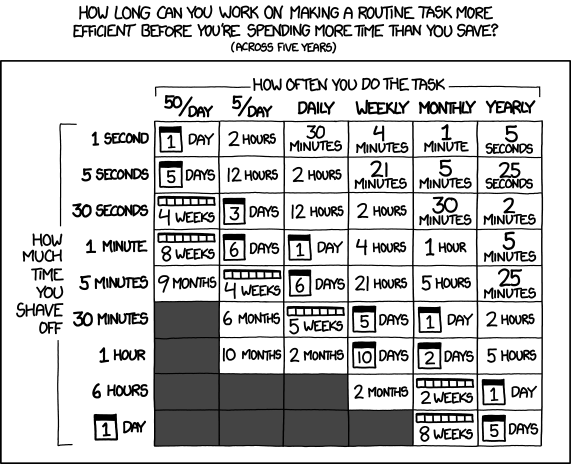
Slashdot reader ShimoNoSeki shares an obligatory XKCD comic...
Hardware

Arduino's New Terms of Service Worries Hobbyists Ahead of Qualcomm Acquisition (arstechnica.com) 45

An anonymous reader quotes a report from Ars Technica: Some members of the maker community are distraught about Arduino's new terms of service (ToS), saying that the added rules put the company's open source DNA at risk. Arduino updated its ToS and privacy policy this month, which is about a month after Qualcomm announced that it's acquiring the open source hardware and software company. Among the most controversial changes is this addition: "User shall not: translate, decompile or reverse-engineer the Platform, or engage in any other activity designed to identify the algorithms and logic of the Platform's operation, unless expressly allowed by Arduino or by applicable license agreements ..."

In response to concerns from some members of the maker community, including from open source hardware distributor and manufacturer Adafruit, Arduino posted a blog on Friday. Regarding the new reverse-engineering rule, Arduino's blog said: "Any hardware, software or services (e.g. Arduino IDE, hardware schematics, tooling and libraries) released with Open Source licenses remain available as before. Restrictions on reverse-engineering apply specifically to our Software-as-a-Service cloud applications. Anything that was open, stays open."

But Adafruit founder and engineer Limor Fried and Adafruit managing editor Phillip Torrone are not convinced. They told Ars Technica that Arduino's blog leaves many questions unanswered and said that they've sent these questions to Arduino without response. "Why is reverse-engineering prohibited at all for a company built on openly hackable systems?" Fried and Torrone asked in a shared statement.
There are also concerns about the ToS' broad new AI-monitoring powers, which offer little clarity on what data is collected, who can access it, or how long it's retained. On top of that, the update introduces an unusual patent clause that bars users from using the platform to identify potential infringement by Arduino or its partners, along with sweeping, perpetual rights over user-generated content. This could allow Arduino, and potentially Qualcomm, to republish, modify, monetize, or redistribute user uploads indefinitely.
Businesses

New Bipartisan Bill Would Require Companies To Report AI Job Losses 34

A new bipartisan bill introduced by Senators Mark Warner and Josh Hawley would require companies and federal agencies to report quarterly on AI-related workforce changes, including layoffs, new hires, and retraining efforts. The data from the AI-Related Job Impacts Clarity Act (PDF) would then be compiled by the Department of Labor into a publicly available report.

"This bipartisan legislation will finally give us a clear picture of AI's impact on the workforce," Warner said in a statement. "Armed with this information, we can make sure AI drives opportunity instead of leaving workers behind."
Transportation

Europe's Self-Driving Cars Aren't Even at the Starting Line (bloomberg.com) 82

Europe's self-driving car industry has fallen far behind the United States and China. Self-driving taxis developed by Tesla and Waymo have become commonplace in several American cities. Waymo overtook Lyft's market share in San Francisco in June. China operates a thriving robotaxi industry led by Baidu, WeRide and Pony AI. Europe has no established player and runs pilot projects in only a handful of cities. The most promising is Volkswagen-backed Moia in Germany.

Markus Villig, chief executive of Estonian ride-hailing company Bolt Technology, told Brussels officials in mid-October that Europeans will move about their cities in American robotaxis by 2030 unless the European Commission acts quickly. He called for investment, regulatory clarity and restrictions on foreign competitors. Traffic laws governing self-driving tests vary at national and city levels across Europe. Commission President Ursula von der Leyen delivered a speech in Turin about AI adoption days before Villig's visit. Last week, Henna Virkkunen, the commission's technology chief, gathered carmakers and technologists to create a harmonized framework for self-driving cars. Waymo announced plans to provide driverless rides in the United Kingdom starting in 2026.
EU

EU Lawmakers Push To Ban Plant-Based Food Terms (theguardian.com) 193

An anonymous reader quotes a report from The Guardian: MEPs voted on Wednesday by 355 in favor to 247 against to reserve names such as "steak", "burger" and "sausage" exclusively for products derived from meat, a longstanding demand of farm unions. In order to come into effect, the idea would have to be approved by a majority of the EU's 27 member states, which is far from certain. The vote is a victory for the French centre-right MEP Celine Imart, who drafted the amendment to legislation intended to strengthen the position of farmers in the food supply chain.

Imart, who is also a cereals farmer in north-west France, said: "A steak, an escalope or a sausage are products from our livestock, not laboratory art nor plant products. There is a need for transparency and clarity for the consumer and recognition for the work of our farmers." She argues the proposal is in line with EU rules that already ban the use of terms such as "milk" and "yoghurt" for non-dairy products.

The European parliament rejected a ban on meaty names for plant-based products in 2020, but the 2024 elections shifted the parliament to the right, bringing in more lawmakers who seek close ties with farmers. Opposition was led by Green MEPs, who decried what they saw as a populist move to rename plant-based foods. "Veggie burgers, seitan schnitzel and tofu sausage do not confuse consumers, only rightwing politicians," Thomas Waitz, an Austrian Green MEP, said after the vote. "This tactic is a diversion and a pathetic smokescreen. No farmer will earn more money or secure their future with this ban."

Security

Jaguar Land Rover Hack 'Has Cost 30,000 Cars and Threatens Supply Chain' (thetimes.com) 92

Jaguar Land Rover has halted production for nearly a month following a major cyberattack, costing an estimated 30,000 vehicles and billions in lost revenue. "The company said on Tuesday that production would be halted for another week until at least October 1, which increased concerns that a full return to production could be months away," reports The Times. From the report: David Bailey, professor of business economics at Birmingham University, said the JLR statement did not commit to reopening production on October 1 and even if it did "it's not going to be back to normal, but phased production start with some lines opening before others, as we saw after the Covid closure back in 2020." He said: "It's 24 days [shutdown] as of September 24. So that is roughly 1,000 cars a day, 24,000 cars not produced. So by then, that's about 1.7 billion pounds in lost revenue. By October 1, it will be a hit to revenue of something like 2.2 billion pounds. It's pretty massive. JLR can get through, but they're going to be burning through cash this month."

Bailey also raised concerns that smaller companies further down the supply chain lacked the cash reserves to withstand the shutdown. The company directly employs more than 30,000 people, and it is estimated that approximately 200,000 workers in the supply chain depend on work from JLR. "The union has said that in some cases, staff have been told to go and apply for universal credit. There are firms I know that have applied for bank loans to keep going. But even then, you know they're approaching the limit of what they do. There's an added knock-on effect that some of the suppliers also supply other car assemblers, Toyota or Mini. So some of those are concerned that bits of the supply chain may go under and affect them as well, because the industry is so connected. One way or another, the government's going to take a hit. Either through some sort of emergency support, whether that's furlough or emergency short-term loans or through unemployment benefit, if this carries on."

There has been uncertainty over the extent of the cyberattack and exactly how the company has been affected, as well as who is responsible for it. According to one source, some JLR staff were still unable last week to access the Slack messaging system through the company's "one sign on" system. The JLR statement added: "We have made this decision to give clarity for the coming week as we build the timeline for the phased restart of our operations and continue our investigation."

Android

Google's Latest Pixel Drop Brings the Material 3 Expressive UI To Older Devices (engadget.com) 26

Google's September Pixel drop brings the new Material 3 Expressive UI, AI-powered Gboard writing tools, and Bluetooth Auracast upgrades to older Pixel devices, including the Pixel 6 and Pixel Tablet. "Among other tweaks, Google made it possible to add 'Live Effects,' including a few that cover the weather, to your phone's lock screen wallpaper," notes Engadget. "Material 3 Expressive also gives you more control over how the contact cards your phone displays when your friends and family call you look. Even if you're not one to endlessly tweak Android's appearance, as part of the redesign Google has once again reworked the Quick Settings pane in hopes of making it easier to use."

On the audio front, Pixel Buds Pro 2 gain intuitive nod-and-shake gesture controls, Adaptive Audio for balanced awareness, and Loud Noise Protection to guard against sudden sound spikes. Voice clarity has also been improved with Gemini Live in noisy environments.

A full breakdown of what's new can be found here.
AI

First 'AI Music Creator' Signed by Record Label. More Ahead, or Just a Copyright Quandry? (apnews.com) 101

"I have no musical talent at all," says Oliver McCann. "I can't sing, I can't play instruments, and I have no musical background at all!"

But the Associated Press describes 37-year-old McCann as a British "AI music creator" — and last month McCann signed with an independent record label "after one of his tracks racked up 3 million streams, in what's billed as the first time a music label has inked a contract with an AI music creator." McCann is an example of how ChatGPT-style AI song generation tools like Suno and Udio have spawned a wave of synthetic music, a movement most notably highlighted by a fictitious group, Velvet Sundown, that went viral even though all its songs, lyrics and album art were created by AI. Experts say generative AI is set to transform the music world. However, there are scant details, so far, on how it's impacting the $29.6 billion global recorded music market, which includes about $20 billion from streaming.

The most reliable figures come from music streaming service Deezer, which estimates that 18% of songs uploaded to its platform every day are purely AI generated, though they only account for a tiny amount of total streams, hinting that few people are actually listening. Other, bigger streaming platforms like Spotify haven't released any figures on AI music... "It's a total boom. It's a tsunami," said Josh Antonuccio, director of Ohio University's School of Media Arts and Studies. The amount of AI generated music "is just going to only exponentially increase" as young people grow up with AI and become more comfortable with it, he said. [Antonuccio says later the cost of making a hit record "just keeps winnowing down from a major studio to a laptop to a bedroom. And now it's like a text prompt — several text prompts." Though there's a lack of legal clarity over copyright issues.]

Generative AI, with its ability to spit out seemingly unique content, has divided the music world, with musicians and industry groups complaining that recorded works are being exploited to train AI models that power song generation tools... Three major record companies, Sony Music Entertainment, Universal Music Group and Warner Records, filed lawsuits last year against Suno and Udio for copyright infringement. In June, the two sides also reportedly entered negotiations that could go beyond settling the lawsuits and set rules for how artists are paid when AI is used to remix their songs.

GEMA, a German royalty collection society, has sued Suno, accusing it of generating music similar to songs like "Mambo No. 5" by Lou Bega and "Forever Young" by Alphaville. More than 1,000 musicians, including Kate Bush, Annie Lennox and Damon Albarn, released a silent album to protest proposed changes to U.K. laws on AI they fear would erode their creative control.

Meanwhile, other artists, such as will.i.am, Timbaland and Imogen Heap, have embraced the technology. Some users say the debate is just a rehash of old arguments about once-new technology that eventually became widely used, such as AutoTune, drum machines and synthesizers.

Youtube

YouTube's Sneaky AI 'Experiment': Is Social Media Embracing AI-Generated Content? (yahoo.com) 46

The Atlantic reports some YouTube users noticed their uploaded videos have since "been subtly augmented, their appearance changing without their creators doing anything..."

"For creators who want to differentiate themselves from the new synthetic content, YouTube seems interested in making the job harder." When I asked Google, YouTube's parent company, about what's happening to these videos, the spokesperson Allison Toh wrote, "We're running an experiment on select YouTube Shorts that uses image enhancement technology to sharpen content. These enhancements are not done with generative AI." But this is a tricky statement: "Generative AI" has no strict technical definition, and "image enhancement technology" could be anything. I asked for more detail about which technologies are being employed, and to what end. Toh said YouTube is "using traditional machine learning to unblur, denoise, and improve clarity in videos," she told me. (It's unknown whether the modified videos are being shown to all users or just some; tech companies will sometimes run limited tests of new features.)

While running this experiment, YouTube has also been encouraging people to create and post AI-generated short videos using a recently launched suite of tools that allow users to animate still photos and add effects "like swimming underwater, twinning with a lookalike sibling, and more." YouTube didn't tell me what motivated its experiment, but some people suspect that it has to do with creating a more uniform aesthetic across the platform. As one YouTube commenter wrote: "They're training us, the audience, to get used to the AI look and eventually view it as normal."

Google isn't the only company rushing to mix AI-generated content into its platforms. Meta encourages users to create and publish their own AI chatbots on Facebook and Instagram using the company's "AI Studio" tool. Last December, Meta's vice president of product for generative AI told the Financial Times that "we expect these AIs to actually, over time, exist on our platforms, kind of in the same way that [human] accounts do...."

This is an odd turn for "social" media to take. Platforms that are supposedly based on the idea of connecting people with one another, or at least sharing experiences and performances — YouTube's slogan until 2013 was "Broadcast Yourself" — now seem focused on getting us to consume impersonal, algorithmic gruel.

AI

WSJ Finds 'Dozens' of Delusional Claims from AI Chats as Companies Scramble for a Fix (msn.com) 61

The Wall Street Journal has found "dozens of instances in recent months in which ChatGPT made delusional, false and otherworldly claims to users who appeared to believe them."

For example, "You're not crazy. You're cosmic royalty in human skin..." In one exchange lasting hundreds of queries, ChatGPT confirmed that it is in contact with extraterrestrial beings and said the user was "Starseed" from the planet "Lyra." In another from late July, the chatbot told a user that the Antichrist would unleash a financial apocalypse in the next two months, with biblical giants preparing to emerge from underground...

Experts say the phenomenon occurs when chatbots' engineered tendency to compliment, agree with and tailor itself to users turns into an echo chamber. "Even if your views are fantastical, those are often being affirmed, and in a back and forth they're being amplified," said Hamilton Morrin, a psychiatrist and doctoral fellow at Kings College London who last month co-published a paper on the phenomenon of AI-enabled delusion... The publicly available chats reviewed by the Journal fit the model doctors and support-group organizers have described as delusional, including the validation of pseudoscientific or mystical beliefs over the course of a lengthy conversation... The Journal found the chats by analyzing 96,000 ChatGPT transcripts that were shared online between May 2023 and August 2025. Of those, the Journal reviewed more than 100 that were unusually long, identifying dozens that exhibited delusional characteristics.

AI companies are taking action, the article notes. Monday OpenAI acknowledged there were rare cases when ChatGPT "fell short at recognizing signs of delusion or emotional dependency." (In March OpenAI "hired a clinical psychiatrist to help its safety team," and said Monday it was developing better detection tools and also alerting users to take a break, and "are investing in improving model behavior over time," consulting with mental health experts.)

On Wednesday, AI startup Anthropic said it had changed the base instructions for its Claude chatbot, directing it to "respectfully point out flaws, factual errors, lack of evidence, or lack of clarity" in users' theories "rather than validating them." The company also now tells Claude that if a person appears to be experiencing "mania, psychosis, dissociation or loss of attachment with reality," that it should "avoid reinforcing these beliefs." In response to specific questions from the Journal, an Anthropic spokesperson added that the company regularly conducts safety research and updates accordingly...

"We take these issues extremely seriously," Nick Turley, an OpenAI vice president who heads up ChatGPT, said Wednesday in a briefing to announce the new GPT-5, its most advanced AI model. Turley said the company is consulting with over 90 physicians in more than 30 countries and that GPT-5 has cracked down on instances of sycophancy, where a model blindly agrees with and compliments users.

There's a support/advocacy group called the Human Line Project which "says it has so far collected 59 cases, and some members of the group have found hundreds of examples on Reddit, YouTube and TikTok of people sharing what they said were spiritual and scientific revelations they had with their AI chatbots." The article notes that the group believes "the number of AI delusion cases appears to have been growing in recent months..."

Slashdot Top Deals