Crime

Suspected Developer of Crypto Mixer Tornado Cash Arrested (techcrunch.com) 37

The Dutch government agency responsible for investigating financial crimes said it has arrested an individual suspected of being a developer of the U.S.-sanctioned crypto mixing service Tornado Cash in a move that has rattled some crypto and privacy advocates. From a report: The Fiscal Information and Investigation Service said Friday that the arrested 29-year-old man is suspected to be involved in "concealing criminal financial flows and facilitating money laundering" through the popular crypto mixing service. "Multiple arrests are not ruled out," it said. The agency added that it arrested the individual in Amsterdam. The move comes days after the U.S. government sanctioned Tornado Cash -- a service that allows users to mask their transactions by jumbling funds from different sources before sending them to the ultimate destination -- for its role in enabling billions of dollars' worth of cryptocurrency to be laundered through its platform.
China

China Has Painted Itself Into a Semiconductor Corner (bloomberg.com) 123

Tim Culpan, writing at Bloomberg: As Washington embarks on a multi-billion dollar, decade-long semiconductor development campaign, Beijing is reckoning with its own 20-year effort that's largely failed to deliver. Both will need to grapple with wasted funds and misguided goals as they play catch-up to Taiwan and South Korea. Architects of China's ambitious efforts may be facing the music for having not produced world-beating technology, Bloomberg News reported this week. Multiple corruption probes announced by authorities stem from anger among the nation's top leaders over an inability to develop semiconductors that could replace American components, it reported. Two of the most scrutinized areas are the $9 billion bailout of Tsinghua Unigroup Co., and the National Integrated Circuit Industry Investment Fund -- known as the Big Fund.

For all intents and purposes, China has failed to achieve its semiconductor goals, and those tasked with realizing them are being brought to account. Beijing won't be smarting at the loss of money -- it's been willing to burn cash -- but at the lack of progress such expenditure was supposed to buy. Those looking at China's achievements are mostly finding what they seek, and ignoring the rest. Semiconductor Manufacturing International, for example, got a lot of attention recently when industry analysts TechInsights wrote: "SMIC has been able to fabricate features that are small enough to be considered 7nm."

The Almighty Buck

IRS Seeks SFOX Customer Information in Cryptocurrency Tax Push (bloomberg.com) 13

The Internal Revenue Service is seeking to identify customers of cryptocurrency prime dealer SFOX as part of its efforts to force crypto investors to pay taxes on their holdings. Bloombeg reports: In court filings in New York and Los Angeles, the tax authority asked federal judges to let it serve summonses on SFOX and M.Y. Safra Bank, which partnered with SFOX in 2019 to offer its customers cash deposit accounts backed by the Federal Deposit Insurance Corporation. The IRS is seeking account and transaction records for users with cryptocurrency transactions over $20,000 in any year from 2016 to 2021. "Transactions in cryptocurrency have grown substantially in recent years, and the IRS is concerned that taxpayers are not properly reporting these transactions on their tax returns," a lawyer for the government said in court papers filed Monday in Los Angeles. Meanwhile, according to Bloomberg (paywalled), the FTC is "investigating the operators of the BitMart cryptocurrency exchange over a December 2021 hack that led to consumer losses between $150 million and $200 million -- marking the agency's first known probe into crypto markets."
Businesses

Crypto Mixer Used by North Korea Slapped With US Sanctions (bloomberg.com) 21

Tornado Cash, a popular cryptocurrency service that allows users to mask their transactions, was sanctioned by the US Treasury Department after North North Korean hackers relied on it to launder illicit gains, officials announced on Monday. The sanctions bar American companies and individuals from doing business with it. From a report: The platform facilitates anonymous transactions by mixing funds from different sources before transmitting them to the ultimate beneficiary. Tornado Cash has been used to launder more than $7 billion in virtual currency, a senior Treasury official said in a press conference. North Korea's Lazarus Group has laundered about $450 million through the service, according to the official. It was also used to launder more than $100 million in the June hack of the Harmony blockchain's Horizon Bridge, which allows crypto trading between other blockchains, the official said.

Described by administration officials as the go-to mixer for cyber criminals, Tornado Cash became the second such service targeted by the Treasury Department. In May, the agency issued sanctions against Blender.io, which was also allegedly used by North Korean hackers to launder illicit proceeds from hacking. Following the sanctions, it appears Blender.io is no longer operating, the official said. The action against Tornado is a "watershed" moment and the Treasury's "most significant action in the crypto space to date," said Ari Redbord, head of legal and government affairs at TRM Labs, a blockchain analysis firm used by governments and financial institutions to fight fraud, money laundering and financial crime, in an email. "This designation sends a message that the US government will not tolerate mixing services that cannot stop illicit actors from using their services."

The Almighty Buck

US CHIPS Act Funds Are Not For 'Stock Buybacks' (theregister.com) 62

An anonymous reader quotes a report from The Register: The US Commerce Department says it will strictly control use of subsidies under the recently passed CHIPS and Science Act, which promises to unlock billions of dollars in funding for domestic chip manufacturing. The eagerly anticipated spending bill paves the way for $280 billion in funding for science and technology, roughly $52 billion of which is earmarked for boosting US semiconductor production. Its passing was greeted by companies such as Intel and Micron, the latter of which promised to ramp up stateside memory production over the next few years in exchange for some of that cash.

However, the Commerce Department has given chipmakers notice that it will not be allowing a free-for-all, and will not let them use government funding for "stock buybacks or to pad their bottom line," it said in a published statement. Instead, subsidies awarded will be "no larger than is necessary to ensure a project happens here in the United States," the Commerce Department said, adding that it wanted to avoid a situation where states and municipalities became embroiled in a subsidy competition in the race to attract chipmakers to build there. The Department also warned that it will not hesitate to clawback funds or pursue other remedies from semiconductor companies that are found to have misused taxpayer dollars. Funding will come with conditions attached: chipmakers that receive a CHIPS subsidy will be prohibited from engaging in "significant transactions in China or other countries of concern" involving any leading-edge semiconductor manufacturing capacity for a period of ten years.

The Almighty Buck

The Spice DAO Crypto Collective Wants to Sell Its 'Dune' Bible - But Can't Find Buyers (theverge.com) 47

Remember the Spice DAO? They raised $3 million to buy a rare copy of a proposed film adaptation of Dune, "allegedly with the misguided idea that owning the book would also grant them the rights to its content," Morning Brew reported back in January. Their ambitious goal was to make the Dune bible public, before producing an animated series and supporting community projects.

But now they're just trying to sell it, in what they're calling "Redemption Phase One" — although project lead Kortelin indicated on Discord that the bible currently has "no willing buyers," the Verge reports: After a series of setbacks in an ambitious plan for a crypto-powered media studio, the group is letting people who hold its $SPICE token cash out by withdrawing their money from the group's treasury. It will change its name to "Spice Club," a "members only group" instead of a body with a formal voting structure. And it will cut its upkeep expenses to the bare minimum, a process that includes handing off the fragile and valuable book that inspired its creation.

Members who hold $SPICE might earn returns from the Spice Club's remaining initiatives. The group hopes to make money from the sale of the book and a non-fungible token (NFT) collaboration with comics artist Frank Miller. But that plan is complicated by the dismal state of the cryptocurrency market and legal questions around DAOs and tokens like $SPICE as well as doubts about whether the book could be auctioned for anything remotely approaching its purchase price of roughly $3 million.

Thanks to long-time Slashdot reader UnknowingFool for sharing the story!
The Courts

Amazon Sues Admins From 10,000 Facebook Groups Over Fake Reviews (techcrunch.com) 31

An anonymous reader quotes a report from TechCrunch: Amazon filed a lawsuit Monday against the administrators of more than 10,000 Facebook groups that coordinate cash or goods for buyers willing to post bogus product reviews. The global groups served to recruit would-be fake reviewers and operated in Amazon's online storefronts in the U.S., the U.K., France, Germany, Spain, Japan and Italy. If 10,000 Facebook groups sounds like a lot, it's apparently the sum total of groups Amazon has reported to Facebook since 2020. The company notes that past legal action it's taken has been effective and "shut down multiple major review brokers," and yet here we are. They've been suing people for this stuff since all the way back in 2015.

The company named one group, "Amazon Product Review," which boasted more than 40,000 members until Facebook removed it earlier in 2022. That one evaded detection through the time-honored, AI-eluding strategy of swapping a few letters around in phrases that would get it busted. Amazon says that it will leverage the discovery process to "identify bad actors and remove fake reviews commissioned by these fraudsters that haven't already been detected by Amazon's advanced technology, expert investigators and continuous monitoring." The monitoring might be continuous but it's clear that thousands and thousands of illegitimate reviews push products across the online retailer's massive digital storefront every day, all around the world. And regulators are taking notice -- something that's bound to light a little fire under everyone's favorite online shopping monolith.

IT

71 US Cities Are Now Paying Tech Workers to Abandon Silicon Valley. And It's Working (livemint.com) 76

"A growing number of cities and towns all over the U.S. are handing out cash grants and other perks aimed at drawing skilled employees of faraway companies to live there and work remotely," reports the Wall Street Journal: A handful of such programs have existed for years, but they have started gaining traction during the pandemic — and have really taken off in just the past year or so. Back in October there were at least 24 such programs in the U.S. Today there are 71, according to the Indianapolis-based company MakeMyMove, which is contracted by cities and towns to set up such programs.

Because these programs specifically target remote workers who have high wages, a disproportionate share of those who are taking advantage of them work in tech — and especially for big tech companies. Companies whose employees have participated in one remote worker incentive program in Tulsa, Oklahoma, include Adobe, Airbnb, Amazon, Apple, Dell, Facebook parent Meta Platforms, Google, IBM, Microsoft, Lyft, Netflix, Oracle and Siemens, according to a spokeswoman for the organization.

Local governments are offering people willing to move up to $12,000 in cash, along with subsidized gym memberships, free babysitting and office space....

A skeptic might ask why local economic development programs are spending funds to subsidize the lives of people who work for some of the most valuable companies in the world. On the other hand, because these remote workers aren't coming to town seeking local jobs, an argument can be made that they constitute a novel kind of stimulus program for parts of the country that have been left out of the tech boom — courtesy of big tech companies... Every remote worker these places successfully attract and retain is like gaining a fraction of a new factory or corporate office, with much less expenditure and risk, argues Mark Muro, who studies cities and labor at the Brookings Institution.

The reporter interviewed an Amazon engineer who moved to Greensburg, Indiana (population: 12,193), and Meta worker David Gora, who moved to Tulsa, Oklahoma and praises its relocation program's sense of mission, possibility, and community. "Even with the pay cuts that Meta has imposed on workers who relocate to areas with a lower cost of living, Mr. Gora is saving a lot more money and has a much higher quality of life than before, he adds."

Tulsa's program is unique in that it's funded by a philanthropic organization rather than a local economic-development budget, the article points out. But it adds that "a study conducted by the Economic Innovation Group and commissioned by Tulsa Remote concluded that for every two people the program brings to the city, one new job is created." By contrast, when an office moves to a town, every new high-wage tech job creates an estimated five more jobs in sectors including healthcare, education and service, according to research by economist Enrico Moretti. That's because those deals involve not only people but the money that goes into building and maintaining facilities, paying commercial property taxes and more.

Still, for towns that don't have the budget to attract a whole office or factory, the modest impact of bringing in a handful of remote tech workers can be balanced by the much smaller investment required to attract them.

Crime

What Happened to the Teen Who Stole $23.8M in Cryptocurrency? (rollingstone.com) 67

15-year-old Ellis Pinsky stole $23.8 million worth of cryptocurrency — and his life was never the same. For example, Rolling Stone reports, in his last year of high school, "Four men wearing ski masks and gloves, armed with knives, rope, brass knuckles, and a fake 9 mm," crept around the back of his home in the suburbs: Two weeks before the break-in, a lawsuit had been filed against him, and news stories had circulated connecting him to the hack. He knew that the thieves wanted this money, the millions and millions of dollars he had stolen. He also knew that he couldn't give it to them. He didn't have it. Not anymore.
The magazine paints the portrait of "an anxious young man in Invisalign braces" who describes the revelation he'd had at the age of 13. "The internet held such secrets. All he had to do was uncover them." As he soon found, there were plenty of people working to uncover them all the time, and willing to share their methods — for a price.... Realizing that a lot of the information social engineers used came from hacked databases, he began teaching himself to program, particularly to do the Structured Query Language injections and cross-site scripting that allowed him to attack companies' database architecture. The terabyte upon terabyte of databases he extracted, traded, and hoarded made him valuable to OGUsers as well as to others, like the Russian hackers he was able to converse with thanks to his fluency with his mother's native language... By the time he was 14, he tells me, "I think it's fair to say I had the capabilities to hack anyone."
The article describes him as "attending high school by day and extracting the source code of major corporations by night.... He was 14 years old and taken with the thrill of possessing a hidden superpower, of spending his nights secretly tapping into an underground world where he was esteemed and even feared. And then, in the morning, being called downstairs to breakfast." He wrote a Python script to comb through social media networks and seek out any mentions of working for a [cellphone] carrier. Then he'd reach out with an offer of compensation for helping him with a task. Every fifth or sixth person — underpaid and often working a short-term contract — would say they were game, as Pinsky tells it. For a couple hundred dollars' worth of bitcoin, they'd be willing to do a SIM swap, no questions asked. Eventually, Pinsky says, he had employees at every major carrier also working for him. Then the stakes got even higher. It was only a matter of time before OG hackers, known to each other as "the Community," realized that if they could use the SIM-swapping method to steal usernames, they could just as easily use it to steal cryptocurrency...
In one massive heist Pinksky stole 10% of all the Trigger altcoins on the market from crypto impresario Michael Terpin. ("As Pinsky's money launderers were converting it, the market was crashing in real time.") Pinsky recruited a crew to launder the money — at least one of which simply kept it — but even with all the conversion fees, he still made off with millions. And then... For a while, he half-expected the FBI to knock on his door at any moment, just like in the movies; but as time passed, he grew less anxious.... He says he moved on to learning different types of programming. He ran a sneaker business that used bots and scripts to snap up limited pairs then flip them... He went to soccer practice. He and his friends had started hanging out with girls on the weekend, driving down to the docks where you could see the glowing lights from the Tappan Zee Bridge.
Until Terpin figured out it was Pinsky who'd robbed him: Pinsky and his legal team preempted his arrest by contacting the U.S. attorney directly and offering his cooperation. In February 2020, he voluntarily returned every last thing he says he got from the Terpin heist: 562 bitcoins, the Patek watch, and the cash he'd stored in the safe under his bed.... When I ask if he has also worked with the FBI to help bring down other hackers, he blinks quickly and then changes the subject.
Pinsky has not been criminally charged — partly because he was a minor, but also because of his cooperation with law enforcement. But filing a civil suit, Terpin wants to be compensated with triple the amount stolen, arguing that the teenager who robbed him was running an organized crime racket and that he should be heavily punished to set an example.

Rolling Stone's article raisees the question: what should happen next?
The Almighty Buck

What May Be Coming To Startups, 2022 Edition (eladgil.com) 39

Elad Gil, a high-profile angel investor, writes: The high level view is that things have yet to get truly bad in private tech. 2021-2022 were an anomaly due to COVID policies which both created an incredibly cheap low interest money environment, pumped the stock market, and facilitated adoption of certain types of tech. This environment led to both excess in fundraising but also in hiring. This means that as money transitions back to to "normal" levels teams that were hired too far ahead need to shrink. Many areas (hiring plans, valuations, time venture capital raised lasts, etc) are roughly reseting to 2018/2019 norms, which themselves were all time highs prior to the COVID era.

If interest rates and money supply continue to tighten and a recession happens, then things should get worse. The below largely deals with the base case of things roughly stay where they are now. More likely, things will get worse before they get better. Nonetheless, it is still a great time to start a company. So what do the next few quarters look like?

1. Valuations will continue to drop and are not stable yet.
2. Top up rounds: Many companies are doing quick top-up rounds to add 6-18 months of runway and ensure the company has 36 months of cash to outlast any economic downturns or recessions.

3. Money leaving the market: Many investors who can invest in either public or private companies are mainly just focusing on public companies. This not only includes hedge funds, but also family offices and in some cases traditional venture funds. They view public markets as superior in terms of multiples and returns. Why invest in a $5B valuation private tech company with $50M in ARR when you can invest at a $5B valuation for a public company adding $50M in ARR every two months? Public companies are also liquid at most moments so you can exit the position more easily, and you can also hedge the position.

Businesses

Klarna To Raise Fresh Cash at Slashed $6.5 Billion Valuation (wsj.com) 10

Klarna Bank is nearing a deal to raise new money at a valuation of around $6.5 billion, WSJ reported Friday, citing people familiar with the matter, a humbling comedown and a testament to the punishing environment facing startup companies. From a report: The Sweden-based specialty lending and online payments provider is negotiating to raise about $650 million mostly from existing investors led by Sequoia Capital, the people said. Michael Moritz, who is the chairman of the well-known venture-capital firm, serves in the same role at Klarna. The deal has yet to be completed and could still hit last minute snags, the people said. But if completed, it would represent a huge discount on the company's valuation when investors led by an arm of SoftBank Group valued Klarna at $45.6 billion in June 2021.
Businesses

Substack Is Laying Off 14% of Its Staff (nytimes.com) 11

Substack, the newsletter start-up that has attracted prominent writers including George Saunders and Salman Rushdie, laid off 13 of its 90 employees on Wednesday, part of an effort to conserve cash amid an industrywide funding crunch for start-ups. The New York Times reports: Substack's chief executive, Chris Best, told employees that the cuts affected staff members responsible for human resources and writer support functions, among others, according to a person familiar with the discussion. The cuts are a blow to a company that has said it was opening up a new era of media, in which people writing stories and making videos would be more empowered, getting direct payments from readers for what they produce instead of being paid by the publications or sites where their work appears.

Mr. Best told employees on Wednesday that Substack had decided to cut jobs so it could fund its operations from its own revenue without raising additional financing in a difficult market, according to the person with knowledge of the discussion. He said he wanted the company to seek funding from a position of strength if it decided to raise again. In his remarks to employees, Mr. Best said the company's revenues were increasing. He noted that Substack still had money in the bank and was continuing to hire, albeit at a slower place, the person said. Mr. Best said the cuts would allow the company to hone its focus on product and engineering. Months earlier, Substack scrapped a plan to raise additional funding after the market for venture investments cooled.

The Almighty Buck

Behind the Celsius Sales Pitch Was a Crypto Firm Built on Risk (wsj.com) 21

Celsius Network CEO Alex Mashinsky built his cryptocurrency lender into a giant on a pitch that it was less risky than a bank with better returns for customers. But investor documents show the lender carried far more risk than a traditional bank. From a report: The lender issued numerous large loans backed by little collateral, according to Celsius investor documents from 2021 reviewed by The Wall Street Journal. The documents show that Celsius had little cushion in the event of a downturn, and made investments that would be difficult to quickly unwind if customers raced to withdraw their money. Celsius had $19 billion of assets and roughly $1 billion of equity as of last summer, before it raised new funds, according to Celsius investor documents from 2021 reviewed by the Journal. The median assets-to-equity ratio for all the North American banks in the S&P 1500 Composite index was about 9:1, or about half that of Celsius, according to data from FactSet.

For banks, that ratio is of great importance: Regulators look at it as an indicator of risk. For unregulated companies like Celsius, the ratio of 19-1 is particularly high given that some of its assets were investments in the extremely volatile crypto sector, said Eric Budish, an economist at the University of Chicago's business school who studies cryptocurrencies. Large banks often have ratios near Celsius's, but they hold much more stable assets and have access to central-bank loans for ready cash. [...] Founded in 2017 by Mr. Mashinsky, Celsius surged amid the crypto boom to become one of the biggest crypto lenders, with more than $12 billion in deposits. Customers, wooed by high interest rates, flooded in, while venture capitalists showered it with money. Contrasts with banks were at the center of Mr. Mashinsky's public persona. Mr. Mashinsky frequently said Celsius passed along 80% of its lending revenue to customers in the form of its high yields. He often wore a black T-shirt reading, "Banks are not your friends." Compared with banks, "we have much less risk, but we've managed to deliver high single-digit, low double-digit numbers," Mr. Mashinsky told the YouTube channel CTO Larsson in August. Mr. Mashinsky said on a podcast last month that while "normally in panic, everybody runs to the bank and withdraws their money because they're afraid the bank is going to fail," Celsius had proven different in crypto downturns, as its business increased.

Businesses

Fintechs Face Reckoning as Easy Money Dries Up (ft.com) 16

Valuations have collapsed even faster than they climbed, making fresh funding hard to come by. From a report: As a wave of fintechs rode successive funding rounds to ever-higher valuations over the past five years, Swedish buy now, pay later company Klarna declared its ambition to become the Ryanair, Tesla and Amazon of the sector. But now as central banks raise rates in a fight against surging inflation, Klarna is trying to raise fresh cash at less than half its peak $46bn valuation and fintechs are having to come to terms with a world where expansion can no longer be fuelled by cheap money and business models must be demonstrated by profits. A record amount of investment poured into fintech companies in 2021, but many now struggle to raise fresh funds and are discussing selling themselves or accepting lower valuations to stay afloat, according to investors, analysts and executives in the industry.

On Thursday, payments services provider SumUp raised cash at a valuation of $8.5bn -- significantly below the $21bn valuation mooted earlier this year. And as belts tighten, a fintech's chances of survival may be measured by the amount of cash sitting on its balance sheet. "You are in panic mode if your runway is less than a year," said Erik Podzuweit, founder and co-chief executive officer of German investment app Scalable Capital. Venture capital firms more than doubled their investments in the sector last year to $134bn, helping fintech valuations outperform any other tech subsector, according to Crunchbase data. Funding peaked in the second quarter of 2021 as investors such as Accel, Sequoia Capital, SoftBank and Berkshire Hathaway backed groups including Brazilian digital lender Nubank, German broker Trade Republic and Amsterdam-based payments company Mollie. Financial services companies accounted for roughly $1 out of every $5 in venture capital investment last year.

But now public fintech valuations have collapsed even faster than they climbed as funding slowed sharply in the first quarter. Fintech valuations have had a steeper decline than any other technology sector, according to a recent report by Andreessen Horowitz partners, which cited data from Capital IQ. Valuations fell from 25 times forward revenue in October of 2021 to four times in May. Fintech fundraising in the most recent quarter dropped 21 per cent to $28.8bn from the record high of $36.6bn reached in the second quarter of last year, according to CB Insights.

The Almighty Buck

Why Paper Receipts Are Money At the Drive-Thru (krebsonsecurity.com) 183

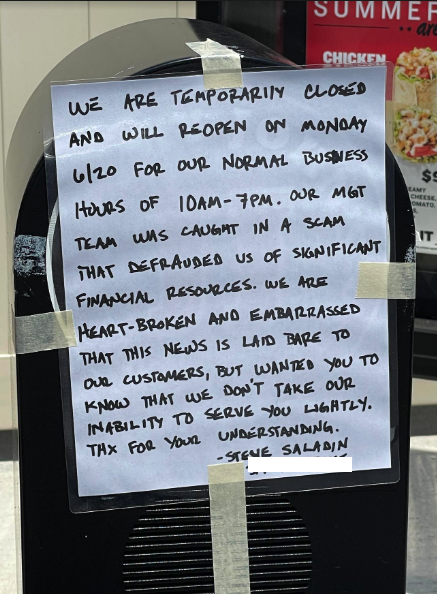
An anonymous reader quotes a report from Krebs on Security: Check out this handmade sign posted to the front door of a shuttered Jimmy John's sandwich chain shop in Missouri last week. See if you can tell from the store owner's message what happened. If you guessed that someone in the Jimmy John's store might have fallen victim to a Business Email Compromise (BEC) or "CEO fraud" scheme -- wherein the scammers impersonate company executives to steal money -- you'd be in good company. In fact, that was my initial assumption when a reader in Missouri shared this photo after being turned away from his favorite local sub shop. But a conversation with the store's owner Steve Saladin brought home the truth that some of the best solutions to fighting fraud are even more low-tech than BEC scams.

Visit any random fast-casual dining establishment and there's a good chance you'll see a sign somewhere from the management telling customers their next meal is free if they don't receive a receipt with their food. While it may not be obvious, such policies are meant to deter employee theft. You can probably guess by now that this particular Jimmy John's franchise -- in Sunset Hills, Mo. -- was among those that chose not to incentivize its customers to insist upon receiving receipts. Thanks to that oversight, Saladin was forced to close the store last week and fire the husband-and-wife managers for allegedly embezzling nearly $100,000 in cash payments from customers. Saladin said he began to suspect something was amiss after he agreed to take over the Monday and Tuesday shifts for the couple so they could have two consecutive days off together. He said he noticed that cash receipts at the end of the nights on Mondays and Tuesdays were "substantially larger" than when he wasn't manning the till, and that this was consistent over several weeks. Then he had friends proceed through his restaurant's drive-thru, to see if they received receipts for cash payments.

"One of [the managers] would take an order at the drive-thru, and when they determined the customer was going to pay with cash the other would make the customer's change for it, but then delete the order before the system could complete it and print a receipt," Saladin said. Saladin said his attorneys and local law enforcement are now involved, and he estimates the former employees stole close to $100,000 in cash receipts. That was on top of the $115,000 in salaries he paid in total each year to both employees. Saladin also has to figure out a way to pay his franchisor a fee for each of the stolen transactions. Now Saladin sees the wisdom of adding the receipt sign, and says all of his stores will soon carry a sign offering $10 in cash to any customers who report not receiving a receipt with their food.

Bitcoin

PayPal Lets Users Transfer Bitcoin and Ethereum To External Wallets (decrypt.co) 9

PayPal announced on Tuesday that the service now "supports the native transfer of cryptocurrencies between PayPal and other wallets and exchanges." Decrypt reports: The ability to conduct external transfers on PayPal's crypto platform, an image of which can be seen below, will start rolling out to users today and be available to everyone in the U.S. in the next week or two. PayPal first launched its crypto offering in late 2020, allowing users to buy, sell, and hold four cryptocurrencies -- Bitcoin, Ethereum, Bitcoin Cash, and Litecoin -- but not to move the funds to external destinations like MetaMask, Coinbase, or hardware wallets.

The fact users now can do this is significant because PayPal, which also owns the popular app Venmo, is used by hundreds of millions of people across the world to move money, and is increasingly used by merchants as a payment platform. It's also notable that PayPal is not backing off its ambitious crypto plans despite a financial downturn that's seen the company's share price get battered in recent months.

AI

AI Shopping Startup's AI Was Actually Just Low Cost Workers in the Philippines (theinformation.com) 43

Some startups are bold and original. And some, like Nate, had more modest goals: automatically filling out shoppers' contact and payment information on retailers' websites. In exchange for sparing them a minute or two of data entry on their phones, Nate charged shoppers $1 per transaction. But it struggled to turn even that vision into reality. The Information: While the company said it was using artificial intelligence to populate customer information during the checkout process, it had actually hired workers in the Philippines to manually enter the data on retailers' sites for a significant portion of the transactions Nate facilitated in 2021, according to two people with direct knowledge of the company's practices. That meant customers' orders were sometimes placed hours after they clicked the buy button through the Nate app. Nate didn't disclose its decidedly low-tech methods to at least some of the investors from whom the startup tried to raise money, according to a person with direct knowledge of fundraising discussions.
The Almighty Buck

Missed Payments, Rising Interest Rates Put 'Buy Now, Pay Later' To the Test (wsj.com) 147

"Buy now, pay later" companies promised a credit revolution that would change the way people pay for things. Rising delinquencies and a slowing economy are clouding that outlook. From a report: Payment plans that allow shoppers to split up the cost of things such as clothing, makeup and home appliances were all the rage last year. The companies behind the plans saw their valuations surge. Scores of retailers rushed to add them at checkout. Block in August announced a roughly $29 billion all-stock deal for Afterpay, one of the biggest companies in the business. But late payments or related losses are piling up for the industry's biggest players -- Affirm, Afterpay and Zip. Their borrowing costs, meanwhile, are rising. Buy-now-pay-later companies sometimes rely on credit lines whose rates rise and fall along with the Federal Reserve's benchmark rate, which has risen 0.75 percentage point so far this year and is poised to go up even more.

Investors, once enamored with the business, are backing away. Affirm went public in January 2021 at $49 a share and rose to more than $170 by November. The stock closed at $28.50 Tuesday. SoftBank-backed Klarna Bank is looking to raise as much as $1 billion in a deal that could value it in the low $30 billion range, far below the roughly $46 billion valuation it achieved last year. The young industry finds itself in a tricky spot at a time when the economy is slowing and, some fear, headed for a recession. Buy-now-pay-later companies boomed when consumers were flush with cash and buying goods at a feverish pace. How they fare in a downturn, when savings evaporate, spending slows and bad debts mount, is untested. To weather the storm, Afterpay and Zip are slowing their new originations.

Businesses

Silicon Valley Investors Give Startups Survival Advice for Downturn (wsj.com) 45

After years of funneling cash into startups' grand ambitions, Silicon Valley's investors are engaging in the grim ritual of delivering survival advice to their portfolio companies. From a report: In recent online slide presentations, blog posts and social-media threads, venture-capital doyens including Lightspeed Venture Partners, Craft Ventures, Sequoia Capital and Y Combinator are telling the founders that they need to take emergency action for what could be the sharpest turn in more than a decade. Their advice includes cutting costs, preserving cash and jettisoning hopes that hedge funds or other investors will swoop in with big checks.

"The boom times of the last decade are unambiguously over," Lightspeed, which has backed companies including social network Snap and crypto exchange FTX, wrote in a dispatch for startup executives that was posted on Medium, a publishing platform, this month. The investors' admonitions are a departure from the growth-above-all mantra for startups in recent years, and come as the venture market is showing signs of sputtering. Funding for global startups -- at around $58 billion in commitments midway through the second quarter -- is on pace to drop by about one-fifth in the period compared with the previous quarter, according to analytics firm CB Insights. The tech-heavy Nasdaq Composite Index is down about 25% from its all-time high in November, and SoftBank Group, which has poured more than $100 billion into investments, this month reported a $26.2 billion loss in the first quarter as valuations plummeted in its portfolio of tech companies.

Businesses

Broadcom To Acquire VMware in Massive $61 Billion Deal (techcrunch.com) 50

Broadcom has announced it is acquiring VMware in a massive $61 billion deal. From a report: The deal is a combination of cash and stock, with Broadcom assuming $8 billion in VMware debt. With VMware, Broadcom gets more than the core virtualization, which the company was built on. It also gets other pieces it acquired along the way to diversify, like Heptio for containerization, and Pivotal, which helps provide support services for companies transitioning to modern technology. At the same time it bought Pivotal, it also acquired security company Carbon Black. That touches upon a lot of technology, but it begs the question, where does it all fit with Broadcom (which has spent a fair amount of money in recent years buying up a couple of key software pieces prior to today's announcement)?

Slashdot Top Deals