The Military

DOD Joins Fight Against 5G Spectrum Proposal, Citing Risks To GPS (arstechnica.com) 33

An anonymous reader quotes a report from Ars Technica: The Department of Defense has weighed in against a proposal before the Federal Communications Commission to open the 1 to 2 Gigahertz frequency range -- the L band -- for use in 5G cellular networks. The reason: segments of that range of radio spectrum are already used by Global Positioning System signals and other military systems. In a letter to FCC Chairman Ajit Pai, Secretary of Defense Mark Esper pressed for the rejection of the proposal by Ligado Networks (formerly known as Lightspeed), saying, "There are too many unknowns and the risks are far too great to federal operations to allow Ligado's proposed system to proceed... This could have a significant negative impact on military operations, both in peacetime and war."

The FCC has already largely brushed aside similar opposition from NASA, the US Navy, and the National Oceanographic and Atmospheric Administration, among others, over another spectrum block in the 24GHz range -- which is used by weather satellites for remote monitoring of water vapor. But comments are still being collected on the Ligado plan for sharing the 1675 to 1680MHz block of the L Band. Pai has been supportive of the plan because that range is adjacent to the existing 1670 to 1675MHz block already in use for wireless services. GPS signals use several blocks of the L band, including a primary channel centered on 1575.42MHz. GPS uses L band signals because of their ability to penetrate cloud cover, rain, and vegetation. The L band is also used by the DOD for a number of other purposes, including tactical air navigation, landing assistance telemetry, Identify Friend or Foe (IFF) signals, and missile range and aircraft telemetry -- though the DOD has already had to move some of these applications further up the spectrum range to make room for previous "commercial reallocation."

Social Networks

Sacha Baron Cohen Gave the Greatest Speech on Why Social Networks Need To Be Put On Check (zdnet.com) 194

For an actor who made a career by playing silly characters, actor Sacha Baron Cohen gave yesterday one of the most eloquent and convincing speeches in a long time in support of cracking down on large social media networks to prevent the spread of lies and hate speech that these platforms allow. From a report: While accepting his award, Cohen touched on the role companies like Facebook, Google, and Twitter have played in spreading lies and hate speech online, calling the sites "the greatest propaganda machine in history." Below is a short summary of his main talking points. Cohen called Facebook, YouTube and Google, Twitter and others -- the biggest propaganda machine in history. He coined the term "Silicon Six" to describe the six US billionaires that control this machine -- naming Zuckerberg at Facebook, Sundar Pichai at Google, Larry Page and Sergey Brin at Alphabet, Susan Wojcicki at YouTube, and Jack Dorsey at Twitter. The actor ripped Zuckerberg for defending holocaust deniers.

He ripped Zuckerberg for his platform facilitating Russia's interference in US elections. He ripped Zuckerberg for facilitating the Myanmar genocide. Said if another genocide takes place, Zuckerberg needs to go to jail. Cohen ripped Facebook for allowing political ads. Said if Facebook existed in the 1930s they would have allowed Hitler to post "post 30-second ads on his 'solution' to the 'Jewish problem'." Cohen likened the Christchurch massacre video to "a snuff film broadcast by social media." He said social media sites are today's largest publishers, and should have to abide to the same standards that newspapers, radio, and TV stations abide. He agreed that social media should function based on government-mandated rules, and not by internal policies set by billionaires more focused on protecting share prices than human life. He called "for regulation and legislation to curb the greed of these high-tech robber barons."

Privacy

Facebook Built a Facial Recognition App That Let Employees Identify People By Pointing a Phone at Them (businessinsider.com) 27

Facebook once built an internal app that let employees identify people using facial recognition and their phone cameras, Business Insider reported Friday. From the report: The app, which was developed between 2015 and 2016, utilised Facebook's vast collection of user identities to automatically recognise the person at whom the phone's camera was pointed. The app was not released publicly, and Facebook tells Business Insider that it only worked on company employees and any of their friends who opted in to the social network's facial recognition system. "As a way to learn about new technologies, our teams regularly build apps to use internally. The apps described here were only available to Facebook employees, and could only recognize employees and their friends who had face recognition enabled," said a Facebook spokesperson. The existence of the app illustrates how Facebook has been quick to experiment with technology that could have significant societal implications.
Privacy

1.2 Billion Records Found Exposed Online in a Single Server (wired.com) 17

JustAnotherOldGuy writes: For well over a decade, identity thieves, phishers, and other online scammers have created a black market of stolen and aggregated consumer data that they used to break into people's accounts, steal their money, or impersonate them. In October, dark web researcher Vinny Troia found one such trove sitting exposed and easily accessible on an unsecured server, comprising 4 terabytes of personal information -- about 1.2 billion records in all. While the collection is impressive for its sheer volume, the data doesn't include sensitive information like passwords, credit card numbers, or Social Security numbers. It does, though, contain profiles of hundreds of millions of people that include home and cell phone numbers, associated social media profiles like Facebook, Twitter, LinkedIn, and Github, work histories seemingly scraped from LinkedIn, almost 50 million unique phone numbers, and 622 million unique email addresses. "It's bad that someone had this whole thing wide open," Troia says. "This is the first time I've seen all these social media profiles collected and merged with user profile information into a single database on this scale. From the perspective of an attacker, if the goal is to impersonate people or hijack their accounts, you have names, phone numbers, and associated account URLs. That's a lot of information in one place to get you started."
Space

Astronomers Detect Water Vapor Around Jupiter's Moon Europa (wired.com) 30

In the search for life in our solar system, Mars tends to steal the spotlight. But in recent years Jupiter's fourth largest moon, Europa, has emerged as a promising extraterrestrial nursery. Planetary scientists have long suspected Europa may harbor a vast liquid water ocean beneath its thick, icy crust. If Europa's ocean also has a source of energy -- think hydrothermal vents -- and a few choice chemical elements, there's a decent chance it could support basic lifeforms. From a report: This theory makes a lot of assumptions, but on Monday it received one of its biggest boosts yet. An international team of astronomers announced they directly detected water vapor in Europa's atmosphere for the first time. As detailed in a paper published in Nature Astronomy, this method of detection is strong evidence that liquid water exists beneath the surface of Europa. "This doesn't necessarily mean the water vapor is coming from an ocean," says NASA planetary scientist Lucas Paganini. "But it does seem like this detection is connected to liquid water under the surface." A lot of what we know about Europa was gleaned from data collected by the Galileo spacecraft on its tour of Jupiter in the late '90s. One of the most remarkable findings from that mission was that something was messing with Jupiter's magnetic field. Based on this finding, planetary scientists hypothesized Europa might be home to an electrically conductive fluid, like salt water, that was causing the magnetic disturbances.
AT&T

AT&T Promises Low-Band 5G for 5 Cities in Weeks, 15 by Early 2020 (venturebeat.com) 35

Normally, major 5G network expansion news has been exciting enough for carriers to announce first thing in the morning, but AT&T just continued its already confusing 5G story by revealing a big change in the dead of night: It's launching a low-band 5G network across five cities in "the coming weeks," with promises to cover at least 15 cities by February 2020. From a report: This will be the carrier's first 5G launch targeted at regular customers. The good news: Some form of AT&T 5G service will soon be available in Indianapolis, Pittsburgh, Providence, Rochester, and San Diego, followed by Birmingham, Boston, Bridgeport, Buffalo, Las Vegas, Louisville, Milwaukee, New York City, San Francisco, and San Jose early next year. Initial service maps actually cover wide swaths of each city, in some cases extending into suburbs, and the carrier suggests the low-band 5G will work at roughly two-mile distances from towers, including "on the go," residential," "suburban," and "rural" usage.
The Courts

'The Ducks Have Won': French Court Says They May Keep on Quacking (reuters.com) 124

The ducks on a small French smallholding may carry on quacking, a French court ruled this week, rejecting a neighbor's complaint that the birds' racket was making their life a misery. From a report: The court in the town of Dax ruled that the noise from the flock of around 60 ducks and geese kept by retired farmer Dominique Douthe in the foothills of the Pyrenees, southwestern France, was within acceptable limits, broadcaster France 3 said. "The ducks have won," Douthe told Reuters after the court decision. "I'm very happy because I didn't want to slaughter my ducks." The complaint was brought by Douthe's neighbor who moved from the city around a year ago into a property about 50 meters (yards) away from the enclosure in the Soustons district where Douthe keeps her flock. The dispute is the latest in a series of court cases that have pitted the traditional way of life in rural France against modern values which, country-dwellers say, are creeping in from the city.
Transportation

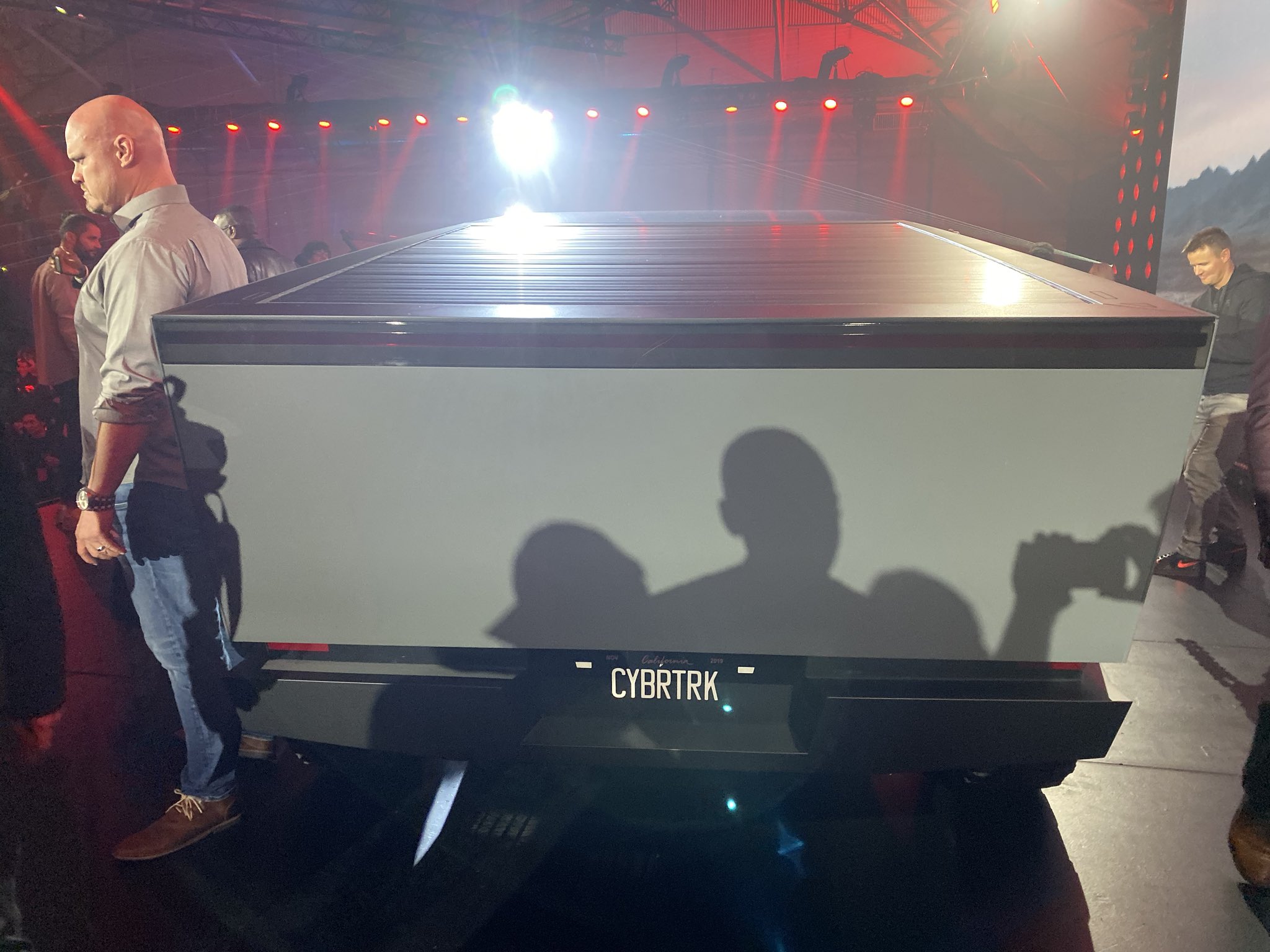
Elon Musk Unveils 'Cybertruck' Electric Pickup Truck 509

At an event in Los Angeles, California, Elon Musk unveiled the company's first electric pickup truck, called the Cybertruck. The design is unlike any other vehicle on the road today, consisting of a stainless steel alloy body that is dent-resistant, scratch-resistant, and sledgehammer proof, as evident by the onstage demo. (The glass is stronger than standard car glass, but sadly it didn't survive the sledgehammer test.) The truck will come in three versions with 250-500 miles of range, depending on the model. It will start at $39,900 for the Single Motor RWD configuration and can be pre-ordered today for $100.

According to Musk, the Cybertruck has pretty much the same dimensions as every other pickup on the market today. It's 231.7 inches long, 79.8 inches wide, 75.0 inches tall and can seat six people. Where it differs is in the performance. Musk claims the Cybertruck can reach 60 mph in 2.9 seconds before continuing through the quarter-mile marker in under 11 seconds. It can also tow up to 14,000 pounds and carry 3,500-pound cargo in its industry-standard 6.5-foot bed.

We covered the Cybertruck unveiling live in LA. Check our Twitter for updates, videos, and photos. Here are some close-up shots of the Cybertruck (via our Twitter page):

Cybertruck1 Cybertruck1 Cybertruck1 Cybertruck1 Cybertruck1 Cybertruck1 Cybertruck1 Cybertruck1
Software

Finland Has an App Showing Shopping's True Carbon Footprint (bloomberg.com) 57

An anonymous reader quotes a report from Bloomberg: Unlike other carbon-footprint calculators already on the market, the application developed by Enfuce Financial Services Oy, a Finnish payment services provider, does not rely on users inputting the data manually. Instead, it combines data from credit cards and banks with purchase data from retailers to provide real-time calculations of how a given product affects the climate. With an estimated 70% of carbon emissions globally attributed to end users, Enfuce chairman and co-founder Monika Liikamaa says the app will help people adapt their lifestyles and make them compatible with the goal of keeping global warming within 1.5 degrees Celsius.

After the initial set up and opt-in, the app will calculate a carbon footprint based on the user's purchases -- to the level of individual steaks or tomatoes. It will then propose actions to reduce their carbon impact. Typical suggestions may include taking a shorter shower, hopping on the bus instead of the car, turning down the thermostat and going vegan for a week. The app is a side project for Enfuce, which already handles sensitive payments data securely. Its core business is to run credit card systems for clients that do not require owning expensive computer servers. Enfuce is in talks with three major banks and is already working with Mastercard Inc. and Amazon.com Inc.'s cloud-server unit. No vendor will have exclusive rights to the system, which should be available by March, the company said.

Science

Scientists Can Now Identify Someone From a Single Strand of Hair (sciencemag.org) 76

sciencehabit shares a report from Science Magazine: A new forensic technique could have criminals -- and some prosecutors -- tearing their hair out: Researchers have developed a method they say can identify a person from as little as 1 centimeter of a single strand of hair -- and that is eight times more sensitive than similar protein analysis techniques. If the new method ever makes it into the courtroom, it could greatly expand the ability to identify the people at the scene of a crime. To get reliable data from hair, forensic scientists previously needed DNA from skin still attached to hair follicles. But recent technologies have instead analyzed proteins in the hair itself, like keratin. Because the sequences of amino acids in proteins vary slightly from person to person based on their genetic code, this information can be used to identify people with a high degree of accuracy without DNA.

The catch? Most methods require several steps of grinding and heating the hair, which destroys much of the protein. And scientists might not always detect enough variation in the remaining proteins to make a confident identification. To get more proteins for analysis, scientists at the National Institute of Standards and Technology (NIST) did away with the grinding and developed a method with only one step: heating the hair in detergent solution. When the researchers used mass spectrometry analysis to find out what they had extracted from the dissolved hair, they found they recovered more proteins -- and their subunits, peptides -- than with other extraction techniques. They also identified a dozen new protein building blocks called genetically variant peptides (GVPs) that differ among individuals. These new GVPs join thousands of others in NIST's library of peptide sequences. GPVs aren't yet used to identify people in criminal cases -- but could be in the future.
There are still some drawbacks with this new method. "To get enough material to build a profile, scientists need 1 day or more, as well as extensive experience with sophisticated protein analysis techniques," the report says.

"In addition, no identification method based on genetically variant peptides in hair proteins has been used in court. There are still a lot of questions to be answered before that's a reality."
Software

Russia Bans Sale of Gadgets Without Russian-Made Software (bbc.com) 78

Russia has passed a law banning the sale of certain devices that are not pre-installed with Russian software. The BBC reports: The law will come into force in July 2020 and cover smartphones, computers and smart televisions. Proponents of the legislation say it is aimed at promoting Russian technology and making it easier for people in the country to use the gadgets they buy. But there are concerns about surveillance and fears that firms could pull out of the Russian market. The law will not mean devices from other countries cannot be sold with their normal software - but Russian "alternatives" will also have to be installed. The legislation was passed by Russia's lower house of parliament on Thursday. A complete list of the gadgets affected and the Russian-made software that needs to be pre-installed will be determined by the government.
Printer

Google Is Terminating Google Cloud Print (9to5google.com) 64

Google has announced that Cloud Print, its cloud-based printing solution, is being retired at the end of next year. 9to5Google reports: The announcement comes in the form of a support document for Cloud Print that popped up recently, which is kind enough to remind us that Cloud Print has technically been in beta since it launched a decade ago: "Cloud Print, Google's cloud-based printing solution that has been in beta since 2010, will no longer be supported as of December 31, 2020. Beginning January 1, 2021, devices across all operating systems will no longer be able to print using Google Cloud Print. We recommend that over the next year, you identify an alternative solution and execute a migration strategy."

Google notes that Chrome OS' native printing solutions have been vastly improved since Cloud Print launched in 2010, and also promises that native printing in Chrome OS will continue to get more features over time: "Google has improved the native printing experience for Chrome OS, and will continue adding features to native printing. For environments besides Chrome OS, or in multi-OS scenarios, we encourage you to use the respective platform's native printing infrastructure and/or partner with a print solutions provider."

The Internet

Apple Pulls All Customer Reviews From Online Apple Store (appleinsider.com) 25

Apple has removed the "Ratings & Reviews" section from all product pages on its website. The changes were apparently made between November 16 and 17, and it's "currently unclear what has prompted this decision, nor when Apple will bring back the option to read the opinions of other customers at the time of purchase," reports AppleInsider. From the report: AppleInsider received a tip from a reader who had noted the buyer review section was missing on Apple's online retail store page. The user also pointed out that the pages have been removed from U.S., U.K., and Australian Apple online stores, which suggests this is not simply a mistake, but rather an intentional move on Apple's behalf. The reviews were pulled over the weekend, though it's not clear as to why this has happened. Apple had been known for leaving up even especially negative reviews, which demonstrated both transparency and integrity to their customers. By removing the reviews, it's possible that Apple will be seen as less credible to potential buyers.
Communications

T-Mobile Reveals Data Breach Affecting Prepaid Customers (tmonews.com) 15

T-Mobile says it has suffered a data breach affecting some prepaid customers. No financial data, social security numbers, or passwords were accessed, but information associated with users' prepaid wireless accounts was obtained, including names, billing addresses, phone numbers, account numbers, rate plans, and features that users have added to their accounts. TmoNews reports: T-Mobile is in the process of notifying all customers that've been affected by this data breach. If you got a notification, you should update the PIN on your T-Mobile account. T-Mo does say that it's possible that some affected customers may not be notified because their contact info isn't up-to-date, so if that's the case with you, you can contact T-Mobile support for more info by dialing 611 from your T-Mo phone or 1-800-TMOBILE from any phone. There's no word yet on exactly how many customers were affected by this security issue, but some Reddit users have chimed in to say that they've been alerted to the breach by T-Mobile. "We take the security of your information very seriously and have a number of safeguards in place to protect your personal information from unauthorized access," T-Mobile says. "We truly regret that this incident occurred and apologize for any inconvenience this has caused you."
Games

Half Life Alyx Hits PC VR Headsets In March 2020 (arstechnica.com) 67

An anonymous reader quotes a report from Ars Technica: After a tease earlier this week, Valve has revealed more details and a new trailer for the first new Half-Life content in over a decade. The "full-length" Half Life: Alyx will hit Steam in March 2020, Valve says, with support for "all PC-based VR headsets." Pre-orders are already available for $59.99, though the game will be free if you own a Valve Index headset. The game, which Valve says is "set between the events of Half-Life and Half-Life 2," has been "designed from the ground up for Virtual Reality" (i.e. you can stop hoping for a 2D monitor release). "Everyone at Valve is excited to be returning to the world of Half-Life," Valve founder Gabe Newell said in a statement. "VR has energized us."

Today's video trailer shows that next year's Alyx-ization of Half-Life is equal parts abstract and concrete. The VR perspective from today's trailer doesn't include any floating body parts or feet; the only part of your virtual self you'll see, at least in today's trailer, is your hands, covered in a pair of gloves. Yet we also hear Alyx's voice, which indicates that this game's protagonist won't be nearly as silent as Freeman in his own mainline adventures. Today's announcement includes video footage that confirms a data-leak examination by Valve News Network earlier this year: a new manipulation system dubbed the Gravity Gloves. And boy do these things look cool. Need to grab or pick something up? Point at whatever that object is (whether it's close or far away) with an open hand until it glows orange, then close your hand and flick your wrist toward yourself to fling the item in your direction. At this point, you get a moment to physically "catch" the object in question. Point, clench, flick, catch.

Today's trailer also confirms bits and pieces of the exciting HLA details I've previously heard about from multiple sources. For instance, the trailer includes teases of the game's approach to VR-exclusive puzzles, particularly those that require moving hands around a three-dimensional space. Some of these puzzles will require scanning and finding clues hidden inside of the virtual world's walls (and moving or knocking down anything hindering your ability to see or touch said walls). Other puzzles will require arranging what look like constellations or grids of stars around a 3D space in order to match certain patterns. And then there's the matter of familiar Half-Life creatures coming to life for the first time in over 12 years, which means they're that much more detailed and gruesome as rendered in the Source 2 engine.
The Half-Life website specifies that this game can be played sitting, standing, or with "roomscale" movement. Players can use finger-tracking or trigger-based VR controllers and move around the VR environments by "teleporting" from point A to point B, "shifting" smoothly to a new position, or just walking continuously with an analog stick.
Google

Google Shakes Up Its 'TGIF' -- and Ends Its Culture of Openness (wired.com) 102

"It's not working in its current form," Google CEO Sundar Pichai said of what was once the hallmark of Google culture. In 2020, he declared, the meetings would be limited to once a month, and they would be more constrained affairs, sticking to "product and business strategy." Don't Be Evil has changed to Don't Ask Me Anything. From a report: With that, Pichai not only ended an era at Google, he symbolically closed the shutters on a dream held widely in the tech world -- that one can scale a company to global ubiquity while maintaining the camaraderie of an idealistic clan. Pichai cited decreased attendance rates, the difficulty of running a real-time gathering across time zones, and an uptick in meetings among big product groups like Cloud or YouTube. His most resonant reason, however, was that Google employees could no longer be trusted to keep matters confidential.

He cited "a coordinated effort to share our conversations outside of the company after every TGIF ... it has affected our ability to use TGIF as a forum for candid conversations on important topics." He also noted that while many want to hear about product launches and business strategies, some attend to "hear answers on other topics." It seems obvious he was referring to recent moments when aggrieved employees registered objections to Google's policies and missteps -- on developing a search engine for China, bestowing millions of dollars to executives charged with sexual misconduct, or hiring a former Homeland Security apparatchik. Pichai says Google may address such issues in specific town-hall meetings when warranted.

Social Networks

Twitter Says It Will Let All Users Hide Replies To Tweets (bloomberg.com) 49

Twitter said it will start letting all users hide replies to the tweets they send, an effort to improve the health of discussions and interactions on the service. From a report: The company has been testing the feature since summer in different markets, including the U.S. and Japan, but is now rolling it out globally. The tool lets users hide specific comments made on their posts, meaning those comments won't be visible to other users unless they click a button to reveal them. The change provides a degree of control that could be used to keep spammers away, or to hide hateful or inappropriate replies.
The Military

One Reason the US Military Can't Fix Its Own Equipment 85

Manufacturers can prevent the Department of Defense from repairing certain equipment, which puts members of the military at risk. Elle Ekman, a logistics officer in the United States Marine Corps, writes: In the United States, conversations about right-to-repair issues are increasing, especially at federal agencies and within certain industries. In July, the Federal Trade Commission hosted a workshop to address "the issues that arise when a manufacturer restricts or makes it impossible for a consumer or an independent repair shop to make product repairs." It has long been considered a problem with the automotive industry, electronics and farming equipment. Senators Elizabeth Warren and Bernie Sanders have even brought it up during their presidential campaigns, siding with farmers who want to repair their own equipment; while the senators are advocating national laws, at least 20 states have considered their own right-to-repair legislation this year.

I first heard about the term from a fellow Marine interested in problems with monopoly power and technology. A few past experiences then snapped into focus. Besides the broken generator in South Korea, I remembered working at a maintenance unit in Okinawa, Japan, watching as engines were packed up and shipped back to contractors in the United States for repairs because "that's what the contract says." The process took months. With every engine sent back, Marines lost the opportunity to practice the skills they might need one day on the battlefield, where contractor support is inordinately expensive, unreliable or nonexistent. I also recalled how Marines have the ability to manufacture parts using water-jets, lathes and milling machines (as well as newer 3-D printers), but that these tools often sit idle in maintenance bays alongside broken-down military equipment. Although parts from the manufacturer aren't available to repair the equipment, we aren't allowed to make the parts ourselves "due to specifications."
Google

Google Will Pay Bug Hunters Up To $1.5M if They Can Hack Its Titan M Chip (zdnet.com) 21

Google announced today that it is willing to dish out bug bounty cash rewards of up to $1.5 million if security researchers find and report bugs in the Android operating system that can also compromise its new Titan M security chip. From a report: Launched last year, the Titan M chip is currently part of Google Pixel 3 and Pixel 4 devices. It's a separate chip that's included in both phones and is dedicated solely to processing sensitive data and processes, like Verified Boot, on-device disk encryption, lock screen protections, secure transactions, and more. Google says that if researchers manage to find "a full chain remote code execution exploit with persistence" that also compromises data protected by Titan M, they are willing to pay up to $1 million to the bug hunter who finds it. If the exploit chain works against a preview version of the Android OS, the reward can go up to $1.5 million.
IOS

Inside Apple's iPhone Software Shakeup After Buggy iOS 13 Debut (bloomberg.com) 55

Apple is overhauling how it tests software after a swarm of bugs marred the latest iPhone and iPad operating systems, Bloomberg reported Thursday. From the report: Software chief Craig Federighi and lieutenants including Stacey Lysik announced the changes at a recent internal "kickoff" meeting with the company's software developers. The new approach calls for Apple's development teams to ensure that test versions, known as "daily builds," of future software updates disable unfinished or buggy features by default. Testers will then have the option to selectively enable those features, via a new internal process and settings menu dubbed Flags, allowing them to isolate the impact of each individual addition on the system. When the company's iOS 13 was released alongside the iPhone 11 in September, iPhone owners and app developers were confronted with a litany of software glitches.

Apps crashed or launched slowly. Cellular signal was inconsistent. There were user interface errors in apps like Messages, system-wide search issues and problems loading emails. Some new features, such as sharing file folders over iCloud and streaming music to multiple sets of AirPods, were either delayed or are still missing. This amounted to one of the most troubled and unpolished operating system updates in Apple's history. The new development process will help early internal iOS versions to be more usable, or "livable," in Apple parlance. Prior to iOS 14's development, some teams would add features every day that weren't fully tested, while other teams would contribute changes weekly. "Daily builds were like a recipe with lots of cooks adding ingredients," a person with knowledge of the process said.

Slashdot Top Deals