Biotech

Quantum Computing Milestone: Researchers Compute With 'Hot' Silicon Qubits (ieee.org) 18

"Two research groups say they've independently built quantum devices that can operate at temperatures above 1 Kelvin — 15 times hotter than rival technologies can withstand," reports IEEE Spectrum. (In an article shared by Slashdot reader Wave723.)

"The ability to work at higher temperatures is key to scaling up to the many qubits thought to be required for future commercial-grade quantum computers..." HongWen Jiang, a physicist at UCLA and a peer reviewer for both papers, described the research as "a technological breakthrough for semiconductor based quantum computing." In today's quantum computers, qubits must be kept inside large dilution refrigerators at temperatures hovering just above absolute zero. Electronics required to manipulate and read the qubits produce too much heat and so remain outside of the fridge, which adds complexity (and many wires) to the system...

"To me, these works do represent, in rapid succession, pretty big milestones in silicon spin qubits," says John Gamble, a peer reviewer for one of the papers and a senior quantum engineer at Microsoft. "It's compelling work...." Moving forward, Gamble is interested to see if the research groups can scale their approach to include more qubits. He's encouraged by their efforts so far, saying, "The fact that we're seeing these types of advances means the field is progressing really well and that people are thinking of the right problems."

Besides Microsoft, Google and IBM have also "invested heavily in superconducting qubits," the article points out. And there's also a hopeful comment from Lee Bassett, a physicist focused on quantum systems at the University of Pennsylvania. "Each time these silicon devices pass a milestone — and this is an important milestone — it's closer and closer to the inflection point.

"This infrastructure of integrated, silicon-based electronics could take over, and this technology could just explode."
The Internet

Are We on the Cusp of a Metaverse, the Next Version of the Internet? (washingtonpost.com) 69

The Washington Post describes it as "the next internet." Wikipedia defines it as "a collective virtual shared space...including the sum of all virtual worlds, augmented reality, and the Internet." But it was Neal Stephenson who named it "the metaverse" in his 1992 science fiction novel Snow Crash.

Are we closer to seeing it happen? The Washington Post reports: In the past month, office culture has coalesced around video chat platforms like Zoom, while personal cultural milestones like weddings and graduations are being conducted in Nintendo's Animal Crossing: New Horizons. The Metaverse not only seems realistic — it would probably be pretty useful right about now. The Metaverse reality is still years, possibly decades, away. But Epic Games CEO Tim Sweeney has been publicly pushing for its creation, and he isn't alone in his desire to push for the Metaverse, where the online world echoes and fulfills real-world needs and activities. Constructing the virtual Internet space is Silicon Valley's macro goal, many of whom are obsessed with Neal Stephenson's 1992 book, "Snow Crash," which defined the term.

In recent years, Facebook, Google and Samsung have all made heavy investments in cloud computing and virtual reality companies in anticipation of a Metaverse... But it's Epic Games, with Fortnite, that has the most viable path forward in terms of creating the Metaverse, according to an essay by venture capitalist and former Amazon executive Matthew Ball... [The article also notes other "traits" of the metaverse in Minecraft and Roblox.] The most widely agreed core attributes of a Metaverse include always being live and persistent — with both planned and spontaneous events always occurring — while at the same time providing an experience that spans and operates across platforms and the real world. A Metaverse must also have no real cap on audience, and have its own fully functioning economy... Fortnite hasn't reached Metaverse status yet. But Fortnite as a social network and impossible-to-ignore cultural phenomenon, Ball says, provides Epic Games a key advantage for leading in the Metaverse race. Fortnite draws a massive, willing and excited audience online to engage with chaotically clashing intellectual properties... "This organic evolution can't be overemphasized," Ball writes in his essay. "If you 'declared' your intent to start a Metaverse, these parties would never embrace interoperability or entrust their IP. But Fortnite has become so popular and so unique that most counterparties have no choice but to participate... Fortnite is too valuable a platform...."

The current swarm to an online-only social and capitalist economy has only highlighted the current Internet's failings, and what the Metaverse needs to do, Ball said. Big sites like Facebook, Google and Amazon continue to dominate online activity, as do larger streaming services like YouTube and Netflix. But each location requires its own membership and has separate ecosystems. "Right now, the digital world basically operates as though every restaurant and bar you go to requires a different ID card, has a different currency, requires their own dress codes and has their own units [of service and measurement]," Ball said. "It is clear that this really advantages the biggest services. People are just sticking to the big games, really. However there's a clear argument that reducing network lock-in can really raise all boats here."

Sweeney said as much in his DICE Summit keynote speech February. If the game industry wants to reshape the Internet and move away from Silicon Valley's walled gardens, Sweeney stressed that publishers need to rethink economies in the same way email was standardized... "We need to give up our attempts to each create our own private walled gardens and private monopoly and agree to work together and recognize we're all far better off if we connect our systems and grow our social graphs together.

Neal Stephenson answered questions from Slashdot readers back in 2004.
The Internet

ICANN Delays .Org Sale After Scathing Letter from California's Attorney General (arstechnica.com) 21

Ars Technica reports: ICANN, the nonprofit that oversees the Internet's domain name system, has given itself another two weeks to decide whether to allow control of the .org domain to be sold to private equity firm Ethos Capital. The decision comes after ICANN received a blizzard of letters from people opposed to the transaction, including California Attorney General Xavier Becerra.

Becerra's letter was significant because ICANN is incorporated in California. That means it's Becerra's job to make sure that ICANN is living up to the commitments in its articles of incorporation, which promise that ICANN will operate "for the benefit of the Internet community as a whole." Becerra questioned whether ICANN was really doing that. "There is mounting concern that ICANN is no longer responsive to the needs of its stakeholders," he wrote...

Ethos Capital's plan is to buy the Public Interest Registry (PIR) from its current parent organization, the nonprofit Internet Society. To help finance the sale, Ethos will saddle PIR with $300 million in debt — a common tactic in the world of leveraged buyouts. Becerra warns that this tactic could endanger the financial viability of the PIR — especially in light of the economic uncertainty created by the coronavirus. "If the sale goes through and PIR's business model fails to meet expectations, it may have to make significant cuts in operations," Becerra warns. "Such cuts would undoubtedly affect the stability of the .org registry."

Becerra also blasts the Internet Society for considering the sale in the first place. "ISOC purports to support the Internet, yet its actions, from the secretive nature of the transaction, to actively seeking to transfer the .org registry to an unknown entity, are contrary to its mission and potentially disruptive to the same system it claims to champion and support," he writes.

Becerra ends his letter with a warning: "This office will continue to evaluate this matter, and will take whatever action necessary to protect Californians and the nonprofit community."

ICANN's first CEO Michael Roberts, and original board chair Esther Dyson also harshly criticized the proposed sale this week, calling it "totally inappropriate..."

"ICANN has not meaningfully acted to address the likely proposed service cuts, increase in prices or trafficking of data of non-profits to obtain additional revenue."
Netscape

Silicon Valley Legends Launch 'Beyond Identity' To Eliminate All Passwords (securityweek.com) 143

SecurityWeek editor wiredmikey shares new that Jim Clark and Tom Jermoluk (past founders of Netscape, Silicon Graphics and @Home Network) "have launched a phone-resident personal certificate-based authentication and authorization solution that eliminates all passwords."

Security Week reports: The technology used is not new, being based on X.509 certificates and SSL (invented by Netscape some 25 years ago and still the bedrock of secure internet communications). It is the opportunity provided by the modern smartphone with biometric user access, enough memory and power, and a secure enclave to store the private keys of a self-certificate that never leaves the device that is new. The biometric access ties the phone to its user, and the Beyond Identity certificate authenticates the device/user to the service provider, whether that's a bank or a corporate network...

"When this technology was created at Netscape during the beginning of the World Wide Web, it was conceived as a mechanism for websites to securely communicate, but the tools didn't yet exist to extend the chain all the way to the end user," commented Jermoluk. "Beyond Identity includes the user in the same chain of certificates bound together with the secure encrypted transport (TLS) used by millions of websites in secure communications today...."

With no passwords, the primary cause of data breaches (either to steal passwords or by using stolen passwords) is gone. It removes all friction from the access process, takes the password reset load off the help desk, and can form the basis of a zero-trust model where identity is the perimeter.

Though they're first focusing on the corporate market, their solution should be available to consumers by the end of 2020, the article reports, which speculates that the possibility of pre-also installing the solution on devices "is not out of the question."
The Military

Air Force Official Sees Use of Flying Cars By 2023 (breakingdefense.com) 101

"Now is the perfect time to make Jetson's cars real," says the Assistant Secretary of the Air Force for Acquisition, Technology & Logistics.

Breaking Defense reports: 'Flying cars' using electric vertical takeoff and landing (eVTOL) technology could be in full-up production for Air Force use in moving cargo and people within three years, says Air Force acquisition head Will Roper. Such a capability, Roper enthused, would give the U.S. military the ability to undertake missions "in three dimensions that we normally do in two," giving the services "much greater agility." This is why the Air Force program for investing in commercial firms now pursuing eVTOL vehicles is called "Agility Prime," he noted.

The Air Force will take a first look at vendor offerings in a virtual pitch event at the end of the month, with a focus on small eVTOL vehicles that could be used for missions involving transport of only a few people... Roper added that he expects that granting commercial producers Air Force safety certifications and allowing them to rack up flying hours under Agility Prime "will really help accelerate domestic use of these vehicles and [allow some companies to] get FAA certification sooner that it would have come if we had not interjected ourselves into the market...."

Agility Prime is designed as a "challenge" where eVTOL vehicle makers compete in a series of demonstration that ultimately could result in a contract for full-scale production.

Long-time Slashdot reader sandbagger explains that they're looking for "a 100+ MPH vehicle that can go for at least 100 miles, with the ability to carry up to eight people."

"If Slashdotters have something in their basements upon which they have been working, get your flying machines ready because prototypes must be able to take flight by December 17th."
Transportation

Fewer Car Accidents From Sheltering in Place Saved California $1B (sfgate.com) 90

An anonymous reader quotes SFGate: The statewide order to shelter in place that went into effect on March 20 had a beneficial side-effect: Accidents, injuries and fatalities on California roadways were cut in half, saving the state and residents of California $1 billion, according to a UC Davis study.

In the 22 days after the shelter-in-place order (March 21-April 11), there was an average of 450 vehicle collisions per day throughout the state, according to the study conducted by the Road Ecology Center at UC Davis. During the same period in 2019, there were 1,128 collisions per day. In the 22 days prior to sheltering in place, there were 1,056 accidents per day...

"The reduction in numbers of all collisions, injury, and fatal collision was equivalent to a $40 million/day savings in costs and about $1 billion in savings since the Governor's order went into effect," the study concluded. The figures were calculated using Federal Highway Administration data, which includes savings from "property damage, treatment of injuries, lost time at work, emergency responses, insurance claims, and the equivalent cost of a life."

California has ordered some insurance companies to refund premiums paid in March and April for car accidents.
Transportation

Wary of Public Transport, Coronavirus-Hit Americans Turn To Bikes (reuters.com) 110

Timothy Aeppel writing for Reuters: The coronavirus pandemic has sparked a surge in bike sales across the United States, according to a major manufacturer and a half dozen retailers interviewed by Reuters. Many of the purchases are by people looking for a way to get outside at a time of sweeping shutdowns and stay-at-home orders aimed at containing the virus: Even the worst affected states are allowing people out to exercise. [...] To be sure, bikes remain well down the list of U.S. commuting preferences.

About 870,000 Americans, on average, commuted to work by bicycle in the five years through 2017, or about 0.6% of all workers, according to the U.S. Census Bureau. The rate was higher in urban areas, at about 1.1%, and about 20 cities with at least 60,000 residents had rates of about 5% or more. A more recent survey, though, showed a higher percentage of U.S. workers using a bike to get to work. Private research firm Statista Inc.'s 2019 survey showed 5% rode their own bike, while another 1% used a bike share service, an increasingly common option in larger cities.
The article notes that many bike shops remain open during the pandemic because many local governments have declared bicycles an essential transportation item.

Kent International, a bike importer and manufacturer, said sales of its low-priced bikes had surged over the past month. "Kent is already out of stock on five of its top 20 models and expects that to rise to 10 by the end of the month," writes Aeppel, citing chief executive and chairman Arnold Kamler. "Kamler said sales at most of the major retailers he supplies were up 30% last month and are up over 50% so far in April, with the surge in demand forcing him to change shipping arrangements."
Piracy

The Pirate Bay Blocked By MalwareBytes But Normal Service Will Be Resumed (torrentfreak.com) 16

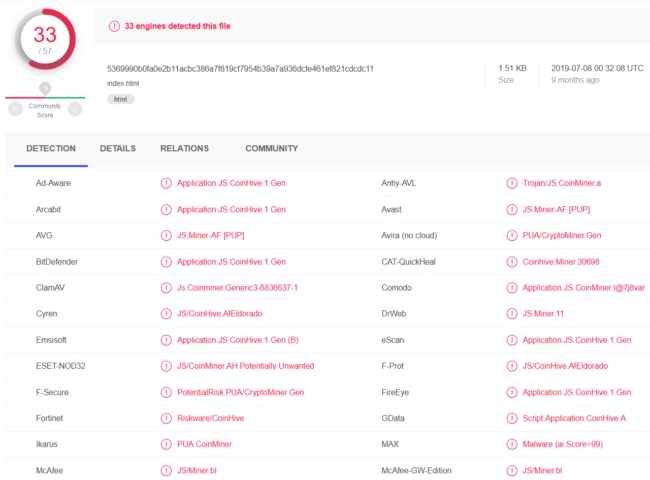
The Pirate Bay returned to the clear web this week after a month-long hiatus. However, the structure of the infamous torrent index presented an access problem to users of the popular anti-malware software MalwareBytes, which persistently blocked an essential element of the platform due to the presence of "a few" cryptocurrency miners on a secondary domain. TorrentFreak reports: The problem lay in The Pirate Bay's setup. Aside from cosmetic changes to some pages, the site sends requests to another domain (apibay.org) in order to present torrents to the user on thepiratebay.org. However, those accessing the main domain with Malwarebytes installed were greeted with blank torrent pages after the security software blocked apibay.org. Any warning of this type, especially concerning trojans, should be of concern to users of any site. However, dumping trojans on users hasn't been the modus operandi of The Pirate Bay thus far, so TorrentFreak contacted Malwarebytes to find out what was causing the alert.

Manager of WebProtection Labs at MalwareBytes Andres Ortiz informs TorrentFreak that the issue was caused by the presence of "a few" cryptocurrency miners, not on thepiratebay.org, but on a sub-directory of apibay.org, the domain from where TPB appears to present its torrent results. The analysis for just one example miner is shown [here]. After examining the apibay.org domain once again, MalwareBytes has now confirmed that the miners have been removed so in response, they will push an update to their users to stop TPB's indexes from being blocked moving forward. However, if any party reintroduces the miners, it's certainly possible that the site will be rendered inaccessible once again.

Earth

Deep Sea Squid Communicate By Glowing Like E-Readers 25

An anonymous reader quotes a report from NPR: Deep in the Pacific Ocean, six-foot-long Humboldt squid are known for being aggressive, cannibalistic and, according to new research, good communicators. Known as "red devils," the squid can rapidly change the color of their skin, making different patterns to communicate, something other squid species are known to do. But Humboldt squid live in almost total darkness more than 1,000 feet below the surface, so their patterns aren't very visible. Instead, according to a new study, they create backlighting for the patterns by making their bodies glow, like the screen of an e-reader.

Ben Burford, a graduate student at Stanford University, and his colleagues studied deep-water footage taken by the Monterey Bay Aquarium Research Institute's remotely operated vehicles off the California coast. They found the squid make around 30 different patterns of lines, stripes and patches. The patterns appear dark, but researchers believe they're illuminated by the squid's bioluminescent skin. Some of the patterns are only used around other squid, suggesting they're used for communication. The squid also appear to reorder the patterns, almost like words in a sentence.
Music

Apple Music On the Web Exits Beta (macrumors.com) 14

The web-based Apple Music experience that launched in beta last September is now available at music.apple.com. MacRumors reports: The previous beta.music.apple.com address automatically forwards to the newly launched version. Once you're signed into the web version of Apple Music with your Apple ID that has an associated Apple Music subscription, you'll have access to all of your library and playlist content, as well as the same personal mixes and recommendations you'll see in the Music apps for iOS, Mac, and Android. Apple Music content plays right in the web browser, providing access for an array of devices and platforms that don't have native Music app support, include Windows 10, Linux, and Chrome OS.
The Internet

ICANN Delays .Org Sale Again After California's AG Intervenes At Last Minute (theregister.co.uk) 27

ICANN has again delayed a decision on the sale of the .org registry, pushing the issue off for another month. The Register reports: The organization's board of directors was due to decide today on whether to approve the $1.13 billion sale of the .org domain from the Internet Society to private equity firm Ethos Capital, but a last-minute letter from California's attorney general Xavier Becerra appears to have upended the plan. Rather than take a vote, the ICANN board debated the issue and ultimately decided to put off a decision until May 4 -- the fourth such delay. The organization formally acknowledged the decision late on Thursday evening local time.

"We have agreed to extend the review period to May 4, 2020, to permit additional time to complete our review," it said. The attorney general's letter [PDF] arrived just hours before the meeting and told the non-profit organization in stark terms that it should not approve the sale as it "raises serious concerns that cannot be overlooked." "Empowering a for-profit entity that could undermine the accessibility and affordability of the .org domain, which serves nonprofits, should concern all of us," the California AG's office told The Reg. "We're urging ICANN to deny the request to transfer control of the .org domain to a for-profit private equity firm. In California, we're committed to an Internet that serves everyone and we're simply concerned that this transfer puts profits above the public interest."

"If, as proposed, Ethos Capital is permitted to purchase PIR, it will no longer have the unique characteristics that ICANN valued at the time that it selected PIR as the nonprofit to be responsible for the .ORG registry," Becerra's letter notes. "In effect, what is at stake is the transfer of the world's second largest registry to a for-profit private equity firm that, by design, exists to profit from millions of nonprofit and non-commercial organizations." "Little is known about Ethos Capital and its multiple proposed subsidiaries," the letter states. "Even less is known about how these for-profit corporate entities and private investors will operate their businesses... Given the lack of transparency regarding Ethos' future plans, approval of the transfer may place at risk the operational stability of the .ORG registry."

AT&T

AT&T Gave FCC False Broadband-Coverage Data In Parts of 20 States (arstechnica.com) 28

An anonymous reader quotes a report from Ars Technica: AT&T falsely reported to the Federal Communications Commission that it offers broadband in nearly 3,600 census blocks spread across parts of 20 states. AT&T disclosed the error to the FCC in a filing a week ago. The filing provides "a list of census blocks AT&T previously reported as having broadband deployment at speeds of at least 25Mbps downstream/3 Mbps upstream that AT&T has removed from its Form 477 reports." The 78-page list includes nearly 3,600 blocks.

With Form 477 reports, ISPs are required to tell the FCC which census blocks they offer service in. The FCC uses the data to track broadband-deployment progress and, crucially, to decide which census blocks get government funding for deploying Internet service. AT&T falsely reporting broadband-data coverage could prevent other ISPs from getting that funding and leave Americans without broadband access. When contacted by Ars, AT&T said the mistake was caused by a software problem. "The updates to the census blocks address an issue with a third party's geocoding software. There has been no change to our service area and this doesn't affect the service we provide our customers," AT&T told Ars.

AI

AI Researchers Propose 'Bias Bounties' To Put Ethics Principles Into Practice (venturebeat.com) 47

Researchers from Google Brain, Intel, OpenAI, and top research labs in the U.S. and Europe joined forces this week to release what the group calls a toolbox for turning AI ethics principles into practice. From a report: The kit for organizations creating AI models includes the idea of paying developers for finding bias in AI, akin to the bug bounties offered in security software. This recommendation and other ideas for ensuring AI is made with public trust and societal well-being in mind were detailed in a preprint paper published this week. The bug bounty hunting community might be too small to create strong assurances, but developers could still unearth more bias than is revealed by measures in place today, the authors say.

"Bias and safety bounties would extend the bug bounty concept to AI and could complement existing efforts to better document data sets and models for their performance limitations and other properties," the paper reads. "We focus here on bounties for discovering bias and safety issues in AI systems as a starting point for analysis and experimentation but note that bounties for other properties (such as security, privacy protection, or interpretability) could also be explored."

AI

MIT's AI Suggests That Social Distancing Works (venturebeat.com) 78

In a preprint academic paper published in early April, MIT researchers describe a model that quantifies the impact of quarantine measures on the spread of COVID-19, the novel coronavirus. From a report: Unlike most of the models that have so far been proposed, this one doesn't rely on data from studies about previous outbreaks, like SARS or MERS. Instead, it taps an AI algorithm trained to capture the number of infected individuals under quarantine using the SEIR model, which groups people into classes like "susceptible," "exposed," "infected," and "recovered." This approach potentially achieves accuracy higher than or comparable to previous work, which could help to better inform governments, health systems, and nonprofits as they make treatment and policy decisions about social distancing. For instance, the model found that in places like South Korea, where there was immediate government intervention, the virus spread plateaued more quickly.

"Our model shows that quarantine restrictions are successful in getting the effective reproduction number from larger than one to smaller than one. The [model] is learning what we are calling the 'quarantine control strength function,'" said George Barbastathis, MIT professor of mechanical engineering, who developed the model over the course of several weeks with civil and environmental engineering Ph.D. candidate Raj Dandekar as a part of a final class project. "That corresponds to the point where we can flatten the curve and start seeing fewer infections."

Google

Google is Building Physical and Virtual Debit Cards (techcrunch.com) 62

Would you pay with a "Google Card?" TechCrunch has attained imagery that shows Google is developing its own physical and virtual debit cards. From the report The Google card and associated checking account will allow users to buy things with a card, mobile phone or online. It connects to a Google app with new features that let users easily monitor purchases, check their balance or lock their account. The card will be co-branded with different bank partners, including CITI and Stanford Federal Credit Union. A source provided TechCrunch with the images seen here, as well as proof that they came from Google. Another source confirmed that Google has recently worked on a payments card that its team hopes will become the foundation of its Google Pay app -- and help it rival Apple Pay and the Apple Card. Currently, Google Pay only allows online and peer-to-peer payments by connecting a traditionally issued payment card. A Google Pay Card would vastly expand the app's use cases, and Google's potential as a fintech giant.
Communications

FCC To Approve 5G Network Despite Military Saying It Will Harm GPS (arstechnica.com) 56

An anonymous reader quotes a report from Ars Technica: The Federal Communications Commission is set to approve a new 5G cellular network despite claims from the Department of Defense that it will interfere with Global Positioning System (GPS) services. FCC Chairman Ajit Pai today asked fellow commissioners to approve an "application to deploy a low-power terrestrial nationwide network in the L-Band that would primarily support 5G and Internet of Things services." The application is from Ligado, formerly known as LightSquared, which for nearly a decade has sought permission to build a wireless network using frequencies near those used for GPS. A previous failure to obtain FCC approval helped push LightSquared into bankruptcy.

The FCC said its draft order would "ensure that adjacent band operations, including GPS, are protected from harmful interference." Pai said the FCC has "compiled an extensive record, which confirms that it is in the public interest to grant Ligado's application while imposing stringent conditions to prevent harmful interference." He continued: "Although I appreciate the concerns that have been raised by certain Executive Branch agencies, it is the Commission's duty to make an independent determination based on sound engineering. And based on the painstaking technical analysis done by our expert staff, I am convinced that the conditions outlined in this draft order would permit Ligado to move forward without causing harmful interference. For example, the draft order would authorize downlink operations at a power level that represents a greater than 99 percent reduction from what Ligado proposed in its 2015 application."
The base-station power reduction is "from 32dBW to 9.8dBW," and Ligado committed to a 23MHz "guard-band using its own licensed spectrum to further separate its terrestrial base station transmissions from neighboring operation," the FCC said. "As such, Ligado is now only seeking terrestrial use of the 1526-1536MHz, 1627.5-1637.5MHz, and 1646.5-1656.5MHz bands."

Ligado isn't competing directly against the big telecom giants. Instead, the company "plans to deliver custom private networks for industrial firms, service for [IoT] devices and unmanned systems, and connectivity for other business and government use cases," reports Ars. "Ligado could also supply capacity to the major wireless carriers."
Businesses

Tech's Early Work-From-Home Mandates Helped California, Washington Flatten Curve (cnbc.com) 89

gollum123 shares a report from CNBC: On March 19, California Gov. Gavin Newsom announced a statewide shelter-in-place order to stem the spread of the Covid-19 coronavirus. Washington State Gov. Jay Inslee followed four days later. While they were moving aggressively relative to the rest of the country, the top employers in their states were weeks ahead of them. Twitter was the first to move, strongly encouraging its nearly 5,000 employees to work from home on March 1, because of the rapidly spreading coronavirus, and making the order mandatory on March 11. Amazon told its roughly 50,000 Seattle-area employees on March 4 to work from home if they could. Facebook informed its Bay Area workers the next day that it was 'strongly recommending' they work remotely. Over the next week, Google, Microsoft and Salesforce mostly emptied out, keeping about 200,000 people away from the office. Tech has taken a beating in recent years as critics have attacked the industry's growing power, privacy abuses and executive malfeasance. But the industry's early social-distancing moves are a big reason that California and Washington, two early U.S. hotspots of virus outbreak, have bent the infection curve while other states are deep in crisis.
Facebook

Facebook Cancels Large In-Person Events Through June 2021 (cnn.com) 15

An anonymous reader quotes a report from CNN: Facebook (FB) is canceling all of its planned physical events with 50 or more people through June 2021 due to concerns about the coronavirus pandemic. Some of those events will be held virtually instead, wrote CEO Mark Zuckerberg in a post on his Facebook page on Thursday. Zuckerberg also said the "vast majority" of Facebook employees will work from home through at least the end of next month. The company is extending its policy of no business travel through at least June.

"A small percent of our critical employees who can't work remotely, like content reviewers working on counter-terrorism or suicide and self-harm prevention, and engineers working on complex hardware, may be able to return sooner, but overall, we don't expect to have everyone back in our offices for some time," Zuckerberg said. Zuckerberg also said employees who feel they can't return to the office for reasons such as lack of childcare can work remotely through at least the summer.

Cellphones

Samsung's Galaxy S10 Lite Will Launch In the US On April 17th For $650 (theverge.com) 35

Samsung is launching a more budget-friendly version of the Galaxy S10, called the Galaxy S10 Lite. According to The Verge, it'll be available in the U.S. starting tomorrow for $650. The Verge reports: The Galaxy S10 Lite is a budget version of the Galaxy S10 flagship, and it has a 6.7-inch Super AMOLED Infinity-O display at 2400 x 1080 resolution, a Snapdragon 855 processor, and a triple-lens rear camera setup with a 5-megapixel f/2.4 macro lens; a 48-megapixel F2.0 wide-angle lens with "Super Steady OIS;" and a 12-megapixel f/2.2 ultra-wide with a 123-degree angle lens. The company also announced the Galaxy Tab S6 Lite that'll be available in Q2 2020 with a starting price of $349. "The Galaxy Tab S6 Lite has a 10.4-inch screen, an S Pen that can snap to the tablet's body via magnets, an 8-megapixel rear camera lens, a 5-megapixel front camera lens, and a headphone jack," reports The Verge. "You'll also be able to buy an LTE version of the tablet."
Graphics

Minecraft Ray Tracing Launches April 16, and It Is Breathtaking (venturebeat.com) 92

Microsoft and Nvidia are releasing Minecraft with RTX in beta for everyone April 16. This update adds ray-tracing effects like lighting, reflections, shadows, and more. And this is potentially the next generation for Minecraft visuals. VentureBeat reports: Nvidia and Microsoft developed the game together, and they are finally ready to let everyone see it for themselves. You can get the game by opting into the beta for the Minecraft for Windows 10 version. Of course, you might ask if it "just works," then what took so long? And that's a fair question. But for Minecraft, Nvidia and Microsoft couldn't flip a switch. They needed to update the game with physically based materials. This enables the RTX light rays to correctly bounce off objects. A green block will add a green tint to any reflected light, for example. And water will bend light and reflect the world behind you in its surface. These sort of visuals are often too complicated for traditional lighting techniques.

Nvidia and Microsoft had to update Minecraft with physically based materials. The two companies also spent some time improving performance. Nvidia turned to its DLSS technology to achieve "playable framerates." DLSS is deep-learning super-sampling. It uses machine learning to determine what a game should look like at an ultra-high resolution. DLSS can then take that data and rebuild an image from significantly less visual information. This enables a game to run at 1080p while generating an image that looks nearly indistinguishable from native 4K. To ensure that Minecraft with RTX is actually playable, Nvidia is bundling the update with DLSS. This gets you 40-to-60 frames per second in most circumstances. That's up from about 25-to-35 frames per second without DLSS.

Slashdot Top Deals