The Internet

Vivaldi Browser Adds a Pause Button For the Internet (pcmag.com) 34

It can be hard to tear yourself away from the never-ending stream of content provided by the internet, so Vivaldi decided to make taking a break easier by introducing a pause button. PCMag reports: Version 3.3 of the Vivaldi browser introduces a new feature called "Break Mode." Rather than having to close your browser, Break Mode allows you to effectively pause your access to the internet with a button press. Once installed, Vivaldi 3.3 displays a pause button on the status bar. When pressed, Break Mode is engaged, which "mutes and stops HTML5 audio and videos, hides all tabs, panels, and other content leaving the screen clean." It's also possible to trigger Break Mode with the keyboard shortcut Ctrl + "." and to activate it via the browser's Quick Commands.

The Vivaldi team sees it as a way of allowing you to "interact with the physical world" while at the same time not having to remember which tabs you had open or what you were viewing when you're ready to return. Pressing the pause button again resumes access just as you left it. Break Mode also acts as a very simple and quick way to hide what you were doing on the internet, which could come in very handy seeing as we're spending so much more time at home together.
Other new features include more options for customizing themes as well as adding a new "Private" theme, highlighting base domains to help identify malicious web pages, easier cropping of URLs in the address bar making it easier to visit different parts of a website, and enhancements to the built-in tracker and ad blocker allowing whole pages to be easily blocked.
Transportation

Tesla Model Y Owners Find Cooling System Cobbled Together With Home Depot-Grade Fake Wood (thedrive.com) 189

An anonymous reader quotes a report from The Drive: According to several owners of the all-new Model Y, Tesla has allegedly assembled their cars using what appears to be faux wood trim from a home improvement store. It all started with a forum post featuring a photo of a Model Y's frunk plastics removed. The original poster of the thread had reportedly spent more than ten hours disassembling their Model Y to correct poor panel fitment when they came across a large chunk of metal secured with green tape and a small strap. "Someone made a run to Home Depot to make Q2 numbers," jested the thread's original poster.

Shortly after, a few other posters chimed in with photos of the same part, showing more wood grain and a few plain white mounts as well. That part you're looking at is the Model Y's Liquid Cooled Condenser (LCC). Its job is essentially that of a heat exchanger, passing refrigerant through a large block where it transfers the thermal properties of the cryogen with other parts of the cooling system. This is just one small sliver of Tesla's unique octavalve cooling system found in the Model Y that is responsible for conditioning the car's cabin, battery, and drive unit simultaneously. The trim appears to be providing some strain relief for the strap holding the LCC in place, perhaps to keep the tension from providing unnecessary stress on the condenser during vibration or flexing, or to prevent any sharp corners from severing the strap itself. However, it's worth noting that Tesla didn't always use what appears to be akin to in-home molding in this application. In fact, several videos on YouTube show vehicles fitted with a clear plastic part in place of the trim. Interestingly, Tesla's own parts catalog doesn't show the any such mounting solution found on the various Model Ys in the thread. It's not clear if the part simply isn't documented, or if it was a rapid fix that has remained in production for quite some time.

United States

Ireland To Order Facebook To Stop Sending User Data To US (wsj.com) 38

A European Union privacy regulator has sent Facebook a preliminary order to suspend data transfers to the U.S. about its EU users, WSJ reported Wednesday, citing people familiar with the matter, an operational and legal challenge for the company that could set a precedent for other tech giants. From the report: The preliminary order, the people said, was sent by Ireland's Data Protection Commission to Facebook late last month, asking for the company's response. It is the first significant step EU regulators have taken to enforce a July ruling about data transfers from the bloc's top court. That ruling restricted how companies like Facebook can send personal information about Europeans to U.S. soil, because it found that Europeans have no effective way to challenge American government surveillance. To comply with Ireland's preliminary order, Facebook would likely have to re-engineer its service to silo off most data it collects from European users, or stop serving them entirely, at least temporarily. If it fails to comply with an order, Ireland's data commission has the power to fine Facebook up to 4% of its annual revenue, or $2.8 billion. Nick Clegg, Facebook's top policy and communications executive, confirmed that Ireland's privacy regulator has suggested, as part of an inquiry, that Facebook can no longer in practice conduct EU-U.S. data transfers using a widely used type of contract. "A lack of safe, secure and legal international data transfers would damage the economy and prevent the emergence of data-driven businesses from the EU, just as we seek a recovery from Covid-19," Mr. Clegg said.
Software

Marc Levoy on the Balance of Camera Hardware, Software, and Artistic Expression (theverge.com) 35

A major focus of any smartphone release is the camera. For a while, all eyes were on the camera's hardware -- megapixels, sensors, lenses, and so on. But since Google's Pixel was introduced, there's been a lot more interest in the camera's software and how it takes advantage of the computer it's attached to. Marc Levoy, former distinguished engineer at Google, led the team that developed computational photography technologies for the Pixel phones, including HDR+, Portrait Mode, and Night Sight, and he's responsible for a lot of that newfound focus on camera processing. An excerpt from the wide-ranging interview: Nilay Patel: When you look across the sweep of smartphone hardware, is there a particular device or style of device that you're most interested in expanding these techniques to? Is it the 96-megapixel sensors we see in some Chinese phones? Is it whatever Apple has in the next iPhone? Is there a place where you think there's yet more to be gotten?
Marc Levoy: Because of the diminishing returns due to the laws of physics, I don't know that the basic sensors are that much of a draw. I don't know that going to 96 megapixels is a good idea. The signal-to-noise ratio will depend on the size of the sensor. It is more or less a question of how big a sensor can you stuff into the form factor of a mobile camera. Before, the iPhone smartphones were thicker. If we could go back to that, if that would be acceptable, then we could put larger sensors in there. Nokia experimented with that, wasn't commercially successful.
Other than that, I think it's going to be hard to innovate a lot in that space. I think it will depend more on the accelerators, how much computation you can do during video or right after photographic capture. I think that's going to be a battleground.

Nilay Patel:When you say 96 is a bad idea -- much like we had megahertz wars for a while, we did have a megapixel war for a minute. Then there was, I think, much more excitingly, an ISO war, where low-light photography and DSLRs got way better, and then soon, that came to smartphones. But we appear to be in some sort of megapixel count war again, especially on the Android side. When you say it's not a good idea, what makes it specifically not a good idea?
Marc Levoy: As I said, the signal to noise ratio is basically a matter of the total sensor size. If you want to put 96 megapixels and you can't squeeze a larger sensor physically into the form factor of the phone, then you have to make the pixels smaller, and you end up close to the diffraction limit and those pixels end up worse. They are noisier. It's just not clear how much advantage you get. There might be a little bit more headroom there. Maybe you can do a better job of de-mosaicing -- meaning computing the red, green, blue in each pixel -- if you have more pixels, but there isn't going to be that much headroom there. Maybe the spec on the box attracts some consumers. But I think, eventually, like the megapixel war on SLRs, it will tone down, and people will realize that's not really an advantage.

Bug

Academics Find Crypto Bugs in 306 Popular Android Apps, None Get Patched (zdnet.com) 32

A team of academics from Columbia University has developed a custom tool to dynamically analyze Android applications and see if they're using cryptographic code in an unsafe way. From a report: Named CRYLOGGER, the tool was used to test 1,780 Android applications, representing the most popular apps across 33 different Play Store categories, in September and October 2019. Researchers say the tool, which checked for 26 basic cryptography rules (mentioned in the source story), found bugs in 306 Android applications. Some apps broke one rule, while others broke multiple.
Facebook

Facebook Will Pay Users To Log Off Before 2020 Election (nypost.com) 67

Facebook is offering users money to refrain from using the site and Instagram in the weeks leading up to the bitterly contested November elections. The New York Post reports: To assess the impact of social media on voting, the company will pay selected members up to $120 to deactivate their accounts beginning at the end of September. "Anyone who chooses to opt-in -- whether it's completing surveys or deactivating FB or IG for a period of time -- will be compensated," Facebook spokesperson Liz Bourgeois tweeted last week. "This is fairly standard for this type of academic research." The Silicon Valley giant said it expects 200,000 to 400,000 people to take part.

"Representative, scientific samples of people in the US will be selected and invited to participate in the study. Some potential participants will see a notice in Facebook or Instagram inviting them to take part in the study," Facebook said. "Study samples will be designed to ensure that participants mirror the diversity of the US adult population, as well as users of Facebook and Instagram." The results of the study are expected to be released sometime next year.

Communications

Astronomers Find No Signs of Alien Tech After Scanning Over 10 Million Stars 153

A new large-scale survey of the sky looked into the dark forest of the cosmos, examining over 10 million stars, but failed to turn up any evidence of alien technologies. CNET reports: The study, published in Publications of the Astronomical Society of Australia on Monday, details a search for extraterrestrial intelligence (SETI) using the Murchison Widefield Array (MWA), a collection of 4096 antennas planted in the red soil of Western Australia that detects radio signals from space. "They are little spider-like antennas that sit on the ground," explains Chenoa Tremblay, co-author on the study and astrophysicist with CSIRO, an Australian government scientific research organization.

Tremblay and co-author Stephen Tingay, from the International Centre for Radio Astronomy Research, used the MWA to listen out for "technosignatures," or evidence of alien technology, in a portion of the sky around the Vela constellation. Tremblay explains this region is scientifically interesting because a large number of stars have exploded and died, creating ideal conditions for new stars to form. The search for extraterrestrial life "piggy-backs" on other work studying this region to understand the life cycle of stars. [...] After listening to the Vela region for 17 hours, no unknown signals were detected. While the survey was able to capture over 10.3 million stellar sources and contained six known exoplanets (likely many more exist in the region), the team notes it was like trying to find something in an ocean, but only studying "a volume of water equivalent to a large backyard swimming pool." And there's another big caveat. "Looking for technosignatures is assuming that the civilization have technology similar to our own," says Tremblay.
Transportation

Tesla Can Detect Aftermarket Hacks Designed To Defeat EV Performance Paywalls (thedrive.com) 209

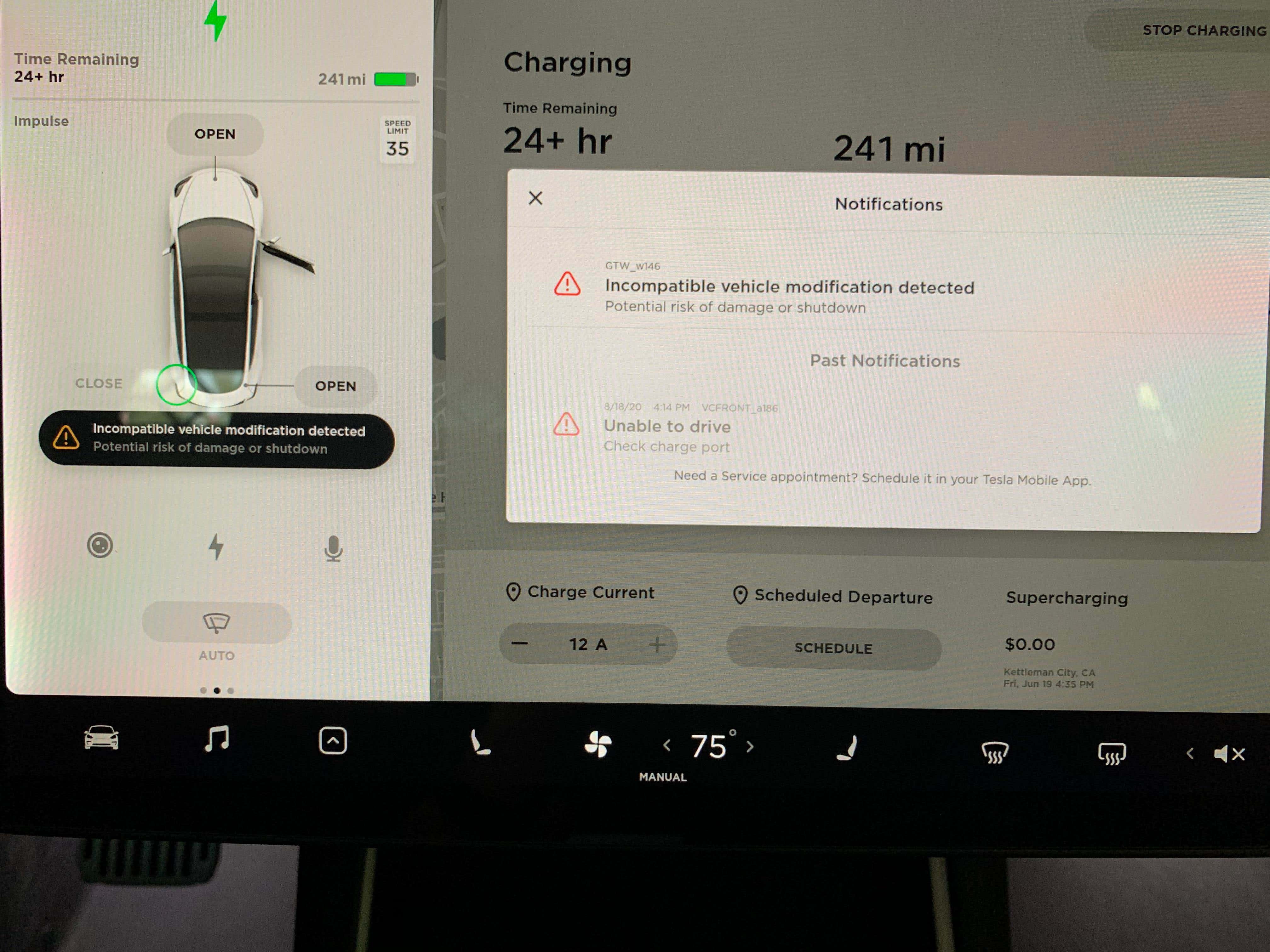
As recently highlighted by a Tesla Model 3 owner on Reddit, your connected car knows when you've hacked it, and it might be logging that data to use against you in a future warranty claim. The Drive reports: The image you see above is a warning message popped up on the man's Model 3 infotainment screen after he installed the latest over-the-air OS update from Tesla a couple weeks ago. Prior to the update, he had also added an aftermarket module from an outfit called Ingenext that allows the dual-motor Model 3 to achieve its quickest 0-60 mph time without Tesla's requisite $2,000 "Acceleration Boost" option. Its presence didn't trigger a warning prior to the software update, and though the car still drove normally, the owner couldn't get the display to clear. Ingenext is a Canadian company focused on activating the latent performance and comfort features baked-in to Tesla vehicles. One particular modification developed by the company is called "Boost 50," a $1,458 upgrade which claims to shave up to a half-second off the zero-to-60 MPH time when installed in a Model 3 equipped with dual motors but not the performance option.
[...]
Ingenext's founder Guillaume Andre told The Drive that he feared Tesla could use the detection of aftermarket parts to justify blocking vehicles from using the Supercharger network and make customers "a prisoner of the Tesla system". The owner of the Model 3 that began getting the pop-ups told us that he planned to visit a Tesla Supercharger to ensure normal functionality, but has not yet reported the results of his findings. [...] Ingenext got to working on finding just how Tesla detected its "undetectable" mod. After some prodding, it was determined that the vehicle had used a separate communications network to detect the presence of the module and ultimately determined that a second small hardware module could be installed to combat the detection. Ingenext dubbed its fix the "Nice Try Module" and has already begun shipping it to customers.

The Tesla community is torn on this matter. Some argue that owners who purchased the module knew the risk of not going through the official channels, akin to using a cheat code to unlock a DLC upgrade in a video game. Others bring up the very valid point of right to repair -- but does that also include right to modify? After all, you do own the vehicles you spent upwards of $40,000 on. Nearly every enthusiast-focused vehicle has an off-the-shelf tune of some sort that can be purchased. Ingenext says that this is only the beginning of a fight that it anticipates will be an uphill battle, if not for it, than for all aftermarket companies who develop performance mods for Teslas.

Software

'PUBG Mobile' Will Escape India Ban By Cutting Out Tencent (engadget.com) 30

Last week, India banned another 118 apps with links to China. PUBG Mobile Lite and PUBG Mobile Nordic Map were included in that sweeping ban. Now, PUBG Corporation says it's looking for ways to bring the apps back to India. Engadget reports: The South Korean company was included in the ban because the mobile games are published by China's Tencent. In a statement shared today, PUBG Corporation said it will no longer use Tencent Games to publish the PUBG Mobile franchise in India. According to TechCrunch, prior to the ban, PUBG Mobile had more than 40 million monthly active users in India, so there's a strong incentive to restore the game.

"Moving forward, PUBG Corporation will take on all publishing responsibilities within the country," it said. "As the company explores ways to provide its own PUBG experience for India in the near future, it is committed to doing so by sustaining a localized and healthy gameplay environment for its fans."

Businesses

Tech Firms Face Growing Resentment Toward Parent Employees During COVID-19 (cnet.com) 413

Over time, as Silicon Valley companies had to change the way its employees work during the COVID-19 pandemic, "an undercurrent of resentment has bubbled up across the tech industry against those splitting time between work and family, and it's spilled out in public on employee message boards, company chat software and on social networks," reports CNET. From the report: At Facebook, the pushback has forced COO Sheryl Sandberg, a parent herself, to defend the company's policies. "I do believe parents have certain challenges," Sandberg said in an August meeting, according to a report in The New York Times. "But everyone has challenges, and those challenges are very, very real." Meanwhile, some employees at Apple, Facebook and Uber say they're barely making it all work. More than half of 1,000 people surveyed by Care.com said they felt like they'd let down their colleagues due to juggling children and work during the pandemic. Of the respondents to the survey, published in August, 52% said they hide their childcare issues because they worry colleagues won't understand. And 45% believe their career advancement has suffered because they're juggling work and kids at home.

As the pandemic spread, many tech companies expanded policies to help parents deal with the sudden responsibility of caring for children while also working full time. Some, like Google and Microsoft, extended paid time off. Companies like Apple, Facebook and Uber also emphasized willingness to allow for more-variable work schedules. [...] Other tech firms express the same sentiments to caregiver employees and to the press. But some employees say the companies haven't successfully woven those feelings into their hard-charging cultures, which, before the pandemic, often included the expectation that people would endure long commutes to the office so they could be at their desks, working into the evening.

It's led to surprising clashes within tech companies, where parent employees are learning that some managers and peers resent the benefits and flexibility parents are getting. Many parents are also reporting they need more time to finish tasks, in part because of the regular interruptions caused by children. A July survey of 1,726 active job seekers by the recruiting site ZipRecruiter found that mothers at home with school-age kids expect work hours to reduce by 9%, while fathers say they expect a drop of 5%. Taken together, these new working arrangements have led some nonparent employees to accuse the parents of being treated better by management while failing to pull their weight.

Security

Windows 10 Themes Can Be Abused To Steal Windows Passwords (bleepingcomputer.com) 37

AmiMoJo writes: Specially crafted Windows 10 themes and theme packs can be used in 'Pass-the-Hash' attacks to steal Windows account credentials from unsuspecting users. Windows allows users to create custom themes that contain customized colors, sounds, mouse cursors, and the wallpaper that the operating system will use. Windows users can then switch between different themes as desired to change the appearance of the operating system. A theme's settings are saved under the %AppData%\Microsoft\Windows\Themes folder as a file with a .theme extension, such as 'Custom Dark.theme.' Windows themes can then be shared with other users by right-clicking on an active theme and selecting 'Save theme for sharing,' which will package the theme into a '.deskthemepack' file. These desktop theme packs can then be shared via email or as downloads on websites, and installed by double-clicking them.

This weekend security researcher Jimmy Bayne (@bohops) revealed that specially crafted Windows themes could be used to perform Pass-the-Hash attacks. Pass-the-Hash attacks are used to steal Windows login names and password hashes by tricking a user into accessing a remote SMB share that requires authentication. When trying to access the remote resource, Windows will automatically try to login to the remote system by sending the Windows user's login name and an NTLM hash of their password. In a Pass-the-Hash attack, the sent credentials are harvested by the attackers, who then attempt to dehash the password to access the visitors' login name and password.

Wireless Networking

Apple, Amazon, Google, and Zigbee Alliance Standard For Smart Home Tech On Track For 2021 Release (macrumors.com) 69

An anonymous reader quotes a report from MacRumors: Last year, Apple, Amazon, Google, and the Zigbee Alliance, which includes Ikea, Samsung, and Philips, announced a new working group known as "Project Connected Home over IP" that set about developing an IP-based open-source connectivity standard for smart home products, with a focus on increased compatibility, security, and simplified development for manufacturers. The group has today announced a major update on the project, stating that development is ongoing, and that work is on track for a 2021 release.

The update reveals the first concrete information about how the open-source smart home standard will work. A large number of devices will be supported by the protocol, including "lighting and electrical (e.g., light bulbs, luminaires, controls, plugs, outlets), HVAC controls (e.g., thermostats, AC units), access control (e.g., door locks, garage doors), safety and security (e.g., sensors, detectors, security systems), window coverings/shades, TVs, access points, bridges and others," as well as additional "consumer electronics products." The announcement also reveals that the group has grown significantly, now with 145 active member companies. Between these companies there are hundreds of product, engineering, and marketing experts, working across 30 cross-functional teams to deliver the new standard.
The group aims to provide a "draft specification" by the end of the year, and release the completed standard next year.
Google

Google's New 'Verified Calls' Feature Will Tell You Why a Business is Calling You (techcrunch.com) 69

Google today is introducing a new feature for Android phones that will help legitimate businesses reach their customers by phone by having their brand name and reason for calling properly identified. From a report: The feature, known as "Verified Calls," will display the caller's name, their logo, a reason why they're calling, and a verification symbol that will indicate the call has been verified by Google. The feature arrives at a time when spam calls are on the rise. U.S. consumers received 61.4 billion spam calls in 2019, according to a recent report from RoboKiller, representing a 28% increase from the prior year. The U.S. Federal Communications Commission also says that unwanted calls, are its top consumer complaint. Google's new system gives legitimate businesses a way to share their information with consumers along with their reason for calling on the incoming call screen. This, however, only works with those participating businesses who have chosen to sign up with one of Google's partners in order to have their calls verified. According to Google's website for the service, businesses can get started with Verified Calls by working with a partner such as Neustar, JustCall, Telecall, Zenvia, Prestus, Aspect, Five9, Vonage, Bandwidth, IMImobile, Kaleyra, Quiubas Mobile, or Datora.
Android

Google Begins Rolling Out Android 11 (venturebeat.com) 32

Google today launched Android 11, the latest version of its mobile OS, and pushed the source code to the Android Open Source Project (AOSP). From a report: Unlike previous major versions, Android 11 is not only arriving as an over-the-air update to Pixel phones first, but also on OnePlus, Xiaomi, Oppo, and Realme phones "with more partners launching and upgrading devices over the coming months." That's a major departure for Android, updates for which take months to arrive thanks to carriers and device makers dragging their feet. It doesn't help that Android is the dominant mobile operating system available on thousands of different device configurations, powering over 2.5 billion monthly active devices. [...] Android 11 brings a long list of new features. Google originally split them into three themes: People, Controls, and Privacy. But there is also support for 5G, new screen types, and call screening. There's even a frame rate API for helping apps and games adopt variable refresh rates, which will be a big focus over the next few years as phones and TVs adopt the feature from computer monitors. Google also expanded the Neural Networks API for running computationally intensive machine learning operations.
Microsoft

Microsoft is Building a New Midrange Surface Clamshell PC With a 12.5-inch Display (windowscentral.com) 32

An anonymous reader shares a report: Microsoft has seen success with its budget friendly Surface Go tablet thanks to its $399 starting price, and it appears the company is hoping to further capitalize on that success with another price conscious Surface PC, this time in the form of a laptop. Codenamed Sparti, I'm told that Microsoft is working on a lightweight midrange clamshell PC designed with students in mind. According to my sources, Sparti has a 12.5-inch display with a 10th-generation Intel Core i5 processor, 4GB RAM, and 64GB storage in the entry-level model. It'll ship with Windows 10 in S mode and be priced somewhere between $500 and $600. I'm told that Sparti is being positioned as a more affordable Surface Laptop, similar to how Microsoft positions the Surface Go alongside the Surface Pro today.
Businesses

Apple iCloud, Google Drive and Dropbox Probed Over 'Unfair' Terms and Conditions in Italy (techcrunch.com) 50

Italy's competition authority has opened an investigation into cloud storage services operated by Apple, Dropbox and Google, in response to a number of complaints alleging unfair commercial practices. From a report: In a press release announcing the probe, the AGCM says it's opened six investigations in all. The services of concern are Google's Drive, Apple iCloud and the eponymous Dropbox cloud storage service. As well as allegations of unfair commercial practices, the regulator said it's looking into complaints of violations of Italy's Consumer Rights Directive. A further complaint alleges the presence of vexatious clauses in the contract. All three cloud storage services are being investigated over complaints of unfair practices related to the collection of user data for commercial purposes -- such as a lack of proper information or valid consent for such commercial data collection -- per the press release.
Businesses

The 'Brushing' Scam That's Behind Mystery Parcels (bbc.com) 142

If you've ever received a parcel from a shopping platform that you didn't order, and nobody you know seems to have bought it for you, you might have been caught up in a "brushing" scam. From a report: It has hit the headlines after thousands of Americans received unsolicited packets of seeds in the mail, but it is not new. It's an illicit way for sellers to get reviews for their products. And it doesn't mean your account has been hacked. Here's an example of how it works: let's say I set myself up as a seller on Amazon, for my product, Kleinman Candles, which cost $3 each. I then set up a load of fake accounts, and I find random names and addresses either from publicly available information or from a leaked database that's doing the rounds from a previous data breach. I order Kleinman Candles from my fake accounts and have them delivered to the addresses I have found, with no information about where they have been sent from. I then leave positive reviews for Kleinman Candles from each fake account -- which has genuinely made a purchase.

This way my candle shop page gets filled with glowing reviews (sorry), my sales figures give me an algorithmic popularity boost as a credible merchant -- and nobody knows that the only person buying and reviewing my candles is myself. It tends to happen with low-cost products, including cheap electronics. It's more a case of fake marketing than cyber-crime, but "brushing" and fake reviews are against Amazon's policies. Campaign group Which? advises that you inform the platform they are sent by of any unsolicited goods.

Social Networks

On Twitter Usernames With Lots of Numbers (tinysubversions.com) 49

Darius Kazemi: There's a common belief that Twitter accounts with usernames like @jsmith12345678 must be bots, or trolls, or otherwise nefarious actors. The thing is, since at least as far back as December 2017, the Twitter signup process has not allowed you to choose your own username! It instead gives you a name based on your first and last name, plus eight numbers on the end. You aren't prompted to pick a more distinctive username after that, and you can change it but you need to figure out how to do it yourself. (The December 2017 date was confirmed to me privately by someone who works at Twitter Design.) This means that when you see a reply from someone with a username with a bunch of numbers in it, it's actually pretty likely that the user is simply someone who joined Twitter after December 2017 and either doesn't care to change their username, or doesn't know that they can change it, or doesn't know how to change it. In other words, it's probably a user who isn't very technically savvy.
China

Qualcomm's Founder On Why the US Doesn't Have Its Own Huawei (wired.com) 89

Wired has interviewed Irwin Jacobs, a founder of Qualcomm. They talk about a wide-range of topics. Here's an excerpt that addresses Chinese tech giant Huawei's growth globally: At first, Qualcomm manufactured its own phone headsets, selling them in Asia. That was around the time it went public in 1991. Eventually, though, it sold off those parts of the business and became strictly an under-the-hood company. This decision wound up having implications in the current competition between the US and China, particularly with the telecom giant Huawei. Because of security concerns, the US is currently doing all it can to stifle adoption of Huawei's products. All of this might be easier if there were an American equivalent to Huawei -- a company working to pioneer the infrastructure of the next generation of wireless that also sold products directly to people. (In this case, that next generation is the much anticipated 5G standard.) Why didn't Qualcomm pursue that?

"We did think about that, but we wanted CDMA to go worldwide," says Jacobs. He says that Qualcomm was still fighting its Holy War, trying to get CDMA accepted everywhere. Being a competitor to carriers would impede that. In 1993, the strategy paid off, when CDMA became the wireless standard. Jacobs says he thought that other US companies, like Motorola, would stay in the business. But one by one, they either shut down or sold out to foreign companies. Qualcomm, by selling companies a comprehensive chipset that could power a cellphone, actually made it easier for new Chinese competitors to hit the market, because they had the tools to create a product instantly. "Unfortunately," he says, "nobody in the US has really run with it" and done the same thing. Another complicating factor is that governments in China and Europe have had industrial aid policies that helped their telecom firms in a way that the US has not. "Our government has not provided R&D support or other support that Huawei and ZTE (another successful Chinese firm) managed to get from their own government," Jacobs says.

Businesses

Netflix's Reed Hastings Deems Remote Work 'a Pure Negative' (wsj.com) 205

From an interview: WSJ: What elements of the Netflix culture are tougher to maintain now that so many employees are working from home?
Mr. Hastings: Debating ideas is harder now.

WSJ: Have you seen benefits from people working at home?
Mr. Hastings: No. I don't see any positives. Not being able to get together in person, particularly internationally, is a pure negative. I've been super impressed at people's sacrifices.

WSJ: It's been anticipated that many companies will shift to a work-from-home approach for many employees even after the Covid-19 crisis. What do you think?
Mr. Hastings: If I had to guess, the five-day workweek will become four days in the office while one day is virtual from home. I'd bet that's where a lot of companies end up.

Slashdot Top Deals