Google

Verily's COVID Testing Program Halted in San Francisco and Oakland (californiahealthline.org) 43

Amid fanfare in March, California officials celebrated the launch of a multimillion-dollar contract with Verily -- Google's health-focused sister company -- that they said would vastly expand COVID testing among the state's impoverished and underserved communities. But seven months later, San Francisco and Alameda counties -- two of the state's most populous -- have severed ties with the company's testing sites amid concerns about patients' data privacy and complaints that funding intended to boost testing in low-income Black and Latino neighborhoods instead was benefiting higher-income residents in other communities. From a report: San Francisco and Alameda are among at least 28 counties, including Los Angeles, where California has paid Verily to boost testing capacity through contracts collectively worth $55 million, according to a spokesperson for the California Governor's Office of Emergency Services. About half of them have received COVID tests through six mobile units that travel among rural areas. Gov. Gavin Newsom has heralded the investment as a game changer in addressing persistent inequities in access to COVID testing across the state that tend to fall along lines of ethnicity and income. The goal, he said in April, touting six new Verily testing sites, was to "make sure we're truly testing California broadly defined, not just parts of California and those that somehow have the privilege of getting ahead of the line." Yet the roadblocks for getting underrepresented populations to use the program soon became apparent to Alameda County officials. In a June letter to California Secretary of Health Mark Ghaly, Oakland Mayor Libby Schaaf and other members of the county's COVID-19 Racial Disparities Task Force raised numerous concerns about the Verily protocols.
The Internet

Study Shows Which Messengers Leak Your Data, Drain Your Battery, and More (arstechnica.com) 28

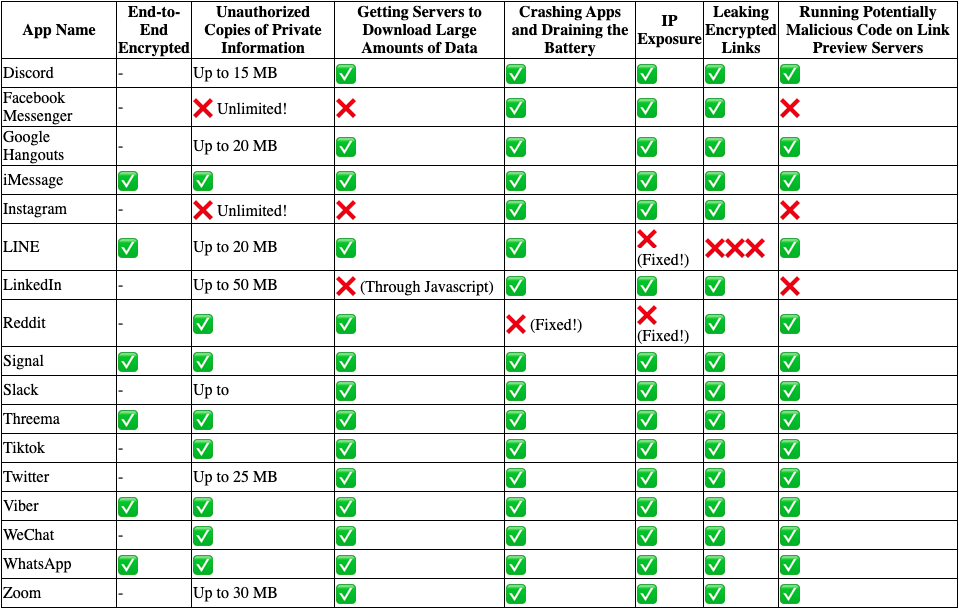
An anonymous reader quotes a report from Ars Technica: Link previews are a ubiquitous feature found in just about every chat and messaging app, and with good reason. They make online conversations easier by providing images and text associated with the file that's being linked. Unfortunately, they can also leak our sensitive data, consume our limited bandwidth, drain our batteries, and, in one case, expose links in chats that are supposed to be end-to-end encrypted. Among the worst offenders, according to research published on Monday, were messengers from Facebook, Instagram, LinkedIn, and Line. More about that shortly.

The researchers behind Monday's report, Talal Haj Bakry and Tommy Mysk, found that Facebook Messenger and Instagram were the worst offenders. As the chart below shows, both apps download and copy a linked file in its entirety -- even if it's gigabytes in size. Again, this may be a concern if the file is something the users want to keep private. It's also problematic because the apps can consume vast amounts of bandwidth and battery reserves. Both apps also run any JavaScript contained in the link. That's a problem because users have no way of vetting the security of JavaScript and can't expect messengers to have the same exploit protections modern browsers have.

LinkedIn performed only slightly better. Its only difference was that, rather than copying files of any size, it copied only the first 50 megabytes. Haj Bakry and Mysk reported their findings to Facebook, and the company said that both apps work as intended. Meanwhile, when the Line app opens an encrypted message and finds a link, it appears to send the link to the Line server to generate a preview. "We believe that this defeats the purpose of end-to-end encryption, since LINE servers know all about the links that are being sent through the app, and who's sharing which links to whom," Haj Bakry and Mysk wrote. Discord, Google Hangouts, Slack, Twitter, and Zoom also copy files, but they cap the amount of data at anywhere from 15MB to 50MB. [This chart] provides a comparison of each app in the study.

Communications

About 3% of Starlink Satellites Have Failed So Far (phys.org) 165

According to Phys.Org, about 3% of SpaceX's Starlink satellites "have proven to be unresponsive and are no longer maneuvering in orbit, which could prove hazardous to other satellites and spacecraft in orbit." From the report: In order to prevent collisions in orbit, SpaceX equips its satellites with krypton Hall-effect thrusters (ion engines) to raise their orbit, maneuver in space and deorbit at the end of their lives. However, according to two recent notices SpaceX issued to the Federal Communications Commission (FCC) over the summer (mid-May and late June), several of their satellites have lost maneuvering capability since they were deployed. Unfortunately, the company did not provide enough information to indicate which of their satellites were affected. For this reason, astrophysicist Jonathan McDowell of the Harvard-Smithsonian Center for Astrophysics (CfA) and the Chandra X-ray Center presented his own analysis of the satellites' orbital behavior to suggest which satellites have failed.

The analysis was posted on McDowell's website (Jonathan's Space Report), where he combined SpaceX's own data with U.S. government sources. From this, he determined that about 3% of satellites in the constellation have failed because they are no longer responding to commands. Naturally, some level of attrition is inevitable, and 3% is relatively low as failure rates go. But every satellite that is incapable of maneuvering due to problems with its communications or its propulsion system creates a collision hazard for other satellites and spacecraft. As McDowell told Business Insider: "I would say their failure rate is not egregious. It's not worse than anybody else's failure rates. The concern is that even a normal failure rate in such a huge constellation is going to end up with a lot of bad space junk."

Power

The Explosive Problem of 'Zombie' Batteries (bbc.com) 120

AmiMoJo shares a report from the BBC: The Environmental Services Association (ESA), which represents waste firms like Biffa, Veolia and Suez, says too many batteries are going into either recycling bins or black rubbish bags, where they are easily damaged by sorting equipment and start to burn -- so-called "zombie" batteries. The ESA has launched a campaign called Take Charge which encourages people to dispose of batteries properly. "Unfortunately, the majority of batteries thrown away in the UK at the moment are not put in the proper recycling bins. Fires caused by carelessly discarded zombie batteries endanger lives, cause millions of pounds of damage and disrupt waste services," says Jacob Hayler, executive director of ESA.

Lithium-ion batteries, which power mobile phones, tablets and toothbrushes, can be extremely volatile if damaged. CCTV footage taken at several recycling centers shows explosions sending flames and debris shooting across sorting areas. And those sorts of batteries are a growing menace. Between April 2019 and March 2020, lithium-ion batteries were suspected to have caused around 250 fires at waste facilities. That is 38% of all fires, up from 25% compared to the previous year, according to the latest data from ESA. In many cases the precise cause of a fire is never established but ESA says it is likely that lithium-ion batteries account for an even bigger proportion of fires.

Displays

Samsung, Stanford Make a 10,000 PPI Display That Could Lead To 'Flawless' VR (engadget.com) 62

Samsung and Stanford University have developed OLED technology that supports resolutions up to 10,000 pixels per inch -- "well above what you see in virtually any existing display, let alone what you'd find in a modern VR headset like the Oculus Quest 2," reports Engadget. From the report: The newOLED tech uses films to emit white light between reflective layers, one silver and another made of reflective metal with nano-sized corrugations. This "optical metasurface" changes the reflective properties and allows specific colors to resonate through pixels. The design allows for much higher pixel densities than you see in the RGB OLEDs on phones, but doesn't hurt brightness to the degree you see with white OLEDs in some TVs. This would be ideal for VR and AR, creating a virtually 'flawless' image where you can't see the screen door effect or even individual pixels. This might take years to arrive when it would require much more computing power, but OLED tech would no longer be an obstacle.
Chrome

Chrome OS May Finally Be Getting a Dark Mode (theverge.com) 16

New submitter andreavenezia shares a report from The Verge: Chrome OS may finally be getting a dark mode, but so far it's only been spotted in its experimental Canary channel, Android Central reported. Before you go tinkering with Canary just be advised: Canary is Google's "bleeding edge" Chrome OS path, which receives daily updates of features before they've been widely tested. It can only be accessed from Chromebooks switched into a special developer mode (not to be confused with the Chrome OS Developer channel). Google warns that Canary can be "unstable."

But at the moment, to activate dark mode on your Chromebook, you need to have the Canary channel installed. Once you've done that, Android Central says you just open Chrome and type in chrome://flags/#enable-force-dark and chrome://flags/#enable-webui-dark-mode into the URL bar. I should note I tried this on my older Chromebook and wasn't able to get it to work. But here's the view Android Police captured. Android Central says the dark mode has some bugs, but notes it seems to apply across the UI, not just as darker backgrounds.

Facebook

Pakistan's PM Asks Facebook To Ban Islamophobic Content (reuters.com) 211

Pakistan Prime Minister Imran Khan called on Facebook to ban Islamophobic content on its platform, warning of a spike in radicalization amongst Muslims, hours after he hit out at the French president for "attacking Islam." Reuters reports: Pakistan summoned the French ambassador in Islamabad as anger spread on Monday over President Emmanuel Macron's reaction to the murder last week of a French teacher by an Islamist. Khan, in an open letter posted on Twitter on Sunday, said "growing Islamophobia" was encouraging extremism and violence worldwide, especially through social media platforms such as Facebook. "I would ask you to place a similar ban on Islamophobia and hate against Islam for Facebook that you have put in place for the Holocaust," Khan said.

"One cannot send a message that while hate messages against some are unacceptable, these are acceptable against others," Khan said, adding such a stance was "reflective of prejudice and bias that will encourage further radicalization." In response, a Facebook spokeswoman told Reuters the company opposed all forms of hate and did not allow attacks based on race, ethnicity, national origin or religion. "We'll remove this hate speech as soon as we become aware of it," the spokeswoman said in a statement, adding that Facebook had "more work to do."

Privacy

Surveillance Startup Used Own Cameras To Harass Coworkers (vice.com) 54

An anonymous reader shares a report: Verkada, a fast-growing Silicon Valley surveillance startup, equips its offices in downtown San Mateo, California, with its own state-of-the-art security cameras. Last year, a sales director on the company's sales team abused their access to these cameras to take and post photos of colleagues in a Slack channel called #RawVerkadawgz where they made sexually explicit jokes about women who worked at the company, according to a report in IPVM, which Motherboard independently verified and obtained more information about. "Face match... find me a squirt," the sales director wrote in the company Slack channel in August 2019, according to one screenshot obtained by Motherboard. The comment was posted along with a series of photos of employees' faces captured with the office's surveillance system which were patched together using a Verkada facial recognition feature. "Face search," as it's called, can pinpoint an individual in a sea of faces. The pinpointed face, in this instance, belonged to a Verkada employee, her mouth wide open. In addition to verifying the incident with three sources who worked at Verkada at the time, Motherboard compared the format of the images posted to those included in Verkada's publicly available demo videos to verify that they were indeed captured by the company's surveillance cameras.
Security

Over 100 Irrigation Systems Left Exposed Online Without a Password (zdnet.com) 29

More than 100 smart irrigation systems were left exposed online without a password last month, allowing anyone to access and tamper with water irrigation programs for crops, tree plantations, cities, and building complexes. From a report: The exposed irrigation systems were discovered by Security Joes, a small boutique security firm based in Israel. All were running ICC PRO, a top-shelf smart irrigation system designed by Motorola for use with agricultural, turf, and landscape management. Security Joes co-founder Ido Naor told ZDNet last month that companies and city officials had installed ICC PRO systems without changing default factory settings, which don't include a password for the default account. Naor says the systems could be easily identified online with the help of IoT search engines like Shodan. Once attackers locate an internet-accessible ICC PRO system, Naor says all they have to do is type in the default admin username and press Enter to access a smart irrigation control panel. Here, Naor says attackers can pause or stop watering events, change settings, control the water quantity and pressure delivered to pumps, or lock irrigation systems by deleting users.
Facebook

Facebook Steps Into Cloud Gaming -- and Another Feud With Apple (techcrunch.com) 27

Facebook will soon be the latest tech giant to enter the world of cloud gaming. Their approach is different than what Microsoft or Google has built, but Facebook highlights a shared central challenge: dealing with Apple. From a report: Facebook is not building a console gaming competitor to compete with Stadia or xCloud; instead, the focus is wholly on mobile games. Why cloud stream mobile games that your device is already capable of running locally? Facebook is aiming to get users into games more quickly and put less friction between a user seeing an advertisement for a game and actually playing it themselves. Users can quickly tap into the title without downloading anything, and if they eventually opt to download the title from a mobile app store, they'll be able to pick up where they left off. Facebook's service will launch on the desktop web and Android, but not iOS due to what Facebook frames as usability restrictions outlined in Apple's App Store terms and conditions.

[...] For a user downloading a lengthy single-player console epic, the short pitstop is an inconvenience, but long-time Facebook gaming exec Jason Rubin says that the stipulations are a non-starter for what Facebook's platform envisions, a way to start playing mobile games immediately without downloading anything. "It's a sequence of hurdles that altogether make a bad consumer experience," Rubin tells TechCrunch.

Education

Schools Clamored for Seesaw's App. That Was Good News, and Bad News. (nytimes.com) 18

An anonymous reader shares a report: The first requests that upended Seesaw, a popular classroom app, came in January from teachers and education officials abroad. Their schools were shutting down because of the coronavirus, and they urgently wanted the app adjusted for remote learning. The company figured it could do that with a single short hackathon project. "We were so naive," said Emily Voigtlander Seliger, a Seesaw product manager. Weeks later, reality hit: The virus spread to the United States, where more of the app's users are. Seesaw had been designed for students in a classroom to submit an audio comment or a digital drawing after a lesson. But thousands of teachers suddenly wanted it to work as a full-featured home learning tool. Rather than using Seesaw for a couple of assignments a week, they were using it for hours each day. It seemed like every start-up's dream: racing to keep up with demand from people desperate for your app. And in many ways, that has worked out well for Seesaw, a San Francisco company. The number of student posts on its app increased tenfold from February to May, Seesaw says, and the paid customer base has tripled from last year. The app is now used in more than three-quarters of American schools, including big districts like Dallas and Los Angeles.

[...] But Seesaw's experience also shows the kinds of hurdles that a company must jump in such extreme circumstances, going through years' worth of growing pains in a few months. Other digital education products, like Zoom and Google Classroom, experienced similar growth spurts and ran into their own problems -- such as unwelcome strangers who dropped into those early weeks of Zoom school. But they are public companies with resources to spare. Seesaw had just 60 employees in February, when the coronavirus hit the United States, and was trying to prove that it deserved a tryout for the big leagues. Small issues that the company knew about but hadn't addressed before the pandemic became significant problems. Teachers begged for app reliability, but some changes Seesaw made for at-home use didn't always work smoothly. While Seesaw executives wanted the app to be interesting for students, it had to be streamlined enough for frazzled parents suddenly running at-home school.

Space

Vint Cerf Is Working on an Internet for Outer Space (quantamagazine.org) 86

"TCP/IP doesn't work at interplanetary distances," 77-year-old Vinton Cerf tells Quanta magazine. "So we designed a set of protocols that do." Specifically, bundle protocols: a disruption/delay-tolerant networking (DTN) protocol with nodes that can also store information: A data packet traveling from Earth to Jupiter might, for example, go through a relay on Mars, Cerf explained. However, when the packet arrives at the relay, some 40 million miles into the 400-million-mile journey, Mars may not be oriented properly to send the packet on to Jupiter. "Why throw the information away, instead of hanging on to it until Jupiter shows up?" Cerf said. This store-and-forward feature allows bundles to navigate toward their destinations one hop at a time, despite large disruptions and delays...

So, a couple decades after conceiving of bundle protocols, is the interplanetary internet up and running?

We don't have to build the whole thing and then hope somebody uses it. We sought to get standards in place, as we have for the internet; offer those standards freely; and then achieve interoperability so that the various spacefaring nations could help each other. We're taking the next obvious step for multi-mission infrastructure: designing the capability for an interplanetary backbone network. You build what's needed for the next mission. As spacecraft get built and deployed, they carry the standard protocols that become part of the interplanetary backbone. Then, when they finish their primary scientific mission, they get repurposed as nodes in the backbone network. We accrete an interplanetary backbone over time.

In 2004, the Mars rovers were supposed to transmit data back to Earth directly through the deep space network — three big 70-meter antennas in Australia, Spain and California. However, the channel's available data rate was 28 kilobits per second, which isn't much. When they turned the radios on, they overheated. They had to back off, which meant less data would come back. That made the scientists grumpy. One of the JPL engineers used prototype software — this is so cool! — to reprogram the rovers and orbiters from hundreds of millions of miles away. We built a small store-and-forward interplanetary internet with essentially three nodes: the rovers on the surface of Mars, the orbiters and the deep space network on Earth. That's been running ever since.

We've been refining the design of those protocols, implementing and testing them. The latest protocols are running back-and-forth relays between Earth and the International Space Station... We did another test at the ISS where the astronauts were controlling a little robot vehicle in Germany.

Facebook

Facebook Finally Launches Its New Oversight Board for Content Moderation (nbcnews.com) 111

NBC News reports that "Social media users who believe their posts have been unfairly removed from Facebook or Instagram can now file an appeal to Facebook's Independent Oversight Board, the company announced Thursday." Positioned as a "Supreme Court" for Facebook's content moderation decisions, the external panel of 20 journalists, academics, lawyers and human rights experts will weigh in — and potentially override its content moderation decisions. The board has up to 90 days to review cases submitted by users through its website after they have exhausted their content appeal options directly with Facebook. If the Board sides with the user, Facebook will restore the content and potentially re-evaluate its policies.

"The Oversight Board wasn't created to be a quick fix or an all-encompassing solution," said Helle Thorning-Schmidt, co-chair of the board and former prime minister of Denmark. But it aims to "offer a critical independent check on Facebook's approach to moderating some of the most significant content issues." By announcing the board on Thursday, Facebook has launched an unprecedented model of governance that no other social media outlet has created... "The Oversight Board has the potential to revolutionize how we think about the relationship between private corporations and our public rights," said Kate Klonick, an assistant professor at the St. John's University School of Law, who has published research on the Oversight Board. "It's a step toward recognition that these transnational companies control our public rights in a way that governments don't and that we need to create a participatory and democratic mechanism to inform those companies that those rights are protected...."

"Of all the criticisms that are lodged against Facebook, I think one of the biggest is that we can't trust them," Jamal Greene, a Columbia Law School professor and co-chair of the Oversight Board, said in an interview in September. "One of the aims of the Oversight Board is to try to establish an institution that can be trusted..." During test panels, there were times when board members noted that their decision could affect Facebook's commercial model. For example, being more permissive about images containing some types of nudity on the platform could deter users in parts of the world with stricter cultural norms.

"The reaction has always been 'Well, that's not our problem, that's Facebook's problem,'" said board member Alan Rusbridger, former editor-in-chief of The Guardian. "So I don't think anyone is coming into this thinking we're here to help Facebook continue with life as normal."

Google

'Apple, Google and a Deal That Controls the Internet' (nytimes.com) 29

The New York Times' looks at "a deal that controls the internet" — Apple's agreement to feature Google as the preselected search engine for iPhones, saying America's Justice Department views it "as a prime example of what prosecutors say are Google's illegal tactics to protect its monopoly and choke off competition..." The scrutiny of the pact, which was first inked 15 years ago and has rarely been discussed by either company, has highlighted the special relationship between Silicon Valley's two most valuable companies — an unlikely union of rivals that regulators say is unfairly preventing smaller companies from flourishing. "We have this sort of strange term in Silicon Valley: co-opetition," said Bruce Sewell, Apple's general counsel from 2009 to 2017. "You have brutal competition, but at the same time, you have necessary cooperation." Apple and Google are joined at the hip even though Mr. Cook has said internet advertising, Google's bread and butter, engages in "surveillance" of consumers and even though Steve Jobs, Apple's co-founder, once promised "thermonuclear war" on his Silicon Valley neighbor when he learned it was working on a rival to the iPhone. Apple and Google's parent company, Alphabet, worth more than $3 trillion combined, do compete on plenty of fronts, like smartphones, digital maps and laptops. But they also know how to make nice when it suits their interests. And few deals have been nicer to both sides of the table than the iPhone search deal.

Nearly half of Google's search traffic now comes from Apple devices, according to the Justice Department, and the prospect of losing the Apple deal has been described as a "code red" scenario inside the company. When iPhone users search on Google, they see the search ads that drive Google's business. They can also find their way to other Google products, like YouTube. A former Google executive, who asked not to be identified because he was not permitted to talk about the deal, said the prospect of losing Apple's traffic was "terrifying" to the company. The Justice Department, which is asking for a court injunction preventing Google from entering into deals like the one it made with Apple, argues that the arrangement has unfairly helped make Google, which handles 92 percent of the world's internet searches, the center of consumers' online lives...

[C]ompetitors like DuckDuckGo, a small search engine that sells itself as a privacy-focused alternative to Google, could never match Google's tab with Apple. Apple now receives an estimated $8 billion to $12 billion in annual payments — up from $1 billion a year in 2014 — in exchange for building Google's search engine into its products. It is probably the single biggest payment that Google makes to anyone and accounts for 14 to 21 percent of Apple's annual profits. That's not money Apple would be eager to walk away from.

In fact, Mr. Cook and Mr. Pichai met again in 2018 to discuss how they could increase revenue from search. After the meeting, a senior Apple employee wrote to a Google counterpart that "our vision is that we work as if we are one company," according to the Justice Department's complaint.
The article remembers Steve Jobs unveiling the iPhone in 2007 — and then inviting Google CEO Eric Schmidt onto the stage. Schmidt, who was also on Apple's board of directors, joked "If we just sort of merged the two companies, we could just call them AppleGoo."

He'd also added that with Google search on the iPhone, "you can actually merge without merging."
X

Is X.Org Server Abandonware? (phoronix.com) 123

Phoronix ran a story this morning with this provocative headline: "It's Time To Admit It: The X.Org Server Is Abandonware." The last major release of the X.Org Server was in May 2018 but don't expect the long-awaited X.Org Server 1.21 to actually be released anytime soon. This should hardly be surprising but a prominent Intel open-source developer has conceded that the X.Org Server is pretty much "abandonware" with Wayland being the future. [Or, more specifically, that "The main worry I have is that xserver is abandonware without even regular releases from the main branch."]

This comes as X.Org Server development hits a nearly two decade low, the X.Org Server is well off its six month release regimen in not seeing a major release in over two years, and no one is stepping up to manage the 1.21 release. A year ago was a proposal to see new releases driven via continuous integration testing but even that didn't take flight and as we roll into 2021 there isn't any motivation for releasing new versions of the X.Org Server by those capable of doing so.

Red Hat folks have long stepped up to manage X.Org Server releases but with Fedora Workstation using Wayland by default and RHEL working that way, they haven't been eager to devote resources to new X.Org Server releases. Other major stakeholders also have resisted stepping up to ship 1.21 or commit any major resources to new xorg-server versions.

The Media

Snopes.com Exposes 4chan Campaign to 'Kindle Mistrust in Snopes' (snopes.com) 264

"This is the perfect moment to do this. This is an age of conspiracies for boomers... Let's kindle their mistrust in Snopes and other fact checkers," wrote one 4chan poster.

Snopes.com later reported: In October 2020, a series of threads was posted to the anonymous internet forum 4Chan as part of operation "Snopes-Piercer," a smear campaign with the stated goal of "red-pilling some normies" — internet slang for a propaganda technique in which distorted, fabricated, or skewed information is used to further a self-determined "truth." In order to "red-pill" these people (one thread noted that "boomers" were the primary target), the plan was to create and circulate doctored screenshots of Snopes fact checks to make it appear as if Snopes fact-checkers addressed claims that we had not.

Over the next few days, users created and shared these fake Snopes screenshots in a number of additional 4chan threads. These images were also posted on social media sites, like Twitter.... Some were humorous (we did not actually address the claim that CNN reporter Chris Cuomo was actually Fredo from "The Godfather"), some were insidious (we did not really publish a fact check questioning the Holocaust), and some were political (we did not publish a fact check questioning the results of the 2020 election before the election happened)...

These red pill campaigns all follow a basic formula. The user decides what they want to be true and then they set out to find, or manufacture, the evidence to support that truth. A concerted effort is then made to spread these false narratives to as wide an audience as possible in order to "red-pill" the general population. In this formula, the desired "truth" comes first. The "evidence" comes second.

It goes without saying that this method is antithetical to the mission of Snopes, fact-checkers in general, journalists, and anyone seeking an objective view of reality.

Chrome

Chrome Caught Exempting Google Sites From User Requests To Delete Data (msn.com) 50

This week the Verge reported: If you ask Chrome to delete all cookies and site data whenever you quit the browser, it's reasonable to expect that this policy applies to all websites. Recently, though, a bug in the browser meant data wasn't being removed for two sites in particular: Google and YouTube.

This problem was first documented by iOS developer Jeff Johnson on his blog. Johnson found that in Chrome version 86.0.4240.75, "local storage" data for Google.com and YouTube.com stuck around even after restarting the browser. We've been able to replicate similar behavior... The Register notes that Chrome's behavior could allow Google to stash cookie-style data as site data, allowing it to track users even when they think they're being careful by deleting their cookie and site data every time they close the browser.

In a statement, Google said it was aware of the issue and was working on a fix... At least one of the affected sites, YouTube, appears to have already been fixed. After we upgraded the Chrome browser to version 86.0.4240.111, YouTube's local storage data seems to successfully purge after a restart, although the data from Google.com still sticks around.

Social Networks

Cult Expert Predicts QAnon Adherents Will 'Get Angry and Exit' (nbcnews.com) 343

"From my time studying cults and helping followers escape them, I can reassure you that QAnon will disintegrate in the United States over time if effective measures are taken if and when Trump is defeated," writes prominent mental health counselor Steven Haasan: When cult adherents get confused, then ashamed, then realize they've been scammed, they get angry and exit. While some followers may continue to believe in the cult for some time — especially if they stay in an information silo — eventually contact with family and friends who care about them and others who have escaped from cults can and will help people come back to themselves. People are not permanently programmed, despite what some pundits and politicians may say. Like fashions and fads, movements end.

How do we dismantle a dangerous cult safely and turn this into yet another American fad as embarrassing as bell-bottoms, polyester and pet rocks? By dismantling the power of its mythology so people who have been pulled into it return to independent thinking. Fundamentally, QAnon is a mind virus, and we must bring the rate of transmission down. For starters, stop mocking QAnon and calling it a conspiracy theory; it is a psy-op, an intentional online cult movement aimed at recruiting and indoctrinating people into an all-or-nothing, us-vs.-them, good-vs.-evil frame. It is important to understand that QAnon believers think they are heroes and believe they are aligned with a righteous cause. We must take them seriously and build a rapport of respect. In other words, agree and amplify that human trafficking is bad and wrong. Then show legitimate groups fighting trafficking... Reclaim this issue and demonstrate that QAnon is talking about it but does nothing, while others are taking action to make a difference...

[W]hile QAnon promoters are currently being removed from the internet platforms they use to spread their propaganda and interact with adherents, as they should be, this approach will only temporarily disrupt and slow down new recruits, rather than help anyone exit. In fact, these moves can validate followers' beliefs that they are being persecuted, while a large percentage of cult members will simply be directed to alternative platforms... The key to helping these folks out is more respectful interaction — not cancel culture, demonization or mockery. People need to be able to exit with dignity. We need to find ways to allow people to return to society with their humanity intact, in a way that honors the very real questions that led them to look toward alternative answers in the first place.

DRM

Twitch Suddenly Mass-Deletes Thousands of Videos, Citing Music Copyright Claims (theverge.com) 75

"It's finally happening: Twitch is taking action against copyrighted music — long a norm among streamers — in response to music industry pressure," reports Kotaku.

But the Verge reports "there's some funny stuff going on here." First, Twitch is telling streamers that some of their content has been identified as violating copyright and that instead of letting streamers file counterclaims, it's deleting the content; second, the company is telling streamers it's giving them warnings, as opposed to outright copyright strikes...

Weirdly Twitch decided to bulk delete infringing material instead of allowing streamers to archive their content or submit counterclaims. To me, that suggests that there are tons of infringements, and that Twitch needed to act very quickly and/or face a lawsuit it wouldn't be able to win over its adherence to the safe harbor provision of the DMCA.

The email Twitch sent to their users "encourages them to delete additional content — up to and including using a new tool to unilaterally delete all previous clips," reports Kotaku. One business streamer complains that it's "insane" that Twitch basically informs them "that there is more content in violation despite having no identification system to find out what it is. Their solution to DMCA is for creators to delete their life's work. This is pure, gross negligence."

Or, as esports consultant Rod "Slasher" Breslau puts it, "It is absolutely insane that record labels have put Twitch in a position to force streamers to delete their entire life's work, for some 10+ years of memories, and that Twitch has been incapable of preventing or aiding streamers for this situation. a total failure all around."

Twitch's response? It is crucial that we protect the rights of songwriters, artists and other music industry partners. We continue to develop tools and resources to further educate our creators and empower them with more control over their content while partnering with industry-recognized vendors in the copyright space to help us achieve these goals.
Debian

Debian Donates 10,000 Euros to Fund Free and Decentralized Livestreaming (debian.org) 20

PeerTube (developed by Framasoft) is "the free and decentralized alternative to video platforms, providing you over 400,000 videos published by 60,000 users and viewed over 15 million times," according to its web site. But now they're exploring livestreaming, writes Debian developer Phil Hands (Slashdot reader #2,365): Holding DebConf20 online this year highlighted the effort involved in setting up Live Streaming using Free Software — something that is beyond the reach of many smaller events which is where PeerTube with Live Streaming should be a perfect fit.
In June PeerTube had posted a roadmap with a humble request for donations in lieu of a crowdfunding campaign: At a time when no one knows what the future holds, we deem it inappropriate to start a crowdfunding campaign and threaten not to do our best on PeerTube if we don't get the necessary funds. We believe in the public utility of PeerTube, so much so that we commit to working on it for six months to make this v3 happen, even if we must do it with our own funds (which we had already done for v2).

We still hope that by sharing this roadmap as widely as possible, some of you will support us in our approach with a donation that will allow us to fund this project.

And this week PeerTube's official Twitter feed announced that "Thanks to Debian's €10,000 donation we've just reached the 4th step of our PeerTube fundraising" — livestreaming. "Many thanks to all those who donated. And it's not too late to contribute."

"We hope this unconventional gesture from the Debian project will help us make this year somewhat less terrible," added the Debian blog, "and give us, and thus humanity, better Free Software tooling to approach the future." It describes their donation as "a strong sign of recognition from an international project — one of the pillars of the Free Software world — towards a small French association which offers tools to liberate users from the clutches of the web's giant monopolies."

And secondly, "it's a substantial amount of help in these difficult times, supporting the development of a tool which equally belongs to and is useful to everyone. The strength of Debian's gesture proves, once again, that solidarity, mutual aid and collaboration are values which allow our communities to create tools to help us strive towards Utopia."

Slashdot Top Deals