EU

European Regulators Prepare For MAX To Return To Service In 2021 (theregister.com) 40

thegreatbob writes: Looks like the main additions over the FAA's requirements are some additional pilot training requirements. The actual EASA statement can be found here. Confirms what the available information had been pointing to: the plane flies tolerably without its Maneuvering Characteristics Augmentation System (MCAS), but does not meet certification criteria. [The MCAS was a software system installed on the Max by Boeing to compensate for the Max having larger engines than its predecessors in the 737 family of airliners. Those larger engines changed the way the aeroplane responded to its controls, requiring a software system to keep it within certifiable limits.] The EU Aviation Safety Agency made the announcement after confirming the airliner will return to European skies in January 2021.

Patrick Ky, chief of EASA, said in a statement: "EASA's review of the 737 MAX began with the MCAS but went far beyond. We took a decision early on to review the entire flight control system and gradually broadened our assessment to include all aspects of design which could influence how the flight controls operated. This led, for example, to a deeper study of the wiring installation, which resulted in a change that is now also mandated in the Proposed Airworthiness Directive."

Ky added: "We also pushed the aircraft to its limits during flight tests, assessed the behavior of the aircraft in failure scenarios, and could confirm that the aircraft is stable and has no tendency to pitch-up even without the MCAS." A spokesperson for EASA clarified that the Max's MCAS "is necessary to meet the safety regulation and obtain the necessary safety margins. However, when it is lost (failed and inoperative), an averagely skilled and trained crew is still able to safely fly and land the airplane."
Google

Google Ordered To Hand Over Emails in $600 Million Divorce Battle (ft.com) 33

A US court has ordered Google to hand over the personal emails of the son of a Russian oligarch as part of a bitter $601 million divorce case. From a report [Editor's note: the link may be paywalled; alternative source]: Judge Virginia DeMarchi in California told the US tech group to surrender Temur Akhmedov's emails for use as evidence in a lawsuit brought by his mother, Tatiana Akhmedova, the wife of an ally of President Vladimir Putin. Ms Akhmedova has gone to court in the US and the UK in an attempt to force her ex-husband, Farkhad Akhmedov, to pay the world's largest-ever divorce settlement. Google said the order was a breach of its customer's privacy. The divorce case, which is being funded by litigation financier Burford Capital, has led to a legal battle over assets including a helicopter, a private jet and a superyacht called the Luna that used to belong to Chelsea Football Club owner Roman Abramovich. Google sought to block the order to give up the emails this week on the basis that to do so would infringe Mr Akhmedov's right to privacy because he had not given consent to share them. Ms DeMarchi said Google's concern for the "privacy and security of its account holders' communications" was "commendable" but ruled the request did not breach the US Stored Communications Act, which governs voluntary and compelled disclosure of emails. The information from the emails will be used to learn whether Temur assisted his father in the fraudulent transfer of assets, and if so, to win a judgment against him, Tatiana Akhmedova said in a filing.
The Internet

AWS Outage Has Taken Down a Big Chunk of the Internet (theverge.com) 90

Amazon Web Services (AWS), Amazon's internet infrastructure service that is the backbone of many websites and apps, is experiencing a major outage affecting a large portion of the internet. From a report: "Kinesis has been experiencing increased error rates this morning in our US-East-1 Region that's impacted some other AWS services," Amazon said in a statement to The Verge. "We are working toward resolution." And, ironically, in a notice on the AWS Service Health Dashboard, Amazon said the issue has apparently "affected our ability to post updates" to that dashboard. "We continue to work towards recovery of the issue affecting the Kinesis Data Streams API in the US-EAST-1 Region," Amazon said in a 1:47PM ET update posted to the dashboard. "For Kinesis Data Streams, the issue is affecting the subsystem that is responsible for handling incoming requests. The team has identified the root cause and is working on resolving the issue affecting this subsystem."
Google

Google Plans Fiber-Optic Network To Connect Via Saudi Arabia and Israel for First Time (wsj.com) 29

Google is laying the groundwork for a fiber-optic network that for the first time will connect through historical enemies Saudi Arabia and Israel while opening a new corridor for global internet traffic, according to people familiar with the plans. From a report: The project linking India to Europe is Google's latest globe-crossing internet construction effort. The Alphabet subsidiary is vying with Facebook to build more network capacity to support its surging user demand for videos, search results and other products. Expanded connectivity between Europe and India would also help Google roll out data centers globally and catch up to rivals Microsoft and Amazon.com in the business of on-demand cloud-computing. Google, which names most of its internet cables after scientists, has dubbed the new route Blue Raman after Indian physicist Chandrasekhara Venkata Raman. A submarine cable project the length of Blue Raman -- at more than 5,000 miles -- would cost typically up to $400 million, according to Dubai-based telecommunications firm Salience Consulting.

Google is expected to turn to telecom-company partners to help fund the project, including Oman Telecommunications and Telecom Italia, which are helping finance the route, according to those with knowledge of the project. Those partners and others will help fund the cable's construction while sharing its fiber-optic infrastructure. Those familiar with Google's Blue Raman project cautioned that it still might not materialize. Because it crosses multiple borders, the project will require agreements with several regulators, and one setback could force Google to redesign the route. For example, Google's consortium still lacks the go-ahead it needs from Saudi government authorities to connect the Blue Raman project, some of these people said.

China

ZTE's Designation as Security Threat Affirmed by US FCC (bloomberg.com) 27

The U.S. Federal Communications Commission affirmed its decision to designate ZTE as a national security threat over concerns telecommunications gear made by the Chinese company could be used for spying. From a report: The action shows that the FCC remains determined to drive ZTE and fellow Shenzhen-based manufacturer Huawei Technologies Co. from the U.S. market, where small rural carriers rely on their cheap network equipment. The agency at its Dec. 10 meeting is to consider rules for listing prohibited gear, FCC Chairman Ajit Pai said in a Nov. 18 blog post that identified Huawei as a threat. The FCC has said ZTE and Huawei pose a risk of espionage, an allegation each company denies. The agency has increasingly scrutinized Chinese companies amid tensions between Beijing and Washington over trade, the coronavirus and security issues. The FCC is considering banning three Chinese telephone companies, and last year barred China Mobile from entering the American market. The FCC on June 30 designated both companies national security threats, and ZTE asked the agency to reconsider its listing. The company said it supplies safe and secure equipment and is "clearly and fully dedicated to complying with all applicable laws in the United States."
Cellphones

Study Finds Users, Not Notifications, Initiate 89% of Smartphone Interactions (psychnewsdaily.com) 33

According to a new study published in the journal Computers In Human Behavior, smartphone users initiate 89% of the interactions, with only 11% initiated by a notification. "This is at odds with previous academic literature and news reports which commonly claim that smartphone notifications are ruining your life, ruining productivity, and so on," reports PsychNewsDaily. From the report: "The perceived disruptiveness of smartphones is not mainly driven by external notifications," the study's authors write, "but by an urge of the user to interact with their phone that seems to occur in an almost automatic manner, just as a smoker would light a cigarette." [...] The researchers explain that many users felt compelled to check their phones even when they had switched off notifications. "Seeing this has made me realize that I don't even remember picking it up," one of the subjects said in a subsequent interview with the study's authors. The study also found that the average duration of a smartphone interaction was 64 seconds. About 50% of the interactions were 23 seconds or less.

The most common activity users engaged in when using their phones was checking WhatsApp, which accounted for 22% of interactions. [...] The second most common interaction, at 17% of the total, was a "lock screen check," which means briefly unlocking the phone to check for new notifications. In third place was interacting with Instagram (16%). Facebook and Facebook messenger together accounted for 13% of the interactions, e-mail for 6%, web browsing 4%, music 3%, Snapchat 2%, and photos 2%. Phone calls -- these devices are phones, after all -- only comprised about 1% of the interactions.

The participants generally considered e-mail notifications the most important. Likewise, they largely considered group chats a "source of distress," and found most group-chat messages unimportant. Smartphone interactions were longer when users were alone versus with others, and were also longer at home versus at work. Likewise, these interactions were shorter when participants received notifications, compared to when they "self-disrupt." This indicates that smartphone use is more purposeful when users receive notifications, and more "distraction-seeking" when they check their phones themselves. The researchers also found that the scrolling features on apps like Instagram and Facebook led to the longest interactions.

OS X

Is Apple Silicon Ready? (thenextweb.com) 132

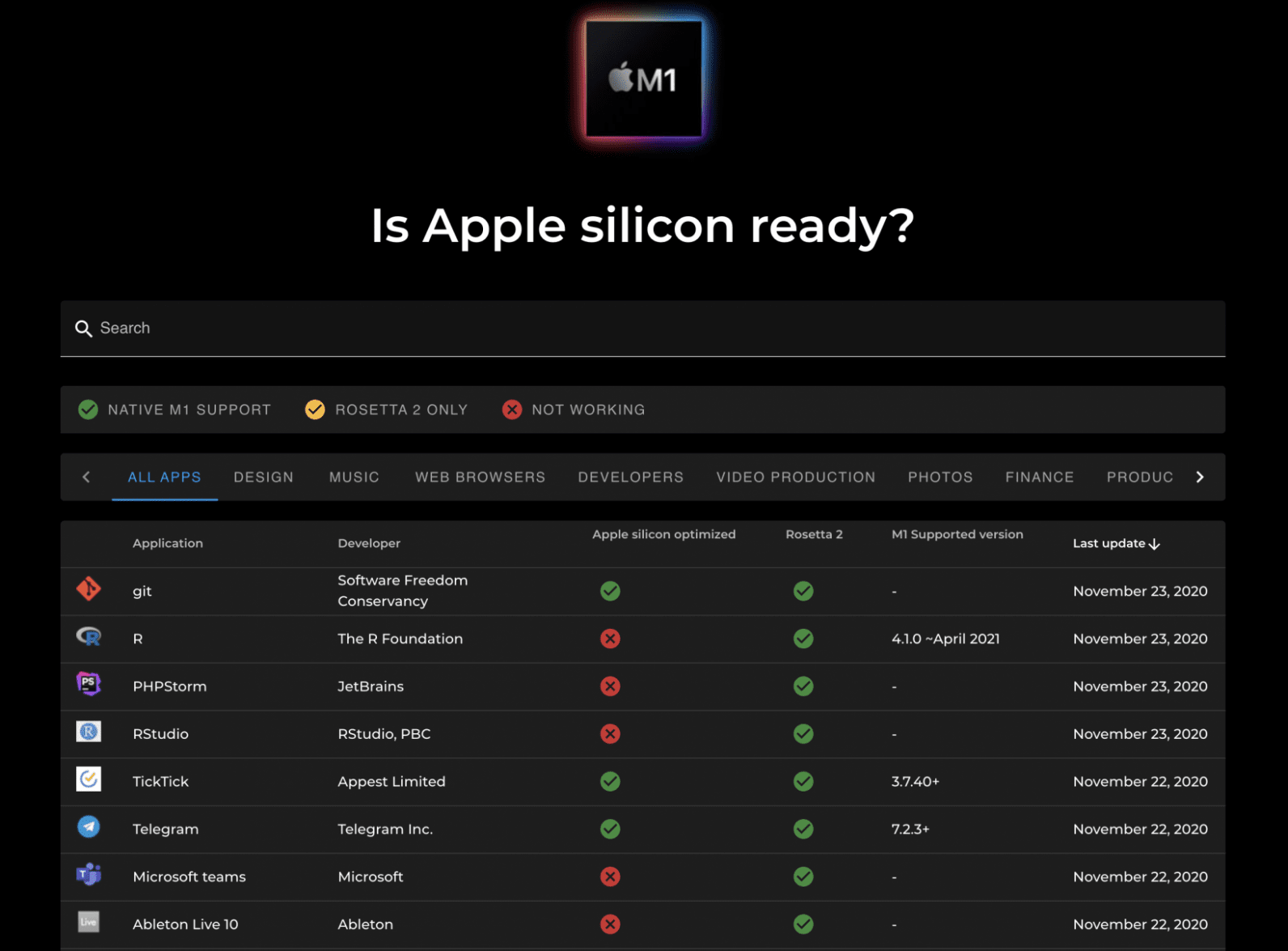
Programmer Abdullah Diaa has put together a website to help determine if your favorite apps work on Apple Silicon yet. An anonymous reader shares a report from The Next Web: ... [P]lease say hello to Is Apple silicon ready? The idea behind the site is simple: it shows you if specific apps will work on laptops and desktops with Apple's in-house chip. Easy to get your head around, right? It shows you a list of software and, if they have native M1 support, they're given a green tick.

Here's an image that shows you what's going on far clearer than lots of words could. As you can see, the site also shows you if the app you're after has Rosetta 2 support. Effectively, Rosetta 2 is an emulator, allowing a large number of apps designed for Intel machines to run on Apple Silicon. If this is supported, you will still be able to use that software on an M1-toting machine.
Further reading: Linus Torvalds Would Like To Use An M1 Mac For Linux, But...
Desktops (Apple)

Linus Torvalds Would Like To Use An M1 Mac For Linux, But... (zdnet.com) 246

Yes, Torvalds said he'd love to have one of the new M1-powered Apple laptops, but it won't run Linux and, in an exclusive interview he explains why getting Linux to run well on it isn't worth the trouble. Steven J. Vaughan-Nichols writes via ZDNet: Recently, on the Real World Technologies forum, Linux's creator Linus Torvalds was asked what he thought of the new M1-powered Apple laptops. Torvalds replied, "I'd absolutely love to have one if it just ran Linux." You may think, "what's the problem? Doesn't Linux run on practically every processor on the planet from 80386s to IBM s390x to the ARM family of which Apple's M1 chip is a child?" Well, yes, yes it does. But it takes more than a processor to run a computer.

Torvalds would like to run Linux on these next-generation Macs. As he said, "I've been waiting for an ARM laptop that can run Linux for a long time. The new Air would be almost perfect, except for the OS. And I don't have the time to tinker with it, or the inclination to fight companies that don't want to help." Aye, there's the rub. In an exclusive interview, Torvalds expanded on why he can't see porting Linux to the M1-based Macs. "The main problem with the M1 for me is the GPU and other devices around it, because that's likely what would hold me off using it because it wouldn't have any Linux support unless Apple opens up."

Still, while Torvalds knows Apple opening up their chipsets "seems unlikely, but hey, you can always hope." Even if that "wasn't an issue," Torvalds continued, "My personal hope would be more cores. Even in a laptop, I don't care about 20-hour battery life (and I wouldn't get it building kernels anyway). I'd rather plug it in a bit more often, and have 8 big cores." As for the Mac's limited RAM -- no more than 16GBs on current models -- he can live with that. "16GBs is actually ok by me because I don't tend to do things that require a lot more RAM. All I do is read email, do git and kernel compiles. And yes, I have 64GB in my desktop, but that's because I have 32 cores and 64 threads, and I do hugely parallel builds. Honestly, even then 32GB would be sufficient for my loads." That said, other developers and power users may want more from the new Macs, Torvalds thinks. "The people who really want tons of memory are the ones doing multiple VMs or huge RAW file photography and video."

Twitter

Twitter Will Warn You If You 'Like' Misleading Tweets (engadget.com) 175

Earlier this year, Twitter started flagging disputed and potentially misleading tweets. Now, it's expanding the feature so that you'll also get a warning if you attempt to "like" a disputed tweet. Engadget reports: Tapping the heart button on a post that's been labeled as misleading will trigger a prompt with a "Find out more" button to pop up. App experimental feature researcher Jane Manchun Wong discovered the expanded function earlier this month. The tweets she tested, which were related to the elections, showed a warning that says "Official sources may not have called the race when this was tweeted."

A week after election day, Twitter revealed that it labeled 300,000 tweets as misleading between October 27th and November 11th. Out of all those, 456 were blocked from being retweeted or liked and were hidden behind a warning before they could even be viewed. The company says its efforts have led to a 29 percent decrease in quoted tweets containing misleading information.
In other Twitter news, the company said today that it would relaunch its verification process early next year along with brand-new guidelines for users seeking out that small, blue badge.
Power

EU Says It Could Be Self-Sufficient In Electric Vehicle Batteries By 2025 (reuters.com) 87

The European Union could produce enough batteries by 2025 to power its fast-growing fleet of electric vehicles without relying on imported cells, European Commission Vice President Maros Sefcovic said on Tuesday. Reuters reports: As part of its plan to become climate neutral by 2050, the EU wants to boost local production of the building blocks for green industries -- including hydrogen fuel to make low-carbon steel and batteries to power clean vehicles. "I am confident that by 2025, the EU will be able to produce enough battery cells to meet the needs of the European automotive industry, and even to build our export capacity," Sefcovic told the online European Conference on Batteries. Today, China hosts roughly 80% of the world's lithium-ion cell production, but Europe's capacity is set to expand fast.

Europe has 15 large-scale battery cell factories under construction, including Swedish company Northvolt's plants in Sweden and Germany, Chinese battery maker CATL's German facility, and South Korean firm SK Innovation's second plant in Hungary. Sefcovic said by 2025 planned European facilities would produce enough cells to power at least 6 million electric vehicles.

Transportation

LA To Launch First 'Transportation Technology Innovation Zone' (archinect.com) 11

Mayor Eric Garcetti announced last week the city's first Transportation Technology Innovation Zone, an area where innovators can test their transportation technology solutions. Archinect reports: Located in the West San Fernando Valley, the zone is the result of a partnership between Mayor Garcetti and City Councilmember Bob Blumenfield, "designed to transform Warner Center into one of L.A.'s mobility innovation and workforce development hubs." "Transportation and technology each have the ability to connect communities, create jobs, and contribute to progress on sustainability, equity, and economic growth -- and Los Angeles takes pride in serving as a testing ground for dynamic and innovative mobility solutions," said Mayor Garcetti in his announcement. "The first-ever Transportation Technology Innovation Zone will unite local businesses, workers, and inventors around how to revolutionize mobility in the West Valley, and it will serve as a model for what's possible as more zones come online in areas across Los Angeles."

The new initiatives is one of the flagship programs of Urban Movement Labs (UML), the transportation solutions accelerator launched by Mayor Garcetti in November 2019. "L.A. is at the forefront of the mobility revolution in our country and across the globe," said Lilly Shoup, Interim Executive Director of Urban Movement Labs in a statement. "With initiatives like the Urban Movement Labs, which accelerates transportation solutions, and the Open Mobility Foundation, which gives policymakers the digital tools they need to govern emerging mobility, Mayor Garcetti and LADOT are leading the conversation on how to embed equity, sustainability, and accessibility into our urban mobility future."

Facebook

Facebook Said It Would Ban Holocaust Deniers. Instead, Its Algorithm Provided a Network for Them (themarkup.org) 62

Last month, Facebook announced a crackdown: The platform would no longer permit content that "denies or distorts the Holocaust" as part of its larger policy prohibiting hate speech. From a report: While noting that successful enforcement could take time, Monika Bickert, Facebook's vice president of content policy, explained the ban in a blog post. "Our decision is supported by the well-documented rise in anti-Semitism globally and the alarming level of ignorance about the Holocaust, especially among young people," she wrote. But as of mid-November, The Markup has found, numerous Facebook pages for well-known Holocaust denial groups remain active -- and for users who find the pages, Facebook's algorithms continue to recommend related content, effectively creating a network for pushing anti-Semitic content. Facebook has long struggled to tamp down on quick-traveling misinformation and shape-shifting conspiracy groups, but many of the discriminatory pages The Markup found either belonged to groups with a long history of prominence within the Holocaust denial movement or directly referenced well-known anti-Semitic or white nationalist memes, making them seem like obvious targets for Facebook's crackdown. It's unclear whether Facebook considers the posts and groups The Markup found unacceptable. The company did not announce how it would define Holocaust denialism, and the company did not respond to multiple requests for comment; all the pages and posts referenced in this article were still active as of Nov. 23 at 5 p.m. ET.
Social Networks

Social Media Companies All Starting To Look the Same (axios.com) 26

Snapchat on Monday launched Spotlight, a video tab within its app that, like TikTok, distributes videos based more on how popular they are than on who created them. Facebook in August launched its TikTok competitor, called Reels. From a report: Snapchat's news comes days after Twitter said it would be adding "Fleets," which are basically Snapchat stories for people who tweet. (Nearly every social media app has launched some version of Stories in the past few years.) Tech platforms used to focus on ways to create wildly different products to attract audiences. Today, they all have similar features, and instead differentiate themselves with their philosophies, values and use cases.
Twitter

Twitter Verification Returns Early Next Year (theverge.com) 21

Twitter announced today that it would relaunch its verification process early next year along with brand-new guidelines for users seeking out that small, blue badge. From a report: Twitter's announcement confirms earlier reporting in June from app researcher Jane Manchun Wong suggesting that the company was creating a new verification system. In Twitter's Tuesday blog post, the company confirmed that this new system would roll out in "early 2021." Twitter is also asking for feedback on a draft proposal for verification. If no changes to this proposal are made, the accounts that would be eligible for verification would include government accounts, companies, brands, nonprofits, news media accounts, entertainment, sports, activists, organizers, and what Twitter refers to as "other influential individuals." Each type of account must meet specific requirements, like being profiled in a media outlet, in order to receive verification. The entirety of Twitter's draft policy can be viewed here. After receiving feedback, Twitter plans to release the final policy on December 17th. Twitter also announced new draft rules explaining when a verification badge could be taken away. If a verified user changes their display name or bio to mislead people on their true identity, Twitter could pull their badge. Repeat terms of service violations could also lead to loss of verified status.
Transportation

Tesla is Now Worth Half a Trillion Dollars (techcrunch.com) 123

Surging Tesla shares have pushed the company's market capitalization to more than $515 billion, a fivefold increase since the start of the year. From a report: The traditionally volatile stock has continued to experience price swings. But since reaching a low for the year in March, Tesla's share price has been on an upwards trajectory that accelerated in August. Tesla's share price, which rose 4.6% in morning trading to $545.62, has helped blast its CEO Elon Musk into the upper stratosphere of Bloomberg's Billionaire Index. As of Tuesday, Musk's net worth had risen $7.24 billion to more than $128 billion. Only Amazon's Jeff Bezos stands in his way to becoming the world's wealthiest person. Tesla shares have been fueled over the past week by news that it will be added to the S&P 500 index in December. Since Friday, the company has added more than $52 billion to its market cap -- the equivalent of adding nearly one and a half Ford Motor Co., to its valuation.
Communications

OneWeb Emerges From Bankruptcy, Plans Global Satellite Broadband By 2022 (arstechnica.com) 80

An anonymous reader quotes a report from Ars Technica: OneWeb has emerged from Chapter 11 bankruptcy under new ownership and says it will begin launching more broadband satellites next month. Similar to SpaceX Starlink, OneWeb is building a network of low-Earth orbit (LEO) satellites that can provide high-speed broadband with much lower latencies than traditional geostationary satellites. After a launch in December, "launches will continue throughout 2021 and 2022 and OneWeb is now on track to begin commercial connectivity services to the UK and the Arctic region in late 2021 and will expand to delivering global services in 2022," OneWeb said in an announcement Friday.

In March this year, OneWeb filed for bankruptcy and reportedly laid off most of its staff. In July, OneWeb agreed to sell the business to a consortium including the UK government and Bharti Global Limited for $1 billion. In the Friday announcement, OneWeb said it has secured "all relevant regulatory approvals" needed to exit bankruptcy. "Together with our UK Government partner, we recognized that OneWeb has valuable global spectrum with priority rights, and we benefit from $3.3 billion invested to date and from the satellites already in orbit, securing our usage rights," Bharti founder and Chairman Sunil Bharti Mittal said.

Security

'Smart' Doorbells For Sale On Amazon, eBay Came Stocked With Security Vulnerabilities (cyberscoop.com) 30

The U.K.-based security company NCC Group and consumer advocacy group Which? have found vulnerabilities in 11 "smart" doorbells sold on popular platforms like Amazon and eBay. CyberScoop reports: One flaw could allow a remote attacker to break into the wireless network by swiping login credentials. Another critical bug, which has been around for years, could enable attackers to intercept and manipulate data on the network. The investigation focused on doorbells made by often obscure vendors, but which nonetheless earned top reviews and featured prominently on Amazon and eBay. The researchers raised concerns that some of the devices were storing sensitive data, including location data and audio and video captured by the doorbell's camera, on insecure servers. One device made by a company called Victure, for example, sent a user's wireless name and password, unencrypted, to servers in China, according to the researchers.

In a statement, Amazon said it requires products sold on its site to be compliant with applicable laws and regulations, and that it has tools to detect "unsafe or non-compliant products from being listed in our stores." eBay said it takes down listings that violate its safety standards, but that the devices flagged by the researchers did not meet that threshold. Victure did not immediately respond to a request for comment. The NCC Group-Which? team said they tried to contact the various vendors of the vulnerable smart doorbells, with mixed success. The unnamed vendor of one device, for example, removed an online listing for the product after the researchers shared their findings.

Businesses

Foxconn Plant Championed By Trump Lands Google Server Contract (bloomberg.com) 65

Foxconn plans to assemble key components for Google servers from its plant in Wisconsin, people familiar with the matter said, finally breathing life into a factory Donald Trump hailed as crucial to bringing manufacturing back to the U.S. Bloomberg reports: The Taiwanese company has decided to locate production for this new contract at the existing complex rather than make the components at home or in China, the people said, asking not to be identified discussing a sensitive move. The under-utilized factory should start mass production in the first quarter, timed with the release of Intel Corp.'s Ice Lake server chips, they said. Foxconn is setting up surface-mount technology assembly lines that it will use to place semiconductors onto circuit boards, they added. A Foxconn representative confirmed it's developing data center infrastructure and high-performance computing "capabilities" in Wisconsin, but declined to name any customers.

Taiwan counts Washington as an essential diplomatic, economic and military ally amid rising tensions with Beijing. Foxconn, which operates most of its factories in central and southern China, won Google's business because it was the only contract manufacturer capable of establishing a surface-mount technology line on American soil, one of the people said. Shanghai-listed Foxconn Industrial Internet Co., its cloud business unit, will oversee the server business in Wisconsin, another person familiar with Foxconn's operations said.

The Internet

Comcast To Enforce 1.2TB Data Cap In Entire 39-State Territory In Early 2021 230

An anonymous reader quotes a report from Ars Technica: Comcast's 1.2TB monthly data cap is coming to 12 more states and the District of Columbia starting January 2021. The unpopular policy was already enforced in most of Comcast's 39-state US territory over the past few years, and the upcoming expansion will for the first time bring the cap to every market in Comcast's territory. Comcast will be providing some "courtesy months" in which newly capped customers can exceed 1.2TB without penalty, so the first overage charges for these customers will be assessed for data usage in the April 2021 billing period.

Comcast's data cap has been imposed since 2016 in 27 of the 39 states in Comcast's cable territory. The cap-less parts of Comcast's network include Northeastern states where the cable company faces competition from Verizon's un-capped FiOS fiber-to-the-home broadband service. But last week, an update to Comcast's website said that the cap is coming to Connecticut, Delaware, Massachusetts, Maryland, Maine, New Hampshire, New Jersey, North Carolina, New York, Pennsylvania, Vermont, West Virginia, and the District of Columbia. The cap is also coming to parts of Virginia and Ohio where it wasn't already implemented. In all, Comcast has nearly 28 million residential Internet customers.
"Comcast's overage charges are $10 for each additional block of 50GB, up to a maximum of $100 each month," notes Ars. "Customers can avoid overage charges by spending an extra $30 a month on unlimited data or $25 for the 'xFi Complete' plan that includes unlimited data and the rental cost for Comcast's xFi gateway modem and router."
The Gimp

Gimp Turns 25 (theregister.com) 121

New submitter thegreatbob shares a report: The General Image Manipulation Program, GIMP, has turned 25. A brief celebration post detailed how the package started life as a July 1995 Usenet thought bubble by then-student Peter Mattis, who posted the following to several newsgroups: Suppose someone decided to write a graphical image manipulation program (akin to photoshop). Out of curiosity (and maybe something else), I have a few (2) questions: What kind of features should it have? (tools, selections, filters, etc.) What file formats should it support? (jpeg, gif, tiff, etc.)" Four months later, Mattis and fellow University of California Berkeley student Spencer Kimball delivered what they described as software "designed to provide an intuitive graphical interface to a variety of image editing operations."

The software ran on Linux 1.2.13, Solaris 2.4, HPUX 9.05, and SGI IRIX. The answer to the file format support question turned out to be GIF, JPEG, PNG, TIFF, and XPM. The rest is history. Richard Stallman gave Mattis and Kimball permission to change the "General" in its name to "GNU", reflecting its open-source status. Today the program is released under the GNU General Public License. As the program added features such as layers, it grew more popular and eventually became a byword for offering a FOSS alternative to Photoshop even though the project pushes back against that description. The project's celebration page says volunteers did their "best to provide a sensible workflow to users by using common user interface patterns. That gave us a few questionable monikers like 'Photoshop for Linux', 'free Photoshop', and 'that ugly piece of software'. We still can wholeheartedly agree with the latter one only!"

Slashdot Top Deals