United States

US Retakes First Place From Japan on Top500 Supercomputer Ranking (engadget.com) 29

The United States is on top of the supercomputing world in the Top500 ranking of the most powerful systems. From a report: The Frontier system from Oak Ridge National Laboratory (ORNL) running on AMD EPYC CPUs took first place from last year's champ, Japan's ARM A64X Fugaku system. It's still in the integration and testing process at the ORNL in Tennessee, but will eventually be operated by the US Air Force and US Department of Energy. Frontier, powered by Hewlett Packard Enterprise's (HPE) Cray EX platform, was the top machine by a wide margin, too. It's the first (known) true exascale system, hitting a peak 1.1 exaflops on the Linmark benchmark. Fugaku, meanwhile, managed less than half that at 442 petaflops, which was still enough to keep it in first place for the previous two years. Frontier was also the most efficient supercomputer, too. Running at just 52.23 gigaflops per watt, it beat out Japan's MN-3 system to grab first place on the Green500 list. "The fact that the world's fastest machine is also the most energy efficient is just simply amazing," ORNL lab director Thomas Zacharia said at a press conference.
The Military

After 80 Years, a Pearl Harbor Sailor Laid to Rest (stltoday.com) 34

Today is Memorial Day in the U.S. — a federal holiday honoring military personnel who died serving their country.

After the Pearl Harbor attack in 1941, 389 unidentified sailors had been interred in a volcanic crater in Honolulu officially designated as the National Memorial Cemetery of the Pacific. After more than 70 years, the U.S government's Defense POW/MIA Accounting Agency began the "USS Oklahoma Project." It continued its work for five years, eventually identifying 355 of the 389 unknown sailors.

The St. Louis Post-Dispatch reports that "After more than 80 years gone, Paul Boemer finally returned from Hawaii."

"And Vince Boemer — who gently accepted the folded American flag that had covered his brother's casket — was happy to welcome him back." "He was a good man," Boemer said. "He was a good older brother."

Earlier this month, Paul Boemer was laid to rest at Jefferson Barracks National Cemetery, in a ceremony scored by the playing of taps and a 21-gun salute. Family, friends, a Navy honor guard in dress whites and several dozen Freedom Rider veterans stood with reverence on a sunny, humid St. Louis day.

"It's a great honor to be part of this," said Vince Boemer, who soon will turn 98. "It's wonderful to see the U.S. government go to these lengths to honor its veterans."

To be sure, Paul Boemer did not plan to be gone so long when he enlisted in the Navy in late 1938. After growing up in south St. Louis, the eighth of 10 children, and graduating from Cleveland High School, the lanky 18-year-old decided on a stint in the military.

He completed basic training, and the Navy assigned the new coxswain — a sailor who helps steer a ship — to the USS Oklahoma. So Boemer boarded a troop transport in Norfolk, Virginia, and sailed to the ship's home port, Ford Island in Pearl Harbor, Hawaii.

That's where Boemer was stationed in 1939 — and on Dec. 7, 1941.

On that day, Japan launched a surprise attack on the U.S. Pacific Fleet; the USS Oklahoma was struck by two torpedoes. The battleship quickly capsized, claiming the lives of 429 crewmen.

Paul Boemer was a month shy of turning 22.

In all, 2,403 U.S. personnel died that Sunday morning at Pearl Harbor and 19 vessels were destroyed or damaged.

But because of "these lengths" taken by the U.S. government, Vince Boemer finally got to see his big brother buried in his hometown.

Thank you for your service.
Social Networks

Instagram Moderators Say Iran Offered Them Bribes to Remove Accounts (bbc.com) 18

The BBC reports: A Persian-language content moderator for Instagram and a former content moderator have said Iranian intelligence officials offered them money to remove Instagram accounts of journalists and activists....

Both content moderators also accused some Iranian colleagues of exhibiting "pro-regime bias" when reviewing posts on the photo-sharing service. They spoke to the BBC after many Iranian Instagram users complained that posts about recent anti-government protests in their country had been deleted. Instagram's owner, Meta Platforms, and the third-party company it uses to moderate content said there was no validity to the claims....

The protests received very little coverage on Iranian state media, meaning that Iranians had to rely on Instagram and other social media sites to learn what was happening on the ground. As the unrest continued, users noticed that some videos posted on Instagram were being removed....

The former content moderator told the BBC that he "personally knew some reviewers who supported the Iranian regime and received instructions from Iran"....

All three interviewees said it was likely that some videos of the protests were removed because they included people shouting: "Death to Khamenei".

Meta has previously said that its guidelines around incitement of violence prohibit calls for the death of a head of state. However, in Iran the phrase "Death to..." is commonly chanted at protests to express discontent with something or someone, rather than to express an actual threat.

Power

Will Electric Cars Transform the Workforce? (laist.com) 181

Gas-powered vehicles "have hundreds of moving parts and other components" that keep mechanics busy, argues CalMatters (which describes itself as a "nonpartisan and nonprofit news organization.")

"By 2040, the state projects that nearly 32,000 auto mechanics jobs will be lost in California, since electric vehicles need far less maintenance and repair than conventional combustion engines." And they base that prediction on statistics from the state's own Air Resources Board (part of California's Environmental Protection Agency): Throughout the economy, an estimated 64,700 jobs will be lost because of the mandate, according to the California Air Resources Board's calculations. On the other hand, an estimated 24,900 jobs would be gained in other sectors, so the estimated net loss is 39,800 jobs, a minimal amount across the state's entire economy, by 2040. But no single workforce in the state would be hurt more than auto mechanics: California has about 60,910 auto service technicians and mechanics, and more than half of those jobs would be lost over the next two decades if the mandate goes into effect, the air board calculates....

Some industries gain jobs while others lose them as the state shifts to zero-emission vehicles. The retail trade sector, which includes gas station workers and automobile and parts dealers, would lose 38,669 jobs by 2040 or about 2% of the retail workforce. Most of the losses would be at gasoline stations. As the electric vehicle fleet grows, air board officials project gas stations could provide charging to offset the losses.... Another 20,831 jobs in state and local government would be eliminated because of the decrease in gas tax revenue.

But the transition to electric cars also will create thousands of jobs. Southern California Edison, Pacific Gas & Electric and other power industry companies would benefit most, with the creation of about 5,600 jobs by 2040 as car owners spend more on electricity to power their vehicles. Insurance carriers will benefit from about 1,700 new jobs, while the construction industry is expected to gain about 3,600.... Mechanics who work on internal combustion engines would still have plenty of work: The rule would not ban sales of used cars, and it wouldn't force the state's residents to stop driving the roughly 29 million gas-powered cars that are already on the road. Californians also could keep importing new or used vehicles from out of state.

That means Californians will still own a lot of gas-powered cars past 2035, softening the blow for car mechanics and industries dependent on fossil fuels, said James Sallee, an economist and research associate at the Energy Institute at University of California, Berkeley's Haas School of Business. Sallee said the changes wouldn't occur fast enough to trigger a sharp economic slowdown within the auto repair industry.

One 67-year-old mechanic still tells CalMatters that "The electric vehicle repair market is just about nonexistent."

But another mechanic tells them "I'm not against electric vehicles. I've always loved cars and I'll work on them until I can't anymore. So we have to adjust. We have to get out of our comfort zones."
United States

Ford Pays Millions Over False Claims About Its 2013 Hybrid's Fuel Economy (consumerreports.org) 32

Ford's fuel-economy figures for the 2013-2014 C-Max hybrids "were not based in reality" says Iowa's attorney general.

And now the Ford Motor Company "will pay $19.2 million to a consortium of 40 states and Washington,D.C.," writes Consumer Reports (which also covers additional false advertising about the payload capacity of its Super Duty pickup trucks). In these two cases, Ford exaggerated numbers for an advantage in competitive segments. And it was caught....

Ford ran a series of ads that claimed the C-Max provided better fuel economy than the Toyota Prius. The 2013 C-Max was originally rated at 47 mpg in city and highway driving, and 47 mpg overall. The claim was that it delivered 47 mpg in every situation. Back on Dec. 6, 2012, Consumer Reports wrote... "After running both vehicles through our real-world tests, we have gotten very good results. But they are far below Ford's ambitious triple-47 figures." We got 37 mpg overall in our tests. That's close to what owners reported on the Environmental Protection Agency's fueleconomy.gov, at 39 mpg.... In our tests, the Toyota Prius at the time got 44 mpg overall, far more than the C-Max.

Iowa's attorney general notes that "In 2013, Ford admitted that its initial fuel economy rating for the C-Max hybrid was likely overstated. The carmaker announced at the time that it would make a 'goodwill payment' of $550 to consumers who purchased a 2013 C-Max hybrid and $325 to those who leased the vehicle, according to Edmunds."

Consumer Reports adds: It then made hardware updates for new models, including a higher final gear ratio, lower-viscosity motor oil, and aerodynamic improvements, including a rear spoiler, new hood seals, and air deflectors in front of the tires, and a higher speed threshold for the electric drive. The new mpg figures were 39 mpg combined for 2014 through 2016 (41 city, 36 highway)...

This case underscores why Consumer Reports goes to great lengths to test the fuel economy of every nonelectric car we purchase. It provides realistic, objective, independent information for car shoppers and helps keep the auto industry honest.

Consumer Reports also quotes Ford's statement on their false advertising. "We are pleased that the matter is closed without any judicial finding of improper conduct."

"We worked with the states to resolve their concerns."
Transportation

Ukrainian Fighters Take to Electric Bikes in War Against Russia (msn.com) 89

"Ukrainian fighters are using electric bikes in the battle against Russia," reports the Washington Post, "mostly in support of reconnaissance missions, demining operations and medical deliveries, according to one of the Ukrainian e-bike makers involved."

"They've reportedly also been used for carrying out sniper attacks." The bikes have a top speed of 55 miles per hour and are relatively silent — helping their riders evade Russian fire.

Ukrainian e-bike firm Eleek initially gave a few bikes to the military when the war began, according to manager Roman Kulchytskyi. Soon after, they began to mass-produce bikes — kitted out in military green, with a small Ukrainian flag on the rear wheel — for Ukraine's fighters.... Working from a bomb shelter, Eleek began making a power bank based on lithium-ion battery cells it had left in stock. After struggling for parts, it turned to electronic cigarettes — launching a social media campaign to get people to send in their devices....

The company added footrests for passengers, improved the charging time, installed a battery control system and included a 220V output that allows soldiers to charge gadgets and can help power Starlink satellite Internet terminals, Kulchytskyi said.... Another advantage of the bikes is that they may not be visible on thermal imaging systems, which are used to detect differences in temperature and help militaries pinpoint potential targets. That's because the electric motor doesn't heat up like an internal combustion engine, Kulchytskyi said.

Daniel Tonkopi, founder of e-bike company Delfast, wrote on Facebook this month that his California-based firm has been donating electric bikes to the Ukrainian army since the war broke out. He included pictures of the bikes carrying antitank weapons and said he had received feedback from the military that they planned to use the bikes to target Russian armored vehicles. During one recent mission, they recounted to him that several vehicles came back with holes but that the riders were intact.... The company is donating 5 percent of all sales to fund humanitarian efforts in Ukraine.

The article notes electric bikes are also being tested by Asutralia's military and New Zealand's Air Force.
Advertising

Remote Learning Apps Tracked Millions of US Children During Pandemic (msn.com) 44

An international investigation uncovered some disturbing results, reports the Washington Post. "Millions of children had their online behaviors and personal information tracked by the apps and websites they used for school during the pandemic..." The educational tools were recommended by school districts and offered interactive math and reading lessons to children as young as prekindergarten. But many of them also collected students' information and shared it with marketers and data brokers, who could then build data profiles used to target the children with ads that follow them around the Web.

Those findings come from the most comprehensive study to date on the technology that children and parents relied on for nearly two years as basic education shifted from schools to homes. Researchers with the advocacy group Human Rights Watch analyzed 164 educational apps and websites used in 49 countries, and they shared their findings with The Washington Post and 12 other news organizations around the world.... What the researchers found was alarming: nearly 90 percent of the educational tools were designed to send the information they collected to ad-technology companies, which could use it to estimate students' interests and predict what they might want to buy.

Researchers found that the tools sent information to nearly 200 ad-tech companies, but that few of the programs disclosed to parents how the companies would use it. Some apps hinted at the monitoring in technical terms in their privacy policies, the researchers said, while many others made no mention at all. The websites, the researchers said, shared users' data with online ad giants including Facebook and Google. They also requested access to students' cameras, contacts or locations, even when it seemed unnecessary to their schoolwork. Some recorded students' keystrokes, even before they hit "submit."

The "dizzying scale" of the tracking, the researchers said, showed how the financial incentives of the data economy had exposed even the youngest Internet users to "inescapable" privacy risks — even as the companies benefited from a major revenue stream.

The Internet

25 Gigabit Per Second Fiber Retail Broadband Service Demoed in New Zealand (www.crn.nz) 69

25 gigabits per second — both downloading and uploading. CRN reports broadband infrastructure wholesaler Chorus demonstrated those speeds over their existing passive optical fiber network [PON]. The demonstration in Auckland achieved 21.4 Gbps throughput, tested simultaneously on the same strand of fibre that ran an 8 Gbps symmetric HyperFibre connection, and a 900/550 Mbps UFB link.... Chorus uses Nokia's Lightspan FX and MX access nodes for multiple types of fibre service, including standard GPON, the XGS-PON behind HyperFibre, point-to-point Ethernet, and envisages the 25 GPON service to run on it as well. It is based on the Quillion chip set line cards, which Nokia says are 50 per cent more energy efficient than earlier models.

Currently, Chorus has no wholesale 25 GPON product, with its fastest offering topping out at 8/8 Gbps HyperFibre. The wholesaler expects to develop a 25 GPON based services within the next two to three years, with a Nokia optical network termination unit that supports either 25/25 Gbps or 25/10 Gbps options. Kurt Rodgers, network strategy manager at Chorus, said the faster broadband service would come into its own for industrial metaverse applications, the Internet of Things, and low-latency cloud connectivity....

Chorus chief technology officer Ewen Powell said the 25 GPON service demonstrated "a future-proofed technology." Although two-wavelength 50 Gbps service is appearing as a choice for providers, with 100 GPON on the horizon, Chorus is betting that the 25 Gbps variant will offer the best cost benefit overall for providers, as it can use existing optics equipment.

Thanks to long-time Slashdot reader Bismillah for submitting the article.
Microsoft

Microsoft Brings 'Windows Subsystem for Linux 2' to Window Server 2022 (theregister.com) 23

With the latest preview patch, Windows Server 2022 now supports WSL2 Linux distros, the Register reports: The move ends an odyssey that began with the arrival of the Windows Subsystem for Linux (WSL) 2 on Windows 10 several years ago and with users' calls for Windows Server to get the same treatment. The change is also somewhat of an about-face from Microsoft. In 2021, in response to pleas from users to backport the tech to Windows Server 2019, [Principal program manager for Windows Server Jeff] Woolsey described WSL in early 2021 as "fantastic for dev" and "perfect for Windows client" but warned: "If we put it in Windows Server, people will use it in production scenarios for which it isn't intended." The approved path was to spin up a full Linux VM. Quite a bit heftier than the lighter-weight WSL2.

Signs of Microsoft listening to feedback showed up earlier this year, as Microsoft Program Manager Craig Loewen "clarified" that WSL2 distros would work on Windows Server version 2004 and 20H2, although the LTSC versions found in many data centers remained free of WSL2. Until this week, that is.

TechRadar provides some context: WSL 2, which was originally released in May 2019 (opens in new tab), uses virtualization technology to run an open source Linux kernel inside of a lightweight utility virtual machine (VM). This empowers Windows users to run popular Linux apps such as Docker. Microsoft claims that unlike a traditional VM experience — which it says can be slow to boot up, is isolated, consumes a lot of resources, and requires your time to manage it — WSL 2 does not have these attributes....

The KB5014021 update is currently optional, but will be automatically rolled out to users next month....

Windows Server updates have not been without issues in recent months, however, with Microsoft having to address various problems caused by the January 2021 Patch Tuesday updates. The company issued an emergency out-of-band update to address bugs that forced domain controllers to reboot endlessly, broke Hyper-V, and rendered ReFS volumes inaccessible while showing them as RAW file systems.

Transportation

New Airbus Facility To Research Cryogenic Fuel Systems For Next-Gen Hydrogen Planes (cnbc.com) 68

An anonymous reader quotes a report from CNBC: Airbus is launching a U.K.-based facility focused on hydrogen technologies, a move which represents the firm's latest attempt to support the design of its next generation of aircraft. In a statement Wednesday, Airbus said the Zero Emission Development Centre in Filton, Bristol, had already begun working on the development of the tech. One of the site's main goals will center around work on what Airbus called a "cost-competitive cryogenic fuel system" that its ZEROe aircraft will need.

Details of three zero-emission, "hybrid-hydrogen" concept planes under the ZEROe moniker were released back in Sept. 2020. Airbus has said it wants to develop "zero-emission commercial aircraft" by the year 2035. The ZEDC in the U.K. will join other similar sites in Spain, Germany and France. "All Airbus ZEDCs are expected to be fully operational and ready for ground testing with the first fully functional cryogenic hydrogen tank during 2023, and with flight testing starting in 2026," the company said.

Businesses

Broadcom To 'Focus On Rapid Transition To Subscription' For VMware (theregister.com) 68

Broadcom has signaled its $61 billion acquisition of VMware will involve a "rapid transition from perpetual licenses to subscriptions." The Register reports: That's according to Tom Krause, president of the Broadcom Software Group, on Thursday's Broadcom earnings call. He was asked how the semiconductor giant plans to deliver on its guidance that VMware will add approximately $8.5 billion of pro forma EBITDA to Broadcom within three years of the deal closing -- significant growth given VMware currently produces about $4.7 billion. And subscriptions was the answer. Krause also repeatedly said Broadcom intends to invest in VMware's key product portfolio and is pleased to be acquiring a sales organization and channel relationships that give it reach Broadcom does not currently enjoy. [...]

Krause and Broadcom CEO Hock Tan both said Broadcom plans to nurture VMware's 300,000-plus customer base. The move to subscription-based licensing will apparently happen over the course of the next few years. [...] VMware may also experience slower growth in the short term due to the licensing shift. Krause said Broadcom is willing to live with lower margins for VMware than it expects from CA and Symantec, with R&D to benefit as a result. The software boss pledged ongoing investment and innovation for VMware's core infrastructure products, naming vSphere, VSAN, vRealize and NSX as the subjects of ongoing love and attention

Transportation

IndyCar Is Moving To 100% Renewable Ethanol In 2023 (arstechnica.com) 43

An anonymous reader quotes a report from Ars Technica: The IndyCar racing series is switching to an entirely renewable fuel next year. On Friday, ahead of Sunday's Indianapolis 500 race, IndyCar announced that starting next year, the race cars will be powered by a new, second-generation renewable ethanol race fuel developed by Shell. The manufacturing process for IndyCar's ethanol will be slightly less exotic than that seen in the low-carbon fuel that Formula 1 is considering for 2026. Rather than carbon capture and electrolysis, Shell will use sugarcane waste and other renewable feedstocks, which are hydrolyzed and fermented at a plant in Brazil operated by Raizen (Shell is a co-owner).

Shell says that the switch "enables at least" 60 percent less carbon dioxide emissions than fossil fuel gasoline, although IndyCar currently runs on an E85 blend of gasoline rather than 100 percent fossil fuel or the 100 percent methanol that powered the sport for so many years. [...] Among other changes to help green the sport is the installation of a 150 kW DC fast charger at the Indianapolis Motor Speedway. And the roughly 5,000 tires that Firestone will transport to the track by Sunday will be hauled there from the tire maker's central Indiana warehouse by one of Penske's electric Freightliner eCascadia trucks.

Communications

Starlink Has Been Approved in Nigeria and Mozambique (techcrunch.com) 13

Elon Musk has announced that Starlink, the satellite internet service launched by SpaceX, has been approved in Nigeria and Mozambique. From a report: This news is coming three days after Musk answered a tweet about the service launch in Africa. "Yes, first countries in Africa to be announced coming soon," he tweeted. "Starlink will serve everywhere on Earth that we're legally allowed to serve."
Google

Russia Opens Cases Against Google, other Foreign Tech Over Data Storage (reuters.com) 51

Russia's communications regulator Roskomnadzor said on Friday it had opened administrative cases against Alphabet's Google and six other foreign technology companies for alleged violations of personal data legislation. From a report: Moscow has clashed with Big Tech over content, censorship, data and local representation in a simmering dispute that has erupted into a full-on information battle since Russia sent tens of thousands of troops into Ukraine on Feb. 24. Russia fined Google 3 million roubles ($46,540) last year for not storing the personal data of Russian users in databases on Russian territory, and on Friday said it had opened a new case over what it called Google's repeated failure to comply with Russian legislation.
Television

Are We on the Verge of an 8K Resolution Breakthrough in Gaming? (arstechnica.com) 104

An anonymous reader shares a report: With the 2020 release of the Xbox Series X and PlayStation 5, we've started to see the era of console games that finally make full use of TVs capable of 4K resolutions (i.e., "Ultra HD" 3840x2160 pixels) that have become increasingly popular in the marketplace. Now, though, at least one TV manufacturer is already planning to support 8K-capable consoles (i.e., 7680x4320 resolution) that it thinks could launch in the next year or two.

Polish gaming site PPL reports on a recent public presentation by Chinese TV and electronics maker TCL. Tucked away in a slide during that presentation is a road map for what TCL sees as "Gen 9.5" consoles coming in 2023 or '24. Those supposed consoles -- which the slide dubs the PS5 Pro and "New Xbox Series S/X" -- will be capable of pushing output at 8K resolution and up to 120 frames per second, according to TCL's slide.

Facebook

Meta Copied VR Technology Key To Metaverse Gaming, Immersion Claims (bloomberg.com) 13

Meta Platforms built its industry-leading virtual reality headset by infringing Immersion's patents, the smaller company alleged in a lawsuit. From a report: The Meta Quest 2, which dominates the market, infringes six patents covering haptic technology, Immersion said in a complaint filed Thursday in federal court in Waco, Texas. In video game systems and controllers, haptics allow users to experience vibrations that mimic real-life forces -- such as blocking a punch in a virtual boxing game. Meta Chief Executive Officer Mark Zuckerberg has committed to spending $10 billion a year to bring to life his vision of a virtual reality-enabled metaverse. Sales of Meta Quest 2 hit 8.7 million units in 2021, twice as much as in the prior year, and the company owns 80% of the market.
Communications

Starlink Gets Nod To Provide Internet in Philippines (bloomberg.com) 9

Starlink has been authorized to provide satellite internet services in the Philippines, paving the way for the SpaceX unit's expansion to Southeast Asia. From a report: The Philippine National Telecommunications Commission said it approved Starlink's registration as a value-added service provider, according to a statement Friday. This would allow Starlink to directly access satellite systems, and to build and operate broadband facilities. The Philippines will be the first country in Southeast Asia to offer Starlink's high speed, low latency satellite internet service, the NTC said.
Businesses

Tech Industry Groups Are Watering Down Attempts at Privacy Regulation, One State at a Time (themarkup.org) 38

Coordinated industry lobbying is overwhelming the scattered efforts of consumer groups and privacy-minded lawmakers. From a report: In late 2019, Utah state senator Kirk Cullimore got a phone call from one of his constituents, a lawyer who represented technology companies in California. "He said, 'I think the businesses I represent would like to have some bright lines about what they can do in Utah,'" Cullimore told The Markup. At the time, tech companies in California were struggling with how they could comply with a new state law that gave individual Californians control over the data that corporations routinely gather and sell about their online activities. The lawyer, whom Cullimore and his office wouldn't identify, recounted how burdensome his corporate clients found the rules, Cullimore remembered, and suggested that Utah proactively pass its own, business-friendly consumer privacy law.

"He said, 'I want to make this easy so consumers can make use of their rights and the compliance is also easy for companies.' He actually sent me some suggested language [for a bill] that was not very complex," Cullimore told The Markup. "I introduced the bill as that." What followed over the next two years was a multipronged influence campaign straight out of a playbook Big Tech is deploying around the country in response to consumer privacy legislation. It's common for industries to lobby lawmakers on issues affecting their business. But there is a massive disparity in the state-by-state battle over privacy legislation between well-funded, well-organized tech lobbyists and their opposition of relatively scattered consumer advocates and privacy-minded politicians, The Markup has found. During the 2021 and 2022 Utah legislative sessions -- when Cullimore's bill made its way through the legislature -- Amazon, Apple, Facebook, Google, and Microsoft collectively registered 23 active lobbyists in the state, according to their lobbying disclosures. Thirteen of those lobbyists had never previously registered to work in the state, and some of them were influential in shaping Cullimore's legislation.

Canada

Internet Drama in Canada (nytimes.com) 88

We all need great internet service, but it doesn't happen by accident. From a report: Let's talk about internet policy! In Canada! Wheee! I'm serious that there are useful lessons from a saga over home internet service in Canada. What has been a promising, albeit imperfect, system that increased choices and improved internet service for Canadians is poised to fall apart. Barring a last-minute government intervention today or Friday, many smaller internet providers in Canada are likely to significantly increase their prices and lose customers or shut down. The dream of more competition leading to better internet service for Canadians is on life support. What's happening in Canada reveals why we need smart internet policy to be paired with strong government oversight to have better and more affordable internet for all -- and it shows what happens when we lose that.

The U.S. has botched it for years, and that's one reason America's internet service stinks. Canada may be a real-world experiment in what happens when muddled government regulation undermines internet policy that has mostly been effective. Bear with me for a lesson in Canada's home internet service. The bottom line is that Canadians have something that is relatively novel to Americans: Many people have options to pick a home internet provider that they don't hate. That's because in Canada -- similar to many countries including Britain, Australia and Japan -- the companies that own internet pipelines are required to rent access to businesses that then sell internet service to homes. Regulators keep a close watch to make sure those rental costs and terms are fair.

Amiga

AmigaOne X1000/X5000 Remains Well Supported With PowerPC Linux 117

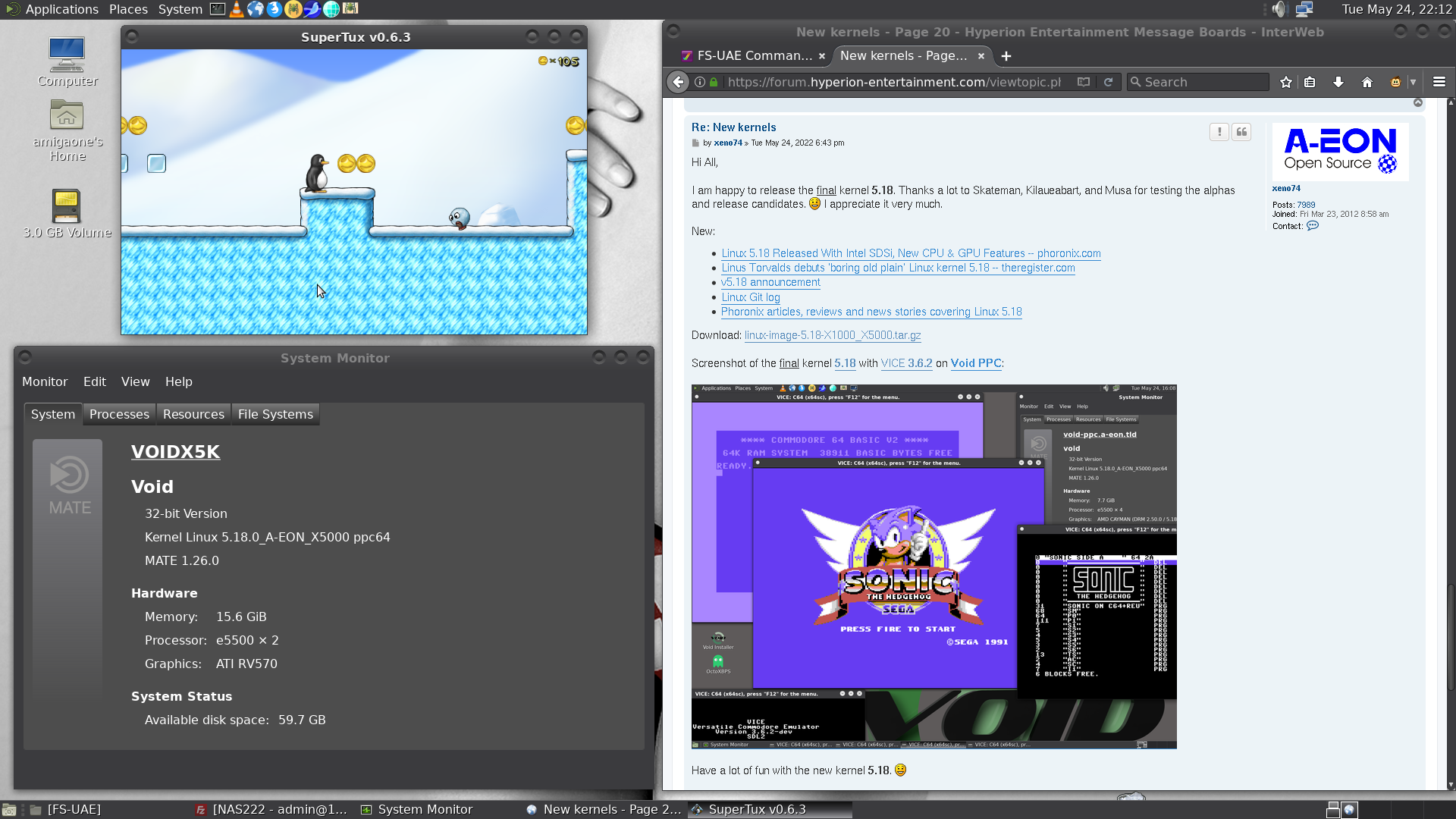
Mike Bouma writes: Despite being expensive and having been sold out for quite some time at the main Amiga Dealers, two days after Linus Torvalds' release of Linux 5.18, Christian "xeno74" Zigotzky made the latest PPC kernel available for the AmigaOne X1000/X5000. Here and here are some screenshots. Linux PPC performs well on AmigaOne computers. For example, here is a 5-year-old YouTube AmigaOne X5000 demonstration video.

Slashdot Top Deals