Google

Google Accused of Pushing 'Free For Life' G Suite Users Onto Paid Plans (theregister.com) 69

Google is again pressuring some longtime G Suite Legacy users to move onto paid Workspace plans, warning that accounts flagged as "commercial use" could lose access to Gmail, Drive, Calendar, and other services if appeals fail. "The trouble, according to users, is that the appeals system appears about as transparent as a brick," adds The Register. From the report: A reader alerted The Register to what appears to be a new crackdown on long-standing G Suite Legacy accounts, with similar complaints now piling up on Reddit from users accused of violating Google's non-commercial use policy, despite insisting they use the accounts only for family email and personal domains. Reports have been stacking up on Reddit's r/gsuitelegacymigration subreddit from users who say their long-running personal G Suite Legacy accounts are suddenly being classified as "commercial use" accounts and pushed toward paid Google Workspace plans by May 2026. A lot of users have been through this before. Google spent part of 2022 trying to wind down free G Suite Legacy accounts, then changed course after users running family domains made enough noise. Now some of those same users are being told they have fallen outside Google's rules after all.

Emails seen by The Register warn users their accounts have been "identified as being used for commercial purposes" and say Google may start suspending Gmail, Calendar, Drive, Meet, and other Workspace services if they do not either win an appeal or begin paying for Workspace subscriptions. "Please upgrade to a paid Google Workspace subscription to continue using your services. Look out for a notification regarding the appeal process in Google Admin console or email," the email reads. "If you don't take action during your 45-day appeal period, Google will begin suspending your Google Workspace core services, including Gmail, Calendar, Drive, and Meet. As a result, you will lose access to these core services and data."
One wrongly-flagged user said the company reversed its decision after they filed a GDPR data request seeking evidence. Others were less fortunate, with some reporting that family-only custom domains were permanently classified as commercial despite failed appeals.
AI

Google Changes Its Search Box for the First Time in 25 Years (nytimes.com) 79

Google is giving its iconic search box its first major redesign since 2001. The new design incorporates, you guessed it, artificial intelligence, "getting bigger and more interactive so that people can ask even longer questions and upload photographs and videos into queries," reports the New York Times. "In addition, people can ask follow-up questions with a chatbot on Google's main search page." From the report: The company will also offer digital assistants, known as agents, to automate searches so that someone who may be apartment hunting can be notified of a new listing without opening a real estate site like Zillow. The search features will be powered by a new artificial intelligence model, Gemini 3.5 Flash. Google said the model had improved on creating software code and performing autonomous tasks, worked faster and was less expensive to run than comparable models.

[...] Google is also bringing one of A.I.'s biggest breakthroughs -- software coding -- to search. When people research complex topics like astrophysics, Gemini can build interactive graphics and simulations behind the scenes to provide a deeper answer than its previous listing of websites. Google said it was introducing an alternative to the agents powered by Anthropic's Claude Code and OpenAI's Codex. Called Gemini Spark, the service is embedded in Gmail, Docs and other Google products, where it can turn meeting notes spread across emails and chats into a single document. It can also read and draft emails.
"The open web is on its way out," says Richard Kramer, a financial analyst with Arete Research. "With A.I., Google is reducing everyone to raw data providers."
Intel

Microsoft Launches Surface Pro 12, Surface Laptop 8 With Intel Chips (theverge.com) 30

Microsoft is launching three new Intel-powered Surface devices for businesses: the Surface Pro 12, Surface Laptop 8, and a smaller 13-inch Surface Laptop model. These new machines come equipped with newer Intel chips, a few business-focused upgrades, and notably higher starting prices. "The high pricing of these three new Surface devices is a sign of things to come for whatever consumer models Microsoft is planning this year," notes The Verge. From the report: This time around Microsoft is refreshing its Surface Pro and Surface Laptop models with Intel's latest Core Ultra Series 3 processors first, ahead of similar models with Qualcomm's new Snapdragon X2 processors later this year. The new Surface Pro 12, or as Microsoft calls it the Surface Pro for Business 13-inch (12th Edition), will be available for businesses today, starting at an eye-watering $1,949.99. The base model will include an Intel Core Ultra 5 processor, 16GB of RAM, 256GB of storage, and the regular 13-inch PixelSense LCD display.

Businesses will have to pay extra for models with Intel's Core Ultra 7 processor, up to 64GB of RAM, and up to 1TB of storage. The top spec Surface Pro 12 with a Core Ultra 7, 64GB of RAM, and 1TB of storage will be priced at $4,399.99, and there are also OLED screen options and models with 5G connectivity. The Surface Pro 12 5G starts at $2,249.99, with a Core Ultra 5, 16GB of RAM, and 256GB of storage. [...] Microsoft is also launching two new versions of the Surface Laptop for businesses today. The Surface Laptop 8, or Surface Laptop for Business 13.8 or 15-inch (8th Edition) as Microsoft calls it, will also be available with a range of Intel's Core Ultra Series 3 chips. It launches alongside a smaller 13-inch model, which is confusingly labeled the Surface Laptop for Business 13-inch (1st Edition).

The 13.8-inch model starts at $1,949.99, and includes Intel's Core Ultra 5 processor, 16GB of RAM, and 256GB of storage. While Surface devices for businesses have typically had higher pricing than consumer models, the $1,949.99 starting price for a Surface Laptop 8 is almost double the original price of the Surface Laptop 7. RAMageddon really has come for Microsoft's Surface Pro and Surface Laptop devices, after recent price increases meant the existing consumer models are now $500 more expensive than their original starting price. The max configuration for the 13.8-inch Surface Pro 8 will include a Core Ultra 7, 64GB of RAM, and 1TB of storage for $4,299.99. A similar version of the 15-inch model (with an x7 processor) will be priced at $4,499.99.

Microsoft

Microsoft Surprises With Its First Server Linux Distribution: Azure Linux 4.0 (zdnet.com) 120

Microsoft is turning Azure Linux into a general-purpose, Fedora-based cloud distribution available to all Azure customers, while also productizing Flatcar as Azure Container Linux for immutable container hosts. "When Microsoft joined the Linux Foundation, there was this big conspiracy theory that somehow the Linux Foundation was undermining open source in partnership with Microsoft, and now you announce that you're shipping a Linux distribution," Jim Zemlin, the Linux Foundation's CEO, said in response to Microsoft's surprise announcement. "That's amazing." ZDNet reports: Until now, [Lachlan Everson, Microsoft's Principal Program Manager on Azure's open-source team] noted, "we had Azure Linux only available to third-party customers through AKS specifically, and that was Azure Linux 3.0." Going forward, this will be ACL. Everson emphasized that Azure Linux 4.0 is the culmination of years of internal usage and the evolution of the earlier Mariner distribution. "So we've been running Azure Linux for many years internally, and we got through to 3.0, and we only allowed it on as a container host on AKS. What we've done is make it a general-purpose, so this is all the learnings that we've had in the heritage of Mariner."

Under the hood, Azure Linux 4.0 is based on Fedora Linux and is delivered as an open distribution on GitHub. This code is available now. Yes, Red Hat knows that Microsoft has done this. Everson continued, "So, we made a decision to use Fedora as an upstream, so it's using RPMs in the Fedora ecosystem. Microsoft curates the packages and the supply chain to fit Azure's cloud platform." Microsoft also created "it to be purpose-built for Azure, which integrates vertically into all of our infrastructure to give you the best Azure Linux experience on Azure." While Azure Linux will ship as a VM image, Microsoft is already preparing a developer-friendly path onto Windows desktops: "And as of today, we have it as a VM image for your VM host on Azure. We're going to announce WSL images as well."

While developers will be able to run Azure Linux locally through WSL, Microsoft is not positioning it as a traditional desktop Linux. Asked whether he could run it on his laptop, Everson said: "I will be able to run it on my laptop, or what have you. Yes, on Windows 11." However, when pressed about a desktop experience, Everson was clear that there are "no plans" for a graphical environment. "It's optimized for server-side in the cloud," he said, adding that even on a developer machine, users should expect a lean environment. "Minimal packages, yeah. The idea is that we offer you a consistent experience to do your development on your machine, and that you can take your workloads as you develop them on your machine and run them with VS Code. You can run your applications on that, and know that the platform is the same that you're running on the cloud, so that you have that kind of consistency between environments."

Flatcar itself remains the upstream project, but Microsoft is packaging it for Azure customers. Everson described Flatcar as "purpose-built, immutable, secure by default, production-ready operating system, and Azure Container Linux is the productization of that, but we're still investing in the upstream Flatcar ecosystem and pulling that downstream into a productized exterior experience just for container workloads, so it's a container hosting in AKS." To underscore the immutable model, he added that "Everything's baked in, so there is no package manager. We bake the bits into the immutable, and they're in the immutable version. So Azure Container Linux is the immutable version. So you shouldn't be changing any system packages or any application packages. Anything that you need to change is customer workloads run in containers."

Businesses

Before Mass Layoffs, Meta Reassigns 7,000 Workers To Focus On AI 45

An anonymous reader quotes a report from the New York Times: Meta told employees on Monday that it was reassigning 7,000 workers to focus on new initiatives around artificial intelligence, the latest change in a company transformation spurred by the powerful technology. Employees will be moved to four new organizations focused on building new A.I. tools and apps, Janelle Gale, Meta's head of human resources, said in an internal memo. The organizations will use "A.I. native design structures" and have fewer managers per employee than other parts of the company, she said, adding that company leaders will send details about the new roles on Wednesday. The restructuring "will make us more productive and make the work more rewarding," Ms. Gale wrote. Meta declined to comment further on the changes. The move comes shortly before Meta begins laying off roughly 8,000 employees, or 10 percent of its work force. Ms. Gale also mentioned Wednesday's layoffs in her memo. "We know days like this are extremely hard, and we appreciate you showing up for each other," Ms. Gale said.

According to the NYT, employees have been asked to work remotely that day and emails about the layoffs would be sent at 4 a.m. local time. Employees in the United States will receive 16 weeks of severance pay, along with two extra weeks for every year they worked at Meta.
Communications

Europe Tests Laser Links As Satellite Comms Outgrow Radio (theregister.com) 40

Europe is testing laser-based satellite communications through a new mountaintop ground station in Greece, aiming to deliver faster, more secure links than traditional radio systems as bandwidth demand grows. The Register reports: Lithuanian space and defense biz Astrolight says that it has commissioned a new optical ground station in Greece that will support ESA-backed CubeSat missions testing laser-based communications between satellites and Earth. The Holomondas Optical Ground Station was built through the PeakSat project, led by the Aristotle University of Thessaloniki with backing from the European Space Agency and Greece's Ministry of Digital Governance. Its job is to receive data from satellites via infrared laser links rather than the radio systems that space operators have relied on for decades.

PeakSat and ERMIS-3, two Greek CubeSats launched in March under ESA's wider Greek IOD/IOV mission program, both carry Astrolight's ATLAS-1 optical communication terminal. Astrolight also built the ground segment, giving the project a fully integrated end-to-end optical communications setup. [...] The company says the station uses an 808-nanometer laser beacon and an optical C-band receiver capable of receiving data at up to 2.5 Gbps. Unlike traditional RF systems, optical links use tightly focused infrared beams that are harder to intercept or jam while also supporting significantly higher throughput.

United States

FBI Wants to Buy Nationwide Access to License Plate Readers (404media.co) 101

The FBI is seeking up to $36 million for nationwide access to automated license plate reader (ALPRs) data, which could let it query vehicle movements across the U.S. and its territories through a commercial database. 404 Media reports: "The FBI has a crucial need for accessible LPRs to provide a diverse and reliable range of collections across the United States. This data should be available across major highways and in an array of locations for maximum usefulness to law enforcement," a statement of work, which describes what data the FBI is seeking access to, reads. ALPR cameras generally work by constantly scanning the color, brand, model, and license plate of vehicles that drive by. This creates a timestamped record of where a particular vehicle was at a specific time that law enforcement can then query, effectively letting them see exactly where someone drove across time. The technology has existed for decades, but has become more pervasive in recent years.

The FBI says it is looking for a vendor that will let it log into a Software-as-a-Service system and then query the collected ALPR data with license plate information, a description of the vehicle, a time or date, and geolocation information. The FBI says it is looking for ALPR coverage in the following areas: Eastern 48 (East of the Mississippi River); Western 48 (West of the Mississippi River); Hawaii; Puerto Rico; Alaska; and outlying areas such as Guam, the U.S. Virgin Islands, or Tribal Territories. In effect, the FBI is looking for ALPR data nationwide and even beyond. An attached price template indicates the FBI is willing to pay $6 million for each of those broad areas, bringing the total to $36 million.

The FBI says it intends to award the contract to a single vendor, but if any such vendor is unable to fulfill all of the requirements, the agency may award the contract to up to two vendors. The contract is specifically for the FBI's Directorate of Intelligence, which oversees the agency's intelligence mission. The FBI is not only a law enforcement agency, but also part of the Intelligence Community.
The report notes that the contract appears aimed at vendors like Flock or Motorola Solutions, since they're some of the only companies able to provide the sort of data the FBI is seeking.

Further reading: Small Town Fights Over Flock's AI-Enhanced Network of License Plate-Reading Cameras
Security

New Windows 'MiniPlasma' Zero-Day Exploit Gives SYSTEM Access, PoC Released (bleepingcomputer.com) 32

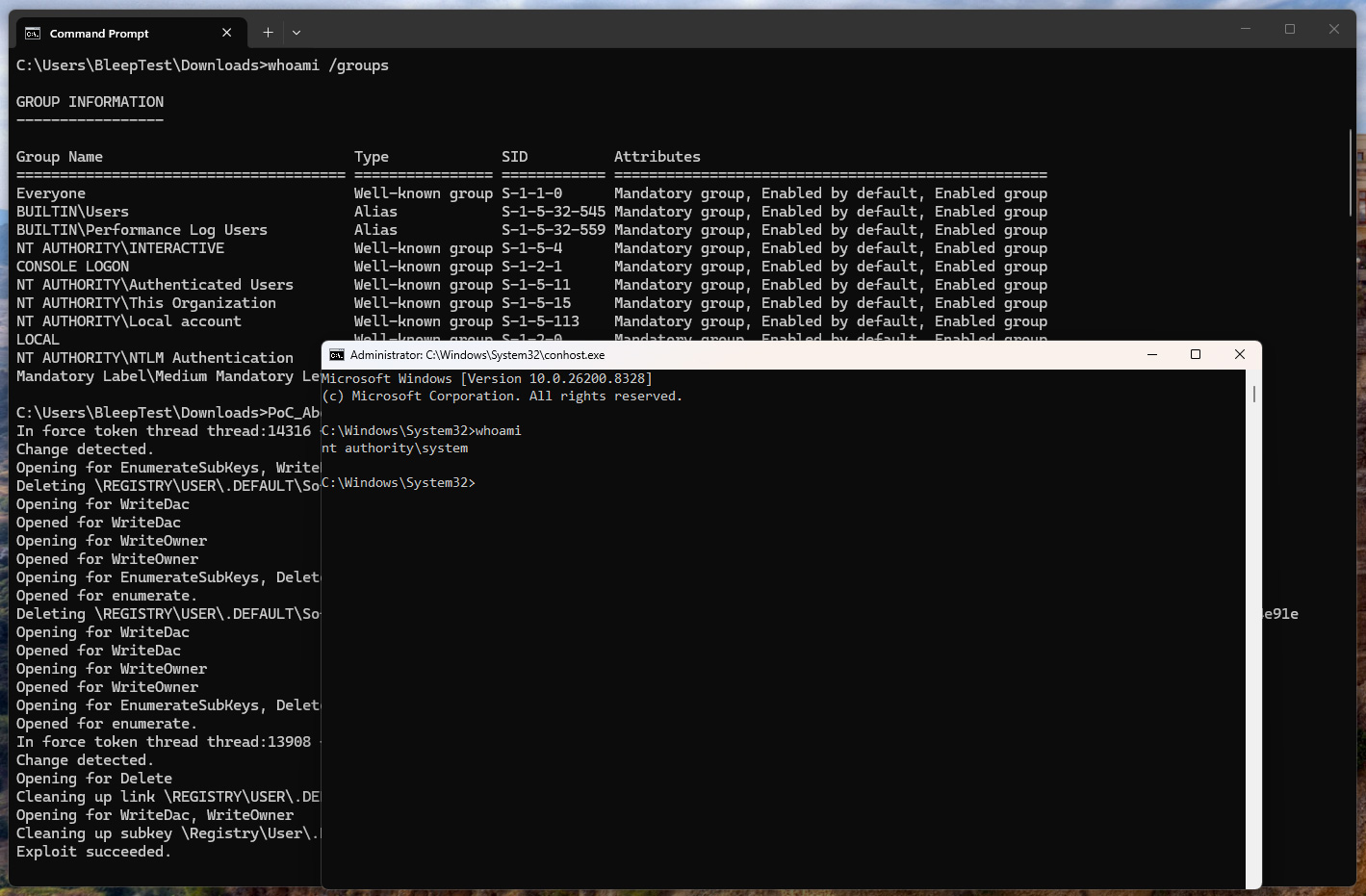
A researcher known as Chaotic Eclipse has released a proof-of-concept exploit for a new Windows zero-day dubbed MiniPlasma, which BleepingComputer confirmed can grant SYSTEM privileges on fully patched Windows 11 systems. The researcher claims the bug is effectively a still-exploitable version of a 2020 flaw Microsoft said it had fixed. From the report: At the time, the flaw was assigned the CVE-2020-17103 identifier and reportedly fixed in December 2020. "After investigating, it turns out the exact same issue that was reported to Microsoft by Google project zero is actually still present, unpatched," explains Chaotic Eclipse. "I'm unsure if Microsoft just never patched the issue or the patch was silently rolled back at some point for unknown reasons. The original PoC by Google worked without any changes."

BleepingComputer tested the exploit on a fully patched Windows 11 Pro system running the latest May 2026 Patch Tuesday updates. In our test, we used a standard user account, and after running the exploit, it opened a command prompt with SYSTEM privileges, as shown in the image [here]. Will Dormann, principal vulnerability analyst at Tharros, also confirmed the exploit works in his tests on the latest public version of Windows 11. However, he said that the flaw does not work in the latest Windows 11 Insider Preview Canary build.

The exploit appears to abuse how the Windows Cloud Filter driver handles registry key creation through an undocumented CfAbortHydration API. Forshaw's original report said that the flaw could allow arbitrary registry keys to be created in the .DEFAULT user hive without proper access checks, potentially enabling privilege escalation. While Microsoft reports having fixed the bug as part of its December 2020 Microsoft Patch Tuesday, Chaotic Eclipse now claims the vulnerability can still be exploited.

Facebook

Meta Layoffs Stress Harsh AI Reality Inside Zuckerberg's Company (cnbc.com) 46

Meta is expected to begin cutting about 8,000 jobs this week as it pours more money into AI infrastructure and looks to "offset" other investments, with additional layoffs reportedly possible later this year. According to CNBC, the morale has worsened inside the company. "Internally, there's an emerging sense of dread across wide swaths of the company," the report says, citing current and former Meta employees. "That's in part because more cuts are expected this year, including a potential round of layoffs in August, followed by another round later in the year, some of the sources said." From the report: [...] Whatever anxiety investors are experiencing, the feelings inside the company are more intense, with some longtime staffers questioning Meta's AI pursuits under AI chief Alexandr Wang, while also weighing if now is the time to leave for opportunities at other companies in the AI race, according to current and former employees. Data aggregated by Blind, an anonymous professional network that requires users to verify their employment with a work email address, reveals some of the internal malaise. Meta's overall rating by employees on Blind has declined 25% from a peak in the second quarter of 2024 to the current period, with a 39% drop in its culture rating. In every category other than compensation, Meta has seen a ratings decline and dramatically underperforms rivals Amazon, Google and Netflix, the Blind data reveals.

The company's full-court press with AI included the recent debut of an employee tracking tool intended to collect data from staffers' actions, such as mouse movements and keystrokes on their work computers. The Model Capability Initiative, or MCI, as it's called, is part of Meta's efforts to train AI models to power digital agents that can perform various coding and white-collar tasks. Employees have characterized the data tracking tool as "dystopian," according to messages viewed by CNBC, with some workers expressing fear that personal information could be leaked. Some Meta workers have noted that their workplace computers appear slower since the company initiated the project, adding to their frustration, sources said.

Meta workers responded by creating an online petition that urges Zuckerberg and leadership to shutter the project. "Collecting and repurposing this kind of data raises serious concerns around privacy, consent, and trust in the workplace," the petition says. "It should not be the norm that companies of any size are permitted to exploit their employees by nonconsensually extracting their data for the purposes of AI training."
Further reading: NYT: 'Meta's Embrace of AI Is Making Its Employees Miserable'
Microsoft

Microsoft Testing Adjustable Taskbar, Start Menu In Windows 11 (bleepingcomputer.com) 98

Microsoft is testing long-requested Windows 11 customization options, including a resizable taskbar, smaller taskbar buttons, and a more configurable Start menu that lets users reduce recommended content. BleepingComputer reports: Starting with Windows 11 Insider Preview Build 26300.8493, the taskbar can now be configured to use smaller buttons and moved to the bottom, top, left, or right side of the screen. "The ability to move the taskbar to the top or sides of the screen has been one of the most requested features, and we are bringing it to Windows 11," said Diego Baca, partner director of Microsoft Design. "With this update, when small taskbar is enabled, you get smaller icons, a shorter taskbar, and more vertical space for your apps (see video below). No restart or sign-out is required."

[...] Microsoft is also rolling out changes to give Windows users more control over the Start menu, allowing them to toggle off recommended content and customize its size. "These controls are designed to work together. If you want a Start menu with just your pinned apps, you can turn off Recommended and All," Boca added. "If you want a full Start that shows everything, you can leave it all on. The goal is simple: it is your choice, and it should be easy to make." However, Microsoft will maintain a list of recently installed apps, as it is a key way for users to discover new applications alongside the Microsoft Store.

Furthermore, Microsoft is improving file relevance by adjusting how files are displayed and ordered to prioritize the most relevant items, and will also allow users to hide their name and profile picture from the Start menu. [...] In addition to taskbar and Start menu improvements, the company plans to reduce notifications, simplify Windows settings, and ensure that device setup on new Windows PCs requires fewer reboots. Microsoft is also working on improving Windows search, aiming for a more consistent experience across the Start menu, taskbar, File Explorer, and Settings.

The Internet

Iran Now Threatens Fees for Subsea Internet Cables in the Strait of Hormuz (cnn.com) 480

Iran's government "wants to charge the world's largest tech companies for using the subsea internet cables laid under the Strait of Hormuz," reports CNN. Their article also notes that Iran's state-linked media outlets "have vaguely threatened that traffic could be disrupted if firms don't pay." Lawmakers in Tehran discussed a plan last week which could target submarine cables linking Arab countries to Europe and Asia. "We will impose fees on internet cables," Iranian military spokesperson Ebrahim Zolfaghari declared on X last week. Iran's Revolutionary Guards-linked media said Tehran's plan to extract revenue from the strait would require companies like Google, Microsoft, Meta, and Amazon to comply with Iranian law while submarine cable companies would be required to pay licensing fees for cable passage, with repair and maintenance rights given exclusively to Iranian firms. Some of these companies have invested in the cables running through the Strait of Hormuz and the Persian Gulf, but it's unclear if those cables traverse Iranian waters.

It's also unclear how the regime could force tech giants to comply, as they are barred from making payments to Iran due to strict US sanctions; as a result, the companies themselves may view Iran's statements as posturing rather than serious policy. Still, state-affiliated media outlets have issued veiled threats warning of damage to cables that could impact some of the trillions of dollars in global data transmission and affect worldwide internet connectivity... Iran's threats are part of a strategy to demonstrate its leverage over the Strait of Hormuz and ensure the survival of the regime, a core objective for the Islamic Republic in this war, said Dina Esfandiary, Middle East lead at Bloomberg Economics. "It aims to impose such a hefty cost on the global economy that no-one will dare attack Iran again," she said.

The article notes that subsea cables "carry vast internet and financial traffic between Europe, Asia and the Persian Gulf," and that targetting them "would affect far more than internet speeds, threatening everything from banking systems, military communications and AI cloud infrastructure to remote work, online gaming and streaming services."

CNN spoke to Mostafa Ahmed, "a senior researcher at the United Arab Emirates-based Habtoor Research Center, who published a paper on the effects of a large-scale attack on submarine communications infrastructure in the Gulf." Armed with combat divers, small submarines, and underwater drones, the Islamic Revolutionary Guard Corps (IRGC) poses a risk to underwater cables, Ahmed said, adding that any attack could trigger a cascading "digital catastrophe" across several continents. Iran's neighbors across the Persian Gulf could face severe disruptions to internet connection, potentially impacting critical oil and gas exports as well as banking.

Beyond the region, India could see a large proportion of its internet traffic affected, threatening its huge outsourcing industry with losses amounting to billions, according to Ahmed... Any disruption could also slow financial trading and cross-border transactions between Europe and Asia, while parts of East Africa could face internet blackouts. And if Iran's proxies decide to employ similar tactics in the Red Sea, the damage could be far worse.

Education

US Math/Reading Scores Continue 13-Year Decline. Researchers Blame Reduced Testing and Social Media (time.com) 132

Test scores "are lower than they were a decade ago in school districts across the U.S.," reports Times magazine, citing new data released Wednesday by Stanford researchers. "Reading scores were down roughly 0.6 grades in 2025 compared to 2015, and math scores were down about 0.4 grades. This means that students were 60% of one school year behind where their peers were in reading a decade earlier and 40% of one school year behind in math."

But Stanford's announcement notes that America's schools "were in a 'learning recession' for seven years before the COVID-19 pandemic, with student test scores in math and reading on a steady decline since 2013." This reversal ended two decades of progress, according to Sean Reardon, the Professor of Poverty and Inequality at Stanford Graduate School of Education, whose data forms the backbone of the new research... The study reframes the narrative of pandemic-era learning loss, arguing that the crisis of the last few years was an acceleration of a problem that was already underway. "The pandemic was the mudslide that followed seven years of erosion in student achievement," said Professor Tom Kane, faculty director of the Center for Education Policy Research at Harvard University, and a lead author of the report...

The study found that the slowdown in learning coincided with two major shifts in American childhood and education policy: the widespread dismantling of test-based accountability systems that defined the No Child Left Behind era and the rise of social media use among young people. Reading scores, in particular, suffered consistently, with the average annual loss in the years just before the pandemic being just as large as the loss during it... Today, 8th-grade reading scores on national assessments are at their lowest point since 1990.

Compounding the problem, chronic student absenteeism remains a major obstacle to improving learning. Though down from its pandemic peak, 23 percent of students were chronically absent in the 2024-25 school year, far above the pre-pandemic rate of 15 percent.

More context from Time magazine: Reading scores were down roughly 0.6 grades in 2025 compared to 2015, and math scores were down about 0.4 grades. This means that students were 60% of one school year behind where their peers were in reading a decade earlier and 40% of one school year behind in math...

"The decline started around the time that social media's use among teens was exploding, and this was also occurring in a number of other countries," says Thomas Kane, one of the authors of the Educational Scorecard report and a professor at Harvard University... [H]e maintains that it is at the core of the decline in reading achievement. He points out that social media use was shown to be heaviest among the lowest achieving students.

"Some states and school districts are making progress," notes the Associated Press, "largely by shifting toward phonics-based instruction and providing extra support for struggling readers."

And "The picture is also brighter in math. Almost every state in the analysis saw improvements in math test scores from 2022 to 2025."
Transportation

How Owners of EVs from Bankrupt Fisker Saved Their Cars With an Open Source Nonprofit (electrek.co) 50

An anonymous reader shared this report from Electrek: When Fisker Inc. filed for Chapter 11 bankruptcy in June 2024, it left roughly 11,000 Ocean SUV owners holding the keys to vehicles that cost them anywhere from $40,000 to $70,000 — and that were rapidly losing the software brains that made them work. No more over-the-air updates. No more connected services. No more warranty. The manufacturer was dead.

What happened next is one of the most remarkable stories in the history of the electric vehicle industry. Instead of accepting that their cars would become rolling paperweights, Fisker Ocean owners organized, reverse-engineered their vehicles' proprietary software, hacked into CAN bus networks, built open-source tools on GitHub, and effectively stood up a volunteer-run open-sourced car company from the ashes of Fisker... Within months of the bankruptcy filing, thousands of Ocean owners formed the Fisker Owners Association (FOA) — a nonprofit that quickly grew to 4,000 members and began operating as something between a car club, a tech startup, and an independent automaker. The FOA hired independent tech experts who began reverse-engineering Fisker's proprietary software patches. Members taught each other how to flash firmware. They organized bulk purchases of replacement parts — negotiating the price of key fobs down from roughly $1,000 each to a fraction of that through coordinated group buys. They hosted free global key fob pairing events, saving each owner $100 to $250...

What started as desperate troubleshooting has evolved into a genuine open-source ecosystem around the Fisker Ocean. On GitHub, a developer named MichaelOE reverse-engineered the API behind Fisker's official "My Fisker" mobile app and built a Home Assistant integration that exposes every cloud API value as a sensor — with all the app's buttons available as Home Assistant controls... [Community members have also been systematically mapping CAN bus files.]

The article noes this "is not an isolated incident. Nikola also filed for bankruptcy, leaving its owners in a similar bind. Canoo and Arrival are headed for liquidation auctions..." Consumer advocates are now pushing for structural changes: mandatory software escrow funds that would keep vehicle software running even if the manufacturer disappears, open-source mandates in bankruptcy proceedings, and shared repair data requirements... European automakers, meanwhile, are moving in a different direction entirely — Volkswagen, BMW, Mercedes-Benz, and eight suppliers signed a memorandum in 2025 to develop a shared open-source automotive software platform....

The Fisker Owners Association has proven that a dedicated community can keep orphaned EVs on the road. But they shouldn't have had to... [O]wners shouldn't need to become hackers and parts brokers and quasi-manufacturers just to keep driving the cars they already paid for.

Graphics

AMD Is Bringing Improved FSR 4 Upscaling To Its Older GPUs (arstechnica.com) 10

AMD says FSR 4.1 will finally bring its newer hardware-accelerated upscaling technology to older Radeon GPUs. "The rollout will begin in July with RDNA3- and 3.5-based GPUs, which include the Radeon RX 7000 series, as well as integrated GPUs like the Radeon 890M and Radeon 8060S," reports Ars Technica. "In 'early 2027,' support will also be extended to the RDNA2 architecture, which includes the Radeon RX 6000 series, integrated GPUs like the Radeon 680M, and the Steam Deck's GPU. This would also open the door to supporting FSR 4 on the PlayStation 5 and Xbox Series X and S, all of which also use RDNA2-based GPUs." From the report: [AMD Computing and Graphics SVP Jack Huynh's] short video presentation didn't get into performance comparisons, but did mention that AMD had to work to get FSR 4's superior hardware-backed upscaling working on its older graphics architectures. RDNA4 includes AI accelerators that support the FP8 data format in the hardware, and porting FSR 4 to older GPUs meant getting it running on the integer-based INT8 hardware in the RDNA3 and RDNA2-based GPUs.

This may mean that FSR 4.1 running on an RDNA3 or RDNA2-based GPU may come with a larger performance hit relative to RDNA4 cards, or that image quality may differ slightly. Modders have already worked to get FSR4 working on INT8-supporting GPUs, and the older GPUs reportedly see a 10 to 20 percent performance hit relative to FSR 3.1 running on the same hardware. AMD's official implementation may or may not improve on these numbers.

[...] Any games that support FSR 4 should be able to support FSR 4.1 running on Radeon 7000-series cards; users will presumably be able to install a driver update in July that enables the new feature. Games that support the older FSR 3.1 can also be forced to use FSR 4 in the Radeon graphics driver.

Security

Bitwarden Scrubs 'Always Free' and 'Inclusion' Values From Its Website (fastcompany.com) 70

Bitwarden appears to be undergoing a quiet shift in leadership and messaging. Its longtime CEO and CFO have stepped down, while the company has removed "Always free" from a prominent password-manager page and replaced "Inclusion" and "Transparency" in its GRIT values with "Innovation" and "Trust." Fast Company reports: In February, longtime CEO Michael Crandell moved to an advisory role, according to LinkedIn, with no announcement from the company. His replacement, Michael Sullivan, former CEO of both Acquia and Insightsoftware, touts his experience with "all facets of mergers and acquisitions" on his own LinkedIn page, including experience working with leading private equity firms. CFO Stephen Morrison also left Bitwarden in April, replaced by former InVision CEO Michael Shenkman. Both Crandell and Morrison joined the company in 2019. Kyle Spearrin, who started Bitwarden as a fun hobby project in 2015, remains the company's CTO.

Meanwhile, Bitwarden has made some subtle tweaks to its website. The page for its personal password manager no longer includes the phrase "Always free." Previously this appeared under the "Pick a plan" section partway down the page, but that section no longer mentions the free plan, though it remains available elsewhere on the page. Bitwarden made this change in mid-April, according to the Internet Archive. Bitwarden has also stopped listing "Inclusion" and "Transparency" as tentpole values on its careers page. The company has long defined its values with the acronym "GRIT," which used to stand for "Gratitude, Responsibility, Inclusion, and Transparency." After May 4, it changed the acronym to stand for "Gratitude, Responsibility, Innovation, and Trust." The phrase "inclusive environment" still appears under a description of Gratitude, while "transparency" is mentioned under the Trust heading. They're just no longer the focus.

Google

The Era of 15GB Free Gmail Storage Is Ending (androidauthority.com) 99

Google has confirmed it is testing a 5GB storage limit for some new Gmail accounts, with users able to unlock the standard 15GB by adding a phone number. Android Authority reports: While the company didn't mention which regions are impacted, user reports from yesterday were mostly from African countries. That said, if Google's tests prove successful, this could possibly become the norm for new sign-ups in more regions. The company could be testing ways to discourage users from creating multiple Gmail accounts to access free cloud storage. However, if you already have a Gmail account with 15GB free storage, it shouldn't be impacted by this change.

The language on Google's support page mentions "up to 15GB of storage." However, it's a recent change. An archived version of the support page from February did not use the words "up to." Whether the test has been running since early March or Google updated its language before it ever started the test, it's evident that the company could roll out the change globally as well.

Transportation

Congress Introduces Bill To Permanently Block Chinese Vehicles From US (caranddriver.com) 122

Longtime Slashdot reader sinij shares a report from Car and Driver: A group of Michigan lawmakers has introduced a bill in Congress that would effectively place a permanent ban on Chinese connected vehicles from being sold in the United States. While an executive order signed by Joe Biden in early 2025 already imposed heavy restrictions, the new bill would codify and expand on the ban, as first reported by Autoweek and explained in a release by the House of Representatives Select Committee on China.

The bill, titled the Connected Vehicle Security Act, was co-signed by John Moolenaar, a Michigan Republican, and Debbie Dingell, a Michigan Democrat. It joins a companion version of the same Connected Vehicle Security Act introduced last month to the Senate by Sen. Bernie Moreno, an Ohio Republican, and Sen. Elissa Slotkin, a Michigan Democrat. While the wording is similar to that found in former President Biden's January 2025 executive order, the new bill would codify the language into law, as well as determine rules for compliance and enforcement.

Specifically, the new bill would restrict Chinese automakers from selling passenger cars in the United States if those vehicles contain any China-developed connectivity software. Officially, the bill covers the sale of vehicles from states deemed "foreign adversary countries," which include China, Russia, North Korea, and Iran. The proposed legislation arrives as Chinese automakers including Chery, Geely, and BYD (maker of the 2026 BYD Dolphin Surf, shown above), continue to rise in prominence in foreign markets around the world.
"Doing the right thing for the wrong reasons," comments sinij. "Connected cars that spy on consumers are not a uniquely Chinese problem and should be addressed for all vehicles."
Transportation

Honda Retreats To Hybrids After Failed EV Bet Triggers Record $9 Billion Loss (electrek.co) 157

An anonymous reader quotes a report from Electrek: Honda is waving the white flag. The Japanese automaker previewed two new hybrids set to launch by 2028 after taking an over $9 billion hit over its failed EV bet, leading to its biggest loss in company history. Honda admitted it was "unable to deliver products that offer value for money better than that of new EV manufacturers, resulting in a decline in competitiveness," after suddenly announcing plans to cancel three new EVs in the US in March, warning restructuring costs could reach 2.5 trillion yen ($15.7 billion).

After posting its first annual loss since it became a publicly traded company in 1957 on Thursday, Honda's CEO Toshihiro Mibe revealed the company's comeback plans. Honda is no longer planning to phase out gas-powered vehicles by 2040. Instead, Honda now aims "to achieve carbon neutrality by 2050," including a mix of EVs, hybrids, carbon-neutral fuels, and carbon-offset tech. Starting next year, Honda plans to begin introducing its next-gen hybrids, underpinned by a new hybrid system and platform. Honda said it aims to improve fuel economy by over 10% in its upcoming hybrids. The new system is expected to help cut costs by over 30% compared to Honda's current hybrid system.

By the end of the decade, Honda plans to launch 15 new hybrid models globally. In North America, its most important market, the company will introduce larger hybrids in the D-segment or above. Honda previewed two of the new hybrids during the business update: the Honda Hybrid Sedan Prototype and the Acura Hybrid SUV Prototype, which the company said will go on sale within the next two years.

United Kingdom

UK Antitrust Regulator Is Officially Investigating Microsoft Office (engadget.com) 58

The UK's Competition and Markets Authority is opening a formal investigation into whether Microsoft's bundling of Windows, Office, Teams, Copilot, and related products harms competition. Engadget reports: "Our aim is to understand how these markets are developing, Microsoft's position within them and to consider what, if any, targeted action may be needed to ensure UK organizations can benefit from choice, innovation and competitive prices," CMA Chief Executive Sarah Cardell said in a statement published by Reuters.

She also stressed the importance of the investigation by noting that hundreds of thousands of UK residents use business software and Microsoft products. The organization will take a look into the company's cloud licensing practices. The CMA has stated that the inquiry will conclude by February. At that point, Microsoft could get slapped with a strategic market label.

Microsoft says it's "committed to working quickly and constructively with the CMA to facilitate its review of the business software market." A strategic market designation doesn't automatically assume wrongdoing, but will give the CMA more leeway when conducting further interventions.

Cellphones

AT&T, Verizon, T-Mobile Team Up To Eliminate 'Dead Zones' Across US (droid-life.com) 42

AT&T, Verizon, and T-Mobile have agreed in principle to form a joint venture (JV) aimed at reducing U.S. mobile dead zones through satellite connectivity, especially in rural areas and during emergencies when ground networks fail. Here are three of the customer benefits listed by the JV (as highlighted by Droid Life): Fewer coverage gaps: Will nearly eliminate dead zones in the U.S. currently without mobile service, reaching previously unserved areas.
Reliable connectivity in emergencies: Redundant connectivity will become available when existing ground-based networks are unavailable due to extreme natural disasters or other unusual disruptions.
Improved network performance: Will give customers more consistent performance and simpler access to satellite services across providers. This will speed up feature updates and improve connectivity for everyone, everywhere.
"It will still take time for these improvements to be available to customers, but this all seems like a positive step," writes Droid Life's Tim Wrobel.

Slashdot Top Deals