Databases

Amazon Will Be Off All Oracle Databases By End of 2019, Says AWS Chief 61

Amazon Web Services CEO Andy Jassy said in an interview on Wednesday that almost all of Amazon's databases that ran on Oracle will be on an Amazon database instead. "We're virtually done moving away from Oracle on the database side," Jassy said. "And I think by the end of 2019 or mid-2019 we'll be done." CNBC reports: Amazon is reducing its reliance on Oracle for its data needs and is instead using its own services. Jassy said 88 percent of Amazon databases that were running on Oracle will be on Amazon DynamoDB or Amazon Aurora by January. He added that 97 percent of "mission critical databases" will run on DynamoDB or Aurora by the end of the year. On Nov. 1, Amazon moved its data warehouse from Oracle to its own service, Redshift, Jassy said.
Businesses

Dell Says It Detected A Security Breach Earlier This Month, But Financial Data Was Not Exposed (zdnet.com) 17

An anonymous reader quotes writes: "Hardware giant Dell announced today a security breach that took place earlier this month, on November 9," reports ZDNet. "Dell says it detected an unauthorized intruder (or intruders) 'attempting to extract Dell.com customer information' from its systems, such as customer names, email addresses, and hashed passwords." These are accounts used for shopping on the official website and the official support forums. "Though it is possible some of this information was removed from Dell's network, our investigations found no conclusive evidence that any was extracted," the company said in a press release, also adding that hackers didn't target payment card or any other sensitive customer information. After it detected the breach, Dell initiated a password reset for all Dell.com customer accounts. The company also said it notified law enforcement and hired a digital forensics firm to perform an independent investigation.
Windows

Microsoft Releases Windows 10 Build 18290 With Start Menu Improvements (betanews.com) 205

DarkRookie2 shares a report a report about Windows 10 Build 18290 for Insiders, which comes with a number of improvements and additions. BetaNews reports: The most noticeable change is to the Start menu which gets a touch of Fluent design, making it look more attractive. Icons have also been added to the power and user menus. The Search and Cortana areas have been given a bit of a cleanup as well. Also new in this build is an option in the Date & Time Settings that will let you manually synchronize your clock with the time server. If you suspect your PC clock might be showing the wrong time, this will let you check and correct the problem if you're right. You can now also check to see which app is using your microphone (just hover over the microphone icon to see), and when your PC has an update that requires a reboot, you'll now be informed via an orange Windows Update indicator in the system tray.
Transportation

Elon Musk's Boring Company Cancels Los Angeles Tunnel Following Lawsuit (gizmodo.com) 277

Elon Musk's Boring Company has settled a lawsuit preventing the company from building a tunnel beneath the 405 freeway in Los Angeles. "[T]he cancellation of the Westside tunnel project is a major blow to Musk's grand plan in the City of Angels," reports Gizmodo. From the report: The Los Angeles Times reports that the project's demise began shortly after the Boring Company obtained a preliminary exemption to skip California's environmental review process and start digging. The city's authorities have been friendly to Musk's plans, but a group of residents in the Westside area filed an environmental suit in May alleging that the tunnel violates state law. The crux of the group's argument was that the Westside tunnel is part of a larger project that the company outlined with a map late last year. According to the suit, California law forbids the approval of individual facets of a larger project, stating that a full environmental review can't "be evaded by chopping large projects into smaller pieces that taken individually appear to have no significant environmental impacts."

The Westside group did not get a ruling on its lawsuit; instead, it seems the two parties settled. The Boring Company did not immediately respond to a request for comment from Gizmodo, but it sent a statement to NBC News that reads: "The parties (The Boring Company, Brentwood Residents Coalition, Sunset Coalition, and Wendy-Sue Rosen) have amicably settled the matter of Brentwood Residents Coalition et al. v. City of Los Angeles (TBC -- The Boring Company). The Boring Company is no longer seeking the development of the Sepulveda test tunnel and instead seeks to construct an operational tunnel at Dodger Stadium."

Google

Google Has a Plan To Eliminate Mosquitoes Around the World (bloombergquint.com) 326

Zorro shares a report: Silicon Valley researchers are attacking flying bloodsuckers in California's Fresno County. It's the first salvo in an unlikely war for Google parent Alphabet: eradicating mosquito-borne diseases around the world. A white high-top Mercedes van winds its way through the suburban sprawl and strip malls as a swarm of male Aedes aegypti mosquitoes shoot out of a black plastic tube on the passenger-side window. These pests are tiny and, with a wingspan of just a few millimeters, all but invisible. "You hear that little beating sound?" says Kathleen Parkes, a spokesperson for Verily Life Sciences, a unit of Alphabet. She's trailing the van in her car, the windows down. "Like a duh-duh-duh? That's the release of the mosquitoes."

Jacob Crawford, a Verily senior scientist riding with Parkes, begins describing a mosquito-control technique with dazzling potential. These particular vermin, he explains, were bred in the ultra-high-tech surroundings of Verily's automated mosquito rearing system, 200 miles away in South San Francisco. They were infected with Wolbachia, a common bacterium. When those 80,000 lab-bred Wolbachia-infected, male mosquitoes mate with their counterpart females in the wild, the result is stealth annihilation: the offspring never hatch. Better make that 79,999. "One just hit the windshield," says Crawford. Mosquito-borne disease eradication is serious stuff for Alphabet, though it is just one of many of the company's forays into health care and life sciences.

Businesses

Amazon Enters Blockchain Market With Cloud-Computing Services (bloomberg.com) 34

Amazon.com is jumping on the blockchain wave with new cloud services that help customers build the technology needed to record transactions. From a report: Amazon Web Services Chief Executive Officer Andy Jassy on Wednesday announced Amazon Managed Blockchain, a new service underpinning blockchain networks that record millions of transactions. The company spent the past year studying the needs of customers interested in blockchain solutions before creating the new products, Jassy said.

The service can be used to manage peer-to-peer payments, process loans and help businesses transact with distributors and suppliers, Jassy said. AWS announced a string of other new or updated cloud offerings, seeking to maintain its lead in the market for internet-based computing.
The company also announced a new service called Amazon Quantum Ledger Database or QLDB, which is a fully managed ledger database with a central trusted authority. The service, which is launching into preview today, offers an append-only, immutable journal that tracks the history of all changes, Amazon said. And all the changes are cryptographically chained and verifiable.
IT

CeBIT, World's Largest IT Conference, Canned (dw.com) 74

Despite turning the trade fair into a fun fair, organizers could not save the beloved but struggling trade fair. CeBIT once boasted 850,000 visitors a year, but that heyday has long since passed. An anonymous reader shares a report: Organizers announced on Wednesday that the world's largest IT conference will be no more. CeBIT, held every year in Hanover, Germany, has been canceled for 2019 facing declining visitor numbers and decreases in exhibition space rentals. "There will be no more CeBIT in Germany in the future," said Onuora Ogbukagu of Deutsche Messe AG, which ran the trade fair that hosted the likes of Apple co-founder Steve Wozniak and data privacy advocate Edward Snowden.

CeBIT was once considered the best barometer of technological trends, and during the dot-com boom in the late 90s and early 2000s, it boasted some 850,000 visitors a year. However, that number has been declining for years, despite cultivating a 'fun fair' atmosphere. The news was met with an outpouring of gratitude for the conference-meets-festival on social media, with many calling it the "end of an era."

Privacy

Real Life Ads Are Taking Scary Inspiration From Social Media (medium.com) 73

Advertisements in the real world are becoming more technologically sophisticated, integrating facial recognition, location data, artificial intelligence, and other powerful tools that are more commonly associated with your mobile phone. Welcome to the new age of digital marketing. From a report: During this year's Fashion Week in New York, a digital billboard ad for New Balance used A.I. technology to detect and highlight pedestrians wearing "exceptional" outfits. A billboard advertisement for the Chevy Malibu recently targeted drivers on Interstate 88 in Chicago by identifying the brand of vehicle they were driving, then serving ads touting its own features in comparison. And Bidooh, a Manchester-based startup that admits it was inspired by Minority Report, is using facial recognition to serve ads through its billboards in the U.K. and other parts of Europe as well as South Korea. According to its website, Bidooh allows advertisers to target people based on criteria like age, gender, ethnicity, hair color, clothing color, height, body shape, perceived emotion, and the presence of glasses, sunglasses, beards, or mustaches.

We've been on the path here since at least a decade ago when the New York Times reported that some digital billboards were equipped with small cameras that could analyze a pedestrian's facial features to serve targeted ads based on gender and approximate age. Things have progressed as you'd expect: In 2016, another Times report described how Clear Channel Outdoor Americas had partnered with companies including AT&T to track people via their mobile phones. The ads could determine the gender and average age of people passing different billboards and determine whether they visited a store after seeing an ad.

Cloud

Amazon Web Services Introduces its Own Custom-Designed ARM Server Processor, Promises 45 Percent Lower Costs For Some Workloads (geekwire.com) 65

After years of waiting for someone to design an ARM server processor that could work at scale on the cloud, Amazon Web Services just went ahead and designed its own. From a report: Vice president of infrastructure Peter DeSantis introduced the AWS Graviton Processor Monday night, adding a third chip option for cloud customers alongside instances that use processors from Intel and AMD. The company did not provide a lot of details about the processor itself, but DeSantis said that it was designed for scale-out workloads that benefit from a lot of servers chipping away at a problem. The new instances will be known as EC2 A1, and they can run applications written for Amazon Linux, Red Hat Enterprise Linux, and Ubuntu. They are generally available in four regions: US East (Northern Virginia), US East (Ohio), US West (Oregon), and Europe (Ireland). Intel dominates the market for server processors, both in the cloud and in the on-premises server market. AMD has tried to challenge that lead over the years with little success, although its new Epyc processors have been well-received by server buyers and cloud companies like AWS. John Gruber of DaringFireball, where we first spotted this story, adds: Makes you wonder what the hell is going on at Intel and AMD -- first they missed out on mobile, now they're missing out on the cloud's move to power-efficient ARM chips.
The Almighty Buck

The App Destroying Iran's Currency (foreignpolicy.com) 83

Iranians are using the messaging app Telegram to spread fake news about the rial -- and make a profit for themselves. From a report: Iranian President Hassan Rouhani owes his re-election in large part to the messaging app Telegram. During Iran's 2017 presidential election, Iranians relied on the app as a rare source of uncensored news about the race, in which Rouhani was not the candidate most favored by hard-liners. Just one year later, Telegram may end up becoming Rouhani's downfall. The app is at the center of Iran's accelerating currency crash.

The Iranian rial was generally acknowledged to have been on a stable path until May, when U.S. President Donald Trump exited the Iran nuclear deal. Prior to the U.S. withdrawal, one U.S. dollar was worth around 37,000 rials; immediately afterwards, a single dollar jumped to around 44,000 rials. The rial has continued to slump ever since, dropping to 50,000 to the dollar, and then 80,000 rials, and then 190,000 during Rouhani's speech at the United Nations General Assembly in September. Right now, it is at 120,500 rials. But it isn't just U.S. sanctions and the fundamental weaknesses of the Iranian economy that have contributed to Iran's currency freefall. It's also the deliberate circulation of rumors and fake news on Telegram by Iranian currency traders and middlemen out to make a profit.

The Internet

Music Industry Asks US Government To Reconsider Website Blocking (torrentfreak.com) 203

An anonymous reader quotes a report from TorrentFreak: At the start of this decade, U.S. lawmakers drafted several controversial bills to make it easier for copyright holders to enforce their rights online. These proposals, including SOPA and PIPA, were met with fierce resistance from the public as well as major technology companies. They feared that the plans, which included pirate site-blocking measures, went too far. In the many years that followed, the "site blocking" issue was avoided like the plague. The aversion was mostly limited to the U.S., as website blocking became more and more common abroad, where it's one of the entertainment industries' preferred anti-piracy tools.

Emboldened by these foreign successes, it appears that rightsholders in the U.S. are now confident enough to bring the subject up again, albeit very gently. Most recently the site-blocking option was mentioned in a joint letter (PDF) from the RIAA and the National Music Publishers' Association (NMPA), which contained recommendations to the Intellectual Property Enforcement Coordinator (IPEC) Vishal Amin. The IPEC requested input from the public on the new version of its Joint Strategic Plan for Intellectual Property Enforcement. According to the music industry groups, website blocking should be reconsidered an anti-piracy tool.
"There are several changes that should be made legislatively to help legal authorities and third parties better protect intellectual property rights," the music groups write. "These include fixing the DMCA, making it a felony to knowingly engage in unauthorized streaming of copyrighted works, and investigating the positive impact that website blocking of foreign sites has in other jurisdictions and whether U.S. law should be revised accordingly."

"As website blocking has had a positive impact in other countries without significant unintended consequences, the U.S. should reconsider adding this to its anti-piracy tool box," the RIAA and NMPA write.
Businesses

Lowe's To Sell Off Its 'Under-Performing' Iris Smart Home Automation Business (cepro.com) 119

CIStud shares a report from CE Pro: Giant home improvement retailer Lowe's is giving up on the smart home market. The company announced its "difficult decision" to exit the home automation market and is seeking a buyer for its Iris Smart Home business as part of a "strategic reassessment." The announcement is part of multiple other maneuvers by Lowe's that include closing its Orchard Supply Hardware business, dumping its Alacrity Renovation Service, shutting down all its locations in Mexico, and shutting more than 50 locations in the U.S. and Canada. Lowe's Iris was hailed as the only entry-level home automation system that handled ZigBee, Z-Wave and Wi-Fi when it came out in 2012. Speaking to investors, president and CEO Marvin Ellison [lumped Lowe's Iris in with other initiatives as an] "underperforming... non-core business."
Medicine

Amazon Starts Selling Software To Mine Patient Health Records (wsj.com) 84

An anonymous reader quotes a report from The Wall Street Journal: Amazon is starting to sell software to mine patient medical records (Warning: source paywalled; alternative source) for information that doctors and hospitals could use to improve treatment and cut costs, the latest move by a big technology company into the health care industry. The software can read digitized patient records and other clinical notes, analyze them and pluck out key data points, Amazon says. The company is expected to announce the launch Tuesday. Amazon Web Services, the company's cloud-computing division, has been selling such text-analysis software to companies outside medicine for use in areas such as travel booking, customer support and supply-chain management. The technology's health-care application is the newest effort by Amazon to tap into the lucrative market.

Amazon officials say the company's software developers trained the system using a process known as deep learning to recognize all the ways a doctor might record notes. "We're able to completely, automatically look inside medical language and identify patient details," including diagnoses, treatments, dosage and strengths, "with incredibly high accuracy," said Matt Wood, general manager of artificial intelligence at Amazon Web Services. During testing, the software performed on par or better than other published efforts, and can extract data on patients' diseases, prescriptions, lab orders and procedures, said Taha Kass-Hout, a senior leader with Amazon's health-care and artificial intelligence efforts.
The project is called Amazon Comprehend Medical, which "allows developers to process unstructured medical text and identify information such as patient diagnosis, treatments, dosages, symptoms and signs, and more," according to a blog post. Dr. Kass-Hout says Amazon Web Services won't see the data processed by its algorithms, "which will be encrypted and unlocked by customers who have the key," reports WSJ.
Medicine

Large Genetic Study Finds First Genes Connected With ADHD (arstechnica.com) 117

A paper published in Nature Genetics this week looked at genetic data from more than 50,000 people, finding 12 different regions of DNA that seemed to play a role in increasing ADHD risk. Ars Technica reports: This evidence comes from a genome-wide association study, or GWAS: a close look at how the DNA of people with ADHD differs from those without. Geneticist Ditte Demontis and her colleagues used data from more than 20,000 people with ADHD, comparing them to a control group of 35,000 people without an ADHD diagnosis. They found 304 points where tiny differences in DNA -- like single letter swaps -- were distributed across their two groups in a statistically telling way. If any of those variants were very close together, the researchers counted them as representing the same stretch of DNA, grouping them together into 12 important regions.

There were correlations between the genetic risk for ADHD and a range of other conditions, including depression and anorexia. That ties in with the idea that genetic variation might be important in a way that plays out system-wide. Some of the genes they identified are also known to be involved in other neurological conditions, including speech and learning disabilities, depression, and schizophrenia.

Privacy

Customer Service Agents Might Be Able To See What You're Typing In Real Time (gizmodo.com) 135

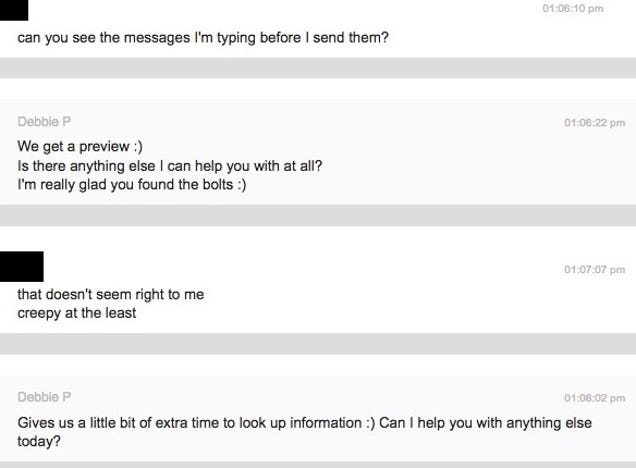
Gizmodo is warning that some customer service agents might be able to see what you're typing in real time. A reader sent them a transcript from a conversation they had with a mattress company after the agent responded to a message he hadn't sent yet. From the report: Something similar recently happened to HmmDaily's Tom Scocca. He got a detailed answer from an agent one second after he hit send. Googling led Scocca to a live chat service that offers a feature it calls "real-time typing view" to allow agents to have their "answers prepared before the customer submits his questions." Another live chat service, which lists McDonalds, Ikea, and Paypal as its customers, calls the same feature "message sneak peek," saying it will allow you to "see what the visitor is typing in before they send it over." Salesforce Live Agent also offers "sneak peak."

This particular magic trick happens thanks to JavaScript operating in your browser and detecting what's happening on a particular site in real time. It's also how companies capture information you've entered into web forms before you've hit submit. Companies could lessen the creepiness by telling people their typing is seen in real time or could eliminate the send button altogether. So if you don't want to be monitored or send secret messages to agents, put your phone on mute while on hold and copy/paste messages from another document to your customer service chatbox. And in general, be nice to customer service agents. It's not their fault.

Privacy

Urban Massage Data Breach Exposed Sensitive Comments On Its Creepy Clients (techcrunch.com) 38

An anonymous reader shares a report from TechCrunch: Urban Massage, a popular massage startup that bills itself as providing "wellness that comes to you," has leaked its entire customer database. The London, U.K.-based startup -- now known as just Urban -- left its Google-hosted ElasticSearch database online without a password, allowing anyone to read hundreds of thousands of customer and staff records. Anyone who knew where to look could access, edit or delete the database. It's not known how long the database was exposed or if anyone else had accessed or obtained the database before it was pulled. It's believed that the database was exposed for at least a few weeks.

Urban pulled the database offline after TechCrunch reached out. Among the records included thousands of complaints from workers about their clients. The records included specific complaints -- from account blocks for fraudulent behavior, abuse of the referral system and persistent cancelers. But, many records also included allegations of sexual misconduct by clients -- such as asking for "massage in genital area" and requesting "sexual services from therapist." Others were marked as "dangerous," while others were blocked due to "police enquiries." Each complaint included a customer's personally identifiable information -- including their name, address and postcode and phone number.

Youtube

YouTube To Make New Originals Available For Free, Ad-Supported Viewing (variety.com) 63

YouTube is removing the paywall for its original programming. Starting next year, the company will move to make all of its new original programming available for free for anyone to watch. "With the change, YouTube is moving toward more mainstream celebrity-driven and creator-based reality fare, while it will continue to greenlight scripted productions," reports Variety. From the report: Until now, YouTube Originals have mainly been available on its YouTube Premium subscription service, although YouTube also has expanded the shows and movies it makes available on an ad-supported basis. The company calls the new YouTube Originals strategy its "Single Slate," which will combine ad-supported and subscription VOD programming initiatives that by 2020 will provide free windows for all YouTube users. Some original productions will remain behind the paywall, including season 2 of "Cobra Kai," an offshoot of the "Karate Kid" movies. Moving forward, YouTube Premium will include early access to original, exclusive content as a reason to pay for the service. YouTube has faced stiff competition in trying to lure paying customers with original content against the likes of Netflix, Hulu and Amazon, which spend far more on content. "As we look to 2019, we will continue to invest in scripted programming and shift to make our YouTube Originals ad supported to meet the growing demand of a more global fanbase," a YouTube rep said in a statement. "This next phase of our originals strategy will expand the audience of our YouTube Original creators, and provide advertisers with incredible content that reaches the YouTube generation."
Cellphones

Google To Open Project Fi To iPhone, Samsung, and OnePlus (theverge.com) 66

Google's Project Fi mobile service will reportedly be adding support for Samsung, OnePlus, and iPhones. "More handsets from existing Fi partners LG and Motorola will also gain Fi support," reports The Verge. "The iPhone experience is apparently 'in beta,' which is a sign that users might run into bugs or be left without some of Fi's features." From the report: The lineup of "Fi-ready" compatible phones -- those that Google says have been fully optimized for the network -- is fairly short: Google is currently selling the Pixel 3, 3 XL, 2 XL, LG G7, LG V35, Moto G6, and Moto X4 (Android One edition) directly through its Project Fi website.

And although Google is apparently about to widen support and officially allow more devices onto Fi, those "Fi-friendly" phones will still offer the best overall user experience for subscribers, according to the report. It's not yet entirely clear what that means, but we should know more once Google makes a proper announcement. Either way, adding that pool of popular hardware will allow for many more consumers to give the service a shot and see if the pricing model and performance are preferable over Fi's larger competitors.

Youtube

YouTube Will Remove All Pop-up Annotations on January 15 (engadget.com) 91

Early last year, YouTube announced that it would be retiring annotations, those boxes that pop up during a video with links and additional information. It discontinued the annotations editor in May of last year and soon all existing annotations will be going away as well. From a report: The company added an update to the help page announcing the end of its annotations editor, saying, "We will stop showing existing annotations to viewers starting January 15, 2019. All existing annotations will be removed."
Communications

5G Will Cover Roughly 1.5 Billion People By 2024, Researchers Say (cnet.com) 43

By the end of 2025, 5G will reach more than 40 percent of the world's population and cover 1.5 billion people, according to the latest mobility report [PDF] from telecommunications company Ericsson, which says its networks currently carry nearly half the world's mobile traffic. From the report: 5G, short for fifth-generation network technology, promises a massive boost in speed and responsiveness. Industry watchers expect the first 5G smartphones to come out in the first half of next year. Researchers forecast that mobile data consumption will reach more than 21GB per month by 2024, which is nearly four times the consumption in 2018. 5G networks will carry 25 percent of global mobile data traffic, according to Ericsson. North America and North East Asia are expected to lead the 5G rollout, followed by Western Europe.

Slashdot Top Deals