Japan

Tokyo Warned of Power Crunch as Japan Endures Heat Wave (nbcnews.com) 74

The Japanese government warned of possible power shortages Monday in the Tokyo region, asking people to conserve energy as the country endures an unusually intense heat wave. From a report: Weather officials have announced the earliest end to the annual summer rainy season since the Japan Meteorological Agency began keeping records in 1951. The rains usually temper summer heat, often well into July. The economy and industry ministry urged people living in the region serviced by the Tokyo Electric Power Co. to conserve power in the afternoon, especially when demand peaks at 4-5 p.m.
Space

Neptune Has Been Slowly Cooling For 15 Years When It Should Be Warming (newscientist.com) 18

Summer on Neptune seems to be cooling down. Observations dating back to 2003 show that the temperature in the planet's southern hemisphere has been dropping, despite the fact that these measurements were taken in the early part of its long summer. New Scientist reports: Michael Roman at the University of Leicester, UK, and his colleagues examined data from several of the world's biggest telescopes to figure out how the temperature of Neptune has changed since the first relatively detailed measurements were made in 2003. "Because we are observing Neptune in this southern summer, we basically expect temperatures to be getting slowly warmer in time," says Roman. "But what we saw was that they dropped by about 8C" over the course of 15 years, he says. The observations also revealed a surprise near the planet's south pole. Between 2018 and 2020, an area there warmed by about 11C, an unexpectedly rapid change given that it takes Neptune more than 165 Earth years to complete a circuit around the sun. "A season on Neptune is over 40 years long, so we'd expect these changes to be a lot more gradual," says Roman.
AI

How AI Can Make Weather Forecasting Better and Cheaper (bloomberg.com) 23

An anonymous reader quotes a report from Bloomberg: In early February a black box crammed with computer processors took a flight from California to Uganda. The squat, 4-foot-high box resembled a giant stereo amp. Once settled into place in Kampala, its job was to predict the weather better than anything the nation had used before (Warning: source may be paywalled; alternative source). The California startup that shipped the device, Atmo AI, plans by this summer to swap it out for a grander invention: a sleek, metallic supercomputer standing 8 feet tall and packing in 20 times more power. "It's meant to be the iPhone of global meteorology," says Alexander Levy, Atmo's co-founder and chief executive officer. That's a nod to Apple's design cred and market strategy: In many countries, consumers who'd never owned desktop computers bought smartphones in droves. Similarly, Atmo says, countries without the pricey supercomputers and data centers needed to make state-of-the-art weather forecasts -- effectively, every nation that's not a global superpower -- will pay for its cheaper device instead.

For its first customer, though, the Uganda National Meteorological Authority (UNMA), Atmo is sending its beta version, the plain black box. Prizing function over form seems wise for the urgent problem at hand. In recent years, Uganda has had landslides, floods, and a Biblical plague of locusts that devastated farms. The locusts came after sporadic drought and rain, stunning officials who didn't anticipate the swarms. "It became an eye-opener for us," says David Elweru, UNMA's acting executive director. Many nations facing such ravages lack the most modern tools to plan for the changing climate. Atmo says artificial intelligence programs are the answer. "Response begins with predictions," Levy says. "If we expect countries to react to events only after they've happened, we're dooming people to disaster and suffering." It's a novel approach. Meteorology poses considerable challenges for AI systems, and only a few weather authorities have experimented with it. Most countries haven't had the resources to try.

Ugandan officials signed a multi-year deal with Atmo but declined to share the terms. The UNMA picked the startup partly because its device was "way, way cheaper" than alternatives, according to Stephen Kaboyo, an investor advising Atmo in Uganda. Kaboyo spoke by phone in February, Kampala's dry season, as rain pelted the city. "We haven't seen this before," he said of the weather. "Who knows what is going to happen in the next three seasons?" [...] Atmo reports that its early tests have doubled the accuracy scores of baseline forecasts in Southeast Asia, where the startup is pursuing contracts. Initial tests on the ground in Uganda correctly predicted rainfall when other systems didn't, according to UNMA officials.

Earth

Black Carbon Pollution from Tourism and Research Increasing Antarctic Snowmelt, Study Says (theguardian.com) 22

Black carbon pollution from tourism and research activities in Antarctica is likely increasing snowmelt on the continent by an estimated 83 tonnes for each visitor, according to new research. From a report: Scientists have estimated that the black carbon produced by vessels, planes and diesel generators results in 23mm of additional snowmelt each summer in the most frequently visited areas of the ice-covered landmass. More than 74,000 tourists visited Antarctica in the 2019-2020 season, nearly double the figures from a decade ago. A team of researchers sampled the snow yearly between 2016 and 2020 at 28 sites spanning 2000km from Antarctica's northern tip to the Ellsworth Mountains.

They focused primarily on the Antarctic peninsula, where about half of the research facilities on the continent are located and where an estimated 95% of Antarctic tourist trips are made. The team estimated that 53,000 tourists visited Antarctica annually between 2016 and 2020. Study co-author Dr Raul Cordero, of the University of Santiago Chile, said Antarctic snow was the cleanest on Earth, typically with baseline levels of black carbon around one part in a billion. "That is 1000 times less than what you would find in the Himalayas, and 100 times less than what you can find in the Andes or in the Rocky Mountains," he said.

United States

Washington Post Editors: America's IRS Shouldn't Make You Scan Your Face (washingtonpost.com) 59

The Washington Post's editorial board announces its position in "The Post's view," a section of its site which officially "represent the views of The Washington Post as an institution, as determined through debate among members of the Editorial Board." Its newest position?

America's Internal Revenue Service "should not make you scan your face to see your tax returns." The Internal Revenue Service might soon force every American who wants to access their taxes online to record a selfie of themselves and submit to facial recognition to verify their identity. The IRS wants to start this extra verification procedure this summer. That would be a mistake. This cannot be the only way to access an account online, as 90 percent of tax filers currently do.

Requiring facial recognition could prevent a substantial number of people from accessing their accounts. Low-income Americans often lack the necessary technology, and research shows people of color are more likely to be misidentified. There are equally serious concerns about privacy and what will happen to the potentially more than 100 million selfies the IRS will collect. Cutting down on fraud is a worthy goal, but facial recognition should not be introduced so swiftly without clear guardrails around the data.... [T]here is no federal law regulating how this sensitive information can be used. And let's not forget that hackers exposed the personal information of more than 140 million Americans when they broke into Equifax — itself once an IRS verification company....

There have been encouraging reports that the IRS is reconsidering its sole reliance on ID.me for online verification for website access. At a minimum, the IRS must offer other verification options and clearly articulate guidelines on what happens to all facial data.

Government

IRS 'Looking Into' Alternatives to Face-Scanning After Privacy Complaints - and Long Wait Times (msn.com) 45

Last week America's Internal Revenue Service announced a live-video-feed verification of taxpayer's faces would be required by this summer access online tax service. But now the Washington Post reports that "complaints of confusing instructions and long wait times to complete the sign-up have caused an unknown number to abandon the process in frustration."

"The $86 million ID.me contract with the IRS also has alarmed researchers and privacy advocates who say they worry about how Americans' facial images and personal data will be safeguarded in the years to come." There is no federal law regulating how the data can be used or shared. While the IRS couldn't say what percentage of taxpayers use the agency's website, internal data show it is one of the federal government's most-viewed websites, with more than 1.9 billion visits last year. The partnership with ID.me has drawn anger from some members of Congress, including Sen. Ron Wyden (D-Ore.), who tweeted that he was "very disturbed" by the plan and would push the IRS for "greater transparency." Rep. Ted Lieu (D-Calif.) called it "a very, very bad idea by the IRS" that would "further weaken Americans' privacy." The Senate Finance Committee is working to schedule briefings with the IRS and ID.me on the issue, a committee aide said.... "No one should be forced to submit to facial recognition as a condition of accessing essential government services," Wyden said in a separate statement. "I'm continuing to seek more information about ID.me and other identity verification systems being used by federal agencies."

A Treasury official said Friday that the department was "looking into" alternatives to ID.me, saying Treasury and the IRS always are interested in improving "taxpayers experience...."

About 70 million Americans who have filed for unemployment insurance, pandemic assistance grants, child tax credit payments or other services already have been scanned by the McLean, Va.-based company, which says its client list includes 540 companies; 30 states, including California, Florida, New York and Texas; and 10 federal agencies, including Social Security, Labor and Veterans Affairs.... Equifax, the credit-reporting company that previously confirmed taxpayers' data for the IRS, had its $7 million contract suspended in 2017 after hackers exposed the personal information of 148 million people...

[ID.me] says 9 of 10 applicants can verify their identity through a self-service face scan in five minutes or less. Anyone who hits a snag is funneled into the backup video-chat verification process...But some who have tried to verify their identities through ID.me for other purposes have reported agonizing delays: cryptic glitches in Colorado, website errors in Arizona, five-hour waits in North Carolina, days-long waits in California and weeks-long benefit delays in New York. The security blogger Brian Krebs wrote last week that he faced a three-hour wait trying to confirm his IRS account, three months before the tax-filing deadline.... The company said it intends to expand its workforce beyond the 966 agents who now handle video-chat verification for the entire country. It has also opened hundreds of in-person identity-verification centers — replicating, in essence, what government offices have done for decades.

The article also points out that advertising is also a key part of ID.me's operation, with people signing up through their web site asked if they want to subscribe to "offers and discounts" — though the company stresses people do have to opt in. And in addition, the article adds, "If a person is using ID.me to confirm their identity with a government agency, the company will not use that verification information for 'marketing or promotional purposes,' the company's privacy policy says."

But a senior counsel at the Electronic Privacy Information Center complained to the Post that "We haven't even gone the step of putting regulations in place and deciding if facial recognition should even be used like this. We're just skipping right to the use of a technology that has clearly been shown to be dangerous and has issues with accuracy, disproportionate impact, privacy and civil liberties."

A spokesperson for the U.S. Treasury Department also told Bloomberg News "that any taxpayer who does not want to use ID.me can opt against filing his or her taxes online." "We believe in the importance of protecting the privacy of taxpayers, while also ensuring criminals are not able to gain access to taxpayer accounts," LaManna added, arguing that it's been "impossible" for the IRS to develop its own cutting-edge identification program because of "the lack of funding for IRS modernization."
Earth

The World Was Cooler In 2021 Than 2020. That's Not Good News. (wired.com) 146

2021 was actually cooler than 2020, points out Wired science journalist Matt Simon. So is that good news?

No. One reason for cooler temperatures in 2021 was likely La Niña, a band of cold water in the Pacific. It's the product of strong trade winds that scour the ocean, pushing the top layer of water toward Asia, causing deeper, colder waters to rush to the surface to fill the void. This in turn influences the atmosphere, for instance changing the jet stream above the United States and leading to more hurricanes in the Atlantic. The sea itself cools things off by absorbing heat from the atmosphere.

The Covid-19 pandemic may have had an additional influence, but not in the way you might think. As the world locked down in 2020, fewer emissions went into the sky, including aerosols that typically reflect some of the sun's energy back into space. "If you take them away, you make the air cleaner, then that's a slight warming impact on the climate," said Gavin Schmidt, director of NASA's Goddard Institute for Space Studies, during a Thursday press conference announcing the findings. But as economic activity ramped back up in 2021, so did aerosol pollution, contributing again to that cooling effect. The 2021 temperature drop "may be possibly due to a resumption of activity that produces aerosols in the atmosphere," Schmidt said...

Today's findings are all the more alarming precisely because 2021 managed to overcome these cooling effects and still tally the sixth-highest temperature. And while global temperatures were cooler in 2021 than the year before, last year 1.8 billion people lived in places that experienced their hottest temperatures ever recorded, according to a report released today by Berkeley Earth. This includes Asian countries like China and North and South Korea, African nations like Nigeria and Liberia, and in the Middle East places like Saudi Arabia and Qatar. "We talk a lot about global average temperatures, but no one lives in the global average," says Zeke Hausfather, a research scientist at Berkeley Earth. "In fact most of the globe, two-thirds of it, is ocean, and no one lives in the ocean — or very few people at least. And land areas, on average, are warming much faster than the rest of the world...."

Last summer in western Canada and the US Pacific Northwest, absurd temperatures of over 120 degrees Fahrenheit killed hundreds of people. According to Hausfather, the heat wave in Portland, Oregon, would have been effectively impossible without climate change, something like a once-every-150,000-year event.

It's a fascinating article, that looks at trouble spots like Antarctica's sea level-threatening "Doomsday Glacier" and a warming Gulf of Mexico, mapping the intensity of 2021's temperature anomalies along with trend graphs for both global temperatures and land-vs-ocean averages. It touches on how climate change is impacting weather — everything from rain and floods to wildfires and locusts — as Bridget Seegers, an oceanographer at NASA, points out that "Extremes are getting worse. People are losing their homes and their lives and air quality, because the wildfires are bad."

But Seegers somehow arrives at a positive thought. "There's just a lot going on, and I want people to also feel empowered that we understand the problem. It's just this other issue of deciding to take collective action....

"There's a lot of reasons for optimism. We're in charge. This would be a lot worse if we're like, 'Oh, it's warming because we're heading toward the sun, and we can't stop it.'"

(Thanks to Slashdot reader Sanja Pantic for sharing the article!)
Businesses

Are 'Zoom Towns' Making Housing Less Affordable? (pewtrusts.org) 82

The CFO of a vacation-rental management company recently told Oregon Public Broadcasting that 20% of people renting a vacation home did so for the first time during the pandemic.

The nonprofit state policy news site Stateline sees a larger trend: Even before the pandemic, the destination towns of the West had a shortage of affordable housing. Limited supply, the remote nature of some of the communities, zoning restrictions and even short construction seasons all contributed.

But the COVID-19 pandemic accelerated everything, including the rise of so-called Zoom towns. Freed from physical offices, suddenly people could live, work and recreate in the vacation communities of the West, with few needs beyond a high-speed internet connection to do jobs that formerly required their presence in major cities. It also in recent years became much easier for owners of second homes to list vacancies with internet-based property firms that promise a steady cash flow in places with seasonal, tourism-based economies. When those homes enter the short-term vacation rental pool, they're no longer available to the local workforce. Brian Chesky, Airbnb's CEO, said recently that about one-fifth of the company's business by room nights is now stays of 30 days or more. People are booking longer stays that combine work and leisure, an area the company sees as full of potential growth...

There are few statewide efforts to address the effects of short-term rentals; some states, such as Idaho, outright prohibit local governments from enacting bans.... In general, the vacation rental industry also fights efforts to enact short-term moratoriums or bans...

[F]ew popular tourist communities in the West have enough affordable options for the staff necessary to run a vacation destination in peak season. In Montana, people who can't afford the rent in some tourist towns have been camping more regularly on public lands in the vicinity, encroaching on grizzly territory. The housing shortage has led directly to more encounters between bears and people, said Bill Avey, a National Forest supervisor in the region. In Whitefish, a gateway to Montana's Glacier National Park, the lack of affordable workforce housing in 2021 forced nearly all food- or beverage-related businesses to curtail hours or close at least one day a week at the height of the summer tourist season, said Lauren Oscilowski, who owns the Spotted Bear Spirits distillery. Over the past year, about half the people on her 11-person team have been forced to move because their landlords decided to turn their housing into more lucrative short-term rentals.

"There's this national thing where hospitality people aren't returning to hospitality because the wages are too low, or they're sick of dealing with the public or whatever it is," Oscilowski said. "But that's just a piece of it. The bigger piece for us is really housing...."

Earth

Low Oxygen Levels Along PNW Coast a 'Silent' Climate Change Crisis (oregonlive.com) 75

An anonymous reader quotes a report from Oregon Live: Nearly two decades ago, fishers discovered an odd occurrence off the coast of Oregon. They were pulling up pots of dead or lethargic crabs. At first they suspected a chemical spill or a red tide. But instead, they learned, dangerously low levels of dissolved oxygen in the ocean water were to blame. The crabs had suffocated. These swaths of hypoxic areas have surfaced every summer on Pacific Northwest shores since it was first recorded in 2002. They are spurred by naturally occurring coastal upwellings and algae blooms, exacerbated by climate change, said Francis Chan, director of the Cooperative Institute for Marine Resources Studies at Oregon State University. Akin to fire season, hypoxia season arrived earlier this year -- the earliest start in 20 years, according to Chan. But unlike wildfire, or other visible climate emergencies, it's gone largely unrecognized. "It's kind of a silent problem happening out there," said Chan. "This year, I can look out and see trees with one side burnt because of the heat wave. As I'm driving on McKenzie highway, I can see Mount Jefferson has no snow on it. But when you drive out to the ocean, it looks exactly the same as last summer."

Typically, hypoxic conditions haven't arrived to the nearshore until mid-June or July. This year hypoxic conditions were reported in April with the upwelling season beginning in March. To get a sense of why an early beginning to the upwelling season is concerning, Chan compared it to the summer drought season. "Say we expected rainfall lasting until March but the rain stops in February. That's all the water we have. We have to last until next year." Similarly, if upwelling starts a month earlier than usual, the amount of oxygen, already low, has to last until the fall when storms promote mixing which adds oxygen back into the system. Chan said as of late September this year, upwelling is still occurring and low levels of oxygen are still persisting.

Climate change is playing a role in worsening oxygen levels. Simply put, warmer water holds less oxygen because the oxygen molecules are moving faster and are more likely to escape from the surface. A little more complicated, climate change is altering the structure of the oceans as the warmer upper layer is more buoyant than the cooler, deeper, already oxygen-poor ocean layer. The warmer upper layer keeps the deeper layer from "taking a breath," explained Chan. On a global scale, the oceans are already losing oxygen. Take this and add local factors like coastal upwelling and phytoplankton bloom decomposition off Washington and Oregon coasts, and you have a system with severely low oxygen levels. [...] There are no records of reoccurring low-oxygen levels like scientists have observed since 2002, despite over 50 years of oceanic monitoring.

Earth

All California National Forests To Temporarily Close Due To 'Wildfire Crisis' (cbsnews.com) 94

All of California's national forests will be closed starting late Tuesday until mid-September to help "better provide public and firefighter safety due to the ongoing California wildfire crisis," said the U.S. Forest Service in an order (PDF). CBS News reports: The closures will be in effect from August 31 at 11:59 p.m. local time until the same time on September 17, according to the USDA Forest Service Pacific Southwest Region. The order doesn't affect the Humboldt-Toiyabe National Forest, the Forest Service said, because it's not in the Pacific Southwest Region. The Forest Service listed in its notice a variety of factors that went into making its decision, including public safety during emergency circumstances, along with decreasing "the potential for new fire starts at a time of extremely limited firefighting resources." Officials also listed criteria for those individuals who are exempt from the order, including those with a specific permit and those who are a federal, state or local officer carrying out an official duty.

Officials said that "more than 6,800 wildfires have burned 1.7 million acres across all jurisdictions in California, and the National Wildfire Preparedness Level ... has been at PL5 since July 14, 2021, only the third time in the past 20 years that the nation has reached PL5 by mid-July -- indicating the highest level of wildland fire activity." The Forest Service said in its order that "forecasts show that conditions this season are trending the same or worse as we move into late summer and fall."

Government

Tahoe's Workforce is Disappearing, As Many Can No Longer Afford to Live There (sfgate.com) 181

200 miles east of Silicon Valley, "A disproportionate number of people who purchased homes in Tahoe in 2020 are employees of some of the largest tech companies in the Bay Area," a real estate brokerage firm specializing in data analytics recently told Outside magazine.

Of the 2,280 new-home buyers Atlasa identified throughout the Tahoe region in 2020, roughly 30 percent worked at software companies. The top three employers were Google (54 buyers), Apple (46), and Facebook (34)... There is, however, one glaring issue with all this rapid, high-priced growth: the people who actually make a mountain town run — the ski instructors and patrollers, lift operators and shuttle drivers, housekeepers and snowcat mechanics, cooks and servers — can no longer afford to live there.
Just last year Sierra Sotheby's found more than 2,350 homes were sold across the Tahoe Basin, for a boggling $3.28 billion (up 86% from the $1.76 billion in 2019), according to the article, which calls the popular tele-working destination a "Zoom town."

Now the region's heading into its summer tourist season — but "with a shorthanded workforce, businesses are unraveling," like the restaurant that simply closed for a week because "We literally do not have enough cooks to operate..." The evidence is showing up in the ways businesses are cutting back during the peak of the busiest time of year, a time when small business owners in Tahoe typically are trying to make as much money as possible so they can survive the slower times of year...

While the hiring crisis spans far and wide across the nation, in Tahoe, the linchpin is housing. At Tahoe Dave's, Dave Wilderotter, the owner of Tahoe Dave's Skis and Boards, starts his employees at $20 an hour. Most of his employees make too much money to qualify for affordable housing. But they don't make enough money to pay Tahoe's rent prices, which have risen by 25% to 50% in the past year. Tahoe's workforce is disappearing because many of them cannot afford to live here any more... Making matters worse, Tahoe's already minimal long-term rental housing stock is getting eaten up by the very hot real estate market. Many landlords are selling homes they've been renting to local workers, leaving those tenants without many options...

"This isn't just tourism that's being hit," says Alex Mourelatos, a business owner on Tahoe's North Shore who also serves on multiple boards for the North Tahoe Public Utility District and nonprofit groups. "It's every service industry. Every industry across people, dentistry, legal, everything, Planned Urban Developments, all the special districts, firemen, teachers, all of them." The hiring crisis has even affected critical services like public transportation. Bus drivers are so hard to come by that the Tahoe Transportation District made the unprecedented decision to shut down an entire bus route down the East Shore.

The district had shuttles but no one to steer the wheel.

PlayStation (Games)

Sony's PlayStation 5 Is Beating Xbox in the Online Black Market (bloomberg.com) 52

Sony's PlayStation 5 and Microsoft's Xbox Series X haven't hit stores yet, but the video game console showdown has already begun in the online black market. From a report: Demand for the PlayStation 5 on resale websites is outstripping that of the new Xbox, and shoppers are paying more to get their hands on the first run of products, market research shows. The vibrant market for scalpers offers a preview of next month's contest when the two rival game companies will release their new consoles to a global audience with a seemingly endless appetite for home entertainment. In the U.S., consumer spending on video game hardware, content and accessories is at record highs. The pandemic triggered a surge in players and engagement through the spring and summer months, at times depleting inventory of the current generation of consoles, according to research firm NPD Group. The PlayStation 5 and Xbox Series S and X, the first major console releases from Sony and Microsoft in seven years, are among the most highly anticipated gadgets of the holiday season. Spending on games over the holidays is expected to jump 24% from last year. "Units will be tough to find," wrote Mat Piscatella, an analyst at NPD.
Earth

With Wildfires, California Experiences a 'Cascading' of Climate Disasters (msn.com) 271

"Multiple mega fires burning more than three million acres. Millions of residents smothered in toxic air. Rolling blackouts and triple-digit heat waves.

"Climate change, in the words of one scientist, is smacking California in the face," reports the New York Times. (Alternate URL here.) The crisis in the nation's most populous state is more than just an accumulation of individual catastrophes. It is also an example of something climate experts have long worried about, but which few expected to see so soon: a cascade effect, in which a series of disasters overlap, triggering or amplifying each other. "You're toppling dominoes in ways that Americans haven't imagined," said Roy Wright, who directed resilience programs for the Federal Emergency Management Agency until 2018 and grew up in Vacaville, California, near one of this year's largest fires. "It's apocalyptic."

The same could be said for the entire West Coast this week, to Washington and Oregon, where towns were decimated by infernos as firefighters were stretched to their limits.

California's simultaneous crises illustrate how the ripple effect works. A scorching summer led to dry conditions never before experienced. That aridity helped make the season's wildfires the biggest ever recorded. Six of the 20 largest wildfires in modern California history have occurred this year. If climate change was a somewhat abstract notion a decade ago, today it is all too real for Californians... "If you are in denial about climate change, come to California," Gov. Gavin Newsom said last month.

Officials have worried about cascading disasters. They just did not think they would start so soon...

Philip B. Duffy, a climate scientist who is president of the Woodwell Climate Research Center, said many people did not understand the dynamics of a warming world. "People are always asking, 'Is this the new normal?'" he said. "I always say no. It's going to get worse."

Movies

Christopher Nolan's 'Tenet' Makes a Global Bet on the Film Industry (wsj.com) 103

In Christopher Nolan's new thriller, "Tenet," the fate of humanity pivots on characters moving back and forth through time. It is an epic, brain-bending exploration of ideas the filmmaker has spent decades examining. But now, as "Tenet" opens after multiple delays in cinemas around the world, it comes loaded with symbolism that its writer and director could never have foreseen. From a report: As the first big-budget theatrical release since Covid-19 struck, "Tenet" represents one of the biggest gambles in Hollywood history -- from the studio wagering it can release the movie amid the pandemic, to long-dormant theater chains banking on it spurring a recovery for their business, to potential ticket buyers balancing safety concerns with their urge to get back to the big screen. Mr. Nolan, though known as a champion of the theatrical experience, is somewhat uneasy with all the significance assigned to his sci-fi spy picture. "This is the most radical shift in my career, my lifetime, between the making of a film and the world it goes out into, and I'm still grappling with that," he says.

Starting with an Aug. 26 opening in parts of Europe and elsewhere, the rollout of "Tenet" reaches the U.S. Sept. 3. It is the fourth domestic release date for the movie -- which was delayed repeatedly as studio and theater executives dealt with shifting lockdown measures -- yet it is still unclear when it will open in regions where indoor theaters remain closed. That includes two cities that are normally first to get new movies, New York City and Los Angeles. When coronavirus lockdowns descended in March, Mr. Nolan says, his team's first challenge was to use remote methods to put the final touches on "Tenet" and turn it in on time to AT&T's Warner Bros. studio. Meanwhile, every big movie on deck for the season, starting with the James Bond installment "No Time To Die," retreated on the calendar to fall or next year. By contrast, Warner Bros. pushed back the July 17 release of "Tenet" by only two weeks, and later pushed it again. The studio never seriously considered an online premiere for "Tenet," a Warner Bros. executive says, even as others experimented with online releases, as Disney has done this summer with "Hamilton" and "Mulan."
The movie enjoyed a strong $53 million debut overseas. "We are off to a fantastic start internationally and couldn't be more pleased," said Toby Emmerich, Warner Bros. Pictures Group chairman. "Christopher Nolan has once again delivered an event-worthy motion picture that demands to be seen on the big screen, and we are thrilled that audiences across the globe are getting the opportunity to see 'Tenet.'"
Power

Bird Deaths Down 70 Percent After Painting Wind Turbine Blades (arstechnica.com) 95

An anonymous reader quotes a report from Ars Technica: Something as simple as black paint could be the key to reducing the number of birds that are killed each year by wind turbines. According to a study conducted at a wind farm on the Norwegian archipelago of Smola, changing the color of a single blade on a turbine from white to black resulted in a 70-percent drop in the number of bird deaths. Previous laboratory studies have suggested that birds may not be very good at seeing obstructions while they're flying, and adding visual cues like different colored fan blades can increase birds' chances of spotting a rapidly rotating fan.

At the Smola wind farm, regular checks of four particular wind turbines -- each 70m tall with three 40m-long blades -- found six white-tailed eagle carcasses between 2006 and 2013. In total, the four turbines killed 18 birds that flew into the blades over those six years, along with five willow ptarmigans that are known to collide with the turbine towers rather than the blades. (Another four turbines selected as a control group were responsible for seven bird deaths, excluding willow ptarmigans, over the same timeframe.) And so, in 2013, each of the four turbines in the test group had a single blade painted black. In the three years that followed, only six birds were found dead due to striking their turbine blades. By comparison, 18 bird deaths were recorded by the four control wind turbines -- a 71.9-percent reduction in the annual fatality rate. Digging into the data a little more showed some variation on bird deaths depending upon the season. During spring and autumn, fewer bird deaths were recorded at the painted turbines. But in summer, bird deaths actually increased at the painted turbines, and the authors note that the small number of turbines in the study and its relatively short duration both merit longer-term replication studies, both at Smola and elsewhere.
The study has been published in the journal Ecology and Evolution.
Medicine

COVID-19 Vaccines With 'Minor Side Effects' Could Still Be Pretty Bad (wired.com) 243

"The risk of nasty side effects in the Moderna and Oxford trials should be made clear now, before it ends up as fodder for the skeptics," argues Hilda Bastian, a former consumer health care advocate and a Ph.D. student at Bond University who studies evidence-based medicine. An anonymous reader shares an excerpt from her article via Wired: On Monday, vaccine researchers from Oxford University and the pharmaceutical company AstraZeneca announced results from a "Phase 1/2 trial," suggesting their product might be able to generate immunity without causing serious harm. Similar, but smaller-scale results, were posted just last week for another candidate vaccine produced by the biotech firm Moderna, in collaboration with the U.S. National Institutes of Health. [...] Back in May, a CNN report described the Oxford group as being "the most aggressive in painting the rosiest picture" of its product, so let's start with them. Just how rosy is the Oxford picture really? It's certainly true that this week's news shows the vaccine has the potential to provide protection from Covid-19. But there are flies in the ointment. After the first clinical trial for this vaccine began in April, for example, the researchers added new study arms in which people got acetaminophen every six hours for 24 hours after the injection. That's not featured in their marketing, of course, and I saw no discussion of this unusual step in media coverage in early summer. Newspapers only said the vaccine had been proven "safe with rhesus monkeys," and did not cause any adverse effects in those animal tests. It was a worrying signal though: How rough a ride were people having with this vaccine? Was the acetaminophen meant to keep down fever, headaches, malaise -- or all of the above?

The press release for Monday's publication of results from the Oxford vaccine trials described an increased frequency of "minor side effects" among participants. A look at the actual paper, though, reveals this to be a marketing spin that has since been parroted in media reports. Yes, mild reactions were far more common than worse ones. But moderate or severe harms -- defined as being bad enough to interfere with daily life or needing medical care -- were common, too. Around one-third of people vaccinated with the Covid-19 vaccine without acetaminophen experienced moderate or severe chills, fatigue, headache, malaise, and/or feverishness. Close to 10 percent had a fever of at least 100.4 degrees and just over one-fourth developed moderate or severe muscle aches. That's a lot, in a young and healthy group of people -- and the acetaminophen didn't help much for most of those problems. The paper's authors designated the vaccine as "acceptable" and "tolerated," but we don't yet know how acceptable this will be to most people.

There is another red flag. Clinical trials for other Covid-19 vaccines have placebo groups, where participants receive saline injections. Only one of the Oxford vaccine trials is taking this approach, however; the others instead compare the experimental treatment to an injected meningococcal vaccine. There can be good reasons to do this: Non-placebo injections may mimic telltale signs that you've received an active vaccine, such as a skin reaction, making the trial more truly "blind." But their use also opens the door to doubt-sowing claims that any harms of the new vaccine are getting buried among the harms already caused by the control-group, "old" vaccines.
What about the Moderna vaccine? "According to the press release from May, there were no serious adverse events for the people in that particular dosage group," reports Wired. "But last week's paper shows the full results: By the time they'd had two doses, every single one was showing signs of headaches, chills or fatigue; and for at least 80 percent this could have been enough to interfere with their normal activities. A participant who had a severe reaction to a particularly high dose has talked in detail about how bad it was: If reactions even half as bad as this were to be common for some of these vaccines, they will be hard sells once they reach the community -- and there could be a lot of people who are reluctant to get the second injection."

UPDATE 7/27/20: Slashdot interviewed Oxford Vaccine Trial participant Jennifer Riggins and asked what her reaction was to Wired's article. Riggins is an American technology journalist and marketer who's self-employed in London. Here's what she said:

"I think the article is a poorly written, poorly researched opinion piece. It says offering acetaminophen or paracetamol is unusual with vaccines. I'm a working mom with a three-year-old, and you are told to give them acetaminophen or paracetamol before all live vaccines as they can cause discomfort and fever for the first 24 to 48 hours.

"I'm actually surprised this article was in Wired that tends to be reputable. It seems to be written by a vaccine skeptic at best who knows little about them. This is a dangerous message because we most likely won't have a widely distributed vaccine til 2021 at earliest. Even longer if you consider, like the chicken pox vaccine, it needs a booster for efficacy. This flu season is going to be awful and then combined with this coronavirus. Add to that less kids are getting vaccinated or at least are delayed during the pandemic. Any antivaxxer message is incredibly dangerous. We won't be able to have herd immunity for Covid-19 by winter but we could for the flu which will save so many lives."
Earth

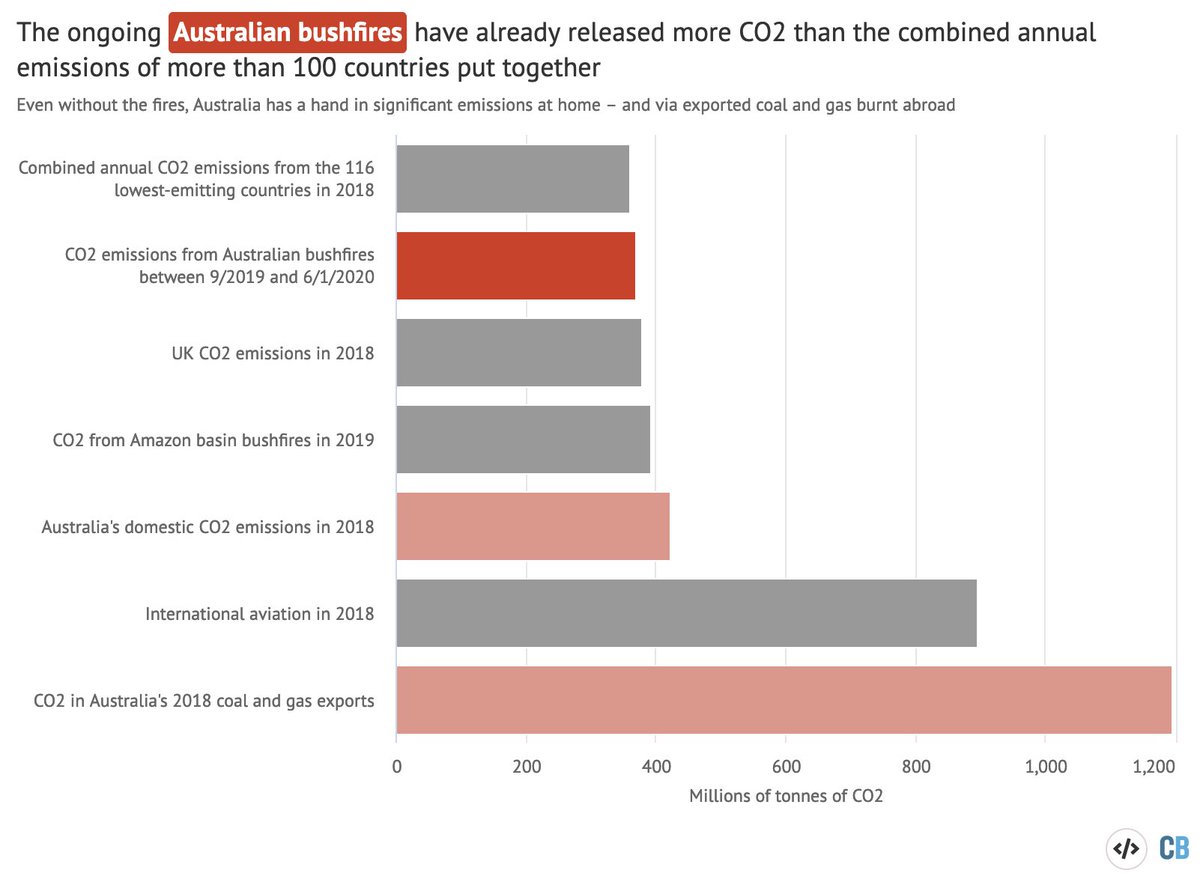
Australia's Wildfires Have Created More Emissions Than 116 Nations (technologyreview.com) 155

"The wildfires raging along Australia's eastern coast have already pumped around 400 million metric tons of carbon dioxide into the atmosphere," reports MIT's Technology Review, "further fueling the climate change that's already intensifying the nation's fires."

That's more than the total combined annual emissions of the 116 lowest-emitting countries, and nine times the amount produced during California's record-setting 2018 fire season. It also adds up to about three-quarters of Australia's otherwise flattening greenhouse-gas emissions in 2019.

And yet, 400 million tons isn't an unprecedented amount nationwide at this point of the year in Australia, where summer bush fires are common, the fire season has been growing longer, and the number of days of "very high fire danger" is increasing. Wildfires emissions topped 600 million tons from September through early January during the brutal fire seasons of 2011 and 2012, according to the European Union's Copernicus Atmosphere Monitoring Service.

But emissions are way beyond typical levels in New South Wales, where this year's fires are concentrated. More than 5.2 million hectares (12.8 million acres) have burned across the southeastern state since July 1, according to a statement from the NSW Rural Fire Service... The situation grew more dangerous in recent days, as hot and windy conditions returned. Two giant fires merged into a "megafire" straddling New South Wales and Victoria, and covering some 600,000 hectares (1.5 million acres).

The article also argues that wildfires are releasing carbon stored in the vegetation dried by warming temperatures.

"That creates a vicious feedback loop, as the very impacts of climate change further exacerbate it, complicating our ability to get ahead of the problem."
Australia

Climate Change is Intensifying Australia's Fires (technologyreview.com) 177

Tens of thousands of Australians are fleeing their homes as hundreds of fires rage across the continent's southeast coast. And yes, climate change is almost certainly to blame for the extent of the disaster. From a report: With more than a thousand buildings destroyed and 17 deaths since October, it already ranks as one of the worst fire seasons in Australia's history -- and summer there has barely begun. What's driving the fires? Summer wildfires are common in Australia, but climate change is making them worse. Spring rainfall has declined in recent decades, even as temperatures rise, extreme heat events become more common, and droughts turn more severe, according to a 2018 report by Australia's Bureau of Meteorology. Those forces have contributed to a greater number of days with "very high fire dangers," and helped extend the fire season into spring.
Communications

Initial Tests of the Samsung Galaxy S10 5G and 5G Networks in US Cities Find The Phone Often Overheats and Switches To 4G (wsj.com) 71

Joanna Stern, reporting for the Wall Street Journal: One of the biggest findings of my multi-city 5G review tour: The Samsung Galaxy S10 5G isn't reliable in the summer -- unless, well, you summer in Iceland. When I ran tests, the phone's 5G often switched off due to overheating, leaving me with a 4G connection. Cellular carriers demo-ing or testing the phone have taken to cooling the devices with ice packs and air conditioners. The phone does this when the temperature reaches a certain threshold to minimize energy use and optimize battery, a Samsung spokeswoman said. "As 5G technology and the ecosystem evolve, it's only going to get better," she added. But there is good part, too. The report adds: After nearly 120 tests, more than 12 city miles walked and a couple of big blisters, I can report that 5G is fasten-your-seat-belt fast...when you can find it. And you're standing outdoors. And the temperature is just right. As my findings show, 5G is absolutely not ready for you. But like any brand new network technology, it provides a glimpse of the future. "Holy spit!" I said the first time I saw a speed test hit 1,800 megabits per second on Verizon's network in downtown Denver. [...] Don't speak megabits? I downloaded the whole new season of "Stranger Things" from Netflix -- 2.1 gigabytes of video -- in 34 seconds. The same averaged more than an hour on my 4G connections. And I downloaded a huge, 10GB file full of video and images from Google Drive in 2.5 minutes.
Power

California May Go Dark This Summer, and Most Aren't Ready (bloomberg.com) 444

schwit1 quotes a report from Bloomberg: A plan by California's biggest utility to cut power on high-wind days during the onrushing wildfire season could plunge millions of residents into darkness. And most people aren't ready. The plan by PG&E comes after the bankrupt utility said a transmission line that snapped in windy weather probably started last year's Camp Fire, the deadliest in state history. While the plan may end one problem, it creates another as Californians seek ways to deal with what some fear could be days and days of blackouts. Some residents are turning to other power sources, a boon for home battery systems marketed by Sunrun, Tesla and Vivint Solar. But the numbers of those systems in use are relatively small when compared with PG&E's 5.4 million customers. Meanwhile, Governor Gavin Newsom said he's budgeting $75 million to help communities deal with the threat. PG&E said the city of Calistoga could have its service cut as many as 15 times this fire season, depending on how extreme the weather is. The utility also plans to set up dozens of so-called "resiliency centers," where backup generators can be brought in to run essential services.

"The utility aims to give at least two days warning about a shutoff and has embarked on a public awareness campaign including mailing letters to customers and is working to identify vulnerable residents," reports Bloomberg. "It also will be working to get power restored in a day after a shutoff, though its customers could be out for as many as five days."

Slashdot Top Deals