Media

How Worried Should You Be About Those Tom Cruise Deepfakes? (vice.com) 81

Are the TikTok deepfake videos of Tom Cruise doing magic and playing golf a threat to global democracy? Not exactly. "[T]he reality is that they took a lot of time, technical expertise, and the skilled performance of a real actor," reports VICE News. "Rather than predicting a dark future of disinformation for the masses, they're simply another example of what can be done with significant time and resources." From the report: The Tom Cruise videos, posted on the @deeptomcruise TikTok account, have been viewed over 11 million times on the app and millions more times on other platforms. The videos were suddenly deleted from the TikTok account on Wednesday morning, shortly after VICE News contacted the people who produced them. They show the fake Cruise playing golf, falling over while telling a story about former Soviet leader Mikhail Gorbachev, and finally, doing a close-up magic trick with a coin.

There's no question the videos are really good. When scanned through several of the best publicly available deepfake detection tools, they avoided discovery. That led many to claim that a new threshold had been reached in deepfake sophistication, and that social media would soon be overwhelmed with similar videos. But that kind of analysis fails to take into account the amount of time, money, and skill it took to produce these videos.

They are the work of Belgian visual effects artist Chris Ume, who is part of a group known as Deep Voodoo Studio, a team of the world's best deepfake artists assembled by the creators of the hit TV show "South Park," Trey Parker and Matt Stone. The team worked with English actor Peter Serafinowicz to produce a 2020 YouTube show called "Sassy Justice," which featured multiple deepfakes of celebrities and politicians. The Tom Cruise TikTok videos required not only the expertise of Ume and his team but also the cooperation of Miles Fisher, a well-known Tom Cruise impersonator who was behind a viral video in 2019 that purported to show Cruise announcing his candidacy for the 2020 election. Ume has even detailed some of the highly complex and involved technical processes he had to go through to produce previous deepfakes.

Security

First Fully Weaponized Spectre Exploit Discovered Online (therecord.media) 35

Catalin Cimpanu, reporting for The Record: A fully weaponized exploit for the Spectre CPU vulnerability was uploaded on the malware-scanning website VirusTotal last month, marking the first time a working exploit capable of doing actual damage has entered the public domain. The exploit was discovered by French security researcher Julien Voisin. It targets Spectre, a major vulnerability that was disclosed in January 2018. [...] The vulnerability, which won a Pwnie Award in 2018 for one of the best security bug discoveries of the year, was considered a milestone moment in the evolution and history of the modern CPU. Its discovery, along with the Meltdown bug, effectively forced CPU vendors to rethink their approach to designing processors, making it clear that they cannot focus on performance alone, to the detriment of data security. Software patches were released at the time, but the Meltdown and Spectre disclosures forced Intel to rethink its entire approach to CPU designs going forward.

At the time, the teams behind the Meltdown and Spectre bugs published their work in the form of research papers and some trivial proof-of-concept code to prove their attacks. Shortly after the Meltdown and Spectre publications, experts at AV-TEST, Fortinet, and Minerva Labs spotted a spike in VirusTotal uploads for both CPU bugs. While initially there was a fear that malware authors might be experimenting with the two bugs as a way to steal data from targeted systems, the exploits were classified as harmless variations of the public PoC code published by the Meltdown and Spectre researchers and no evidence was found of in-the-wild attacks. But today, Voisin said he discovered new Spectre exploits -- one for Windows and one for Linux -- different from the ones before. In particular, Voisin said he found a Linux Spectre exploit capable of dumping the contents of /etc/shadow, a Linux file that stores details on OS user accounts.

News

FBI Confirms Report of 'Long, Cylindrical' UFO 'Moving Really Fast' Over New Mex (popularmechanics.com) 150

An anonymous reader shares a PopularMechanics report: An American Airlines flight crew encountered an unidentified flying object over New Mexico on February 21. American Airlines has confirmed the strange incident, during which a "long, cylindrical object that almost looked like a cruise missile" zipped over the Airbus A320, according to a pilot's transmission obtained by The War Zone. American Airlines Flight 2292 was en route from Cincinnati to Phoenix on Sunday afternoon when it came into contact with the mysterious object at approximately 37,000 feet over northeastern New Mexico. Radio interceptor Steve Douglass captured Flight 2292's transmission on the Albuquerque Center frequency of 127.850 MHz or 134.750 MHz.

In the transmission, which you can hear here, the American Airlines pilot reported:

"Do you have any targets up here? We just had something go right over the top of us. I hate to say this, but it looked like a long, cylindrical object that almost looked like a cruise missile type of thing -- moving really fast right over the top of us."

Albuquerque Center didn't respond to the pilot's report because local air traffic interfered, Douglass wrote on his blog, Deep Black Horizon. American Airlines Flight 2292 safely landed in Phoenix shortly after the encounter.

American Airlines later confirmed with The War Zone the validity of the transmission:

"Following a debrief with our Flight Crew and additional information received, we can confirm this radio transmission was from American Airlines Flight 2292 on Feb. 21. For any additional questions on this, we encourage you to reach out to the FBI."
When TMZ reached out to the FBI, spokesperson Frank Fisher said the Bureau is "aware of the reported incident." He continued: "While our policy is to neither confirm nor deny investigations, the FBI works continuously with our federal, state, local, and tribal partners to share intelligence and protect the public."

The Federal Aviation Administration (FAA) also released a short statement confirming the encounter:

A pilot reported seeing an object over New Mexico shortly after noon local time on Sunday, Feb. 21, 2021. FAA air traffic controllers did not see any object in the area on their radarscopes.

Google

Second Google AI Ethics Leader Fired, She Says Amid Staff Protest (reuters.com) 210

Alphabet's Google on Friday fired scientist Margaret Mitchell, she said in a Twitter post, after weeks of being under investigation for moving thousands of files outside the company amid a battle over research freedom and diversity. From a report: Google's ethics in artificial intelligence research unit has been under scrutiny since December's dismissal of scientist Timnit Gebru, which prompted protest from thousands of Google workers. In a statement, Google said, "After conducting a review of this manager's conduct, we confirmed that there were multiple violations of our code of conduct, as well as of our security policies, which included the exfiltration of confidential business-sensitive documents and private data of other employees."

VentureBeat offers more context: In an email sent to management shortly before Mitchell was placed on investigation, Mitchell called Google firing Gebru "forever after a very, very, very bad decision." Mitchell was a member of the recently formed Alphabet Workers Union. Timnit Gebru has previously suggested that union protection could be a key part of protection for AI researchers. Mitchell and Gebru worked together on the Ethical AI team in 2018, eventually creating what's believed to be one of the most diverse divisions within Google Research. Friday's move comes hours after Google told employees it had wrapped up its investigation into the ouster of prominent AI researcher Timnit Gebru. Axios reports on that: The company declined to say what the internal inquiry found, but said it is making some changes to how it handles issues around research, diversity and employee exits. Under its new policies, Google says it will: tie pay for those at the vice president level and above partly to reaching diversity and inclusion goals; streamline its process for publishing research; increase its staff related to employee retention; and enact new procedures around potentially sensitive employee exits.

"I understand we could have and should have handled this situation with more sensitivity," Google AI head Jeff Dean said in a memo on Friday, obtained by Axios, outlining the changes. "And for that, I am sorry." "I heard and acknowledge what Dr. Gebru's exit signified to female technologists, to those in the Black community and other underrepresented groups who are pursuing careers in tech, and to many who care deeply about Google's responsible use of AI. It led some to question their place here, which I regret," Google AI head Jeff Dean, wrote in an internal email on Friday.
Commenting on Axios' news, Gebru said: I expected nothing more obviously. I write an email asking for things, I get fired, and then after a 3 month investigation, they say they should probably do some of the things I presumably got fired asking for, without holding anyone accountable for their actions. Editor's note: The story was updated at 22:54 GMT with Google's statement.
Businesses

Stadia Leadership Praised Development Studios For 'Great Progress' Just One Week Before Laying Them All Off (kotaku.com) 119

Developers at Google's recently formed game studios were shocked February 1 when they were notified that the studios would be shut down, Kotaku reported Tuesday, citing four sources with knowledge of what transpired. From the report: Just the week prior, Google Stadia vice president and general manager Phil Harrison sent an email to staff lauding the "great progress" its studios had made so far. Mass layoffs were announced a few days later, part of an apparent pattern of Stadia leadership not being honest and upfront with the company's developers, many of which had upended their lives and careers to join the team. "[Stadia Games and Entertainment] has made great progress building a diverse and talented team and establishing a strong lineup of Stadia exclusive games," Harrison's January 27 email read, according to sources. "We will confirm the SG&E investment envelope shortly, which will, in turn, inform the SG&E strategy and 2021 [objectives and key results]."

Five days later, Harrison appeared to reverse course completely, announcing in a public blog post that the head of Stadia Games and Entertainment, Jade Raymond, left the company, and Google would "not be investing further in bringing exclusive content from our internal development team SG&E." Stadia developers learned the news, first reported by Kotaku, at almost the same time as everyone else via an internal email and conference call with Harrison. The messy rollout came after an already grueling year working through the pandemic. It was reminiscent of Stadia's own launch, which appeared rushed and left out many features promoted during the service's reveal, only to be added months later. In this case, however, Stadia's own developers were the ones impacted by the botched planning. Released in November 2019, Stadia initially struggled due to its monetization model and a lack of games.

The Courts

Biden DOJ Halts Trump Admin Lawsuit Against California Net Neutrality Rules (arstechnica.com) 131

An anonymous reader quotes a report from Ars Technica: The Biden administration has abandoned a Trump-era lawsuit that sought to block California's net neutrality law. In a court filing today, the US Department of Justice said it "hereby gives notice of its voluntary dismissal of this case." Shortly after, the court announced that the case is "dismissed in its entirety" and "all pending motions in this action are denied as moot."

The case began when Trump's DOJ sued California in September 2018 in US District Court for the Eastern District of California, trying to block a state net neutrality law similar to the US net neutrality law repealed by the Ajit Pai-led FCC. Though Pai's FCC lost an attempt to impose a blanket, nationwide preemption of any state net neutrality law, the US government's lawsuit against the California law was moving forward in the final months of the Trump administration.

The Biden DOJ's voluntary dismissal of the case puts an end to that. "I am pleased that the Department of Justice has withdrawn this lawsuit," FCC Acting Chairwoman Jessica Rosenworcel said today. "When the FCC, over my objection, rolled back its net neutrality policies, states like California sought to fill the void with their own laws. By taking this step, Washington is listening to the American people, who overwhelmingly support an open Internet, and is charting a course to once again make net neutrality the law of the land."
The report notes that California still has to defend its net neutrality rules against a separate lawsuit filed by the major broadband-industry lobby groups. "The industry groups representing all the biggest ISPs and many smaller ones filed an amended complaint against California in August 2020, claiming the net neutrality law is 'unconstitutional state regulation,'" reports Ars.
Space

Galaxy-Size Gravitational-Wave Detector Hints At Exotic Physics (scientificamerican.com) 43

The fabric of spacetime may be frothing with gigantic gravitational waves, and the possibility has sent physicists into a tizzy. A potential signal seen in the light from dead stellar cores known as pulsars has driven a flurry of theoretical papers speculating about exotic explanations. Scientific American reports: The most mundane, yet still quite sensational, possibility is that researchers working with the North American Nanohertz Observatory for Gravitational Waves (NANOGrav), which uses the galaxy as a colossal gravitational-wave detector, have finally seen a long-sought background signature produced when supermassive black holes crash and merge throughout the universe. Another interpretation would have it originating from a vibrating network of high-energy cosmic strings that could provide scientists with extremely detailed information about the fundamental constituents of physical reality. A third possibility posits that the collaboration has spotted the creation of countless small black holes at the dawn of time, which could themselves account for the mysterious substance known as dark matter.
[...]
The NANOGrav collaboration still needs to confirm that it is in fact seeing gravitational waves. And the shape of those gravitational waves' spectrum has yet to be traced out and found to conform to the cosmic string interpretation, each of which is likely to take years. Meanwhile, another contingent of the physics community has suggested that the signal could originate from entities known as primordial black holes. Unlike regular black holes, which are born when gigantic stars die, these would form in the early universe, when matter and energy were nonuniformly scattered through the cosmos as a consequence of processes that occurred at the end of inflation. Certain overdense areas could collapse under their own weight, generating black holes in a variety of sizes. Observations from LIGO and Virgo that could indicate mergers between primordial black holes have already planted the idea in many researchers' minds that these strange objects are more than speculative fictions. Certain theorists like them because, as entities that give off no light, they could account for some or even all of the dark matter in the universe.

Along with two co-authors, Riotto has written a third paper appearing in PRL showing how the NANOGrav signal could be accounted for by a multitude of black holes the size of asteroids being created shortly after the big bang, producing a gravitational wave relic that would travel to us in the modern day. According to the researchers' model, these miniature primordial black holes could comprise up to 100 percent of the dark matter in the universe. [...] Nevertheless, the burst of theoretical activity shows how seriously physicists are taking these results. NANOGrav researchers have another two and a half years of pulsar data they are combing through, which could help distinguish whether some or a combination of all these explanations might be viable.

Security

SolarWinds Patches Vulnerabilities That Could Allow Full System Control (arstechnica.com) 15

An anonymous reader quotes a report from Ars Technica: SolarWinds, the previously little-known company whose network-monitoring tool Orion was a primary vector for one of the most serious breaches in US history, has pushed out fixes for three severe vulnerabilities. Martin Rakhmanov, a researcher with Trustwave SpiderLabs, said in a blog post on Wednesday that he began analyzing SolarWinds products shortly after FireEye and Microsoft reported that hackers had taken control of SolarWinds' software development system and used it to distribute backdoored updates to Orion customers. It didn't take long for him to find three vulnerabilities, two in Orion and a third in a product known as the Serv-U FTP for Windows. There's no evidence any of the vulnerabilities have been exploited in the wild.

The most serious flaw allows unprivileged users to remotely execute code that takes complete control of the underlying operating system. Tracked as CVE-2021-25274 the vulnerability stems from Orion's use of the Microsoft Message Queue, a tool that has existed for more than 20 years but is no longer installed by default on Windows machines. [...] The second Orion vulnerability, tracked as CVE-2021-25275, is the result of Orion storing database credentials in an insecure manner. Specifically, Orion keeps the credentials in a file that's readable by unprivileged users. Rakhmanov facetiously called this "Database Credentials for Everyone." While the files cryptographically protect the passwords, the researcher was able to find code that converts the password to plaintext. The result: anyone who can log in to a box locally or through the Remote Desktop Protocol can gain the credentials for the SolarWindsOrionDatabaseUser.

The third vulnerability, tracked as CVE-2021-25276, resides in the Serv-U FTP for Windows. The program stores details for each account in a separate file. Those files can be created by any authenticated Windows user. Rakhmanov wrote: "Specifically, anyone who can log in locally or via Remote Desktop can just drop a file that defines a new user, and the Serv-U FTP will automatically pick it up. Next, since we can create any Serv-U FTP user, it makes sense to define an admin account by setting a simple field in the file and then set the home directory to the root of C:\ drive. Now we can log in via FTP and read or replace any file on the C:\ since the FTP server runs as LocalSystem."
Fixes for Orion and Serv-U FTP are available here and here.
Facebook

Myanmar Blocks Facebook as Resistance Grows To Coup (apnews.com) 76

Myanmar's new military government blocked access to Facebook as resistance to Monday's coup surged amid calls for civil disobedience to protest the ousting of the elected government and its leader, Aung San Suu Kyi. From a report: Facebook is especially popular in Myanmar and is how most people access the internet. The military seized power shortly before a new session of Parliament was to convene on Monday and detained Suu Kyi and other top politicians. It said it acted because the government had refused to address its complaints that last November's general election, in which Suu Kyi's party won a landslide victory, was marred by widespread voting irregularities. The state Election Commission has refuted the allegations.

[...] Facebook users said service disruptions began late Wednesday night. "Telecom providers in Myanmar have been ordered to temporarily block Facebook. We urge authorities to restore connectivity so that people in Myanmar can communicate with family and friends and access important information," Facebook said in a statement. In 2018, Facebook removed several accounts linked to Myanmar's military, including that of Senior Gen. Min Aung Hlaing, the officer who led this week's coup, following complaints that they appeared to fuel hatred toward the country's Muslim Rohingya minority. The Rohingya were targeted in a brutal 2017 army counterinsurgency campaign that drove more than 700,000 to neighboring Bangladesh. Critics say the army's actions constituted genocide. A Norway-based humanitarian group said Thursday that Myanmar's political crisis could create a humanitarian disaster affecting 1 million vulnerable people if international aid groups are restricted further.

The Almighty Buck

GameStop Shares Plunge as Traders Dump Stock (theguardian.com) 160

Shares in GameStop plunged by 65% in early trading on Wall Street as the trading mania sparked by small investors, that sent its stock surging and cost hedge funds billions of dollars, lost momentum. From a report: The struggling Texas-based video game store chain has been the focal point of a battle by small traders, using forums such as Reddit, to punish Wall Street hedge funds that have bet on certain stocks falling in value. GameStop shares hit a high of $470 last Thursday but slumped to $80 shortly after the market opened. They recovered to $117 by mid-session, down 48% on their opening price. A year ago, shares in the 37-year-old chain, which plans to close 450 stores this year, were changing hands at $3.25 a share. Other heavily shorted stocks also targeted by amateur investors on influential forums such as WallStreetBets on Reddit are also in freefall. AMC Entertainment, the world's biggest theatre chain and owner of Odeon in the UK, lost 55% shortly after the opening bell on Wall Street. It later made up some of those losses to trade at $8 by mid afternoon.
Space

Biofuel-Powered Rocket Makes Historic Launch in Maine (pressherald.com) 54

Despite bad weather and early technical difficulties, employee-owned bluShift Aerospace "made history Sunday afternoon when it launched its prototype rocket, Stardust 1.0," reports Maine's Portland Press Herald: The company became the first in Maine to launch a commercial rocket and the first in the world to launch a rocket using bio-derived fuel... It carried three payloads, two commercial and one, free of charge, from Falmouth High School... The rocket and payloads returned to the ground under a parachute shortly after launch and were retrieved by a team of snowmobilers. The rocket is intended to be reusable and environmentally friendly.

While the components of the biofuel remain a company secret, bluShift CEO Sascha Deri said it is solid, non-toxic and carbon neutral. "I can tell you this much, I discovered it with a friend of mine on my brothers farm here in Maine," he said. The company describes its business model as the Uber of space, where they will target a specific customer who wishes to send their payload into a particular orbit.

"We are targeting people that want to go to a specific orbit, they want to have control of their launches, they want to be the primary payload even though their payload is very small," Deri said.

The rocket is roughly 20 feet tall and 14 inches in diameter, the newspaper reports — noting that an earlier launch planned for January 15th had to be called off due to bad weather. "It turns out launching rockets is complicated, apparently it's rocket science," CEO Deri told them.

"We did learn a lot from that failed launch. We learned, first and foremost, that you can't rely upon weather websites, you really need to use a professional meteorologist."

The Associated Press also reports the rocket carried "a Dutch dessert called stroopwafel, in an homage to its Amsterdam-based parent company. Organizers of the launch said the items were included to demonstrate the inclusion of a small payload."
Businesses

Apple Hit With Another European Class Action Over Throttled iPhones (techcrunch.com) 59

A third class action lawsuit has been filed in Europe against Apple seeking compensation -- for what Italy's Altroconsumo consumer protection agency dubs "planned obsolescence" of a number of iPhone 6 models. From a report: The action relates to performance throttling Apple applied several years ago to affected iPhones when the health of the device's battery had deteriorated -- doing so without clearly informing users. It later apologized. The class action suit in Italy is seeking $72.8 million in compensation -- based on at least $72.8 in average compensation per iPhone owner. Affected devices named in the suit are the iPhone 6, 6S, 6 Plus and 6S Plus, per a press release put out by the umbrella consumer organization, Euroconsumers, which counts Altroconsumo a a member. The suit is the third to be filed in the region over the issue -- following suits filed in Belgium and Spain last month. A fourth -- in Portugal -- is slated to be filed shortly.
Businesses

Amazon Offers Biden Help With Covid-19 Vaccine Distribution (nbcnews.com) 245

Amazon has extended an offer to President Joe Biden to assist with the national distribution of Covid-19 vaccines, a move that could expedite the federal effort to combat the pandemic. From a report: Dave Clark, the CEO of Amazon's consumer business, and one of the company's highest-ranking executives, sent a letter to the president shortly after he was sworn in Wednesday. "As you begin your work leading the country out of the COVID-19 crisis, Amazon stands ready to assist you in reaching your goal of vaccinating 100 million Americans in the first 100 days of your administration," he wrote in his letter, a copy of which was obtained by NBC News.

"We are prepared to leverage our operations, IT, & communications capabilities and expertise to assist your administration's vaccination efforts," Clark wrote. "Our scale allows us to make a meaningful impact immediately in the fight against COVID-19, and we stand ready to assist you in this effort." Clark said Amazon had agreements in place with licensed third-party health care providers to administer vaccines on-site at Amazon facilities. "We are prepared to move quickly once vaccines are available," he wrote.

United States

Biden Sworn In as 46th President (nytimes.com) 980

Joseph Robinette Biden Jr. was sworn in as the 46th president of the United States on Wednesday, taking office at a moment of profound economic, health and political crises with a promise to seek unity after a tumultuous four years that tore at the fabric of American society. New York Times: With his hand on a five-inch-thick Bible that has been in his family for 128 years, Mr. Biden recited the 35-word oath of office swearing to "preserve, protect and defend the Constitution" in a ceremony administered by Chief Justice John G. Roberts Jr., completing the process at 11:49 a.m., 11 minutes before the authority of the presidency formally changes hands.

The ritual transfer of power came shortly after Kamala Devi Harris was sworn in as vice president by Justice Sonia Sotomayor, her hand on a Bible that once belonged to Thurgood Marshall, the civil rights icon and Supreme Court justice. Ms. Harris's ascension made her the highest-ranking woman in the history of the United States and the first Black American and first person of South Asian descent to hold the nation's second highest office. The ceremony on a chilly, breezy day with a smattering of snowflakes brought to a close the stormy and divisive four-year presidency of Donald J. Trump. In characteristic fashion, Mr. Trump once again defied tradition by leaving Washington hours before the swearing in of his successor rather than face the reality of his own election defeat, although Mike Pence, his vice president, did attend.
President Biden's speech: This is America's day. This is democracy's day. Few people in our nation's history have been more challenged or found a time more challenging or difficult than the time we're in now. To overcome these challenges, to restore the soul and secure the future of America, requires so much more than words and requires the most elusive of all things in a democracy: unity. Live coverage: YouTube.
Social Networks

Ask Slashdot: How Should User-Generated Content Be Moderated? (vortex.com) 385

"I increasingly suspect that the days of large-scale public distribution of unmoderated user generated content on the Internet may shortly begin drawing to a close in significant ways..." writes long-time Slashdot reader Lauren Weinstein.

And then he shares "a bit of history": Back in 1985 when I launched my "Stargate" experiment to broadcast Usenet Netnews over the broadcast television vertical blanking interval of national "Superstation WTBS," I decided that the project would only carry moderated Usenet newsgroups. Even more than 35 years ago, I was concerned about some of the behavior and content already beginning to become common on Usenet... My determination for Stargate to only carry moderated groups triggered cries of "censorship," but I did not feel that responsible moderation equated with censorship — and that is still my view today. And now, all these many years later, it's clear that we've made no real progress in these regards...
But as it stands now, Weinstein believes were probably headed to "a combination of steps taken independently by social media firms and future legislative mandates." [M]y extremely strong preference is that we deal with these issues together as firms, organizations, customers, and users — rather than depend on government actions that, if history is any guide, will likely do enormous negative collateral damage. Time is of the essence.
Weinstein suggests one possibility: that moderation at scale "may follow the model of AI-based first-level filtering, followed by layers of human moderators."

But what's the alternative? Throngs of human moderators? Leaving it all to individual users? Limiting the amount of user-generated content? No moderation whatsoever?

Share your own thoughts and ideas in the comments. How should user-generated content be moderated?
Government

Parler Users Breached Deep Inside US Capitol Building, GPS Data Shows (gizmodo.com) 271

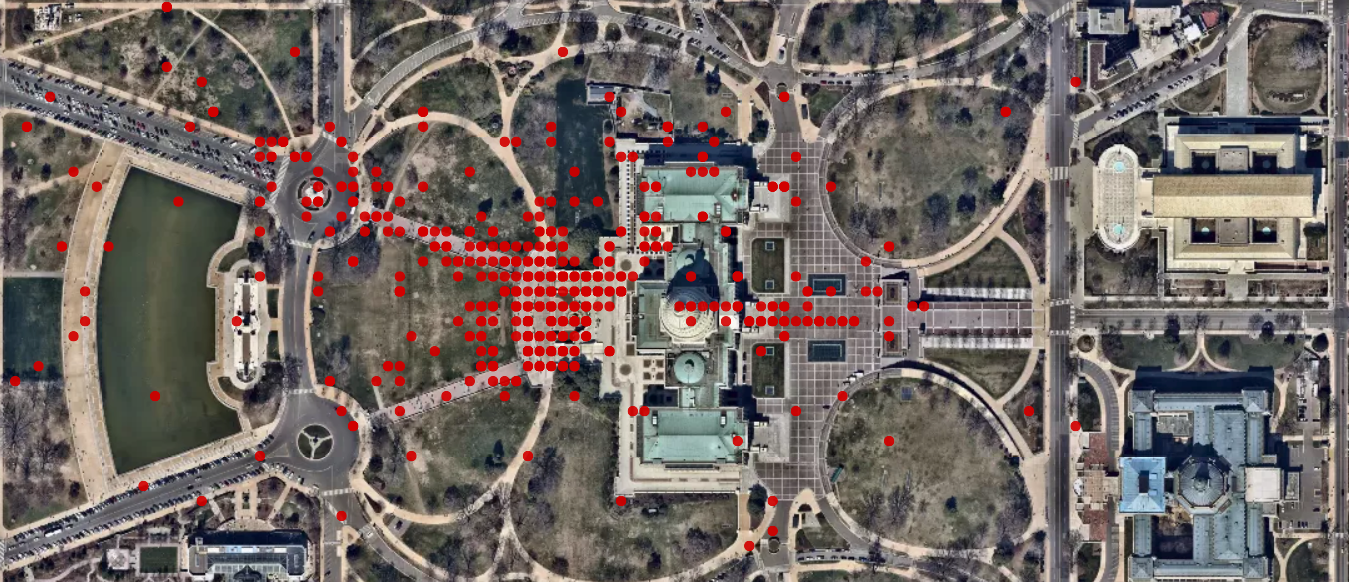
An anonymous reader quotes a report from Gizmodo: At least several users of the far-right social network Parler appear to be among the horde of rioters that managed to penetrate deep inside the U.S. Capitol building and into areas normally restricted to the public, according to GPS metadata linked to videos posted to the platform the day of the insurrection in Washington. The data, obtained by a computer hacker through legal means ahead of Parler's shutdown on Monday, offers a bird's eye view of its users swarming the Capitol grounds after receiving encouragement from President Trump -- and during a violent breach that sent lawmakers and Capitol Hill visitors scrambling amid gunshots and calls for their death. GPS coordinates taken from 618 Parler videos analyzed by Gizmodo has already been sought after by FBI as part of a sweeping nationwide search for potential suspects, at least 20 of whom are already in custody.

Gizmodo has mapped nearly 70,000 geo-located Parler posts and on Tuesday isolated hundreds published on January 6 near the Capitol where a mob of pro-Trump supporters had hoped to overturn a democratic election and keep their president in power. The data shows Parler users posting all throughout the day, documenting their march from the National Mall to Capitol Hill where the violent insurrection ensued. The precise locations of Parler users inside the building can be difficult to place. The coordinates do not reveal which floors they are on, for instance. Moreover, the data only includes Parler users who posted videos taken on January 6. And the coordinates themselves are only accurate up to an approximate distance of 12 yards (11 meters).

The red dot just south of the Capitol Rotunda's center on the map above is linked to a video Gizmodo verified that shows rioters in red MAGA hats shouting obscenities about House Speaker Nancy Pelosi, whose office is a short walk to the west. But other dots nearby could indicate videos captured in adjacent offices, stairwells, or hallways leading toward the House and Senate chambers. A second video successfully linked to the Parler data belongs to a rioter who filmed a mob in the Rotunda chanting, "Whose House? Our House?" (while facing the Senate side of the building). Other coordinates pulled from Parler point to users roaming the north side of the building near the Senate chamber, either near leadership offices or the press gallery, depending on which floor they were on. Other location data from outside the Capitol follows the precise route the crowd took from the National Mall shortly after a speech by President Trump...

News

Boeing 737 With 62 Aboard Crashed After Takeoff From Jakarta, Say Authorities (bloomberg.com) 123

A Sriwijaya Air flight with 62 aboard is missing after losing contact with Indonesia's aviation authorities shortly after takeoff from Jakarta. From a report: Flight SJ182, a 26-year-old Boeing 737-500, was scheduled to depart from the nation's capital to Pontianak on the island of Borneo at 1:40 p.m. local time, according to FlightRadar24 data. It had 56 passengers on board, along with two pilots and four cabin crew, MetroTV reported. Indonesian authorities said they have sent a search vessel from Jakarta to plane's last known location in the Java Sea. First responders were also deployed to the site to aid potential survivors, local TV reported. Sriwijaya Air said it's working to obtain more detailed information about the flight, and will release an official statement later. Updated at 14:53 GMT: The plane crashed, the Indonesian authorities said moments ago.
AI

Google Told Its Scientists To 'Strike a Positive Tone' in AI Research (reuters.com) 51

Alphabet's Google this year moved to tighten control over its scientists' papers by launching a "sensitive topics" review, and in at least three cases requested authors refrain from casting its technology in a negative light, Reuters reported Wednesday, citing internal communications and interviews with researchers involved in the work. From a report: Google's new review procedure asks that researchers consult with legal, policy and public relations teams before pursuing topics such as face and sentiment analysis and categorizations of race, gender or political affiliation, according to internal webpages explaining the policy. "Advances in technology and the growing complexity of our external environment are increasingly leading to situations where seemingly inoffensive projects raise ethical, reputational, regulatory or legal issues," one of the pages for research staff stated. Reuters could not determine the date of the post, though three current employees said the policy began in June. The "sensitive topics" process adds a round of scrutiny to Google's standard review of papers for pitfalls such as disclosing of trade secrets, eight current and former employees said. For some projects, Google officials have intervened in later stages. A senior Google manager reviewing a study on content recommendation technology shortly before publication this summer told authors to "take great care to strike a positive tone," according to internal correspondence read to Reuters.
Youtube

YouTube Class Action: Same IP Address Used To Upload 'Pirate' Movies and File DMCA Notices (torrentfreak.com) 53

An anonymous reader quotes a report from TorrentFreak: YouTube says it has found a "smoking gun" to prove that a class-action lawsuit filed by Grammy award-winning musician Maria Schneider and Pirate Monitor Ltd was filed in bad faith. According to the Google-owned platform, the same IP address used to upload 'pirate' movies to the platform also sent DMCA notices targeting the same batch of content.

In a motion to dismiss filed in November, Pirate Monitor said YouTube had provided no "hard evidence" to back up these damaging claims, demanding that the court disregard the allegations and reject calls for the right to an injunction to prevent Pirate Monitor from submitting wrongful DMCA notices in the future. YouTube now provides a taster of some of the supporting evidence it has on file. "Pirate Monitor devised an elaborate scheme to prove itself sufficiently trustworthy to use YouTube's advanced copyright management tools," YouTube begins. "Through agents using pseudonyms to hide their identities, Pirate Monitor uploaded some two thousand videos to YouTube, each time representing that the content did not infringe anyone's copyright. Shortly thereafter, Pirate Monitor invoked the notice-and-takedown provisions of the Digital Millennium Copyright Act to demand that YouTube remove the same videos its agents had just uploaded."

In all, YouTube processed nearly 2,000 DMCA notices it received by Pirate Monitor in the fall of 2019. All of the targeted videos had a uniform length, around 30 seconds each, generated from "obscure Hungarian movies". They had been uploaded in bulk from users with IP addresses allocated to Pakistan. [...] While the nature of the uploads is indeed suspicious, YouTube says that it also found what it describes as a "smoking gun", i.e evidence that the uploads and DMCA notices were being sent by the same entity. "After considerable digging, YouTube found a smoking gun. In November 2019, amidst a raft of takedown notices from Pirate Monitor, one of the 'RansomNova' users that had been uploading clips via IP addresses in Pakistan logged into their YouTube account from a computer connected to the Internet via an IP address in Hungary," YouTube explains.
The opposition to Pirate Monitor's motion to dismiss can be found here.
Firefox

Firefox 84 Claims Speed Boost from Apple Silicon, Vows to End Flash Support (zdnet.com) 40

The Verge reports: Firefox's latest update brings native support for Macs that run on Apple's Arm-based silicon, Mozilla announced on Tuesday. Mozilla claims that native Apple silicon support brings significant performance improvements: the browser apparently launches 2.5 times faster and web apps are twice as responsive than they were on the previous version of Firefox, which wasn't native to Apple's chips...

Firefox's support of Apple's Arm-based processors follows Chrome, which added support for Apple's new chips shortly after the M1-equipped MacBook Pro, MacBook Air, and Mac mini were released in November.

Firefox 84 will also be the very last release to support Adobe Flash, notes ZDNet, calling both developments "a reminder of the influence Apple co-founder Steve Jobs has had and continues to exert on software and hardware nine years after his death." Jobs wrote off Flash in 2010 as successful Adobe software but one that was a 'closed' product "created during the PC era — for PCs and mice" and not suitable for the then-brand-new iPad, nor any of its prior iPhones. Instead, Jobs said the future of the web was HTML5, JavaScript and CSS.

At the end of this year Google Chrome, Microsoft Edge and Apple Safari also drop support for Flash.

Senior Apple execs recently reflected in an interview with Om Malik what the M1 would have meant to Jobs had been alive today. "Steve used to say that we make the whole widget," Greg Joswiak, Apple's senior vice president of Worldwide Marketing told Malik.

"We've been making the whole widget for all our products, from the iPhone, to the iPads, to the watch. This was the final element to making the whole widget on the Mac."

ZDNet also notes that Firefox 84 offers WebRender, "Mozilla's faster GPU-based 2D rendering engine" for MacOS Big Sur, Windows devices with Intel Gen 6 GPUs, and Intel laptops running Windows 7 and 8. "Mozilla promises it will ship an accelerated rendering pipeline for Linux/GNOME/X11 users for the first time."

Firefox now also uses "more modern techniques for allocating shared memory on Linux," writes Mozilla, "improving performance and increasing compatibility with Docker."

And Firefox 85 will include a new network partitioning feature to make it harder for companies to track your web surfing.

Slashdot Top Deals