XBox (Games)

Four Years Later, Xbox Exec Admits How Microsoft Screwed Up Disc Resale Plan (arstechnica.com) 115

An anonymous reader quotes a report from Ars Technica: We're now approaching the four-year anniversary of Microsoft's rollout (and subsequent reversal) of a controversial plan to let game publishers limit resale of used, disc-based games. Looking back on that time recently, Microsoft Corporate Vice President for Windows and Devices Yusuf Mehdi acknowledged how that rollout fell flat and discussed how hard it was for the firm to change course even in light of fan complaints at the time. In a blog post on LinkedIn posted last weekend, Mehdi writes: "With our initial announcement of Xbox One and our desire to deliver breakthroughs in gaming and entertainment, the team made a few key decisions regarding connectivity requirements and how games would be purchased that didn't land well with fans. While the intent was good -- we imagined a new set of benefits such as easier roaming, family sharing and new ways to try and buy games, we didn't deliver what our fans wanted. We heard their feedback, and while it required great technical work, we changed Xbox One to work the same way as Xbox 360 for how our customers could play, share, lend, and resell games. This experience was such a powerful reminder that we must always do the right thing for our customers, and since we've made that commitment to our Xbox fans, we've never looked back." It's an interesting reflection in light of an interview Mehdi gave to Ars Technica at E3 2013, when the executive defended Microsoft's announced plans for Xbox One game licensing. Mehdi, then serving as Xbox chief marketing and strategy officer, stressed at the time that "this is a big change, consumers don't always love change, and there's a lot of education we have to provide to make sure that people understand... We're trying to do something pretty big in terms of moving the industry forward for console gaming into the digital world. We believe the digital world is the future, and we believe digital is better."
Iphone

Original iPhone Prototype With iPod Click Wheel Surfaces Online (macrumors.com) 35

Famed Apple leaker Sonny Dickson has shared an early prototype of the original iPhone, with a collection of images and a video that provides a glimpse into one version of the iPhone that Apple created and tested before ending up with the first iteration of the device. Mac Rumors reports: The prototype includes some similar features to the first generation iPhone, like an aluminum chassis, multi-touch compatible screen, 2G connectivity and Wi-Fi, but its entire user interface is taken directly from the click wheel system of Apple's original iPod line. Called "Acorn OS," the prototype software includes an on-screen click wheel on the bottom half of the screen and a menu system on the top half, and the two are bisected by a bar with rewind, menu, play/pause, and fast-forward buttons. On the menu are options such as "Favorites," "SMS," "Music," "Settings," and "Recents," and it's navigated by circling around the click wheel to go up and down, with a center press confirming an action, just like on the iPod. Dickson references Apple's patent for a "multi-functional hand-held device," filed and published in 2006, as proof that such a prototype did exist at one point and could potentially have been an alternate version of the iPhone. In one of the patent's drawings, a click wheel can be seen as a possible input method for the proposed device. The patent's abstract describes a product with "at most only a few physical buttons, keys, or switches so that its display size can be substantially increased."
Desktops (Apple)

Apple Says It's Out of the Standalone Display Business (macrumors.com) 108

The launch and marketing push of the 27-inch 5K UltraFine Display made in partnership with LG all but confirms that Apple is out of the standalone display business. Previously, it was rumored Apple was working on its own branded Thunderbolt Display powered by an integrated GPU, but with the launch of LG's display it appears to indicate Apple gave up those plans. The Verge's Nilay Patel also confirms the news, tweeting: "Good notes by @jsnell. I can add that Apple told me it's out of standalone display biz." 9to5Mac reports: The two new LG displays, which will be available later this year, feature Thunderbolt 3 connectivity for an easy one-cable-solution for new MacBook owners. Apple will sell both displays, a 4K model for $699.95 and a 5K model for $1299.95, on its online store. Back in June, Apple officially discontinued its lone company-branded monitor, the Thunderbolt Display, after it had languished for a period of time without a substantial update. Apple's statement on the discontinuation made it appear as if it may be the last of the Apple-branded display, and this has been seemingly confirmed: "We're discontinuing the Apple Thunderbolt Display. It will be available through Apple.com, Apple's retail stores and Apple Authorized Resellers while supplies last. There are a number of great third-party options available for Mac users," said an Apple spokesperson.
Security

Hacking Group 'OurMine' Claims Credit For Attack On Pokemon Go Servers (independent.co.uk) 48

An anonymous reader writes: A group of hackers known as OurMine have attacked Pokemon Go's login servers, making it all but impossible for players to get online. The group says they hacked the game in an effort for the game to be more stable. They want to show the developers behind Pokemon Go that the app can and should be made more secure. Prior to the hack, the servers have been shaky as interest in the game has spiked. But over the weekend, users faced the most extreme connectivity issues yet. "No one will be able to play this game till Pokemon Go contact us on our website to teach them how to protect it!" the group wrote on its website. A different hacking group, which claimed to be part of OurMine, said that the latest attack had been launched after the huge outage caused by a group called Poodlecorp, on Saturday. "The group makes money from charging for vulnerability assessment, where hackers attempt to break into corporate networks to check how safe they are," reports The Independent. A representative said via Twitter that the group wasn't requesting money from those behind Pokemon Go, and that OurMine "just don't want other hackers [to] attack their servers." It should come as no surprise to see that the servers have been having trouble keeping up with demand as Pokemon Go has become the biggest mobile game in U.S. history after launching just about two weeks ago.
Open Source

A Smaller Version of Raspberry Pi 3 Is Coming Soon (pcworld.com) 89

An anonymous reader quotes a report from PCWorld: A smaller version of the popular Raspberry Pi 3 will go on sale in a few months. Raspberry Pi is developing a new version of its Compute Module, a single-board computer that plugs into specific on-board memory slots. The new Pi will be more like a mini-computer inside a computer, and it won't come with a power supply. The Compute Module will have similar circuitry to that of Raspberry Pi 3, a wildly successful computer that can be a PC replacement. But it will be smaller, with the memory, CPU, and storage embedded tightly on a board. While the Compute Module will have a 64-bit ARM processor like the Pi 3, it won't have Wi-Fi, Eben Upton, founder of Raspberry Pi, said in an interview with IDG News Service. The Compute Module could ship as soon as this quarter, Upton said. It will be priced similar to its predecessor, the 2-year-old Compute Module, available from reseller RS Components for about $24. The older Compute Module is based on the original Raspberry Pi. Like Raspberry Pi 3, the new Compute Module will work with Linux and Microsoft's Windows 10 IoT Core, Upton said. A Compute Module Development Kit, in which the Compute Module can be slotted for testing, may also be sold. The Development Kit could have multiple connectivity and port options, much like the Raspberry Pi 3. Last month, the biggest manufacturer of the Raspberry Pi, Premier Farnell, was acquired by Swiss industrial component supplier Daetwyler Holding AG for roughly $871 million.
Government

Free Wi-Fi Program in Los Angeles Fails to Provide Free Wi-Fi (latimes.com) 94

The Los Angeles Time found no internet connectivity in 24 public locations, despite a three-year, $500,000 grant to provide them with free Wi-Fi service. Investigations both last year and again in March found that none of the 18+ locations checked were able to successfully connect to the internet, prompting a PUC investigation that confirmed only two of the hotspots were working. The grant was part of a $315 million state-wide program using surcharges on utility bills to promote high-quality communication services, though in Los Angeles most of the money for "underserved" areas was being directed to outreach and education. The Wi-Fi company's executive director said maintaining their networks had proved to be difficult, though one economist argued it would've been more productive to give net-access subsidies directly to the poor, a program the FCC recently voted to expand.
The Internet

Mark Zuckerberg Issues Call For Universal Internet Access 142

An anonymous reader writes: During the 70th annual U.N. General Assembly session, Zuckerberg discussed the "importance of connectivity in achieving the U.N.'s sustainable development goals. Connecting the world is one of the fundamental challenges of our generation. More than 4 billion people don't have a voice online." Zuckerberg said. Reuters reports: "The connectivity campaign calls on governments, businesses and innovators to bring the Internet to the some 4 billion people who now do not have access, organizers said. Signing on to the connectivity campaign were U2 star Bono, co-founder of One, a group that fights extreme poverty; actress Charlize Theron, founder of Africa Outreach Project; philanthropists Bill and Melinda Gates; British entrepreneur Richard Branson; Huffington Post editor Arianna Huffington; Colombian singer Shakira, actor and activist George Takei and Wikipedia co-founder Jimmy Wales."
Communications

Ask Slashdot: Suggestions For Taking a Business Out Into the Forest? 146

An anonymous reader writes: I'm a huge fan of primitive survival reality TV. I am also self-employed in web troubleshooting and hosting services. I have to be available 24/7, but a lot of my work is just being online for a few minutes at a time. I often think about taking my business 'outdoors', camping, 3-7 days or so at a time — but staying online. Has anyone had experience with this? How did you do it, in terms of internet connectivity and portable power? Satellite internet or long distance Wi-Fi antennaes and a very tall pole? I've looked at some portable power stations with solar attachments, but the idea of hand-cranking to recharge if it's overcast isn't fun, after all, the point is to relax. But I'm willing to manually recharge if it's realistic (would prefer pedaling though!) I happen to have a Toughbook CF-52 (I just thought it was cool) but I may need to replace that with a more eco-friendly laptop as well. Thanks!
Communications

For New Yorkers, Cablevision Introduces a Wi-Fi-Centric VoiP Network 43

The New York Times reports that Cablevision Systems plans to announce on Monday the start of a low-cost mobile phone service that will use Wi-Fi for connectivity rather than standard cellular networks, the first such service to be introduced by a cable operator. Called Freewheel, the service will offer unlimited data, talking and texting worldwide for $29.95 a month, or $9.95 a month for Cablevision’s Optimum Online customers — a steep discount compared with standard offerings from traditional cellular carriers. Freewheel customers initially must use a specific Motorola Moto G smartphone, which is being sold for $99.95. The service goes on sale next month, and no annual contract is required. (Reuters carries a similar story.)
The Internet

About 40% of World Population Online, 90% of Offliners In Developing Countries 45

New submitter lx76 writes: The International Telecommunications Union does research on telecommunications in society worldwide, from cellphones to internet use. Since 2009, on a yearly basis, they've released their research findings in a report called the Measuring Information Society Report. This year's report is over 200 pages long, illustrated with abundant graphs and tables (PDF). It's not a light read. But one of the interesting numbers is an index showing the divide in global connectivity. From the report: "Over the past year, the world witnessed continued growth in the uptake of ICT [Information and Communication Technology] and, by end 2014, almost 3 billion people will be using the Internet, up from 2.7 billion at end 2013..... Despite this encouraging progress, there are important digital divides that need to be addressed: 4.3 billion people are still not online, and 90 per cent of them live in the developing world."

The report continues, "As this report finds, ICT performance is better in countries with higher shares of the population living in urban areas, where access to ICT infrastructure, usage and skills is more favorable. Yet it is precisely in poor and rural areas where ICTs can make a particularly significant impact." Projects like Google's Project Loon have their work cut out for them."
Encryption

Tor Executive Director Hints At Firefox Integration 117

blottsie writes: Several major tech firms are in talks with Tor to include the software in products that can potentially reach over 500 million Internet users around the world. One particular firm wants to include Tor as a "private browsing mode" in a mainstream Web browser, allowing users to easily toggle connectivity to the Tor anonymity network on and off. "They very much like Tor Browser and would like to ship it to their customer base," Tor executive director Andrew Lewman wrote, explaining the discussions but declining to name the specific company. "Their product is 10-20 percent of the global market, this is of roughly 2.8 billion global Internet users." The product that best fits Lewman's description, by our estimation, is Mozilla Firefox, the third-most popular Web browser online today and home to, you guessed it, 10 to 20 percent of global Internet users.
Power

Harvesting Wi-Fi Backscatter To Power Internet of Things Sensors 138

vinces99 (2792707) writes "Imagine a world in which your wristwatch or other wearable device communicates directly with your online profiles, storing information about your daily activities where you can best access it – all without requiring batteries. Or, battery-free sensors embedded around your home that could track minute-by-minute temperature changes and send that information to your thermostat to help conserve energy. This not-so-distant 'Internet of Things' reality would extend connectivity to perhaps billions of devices. Sensors could be embedded in everyday objects to help monitor and track everything from the structural safety of bridges to the health of your heart. But having a way to cheaply power and connect these devices to the Internet has kept this from taking off. Now, University of Washington engineers have designed a new communication system that uses radio frequency signals as a power source and reuses existing Wi-Fi infrastructure to provide Internet connectivity to these devices. Called Wi-Fi backscatter, this technology is the first that can connect battery-free devices to Wi-Fi infrastructure. The researchers will publish their results at the Association for Computing Machinery's Special Interest Group on Data Communication's annual conference this month in Chicago. The team also plans to start a company based on the technology. The Pre-print research paper.
Censorship

North Korean Business Park Getting Internet Access 46

Daniel_Stuckey writes "A business park in North Korea will soon have (limited) access to the Internet, according to news reports. The Register wrote that an industrial park in the Kaesong Industrial Region will house Internet-connected PCs by the first half of this year. The Daily NK explained that the first step to connectivity will be an Internet cafe with 20 computers but afterward company offices will also be connected. They quoted a spokesperson from the Ministry of Unification — a department of the South Korean government that works on unifying the two Koreas — as saying, 'We are planning to launch the basic level of Internet services at the Kaesong Industrial Complex starting in the first half of this year,' and adding, 'Officials and employees in the North's border city will be able to use most of the online services now available in South Korea.'"
Science

Brain Function "Boosted For Days After Reading a Novel" 110

cold fjord writes "The Independent reports, 'Being pulled into the world of a gripping novel can trigger actual, measurable changes in the brain that linger for at least five days after reading ... The new research, carried out at Emory University ... found that reading a good book may cause heightened connectivity in the brain and neurological changes that persist in a similar way to muscle memory. The changes were registered in the left temporal cortex, an area of the brain associated with receptivity for language, as well as the primary sensory motor region of the brain. Neurons of this region have been associated with tricking the mind into thinking it is doing something it is not, a phenomenon known as grounded cognition — for example, just thinking about running, can activate the neurons associated with the physical act of running. "The neural changes that we found associated with physical sensation and movement systems suggest that reading a novel can transport you into the body of the protagonist," said neuroscientist Professor Gregory Berns, lead author of the study. "We already knew that good stories can put you in someone else's shoes in a figurative sense. Now we're seeing that something may also be happening biologically."'"
Microsoft

Bill Gates: Internet Will Not Save the World 247

quantr points out an interview with Bill Gates in which he talks about setting priorities for making a difference in the world. Quoting: "The internet is not going to save the world, says the Microsoft co-founder, whatever Mark Zuckerberg and Silicon Valley's tech billionaires believe. But eradicating disease just might. Bill Gates describes himself as a technocrat. But he does not believe that technology will save the world. Or, to be more precise, he does not believe it can solve a tangle of entrenched and interrelated problems that afflict humanity's most vulnerable: the spread of diseases in the developing world and the poverty, lack of opportunity and despair they engender. 'I certainly love the IT thing,' he says. 'But when we want to improve lives, you've got to deal with more basic things like child survival, child nutrition.' These days, it seems that every West Coast billionaire has a vision for how technology can make the world a better place. A central part of this new consensus is that the internet is an inevitable force for social and economic improvement; that connectivity is a social good in itself. It was a view that recently led Mark Zuckerberg to outline a plan for getting the world's unconnected 5 billion people online, an effort the Facebook boss called 'one of the greatest challenges of our generation.' But asked whether giving the planet an internet connection is more important than finding a vaccination for malaria, the co-founder of Microsoft and world's second-richest man does not hide his irritation: 'As a priority? It's a joke.'"
Technology

'Pushback': Resisting the Life of Constant Connectivity 111

vinces99 writes "Researchers at the University of Washington have studied and named a trend lots of people can identify with: the desire to resist constant connectivity and step back from the online world. They call it 'pushback.' The researchers looked closely at instances of pushback against technology, reviewing 73 sources divided equally among three areas of online expression: personal blogs and websites, popular media sources and academic conferences and journals. Co-author Ricardo Gomez said they thought they'd find frustration with devices, costs or learning new technologies as key pushback motivations. Instead, the reasons were more emotionally based, with 'dissatisfaction' — the thought that users' needs are not really being met by technology — most often expressed, followed by political, religious or moral concerns. Other motivations were the wish to regain control of time and energy and fear of addiction to the technology. Among the least-often reported objections were worries about loss of privacy."
Facebook

Internet.org: Altruistic, Or the Ultimate In Cynicism? 174

Nerval's Lobster writes with one take on an effort to "make Internet access available to the two-thirds of the world who are not yet connected": "In conjunction with a variety of partners (including Nokia, Opera, Qualcomm and Samsung), Facebook is launching Internet.org, which will try to make Internet access more affordable to more people. The partnership will also work on ways to lower the amount of data necessary to power most apps and Internet experiences, which could help people in areas with poor connectivity access online services, and devise incentives for businesses and manufacturers to offer customers more affordable access. Why would Facebook and its partners want to connect another 5 billion people to the Internet? Sure, there are altruistic reasons — people online can access information that will improve or even save their lives. But for Facebook, more people online equals more ad revenue, which equals more profit. Social networking in the developed world is reaching a saturation point, with a significant percentage of the population already on one (or more) social networks; only by expanding into developing nations can Facebook and its ilk maintain the growth rates that Wall Street demands. In a similar vein, building devices and services accessible via weaker Internet connections would open up a whole new customer base for the app developers and manufacturers of the world. In theory, Internet.org plans on enlisting a variety of nonprofits and 'experts' to help in its effort; but the initial announcement only lists for-profit companies among its constituency. NGOs, academics and the aforementioned experts will apparently arrive 'over time.' So is this effort really charitable, or a cynical attempt to break into new markets?"
DRM

Microsoft Creative Director 'Doesn't Get' Always-On DRM Concerns 572

New submitter SoVi3t points out comments from Microsoft Studios Creative Director Adam Orth about the debate over always-online DRM, brought to the fore recently by the disastrous launch of SimCity and rumors that the next-gen Xbox console will require it. "Don't want a gaming console that requires a persistent internet connection? 'Deal with it,' says Microsoft Studio's creative director. In what he later termed a 'fun lunch break,' Orth took to Twitter to express his shock at people who take umbrage with the idea of an always-on console. When quizzed by other Twitter users about people with no internet connection, he suggested that they should get one, as it is 'awesome.' He then likened people who worry about intermittent internet connectivity being an issue as the same as someone not buying a vacuum cleaner because the electricity sometimes goes out. While Orth later apologized, saying it had being a bit of banter with friends, it did raise awareness that there are more than a few people who are very unhappy with the possibility of an always-on future version of the Xbox. Orth has also now switched his Twitter account settings to private."
Education

Internet-Deprived Kids Turning To 'McLibraries' 331

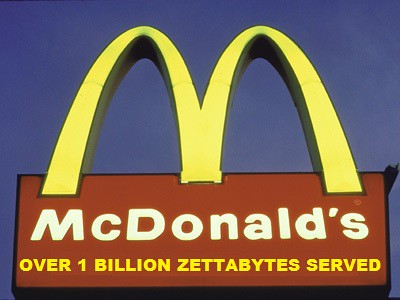
theodp writes "After the school computer lab and public library close for the night in many communities, the local McDonald's is often the only place to turn for students without internet access at home. 'Cheap smartphones and tablets have put Web-ready technology into more hands than ever,' reports the WSJ's Anton Troianovski. 'But the price of Internet connectivity hasn't come down nearly as quickly. And in many rural areas, high-speed Internet through traditional phone lines simply isn't available at any price. The result is a divide between families that have broadband constantly available on their home computers and phones, and those that have to plan their days around visits to free sources of Internet access.' The FCC says it can make broadband available to all Americans by spending $45 billion over 10 years, but until then the U.S. will have to rely on Mickey D's, Starbucks, and others to help address its digital divide. Time to update that iconic McDonald's sign?"
Media

Users Abandon Ship If Online Video Quality Is Not Up To Snuff, Says Study 155

An anonymous reader writes "The first large scientific study of how people respond to poor video quality on the Internet paints a picture of ever rising user expectations and the willingness to abandon ship if those expectations are not met (PDF). Some nuggets: 1) Some users are willing to wait for no more than 2 seconds for a video to start playing, with each additional second adding 6% to the abandonment rate. 2) Users with good broadband connectivity expect faster video load times and are even more impatient than ones on mobile devices. 3) Users who experience video freezing watch fewer minutes of the video than someone who does not experience freezing. If a video freezes for 1% of its total play time, 5% less of its total play time is watched, on average. 4) Users who experience failures when they try to play videos are less likely to return to the same website in the future. Big data was analyzed (260+ million minutes of video) and some cool new data analysis techniques used."

Slashdot Top Deals