Businesses

How Top-Valued Microsoft Has Avoided the Big Tech Backlash (nytimes.com) 71

Google, Facebook, Amazon and Apple are targets of government investigations and public outrage, facing accusations that they abuse their power in various ways, from exploiting personal information to stifling rivals. Conspicuously absent from most of that criticism? Microsoft, a tech company worth more than them all. From a report: The software giant, valued at more than $1 trillion by investors, is no stranger to government scrutiny and public criticism. It endured years of antitrust investigations, and faced a long public trial that almost split up the company. In the end, Microsoft paid billions in fines and settlements, and absorbed humbling lessons. But its "Evil Empire" moniker, once a label favored by the company's critics, has fallen by the wayside.

Market shifts and the evolution of Microsoft's business over the years help explain the transformation. It is less a consumer company than its peers. For example, Microsoft's Bing search engine and LinkedIn professional network sell ads, but the company as a whole is not dependent on online advertising and the harvesting of personal data, unlike Facebook and Google. [...] But Microsoft has also undergone a corporate personality change over the years, becoming more outward looking and seeking the views of policymakers, critics and competitors. That shift has been guided by Brad Smith, Microsoft's president, diplomat-in-residence and emissary to the outside world. In a new book, Mr. Smith makes the case for a new relationship between the tech sector and government -- closer cooperation and challenges for each side. "When your technology changes the world," he writes, "you bear a responsibility to help address the world that you have helped create." And governments, he writes, "need to move faster and start to catch up with the pace of technology."

Microsoft

After 10 Years, Bing Is 'Not the Laughingstock of Technology Anymore' (bnnbloomberg.ca) 129

Bloomberg remembers the launch of Bing ten years ago -- "It was all a little sad". There was even a jingle-writing contest in which song-a-day writer Jonathan Mann won a $500 gift card for his song "Bing Goes the Internet". (After TechCrunch called it "awful" and compared it to the sound of dying cows, the songwriter released a second song which consisted of nothing but the text of TechCrunch's article.)

Now Bloomberg asks, "How did Bing go from a joke to generating nearly three times the advertising revenue of Twitter?" What seemed like a typical Microsoft reaction to fear of Google has become -- with the help of blood, sweat, tears and the Nadellaissance -- a nice business. Microsoft now generates about $7.5 billion in annual revenue from web search advertising. That is a pipsqueak compared with Google's $120 billion in ad sales over the last 12 months. But it's more revenue brought in by either Microsoft's LinkedIn professional network or the company's line of Surface computers and other hardware...

Microsoft in recent years outsourced chunks of its advertising business and stuck Bing in spots that Microsoft controls or that Google couldn't grab. Importantly, Microsoft made Bing front and center for people using search boxes on Windows computers and Office software, practically guaranteeing that a healthy share of PC owners would wittingly or unwittingly use the "decision engine." Research firm comScore estimates Microsoft accounts for a little under one-quarter of U.S. web searches conducted on desktop computers. Microsoft's market share is far smaller outside the U.S. and practically nonexistent on smartphones... [T]his year it struck a deal to handle searches and ads tied to searches on Yahoo, AOL and other Verizon Communications Inc. internet properties. Those aren't glamorous corners of the internet, but they have a lot of traffic and therefore a lot of people searching for running shoes and local dentists. All that helps use of Bing and lifts the ad revenue that flows through Microsoft's accounts.

Microsoft has also pared costs to the point where Bing stopped bleeding red ink... Bing at least stands on its own two feet, and company executives have said that Microsoft has learned from the search business how to run big data-collecting and crunching technologies.

The article argues that Bing's success has been good for Google, since it keeps them from looking like a monopoly.
The Military

North Korea Advertises Military Hardware On Twitter and YouTube, Defying Sanctions (vice.com) 61

eatmorekix shares a report from Motherboard: Glocom, a front company for the government of North Korea that sells sanctioned equipment, isn't giving up. In 2017, before YouTube quietly removed Glocom's channel, the company was advertising missile navigation and other military products on the video platform. But Glocom has returned. It setup a new channel, and also had a presence on Twitter, until Motherboard flagged Glocom's accounts to social media companies. The news not only signals the perseverance of parts of the North Korean's money-making enterprises, but also a slice of the content moderation issues that tech platforms constantly face. Glocom "is using them as platforms to market sanctions violating products," Shea Cotton, research associate at the James Martin Center for Nonproliferation Studies, and who has a particular focus on North Korea, told Motherboard in an email. A United Nations report says that Glocom is run by North Korean intelligence agents, even though it pitches itself as a Malaysian company.

Cotton said "this company continues to operate openly. Most DPRK [Democratic Peoples' Republic of Korea] fronts, when exposed, usually fold or at the very least shut down and move their operations to another country and re-open under a new name. This one hasn't done that. We've seen them try to create this spin off brand called 'FACOM' and sell a few of their products under it but as you've seen their main brand is still thriving apparently."
Facebook

Facebook Sues China-Based Companies For Selling Fake Accounts (bloomberg.com) 24

An anonymous reader quotes a report from Bloomberg: Facebook and its Instagram unit sued four companies and three people based in China for promoting the sale of fake accounts, likes and followers that the social network giant says can be used for nefarious purposes. The Chinese companies advertised and created the fake accounts over the last two years and marketed them for sale on six websites, selling them in bulk quantities, according to a complaint filed Friday in San Francisco federal court. "Fake and inauthentic accounts can be used for spam and phishing campaigns, misinformation campaigns, marketing scams, advertising fraud, and other fraud schemes which are profitable at scale," Facebook and Instagram alleged. They said fake accounts were also created on Amazon, Apple, Google, LinkedIn and Twitter. The companies named as defendants -- 9 Xiu Shenzhen, 9 Xiu Feishu, 9 Xiufei and Home Network -- are based in Longyan and Shenzhen. They are affiliated manufacturers of electronics and hardware, as well as providers of software and online advertising services, according to the complaint.
Advertising

MailChimp Bans Emails Promoting Cryptocurrency (gizmodo.com) 48

"MailChimp to Cryptocurrency Promoters: Your Fake Money's No Good Here," jokes the headline at Gizmodo. The mass emailing service -- which sends over a billion emails a day -- just updated its Acceptable Use Policy to warn users that MailChimp "does not allow businesses involved in any aspect of the sale, transaction, exchange, storage, marketing, or production of cryptocurrencies, virtual currencies, and any digital assets related to an Initial Coin Offering, to use MailChimp to facilitate or support any of those activities."

An anonymous reader quotes Gizmodo: The ban on cryptocurrency promotion isn't out of the blue so much as a clarification of existing use policies... In a statement to Gizmodo, MailChimp further clarified: "We recognize that blockchain technology is in its infancy and has tremendous potential. Nonetheless, the promotion and exchange of cryptocurrencies is too frequently associated with scams, fraud, phishing, and potentially misleading business practices at this time..." MailChimp previously held policies prohibiting multi-level marketing, "make money online" businesses, and "industries hav[ing] higher-than-average abuse complaints," and earmarked "online trading, day trading tips, or stock market related content" for "additional scrutiny..."

This follows similar, though less restrictive bans by Facebook (and Instagram by extension), Google, Linkedin, Twitter, and Snapchat on ICO ads, and country-wide bans in China and South Korea.

Futurism reports that the first victims are "responding in kind by attempting to read the riot act to a Twitter account whose avatar is a monkey with a hat," strongly informing that monkey that "Centralized capricious power is exactly why we need blockchains."
Crime

Crooks Created 28 Fake Ad Agencies To Disguise Massive Malvertising Campaign (bleepingcomputer.com) 36

An anonymous reader quotes a report from Bleeping Computer: A group of cyber-criminals created 28 fake ad agencies and bought over 1 billion ad views in 2017, which they used to deliver malicious ads that redirected unsuspecting users to tech support scams or sneaky pages peddling malware-laden software updates or software installers. The entire operation -- codenamed Zirconium -- appears to have started in February 2017, when the group started creating the fake ad agencies which later bought ad views from larger ad platforms. These fake ad agencies each had individual websites and even LinkedIn profiles for their fake CEOs. Their sole purpose was to interface with larger advertising platforms, appearing as legitimate businesses. Ad security company Confiant, the one who discovered this entire operation, says ads bought by this group reached 62% of ad-monetized websites on a weekly basis. All in all, Confiant believes that about 2.5 million users who've encountered Zirconium's malicious ads were redirected to a malicious site, with 95% of the victims being based in the U.S.
Businesses

The Brutal Fight To Mine Your Data and Sell It To Your Boss (bloomberg.com) 75

An anonymous reader shares a report from Bloomberg, explaining how Silicon Valley makes billions of dollars peddling personal information, supported by an ecosystem of bit players. Editor Drake Bennett highlights the battle between an upstart called HiQ and LinkedIn, who are fighting for your lucrative professional identity. Here's an excerpt from the report: A small number of the world's most valuable companies collect, control, parse, and sell billions of dollars' worth of personal information voluntarily surrendered by their users. Google, Facebook, Amazon, and Microsoft -- which bought LinkedIn for $26.2 billion in 2016 -- have in turn spawned dependent economies consisting of advertising and marketing companies, designers, consultants, and app developers. Some operate on the tech giants' platforms; some customize special digital tools; some help people attract more friends and likes and followers. Some, including HiQ, feed off the torrents of information that social networks produce, using software bots to scrape data from profiles. The services of the smaller companies can augment the offerings of the bigger ones, but the power dynamic is deeply asymmetrical, reminiscent of pilot fish picking food from between the teeth of sharks. The terms of that relationship are set by technology, economics, and the vagaries of consumer choice, but also by the law. LinkedIn's May 23 letter to HiQ wasn't the first time the company had taken legal action to prevent the perceived hijacking of its data, and Facebook and Craigslist, among others, have brought similar actions. But even more than its predecessors, this case, because of who's involved and how it's unfolded, has spoken to the thorniest issues surrounding speech and competition on the internet.
Advertising

Could Cryptocurrency Mining Kill Online Advertising? (linkedin.com) 164

"Could it turn out users actually prefer to trade a little CPU time to website owners in favor of them not showing ads?" writes phonewebcam, a long-time Slashdot reader. Slashdot covered the downside [of in-browser cryptocurrency mining] recently, with even [Portuguese professional sportsballer] Cristiano Ronaldo's official site falling victim, but that may not be the full story. This could be an ideal win-win situation, except for one huge downside -- the current gang of online advertisers.
By "current gang of online advertisers," he means Google, according to a longer essay at LinkedIn: Naturally, the world's largest ad broker, which runs the world most popular browser (desktop and mobile) is keen to see how this plays out, and is also uniquely placed to be able to heavily influence it, too... As it happens, Chrome users can already do something about it via extensions, for example AntiMiner... If cryptocurrencies have a future - and that's a big if (look at China's Bitcoin ban) - it could well turn out that their role just took an unexpected turn.
Microsoft

Finding the Next Generation of Teachers With "Innovative Microsoft Ads" 122

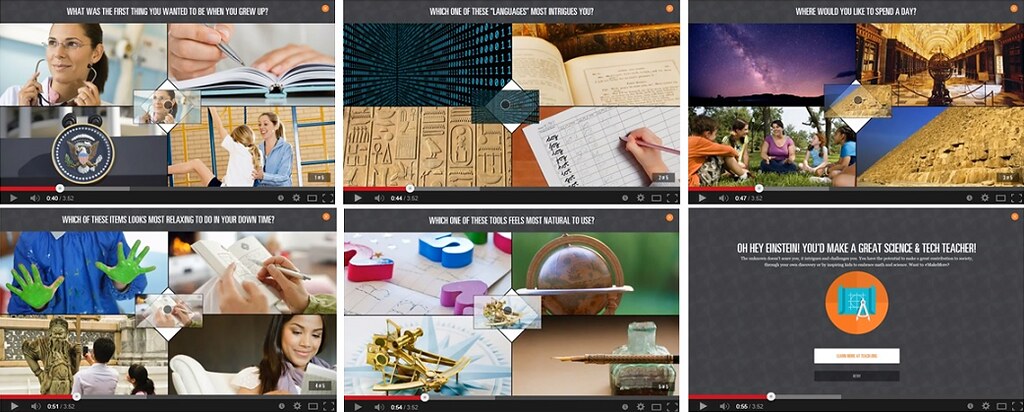
theodp (442580) writes "Back in 2011, the U.S. Dept. of Education delegated teacher recruitment to Microsoft (RFP, pdf). 'The decision to turn over TEACH to [Microsoft] Partners in Learning serves to expand the already outsized influence Gates and his fortune have on public education,' wrote the Washington Post at the time. So, 'what happens when a public institution in a democracy — the US Department of Education — outsources its goal of recruiting good teachers to a private industry?' Well, in addition to Teach.org and redundant social media efforts on Twitter, Facebook, Tumblr, Instagram, Linkedin, and YouTube, the U.S. is now relying on 'Innovative Microsoft Advertising to Recruit the next Generation of Teachers'. From the press release, 'The Ad Council and TEACH have formed a unique outreach campaign with Microsoft's Advertising team in an effort to recruit the next generation of teachers who will drive innovation and redefine teaching in K-12 classrooms. Microsoft donated over 125 million impressions across Xbox 360, Windows 8, and MSN in order to encourage consumers to rediscover teaching through interactive ad units. This media effort is an extension of the Ad Council and TEACH's public service advertising (PSA) campaign, Make More...Throughout March, consumers were able to engage with TEACH "NUads on Xbox", via gesture, voice or controller on their Xbox 360 consoles...Most recently, Microsoft leveraged their Windows 8 platform to provide a unique experience to consumers, enabling them to navigate through a series of questions to help "discover their true passion," along with the opportunity to play challenging mind and word games, such as a word scramble and tangrams.' Check out the demo of the Windows 8 platform experience [YouTube], in which a person is advised 'You'd Make a Great Science & Tech Teacher,' on the basis of a 'Personality Quiz' consisting of five dragged-and-dropped photos."
Image

Book Review: Digital Vertigo Screenshot-sm 65

benrothke writes "In Digital Vertigo: How Todays Online Social Revolution Is Dividing, Diminishing, and Disorienting Us, author Andrew Keen, who describes himself as the Anti-Christ of Silicon Valley (whatever that means), raises numerous profound questions about social media and its implications on society. In the new world of social media and Web 3.0, which is claiming to revolutionize communication and interactions, Keen writes that history is repeating itself and points to the beginning of the industrial revolution as an example. He writes of Jeremy Bentham who invented the Panopticon; a structure where the inhabitants were watched at all times. Bentham felt the Panopticon could make humanity more virtuous, more hard-working and happier; similar to the promise of Web 3.0. The Panopticon was a failure, and Keen sees the same for Web 3.0. The book is a critique of Web 3.0." Read below for the rest of Ben's review.
Businesses

LinkedIn Hurries To Address Privacy Stumble 58

swandives writes "LinkedIn will make changes to a 'social advertising' feature that has been criticized for using members' names and photographs in advertisements on its website. Amid mounting criticism, the social networking service says it has been 'listening' to its users and 'could have communicated' its intentions with the new ad feature more clearly. As a result, it said, it will change how the advertisements appear. If a LinkedIn user 'follows' a company or service on LinkedIn, the ad feature can display the user's name and photo in advertisements for that company. LinkedIn said its goal was to deliver more useful ads, but some LinkedIn users complained it was a privacy violation, particularly because they have to opt out of the feature rather than opt in. It will be interesting to see whether the changes affect stocks, especially since the network's IPO in May, when shares closed at more than double the initial price, prompting concerns over another dot-com bubble."
Book Reviews

Book Review: Inkscape 0.48 Essentials for Web Designers 91

JR0cket writes"Inkscape is an open source 2D drawing tool that helps you create graphic designs, from simple buttons and logos to full blown posters and web page designs. Inkscape is similar to Adobe Illustrator or CorelDraw and gives you a vector based graphics tool that uses the W3C Scalable Vector Graphics (SVG) format. Inkscape is easy to use, although learning the tricks that make designing a web site look great are more involved. The Inkscape 0.48 Essentials for Web designers is specifically focused on helping you to create your first web site designs and does a great job of getting you started. Most if not all the techniques covered are relevant to creating other graphic works too, so its useful as a general Inkscape tutorial." Read on for the rest of John's review.
Google

Google Patenting 'Exponential' Friend Spamming 64

theodp writes "'The web is better when it's social,' declared Google as it unveiled its OpenSocial initiative. Sounds great, right? Well, maybe not so much, unless you're keen on giving companies the capability to 'exponentially' bombard you with advertising across all of your social networking sites. On Thursday, the USPTO published Google's patent application for Propagating Promotional Information on a Social Network, which the search giant explains 'generally relates to creating and providing promotional information (e.g., advertising, public service announcements, etc.) to users of a social network (e.g., FACEBOOK, MYSPACE, ORKUT, LINKEDIN, TWITTER, etc.).' By doing so 'across multiple social networks,' Google adds, 'the impact of the other promotional information may exponentially expand to other users of a social network."
Microsoft

Microsoft May Be Targeting the Ubuntu Desktop 583

mjasay writes "Microsoft is advertising for a new director of open source strategy, but this one has a specific purpose: fight the Linux desktop. 'The Windows Competitive Strategy team is looking for a strong team member to lead Microsoft's global desktop competitive strategy as it relates to open source competitors.' For a variety of reasons, this move is almost certainly targeted at Ubuntu Linux's desktop success. With the Mac, not Linux, apparently eating into Microsoft's Windows market share, what is it about desktop Linux, and specifically Ubuntu, that has Microsoft spooked?" Reader christian.einfeldt notes Microsoft's acknowledgment of the FOSS threat to their business model within SEC filings, and suggests that this job posting could instead be about maintaining Internet Explorer's market share lead against Firefox.

Slashdot Top Deals