Software

Canonical Helps Launch A Snap Store For The Orange Pi Community (ubuntu.com) 55

"Developers can distribute their applications packaged as snaps to Orange Pi owners," explains a new blog post from Canonical, bragging that "hackers and tinkerers can install complex IoT and server projects in seconds." An anonymous reader quotes Ubuntu's Insights blog: Orange Pi maker Shenzhen Xunlong Software Co. Ltd is launching an app store in partnership with Canonical to foster an active community of developers and users. Through this app store, developers gain a simple mechanism to share their applications, projects and scripts between themselves and with the wider Orange Pi community...

With snaps developers can distribute their application in a secure, confined package bundled with all its dependencies, so users can install applications that could take half an hour to install in just a few seconds. The Orange Pi App Store uses the whitelabel app store offering from Canonical, which lets them distribute applications to the Orange Pi community under its own brand. The store is a place for developers to share their Orange Pi specific applications. It also benefits from the wealth of applications available in the Ubuntu snap store, also available through the store.

Are there any Slashdot readers who are actually using snaps? Or -- for that matter -- are there any Slashdot readers developing with the Orange Pi?
Businesses

Raspberry Pi Becomes Third Best-Selling General Purpose Computer of All Time, Beating Commodore 64 (raspberrypi.org) 145

The Raspberry Pi has outsold the Commodore 64 by selling north of 12.5 million boards in five years, becoming the world's third best-selling general purpose computer. "The Commodore 64, had, until recently, the distinction of being the third most popular general purpose computing platform," Eben Upton told a crowd at the fifth birthday party. "That's what I'm here to celebrate," he said, "we are now the third most popular general purpose computing platform after the Mac and PC." The MagPi Magazine reports: The Raspberry Pi Model 3 is the best-selling Raspberry Pi. This chart shows that Raspberry Pi 3 has accounted for almost a third of all Raspberry Pi boards sold. The Model 3 sits next to its immediate predecessor, the Raspberry Pi 2B+ (which has the same board shape but a slightly slower CPU). These two boards account for over half of all Raspberry Pi boards sold. The rest of the sales are between older models. The original Model A accounts for just 2 percent of sales. So keep one if you've got it as they're pretty rare. We should point out, before the Commodore fan club arrives, that there are discrepancies in the total number of sales of the C64. The 12.5 million figure comes from an analysis of serial numbers. This article by Michael Steil explains in detail why the 12.5 million number is accurate. We hold it to be the most accurate analysis of Commodore 64 sales (other opinions are available).
Operating Systems

NetBSD 7.1 Released (netbsd.org) 45

New submitter fisted writes: The NetBSD Project is pleased to announce NetBSD 7.1, the first feature update of the NetBSD 7 release branch. It represents a selected subset of fixes deemed important for security or stability reasons, as well as new features and enhancements. Some highlights of the 7.1 release are:

-Support for Raspberry Pi Zero.
-Initial DRM/KMS support for NVIDIA graphics cards via nouveau (Disabled by default. Uncomment nouveau and nouveaufb in your kernel config to test).
The addition of vioscsi, a driver for the Google Compute Engine disk.
-Linux compatibility improvements, allowing, e.g., the use of Adobe Flash Player 24.
-wm(4): C2000 KX and 2.5G support; Wake On Lan support; 82575 and newer SERDES based systems now work.
-ODROID-C1 Ethernet now works.
-Numerous bug fixes and stability improvements.

NetBSD is free. All of the code is under non-restrictive licenses, and may be used without paying royalties to anyone. Free support services are available via our mailing lists and website. Commercial support is available from a variety of sources. More extensive information on NetBSD is available from http://www.NetBSD.org.
You can download NetBSD 7.1 from one of these mirror sites.
Math

This Is How the Number 3.14 Got the Name 'Pi' (time.com) 133

An anonymous reader shares a Time article: Ancient research on real numbers likely "didn't get improved upon until the age of Newton," says John Conway, mathematics professor emeritus at Princeton University who once won the school's Pi Day pie-eating contest. Sir Isaac Newton recorded 16 digits of pi in 1665, later admitting that he was "ashamed" of how long he had worked on the computations, as it meant that he had "no other business at the time," per the MAA. It was not until the 18th century -- about two millennia after the significance of the number 3.14 was first calculated by Archimedes -- that the name "pi" was first used to denote the number. In other words, the Greek letter used to represent the idea was not actually picked by the Ancient Greeks who discovered it. British mathematician William Jones came up with the Greek letter and symbol for the figure in 1706, and it was popularized by Swiss mathematician Leonhard Euler, Catherine the Great's mathematician, a few decades later. "Euler was a much better mathematician than the people who used [pi] before, and he wrote very good textbooks," says Conway. "He used it because the Greek letter Pi corresponds with the letter 'P'... and pi is about the perimeter of the circle."
Hardware

Raspberry Pi Zero W is a $10 Computer With Wi-Fi and Bluetooth (betanews.com) 138

On the fifth birthday of the original Raspberry Pi, the foundation has announced the Raspberry Pi Zero W, a slightly more capable variant of the miniature computer. From a report on BetaNews: It's essentially a Pi Zero with the addition of the two features many people have been requesting -- wireless LAN and Bluetooth. Priced at $10, the Pi Zero W uses the same Cypress CYW43438 wireless chip as Raspberry Pi 3 Model B to deliver 802.11n wireless LAN and Bluetooth 4.0 connectivity. The full list of features is as follows: 1GHz, single-core CPU, 512MB RAM, mini-HDMI port, micro-USB On-The-Go port, micro-USB power, HAT-compatible 40-pin header, composite video and reset headers, CSI camera connector, 11n wireless LAN, and Bluetooth 4.0.
Android

ZDNet: Linux 'Takes The World' While Windows Dominates The Desktop (zdnet.com) 224

ZDNet editor-in-chief Steve Ranger writes that desktop dominance is less important with today's cloud-based apps running independent of operating system, arguing that the desktop is now "just one computing platform among many." An anonymous reader quotes his report: Linux on the desktop has about a 2% market share today and is viewed by many as complicated and obscure. Meanwhile, Windows sails on serenely, currently running on 90% of PCs in use... That's probably OK because Linux won the smartphone war and is doing pretty well on the cloud and Internet of Things battlefields too.

There's a four-in-five chance that there's a Linux-powered smartphone in your pocket (Android is based on the Linux kernel) and plenty of IoT devices are Linux-powered too, even if you don't necessarily notice it. Devices like the Raspberry Pi, running a vast array of different flavours of Linux, are creating an enthusiastic community of makers and giving startups a low-cost way to power new types of devices. Much of the public cloud is running on Linux in one form or another, too; even Microsoft has warmed up to open-source software.

The Courts

SAP License Fees Also Due For Indirect Users, Court Rules (networkworld.com) 123

SAP's licensing fees "apply even to related applications that only offer users indirect visibility of SAP data," according to a Thursday ruling by a U.K. judge. Slashdot reader ahbond quotes Network World: The consequences could be far-reaching for businesses that have integrated their customer-facing systems with an SAP database, potentially leaving them liable for license fees for every customer that accesses their online store. "If any SAP systems are being indirectly triggered, even if incidentally, and from anywhere in the world, then there are uncategorized and unpriced costs stacking up in the background," warned Robin Fry, a director at software licensing consultancy Cerno Professional Services, who has been following the case...

What's in dispute was whether the SAP PI license fee alone is sufficient to allow Diageo's sales staff and customers to access the SAP data store via the Salesforce apps, or whether, as SAP claims, those staff and customers had to be named as users and a corresponding license fee paid. On Thursday, the judge sided with SAP on that question.

Robotics

New Kit Turns A Raspberry Pi Into A Robot Arm (raspberrypi.org) 36

An anonymous reader writes: A new kit turns your Raspberry Pi into a robotic arm. It's controlled by an on-board joystick, or even a web browser, and "because it's connected to the Pi you can program it through any of the various programming languages that already run on the Pi," according to its creators. "There's also free software available which lets you program it through a web interface using drag and drop programming environments like Scratch and Blockly or with Python and Javascript for the more experienced."

They explain in a video on Kickstarter that "Our mission is to get children excited about technology through building and programming their own robots," and they've already raised three times their original $12,411 fundraising goal. The Raspberry Pi blog describes it as "a great kit for anyone wanting to step into the world of digital making."

Long-time Slashdot reader bjpirt adds that "It's completely open source and hackable."
AI

Google Is Partnering With Raspberry Pi To Create AI (zdnet.com) 57

Google is planning to bring artificial intelligence and machine learning tools to the diminutive Raspberry Pi this year. The Raspberry Pi Foundation said in a statement, "Google is going to arrive in style in 2017. The tech titan has exciting plans for the maker community." ZDNet reports: The advertising-to-cloud-computing giant intends to make a range of smart tools available this year, according to the Foundation. "Google's range of AI and machine learning technology could enable makers to build even more powerful projects," it said. Google has developed a huge range of tools for machine learning, IoT, wearables, robotics, and home automation, and it wants Raspberry Pi fans to fill out a survey that will help it to understand what tools to provide. The survey mentions face- and emotion-recognition and speech-to-text translation, as well as natural language processing and sentiment analysis. "The tech giant also provides powerful technology for navigation, bots, and predictive analytics. The survey will help them get a feel for the Raspberry Pi community, but it'll also help us get the kinds of services we need," said the Foundation.
Open Source

Raspberry Pi Gets Competitors (hackaday.com) 115

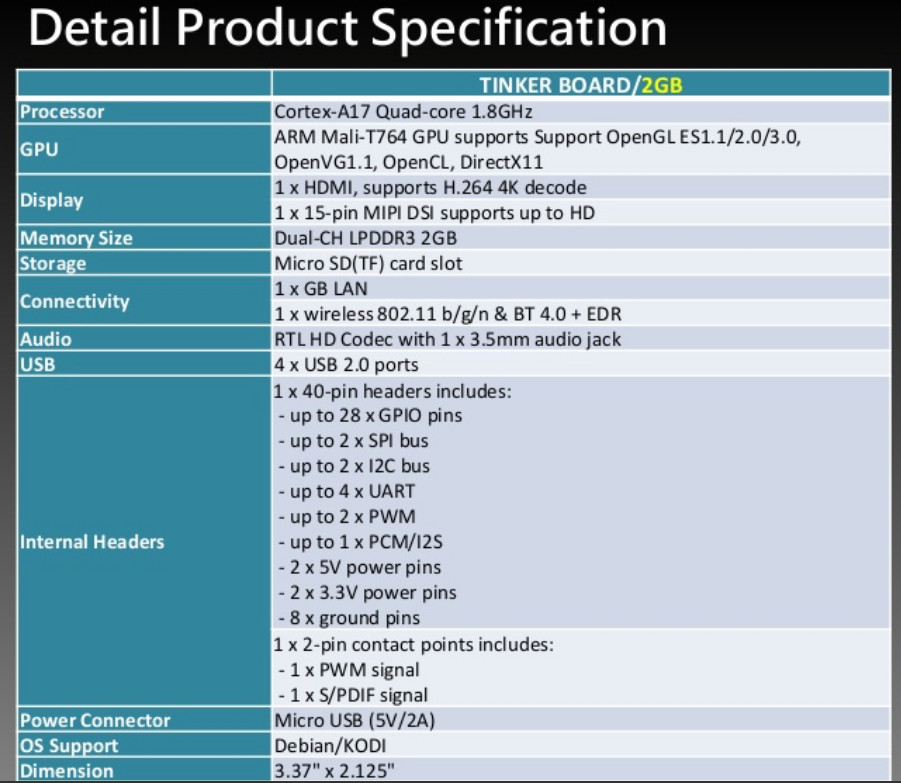
Hackaday reports that Asus has "quietly released their Tinker board that follows the Pi form factor very closely, and packs a 1.8 GHz quad-core ARM Cortes A17 alongside an impressive spec At £55 (about $68) where this is being written it's more expensive than the Pi, but Asus go to great lengths to demonstrate that it is significantly faster."

And though the Raspberry Pi foundation upgraded their Compute Module, Pine64 has just unveiled their new SOPINE A64 64-bit computing module, a smaller version of the $15 Pine64 computer. An anonymous reader quotes ComputerWorld: At $29, the SOPINE A64 roughly matches the price of the Raspberry Pi Compute Module 3, which ranges from $25 to $30. The new SOPINE will ship in February, according to the website. The SOPINE A64 can't operate as a standalone computer like the Pine64. It needs to be plugged in as a memory slot inside a computer. But if you want a full-blown computer, Pine64 also sells the $15 SOPINE Baseboard Model-A, which "complements the SOPINE A64 Compute Module and turns it into a full single board computer," according to the company...

The original Pine64 was crowdsourced and also became popular for its high-end components like a 64-bit chip and DDR3 memory... It has 2GB RAM, which is twice that of Raspberry Pi's compute module. SOPINE also has faster DDR3 memory, superior to DDR2 memory in Raspberry Pi Compute Module 3 board.

Data Storage

Raspberry Pi Upgrades Compute Module With 10 Times the CPU Performance (arstechnica.com) 71

An anonymous reader quotes a report from Ars Technica: The Raspberry Pi Compute Module is getting a big upgrade, with the same processor used in the recently released Raspberry Pi 3. The Compute Module, which is intended for industrial applications, was first released in April 2014 with the same CPU as the first-generation Raspberry Pi. The upgrade announced today has 1GB of RAM and a Broadcom BCM2837 processor that can run at up to 1.2GHz. "This means it provides twice the RAM and roughly ten times the CPU performance of the original Compute Module," the Raspberry Pi Foundation announcement said. This is the second major version of the Compute Module, but it's being called the "Compute Module 3" to match the last flagship Pi's version number. The new Compute Module has more flexible storage options than the original. "One issue with the [Compute Module 1] was the fixed 4GB of eMMC flash storage," the announcement said. But some users wanted to add their own flash storage. "To solve this, two versions of the [Compute Module 3] are being released: one with 4GB eMMC on-board and a 'Lite' model which requires the user to add their own SD card socket or eMMC flash." The core module is tiny so that it can fit into other hardware, but for development purposes there is a separate I/O board with GPIO, USB and MicroUSB, CSI and DSI ports for camera and display boards, HDMI, and MicroSD. The Compute Module 3 and the lite version cost $30 and $25, respectively.
Education

Ask Slashdot: What's The Best Job For This Recent CS Grad? 261

One year away from graduating with a CS degree, an anonymous reader wants some insights from the Slashdot community: [My] curriculum is rather broad, ranging from systems programming on a Raspberry Pi to HTML, CSS, JavaScript, C, Java, JPA, Python, Go, Node.js, software design patterns, basic network stuff (mostly Cisco) and various database technologies... I'm working already part-time as a system administrator for two small companies, but don't want to stay there forever because it's basically a dead-end position. Enjoying the job, though... With these skills under my belt, what career path should I pursue?
There's different positions as well as different fields, and the submission explains simply that "I'm looking for satisfying and rewarding work," adding that "pay is not that important." So leave your suggestions in the comments. What's the best job for this recent CS grad?
Debian

Linux.com Announces The Best Linux Distros for 2017 (linux.com) 224

Friday Linux.com published their list of "what might well be the best Linux distributions to be found from the ever-expanding crop of possibilities... according to task." Here's their winners (as chosen by Jack Wallen), along with a short excerpt of his analysis.
  • Best distro for sysadmins : Parrot Linux. "Based on Debian and offers nearly every penetration testing tool you could possibly want. You will also find tools for cryptography, cloud, anonymity, digital forensics, programming, and even productivity."
  • Best lightweight distribution: LXLE. "Manages to combine a perfect blend of small footprint with large productivity."
  • Best desktop distribution: Elementary OS "I'm certain Elementary OS Loki will do the impossible and usurp Linux Mint from the coveted 'best desktop distribution' for 2017."
  • Best Linux for IoT: Snappy Ubuntu Core "Can already be found in the likes of various hacker boards (such as the Raspberry Pi) as well as Erle-Copter drones, Dell Edge Gateways, Nextcloud Box, and LimeSDR."
  • Best non-enterprise server distribution: CentOS. "Since 2004, CentOS has enjoyed a massive community-driven support system."
  • Best enterprise server distribution: SUSE. "Don't be surprised if, by the end of 2017, SUSE further chips away at the current Red Hat market share."

Wallen also chose Gentoo for "Best distribution for those with something to prove," saying "This is for those who know Linux better than most and want a distribution built specifically to their needs... a source-based Linux distribution that starts out as a live instance and requires you to then build everything you need from source." And surprisingly, he didn't mention his own favorite Linux distro, Bodhi Linux, which he describes elsewhere as "a melding of Ubuntu and Enlightenment".


Operating Systems

OpenELEC 7.0 Linux Distribution Now Available For PC and Raspberry Pi (betanews.com) 28

Readers BrianFagioli writes: Some operating systems are targeted at a single use to minimize the overhead and maximize the power of the hardware. One such focused OS is OpenELEC. This Linux distribution is designed to serve as a media center -- nothing more, nothing less. Today, the popular distro reaches stable version 7.0. There are images for both x86 and Raspberry Pi 2 and 3, meaning there is a very good chance you own compatible hardware. OpenELEC 7.0 release contain a Kodi major version bump. If you are updating from OpenELEC 6.0 or earlier we strongly recommend you perform a full backup before performing a manual update. If you experience issues please perform a soft-reset to clear OpenELEC and Kodi settings. "The OpenELEC 7.0 (internal version 7.0.0) release has been published. Users running OpenELEC 6.95.1 or later with auto-update enabled will be prompted on-screen to reboot and apply the update once it has been downloaded and enabled in some hours. Users running older OpenELEC releases or with auto-update disabled will need to manually update," says Stephan Raue, maintainer, OpenELEC Mediacenter Project.
Desktops (Apple)

Raspberry Pi's Linux-Based PIXEL Desktop Now Available For PC and Mac (betanews.com) 50

From a report on BetaNews: If you own a Raspberry Pi, you're probably familiar with PIXEL. The desktop environment is included in the Raspbian OS. The Raspberry Pi Foundation describes PIXEL as the "GNU/Linux we would want to use" and understandably so. It offers a smart, clean interface, a decent selection of software, the Chromium web browser with plug-ins, and more -- and from today it's available for PC and Mac. The version of Debian+PIXEL for x86 platforms is described as "experimental" but having taken it for a spin, it seems pretty stable to me. To run PIXEL on your PC or Mac, download the image, burn it onto a DVD or flash it onto a USB memory stick, and boot from it. The desktop environment will load ready for use.
Networking

Ask Slashdot: Could A 'Smart Firewall' Protect IoT Devices? 230

To protect our home networks from IoT cracking, Ceaus wants to see a smart firewall: It's a small box (the size of a Raspberry Pi) with two ethernet ports you put in front of your ISP router. This firewall is capable of detecting your IoT devices and blocking their access to the internet, only and exclusively allowing traffic for the associated mobile app (if there is one). All other outgoing IoT traffic is blocked... Once you've plugged in your new IoT toaster, you press the "Scan" button on the firewall and it does the rest for you.
This would also block "snooping" from outside your home network, and of course, keep your devices off botnets. The original submission asks "Does such a firewall exist? Is this a possible Kickstarter project?" So leave your best answers in the comments. Could a smart firewall protect IoT devices?
Privacy

A $5 Tool Called PoisonTap Can Hack Your Locked Computer In One Minute (vice.com) 172

An anonymous reader quotes a report from Motherboard: A new tool makes it almost trivial for criminals to log onto websites as if they were you, and get access to your network router, allowing them to launch other types of attacks. Hackers and security researchers have long found ways to hack into computers left alone. But the new $5 tool called PoisonTap, created by the well-known hacker and developer Samy Kamkar, can even break into password-protected computers, as long as there's a browser open in the background. Kamkar explained how it works in a blog post published on Wednesday. And all a hacker has to do is plug it in and wait. PoisonTap is built on a Raspberry Pi Zero microcomputer. Once it's plugged into a USB port, it emulates a network device and attacks all outbound connections by pretending to be the whole internet, tricking the computer to send all traffic to it. Once the device is positioned in the middle like this, it can steal the victim's cookies, as long as they come from websites that don't use HTTPS web encryption, according to Kamkar. Security experts that reviewed Kamkar's research for Motherboard agreed that this is a novel attack, and a good way to expose the excessive trust that Mac and Windows computers have in network devices. That's the key of PoisonTap's attacks -- once what looks like a network device is plugged into a laptop, the computer automatically talks to it and exchanges data with it.
AI

IBM's Project Intu brings Watson's Capabilities To Any Device (siliconangle.com) 17

IBM has launched a new system-agnostic platform called Project Intu with which it aims to bring "embodied cognition" to a range of devices. From a report on SiliconAngle: In IBM's parlance, "cognitive computing" refers to machine learning. The idea behind Project Intu is that developers will be able to use the platform to embed the various machine learning functions offered by IBM's Watson service into various applications and devices, and make them work across a wide spectrum of form factors. So, for example, developers will be able to use Project Intu's capabilities to embed machine learning capabilities into pretty much any kind of device, from avatars to drones to robots and just about any other kind of Internet of Things' device. As a result, these devices will be able to "interact more naturally" with users via a range of emotions and behaviors, leading to more meaningful and immersive experiences for users, IBM said. What's more, because Project Intu is system-agnostic, developers can use it to build cognitive experiences on a wide range of operating systems, be it Raspberry PI, MacOS, Windows or Linux. Project Intu is still an experimental platform, and it can be accessed via the Watson Developer Cloud, the Intu Gateway and also on GitHub.
Classic Games (Games)

The NES Classic is a $60 Single Board Computer Running Linux 121

"Nintendo's accurate NES emulator apparently needs no less than a quad-core CPU," joked Ars Technica. "The next step, of course, is unscrewing of the nostalgic little box to see how it ticks -- and whether its limited functionality might ever be expanded, either officially or by hackers." Slashdot reader romiz summarizes what's inside Nintendo's new miniature emulator for classic games: With a quad-core ARM Cortex-A7, 256 MB of RAM, and 512 MB of NAND Flash, it is typical of the hardware found in Linux single board computers, like the Raspberry Pi 2. Surprisingly for Nintendo, there does not seem to be any custom components in it, and it looks like it even does run Linux. [YouTube video] The GPL license for the kernel and many other open source components is visible in the legal information screen. The source, however, is not yet available on Nintendo's open source page.

But it is the re-edition a 1980s video console: there is no network access, no hardware expansion port, and the 30 games cannot be changed. Changing the system running on it will probably be difficult.
Linux

Meet VoCore2 Lite, a $4 Coin-Sized, Open Source Linux Computer (zdnet.com) 106

An anonymous reader shares a report on ZDNet:Four bucks buys a lot of hardware these days, and nothing highlights this more than a project like the VoCore2 Lite. VoCore2 is an open source Linux computer and a fully-functional wireless router that is smaller than a coin. It can also act as a VPN gateway for a network, an AirPlay station to play lossless music, a private cloud to store your photos, video, and code, and much more. The Lite version of the VoCore2 features a 580MHz MT7688AN MediaTek system on chip (SoC), 64MB of DDR2 RAM, 8MB of NOR storage, and a single antenna slot for Wi-Fi that supports 150Mbps. Spend $12 and go for the full VoCore2 option and you get the same SoC, but you get 128MB of DDR2 RAM, 16MB of NOR storage, two antenna slots supporting 300Mbps, an on-board antenna, and PCIe 1.1 support.

Slashdot Top Deals