
Journal GeckoFood's Journal: Potato Bread, Recipe and Discussion 3
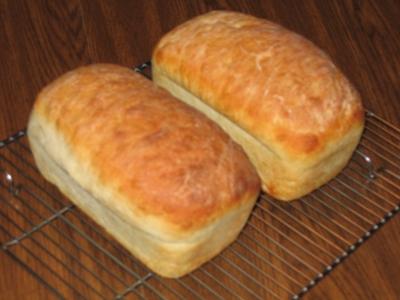
This weekend I made potato bread and it turned out better than it usually does. I mentioned this to Bethanie and she threatened bodily harm if I didn't post the recipe, so here it is. After the recipe, I have some notes about what I did differently that worked out well.
+++
Potato Bread
- 1 1/2 c. mashed potatoes
- 1 1/2 c. potato water, very hot
- 2 tbsp. sugar
- 2 tbsp. shortening or butter
- 2 1/2 tsp. salt
- 1/4 c. lukewarm water (110 - 130 degrees F)
- 1 pkg., or 2 1/4 tsp., dry yeast
- 6 1/2 c. flour
In a saucepan, combine the mashed potatoes, potato water, sugar, shortening and salt. Stir until the potatoes are smooth and the shortening is melted. Cool until between 110 and 130 degrees F.
In a large mixing bowl, pour the lukewarm water over the yeast. Stir and allow this to stand for a few minutes, until the yeast begins to foam. Add the potato mixture to the yeast. Add half of the flour and mix until incorporated. Gradually add the remaining flour and knead until smooth and satiny. If sticky, add a little more flour. Clean and grease the bowl, put the dough back in the prepared bowl, and cover with a damp cloth or plastic wrap. Allow the dough to rise in a warm place until doubled in bulk, about an hour. Punch down dough. Divide in half and shape into 2 round loaves or place in greased 9x5x3 inch loaf pans. Cover with damp cloth and let rise until doubled in bulk, again about an hour. Bake in an oven at 450 degrees F for 15 minutes. Reduce heat to 350 degrees F and bake about 35 minutes more or until golden. Makes 2 loaves.
+++
I'll start off by saying that this recipe is messy but very easy - if you take your time and have the temperatures right, you really can't foul this up.
I usually make round loaves, on a baking stone that is actually a porcelain floor tile from Italy that I had specially cut to fit my oven. The stone gives more even cooking on the bottom and the crust is a little more interesting. For this occasion I used 8x4 loaf pans, because I wanted to minimize the chances of the loaves collapsing on transfer (I was making these for a crowd). Rightfully I should have used 9x5's, but the pans I have are shaped weird and it makes a waste of the heel (which, IMHO, is the best slice of the whole thing).
I reduced the flour. I eliminated one cup of flour, and as a result I had a sticky, almost wet dough that required some careful handling and a little extra grease in the loaf pans. This made it a bit harder to work with, but it made the end result more moist and soft. Because I chose to mix by hand instead of by KitchenAid mixer, I had a lot more control over the dough.
I usually use wax paper instead of a damp cloth to cover the loaves. That said, the wax paper must be heavily greased or the dough will stick to it and the loaf will collapse when you remove the wax paper from it.
If I follow the temperatures and times exactly I will get pumice and the smoke detector will be very interested in what's happening... My oven is a little off, so I have to adjust to compensate for it. I set the oven to 375 degrees F and let the bread bake for 30 - 35 minutes. YMMV.
To make this bread *outstanding*, one time I eliminated the sugar, I used cold water for the proof, I refrigerated the potato mixture before adding to the yeast, and after I was done kneading the threw the whole works in the refrigerator overnight for the first rising. It took a lot longer to rise once it came out and was allowed to warm to room temperature, but the end result was the most amazing potato bread you can imagine - the flavor was very distinct and nutty, the texture of the crumb was very irregular and pleasant, and the crust was chewy. This is something to try if you have the time and the patience.

now (Score:2)
just curious
always on the lookout for bread recipes from teh gecko!
Re:now (Score:1)
I am very much interested in making a gf version. Right now the one type of flour that I know is easily available is corn flour, but I am guessing rice flour would be a better match with the potatoes. Instead of gluten I would have to substitute in xanthan gum, and beyond that I'm not sure - that *may* be enough. I am certainly willing to try it, though!
Let me ask a counter-question, that may make this easier - what kinds of flour
Re:now (Score:2)
Truthfully, your best bet may be to try a few loaves of regular bread, with a mix of rice flour, tapioca starch, and potato starch. Talk to user Pancho_Pistolas about this, ask him for his pizza crust recipe for a good place to start.
Things to know about GF bread: The batter is sticky as hell, you'll need a mixer that can handle stuff that climbs and sticks.
Cornstarch and potato starch alone can be mixed with things like sour cream for a soft dough, with vinegar and baking