An API powered by Google's AI technology allows you to accurately convert speech into text. You can accurately caption your content, provide a better user experience with products using voice commands, and gain insight from customer interactions to improve your service. Google's deep learning neural network algorithms are the most advanced in automatic speech recognition (ASR). Speech-to-Text allows for experimentation, creation, management, and customization of custom resources. You can deploy speech recognition wherever you need it, whether it's in the cloud using the API or on-premises using Speech-to-Text O-Prem. You can customize speech recognition to translate domain-specific terms or rare words. Automated conversion of spoken numbers into addresses, years and currencies. Our user interface makes it easy to experiment with your speech audio.
Learn more
Fathom is the free AI meeting assistant that instantly records, transcribes, and summarizes your Zoom, Meet, or Microsoft Teams meetings so you can focus on the conversations instead of taking notes.
Fathom is an AI-driven meeting assistant that automatically records, transcribes, and summarizes your virtual meetings across platforms like Zoom, Google Meet, and Microsoft Teams. Designed to save time and increase productivity, Fathom generates actionable summaries in under 30 seconds and syncs with your CRM for streamlined follow-ups. The platform's unique features include real-time transcription, meeting highlights, and the ability to share clips, making it ideal for teams looking to improve meeting efficiency and reduce administrative work.
Learn more
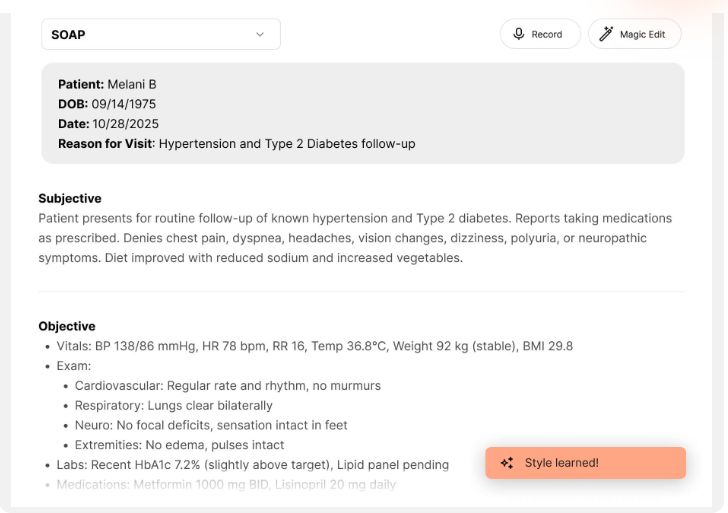
AISOAP
AISOAP is an innovative medical scribe powered by artificial intelligence, designed to swiftly convert patient interactions into neatly organized SOAP (Subjective, Objective, Assessment, Plan) notes. By efficiently recording and transcribing medical consultations, it can minimize documentation time by as much as 95%, thus enabling healthcare providers to devote more attention to their patients. Supporting a diverse range of over 50 medical specialties, AISOAP guarantees that the summaries and terminology used are clinically precise and relevant across different areas of medicine. Users are presented with a selection of templates and the option to customize their notes according to specific needs, which promotes smooth integration with Electronic Health Records (EHR) and Electronic Medical Records (EMR) platforms. The sophisticated medical AI within the system captures vital information from conversations, producing highly accurate clinical notes. Furthermore, the 'Magic AI Edit' feature empowers clinicians to articulate their preferred templates or outcomes in their own language, resulting in personalized SOAP notes that encompass all critical details, while also enhancing workflow efficiency in healthcare settings. Ultimately, AISOAP stands out as a valuable tool for improving the overall documentation process in medical practice.
Learn more
ScribeHealth
ScribeHealth utilizes advanced AI technology to serve as a medical scribe that actively listens to discussions between patients and clinicians, transcribing and coding clinical notes in real time while requiring minimal input from healthcare professionals. This innovative solution boasts a high level of accuracy, adapts through user feedback, and allows most doctors to spend just a few minutes making adjustments instead of composing notes entirely from the beginning. It integrates effortlessly with various existing EHR/EMR systems such as Epic, Cerner, AllScripts, and Jane, through secure APIs, and complies with HL7/FHIR standards, ensuring that note syncing fits seamlessly into the daily routines of clinicians. With robust security measures including bank-level encryption, automatic deletion of audio recordings post-transcription, and strict adherence to HIPAA regulations, patient privacy is meticulously protected. Additionally, ScribeHealth provides valuable features like session analytics, speaker identification, and the ability to understand context for better extraction of symptoms and assessments, enhancing the overall efficiency of clinical documentation. This technology not only streamlines the documentation process but also empowers healthcare providers to focus more on patient care rather than administrative tasks.
Learn more