Average Ratings 0 Ratings
Average Ratings 0 Ratings
Similar Products
-
IONOS Cloud Object StorageIONOS Cloud Object Storage is a flexible storage solution tailored for the management and retrieval of extensive volumes of unstructured data within cloud platforms. Fully compliant with the S3 API standard, it empowers developers and IT professionals to utilize existing S3 clients and tools for bucket and object management, seamlessly integrating into modern cloud-native applications and systems. This service allows businesses to store nearly limitless amounts of static or backup data without the complexities of traditional storage management. Engineered for both reliability and high availability, it ensures data remains accessible and secure through redundant storage mechanisms across multiple nodes, safeguarding against potential infrastructure failures. Ideal for a variety of use cases, it supports the storage of backups, archives, and disaster recovery snapshots, while also efficiently managing substantial datasets that are essential for analytics, machine learning, or digital content initiatives. Furthermore, its scalability makes it an excellent choice for organizations anticipating growth or needing to adapt quickly to changing data storage requirements.
-
QuantaStorQuantaStor, a unified Software Defined Storage platform, is designed to scale up and down to simplify storage management and reduce overall storage costs. QuantaStor storage grids can be configured to support complex workflows that span datacenters and sites. QuantaStor's storage technology includes a built-in Federated Management System that allows QuantaStor servers and clients to be combined to make management and automation easier via CLI and RESTAPIs. QuantaStor's layered architecture gives solution engineers unprecedented flexibility and allows them to design applications that maximize workload performance and fault tolerance for a wide variety of storage workloads. QuantaStor provides end-to-end security coverage that allows multi-layer data protection for cloud and enterprise storage deployments.
-
Files.com6,000+ companies trust Files.com to automate and secure business critical transfers. We obsess about security, compliance, reliability, and performance so your critical business processes just work every time. Easily manage any transfer flow without writing scripts or code, and onboard workloads and partners effortlessly. We support standard file transfer protocols (FTP, SFTP, AS2) for working with external partners and also provide native apps for high performance internal transfers. As a fully Cloud-Native SaaS, there are no servers for you to buy or maintain, there is no installation required, and high availability and redundancy are built in and free. Our InfoSec Program is audited annually by Kirkpatrick Price, a leading information security CPA firm. Our audit covers the scope of the entire Files.com business (not just datacenter operations) and names Files.com specifically. Beware of smaller competitors who try to pass off someone else’s audit as their own. Technical capabilities include encryption at-rest and in-transit, four types of two-factor authentication, nine enterprise identity (SSO) integrations, configurable password and session policies, and a perfect “A+” score from Qualys SSL Labs.
-
Google Cloud PlatformGoogle Cloud is an online service that lets you create everything from simple websites to complex apps for businesses of any size. Customers who are new to the system will receive $300 in credits for testing, deploying, and running workloads. Customers can use up to 25+ products free of charge. Use Google's core data analytics and machine learning. All enterprises can use it. It is secure and fully featured. Use big data to build better products and find answers faster. You can grow from prototypes to production and even to planet-scale without worrying about reliability, capacity or performance. Virtual machines with proven performance/price advantages, to a fully-managed app development platform. High performance, scalable, resilient object storage and databases. Google's private fibre network offers the latest software-defined networking solutions. Fully managed data warehousing and data exploration, Hadoop/Spark and messaging.
-
Diplomat Managed File TransferDiplomat MFT from Coviant Software is a secure and scalable managed file transfer platform that replaces manual scripts and outdated FTP with reliable, automated file delivery. It supports secure protocols like SFTP, FTPS, HTTPS, and AS2, and integrates easily with cloud services including AWS S3, Azure Blob Storage, Google Cloud, Oracle Cloud, SharePoint, Dropbox, and more. Trusted for over 20 years without a single breach, Diplomat MFT helps organizations meet compliance standards like HIPAA, HITECH, GLBA, PCI/DSS, GDPR, and DORA. Advanced security features include automated PGP encryption, MFA, IP whitelisting, and threat intelligence scanning. Still using insecure or outdated tools for critical file transfers? Diplomat MFT is the smarter alternative. Built to simplify operations, close compliance gaps, and protect your most sensitive data. Start your free trial today.
-
Comet BackupStart running backups and restores in less than 15 minutes! Comet is a fast, secure all-in-one backup platform for businesses and IT providers. You control your backup environment and storage destination (local, Wasabi, AWS, Google Cloud Storage, Azure, Backblaze, or other S3 storage providers). Our software supports businesses across 120 countries in 13 languages. Test drive Comet Backup with a 30-day FREE trial!
-
FinOpslyMost enterprises can report what AI cost them. Far fewer can say which team owns it, whether it was approved, or what it returned. FinOpsly closes that gap. The platform governs AI spend on the same cost model that carries the cloud, data platform and SaaS an AI workload consumes, so a business unit sees the full cost of an AI initiative instead of four disconnected bills. Capabilities include: Cost estimation before deployment. Model an architecture and get a priced workload across model APIs, GPU capacity, warehouse consumption and storage, with the assumptions on screen. Weigh model choices against consumption you have actually measured. Attribution that holds up in a chargeback cycle. Spend resolves to owners, teams, applications, business units and customers through hierarchies nine or more levels deep. Tagging is standardized across providers, keys and resources are labeled in bulk from plain-language rules, and whatever remains unattributed is published as a number, not absorbed. Guardrails that act. Set budgets by project, team or API key. Catch anomalies with root cause and route them to whoever owns the resource. Surface waste that provider tooling misses, using FinOpsly's own detection models. Plan commitments across AWS, Azure and Google Cloud. Park idle compute on approved schedules, reversibly. Financial results you can defend. Automated chargeback in a single cycle. Savings measured as what reached run-rate against a no-action baseline. Unit economics down to cost per call, per active user and per customer served. For technology and finance leaders accountable for what AI spend returns.
-
Compute with HivenetHivenet Compute gives you on-demand RTX 5090 and RTX Pro 6000 GPUs, plus vCPU instances, billed per second while they run. Hivenet owns and operates the infrastructure, with data centres in France, the UAE and the US, so EU teams can keep workloads and data in Europe. Use it for training and fine-tuning, inference, notebooks, rendering and batch jobs. Launch from ready-made templates in a few minutes, or automate everything through the public Compute API. If you'd rather not run the serving layer yourself, the Inference API gives you an OpenAI-compatible endpoint. Teams get organisations with role-based access, prepaid credits, and S3-compatible object storage alongside compute.
-
SBS Banking PlatformSBS Banking Platform is a flexible, cloud-native solution that empowers financial institutions to scale at their own pace, offering seamless, digital-first experiences anytime and anywhere. As a fully integrated, front-to-back platform, it drives innovation across a wide range of sectors, including retail, corporate, and neobanking. Whether it’s digital and open banking, deposits, payments, lending, or compliance, SBS Banking Platform provides the tools and infrastructure needed for financial institutions across EMEA to stay ahead of the competition. The platform’s versatility allows for tailored solutions, enabling banks to innovate and meet evolving customer demands. Trusted by top-tier banks, SBS Banking Platform is widely recognized by industry leaders such as Gartner, Forrester, NelsonHall, and IBS for its transformative impact on the financial services landscape. Recent accolades, including recognition by Omdia for digital banking, Chartis for regulatory reporting, and NelsonHall for Cloud, SaaS & BPaaS, highlight the platform’s role in driving progress and excellence in the financial sector.
-
Lockbox LIMSA cloud LIMS that tracks samples, tests results, and manages inventory for life science research, industrial QC labs, and biotech/NGS. Includes regulatory support for CLIA and HIPAA, Part 11 and ISO 17025. The quality, security, traceability, and traceability for samples is crucial to a lab's success. Laboratory professionals can use the Lockbox LIMS system to manage their samples. They have full visibility of every step of the sample's journey from accession to long-term storage. LIMS analysis is more than just tracking results. Lockbox's multilayered sample storage and location management functionality lets you define your lab's storage structure using a variety location options: rooms and storage units, shelves and racks, boxes and boxes.
Description
Azure Blob Storage offers a highly scalable and secure object storage solution tailored for a variety of applications, including cloud-native workloads, data lakes, high-performance computing, archives, and machine learning projects. It enables users to construct data lakes that facilitate analytics while also serving as a robust storage option for developing powerful mobile and cloud-native applications. With tiered storage options, users can effectively manage costs associated with long-term data retention while having the flexibility to scale up resources for intensive computing and machine learning tasks. Designed from the ground up, Blob storage meets the stringent requirements for scale, security, and availability that developers of mobile, web, and cloud-native applications demand. It serves as a foundational element for serverless architectures, such as Azure Functions, further enhancing its utility. Additionally, Blob storage is compatible with a wide range of popular development frameworks, including Java, .NET, Python, and Node.js, and it uniquely offers a premium SSD-based object storage tier, making it ideal for low-latency and interactive applications. This versatility allows developers to optimize their workflows and improve application performance across various platforms and environments.
Description
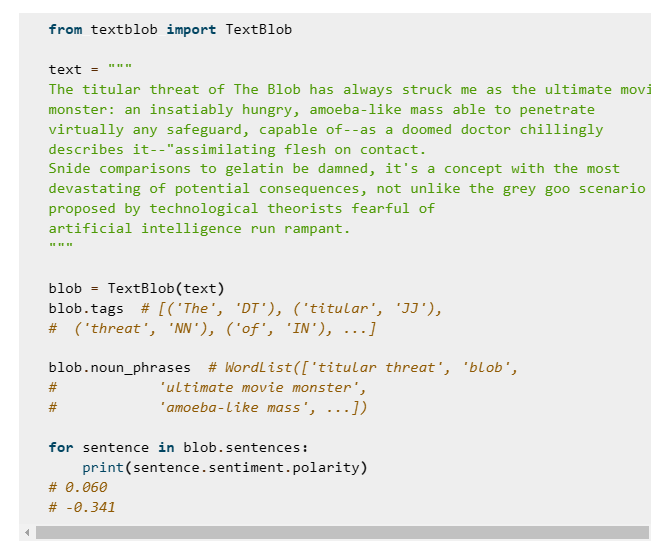
TextBlob is a Python library designed for handling textual data, providing an intuitive API to carry out various natural language processing functions such as part-of-speech tagging, sentiment analysis, noun phrase extraction, and classification tasks. Built on the foundations of NLTK and Pattern, it integrates seamlessly with both libraries. Notable features encompass tokenization (the division of text into words and sentences), frequency analysis of words and phrases, parsing capabilities, n-grams, and word inflection (both pluralization and singularization), alongside lemmatization, spelling correction, and integration with WordNet. TextBlob is compatible with Python versions 2.7 and higher, as well as 3.5 and above. The library is actively maintained on GitHub and is released under the MIT License. For users seeking guidance, thorough documentation is readily accessible, including a quick start guide and a variety of tutorials to facilitate the implementation of different NLP tasks. This rich resource equips developers with the tools necessary to enhance their text processing capabilities.
API Access
Has API
Yes
API Access
Has API
Yes


Integrations
AXtension Content Gate
Yes
Apache DataFusion
Yes
Azure Key Vault
Yes
CVAT
Yes
Camunda
Yes
Conversionomics
Yes
Cribl Stream
Yes
Edge Delta
Yes
FileCatalyst
Yes
Google Cloud Platform
Yes
Integrations
AXtension Content Gate
No
Apache DataFusion
No
Azure Key Vault
No
CVAT
No
Camunda
No
Conversionomics
No
Cribl Stream
No
Edge Delta
No
FileCatalyst
No
Google Cloud Platform
No
Pricing Details
$0.00099
per GB
Free Trial
Yes
Free Version
Yes
Pricing Details
No price information available.
Free Trial
No
Free Version
No
Deployment
Web-Based
Yes
On-Premises
No
iPhone App
No
iPad App
No
Android App
No
Windows
Yes
Mac
No
Linux
No
Chromebook
No
Deployment
Web-Based
No
On-Premises
No
iPhone App
No
iPad App
No
Android App
No
Windows
Yes
Mac
Yes
Linux
Yes
Chromebook
No
Customer Support
Business Hours
Yes
Live Rep (24/7)
Yes
Online Support
Yes
Customer Support
Business Hours
No
Live Rep (24/7)
No
Online Support
Yes
Types of Training
Training Docs
Yes
Webinars
Yes
Live Training (Online)
No
In Person
No
Types of Training
Training Docs
Yes
Webinars
No
Live Training (Online)
No
In Person
No
Vendor Details
Company Name
Microsoft
Founded
1975
Country
United States
Website
azure.microsoft.com/en-us/services/storage/blobs/
Vendor Details
Company Name
TextBlob
Country
United States
Website
textblob.readthedocs.io/en/dev/
Product Features
Product Features
Natural Language Processing
Co-Reference Resolution
No
In-Database Text Analytics
No
Named Entity Recognition
No
Natural Language Generation (NLG)
No
Open Source Integrations
No
Parsing
No
Part-of-Speech Tagging
No
Sentence Segmentation
No
Stemming/Lemmatization
No
Tokenization
No
