Average Ratings 0 Ratings
Average Ratings 0 Ratings
Similar Products
-
Google AI StudioGoogle AI Studio is an all-in-one environment designed for building AI-first applications with Google’s latest models. It supports Gemini, Imagen, Veo, and Gemma, allowing developers to experiment across multiple modalities in one place. The platform emphasizes vibe coding, enabling users to describe what they want and let AI handle the technical heavy lifting. Developers can generate complete, production-ready apps using natural language instructions. One-click deployment makes it easy to move from prototype to live application. Google AI Studio includes a centralized dashboard for API keys, billing, and usage tracking. Detailed logs and rate-limit insights help teams operate efficiently. SDK support for Python, Node.js, and REST APIs ensures flexibility. Quickstart guides reduce onboarding time to minutes. Overall, Google AI Studio blends experimentation, vibe coding, and scalable production into a single workflow.
-
Datasite Diligence Virtual Data RoomYou need more than just a way to exchange documents. You need capabilities such as AI-enhanced redaction. You need an integrated Q&A tool with advanced workflow features. You need a defensible source of truth. You need Datasite Diligence. Datasite provides the most trusted VDR in M&A. Over 14,000 projects are created annually on Datasite. Designed with industry-leading functionality and game-changing productivity tools, due diligence doesn’t get in the way with Datasite Diligence.
-
LM-Kit.NETLM-Kit.NET is an enterprise-grade toolkit designed for seamlessly integrating generative AI into your .NET applications, fully supporting Windows, Linux, and macOS. Empower your C# and VB.NET projects with a flexible platform that simplifies the creation and orchestration of dynamic AI agents. Leverage efficient Small Language Models for on‑device inference, reducing computational load, minimizing latency, and enhancing security by processing data locally. Experience the power of Retrieval‑Augmented Generation (RAG) to boost accuracy and relevance, while advanced AI agents simplify complex workflows and accelerate development. Native SDKs ensure smooth integration and high performance across diverse platforms. With robust support for custom AI agent development and multi‑agent orchestration, LM‑Kit.NET streamlines prototyping, deployment, and scalability—enabling you to build smarter, faster, and more secure solutions trusted by professionals worldwide.
-
kama.aikama.ai is a Responsible AI Agent platform that gives you an accurate, accountable, and safe AI for your organization. It is used for training, quick source of truth for compliance issues, internal support, customer service, and for specialized communities needs. Unlike generic GenAI tools that create answers probabilistically, kama.ai combines deterministic Knowledge Graph AI with governed Generative AI and Trusted Collections. Trusted Collections is a RAG technology that minimizes generative side hallucinations, while providing a core source for accurate, brand-safe, and a correct information source for AI answers. It lets organizations control what their AI Agents know, where answers come from, and how information is delivered to employees, customers, learners, members, or community users. kama.ai’s platform is designed for situations where answers must be accurate, traceable, brand-safe, and aligned with approved source material. Human experts and Knowledge Managers can curate content, review AI-generated drafts, manage knowledge domains, and improve responses over time. This supports a governed-in-advance approach to AI, rather than relying on after-the-fact correction. kama.ai is especially well suited for knowledge-heavy organizations, training programs, compliance environments, Indigenous and community-focused initiatives, HR support, education, research, and other use cases where trusted information matters. This platform focused on Responsible AI use and delivery, results in safer AI adoption, better knowledge access, reduced repetitive workload, and more consistent support for the people who rely on your organization’s expertise. Think kama.ai for trusted AI, governed knowledge, and answers your organization is willing to stand behind.
-
ClickLearnClickLearn simplifies complex business processes using popular software. You can create multi-format learning materials in any language and publish them to a 24/7 learning portal with just one click. A video walkthrough of the process, with narration in your preferred language. Put your learning to the test. This interactive simulation of your workplace allows you to test your knowledge without any hints. Interactive simulation of your workplace environment that guides you through the process. This guide is step-by-step. ClickLearn wrote this guide with perfectly cropped screenshots. ClickLearn Assist can be your go-to helper when you are stuck, need process help, or want to try a new process in the live system. You don't have to worry about making another mistake. All your learning materials can be auto-translated with a click of a button
-
Google Cloud Speech-to-TextAn API powered by Google's AI technology allows you to accurately convert speech into text. You can accurately caption your content, provide a better user experience with products using voice commands, and gain insight from customer interactions to improve your service. Google's deep learning neural network algorithms are the most advanced in automatic speech recognition (ASR). Speech-to-Text allows for experimentation, creation, management, and customization of custom resources. You can deploy speech recognition wherever you need it, whether it's in the cloud using the API or on-premises using Speech-to-Text O-Prem. You can customize speech recognition to translate domain-specific terms or rare words. Automated conversion of spoken numbers into addresses, years and currencies. Our user interface makes it easy to experiment with your speech audio.
-
QuantCloud solution to manage retail spaces, product categories and planograms. Smart automatic generation of planograms based on sales is possible. This allows for the maintenance of planograms in a current state even in large sales networks with many stores. Quant is a complete solution for Space Planning and Category Management, planograms and ranging, shelf labels and POS printing, communication and in-store marketing. Quant Cloud offers all the benefits of cloud computing. You can work remotely on the same projects with your colleagues around the globe and access the same database from different computers. There is no need to create complex infrastructures or overload your IT department. Our consultants are always available to assist you. We train your users, and assist with data integration so Quant can go live in less than 12 week.
-
Planview AdaptiveWorkPlanview AdaptiveWork, previously known as Clarizen, empowers PMOs and professional services teams of various sizes to achieve instant visibility across their operations, streamline workflows, proactively address potential risks, and enhance overall business outcomes. By aligning with the company’s strategic objectives, organizations can maximize workforce effectiveness, ensuring that teams concentrate on delivering the most critical tasks timely. It facilitates the tracking, management, and prioritization of work requests, guaranteeing that each request automatically encompasses all necessary information for execution. With bi-directional integration with your CRM and custom triggers in place, opportunity details can be effortlessly captured to aid in planning client projects. The platform automates and governs the various phases of the request lifecycle, including submission, scoring, prioritization, routing, and approval, thereby streamlining the pathway for converting requests into actionable projects, tasks, or work items. This comprehensive approach not only boosts efficiency but also fosters a culture of accountability and transparency within the organization.
-
ConcordConcord Horizon is an AI native contract platform built from a complete rewrite of Concord’s technology, applying ten years of experience to a modern architecture for faster and more accurate contract work. The redesigned interface offers light and dark mode, collapsible navigation, full screen focus, custom columns, advanced filtering, and consistent tables across modules. AI Copilot supports natural language questions, contract summaries, key point extraction, and fast portfolio insights, while AI Search adds lexical and semantic search with improved performance and multi actions on results. MCP brings contract intelligence into AI tools like ChatGPT and Claude for summaries, tables, or automated monitoring. Concord applies a strict zero data retention policy with AI partners and never uses customer data to train AI models .
-
Google Cloud BigQueryBigQuery is a serverless, multicloud data warehouse that makes working with all types of data effortless, allowing you to focus on extracting valuable business insights quickly. As a central component of Google’s data cloud, it streamlines data integration, enables cost-effective and secure scaling of analytics, and offers built-in business intelligence for sharing detailed data insights. With a simple SQL interface, it also supports training and deploying machine learning models, helping to foster data-driven decision-making across your organization. Its robust performance ensures that businesses can handle increasing data volumes with minimal effort, scaling to meet the needs of growing enterprises. Gemini within BigQuery brings AI-powered tools that enhance collaboration and productivity, such as code recommendations, visual data preparation, and intelligent suggestions aimed at improving efficiency and lowering costs. The platform offers an all-in-one environment with SQL, a notebook, and a natural language-based canvas interface, catering to data professionals of all skill levels. This cohesive workspace simplifies the entire analytics journey, enabling teams to work faster and more efficiently.
Description
Azure AI Language serves as a comprehensive managed service designed for the creation of natural language processing applications. It enables users to pinpoint important terms and phrases, evaluate sentiment, condense text, and construct interactive conversational interfaces. This service allows you to annotate, develop, assess, and deploy tailored AI models without needing extensive machine-learning knowledge. With ready-to-use entity categories applicable to various industries and text analytics tailored for the healthcare sector, its out-of-the-box functionalities promote rapid initiation while still permitting further customization and enhancement as necessary. To fine-tune your machine learning model for specific scenarios, you can provide several labeled examples. Additionally, custom multilingual models can be trained in a single language and effectively applied across several others. Through Language Studio, you can leverage advanced GPT-powered language models to promptly review and recommend labels for your content. Moreover, it facilitates the extraction, labeling, and redaction of critical information in text across diverse categories, making it a versatile tool for various applications. This combination of features ensures that users can efficiently manage their language processing needs regardless of their technical expertise.
Description
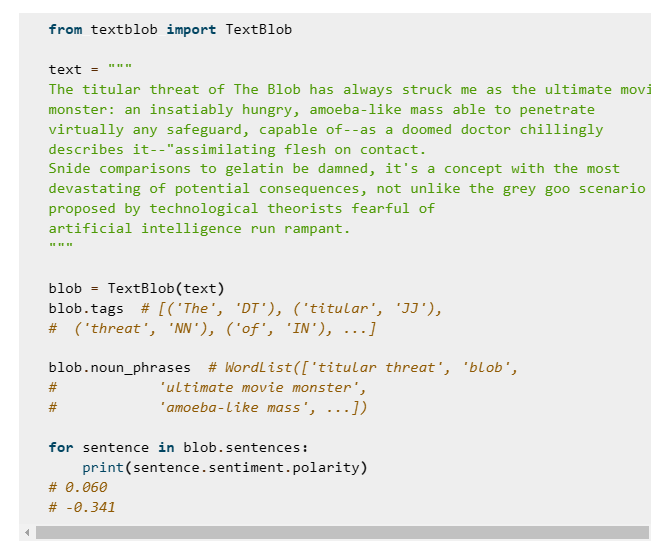
TextBlob is a Python library designed for handling textual data, providing an intuitive API to carry out various natural language processing functions such as part-of-speech tagging, sentiment analysis, noun phrase extraction, and classification tasks. Built on the foundations of NLTK and Pattern, it integrates seamlessly with both libraries. Notable features encompass tokenization (the division of text into words and sentences), frequency analysis of words and phrases, parsing capabilities, n-grams, and word inflection (both pluralization and singularization), alongside lemmatization, spelling correction, and integration with WordNet. TextBlob is compatible with Python versions 2.7 and higher, as well as 3.5 and above. The library is actively maintained on GitHub and is released under the MIT License. For users seeking guidance, thorough documentation is readily accessible, including a quick start guide and a variety of tutorials to facilitate the implementation of different NLP tasks. This rich resource equips developers with the tools necessary to enhance their text processing capabilities.
API Access
Has API
Yes
API Access
Has API
Yes


Pricing Details
$2 per month
Free Trial
Yes
Free Version
No
Pricing Details
No price information available.
Free Trial
No
Free Version
No
Deployment
Web-Based
Yes
On-Premises
No
iPhone App
No
iPad App
No
Android App
No
Windows
No
Mac
No
Linux
No
Chromebook
No
Deployment
Web-Based
No
On-Premises
No
iPhone App
No
iPad App
No
Android App
No
Windows
Yes
Mac
Yes
Linux
Yes
Chromebook
No
Customer Support
Business Hours
Yes
Live Rep (24/7)
Yes
Online Support
Yes
Customer Support
Business Hours
No
Live Rep (24/7)
No
Online Support
Yes
Types of Training
Training Docs
Yes
Webinars
Yes
Live Training (Online)
Yes
In Person
No
Types of Training
Training Docs
Yes
Webinars
No
Live Training (Online)
No
In Person
No
Vendor Details
Company Name
Microsoft
Founded
1975
Country
United States
Website
azure.microsoft.com/en-us/products/ai-services/ai-language/
Vendor Details
Company Name
TextBlob
Country
United States
Website
textblob.readthedocs.io/en/dev/
Product Features
Natural Language Processing
Co-Reference Resolution
No
In-Database Text Analytics
No
Named Entity Recognition
No
Natural Language Generation (NLG)
No
Open Source Integrations
No
Parsing
No
Part-of-Speech Tagging
No
Sentence Segmentation
No
Stemming/Lemmatization
No
Tokenization
No
Product Features
Natural Language Processing
Co-Reference Resolution
No
In-Database Text Analytics
No
Named Entity Recognition
No
Natural Language Generation (NLG)
No
Open Source Integrations
No
Parsing
No
Part-of-Speech Tagging
No
Sentence Segmentation
No
Stemming/Lemmatization
No
Tokenization
No
