Biotech

U.S. State Bans on Lab-Grown Meats Challenged in Court (austinchronicle.com) 49

Last June Texas Agriculture Commissioner Sid Miller said in a statement that Texans "have a God-given right to know what's on their plate, and for millions of Texans, it better come from a pasture, not a lab. It's plain cowboy logic that we must safeguard our real, authentic meat industry from synthetic alternatives."

But California company Wildtype sells lab-grown salmon — and is suing Texas over its ban on cell-cultivated meat, the Austin Chronicle reported this week. The company's founder says lab-grown salmon eliminates the mercury, microplastic, and antibiotic contamination commonly found in seafood. And one chef in Austin, Texas says lab-grown salmon is "awesome" and "something new"-- at the only Texas restaurant that was serving it last summer: Just two months after the salmon hit the menu, Texas banned the sale of cell-cultivated meat... A lawsuit from Wildtype and one other FDA-approved cultivated meat company [argues] it's anti-capitalism and unconstitutional... This law "was not enacted to protect the health and safety of Texas consumers — indeed, it allows the continued distribution of cultivated meat to consumers so long as it is not sold. Instead, SB 261 was enacted to stifle the growth of the cultivated meat industry to protect Texas' conventional agricultural industry from innovative competition that is exclusively based outside of Texas...." [according to the lawsuit]. It was filed in September, immediately after the ban took effect, and cell-cultivated companies are awaiting judgment.
That Texas ban would last two years, notes U.S. News and World Reports, adding that Alabama, Florida, Indiana, Mississippi, Montana, and Nebraska have also passed bans, some temporary "on the manufacturing, sale or distribution of cell-cultured meat." Meanwhile, a new five-year moratorium on lab-grown meat was signed this week by the governor of South Dakota "after rejecting a permanent ban last month," reports South Dakota Searchlight: The new law bars the sale, manufacture or distribution of "cell-cultured protein" products from July 1 this year through June 30, 2031. Violations are punishable by up to 30 days in jail, a fine of up to $500, or both.
"But supporters of lab-grown meat are not going down without a fight," adds U.S. News and World Reports, with another lawsuit also filed challenging a ban in Florida: When Florida Gov. Ron DeSantis signed the ban in Florida, he described it as "fighting back against the global elite's plan to force the world to eat meat grown in a petri dish or bugs to achieve their authoritarian goals." He added that his administration "will save our beef."
The Courts

Supreme Court Allows Trump to Fire Remaining Democrat On FTC (npr.org) 180

The Supreme Court has temporarily allowed President Trump to fire Rebecca Slaughter, the last Democrat on the FTC. "The court's action is technically temporary, since the justices said they will hear arguments in the case in December, but every indication is that the conservative court majority will use the case to reverse a major Supreme Court precedent that dates back almost a century," reports NPR. From the report: Congress created the FTC and lots of other agencies to be multi-member, bipartisan regulatory agencies. And the Supreme Court in 1935 upheld those statutes ruling ruled against then-President Franklin D. Roosevelt's claim that he could fire FTC commissioners at will. In a unanimous opinion at the time, the court said Congress acted within its powers in declaring that a commissioner could only be fired for misconduct -- not for a policy disagreement. But now, prodded by President Trump, the court's six-member conservative majority seems poised to remake the way independent agencies operate. And if the handwriting on the wall is as clear as it seems to be, the independent agencies won't be independent. Their membership will be subject to the will of the president.

The court's action Monday was hardly subtle. While the lower courts had ruled that the president could not fire Slaughter, under the court's 1935 precedent, the conservative Supreme Court majority allowed the president to fire her. Indeed, her name isn't even on the FTC website anymore. And the court so far has allowed Trump to fire other agency board members. In short, the justices are not playing hide-the-ball. And it's a good bet that the court will reverse the 1935 precedent, which until now had been reaffirmed multiple times. The result will be that whereas in the past, these agencies had to be bipartisan, with a minority of opposition party members, now there will be no such requirement. In short, Trump can name all the agency members. And if his successor is a Democrat, he or she can fire all the Republicans.

Power

Is Enron Transforming Into a Real Texas Retail Electricity Provider? (houstonchronicle.com) 26

HGP Storage is a (real) Texas company providing distributed battery-based, utility-scale energy storage systems. Founded in 2013, it has "successfully developed over 20+ sites and closed over 200 MW of distributed energy projects," according to its web site.

And they just teamed up with Enron, reports the Houston Chronicle: The company that took over the defunct Enron brand, led by a "Birds Aren't Real" cofounder [28-year-old Connor Gaydos], held a mostly satirical quarterly earnings call Thursday afternoon but gave updates to an application to become a legitimate Texas energy provider... DJ Withee, chief operating officer and legal counsel at HGP Storage, a company developing utility-scale battery storage farms, was introduced as Enron's vice president of energy service. Withee said he was brought on by Gaydos to set up the customer-facing energy services business.

Enron Energy Texas LLC, a subsidiary of Enron, filed to become a Texas retail electric provider in January. Gaining this designation would allow Enron to sell electricity plans to Texas consumers. "Our business model is actually going to be very simple," Withee said. "We buy wholesale electricity, just like everybody else, but because of our efficiency, because of our use of technology, we are going to have lower costs than our competitors. Lower costs means greater savings that we can pass back to our customers...." According to Withee, Enron's goal is to provide energy at a competitive lower cost that will not only make energy more accessible but also push other Texas retail companies to drop their own prices...

Enron's filing in January included sworn and notarized affidavits from a man named Gregory Forero, who was identified in the documents as vice president of Enron Texas Energy LLC. Forero is the founder and CEO of HGP Storage.

"Forero, who signed his name to three sworn affidavits attesting to the accuracy of the application, could risk perjury charges if the statements of intention to start a legitimate retail electric company are found to be false, according to the Texas Penal Code..."

But does this replace Enron's plan to sell egg-shaped home nuclear reactors?
Bitcoin

Donald and Melania Trump Launch a Pair of Meme Coins (cnn.com) 214

Donald and Melania Trump have launched a pair of meme coins just before President Trump was sworn into office. The coins are already worth billions of dollars, raising "serious ethical questions and conflicts of interest," said Richard Painter, a law professor at the University of Minnesota. CNN reports: Melania Trump launched her cryptocurrency $MELANIA in a social media post Sunday, sending her husband's cryptocurrency $TRUMP, announced two days earlier, plummeting. "The Official Melania Meme is live! You can buy $MELANIA now. https://melaniameme.com," the future first lady wrote on X Sunday. Meme coins are a type of highly volatile cryptocurrency inspired by popular internet or cultural trends. They carry no intrinsic value but can soar, or plummet, in price. "My NEW Official Trump Meme is HERE!" Trump wrote on X Friday. "It's time to celebrate everything we stand for: WINNING! Join my very special Trump Community. GET YOUR $TRUMP NOW. Go to http://gettrumpmemes.com -- Have Fun!" Both coins are trading on the Solana blockchain. [...]

$TRUMP is the first cryptocurrency endorsed by the incoming president, who once trashed bitcoin as "based on thin air." [...] While executive branch employees must follow conflict of interest criminal statutes that prevent them from participating in matters that impact their own financial interests, the law does not apply to the president or the vice president. [...] The Trump coin's market capitalization, which is based on the 200 million coins circulating, is capped at $13 billion, according to CoinMarketCap. The meme coin's website said there will be 1 billion Trump coins over the next three years. Both $MELANIA and $TRUMP's websites contain disclaimers saying the coins are "intended to function as a support for, and engagement with" the values of their respective brands and "are not intended to be, or to be the subject of, an investment opportunity, investment contract, or security of any type."

The website says the meme coin is not politically affiliated. But 80% of the coin's supply is held by Trump Organization-affiliate CIC Digital and Fight Fight Fight LLC, which are both subject to a three-year unlocking schedule -- so they cannot sell all of their holdings at once. Trump coin's fully diluted value (which reflects the eventual total supply of Trump coins) stood at around $54 billion as of Monday morning, according to CoinMarketCap. At that value, the 80% linked to Trump is worth a staggering $43 billion, at least on paper. The $TRUMP coin's website says it is "the only official Trump meme. Now, you can get your piece of history. This Trump Meme celebrates a leader who doesn't back down, no matter the odds," the website reads.
"Trump owning 80% and timing launch hours before inauguration is predatory and many will likely get hurt by it," Nick Tomaino, a former Coinbase executive, said in a post on X. "Trump should be airdropping to the people rather than enriching himself or his team on this."
AI

Photobucket Sued Over Plans To Sell User Photos, Biometric Identifiers To AI Companies (arstechnica.com) 22

Photobucket was sued Wednesday after a recent privacy policy update revealed plans to sell users' photos -- including biometric identifiers like face and iris scans -- to companies training generative AI models. From a report: The proposed class action seeks to stop Photobucket from selling users' data without first obtaining written consent, alleging that Photobucket either intentionally or negligently failed to comply with strict privacy laws in states like Illinois, New York, and California by claiming it can't reliably determine users' geolocation.

Two separate classes could be protected by the litigation. The first includes anyone who ever uploaded a photo between 2003 -- when Photobucket was founded -- and May 1, 2024. Another potentially even larger class includes any non-users depicted in photographs uploaded to Photobucket, whose biometric data has also allegedly been sold without consent.

Photobucket risks huge fines if a jury agrees with Photobucket users that the photo-storing site unjustly enriched itself by breaching its user contracts and illegally seizing biometric data without consent. As many as 100 million users could be awarded untold punitive damages, as well as up to $5,000 per "willful or reckless violation" of various statutes.

United States

Appliance and Tractor Companies Lobby Against Giving the Military the Right to Repair (404media.co) 142

Device manufacturers across multiple industries are lobbying against proposed legislation that would require military contractors to provide the U.S. military with easier access to repair materials and information, according to a document obtained by 404 Media.

The legislation, Section 828 of the Defense Reauthorization Act, aims to address the military's current inability to repair equipment ranging from fighter jets to Navy battleships without relying on contractors. Sen. Elizabeth Warren highlighted the issue in a May hearing, citing examples of how repair restrictions lead to increased costs and operational delays for the Department of Defense.

The lobbying effort extends beyond military contractors to include organizations representing industries such as irrigation equipment, motorcycles, tractors, plumbing, medical devices, and consumer technology. In a letter to lawmakers, these groups argue that the legislation would impose significant burdens on contractors and undermine existing technical data rights statutes.
HP

We Never Agreed To Only Buy HP Ink, Say Printer Owners (theregister.com) 116

HP "sought to take advantage of customers' sunk costs," printer owners claimed this week in a class action lawsuit against the hardware giant. The Register: Lawyers representing the aggrieved were responding in an Illinois court to an earlier HP motion to dismiss a January lawsuit. Among other things, the plaintiffs' filing stated that the printer buyers "never entered into any contractual agreement to buy only HP-branded ink prior to receiving the firmware updates." They allege HP broke several anti-competitive statutes, which they claim: "bar tying schemes, and certain uses of software to accomplish that without permission, that would monopolize an aftermarket for replacement ink cartridges, when these results are achieved in a way that 'take[s] advantage of customers' sunk costs.'"

In the case, which began in January, the plaintiffs are arguing that HP issued a firmware update between late 2022 and early 2023 that they allege disabled their printers if they installed a replacement cartridge that was not HP-branded. They are asking for damages that include the cost of now-useless third-party cartridges and an injunction to disable the part of the firmware updates that prevent the use of third-party ink.

AI

NY Governor Wants To Criminalize Deceptive AI (axios.com) 39

New York Gov. Kathy Hochul is proposing legislation that would criminalize some deceptive and abusive uses of AI and require disclosure of AI in election campaign materials, her office told Axios. From the report: Hochul's proposed laws include establishing the crime of "unlawful dissemination or publication of a fabricated photographic, videographic, or audio record." Making unauthorized uses of a person's voice "in connection with advertising or trade" a misdemeanor offense. Such offenses are punishable by up to one year jail sentence. Expanding New York's penal law to include unauthorized uses of artificial intelligence in coercion, criminal impersonation and identity theft.

Amending existing intimate images and revenge porn statutes to include "digital images" -- ranging from realistic Photoshop-produced work to advanced AI-generated content. Codifying the right to sue over digitally manipulated false images. Requiring disclosures of AI use in all forms of political communication "including video recording, motion picture, film, audio recording, electronic image, photograph, text, or any technological representation of speech or conduct" within 60 days of an election.

Crime

Ignored by Police, Two Women Took Down Their Cyber-Harasser Themselves (msn.com) 104

Here's how the Washington Post tells the story of 34-year-old marketer (and former model) Madison Conradis, who discovered nude behind-the-scenes photos from 10 years earlier had leaked after a series of photographer web sites were breached: Now the photos along with her name and contact information were on 4chan, a lawless website that allows users to post anonymously about topics as varied as music and white supremacy... Facebook users registered under fake names such as "Joe Bummer" sent her direct messages demanding that she send new, explicit photos, or else they would further spread the already leaked photos. Some pictures landed in her father's Instagram messages, while marketing clients told her about the nude images that came their way. Madison was at a friend's party when she got a panicked call from the manager of a hotel restaurant where she had worked: The photos had made their way to his inbox. After two years, hoping a new Florida law against cyberharassment would finally end the torture, Madison walked into her local Melbourne police station and shared everything. But she was told that what she was experiencing was not criminal.

What Madison still did not know was that other women were in the clutches of the same man on the internet — and all faced similar reactions from their local authorities. Without help from the police, they would have to pursue justice on their own.

Some cybersleuthing revealed the four women all had one follower in common on Facebook: Christopher Buonocore. (They were his ex-girlfriend, his ex-fiance, his relative, and a childhood friend.) Eventually Madison's sister Christine — who had recently passed the bar exam — "prepared a 59-page document mapping the entire case with evidence and relevant statutes in each of the victims' jurisdictions. She sent the document to all the women involved, and each showed up at her respective law enforcement offices, dropped the packet in front of investigators and demanded a criminal investigation." The sheriff in Florida's Manatee County, Christine's locality, passed the case up to federal investigators. And in July 2019, the FBI took over on behalf of all six women on the basis of the evidence of interstate cyberstalking that Christine had compiled...

The U.S. attorney for the Middle District of Florida took action at the end of December 2020, but without a federal law criminalizing the nonconsensual distribution of intimate images, she charged Buonocore with six counts of cyberstalking instead, which can apply to some cases involving interstate communication done with the intent to kill, injure, intimidate, harass or surveil someone. He pleaded guilty to all counts the following January...

U.S. District Judge Thomas Barber sentenced Buonocore to 15 years in federal prison — almost four years more than the prosecutor had requested.

Sci-Fi

Pentagon's New UFO Website Lets You Explore Declassified Sightings Info (cnet.com) 54

The U.S. Department of Defense has launched a website collecting publicly available, declassified information on unidentified anomalous phenomena (UAPs). "For now, the general public will be able to read through the posted information," reports CNET. "Soon, US government employees, contractors, and service members with knowledge of US programs can report their own sightings, and later, others will be able to submit reports." From the report: "This website will provide information, including photos and videos, on resolved UAP cases as they are declassified and approved for public release," the department said in a release posted on Thursday. "The website's other content includes reporting trends and a frequently asked questions section as well as links to official reports, transcripts, press releases, and other resources that the public may find useful, such as applicable statutes and aircraft, balloon and satellite tracking sites."

For now, one of the most interesting parts of the site is its trends section. Apparently, most reported UAPs are round, either white, silver or translucent, spotted at around 10,000 to 30,000 feet, 1-4 meters in size, and do not emit thermal exhaust. Hotspots for sightings include both the US East and West coasts. There's also a small section of videos with names such as "DVIDS Video - Unresolved Case: Navy 2021 Flyby," and "UAP Video: Middle East Object." Readers are able to leave comments on the videos. Of the "Middle East Object" video, one person writes,"Noticed I never saw it cast a shadow. But other objects have shadows."

Databases

FBI Forms National Database To Track and Prevent 'Swatting' (nbcnews.com) 71

According to NBC News, the FBI created a national online database in May to facilitate information sharing between hundreds of police departments and law enforcement agencies across the country pertaining to swatting incidents. From the report: No central agency has tracked swatting incidents or suspects in the U.S., so official statistics are not available. By 2019, there were an estimated 1,000 swatting incidents domestically each year, according to a report from the Anti-Defamation League, and each incident is estimated to cost at least $10,000 to affected communities, even before expenditures on follow-up work like investigations, property repairs and counseling. Swatting is increasingly enabled by technology that can be used to mask a caller's real voice, their phone number or IP address (also called "spoofing") or to make their false report sound more credible.

[Chief Scott Schubert with the bureau's Criminal Justice Information Services headquarters in Clarksburg, West Virginia] told NBC News that the FBI's new centralized database should help the agency "get that common picture of what's going on across our nation so we can learn from that." [...] While the earliest recorded case of swatting occurred in 2002, to this day, there is no specific law criminalizing swatting in the U.S., says John Jay's Shapiro. "Without a statute in place, there's no designated resources or training for investigating swatting incidents," she said. "And the 911 dispatchers do not have the resources and training they need to differentiate between actual emergencies and false reports."

Legally, the False Information and Hoaxes statute, also known as section 1038, is most frequently used to prosecute swatting. Other statutes can sometimes apply -- one pertaining to interstate threats involving explosives and another pertaining to interstate communications, which refers to extortion or threats to injure or kidnap somebody. "Too often, perpetrators are getting a slap on the wrist compared to the consequences suffered by their victims," Shapiro said.

News

South Koreans Become Younger Under New Age-Counting Law (bbc.com) 52

South Koreans have become a year or two younger as a new law aligns the nation's two traditional age-counting methods with international standards. The BBC reports: The law scraps one traditional system that deemed South Koreans one year old at birth, counting time in the womb. Another counted everyone as aging by a year every first day of January instead of on their birthdays. The switch to age-counting based on birth date took effect on Wednesday. President Yoon Suk Yeol pushed strongly for the change when he ran for office last year. The traditional age-counting methods created "unnecessary social and economic costs," he said. For instance, disputes have arisen over insurance pay-outs and determining eligibility for government assistance programs.

Previously, the most widely used calculation method in Korea was the centuries-old "Korean age" system, in which a person turns one at birth and gains a year on 1 January. This means a baby born on December 31 will be two years old the next day. A separate "counting age" system, that was also traditionally used in the country, considers a person zero at birth and adds a year on January 1. This means that, for example, as of June 28, 2023, a person born on June 29, 2003 is 19 under the international system, 20 under the "counting age" system and 21 under the "Korean age" system.

Lawmakers voted to scrap the traditional counting methods last December. Despite the move, many existing statutes that count a person's age based on the "counting age" calendar year system will remain. For example, South Koreans can buy cigarettes and alcohol from the year -- not the day -- they turn 19. [...] The traditional age-counting methods were also used by other East Asian countries, but most have dropped it. Japan adopted the international standard in 1950 while North Korea followed suit in the 1980s.

Crime

SBF Asks Court To Dismiss Most Criminal Charges Against Him (axios.com) 63

FTX founder Sam Bankman-Fried is seeking the dismissal of 10 of the 13 charges against him over the collapse of the cryptocurrency exchange. Axios reports: Lawyers for Bankman-Fried, who's pleaded not guilty to fraud, conspiracy, campaign finance law violations and money laundering, in a filing argued that several of the charges failed to properly state an offense. The motion that was filed to the U.S. District Court for the Southern District of New York is seeking the dismissal of 10 of the 13 charges against him. "Simply making a false statement, by itself, does not constitute wire fraud unless it is made for the purpose of obtaining money or property from the victim of the fraud," Bankman-Fried's lawyers wrote.

According to Ars Technica, SBF's lawyers are essentially arguing that there's no evidence of harm caused because fraud requires a "scheme to cause economic loss to the victim," which prosecutors allegedly haven't proved. Instead, SBF alleges that federal prosecutors have concocted "a hodgepodge of different intangible losses" suffered by banks and lenders -- including "the right to honest services," "the loss of control of assets," and "the deprivation of valuable information." [...] "In the end, the Government is trying to transform allegations of dishonesty and unfair dealing into violations of the federal fraud statutes," SBF's lawyers wrote. "While such conduct may well be improper, it is not wire fraud."

The 31-year-old Bankman-Fried, who is currently under house arrest on a $250 million bond at his parents' home in Palo Alto, California, faces more than 155 years in prison if convicted on all counts. A trial has been scheduled for October.
The Internet

Colorado Kills Law That Made It Harder For Cities To Offer Internet Service (arstechnica.com) 63

Yesterday, Colorado eliminated a 2005 law that required local governments to hold an election before offering cable television or telecommunications service, "a process that pitted city and town leaders against well-funded broadband industry lobbying campaigns," reports Ars Technica. From the report: Gov. Jared Polis, a Democrat, signed a bill to eliminate that law yesterday. The bill had been approved by the State House in a 48-14 vote and in the Senate by a 31-4 vote. Both chambers have Democratic majorities, but the votes didn't go entirely along party lines; all of the "no" votes came from Republicans, but other Republicans joined Democrats in approving the bill. The bill signed by Polis "gives local governments the authority to provide broadband service, either on their own or by partnering with industry service providers, without holding a local election," the Governor's Office of Information Technology said.

"Each local government is in a unique position or different phase of connecting residents to high-speed Internet, and this bill allows them to establish broadband plans that meet the needs of their communities," Colorado Broadband Office Executive Director Brandy Reitter said. Going forward, cities and towns won't have to hold elections to opt out of the 2005 restriction on municipal broadband. A vote to opt out of the state law didn't guarantee that a city or town would build a network, but the vote was a necessary step and in some cases resulted in a municipal broadband service.

Government

Colorado Approves First-Ever Agricultural Right to Repair Bill (ifixit.com) 23

Denver legislators have just passed the first-ever agricultural Right to Repair bill. Today's landslide 44-16 vote in the House follows a successful vote in the Senate last month. iFixit reports: Once the Agricultural Right to Repair bill passes, manufacturers will be required to share all the parts, embedded software, firmware, tools, and documentation necessary for repair. One critical step remains: a signature by Governor Polis, who has signaled that he supports the legislation.

To support Right to Repair legislation near you, find your state on Repair.org -- or, if you're outside the US, look for your country's advocacy network here.
The summary of HB23-1011 reads: "Starting January 1, 2024, the bill requires a manufacturer to provide parts, embedded software, firmware, tools, or documentation, such as diagnostic, maintenance, or repair manuals, diagrams, or similar information (resources), to independent repair providers and owners of the manufacturer's agricultural equipment to allow an independent repair provider or owner to conduct diagnostic, maintenance, or repair services on the owner's agricultural equipment.

The bill folds agricultural equipment into the existing consumer right-to-repair statutes, which statutes provide the following:

- A manufacturer's failure to comply with the requirement to provide resources is a deceptive trade practice;
- In complying with the requirement to provide resources, a manufacturer need not divulge any trade secrets to independent repair providers and owners; and
- Any new contractual provision or other arrangement that a manufacturer enters into that would remove or limit the manufacturer's obligation to provide resources to independent repair providers and owners is void and unenforceable; and
- An independent repair provider or owner is not authorized to make modifications to agricultural equipment that permanently deactivate any safety notification system or bring the equipment out of compliance with safety or emissions laws or to engage in any conduct that would evade emissions, copyright, trademark, or patent laws."
The Internet

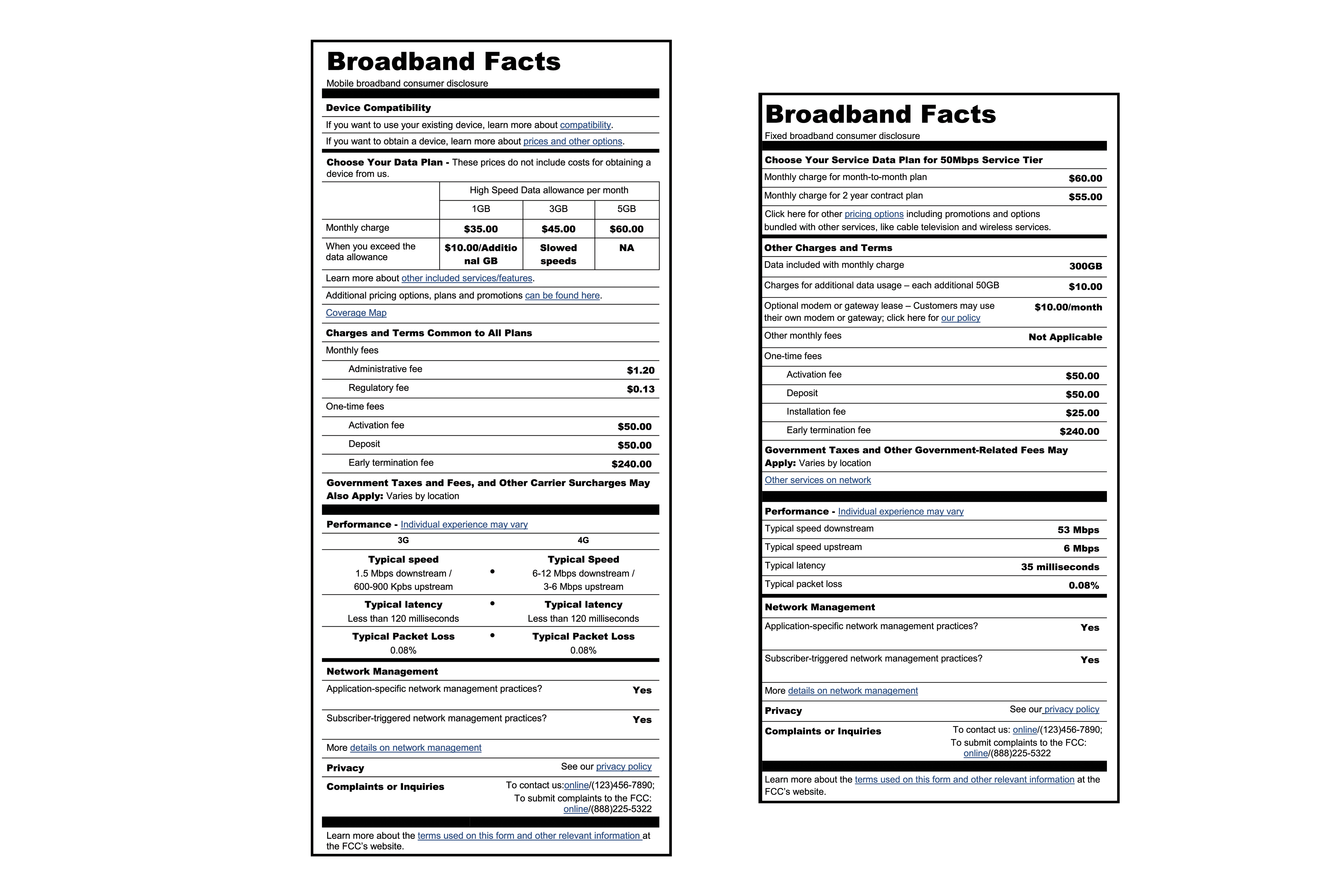
Nutrition Labels For Broadband Internet Are Finally Nearly Here (theverge.com) 23

Six years after we saw the FCC formally propose "nutrition labels" for your carrier's potentially confusing array of plans, the agency says it's finally happening. The Verge reports: This week, it's ordering US internet service providers to adopt the label format you're looking at [here] -- or it will, as soon as some last bureaucratic elements get worked out. They've changed a bit since 2016 -- now, each plan will apparently have its own label rather than ISPs trying to cram all of them into a single sheet, they don't warn you about coverage, and apparently, ISPs will be able to point you to their network management policy legalese instead of having to ding themselves for throttling data or giving some apps a fast lane. They won't have to report packet loss, either, it seems. Thankfully, ISPs will still need to report their typical speeds and latency, not just reiterate their advertised speed. Hopefully, someone will audit that.

Most big ISPs will have six months to slap the new labels onto their websites and distribute them in stores, though the FCC's giving ones with less than 100,000 subscribers a full year to comply. But none of those shot clocks start until the Office of Management and Budget reviews the order to make sure it complies with the Paperwork Reduction Act and similar statutes, the FCC notes, so it might be a bit longer. In the meanwhile, FCC Chair Jessica Rosenworcel suggests that ISPs might want to get ahead of things and adopt them on their own. The FCC also says it hopes these labels will evolve from here [...].

United States

FTC Restores Rigorous Enforcement of Law Banning Unfair Methods of Competition (ftc.gov) 46

The Federal Trade Commission issued a statement today that restores the agency's policy of rigorously enforcing the federal ban on unfair methods of competition. From a report: Congress gave the FTC the unique authority to identify and police against these practices, beyond what the other antitrust statutes cover. But in recent years the agency has not always carried out that responsibility consistently. The FTC's previous policy restricted its oversight to a narrower set of circumstances, making it harder for the agency to challenge the full array of anticompetitive behavior in the market. Today's statement removes this restriction and declares the agency's intent to exercise its full statutory authority against companies that use unfair tactics to gain an advantage instead of competing on the merits.

"When Congress created the FTC, it clearly commanded us to crack down on unfair methods of competition," said FTC Chair Lina M. Khan. "Enforcers have to use discretion, but that doesn't give us the right to ignore a central part of our mandate. Today's policy statement reactivates Section 5 and puts us on track to faithfully enforce the law as Congress designed." Congress passed the Federal Trade Commission Act in 1914 because it was unhappy with the enforcement of the Sherman Act, the original antitrust statute. Section 5 of the FTC Act bans "unfair methods of competition" and instructs the Commission to enforce that prohibition.

Canada

Is a 'Software Engineer' An Engineer? Alberta Regulator Says No, Riling the Province's Tech Sector (theglobeandmail.com) 258

Alberta's engineering regulator is in a fight with the province's technology sector, insisting anyone with the title "software engineer" must hold a permit -- and pay fees for that right. The Globe and Mail reports: The Association of Professional Engineers and Geoscientists of Alberta (APEGA), has asked a court to order one of the province's leading software companies, Octopusapp, known as Jobber, to stop using the term "engineer" in job titles and postings unless it gets a permit from the regulator. That has caused an uproar in Alberta's tech sector. On Friday, the Council of Canadian Innovators (CCI) published an open letter signed by chief executive officers of 32 Alberta tech companies, including Jobber's Sam Pillar, calling on Premier Danielle Smith to stop "regulator overreach" by APEGA.

The letter says APEGA's "aggressive position" would result in "onerous, restrictive and unnecessary certification requirements" for developers, and harm companies' ability to compete for talent. "If we cannot effectively compete for the best employees while headquartered in Alberta, we must seriously consider whether this is a place where our companies can succeed,â states the letter signed by CEOs of Benevity, Symend, Neo Financial Technologies and others. CCI president Benjamin Bergen said he hoped Ms. Smith, who pledged to cut red tape while campaigning to lead the United Conservative Party, would take action "because this is really a red tape issue. It is the only jurisdiction globally that is pushing this. It's making Alberta uncompetitive in the tech sector."

APEGA and Canada's 11 other provincial and territorial engineering regulators have complained for years about companies or individuals who use the titles "software engineer" and "computer engineer," arguing they are prohibited from doing so. In July, Engineers Canada, which represents the regulators, issued a joint statement calling for individuals to be prohibited from using the offending titles unless they are licensed as engineers. "Professional engineers are held to high professional and ethical standards and work in the public interest," it said. "The public places a high degree of trust in the profession and these layers of accountability and transparency help keep Canadians safe." The regulators are mandated to enforce their relative statutes and have sporadically taken legal action to protect their turf. [...] Provincial and territorial laws regulating engineers vary. Alberta's Engineering and Geoscience Professions Act states no individual, corporation or partnership can use the word "engineer" in a job title unless they are "a professional engineer, licensee or permit holder entitled to engage in the practice of engineering."
A spokesperson for Alberta labour minister Kaycee Madu said in an e-mail the government would work with the parties to resolve the issue, adding: "We are concerned by any regulations that impede our competitiveness in the world skilled-labour market."

Meanwhile, Erum Afsar, director of enforcement with APEGA, said in an interview: "What we are doing is regulating what the government has legislated us to do. If you're using that title, you should be registered with APEGA."

Further reading: Oregon Fines Man For Writing a Complaint Email Stating 'I Am An Engineer'
Democrats

Democrats Demand FTC Probe Amazon-iRobot Deal (theverge.com) 47

An anonymous reader quotes a report from The Verge: The Federal Trade Commission is facing mounting pressure to block Amazon's proposed $1.65 billion purchase of iRobot, the company behind Roomba autonomous vacuums. In a letter (PDF) to FTC Chair Lina Khan on Thursday, a group of Democratic lawmakers argued that the proposed merger would unfairly bolster Amazon's dominance in the smart home market by acquiring one of the company's leading competitors. They also criticized Amazon's data privacy and security practices following past acquisitions of companies like Ring, including data sharing partnerships with over 600 law enforcement agencies across the country. "iRobot is a powerful market incumbent, and Amazon, given its vast resources, history of producing smart vacuums... and powerful platform, is an extraordinarily significant 'potential entrant' into the market," the lawmakers wrote on Thursday. "Amazon's ability to acquire iRobot would cause substantially less competition." Sen. Elizabeth Warren (D-MA) led Thursday's letter along with four other House lawmakers, including Rep. Pramila Jayapal (D-WA), who represents thousands of Amazon workers in Seattle.

Earlier this month, The Wall Street Journal reported that antitrust enforcers at the FTC were already reviewing the proposed deal. iRobot confirmed in recent securities filings that the FTC formally requested any documents outlining the proposed purpose and scope of the merger. "Given Amazon's record of infringing on consumers' privacy, and their ongoing history of anticompetitive mergers to increase their monopoly power, the FTC should use its authority to oppose the Amazon -- iRobot transaction," the lawmakers wrote. These investigations would be led by Chair Khan, whose criticisms of Amazon's market power led to her rise in prominence. Khan published a legal paper in 2017 arguing that the federal government may need to pass new antitrust statutes to properly address the market dominance of online tech platforms like Amazon.

Businesses

Software Fees To Make Up 10% of John Deere's Revenues By 2030 (theregister.com) 48

An anonymous reader quotes a report from The Register: US farm machinery giant John Deere has estimated software fees will make up 10 percent of the company's revenues by the end of the decade. Chief executive John May offered the projection in a Wall Street Journal report on how Deere has plowed billions into developing self-driving tractors and crop sprayers that can tell the difference between weeds and produce. Though farmers are already struggling with operating costs -- including fertilizer and fuel -- Deere wants to sell software subscriptions for operating its ever smarter vehicles.

Bernstein analysts estimate that the average gross margin for farming software is 85 percent, compared with 25 percent for equipment sales. All Deere's tractors and harvesters have an autopilot feature included as standard following decades of ushering farmers into more technology-driven agriculture. However, the company now plans to have 1.5 million machines and half a billion acres of land connected to the John Deere Operations Center within a matter of years. This cloud service "will collect and store crop data, including millions of images of weeds that can be targeted by herbicide." Deere also acquired California startup Bear Flag Robotics for $250 million last year to turn old tractors into autonomous vehicles through software. For a company that has the heavy machinery market cornered, the shift is unlikely to be popular with farmers.
The report goes on to note that a number of farm and repair advocacy groups have filed a complaint with the FTC, "claiming that Deere has unlawfully refused to provide the software and technical data necessary to repair its machinery in violation of the Sherman Act and statutes covering unfair and deceptive trade practices."

Slashdot Top Deals