Retail is under pressure from every direction. Consumer expectations have never been higher — product availability, seamless cross-channel service, and frictionless checkout are now baseline requirements, not differentiators. At the same time, the structural conditions of retail operations have deteriorated: one million retail jobs remain unfilled in the US, margins are compressed by cost inflation and tariff increases, and digital commerce continues to raise the bar for physical stores.
Against this backdrop, retail automation has moved from an enterprise preoccupation to an operational survival requirement for businesses of all sizes. And at the centre of that transformation is the point-of-sale system — not as a transaction terminal, but as the operational hub through which automation flows. The retailers pulling ahead are not necessarily those with the largest budgets. They are the ones whose retail automation POS infrastructure lets them do more with the teams they have.
What Retail POS Automation Actually Means in Practice
Retail automation is often discussed in abstract terms — AI, machine learning, robotics. In practice, for the vast majority of retailers, meaningful automation begins with the operational workflows that currently absorb the most manual labour and introduce the most errors: inventory management, purchasing, reporting, and fulfilment.
A retail automation POS platform replaces these manual workflows with rule-based and AI-powered processes that run without constant human intervention. Stock counts update automatically at the point of sale. Purchase orders generate when stock hits a reorder threshold. Reports run on schedule and deliver to whoever needs them. Online availability reflects in-store stock in real time. These capabilities are available today in purpose-built cloud retail platforms — and they are measurably changing how efficiently retailers operate.
Manual vs Automated Retail POS Workflows
| Workflow | Manual Process | Automated POS Process | Impact |
| Stock counting | Physical count, spreadsheet entry | Real-time auto-deduction per sale | Hours saved weekly |
| Reordering | Manager estimates, contacts supplier | Auto-PO at configurable threshold | 2–4 hrs/week recovered |
| Reporting | Export, format, distribute manually | Scheduled delivery to any device | 3–5 hrs/week recovered |
| Seasonal markdowns | Edit individual product records | Bulk rules, scheduled by date/threshold | Eliminates manual pricing errors |
| Online stock sync | Manual update or overnight batch | Real-time bidirectional sync | Near-eliminat es oversells |
| Purchase reconciliation | Manual 3-way match | Automated PO match at receiving | 60–80% time reduction |
| Customer loyalty | Manual point tally or punch card | Auto-accrual at checkout | Zero staff effort required |
Automated Inventory Replenishment: The Biggest Operational Gain
Inventory distortion — the combined cost of stockouts and overstock — costs global retailers $1.73 trillion annually, according to IHL Group’s 2025 research. The root cause in most cases is not poor buying decisions: it is the lag between when stock runs low and when someone notices and acts. A POS system with inventory management that automates replenishment closes this gap entirely. Reorder points are configured per SKU based on lead time and sales velocity. When stock hits that threshold, the system generates a purchase order pre-populated with supplier details and suggested quantities, ready for one-click approval. The manager’s role shifts from reactive firefighting to exception management.
The operational impact is measurable. Real-time automated tracking achieves over 97% inventory accuracy versus a 65% manual baseline. Stockout rates fall by 19%. Inventory turnover improves by 19%. And the labour previously spent on manual stock checks and phone-based reordering is redirected to customer-facing activities — particularly relevant in a market where 74% of retailers report inability to fill customer-facing positions.
AI-Powered Demand Forecasting and Intelligent Replenishment
Automated replenishment based on fixed thresholds is a significant improvement over manual processes, but it is still reactive — it responds to stock depletion. AI-powered demand forecasting goes further, anticipating depletion before it happens. By analysing historical sales patterns, seasonal trends, promotional uplift, and external demand signals, these systems adjust reorder quantities proactively — building stock ahead of known demand spikes and reducing over-ordering during slow periods.
IHL Group’s September 2025 research found that retailers deploying AI and machine learning in their operations achieve sales growth 2.3 times higher and profit growth 2.5 times higher than competitors who do not. The prerequisite for these gains is the operational infrastructure that cloud-based retail automation POS platforms provide — specifically, a real-time data foundation rich enough for AI to act on meaningfully.

Automated Reporting and Omnichannel Fulfilment
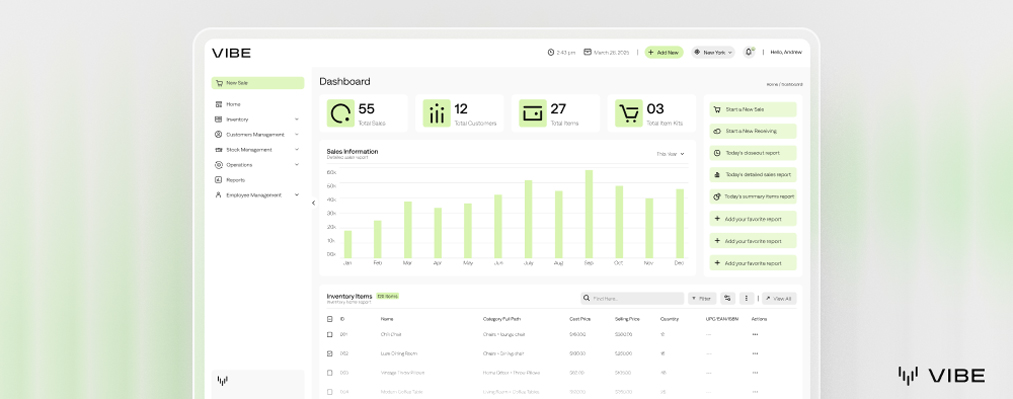
One of the most underestimated costs in retail operations is management time spent on reporting. Compiling last week’s sales by category, comparing it against the prior period, and distributing it to the relevant people happens in every retail business every week — and in most, it is done manually. A retail automation POS replaces this with live dashboards that update continuously, scheduled reports that deliver directly to stakeholders, and exception alerts that flag anomalies — a category underperforming its benchmark, a location with unusual shrinkage, a SKU approaching reorder — without anyone looking for them. Retailers implementing automated reporting report 15–20% operational cost reductions in year one.
Omnichannel fulfilment automation compounds the benefits. Platforms like Vibe Retail are helping retailers connect digital and in-store journeys, making it easier to coordinate inventory visibility, customer engagement, and fulfilment workflows from a unified retail ecosystem. Buy online, pick up in-store requires stock reservation, pick list generation, and confirmation workflows. Ship-from-store requires order routing to the nearest location with available stock. Endless aisle requires ordering from a different location while a customer stands in front of an empty shelf. Retail automation at the fulfilment layer means these processes run without manual coordination between store teams. Retailers with automated omnichannel fulfilment report 27% lower fulfilment costs and 18% reduction in cart abandonment (Manhattan Associates).
The Labour Shortage Makes Automation Non-Optional
The retail automation conversation cannot be separated from the labour shortage reality. One million retail jobs remain unfilled in the US. Baby Boomers are retiring at a rate of 10,000 per day. Real wage pressures continue. In this environment, automation is not a threat to retail employment — it is the mechanism by which retailers maintain operational capacity with the teams they have. Every hour saved through automated inventory management, reporting, and fulfilment is an hour that can be redirected to the customer-facing activities that drive revenue and loyalty. For retailers evaluating where to start, understanding what a modern retail POS system automates versus what it simply digitises is the critical first question — and the answer determines whether the investment delivers genuine operational change or simply replaces paper with screens.
Frequently Asked Questions
What is a retail automation POS system?
A retail automation POS system is a point-of-sale platform that automates key operational workflows — including inventory management, purchase order generation, reporting, markdown scheduling, and omnichannel fulfilment. Rather than requiring manual intervention for routine processes, the system executes them based on configurable rules and, in advanced implementations, AI-powered decision-making.
How does POS automation reduce stockouts in retail?
By monitoring stock levels in real time and automatically generating purchase orders when stock hits a reorder threshold, an automated POS eliminates the lag between depletion and action. Combined with AI demand forecasting that anticipates demand spikes before they occur, automated systems reduce stockout rates by up to 37% versus manual management.
Can small retailers benefit from POS automation?
Yes — and often proportionally more than large chains, because they have less administrative resource to absorb manual processes. Cloud-based retail automation POS platforms are subscription-based, making automation capabilities previously limited to enterprise retailers accessible at any scale.
What role does AI play in retail POS automation?
AI in retail POS systems primarily operates in demand forecasting, anomaly detection, and reporting intelligence. Demand forecasting models analyse historical sales and seasonal patterns to adjust reorder quantities proactively. Anomaly detection flags unexpected variances — shrinkage spikes, underperforming categories — without manual analysis. Retailers using AI-powered operations achieve sales growth 2.3x higher than those who do not (IHL Group, 2025).
What is the ROI of switching to an automated retail POS?
ROI comes from multiple sources: reduced stockout-related lost sales, lower overstock and markdown costs, recovered labour hours from manual processes, and improved fulfilment efficiency. Moving inventory workloads to a cloud platform trims total cost of ownership by 30–40% (Accenture). Retailers typically report 15–20% operational cost reductions within the first year of implementing automated inventory management and reporting.
Related Categories