The contact center software market is one of the fastest-growing segments in enterprise technology, projected to more than double in value by the end of the decade. Demand is accelerating, adoption among small and mid-sized businesses is at an all-time high, and the capability bar keeps rising.
Customers now expect faster responses, more consistent service, and real-time visibility into what’s happening with their calls, regardless of whether they’re dealing with a ten-person support team or a thousand-seat operation.
There’s a problem with that picture, though. Most of the platforms driving this market were built for large enterprises first. The features that smaller businesses actually need, basic queue visibility, automated reporting, callback when lines are busy, tend to exist only inside platforms designed for far more complex environments.

Product Owner at Bicom Systems
Acquiring those features has typically meant acquiring everything that comes with them: higher licensing tiers, additional infrastructure, more complex management overhead, and in many cases a disruptive migration away from the system the business was already running on.
For resellers deploying PBXware’s Multi-Tenant edition, this tension has been a recurring friction point. Their smaller customers were caught in the middle. A standard business phone system couldn’t give them the operational visibility they needed. A full Contact Center platform was more than they could justify. For long, there was no clean answer in between.
CC Lite, introduced in PBXware Version 8, is built to be that answer, and Bicom Systems is quickly moving towards offering full Omnichannel CC on Multi-tenant as well.
A Pattern Resellers Kept Seeing
Multi-Tenant PBXware has long been one of Bicom Systems’ strongest competitive advantages, allowing resellers to manage a diverse customer base from a single installation with the efficiency and economies of scale that come with centralized infrastructure. But the edition had a ceiling. It offered no real-time monitoring for Enhanced Ring Groups, no automated reporting, and no callback capability. Partners kept running into customers who needed exactly those things and had no suitable path to get them.
We don’t need a full Contact Center. We just need key features and we want to stay on Multi-Tenant.
That request, according to Sevda Frasto, Product Owner at Bicom Systems, was a pattern that surfaced consistently across partners over several years.
Moving to the full CC edition means a separate VPS, extra IP addresses, more complex system management, and leaving the Multi-Tenant environment behind entirely, one of the reseller’s core operational advantages.
It’s deliberately scoped to cover essential needs with a great experience, Frasto explains of CC Lite, without overwhelming smaller customers with features they’ll never use.
That framing reflects a broader dynamic playing out across the SMB software market. Research consistently shows that smaller businesses favour vendors who combine relevant features, ease of use, and cost control rather than the most comprehensive feature sets available. The opportunity is to build the right thing for a specific customer profile.
What CC Lite Actually Delivers
CC Lite arrives in v8 as part of the CX Lite package and activates directly within existing Multi-Tenant or Business environments. For resellers managing multiple tenants, that last point matters considerably. Deployment stays operationally simple, and the architecture that makes Multi-Tenant valuable to resellers remains intact.
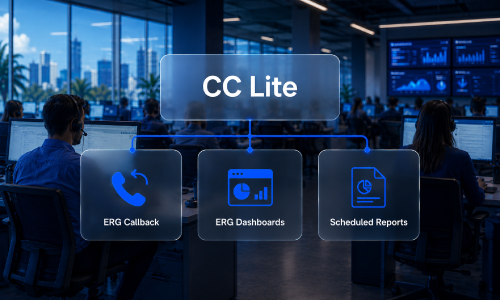
The feature set is focused on three things: callback, real-time visibility, and automated reporting.
ERG Callback handles the scenario that generates the most customer frustration in any small business phone operation: the call that goes unanswered. When a caller abandons a queue, times out, or manually requests a callback, and even in the case of a short call for a chance they have been interrupted abruptly, the system reconnects them automatically as soon as a member becomes available. It removes the burden from the customer to try again and eliminates the manual follow-up work that otherwise falls on the team.
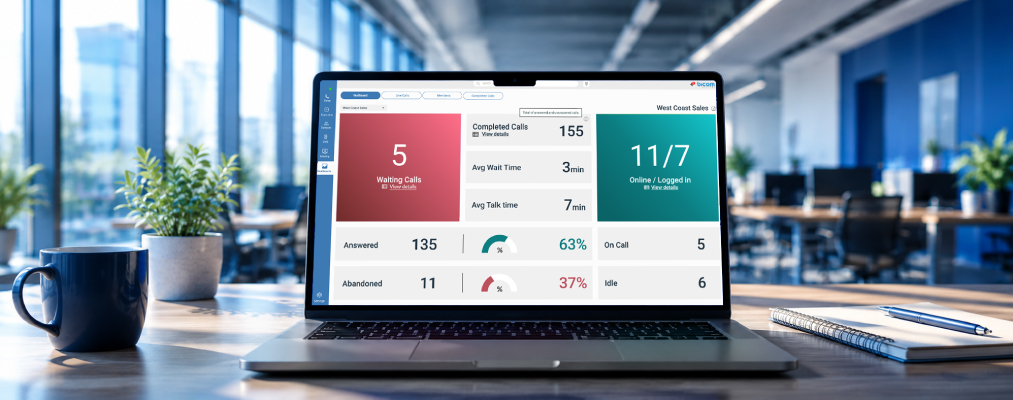
Dashboards for Enhanced Ring Groups(including Wallboard, Members and LiveCalls) give teams real-time visibility into what’s happening across ERG: who is online, idle, or on a call; how many calls are waiting; answered, abandoned, and completed call counts; average wait and talk times. A detailed view goes further, covering member-level activity including missed calls, and a live calls view with caller details and waiting duration. The wallboard window, members and live calls can be detached and displayed on a large screen, making it practical for teams that rely on visual performance tracking throughout the day. The refresh rate is configurable from five seconds upward.
Scheduled Reports close the loop on the data side. Administrators can configure automated ERG and Extension statistics, filtered by time period, Enhanced Ring Groups, members, wait or talk time, DIDs, or customers, and schedule delivery directly to stakeholders’ inboxes. The reports arrive on a cadence the business defines. Nobody has to generate them manually or request them from the reseller’s support desk. As Frasto puts it, it’s a small operational change that makes a big difference in maturity and accountability.
Together, these three capabilities represent what was consistently missing for smaller customers on Multi-Tenant: the operational layer that turns a phone system into something a manager can actually run the business with.

A Full Solution, With Growth Already Planned
It would be easy to position CC Lite as a gateway to the full Contact Center edition, a first rung on a ladder. Frasto is clear that’s not the right framing. The full CC edition exists for environments that need its complexity. CC Lite exists for environments that don’t, and it’s designed to serve those environments well as a complete solution.
That said, it is explicitly a starting point in terms of what Bicom Systems plans to build toward. Research from the team has identified omnichannel as the next major priority after callback, dashboards, and reports, and the broader roadmap involves bringing Contact Center capabilities progressively into Multi-Tenant across two packages, CX Lite and CX Pro. The goal, as Frasto describes it, is eventually one edition with full capabilities and no migration pain.
For resellers, that trajectory matters. Customers who start with CC Lite are entering a platform that will grow around them. The upsell path is built into the structure itself, so there’s no disruptive migration conversation waiting for them later.
The Opportunity for Resellers
The broader market context makes this a well-timed move. SMBs are the fastest-growing segment in contact center software adoption, and competition is pushing even smaller businesses to improve response times, service consistency, and operational visibility. The demand is real. What has been missing, for many resellers, is a way to meet it without recommending a platform change their smaller customers aren’t ready for.
CC Lite reframes that conversation. A reseller can now offer basic operational visibility as an upgrade within the environment the customer already runs, rather than presenting migration as the only path forward. That’s an easier sell, a simpler deployment, and a lower barrier for customers who have been sitting on the fence.
Real-time wallboards, automated reports, and callback may not be exotic capabilities, but they are things businesses across every vertical expect from a customer-facing phone system. The difference now is that for smaller operations, they’re accessible without the infrastructure overhead that previously made them out of reach.
Related Categories