Most safety software now includes some form of AI. For safety leaders and the technology teams that support them, the question is no longer whether to use it. It’s how to introduce it responsibly, and how to tell where it adds real value from where its limitations matter.
The answer depends less on the technology than on how it’s designed, implemented and governed. AI doesn’t change an organization’s work health and safety duties. It changes how work gets done, and that change needs managing like any other.
Where AI adds practical value today
The strongest use cases share a pattern. They reduce administrative effort for people who already know what they’re doing, and a competent person stays accountable for the decision.
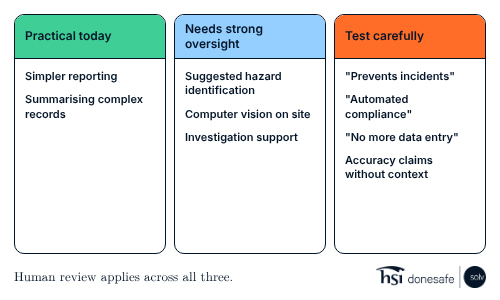
Simpler reporting. Good reporting starts with making the process simple. Conditional logic, pre-filled information based on the user or location, mobile-friendly forms, photo capture and speech-to-text can all reduce the effort required to report. AI can extend this further through tools such as voice agents, where a worker can report an incident through a phone call or guided conversation rather than completing a form manually. The value comes from reducing friction while still giving the worker a chance to confirm the information captured before it is submitted. Easier reporting can improve the quantity and consistency of safety information available to an organization, but the real value comes from whether that information is accurate, reviewed and used to identify and address risk.
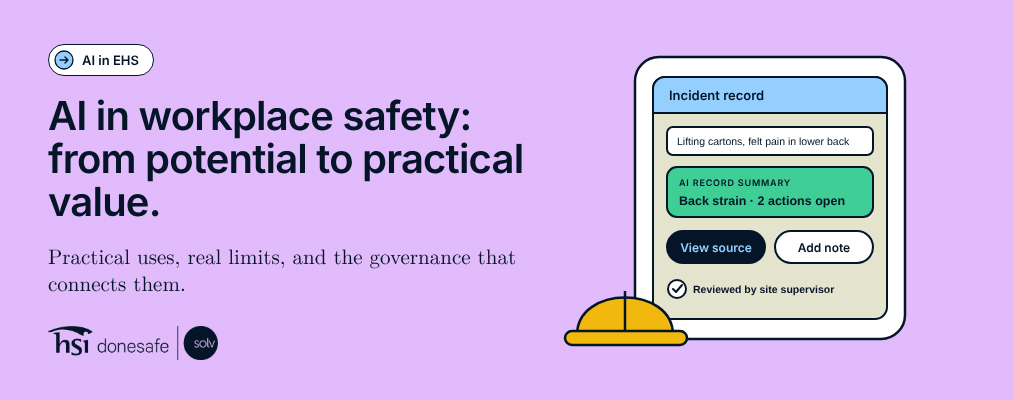
Summarizing complex records. Incident and investigation records can accumulate significant detail as they progress through a workflow. AI-generated summaries can help users quickly understand the key information captured in a record, while the underlying evidence remains available for review. The summary should support navigation and understanding, not replace the source record. In safety and injury management, the ability to locate the original evidence matters as much as the convenience of a summary.
In both cases, the benefit isn’t speed for its own sake. It’s the time it gives back for work that needs experience and judgment: time in the field, hazard identification, and supporting workers and leaders.
Where human judgment matters most
These uses have real potential, but their limitations need to be understood and managed.
Suggested hazard identification. AI can identify potential hazards in images and bring them to a worker’s attention, but context still matters. A model may recognize an object or condition without understanding the task, environment or controls already in place. Treat the output as a prompt for human assessment, not a completed risk assessment.
Computer vision on site. Computer vision can be used to identify conditions such as missing PPE, exclusion-zone breaches or unsafe interactions in monitored environments. It also raises important questions: worker consent and privacy, the risk of excessive monitoring, false positives, and who acts on alerts. Pilot narrowly, consult workers early, and measure whether conditions actually improve.
Investigation support. AI may help summarize information or surface potential contributing factors, but it shouldn’t determine root cause. An early suggestion can anchor an investigation around an obvious explanation, leaving wider issues such as work design, resourcing, procedures or supervision unexplored. Investigators still need to assess the evidence, consider the broader context and establish what contributed to the incident.
Claims worth testing carefully
Some claims deserve close examination before you rely on them:
- “AI that prevents incidents.” AI can help people identify and act on hazards faster. Prevention still depends on effective controls, competent people and good work design.
- “Automated compliance.” Regulatory obligations sit with people and organizations. A tool can track evidence and flag gaps, but accountability stays with you.
- “No more data entry.” Capture can get easier, but someone still needs to verify what matters, especially for notifiable incidents and claims.
- Accuracy figures without context. Ask what data the model was tested on, how accuracy was measured, and how it performs on data like yours.
AI governance is safety governance
The organizations getting the most from AI tend to manage it the way they manage any other change to work. They identify the risks, consult the people affected, put controls in place and review them over time. In practice:
- Consult workers before and during rollout. People closest to the work can see how a tool changes it, including workload, autonomy and monitoring, in ways a project team may miss.
- Keep humans in charge of critical decisions. Be explicit about what AI may generate, what it may suggest, and which decisions always stay with a person.
- Help teams know when to trust and when to challenge. Outputs can be incomplete or oversimplified, especially when the source data is. Build review into the workflow rather than leaving it to individual judgment.
- Fold AI into existing frameworks. Treat it as part of your safety and compliance governance, not a standalone innovation project.
EHS management platforms such as HSI Donesafe can support this approach by bringing incident reporting, hazard management, risk assessments, and corrective actions into a structured environment. By keeping these processes connected, organizations can introduce AI-assisted capabilities within established safety workflows while preserving the human oversight and accountability essential to effective workplace safety management.
Questions to ask any vendor
- What role does the AI actually play? Understand what the tool generates or recommends, and what information it uses.
- Where is the human in the loop? Who confirms, edits or overrides the output, and is that recorded?
- Can we trace outputs back to source records? This matters for summaries and suggestions.
- Where does our data go? Is it used to train shared models? Where is it hosted? How are personal and health details handled?
- What happens when it’s wrong? How are errors surfaced and corrected?
- Can we turn it off? The underlying workflow should still work without the AI.
- How is performance validated over time? Ask what the tool was tested against, how errors and bias are measured, how performance is monitored after implementation, and what triggers a review or change.
A sensible adoption path
- Start where effort is high and risk is low. Incident reporting and record summaries are good candidates.
- Measure what matters. Track time to complete a report, the completeness and accuracy of captured information after review, time to close investigations and overall data quality. Don’t rely on volume alone.
- Involve the frontline. If workers don’t trust a tool, they won’t use it.
- Write down your guardrails before you scale, and review them as you learn.
The bottom line
AI is already reducing administrative effort in parts of safety management, particularly reporting and making sense of complex records. Its wider potential, in hazard identification, detection and investigation support, is real. Realizing it depends on good data, worker consultation and clear accountability.
The most useful test for any safety AI is simple: does it help a competent person make a better-informed decision, while leaving them accountable for it? If it does, it’s worth exploring carefully.
Want to see how this looks in practice? Explore how HSI Donesafe supports workplace safety management, and how HSI Solv helps teams manage injuries and claims through to return to work.
Related Categories