For most of the history of workplace safety, risk was something you could see. A missing guardrail. An unsecured load. A spill on a walkway. Safety programs were built to find hazards like these, fix them, and prove they’d been fixed.
Psychosocial risk doesn’t work like that. Excessive workload, poor role clarity, bullying, fatigue from shift patterns, exposure to traumatic events, lack of support from managers: none of these show up on a site walk. Yet regulators in a growing number of countries now expect employers to identify and control them with the same discipline as physical hazards. Australia, for example, has introduced explicit psychosocial hazard regulations and codes of practice across most of its jurisdictions.
That shift changes who owns the problem, and what kind of problem it is. Psychosocial risk isn’t only a safety problem or an HR problem. It’s a data problem.
The signals already exist, scattered everywhere
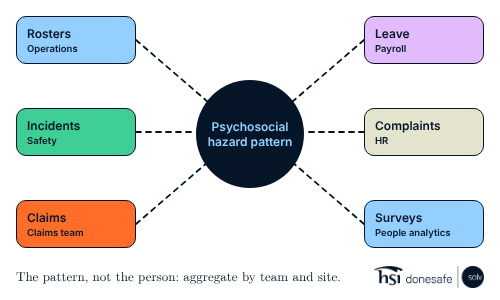
Ask most organisations whether they have data on psychosocial risk and they’ll say no, or point to an annual engagement survey. In reality, the early signals are almost always already being captured, just not in one place and not by one team.
- Rosters and timesheets show excessive overtime, back-to-back shifts and short turnarounds.
- Leave data shows rising unplanned absence in a team or site.
- Incident and hazard reports include near misses linked to fatigue or rushing, and reports of aggression from customers or the public.
- HR case management holds complaints, grievances and bullying allegations.
- Workers’ compensation claims include psychological injury claims, often the longest and most expensive to resolve. Safe Work Australia reports that mental health conditions accounted for 12.2% of serious claims in 2024–25, with a median 34.8 weeks of time lost and $68,600 in compensation paid.
- Pulse surveys capture sentiment on workload, support and role clarity.
- Exit interviews capture the stories nobody told while the person was still employed.
Together, they often tell a clear story well before a claim is lodged, without every signal needing to sit in the safety system. What matters is using the relevant insights, at an appropriate level of aggregation, to inform how psychosocial hazards are assessed and controlled.
Why the usual tools struggle
Traditional safety systems were designed around events: something happened, it was reported, it was investigated. Psychosocial harm usually builds up over time, through conditions rather than events. A team doesn’t have a “workload incident.” It has six months of creeping overtime, two resignations and a manager on stress leave.
HR systems, meanwhile, were built around individual employee records and cases, with confidentiality rightly built in. They’re good at managing a single complaint well. They’re rarely designed to spot a pattern across a site or a role, or to link that pattern to the work itself.
So the gap isn’t a lack of data. It’s that no system is set up to treat these signals as indicators of a hazard in how work is designed.
EHS management platforms such as HSI Donesafe can help organizations bridge this gap by bringing psychosocial hazard identification, risk assessments, corrective actions, and control monitoring into a structured safety management process. This allows safety teams to manage psychosocial risks alongside physical hazards while maintaining clearer accountability for the controls put in place.
Treat psychosocial risk like any other hazard
The good news is that the core discipline of safety management still applies. Identify the hazard, assess the risk, control it, and check whether the controls work. What changes is the inputs.
- Define the hazards that matter for your work. A call centre, a hospital and a construction site carry very different psychosocial profiles. Start with the hazards your regulator names, and map them to your roles.
- Pick a small set of leading indicators. For example, overtime above a threshold, unplanned leave trends, aggression reports, or survey scores on workload. Fewer, well-chosen indicators beat a sprawling dashboard.
- Bring the indicators together at the level of the work, meaning site, team or role, not the individual. Aggregation protects privacy and focuses attention on work design rather than blame.
- Assign controls, owners and review dates, exactly as you would for a physical hazard: redesigned rosters, staffing changes, manager training, de-escalation protocols.
- Close the loop. Track whether the indicators move after the controls go in. If they don’t, the control isn’t working.
Privacy is a design constraint, not an afterthought
Any serious approach to psychosocial risk handles personal and health information. That raises legitimate concerns about surveillance and trust. Get it wrong and you’ll damage the very thing you’re trying to protect.
A few principles help:
- Aggregate by default. Look at teams and sites, not individuals, unless there’s a specific case being managed.
- Separate case detail from risk insight. Confidential HR and medical details stay restricted. The risk register sees the pattern, not the person.
- Be transparent with workers about what’s measured and why. Psychosocial risk management works best when workers are consulted, which many regulators also expect.
What this means for technology leaders
If you work in IT, people analytics or operations, you’re likely to be pulled into this sooner rather than later. The questions you’ll be asked are architectural:
- Can our safety, HR, rostering and claims systems share indicators without exposing personal data?
- Where should a psychosocial risk register live, and who owns it?
- Can we report on controls and their effectiveness in a way that stands up to a regulator or a board?
Those aren’t questions a single new tool answers on its own. They need agreement between safety, HR and IT on definitions, ownership and access, followed by systems that can support that agreement.
The bottom line
Psychosocial risk has moved from a wellbeing initiative to a compliance obligation in many places. It’s a hazard to be managed like any other. The organisations that handle it well won’t necessarily be the ones with the most programs. They’ll be the ones that use the signals already available to identify risk earlier, put appropriate controls in place and check whether those controls are working
See how your organisation measures up with our psychosocial risk readiness check. It takes a few minutes, and no email is required.
Related Categories