Too often, data security regulations like the Health Insurance Portability and Accountability Act (HIPAA) and Gramm-Leach-Bliley Act (GLBA) are regarded as inconvenient and arbitrary rules that hinder an organization’s ability to manage the IT estate. That’s too bad because data privacy and security laws represent a set of best practices that can be a template for protecting the information that your customers, employees, and others have entrusted to your organization, and for the data that you rely on to fulfill your mission. When approached from that perspective, compliance becomes a template for secure, efficient IT operations rather than an inconvenience.
The good news is, there are several tools available for supporting the list of things you need to do to satisfy your compliance checklists. And when you simplify the many laws that define and dictate data security and privacy compliance, you’ll find that there is a lot of overlap from an IT perspective. These are not tools designed as compliance solutions, but solutions that automate essential workflows in a manner that is consistent with compliance mandates. That means you can match your needs to a tool that simplifies compliance and by automating the associated workflows.
What are the Three Pillars of Security Compliance?
As an example, a fully featured enterprise-grade managed file transfer (MFT) solution can automate the execution of several key elements of compliance, ensuring that all data transferred to or from the organization is done in accordance with the law. How is that possible? Three pillars of all data security and privacy regulations are encryption, access, and documentation. A good MFT solution tackles all three, and there are some that go beyond the minimum to offer additional protection for the enterprise. Let’s look at these in order.
Encryption: Every data security and privacy regulation requires that data be encrypted as a guard against unauthorized access. In fact, even if a cybercriminal manages to penetrate your IT network, any data that they manage to swipe is not considered breached if the organization can prove that it was encrypted. An enterprise-grade MFT solution automates PGP encryption management, including encrypting outgoing files and decrypting those that are incoming. Furthermore, when an MFT solution supports the secure file transfer protocol (SFTP) to encrypt the channel over which files travel, data associated with the transmission is protected, giving assurance that the file is legitimate and the information contained in the file has not been tampered with.
Encryption has cost-saving benefits, too. According to the most recent IBM/Ponemon Institute Cost of a Data Breach Report, when an organization is breached, the presence of data encryption lowers the average cost of a data breach by $208K from $4.44M to $4.23M. That’s some excellent ROI for implementing a protection you should have in place anyway.
Access: Access control is a vital component of security and compliance because people are a wild card. Automation can minimize the likelihood of mistakes made through simple human error, but when people inside an organization—malicious insiders—have criminal intent, they magnify the harm caused by a data breach. In fact, the Cost of a Data Breach Report found that the average cost of a breach leaps from $4.44M to $4.92M when a malicious insider is the cause. And while there is no way to completely prevent someone with malicious intent from doing wrong, there are protections that can be implemented that make it much harder for the wrong people to gain access to protected information and give them pause for carrying out their deeds over fear of getting caught.
Access control, guided by the principle of least privilege, ensures that only individuals with a legitimate need to know can get to the information your MFT solution handles. Used in tandem with multi-factor authentication, access control verifies an individual’s identity and determines the appropriate level of access and administrative privileges that person is allowed based on parameters set by the organization. When synchronized with its Lightweight Directory Access Protocol (LDAP), the enterprise can ensure privileges are automated consistently and simply whether they are elevated, lowered, or revoked.
Documentation: The ability to verify compliance through documentation is essential. You may have encrypted that file that got sent beyond the firewall, but if you can’t prove it to an auditor, the assumption is that the file was sent in the clear. An MFT solution should have complete workflow visibility, the ability to capture all workflow process data, and a simple way to produce the documentation required by an auditor.
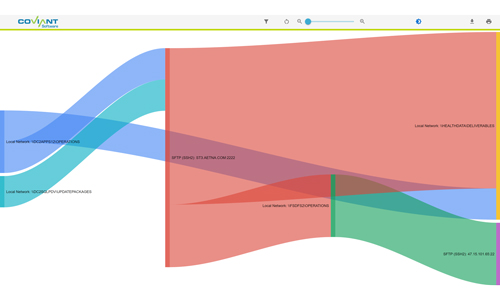
One new twist to documentation under HIPAA that must now be addressed involves the ability to map data flows inside the organization and across the external information supply chain. Doing so shows authorities that you know who you regularly send and receive information from and can take the necessary precautions to exchange that data securely. It also gives your team the means to assess the security practices of those partners and take necessary precautions.
Some organizations choose to establish security standards as a condition for doing business, while others may look for ways to take the burden off the partner in cases where that organization may not have the resources or expertise to meet those standards. A web transfer client with familiar browser-based navigation and automatic PGP encryption makes it easy for the enterprise to extend simplified security standards to its smaller information supply chain partners through its own MFT solution.
Managed File Transfer that Transcends Baseline Security and Compliance Requirements
Once you’ve established baseline standards for streamlining security and compliance via an enterprise-grade managed file transfer solution, you should look for a solution that goes beyond the minimum. Leveraging a security-first architecture and feature set to maximize security, simplicity, and efficiency is the goal. Here’s a list of things to look for when reviewing your MFT choices:
- Automated PGP encryption management
- Threat intelligence
- MFT process data capture for compliance audit reporting and troubleshooting
- Automated data capture and one-click reporting
- Data flow mapping and one-click reporting
- Authorized recipient/destination confirmation
- Robust scheduler with virtually unlimited concurrent job capacity
- Notifications to communication channels of choice (email, text, Slack, Teams, etc.)
- Workflow testing validation in dry run mode prior to launch
- No-code OneDrive, SharePoint, and other cloud-based file transfer automation
- Custom permissions synchronization via LDAP integration
- U.S. based customer and technical support from MFT experts
This is where Diplomat MFT from Coviant Software stands out from the crowd. Designed from the ground-up with a security-first architecture, Diplomat MFT has never been breached in more than twenty years of operation and boasts a full slate of customer-focused features that make automating file transfer workflows simple, secure, and pain-free.
Every feature and function in Diplomat MFT is necessary for executing secure and compliant file transfers with no complications. In fact, the Coviant Software whitepaper “Your Plan of Action to Ensure File Transfer Security” offers a straightforward roadmap for using Diplomat MFT to simplify regulatory compliance for laws like HIPAA and GDPR.
Meeting Data Security and Privacy Requirements Today and in the Future
Our design team tracks trends in security and compliance to make sure our solution anticipates new requirements that affect file transfers. When HIPAA updates take effect later this year as anticipated, enterprises that use Diplomat MFT are ready. It’s that simple. What’s more, Diplomat MFT was designed from the start with a security-first architecture that prioritizes data protection while also enabling functionality that automates critical security and file transfer workflows.
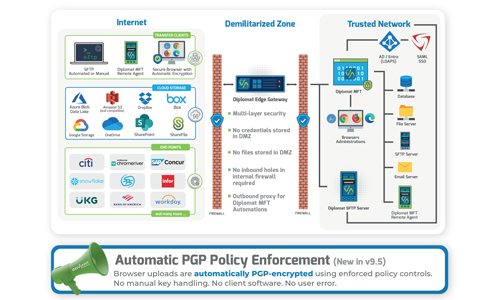
And unlike other file transfer products, Diplomat MFT has never been breached. That’s why customers in healthcare, financial services, government, logistics, manufacturing, retail, education, and more have trusted Coviant Software for more than twenty years. We listen to their needs and lead the way with innovations designed to keep our customers secure and productive. For example, we are the first and only managed file transfer vendor to automate PGP encryption for transfers conducted via a browser-based client. That means your smaller information supply chain partners can send data in accordance with your standards.
If your current managed file transfer solution has you worried about gaps in your compliance and data security strategy that puts you and your people, partners, and patients at risk, Coviant Software can help. Talk with one of our file transfer experts about auditing existing MFT workflows or to schedule a demonstration. We are confident you’ll be impressed with the security, simplicity—and value—of Diplomat MFT.
Related Categories