Advertising

Tim Cook Says Ads That Follow You Online Are 'Creepy' (cnet.com) 181

In a wide-ranging interview with MSNBC and Recode, Apple CEO Tim Cook said that everyone should know how much data they're sharing and what can be inferred about us from that information. He added that privacy "is a human right" and said he's worried about how advertisers and others can abuse access to our data. "To me it's creepy when I look at something and all of a sudden it's chasing me all the way across the web," Cook said. "I don't like that." CNET reports: The comments came as part of a wide-ranging interview between Cook, MSNBC's Chris Hayes and Recode's Kara Swisher. MSNBC broadcast the special, named "Revolution: Apple changing the world" at 5 p.m. PT on Friday. The interview was taped the day after Apple's education event in Chicago, where the company introduced a new 9.7-inch iPad and tools for teachers. The two publications released some early clips and comments from Cook over the past couple of weeks. That included remarks he made about Facebook and its CEO, Mark Zuckerberg in the wake of the Cambridge Analytica scandal. Cook noted that Apple purposely chose not to make "a ton of money" off its customers' data and that Facebook failed to effectively regulate itself, prompting a need for government intervention. Along with Facebook and its privacy issues, Cook talked up DACA and immigration, tax reform, the changing job landscape and the need for everyone to learn coding, among other topics.
Earth

One-Degree Rise In Temperature Causes Ripple Effect In World's Largest High Arctic Lake (folio.ca) 303

An anonymous reader quotes a report from FOLIO Magazine: A 1 C increase in temperature has set off a chain of events disrupting the entire ecology of the world's largest High Arctic lake. "The amount of glacial meltwater going into the lake has dramatically increased," said Martin Sharp, a University of Alberta glaciologist who was part of a team of scientists that documented the rapid changes in Lake Hazen on Ellesmere Island over a series of warm summers in the last decade. "Because it's glacial meltwater, the amount of fine sediment going into the lake has dramatically increased as well. That in turn affects how much light can get into the water column, which may affect biological productivity in the lake." The changes resulted in algal blooms and detrimental changes to the Arctic char fish population, and point to a near certain future of summer ice-free conditions. The findings document an unprecedented shift from the previous three centuries, challenging scientists' expectations of how such a large system could respond so rapidly to a one-degree rise. The study has been published in the journal Nature Communications.
Windows

Is Microsoft Trying To Make Windows 10 Mail Worse? (venturebeat.com) 232

Emil Protalinski via VentureBeat argues that "Windows Mail is unusable, and instead of improving it, Microsoft is looking to drive users away": Microsoft started forcing Mail to use Edge for email links in Windows 10 build 17623 last month. This week, the company started including Office 365 ads right at the bottom of the app. But even these poor decisions are just extra nails in the coffin. Windows Mail has difficulty sending and receiving email. No, I'm not exaggerating for effect. If you have an email open and Windows Mail detects that a new email has hit your inbox, you'll get a notification. Standard stuff. If, however, you then click on said notification, Windows Mail will take you to the open email message, rather than the one that you just clicked on. That's half of the time. The other half of the time this happens, Windows Mail will crash altogether. Apparently having one email open and trying to open another one that just came in is overwhelming for Windows Mail. But that's not the end of it.

Windows Mail is also notorious for not sending emails. Multiple times a week, I open an email, hit reply, type out a quick message, hit send, and alt-tab back to Chrome or Word. Any normal email client will send the message despite the app not being the active window. With Windows Mail, countless times I have wondered why I never got heard back to a specific reply, only to discover hours later, and completely by accident, that the message is still a draft. It's not even sitting in my outbox -- it's just a fucking draft. I end up debating whether to send the email hours late, or if it doesn't make sense to send it anymore. That's not a decision I should have to make. There are of course small features I would like to see added to Windows Mail, like being able to set formatted signatures (as opposed to just plain text), but that's hardly a priority. Windows Mail is unusable, which means Windows 10 doesn't come with an email client. That's incredibly sad.

Education

Berkeley Offers Its Data Science Course Online For Free (berkeley.edu) 33

In a news bulletin, University of California, Berkeley announces that its "Foundations of Data Science" course is "being offered free online this spring for the first time through the campus's online education hub, edX." From the report: The course -- Data 8X (Foundations of Data Science) -- covers everything from testing hypotheses, applying statistical inferences, visualizing distributions and drawing conclusions, all while coding in Python and using real-world data sets. One lesson might take economic data from different countries over the years to track global economic growth. The next might use a data set of cell samples to create a classification algorithm that can diagnose breast cancer. (Learn more from a video on the Berkeley data science website.) The online program is based on the Foundations of Data Science course that Berkeley launched on campus in 2015 and now has more than 1,000 students enrolling every semester. The Foundations of Data Science edX Professional Certificate program is a sequence of three five-week courses taught by three winners of Berkeley's top teaching honor, the Distinguished Teaching Award: DeNero, statistics professor Ani Adhikari and computer science professor David Wagner. The first of the three parts has already started (9 a.m. on April 2), but enrollment will remain open after the course begins. Furthermore, anyone in the world can enroll for free but those who want to earn the certificate will need to pay.
Privacy

'Big Brother' In India Requires Fingerprint Scans For Food, Phones, Finances (nytimes.com) 132

The New York Times reports of the Indian government's intent to build an identification system of unprecedented scope. The country is reportedly "scanning the fingerprints, eyes and faces of its 1.3 billion residents (alternative source) and connecting the data to everything from welfare benefits to mobile phones." Here's an excerpt from the report: Civil libertarians are horrified, viewing the program, called Aadhaar, as Orwell's Big Brother brought to life. To the government, it's more like "big brother," a term of endearment used by many Indians to address a stranger when asking for help. For other countries, the technology could provide a model for how to track their residents. And for India's top court, the ID system presents unique legal issues that will define what the constitutional right to privacy means in the digital age. The government has made registration mandatory for hundreds of public services and many private ones, from taking school exams to opening bank accounts.

Technology has given governments around the world new tools to monitor their citizens. In China, the government is rolling out ways to use facial recognition and big data to track people, aiming to inject itself further into everyday life. Many countries, including Britain, deploy closed-circuit cameras to monitor their populations. But India's program is in a league of its own, both in the mass collection of biometric data and in the attempt to link it to everything -- traffic tickets, bank accounts, pensions, even meals for undernourished schoolchildren.

Operating Systems

Ask Slashdot: Do You Miss Windows Phone? (theverge.com) 284

An anonymous reader writes: After recently switching on an old Windows Phone to create a silly April Fools' joke, The Verge's Tom Warren discovered just how much he missed Microsoft's mobile OS. Two of the biggest features that are hard to find/replicate on iOS and Android are the Metro design and Live Tiles. "Android and iOS still don't have system-wide dark modes, nearly 8 years after Windows Phone first introduced it," notes Warren. "Live Tiles were one of Windows Phone's most unique features. They enabled apps to show information on the home screen, similar to the widgets found on Android and iOS. You could almost pin anything useful to the home screen, and Live Tiles animated beautifully to flip over and provide tiny nuggets of information that made your phone feel far more personal and alive."

Some other neat features include the software keyboard, which Warren argues "is still far better than the defaults on iOS and Android," especially with the recently-added tracing feature that lets you swipe to write words. "Microsoft also experimented with features that were different to other mobile platforms, and some of the concepts still haven't really made their way to iOS or Android: Kid's Corner; Dedicated search button; Browser address bar; People hub; Unified messaging..." Aside from the competition aspect with Google and Apple, do you miss Windows Phone? What are some specific features you miss about the old mobile operating system?

Science

Scientists Discover That Puffin Beaks Are Fluorescent (www.cbc.ca) 36

A scientist in England discovered that the bills of Atlantic puffins glow like freshly cracked glow sticks when under a UV light. CBC.ca reports of how ornithologist Jamie Dunning stumbled upon the discovery: Dunning normally works with twites, another type of bird, but he had been wondering if puffins had Day-Glo beaks for a while, since crested auklets -- seabirds in the same family -- also have light-up bills. So one January day, while having a "troubling" time in the lab, he threw off the lights and shone a UV light on a puffin carcass. "What happened was quite impressive, really," he said. The two yellow ridges on the puffin's bill -- called the lamella and the cere -- lit up like a firefly. And it's real fluorescence, Dunning emphasizes: something about those parts of the puffin bill is allowing that UV light to be absorbed and re-emitted as a bright glowing light.

The fact some birds have this quality and some birds don't indicates the fluorescence certainly has some use for the puffins, Dunning said, but he's not sure what that use might be. "The bill of a puffin is forged by generations, hundreds and thousands of years, of sexual selection. There's a lot going on there. That's why it's so colorful and pretty." But the radiant color is almost certainly not being used as a headlight, he said. He said whatever's making the beak glow is reacting with the UV light waves, and those light waves aren't around in the dark.

Transportation

California May Soon Allow Passengers In Driverless Cars (reuters.com) 165

According to Reuters, California's public utility regulator on Friday signaled it would allow passengers to ride in self-driving cars without a backup driver in the vehicle. It is a big step forward for autonomous car developers, especially as the industry faces heightened scrutiny over safety concerns. From the report: The California Public Utilities Commission, the body that regulates utilities including transportation companies such as ride-hailing apps, issued a proposal that could clear the way for companies such as Alphabet's Waymo and General Motors to give members of the public a ride in a self-driving car without any backup driver present, which has been the practice of most companies so far. The California Department of Motor Vehicles had already issued rules allowing for autonomous vehicle testing without drivers, which took effect this week. The commission said its proposed rules complement the existing DMV rules but provide additional protections for passengers. The proposal, which is set to be voted on at the commission's meeting next month, would clear the way for autonomous vehicle companies to do more testing and get the public more closely acquainted with driverless cars in a state that has closely regulated the industry. It also comes as regulators across the country are taking a harder look at self-driving cars in the aftermath of a crash in Arizona that killed a pedestrian.
Facebook

Facebook Donated To 46 of 55 Members On Committee That Will Question Zuckerberg (usatoday.com) 160

Facebook CEO Mark Zuckerberg will be questioned about user privacy protections next week by members of the House and Senate committees, but as USA Today notes, many of these members were also "some of the biggest recipients of campaign contributions from Facebook employees directly and the political action committee funded by employees." An anonymous reader shares the report: The congressional panel that got the most Facebook contributions is the House Energy and Commerce Committee, which announced Wednesday morning it would question Zuckerberg on April 11. Members of the committee, whose jurisdiction gives it regulatory power over Internet companies, received nearly $381,000 in contributions tied to Facebook since 2007, according to the Center for Responsive Politics. The center is a non-partisan, non-profit group that compiles and analyzes disclosures made to the Federal Election Commission.

The second-highest total, $369,000, went to members of the Senate Commerce, Science and Transportation Committee, which announced later that it would have a joint hearing with the Senate Judiciary Committee to question Zuckerberg on Tuesday. Judiciary Committee members have received $235,000 in Facebook contributions. On the House committee, Republicans got roughly twice as much as Democrats, counter to the broader trend in Facebook campaign gifts. Of the $7 million in contributions to all federal candidates tied to the Menlo Park, Calif.-based social network, Democrats got 65% to Republicans' 33%. Of the 55 members on the Energy and Commerce Committee this year, all but nine have received Facebook contributions in the past decade. The average Republican got $6,800, while the average Democrat got $6,750.

IT

Ask Slashdot: Are Companies Under-Investing in IT? 325

Long-time Slashdot reader johnpagenola writes: In the middle 1970's I had to choose between focusing on programming or accounting. I chose accounting because organizations were willing to pay for good accounting but not for good IT.

Forty years later the situation does not appear to have changed. Target, Equifax, ransomware, etc. show pathetically bad IT design and operation. Why does this pattern of underinvestment in and under-appreciation of IT continue?

Long-time Slashdot reader dheltzel argues that the problem is actually bad hiring practices, which over time leads to lower-quality employees. But it seems like Slashdot's readership should have their own perspective on the current state of the modern workplace.

So share your own thoughts and experiences in the comments. Are companies under-investing in IT?
AI

Elon Musk Is Paying For Free Streaming of a New Documentary about AI Dangers (syfy.com) 185

An anonymous reader quotes Syfy.com: There's a new documentary warning about the perils of artificial intelligence out there, and Elon Musk wants you to see it. So much so that he's making it available to stream for free this weekend. The documentary -- Do You Trust This Computer? -- explores the rise of machine intelligence and its possible consequences... Check out the trailer, and then proceed to be creeped way the hell out.... "It's a subject that I feel we should be paying close attention to," said Musk in a news release. "I think it's important that a lot people see this movie, so I'm paying for it to be seen to the world for free this weekend."
Musk attended the premier of the film with the creator of HBO's Westworld, and tweeted Saturday that the video had 5 million views in just 36 hours.

Musk himself is interviewed in the film, warning of the dire possibility of "an immortal dictator from which we can never escape."
Ruby

Can Ruby Survive Another 25 Years? (techradar.com) 195

TechRadar marked the 25th anniversary of the Ruby programming language by writing "there are still questions over whether it can survive another 25 years." The popularity of the Ruby language has been bolstered for many years by the success of the Ruby on Rails (RoR) web application framework which dominated the web scene, particularly among startups who wanted something that deal with much of the heavy lifting... But RoR, although popular, isn't the superstar that it was and It has faced fierce competition as issues such as scaling have become a greater concern for web companies. The JavaScript framework Node.js, for instance, has become popular as it requires less memory to deal with numerous connections because of its callback functions...

To improve performance further Ruby is introducing JIT (Just-In-Time) technology, which is already used by JVM and other languages. "We've created a prototype of this JIT compiler so that this year, probably on Christmas Day, Ruby 2.6 will be released," Matz confirmed. You can try the initial implementation of the MJIT compiler in the 2.6 preview1... Probably the clearest overview explanation of how MJIT works is supplied by Shannon Skipper: "With MJIT, certain Ruby YARV instructions are converted to C code and put into a .c file, which is compiled by GCC or Clang into a .so dynamic library file. The RubyVM can then use that cached, precompiled native code from the dynamic library the next time the RubyVM sees that same YARV instruction.

Ruby creator Yukihiro Matsumoto says Ruby 3.0 "has a goal of being three times faster than Ruby 2.0," and TechRadar reports that it's obvious that Matsumoto "will do anything he can to enable Ruby to survive and thrive..."

And in addition, "he's thoroughly enjoying himself doing what he does... and his outlook is quite simple: Programming is fun, he's had fun for the last 25 years making Ruby, and at the age of 52 now, he hopes that he'll get to spend the next 25 years having as much fun working on the language he dreamt up and wrote down in -- a now lost -- notebook, at the age of 17."

"We want Ruby to be the language that is around for a long time and people still use," Matsumoto tells another interviewer, "not the one people used to use."
Classic Games (Games)

Original 'System Shock' Code Open Sourced, More Updates Promised (kickstarter.com) 39

"The folks at Nightdive Studios this week released the source code for a Mac version of Looking Glass Studios' 1994 classic System Shock," reports Gamasutra. Friday the game's new owners unveiled on GitHub "the original, unaltered source code that was discovered by OtherSide Entertainment and graciously shared with us a few months ago... We have been hard at work updating this code and plan to release a new version of System Shock: Enhanced Edition as well as the code in the near future." We've gone back to the original vision we shared with you at the start of our Kickstarter campaign -- this time with more reliable performance and higher fidelity visuals thanks to the Unreal Engine... We have been able to re-use the majority of work we've done over the past year and we're making significant progress in a very short amount of time. With that said we'll be inviting our highest tier backers to privately test the game beginning in September at which point we estimate that the game will be fully playable, from start to finish. The majority of the art won't be finished, but we'll be ready to start high-level testing.
Going forward there's even a Twitch component. "In an effort to remain transparent throughout development we're going to begin streaming on a regular basis and inviting the backers to join us." And the audio department has also revealed some of the music from the medical deck.

After their Kickstarter was funded, Nightdive had explored making a "bigger, better game" after receiving a verbal commitment from a game publisher, but then "were left high and dry after making crucial, consequential changes in staff and scope... We still have the funds necessary to complete the game, but the timeline will inevitably move back with our shift in direction..."

"This will be closer to a 1:1 remake with updates to the weapon/character designs but without altering the core gameplay of the original."
Security

'Vigilante Hackers' Strike Routers In Russia and Iran, Reports Motherboard (vice.com) 121

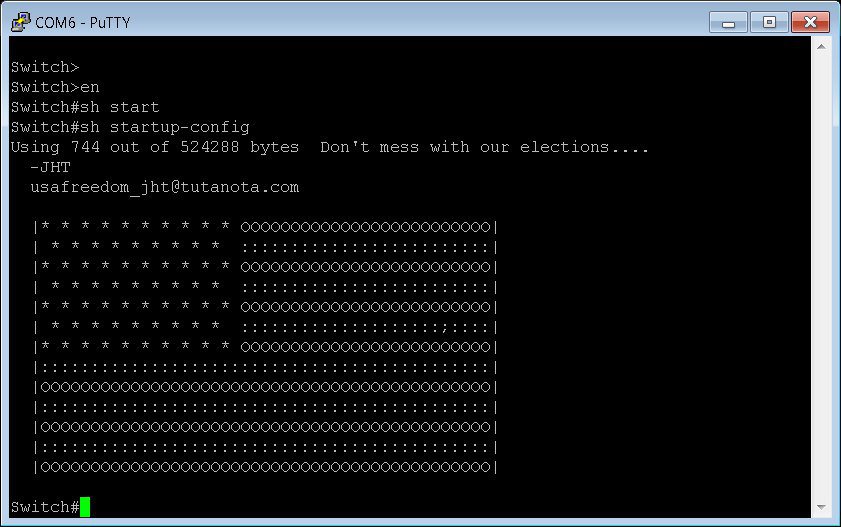
An anonymous reader quotes Motherboard: On Friday, a group of hackers targeted computer infrastructure in Russia and Iran, impacting internet service providers, data centres, and in turn some websites. "We were tired of attacks from government-backed hackers on the United States and other countries," someone in control of an email address left in the note told Motherboard Saturday... "We simply wanted to send a message...." In addition to disabling the equipment, the hackers left a note on affected machines, according to screenshots and photographs shared on social media: "Don't mess with our elections," along with an image of an American flag...

In a blog post Friday, cybersecurity firm Kaspersky said the attack was exploiting a vulnerability in a piece of software called Cisco Smart Install Client. Using computer search engine Shodan, Talos (which is part of Cisco) said in its own blog post on Thursday it found 168,000 systems potentially exposed by the software. Talos also wrote it observed hackers exploiting the vulnerability to target critical infrastructure, and that some of the attacks are believed to be from nation-state actors...

Reuters reported that Iran's IT Minister Mohammad Javad Azari-Jahromi said the attack mainly impacted Europe, India, and the U.S.... The hackers said they did scan many countries for the vulnerable systems, including the U.K., U.S., and Canada, but only "attacked" Russia and Iran, perhaps referring to the post of an American flag and their message. They claimed to have fixed the Cisco issue on exposed devices in the US and UK "to prevent further attacks... As a result of our efforts, there are almost no vulnerable devices left in many major countries," they claimed in an email.

Their image of the American flag was a black-and-white drawing done with ASCII art.
Math

Did Harvard Scientists Predict The End of the Universe? (gizmodo.com) 155

The universe will end with a bang -- and not a whimper -- reports The New York Post, citing a new study by Harvard Researchers predicting exactly when (and how) the universe will end. But Gizmodo's science writer takes issue with the media coverage: That paper predicts that the universe's lifetime would be between 10**88 and 10**241 years, but probably probably around 10**139 years. "I think people don't have a sense as to how big these numbers are," study author and physicist Matthew Schwartz from Harvard told Gizmodo. "It's such an enormous out of time. But they think 10**139 years is 139."

The universe is around 10 billion, or 10**10 years old. 10**139 is a completely unfathomable number of years... It's more than the amount of time it would take to count every atom in the universe, if you had to wait from the Big Bang until now in between counting each atom. That number of years eludes any rational attempt to understand it (Which is probably why it sounds so close -- our heads just short circuit and say, threat!!!). It is forever.

Slashdot Top Deals