United Kingdom

UK Class-Action Targets Mobile Phone Operators With $4.15 Billion Damages Claim (ft.com) 11

The biggest UK mobile phone operators could face total damages of $4.15 billion following class-action claims that they allegedly charged 5 million existing customers "loyalty penalties" over a 16-year period. From a report: Claimant lawyers say they filed court documents at the Competition Appeals Tribunal against Vodafone, EE, Three UK and O2 last week. The claims accuse the phone companies of overcharging on as many as 28.2 million contracts by not reducing the amount customers had to pay after their minimum terms expired, despite them having effectively paid off their mobile devices.

The claim consists of individual lawsuits against each company, with damages sought of up to $1.76 billion from Vodafone, up to $1.38 billion from EE, up to $637.8 million from Three, and up to $322 million from O2. Claimant lawyers at Charles Lyndon, a law firm, estimate that up to 4.8 million people could be affected. If the case is successful, someone who held a contract with one of the mobile operators could receiveÂup to $2,293. The claims are on an "opt-out" basis, which means all qualifying customers will be automatically included in the claim unless they make a choice not to join.

China

'Global Science is Splintering Into Two - And This is Becoming a Problem' 168

The United States and China are pursuing parallel scientific tracks. To solve crises on multiple fronts, the two roads need to become one, Nature's editorial board wrote Wednesday. From the post: It's no secret that research collaborations between China and the United States -- among other Western countries -- are on a downward trajectory. Early indicators of a possible downturn have been confirmed by more sources. A report from Japan's Ministry of Education, Culture, Sports, Science and Technology, published in August, for instance, stated that the number of research articles co-authored by scientists in the two countries had fallen in 2021, the first annual drop since 1993. Meanwhile, data from Nature Index show that China-based scientists' propensity to collaborate internationally has been waning, when looking at the authorship of papers in the Index's natural-science journals.

Nature reported last month that China's decoupling from the countries loosely described as the West mirrors its strengthening of science links with low- and middle-income countries (LMICs), as part of its Belt and Road Initiative. There are many good reasons for China to be boosting science in LMICs, which could sorely do with greater research funding and capacity building. But this is also creating parallel scientific systems -- one centred on North America and Europe, and the other on China. The biggest challenges faced by humanity, from combating climate change to ending poverty, are embodied in a globally agreed set of targets, the United Nations Sustainable Development Goals (SDGs).

Approaching them without shared knowledge can only slow down progress by creating competing systems for advancing and implementing solutions. It's a scenario that the research community must be more aware of and work to avoid. Nature Index offers some reasons as to why collaboration between China and the West is declining. Travel restrictions during the COVID-19 pandemic took their toll, limiting collaborations and barring new ones from being forged. Geopolitical tensions have led many Western governments to restrict their research partnerships with China, on national-security grounds, and vice versa.
Security

Okta Says Hackers Stole Data For All Customer Support Users (cnbc.com) 14

An anonymous reader quotes a report from CNBC: Hackers who compromised Okta's customer support system stole data from all of the cybersecurity firm's customer support users, Okta said in a letter to clients Tuesday, a far greater incursion than the company initially believed. The expanded scope opens those customers up to the risk of heightened attacks or phishing attempts, Okta warned. An Okta spokesperson told CNBC that customers in government or Department of Defense environments were not impacted by the breach. "We are working with a digital forensics firm to support our investigation and we will be sharing the report with customers upon completion. In addition, we will also notify individuals that have had their information downloaded," a spokesperson said in a statement to CNBC.

Nonetheless, Okta provides identity management solutions for thousands of small and large businesses, allowing them to give employees a single point of sign on. It also makes Okta a high-profile target for hackers, who can exploit vulnerabilities or misconfigurations to gain access to a slew of other targets. In the high profile attacks on MGM and Caesars, for example, threat actors used social engineering tactics to exploit IT help desks and target those company's Okta platforms. The direct and indirect losses from those two incidents exceeded $100 million, including a multi-million dollar ransom payment from Caesars.

Facebook

Meta Designed Platforms To Get Children Addicted, Court Documents Allege (theguardian.com) 64

An anonymous reader quotes a report from The Guardian: Instagram and Facebook parent company Meta purposefully engineered its platforms to addict children and knowingly allowed underage users to hold accounts, according to a newly unsealed legal complaint. The complaint is a key part of a lawsuit filed against Meta by the attorneys general of 33 states in late October and was originally redacted. It alleges the social media company knew -- but never disclosed -- it had received millions of complaints about underage users on Instagram but only disabled a fraction of those accounts. The large number of underage users was an "open secret" at the company, the suit alleges, citing internal company documents.

In one example, the lawsuit cites an internal email thread in which employees discuss why a 12-year-old girl's four accounts were not deleted following complaints from the girl's mother stating her daughter was 12 years old and requesting the accounts to be taken down. The employees concluded that "the accounts were ignored" in part because representatives of Meta "couldn't tell for sure the user was underage." The complaint said that in 2021, Meta received over 402,000 reports of under-13 users on Instagram but that 164,000 -- far fewer than half of the reported accounts -- were "disabled for potentially being under the age of 13" that year. The complaint noted that at times Meta has a backlog of up to 2.5m accounts of younger children awaiting action. The complaint alleges this and other incidents violate the Children's Online Privacy and Protection Act, which requires that social media companies provide notice and get parental consent before collecting data from children. The lawsuit also focuses on longstanding assertions that Meta knowingly created products that were addictive and harmful to children, brought into sharp focus by whistleblower Frances Haugen, who revealed that internal studies showed platforms like Instagram led children to anorexia-related content. Haugen also stated the company intentionally targets children under the age of 18.

Company documents cited in the complaint described several Meta officials acknowledging the company designed its products to exploit shortcomings in youthful psychology, including a May 2020 internal presentation called "teen fundamentals" which highlighted certain vulnerabilities of the young brain that could be exploited by product development. The presentation discussed teen brains' relative immaturity, and teenagers' tendency to be driven by "emotion, the intrigue of novelty and reward" and asked how these asked how these characteristics could "manifest ... in product usage." [...] One Facebook safety executive alluded to the possibility that cracking down on younger users might hurt the company's business in a 2019 email. But a year later, the same executive expressed frustration that while Facebook readily studied the usage of underage users for business reasons, it didn't show the same enthusiasm for ways to identify younger kids and remove them from its platforms.

Earth

Brazil Signs On To Global Climate Deal To Triple Renewable Energy (reuters.com) 56

Brazil has signed onto an agreement to triple renewable energy globally by 2030 and shift away from using coal, the country's Foreign Ministry said on Friday, joining a prospective deal backed by the European Union, U.S. and United Arab Emirates. From a report: South America's largest country is now one of roughly 100 countries that have signed onto the deal, according to a European official familiar with the matter. Sources told Reuters earlier this month the aim is for the deal to be officially adopted by leaders attending the United Nation's COP28 climate negotiations that begins next week in Dubai.

Brazil's embassy in Abu Dhabi said in a letter to the United Arab Emirates' Foreign Ministry that it would join the deal titled the "Global Renewables and Energy Efficiency Targets Pledge." A spokesperson for Brazil's Foreign Ministry confirmed the country has decided to join the pact. Brazil is already a major player in renewable energy. More than 80% of the country's electricity comes from renewable sources, led by hydropower with solar and wind energy expanding rapidly.

Microsoft

Microsoft's Windows Hello Fingerprint Authentication Has Been Bypassed (theverge.com) 53

Microsoft's Windows Hello fingerprint authentication has been bypassed on laptops from Dell, Lenovo, and even Microsoft. From a report: Security researchers at Blackwing Intelligence have discovered multiple vulnerabilities in the top three fingerprint sensors that are embedded into laptops and used widely by businesses to secure laptops with Windows Hello fingerprint authentication. Microsoft's Offensive Research and Security Engineering (MORSE) asked Blackwing Intelligence to evaluate the security of fingerprint sensors, and the researchers provided their findings in a presentation at Microsoft's BlueHat conference in October.

The team identified popular fingerprint sensors from Goodix, Synaptics, and ELAN as targets for their research, with a newly-published blog post detailing the in-depth process of building a USB device that can perform a man-in-the-middle (MitM) attack. Such an attack could provide access to a stolen laptop, or even an "evil maid" attack on an unattended device. A Dell Inspiron 15, Lenovo ThinkPad T14, and Microsoft Surface Pro X all fell victim to fingerprint reader attacks, allowing the researchers to bypass the Windows Hello protection as long as someone was previously using fingerprint authentication on a device. Blackwing Intelligence researchers reverse engineered both software and hardware, and discovered cryptographic implementation flaws in a custom TLS on the Synaptics sensor. The complicated process to bypass Windows Hello also involved decoding and reimplementing proprietary protocols.

Security

USB Worm Unleashed By Russian State Hackers Spreads Worldwide (arstechnica.com) 34

An anonymous reader quotes a report from Ars Technica: A group of Russian-state hackers known for almost exclusively targeting Ukranian entities has branched out in recent months either accidentally or purposely by allowing USB-based espionage malware to infect a variety of organizations in other countries. The group -- known by many names, including Gamaredon, Primitive Bear, ACTINIUM, Armageddon, and Shuckworm -- has been active since at least 2014 and has been attributed to Russia's Federal Security Service by the Security Service of Ukraine. Most Kremlin-backed groups take pains to fly under the radar; Gamaredon doesn't care to. Its espionage-motivated campaigns targeting large numbers of Ukrainian organizations are easy to detect and tie back to the Russian government. The campaigns typically revolve around malware that aims to obtain as much information from targets as possible.

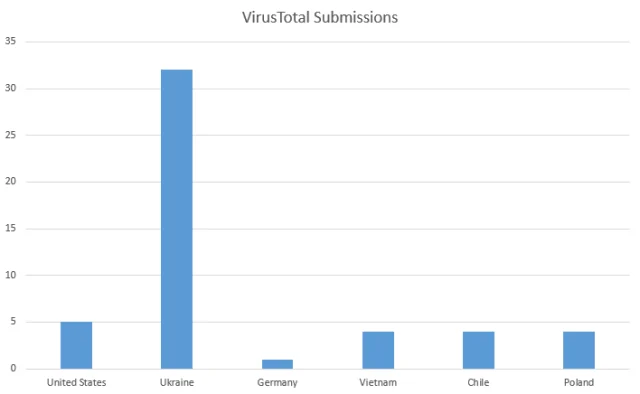
One of those tools is a computer worm designed to spread from computer to computer through USB drives. Tracked by researchers from Check Point Research as LitterDrifter, the malware is written in the Visual Basic Scripting language. LitterDrifter serves two purposes: to promiscuously spread from USB drive to USB drive and to permanently infect the devices that connect to such drives with malware that permanently communicates with Gamaredon-operated command and control servers. "Gamaredon continues to focus on [a] wide variety [of] Ukrainian targets, but due to the nature of the USB worm, we see indications of possible infection in various countries like USA, Vietnam, Chile, Poland and Germany," Check Point researchers reported recently. "In addition, we've observed evidence of infections in Hong Kong. All this might indicate that much like other USB worms, LitterDrifter [has] spread beyond its intended targets."

The image [here], tracking submissions of LitterDrifter to the Alphabet-owned VirusTotal service, indicates that the Gamaredon malware may be infecting targets well outside the borders of Ukraine. VirusTotal submissions usually come from people or organizations that encounter unfamiliar or suspicious-looking software on their networks and want to know if it's malicious. The data suggests that the number of infections in the US, Vietnam, Chile, Poland, and Germany combined may be roughly half of those hitting organizations inside Ukraine.

United States

Secretive White House Surveillance Program Gives Cops Access To Trillions of US Phone Records (wired.com) 104

An anonymous reader quotes a report from Wired: A little-known surveillance program tracks more than a trillion domestic phone records within the United States each year, according to a letter WIRED obtained that was sent by US senator Ron Wyden to the Department of Justice (DOJ) on Sunday, challenging the program's legality. According to the letter, a surveillance program now known as Data Analytical Services (DAS) has for more than a decade allowed federal, state, and local law enforcement agencies to mine the details of Americans' calls, analyzing the phone records of countless people who are not suspected of any crime, including victims. Using a technique known as chain analysis, the program targets not only those in direct phone contact with a criminal suspect but anyone with whom those individuals have been in contact as well.

The DAS program, formerly known as Hemisphere, is run in coordination with the telecom giant AT&T, which captures and conducts analysis of US call records for law enforcement agencies, from local police and sheriffs' departments to US customs offices and postal inspectors across the country, according to a White House memo reviewed by WIRED. Records show that the White House has, for the past decade, provided more than $6 million to the program, which allows the targeting of the records of any calls that use AT&T's infrastructure -- a maze of routers and switches that crisscross the United States. In a letter to US attorney general Merrick Garland on Sunday, Wyden wrote that he had "serious concerns about the legality" of the DAS program, adding that "troubling information" he'd received "would justifiably outrage many Americans and other members of Congress." That information, which Wyden says the DOJ confidentially provided to him, is considered "sensitive but unclassified" by the US government, meaning that while it poses no risk to national security, federal officials, like Wyden, are forbidden from disclosing it to the public, according to the senator's letter.
AT&T spokesperson Kim Hart Jonson said only that the company is required by law to comply with a lawful subpoena. However, "there is no law requiring AT&T to store decades' worth of Americans' call records for law enforcement purposes," notes Wired. "Documents reviewed by WIRED show that AT&T officials have attended law enforcement conferences in Texas as recently as 2018 to train police officials on how best to utilize AT&T's voluntary, albeit revenue-generating, assistance."

"The collection of call record data under DAS is not wiretapping, which on US soil requires a warrant based on probable cause. Call records stored by AT&T do not include recordings of any conversations. Instead, the records include a range of identifying information, such as the caller and recipient's names, phone numbers, and the dates and times they placed calls, for six months or more at a time." It's unclear exactly how far back the call records accessible under DAS go, although a slide deck released under the Freedom of Information Act in 2014 states that they can be queried for up to 10 years.
China

In World's Largest Disinformation Campaign Online, China Is Harassing Americans (cnn.com) 208

"The Chinese government has built up the world's largest known online disinformation operation," reports CNN, "and is using it to harass US residents, politicians, and businesses."

CNN reports that disinformation operation is even "at times threatening its targets with violence, a CNN review of court documents and public disclosures by social media companies has found." The onslaught of attacks — often of a vile and deeply personal nature — is part of a well-organized, increasingly brazen Chinese government intimidation campaign targeting people in the United States, documents show. The U.S. State Department says the tactics are part of a broader multi-billion-dollar effort to shape the world's information environment and silence critics of Beijing that has expanded under President Xi Jinping... Victims face a barrage of tens of thousands of social media posts that call them traitors, dogs, and racist and homophobic slurs.

They say it's all part of an effort to drive them into a state of constant fear and paranoia. Often, these victims don't know where to turn. Some have spoken to law enforcement, including the FBI — but little has been done. While tech and social media companies have shut down thousands of accounts targeting these victims, they're outpaced by a slew of new accounts emerging virtually every day. Known as "Spamouflage" or "Dragonbridge," the network's hundreds of thousands of accounts spread across every major social media platform have not only harassed Americans who have criticized the Chinese Communist Party, but have also sought to discredit U.S. politicians, disparage American companies at odds with China's interests and hijack online conversations around the globe that could portray the CCP in a negative light.

Some numbers from the article:
  • Meta "announced in August it had taken down a cluster of nearly 8,000 accounts attributed to this group in the second quarter of 2023 alone."
  • YouTube owner Google "told CNN it had shut down more than 100,000 associated accounts in recent years."
  • X "has blocked hundreds of thousands of China 'state-backed' or "state-linked" accounts, according to company blogs."

Power

World's Largest Single-Site Solar Farm Goes Online (electrek.co) 62

The world's largest single-site solar farm has gone online in the United Arab Emirates. Called the Al Dhafra solar farm, it features almost 4 million bifacial solar panels and will power nearly 200,000 homes -- all while eliminating 2.4 million tons of carbon emissions annually. Electrek reports: Now that Al Dhafra is online, the UAE's solar power production capacity has increased to 3.2 GW. In September, EWEC called for proposals to develop a 1.5 GW solar farm in Al Khazna near Abu Dhabi. UAE is aiming to triple its renewable energy capacity to 14 GW by 2030. The UAE is hosting COP28 in Dubai, which kicks off on November 30, so, understandably, its rulers would time the launch of the world's largest solar farm just ahead of that event -- it's simply good PR.

UAE is rightly being criticized for putting the CEO of its state oil company, the Abu Dhabi National Oil Company -- the world's 12th-biggest oil company by production -- in charge of COP28. It's also being criticized for hosting COP28 yet having an all-of-the-above approach to energy. The UAE Energy Strategy 2050 targets an energy mix of 44% clean energy, 38% gas, 12% "clean coal" (yes, it really says that), and 6% nuclear. It says it will become carbon neutral by 2050, but how it will do that on 50% fossil fuels is anyone's guess.

Google

Google Paid $8 Billion To Make Its Apps Default On Samsung Phones 32

Lauren Irwin reports via The Hill: Google agreed to pay $8 billion over four years to Samsung to make its apps default on Samsung phones, according to information presented by Epic Games in court. James Kolotouros, vice president for partnerships at Google, testified Monday in a San Francisco trial, saying that the company and Samsung were to share app store revenue to ensure Android mobile devices came with Google Play preinstalled. Epic, the company that makes the popular video game "Fortnite," sued Google in 2020, alleging the company's app marketplace violates antitrust laws.

Epic is trying to show that Google executives have discouraged third-party app stores on Samsung devices so it wouldn't cut into the profit of Google Play, Bloomberg reported. According to Kolotouros's testimony, half or more of Google Play revenue comes from Samsung devices. The trial targets the app store that distributes apps for the company's Android software, which powers virtually all the world's smartphones that aren't made by Apple.

Epic alleges Google has created an illegal monopoly on Android apps so it can boost its profits through commissions, ranging from 15 to 30 percent on purchases made within an app. Google argues it was doing so to compete with Apple and its app store, an argument attacked by Epic attorney Lauren Moskowitz. Earlier in the trial, Google's attorney said the company can't be a monopoly because it faces competition from companies such as Apple.
Further reading: Apple Gets 36% of Google Revenue in Search Deal, Witness Says
Security

New York Plans Cyber Rules for Hospitals (wsj.com) 24

New York regulators Monday plan to issue cybersecurity regulations for hospitals, after a series of attacks crippled operations at medical facilities. From a report: Under draft rules reviewed by The Wall Street Journal, New York will require general hospitals to develop and test incident response plans, assess their cybersecurity risks and install security technologies such as multifactor authentication. Hospitals must also develop secure software design practices for in-house applications, and processes for testing the security of software from vendors. Hacking "is a threat to every hospital, and my firm belief is if we protect the hospital, we're protecting the patients," said James McDonald, health commissioner for New York state.

Healthcare facilities are popular targets for cybercriminals, particularly ransomware operators hoping for quick ransom payments from administrators worried about risks to patients if technology goes down. Hospitals also hold large amounts of sensitive personal information on their staff and patients, including health and financial data. In August, the largest healthcare accreditation body in the U.S. issued cybersecurity guidelines calling for hospitals to prepare for cyberattacks that could take down critical systems for a month or longer -- measures that will require significant investment. Hospitals need to put in place tools and processes that anticipate technology critical for life and safety could be down, and find alternative ways to work without those systems, the nonprofit Joint Commission said.

Earth

Countries Meet in Kenya To Thrash Out Global Plastic Pollution Treaty (theguardian.com) 30

Government delegations will gather in Nairobi, Kenya, to hammer out details of what could be the first global treaty to tackle the plastic pollution crisis. From a report: A key focus for the discussions on Monday will be whether targets to restrict plastic production should be decided unilaterally or whether states should choose their own targets; this is, say environmentalists, the "centre of gravity" for the treaty's ambition. At the last round of negotiations in Paris in May run by the international negotiating committee (INC) the US, Saudi Arabia, India and China favoured a "Paris-style" agreement where states would have the freedom to determine their own commitments, while others, including Africa and many developing countries, preferred strong global commitments.

But there are signs, some observers say, of a shift in the US's position on this key issue, though details have yet to emerge. "The main takeaway for many environmental groups, after INC2 [the negotiations in Paris], was how bad the US position was, in terms of Paris-style voluntary commitments," said Graham Forbes, the global plastics campaign lead for Greenpeace USA. He said there had been signals of a shift. "We are going to be watching very closely to see how that plays out. We need to be speaking about rules and putting in place regulations."

Last month, a "zero draft" version of the text published by the INC as the basis of negotiations over what the head of the United Nations Environment Programme has described as the most important multilateral treaty since the Paris accord in 2015. The goal is to have a formal treaty in place by the end of 2024. This third round of talks, in Kenya from 13-17 November, will mark the halfway point.

AI

GitHub Announces Its 'Refounding' on Copilot, Including an AI-Powered 'Copilot Chat' Assistant (github.blog) 33

This week GitHub announced the approaching general availability of the GPT-4-powered GitHub Copilot Chat in December "as part of your existing GitHub Copilot subscription" (and "available at no cost to verified teachers, students, and maintainers of popular open source projects.")

And this "code-aware guidance and code generation" will also be integrated directly into github.com, "so developers can dig into code, pull requests, documentation, and general coding questions with Copilot Chat providing suggestions, summaries, analysis, and answers." With GitHub Copilot Chat we're enabling the rise of natural language as the new universal programming language for every developer on the planet. Whether it's finding an error, writing unit tests, or helping debug code, Copilot Chat is your AI companion through it all, allowing you to write and understand code using whatever language you speak...

Copilot Chat uses your code as context, and is able to explain complex concepts, suggest code based on your open files and windows, help detect security vulnerabilities, and help with finding and fixing errors in code, terminal, and debugger...

With the new inline Copilot Chat, developers can chat about specific lines of code, directly within the flow of their code and editor.

InfoWorld notes it will chat in "whatever language a developer speaks." (And that Copilot Chat will also be available in GitHub's mobile app.) But why wait until December? GitHub's blog post says that Copilot Chat "will come to the JetBrains suite of IDEs, available in preview today."

GitHub also plans to introduce "slash commands and context variables" for GitHub Copilot, "so fixing or improving code is as simple as entering /fix and generating tests now starts with /tests."

"With Copilot in the code editor, in the CLI, and now Copilot Chat on github.com and in our mobile app, we are making Copilot ubiquitous throughout the software development lifecycle and always available in all of GitHub's surface areas..."

CNBC adds that "Microsoft-owned GitHub" also plans to introduce "a more expensive Copilot assistant" in February "for developers inside companies that can explain and provide recommendations about internal source code."

Wednesday's blog post announcing these updates was written by GitHub's CEO, who seemed to be predicting an evolutionary leap into a new future. "Just as GitHub was founded on Git, today we are re-founded on Copilot." He promised they'd built on their vision of a future "where AI infuses every step of the developer lifecycle." Open source and Git have fundamentally transformed how we build software. It is now evident that AI is ushering in the same sweeping change, and at an exponential pace... We are certain this foundational transformation of the GitHub platform, and categorically new way of software development, is necessary in a world dependent on software. Every day, the world's developers balance an unsustainable demand to both modernize the legacy code of yesterday and build our digital tomorrow. It is our guiding conviction to make it easier for developers to do it all, from the creative spark to the commit, pull request, code review, and deploy — and to do it all with GitHub Copilot deeply integrated into the developer experience.
And if you're worried about the security of AI-generated code... Today, GitHub Copilot applies an LLM-based vulnerability prevention system that blocks insecure coding patterns in real-time to make GitHub Copilot's suggestions more secure. Our model targets the most common vulnerable coding patterns, including hardcoded credentials, SQL injections, and path injections. GitHub Copilot Chat can also help identify security vulnerabilities in the IDE, explain the mechanics of a vulnerability with its natural language capabilities, and suggest a specific fix for the highlighted code.
But for Enterprise accounts paying for GitHub Advanced Security, there's also an upgrade coming: "new AI-powered application security testing features designed to detect and remediate vulnerabilities and secrets in your code." (It's already available in preview mode.)

GitHub even announced plans for a new AI assistant in 2024 that generates a step-by-step plan for responding to GitHub issues. (GitHub describes it as "like a pair programming session with a partner that knows about every inch of the project, and can follow your lead to make repository-wide changes from the issue to the pull request with the power of AI.")

CNBC notes that AI-powered coding assistants "are still nascent, though, with less than 10% enterprise adoption, according to Gartner, a technology industry research firm."

But last month Microsoft CEO Satya Nadella told analysts GitHub Copilot already had one million paying users...

And GitHub's blog post concludes, "And we're just getting started."
The Almighty Buck

California Wants To End Cupertino's Tax Deal With Apple (appleinsider.com) 82

William Gallagher reports via Appleinsider: In a move similar in principle to how the EU retrospectively sought to fine Apple over its tax agreement with Ireland, the California Department of Tax and Fee Administration (CDTFA) is changing the company's arrangement with Cupertino. Since 1998, Apple has declared all of its online sales made in California as having taken place in Cupertino. As first spotted by the San Jose Spotlight, this means that of Apple's 7.25% sales tax, the local 1% portion goes to the city. Then under the same deal, Cupertino actually returns approximately one third of this revenue to Apple. Consequently the benefit to Apple is clear, but also Cupertino profits because it sees significantly greater sales tax revenue than it otherwise might.

"The CDTFA has done an audit of one of our big taxpayers and has identified that there are dollars being allocated improperly," Cupertino Assistant City Manager Matt Morley told the publication, "and through that audit they are asking for that process to be corrected." "The city obviously isn't happy with this and we don't believe the CDTFA is on base," continued Morley. Reportedly, the CDTFA's state tax officials have concluded that the city of Cupertino owes it $56.5 million. This is for the period from April 2021 to June 2023, though it's not clear how those dates were determined. At the same time, the tax officials are said to have decided that Apple must reimburse the state $20 million. This figure would then be reallocated to other areas of the state.

The impact on Cupertino could be significant, but the city is appealing the ruling -- and the appeal could take anywhere from seven to ten years. Even so, the Cupertino City Council has agreed to set aside the $56.5 million to prepare for the potential future loss. Should the CDTFA prevail, Cupertino's Morley said non-essential city services could be reduced or even cut. Annually, Cupertino would see a 73% drop in sales tax revenues, and would face having to cut almost a quarter of its operational costs.

The Courts

Epic Games Goes To Court To Challenge Google's App Store Practices (cnn.com) 63

Epic Games, the maker of the popular game "Fortnite," has launched a battle against Google in federal court in a closely watched antitrust showdown that could reshape how smartphone users get Android apps and pay for in-app content. From a report: Epic's lawsuit in the US District Court in California's Northern District targets the Google Play Store, focusing on Google's fees for in-app subscriptions and one-off transactions, along with other terms that app developers such as Epic say helped Google maintain an illegal monopoly in app distribution.

The legal battle follows a years-long debate about whether app store operators such as Google and Apple foster an open, competitive app ecosystem. The two companies argue their app stores help unlock billions in revenue for small businesses, while ensuring that Android and iOS users benefit from security oversight that the technology giants provide. The jury may hear high-profile witnesses testify from both sides, including Google CEO Sundar Pichai and Epic CEO Tim Sweeney.

The court fight traces back to 2020, when Epic launched Project Liberty, a plan to circumvent Apple and Google's app store terms. That move by Epic forced a confrontation with the tech giants. Epic updated the Fortnite app to encourage players to pay for in-app content directly through Epic's own website -- rather than through Apple and Google's in-app payment systems. That gambit triggered a violation of the app stores' developer terms. The move also prompted both app stores to remove the Fortnite app from their platforms.

Privacy

Apple Warns Indian Opposition Leaders of State-Sponsored iPhone Attacks (techcrunch.com) 29

Apple has warned over a half dozen Indian lawmakers from Prime Minister Narendra Modi's main opposition of their iPhones being targets of state-sponsored attacks, these people said Tuesday, in a remarkable turn of events just months before the general elections in the South Asian nation. From a report: Rahul Gandhi, Indian opposition leader, said in a media briefing Tuesday that his team had received the said alert from Apple. Shashi Tharoor, a key figure from the Congress party; Akhilesh Yadav, the head of the Samajwadi Party; Mahua Moitra, a national representative from the All India Trinamool Congress; Priyanka Chaturvedi of Shiv Sena, a party with notable influence in Maharashtra reported that they too had been notified by Apple regarding a potential security attack on their iPhones. Asaduddin Owaisi, the leader of the All-India Majlis-e-Ittehadul Muslimeen (AIMIM); Raghav Chadha from AAP, originating from an anti-corruption crusade a decade prior and later securing a political foothold in the national capital region; Sitaram Yechury, the General Secretary of the Communist Party of India; alongside Congress spokesperson Pawan Khera were also impacted, they said. Journalists Siddharth Varadarajan and Sriram Karri, along with Observer Research Foundation (ORF) India President Samir Saran shared that they had been served with identical warnings from Apple.
Biotech

Drugmakers Are Set To Pay 23andMe Millions To Access Consumer DNA (bloomberg.com) 106

An anonymous reader quotes a report from Bloomberg: GSK will pay 23andMe $20 million for access to the genetic-testing company's vast trove of consumer DNA data, extending a five-year collaboration that's allowed the drugmaker to mine genetic data as it researches new medications. Under the new agreement, 23andMe will provide GSK with one year of access to anonymized DNA data from the approximately 80% of gene-testing customers who have agreed to share their information for research, 23andMe said in a statement Monday. The genetic-testing company will also provide data-analysis services to GSK.

23andMe is best known for its DNA-testing kits that give customers ancestry and health information. But the DNA it collects is also valuable, including for scientific research. With information from more than 14 million customers, the only data sets that rival the size of the 23andMe library belong to Ancestry.com and the Chinese government. The idea for drugmakers is to comb the data for hints about genetic pathways that might be at the root of disease, which could significantly speed up the long, slow process of drug development. GSK and 23andMe have already taken one potential medication to clinical trials: a cancer drug that works to block CD96, a protein that helps modulate the body's immune responses. It entered that testing phase in four years, compared to an industry average of about seven years. Overall, the partnership between GSK and 23andMe has produced more than 50 new drug targets, according to the statement.

The new agreement changes some components of the collaboration. Any discoveries GSK makes with the 23andMe data will now be solely owned by the British pharmaceutical giant, while the genetic-testing company will be eligible for royalties on some projects. In the past, the two companies pursued new drug targets jointly. GSK's new deal with 23andMe is also non-exclusive, leaving the genetic-testing company free to license its database to other drugmakers.

Transportation

Auto Execs Are Coming Clean: EVs Aren't Working (businessinsider.com) 352

Amiga Trombone shares a report from Insider: With signs of growing inventory and slowing sales, auto industry executives admitted this week that their ambitious electric vehicle plans are in jeopardy, at least in the near term. Several C-Suite leaders at some of the biggest carmakers voiced fresh unease about the electric car market's growth as concerns over the viability of these vehicles put their multi-billion-dollar electrification strategies at risk. Among those hand-wringing is GM's Mary Barra, historically one of the automotive industry's most bullish CEOs on the future of electric vehicles. But this week on GM's third-quarter earnings call, Barra and GM struck a more sober tone. The company announced with its quarterly results that it's abandoning its targets to build 100,000 EVs in the second half of this year and another 400,000 by the first six months of 2024. GM doesn't know when it will hit those targets.

While GM's about-face was somewhat of a surprise to investors, the Detroit car company is not alone in this new view of the EV future. Even Tesla's Elon Musk warned on a recent earnings call that economic concerns would lead to waning vehicle demand, even for the long-time EV market leader. Meanwhile, Mercedes-Benz -- which is having to discount its EVs by several thousand dollars just to get them in customers' hands -- isn't mincing words about the state of the EV market. "This is a pretty brutal space," CFO Harald Wilhelm said on an analyst call. "I can hardly imagine the current status quo is fully sustainable for everybody."
"It's clear that we're dealing with a lot of near-term uncertainty," said Barra. "The transition to EVs, that will have ups and downs."
Toyota Chairman Akio Toyoda said that people are "finally seeing reality" regarding EVs. "I have continued to say what I see as reality," Toyoda, who recently stepped down as Toyota's CEO, said. "There are many ways to climb the mountain that is achieving carbon neutrality," such as hybrids and plug-in hybrids which have long made up a significant share of Toyota's EV sales.

"The reason (hybrids) are so powerful is because they fit the needs of so many customers," Toyota North America's vice president of sales Bob Carter told CNBC last year. "The demand for hybrid has been strong. We expect it to continue to grow as the entire industry transitions over to electrification later this decade."
Crime

Indian Authorities Raid Fake Tech Support Rings After Tipoff From Amazon and Microsoft (theregister.com) 25

Acting on information from Microsoft and Amazon, India's Central Bureau of Investigation (CBI) has raided alleged fake tech support operators and other tech-related crims across the country. From a report: The Bureau shared news of a Thursday operation that saw it conduct 76 searches in relation to five cases. The Bureau stated its effort "was conducted in collaboration with national and international agencies, alongside private sector giants," and described two of its targets as international tech support fraud scams that "impersonated a global IT major and a multinational corporation with an online technology-driven trading platform."

The alleged scammers operated call centers in five regions of India and "systematically preyed on foreign nationals, masquerading as technical support representatives" for at least five years. The scammers sent users pop-up messages that appeared to come from multinational companies and advised of PC problems -- with a toll-free number at which assistance could be had. Victims who called the fakers had their PCs taken over, and were charged hundreds of dollars for a fix.

Slashdot Top Deals