AI

What Happened When Conspiracy Theorists Talked to OpenAI's GPT-4 Turbo? (washingtonpost.com) 134

A "decision science partner" at a seed-stage venture fund (who is also a cognitive-behavioral decision science author and professional poker player) explored what happens when GPT-4 Turbo converses with conspiracy theorists: Researchers have struggled for decades to develop techniques to weaken the grip of conspiracy theories and cult ideology on adherents. This is why a new paper in the journal Science by Thomas Costello of MIT's Sloan School of Management, Gordon Pennycook of Cornell University and David Rand, also of Sloan, is so exciting... In a pair of studies involving more than 2,000 participants, the researchers found a 20 percent reduction in belief in conspiracy theories after participants interacted with a powerful, flexible, personalized GPT-4 Turbo conversation partner. The researchers trained the AI to try to persuade the participants to reduce their belief in conspiracies by refuting the specific evidence the participants provided to support their favored conspiracy theory.

The reduction in belief held across a range of topics... Even more encouraging, participants demonstrated increased intentions to ignore or unfollow social media accounts promoting the conspiracies, and significantly increased willingness to ignore or argue against other believers in the conspiracy. And the results appear to be durable, holding up in evaluations 10 days and two months later... Why was AI able to persuade people to change their minds? The authors posit that it "simply takes the right evidence," tailored to the individual, to effect belief change, noting: "From a theoretical perspective, this paints a surprisingly optimistic picture of human reasoning: Conspiratorial rabbit holes may indeed have an exit. Psychological needs and motivations do not inherently blind conspiracists to evidence...."

It is hard to walk away from who you are, whether you are a QAnon believer, a flat-Earther, a truther of any kind or just a stock analyst who has taken a position that makes you stand out from the crowd. And that's why the AI approach might work so well. The participants were not interacting with a human, which, I suspect, didn't trigger identity in the same way, allowing the participants to be more open-minded. Identity is such a huge part of these conspiracy theories in terms of distinctiveness, putting distance between you and other people. When you're interacting with AI, you're not arguing with a human being whom you might be standing in opposition to, which could cause you to be less open-minded.

Answering questions from Slashdot readers in 2005, Wil Wheaton described playing poker against the cognitive-behavioral decision science author who wrote this article...
Crime

To Identify Suspect In Idaho Killings, FBI Used Restricted Consumer DNA Data (nytimes.com) 99

An anonymous reader quotes a report from the New York Times: As investigators struggled for weeks to find who might have committed the brutal stabbings of four University of Idaho students in the fall of 2022, they were focused on a key piece of evidence: DNA on a knife sheath that was found at the scene of the crime. At first they tried checking the DNA with law enforcement databases, but that did not provide a hit. They turned next to the more expansive DNA profiles available in some consumer databases in which users had consented to law enforcement possibly using their information, but that also did not lead to answers.

F.B.I. investigators then went a step further, according to newly released testimony, comparing the DNA profile from the knife sheath with two databases that law enforcement officials are not supposed to tap: GEDmatch and MyHeritage. It was a decision that appears to have violated key parameters of a Justice Department policy that calls for investigators to operate only in DNA databases "that provide explicit notice to their service users and the public that law enforcement may use their service sites."

It also seems to have produced results: Days after the F.B.I.'s investigative genetic genealogy team began working with the DNA profiles, it landed on someone who had not been on anyone's radar:Bryan Kohberger, a Ph.D. student in criminology who has now been charged with the murders. The case has shown both the promise and the unregulated power of genetic technology in an era in which millions of people willingly contribute their DNA profiles to recreational databases, often to hunt for relatives. In the past, law enforcement officials would need to find a direct match between DNA at the crime scene and that of a specific suspect. Now, investigators can use consumer DNA data to build family trees that can zero in on a person of interest -- within certain policy limits.

Security

Hackers Planted a Steam Game With Malware To Steal Gamers' Passwords 31

Valve removed the game PirateFi from Steam after discovering it was laced with the Vidar infostealer malware, designed to steal sensitive user data such as passwords, cookies, cryptocurrency wallets, and more. TechCrunch reports: Marius Genheimer, a researcher who analyzed the malware and works at SECUINFRA Falcon Team, told TechCrunch that judging by the command and control servers associated with the malware and its configuration, "we suspect that PirateFi was just one of multiple tactics used to distribute Vidar payloads en masse." "It is highly likely that it never was a legitimate, running game that was altered after first publication," said Genheimer. In other words, PirateFi was designed to spread malware.

Genheimer and colleagues also found that PirateFi was built by modifying an existing game template called Easy Survival RPG, which bills itself as a game-making app that "gives you everything you need to develop your own singleplayer or multiplayer" game. The game maker costs between $399 and $1,099 to license. This explains how the hackers were able to ship a functioning video game with their malware with little effort.

According to Genheimer, the Vidar infostealing malware is capable of stealing and exfiltrating several types of data from the computers it infects, including: passwords from the web browser autofill feature, session cookies that can be used to log in as someone without needing their password, web browser history, cryptocurrency wallet details, screenshots, and two-factor codes from certain token generators, as well as other files on the person's computer.
Advertising

Jeep Claims 'Software Glitch' Disabled Opting-Out of In-Vehicle Pop-Up Ads in 'a Few' Cases (theautopian.com) 68

Remember Jeep's new in-dash pop-up ads which reportedly appeared every time you stopped?

"Since I'm a journalist, or at least close enough, I decided that I should at least get Stellantis/Jeep's side of things," writes car-culture site The Autopian: Would Stellantis do something so woefully misguided and annoying? I reached out to our Stellantis/Jeep contact to ask and was initially told that they were "investigating" on their end, which to me felt like a stalling tactic while the proper ass-covering plans were conceived. I eventually got this response from a Stellantis spokesperson:

"This was an in-vehicle message designed to inform Jeep customers about Mopar extended vehicle care options. A temporary software glitch affected the ability to instantly opt out in a few isolated cases, though instant opt-out is the standard for all our in-vehicle messages. Our team had already identified and corrected the error, and we are following up directly with the customer to ensure the matter is fully resolved..."

I suppose a glitch is possible, though I've not seen any examples of this ad popping up with the instant opt-out option available, but I guess it must exist, since not all Jeep owners seem to have had to deal with these ads. I suspect if this was happening to more people than these "few isolated cases" we'd still be cleaning up from the aftermath of the riots and uprisings.

Because, as they write, "Really, I can't think of a quicker way to incur the wrath of nearly every human..."
Supercomputing

Quantum Teleportation Used To Distribute a Calculation (arstechnica.com) 58

An anonymous reader quotes a report from Ars Technica: In today's issue of Nature, a team at Oxford University describes using quantum teleportation to link two pieces of quantum hardware that were located about 2 meters apart, meaning they could easily have been in different rooms entirely. Once linked, the two pieces of hardware could be treated as a single quantum computer, allowing simple algorithms to be performed that involved operations on both sides of the 2-meter gap. [...] The Oxford team was simply interested in a proof-of-concept, and so used an extremely simplified system. Each end of the 2-meter gap had a single trap holding two ions, one strontium and one calcium. The two atoms could be entangled with each other, getting them to operate as a single unit.

The calcium ion served as a local memory and was used in computations, while the strontium ion served as one of the two ends of the quantum network. An optical cable between the two ion traps allowed photons to entangle the two strontium ions, getting the whole system to operate as a single unit. The key thing about the entanglement processes used here is that a failure to entangle left the system in its original state, meaning that the researchers could simply keep trying until the qubits were entangled. The entanglement event would also lead to a photon that could be measured, allowing the team to know when success had been achieved (this sort of entanglement with a success signal is termed "heralded" by those in the field).

The researchers showed that this setup allowed them to teleport with a specific gate operation (controlled-Z), which can serve as the basis for any other two-qubit gate operation -- any operation you might want to do can be done by using a specific combination of these gates. After performing multiple rounds of these gates, the team found that the typical fidelity was in the area of 70 percent. But they also found that errors typically had nothing to do with the teleportation process and were the product of local operations at one of the two ends of the network. They suspect that using commercial hardware, which has far lower error rates, would improve things dramatically. Finally, they performed a version of Grover's algorithm, which can, with a single query, identify a single item from an arbitrarily large unordered list. The "arbitrary" aspect is set by the number of available qubits; in this case, having only two qubits, the list maxed out at four items. Still, it worked, again with a fidelity of about 70 percent.

While the work was done with trapped ions, almost every type of qubit in development can be controlled with photons, so the general approach is hardware-agnostic. And, given the sophistication of our optical hardware, it should be possible to link multiple chips at various distances, all using hardware that doesn't require the best vacuum or the lowest temperatures we can generate. That said, the error rate of the teleportation steps may still be a problem, even if it was lower than the basic hardware rate in these experiments. The fidelity there was 97 percent, which is lower than the hardware error rates of most qubits and high enough that we couldn't execute too many of these before the probability of errors gets unacceptably high.

AI

Police Use of AI Facial Recognition Results In Murder Case Being Tossed (cleveland.com) 50

"A jury may never see the gun that authorities say was used to kill Blake Story last year," reports Cleveland.com.

"That's because Cleveland police used a facial recognition program — one that explicitly says its results are not admissible in court — to obtain a search warrant, according to court documents." The search turned up what police say is the murder weapon in the suspect's home. But a Cuyahoga County judge tossed that evidence after siding with defense attorneys who argued that the search warrant affidavit was misleading and relied on inadmissible evidence. If an appeals court upholds the judge's ruling to suppress the evidence, prosecutors acknowledge their case is likely lost...

The company that produced the facial recognition report, Clearview AI, has been used in hundreds of law enforcement investigations throughout Ohio and has faced lawsuits over privacy violations.

Not only does Cleveland lack a policy governing the use of artificial intelligence, Ohio lawmakers also have failed to set standards for how police use the tool to investigate crimes. "It's the wild, wild west in Ohio," said Gary Daniels, a lobbyist for the American Civil Liberties Union. The lack of state regulation of how law enforcement uses advanced technologies — no laws similarly govern the use of drones or license plate readers — means it is essentially up to agencies how they use the tools.

The affidavit for the search warrant was signed by a 28-year police force veteran, according to the article — but it didn't disclose the use of Clearview's technology.

Clearview's report acknowledged their results were not admissible in court — but then provided the suspect's name, arrest record, Social Security number, according to the article, and "noted he was the most likely match for the person in the convenience store."

Thanks to tlhIngan (Slashdot reader #30,335) for sharing the news.
Music

Critics, Not Fans, Perpetuate the Failed Second Album Myth, Study Shows (phys.org) 41

A new study reveals that the widely accepted "sophomore slump" phenomenon -- where a band's second album is perceived as significantly worse than the first -- exists primarily in professional critics' reviews, not fan ratings. Researchers suggest this bias stems from social conformity among critics, while fans provide more consistent and reliable evaluations across albums. "If every music critic has heard of a sophomore slump and everyone knows it happens, they might be convinced to over-apply it in their reviews," said Gregory Webster, Ph.D., the R. David Thomas Endowed Professor of Psychology at the University of Florida and co-author of the new study. "We suspect it's a kind of social conformity, which we see in a lot of social groups." Phys.Org reports: Webster and his co-author, University of Hannover Professor of Educational Science Lysann Zander, Ph.D., analyzed thousands of albums rated by professional critics and amateur fans. Both critics and fans said that bands' albums generally got worse over time.

But critics were exceptionally harsh with the second album, which was an outlier in this downward trajectory. "It's only critics that show substantial evidence of a sophomore slump bias, whereby they are giving artists' second albums unusually low reviews compared to their first and third albums," Webster said. "Fans show no evidence of a sophomore slump bias."

Webster and Zander expected that fan ratings would reflect a broader consensus about a band's true performance. Fans aren't pressured by the same social norms as professional critics. And with ratings from thousands of fans, the researchers could average across a large group to find more reliable ratings.

Security

Apple Sends Spyware Victims To Nonprofit Security Lab 'Access Now' (techcrunch.com) 14

Since 2021, Apple has been sending threat notifications to certain users, informing them that they may have been individually targeted by mercenary spyware attacks. When victims of spyware reach out to Apple for help, TechCrunch reports, "Apple doesn't tell the targets to get in touch with its own security engineers." Instead, Apple directs them to the nonprofit security lab Access Now, "which runs a digital helpline for people in civil society who suspect they have been targets of government spyware."

While some view this as Apple sidestepping responsibility, cybersecurity experts agree that Apple's approach -- alerting victims, directing them to specialized support, and recommending tools like Lockdown Mode -- has been a game changer in combating mercenary spyware threats. From the report: For people who investigate spyware, Apple sharing spyware notifications with victims represented a turning point. Before the notifications, "We were just like in the dark, not knowing who to check," according to Access Now's legal counsel Natalia Krapiva. "I think it's one of the greatest things that's happened in the sphere of this kind of forensic investigations and hunting of sophisticated spyware," Krapiva told TechCrunch.

Now, when someone or a group of people get a notification from Apple, they are warned that something potentially anomalous is happening with their device, that someone is targeting them, and that they need to get help. And Apple tells them exactly where to get it, according to Scott-Railton, who said Access Now's helpline is the right place to go because "the helpline is able to do good, systematic triage work and support." Krapiva said that the helpline is staffed by more than 30 people, supported by others who work in other departments of the nonprofit. So far in 2024, Krapiva said Access Now received 4,337 tickets through the helpline.

For anyone alerted by a notification, Apple tells those targets and victims of spyware to update their iOS software and all their apps. Apple also suggests the user switches on Lockdown Mode, an opt-in iOS security feature that has stopped spyware attacks in the past by limiting device features that are often exploited to plant spyware. Apple said last year that it is not aware of any successful spyware infection against someone who used Lockdown Mode.

DRM

Takedown Notices Hit Luigi Mangione Merchandise and Photos - Including DMCAs (404media.co) 100

Newsweek supplies some context After his arrest, merch — including T-shirts featuring Mangione's booking photos and others taken from his social media accounts — began popping up for sale on several sites. Websites, including Amazon, eBay and Etsy, have moved to take down products that glorify violence or the suspect. An eBay spokesperson told Newsweek that "items that glorify or incite violence, including those that celebrate the recent murder of UHC CEO Brian Thompson, are prohibited."
Inc. magazine adds: Separately, GoFundMe has shuttered several fundraising campaigns created for Mangione. The fundraising site's terms and conditions are pretty clear on the matter, NBC News reports, with a company spokesperson explaining they prohibit "fundraisers for the legal defense of violent crimes."
But one incident was different, according to a post from the law school of the University of British Columbia: To provide a quick summary, Rachel Kenaston, an artist selling merch on TeePublic received an e-mail from the platform regarding intellectual property claim by UnitedHealth Group Inc and decided to remove Kenaston's design from the merch store. Obviously, it is important to point out that it isn't quite clear who is filing those DMCA claims. While TeePublic, in the email, claimed that they have no say in the matter, [an article from 404 Media] goes on to explain that TeePublic has the right to refuse DMCA claims, but often choose not to in order to avoid headache. The design had nothing to do with UnitedHealthcare-it seems to be a picture of the Mangione in a heart frame. Meaning, whether it was UnitedHealthcare or not, the claim shouldn't hold any weight.

Consensus seems to be mostly leaning towards speculation that it is unlikely to be UnitedHealthcare actually filing those DMCA claims, but rather potential competitors... Regardless of whether or not it really was UnitedHealthcare that filed DMCA claims, I think the important point here is that the merch actually did get taken down. In fact, this would be more problematic if it was from a competitor using DMCA as a form of removing competition, because, then it really has nothing to do with intellectual property. I would assume that this happens quite frequently. Especially for YouTubers, it seems that copyright strikes are more than a mere pesky occurrence, but for many, something that affects livelihood...

The difficult part, as always, is finding the balance between protecting the rights of the copyright holders and ensuring that the mechanisms doesn't get abused.

The artist told Gizmodo she was filing a counterclaim to the copyright notice, adding that instead of a DMCA, "I honestly expected the design to be pulled for condoning violence or something..."

Gizmodo published the image — a watercolored rendition of a hostel surveillance-camera photo released by police — adding "UnitedHealth Group didn't respond to questions emailed on Monday [December 16] about how the company could possibly claim a copyright violation had occurred." And while Gizmodo promised they'd update the post if UnitedHealth responded — there has been no update since...

404 Media adds that the watercolor "is not the only United Healthcare or Luigi Mangione-themed artwork on the internet that has been hit with bogus DMCA takedowns in recent days. Several platforms publish the DMCA takedown requests they get on the Lumen Database, which is a repository of DMCA takedowns." On December 7, someone named Samantha Montoya filed a DMCA takedown with Google that targeted eight websites selling "Deny, Defend, Depose" merch that uses elements of the United Healthcare logo... Medium, one of the targeted websites, has deleted the page that the merch was hosted on...

Over the weekend, a lawyer demanded that independent journalist Marisa Kabas take down an image of Luigi Mangione and his family that she posted to Bluesky, which was originally posted on the campaign website of Maryland assemblymember Nino Mangione. The lawyer, Desiree Moore, said she was "acting on behalf of our client, the Doe Family," and claimed that "the use of this photograph is not authorized by the copyright owner and is not otherwise permitted by law..." In a follow-up email to Kabas, Moore said "the owner of the photograph has not authorized anyone to publish, disseminate, or otherwise use the photograph for any purpose, and the photograph has been removed from various digital platforms as a result," which suggests that other websites have also been threatened with takedown requests. Moore also said that her "client seeks to remain anonymous" and that "the photograph is hardly newsworthy."

404 Media believes the takedown request "shows that the Mangione family or someone associated with it is using the prospect of a copyright lawsuit to threaten journalists for reporting on one of the most important stories of the year..."

UPDATE: Long-time Slashdot reader destinyland notes there's an interesting precedent from 2007: [D]eep within the DMCA law is a counter-provision — 512(f), which states that misrepresenting yourself as a copyright owner has consequences. Any damage caused by harmful misrepresentation must be reimbursed. In 2004 the Electronic Frontier Foundation won a six-figure award from Diebold Election Systems, who had claimed a "copyright" on embarrassing internal memos which were published online.
Earth

Sea Levels are Already Rising in America's Southeast. A Preview of the Future? (msn.com) 87

The Washington Post visits one of over 100 tide-tracking stations around the U.S. -- Georgia's Fort Pulaski tide gauge: Since 2010, the sea level at the Fort Pulaski gauge has risen by more than 7 inches, one of the fastest rates in the country, according to a Washington Post analysis of National Oceanic and Atmospheric Administration data for 127 tide gauges. Similar spikes are affecting the entire U.S. Southeast -- showing a glimpse of our climate future... [I]n the previous 30 years, the ocean rose about 3.7 inches. And the deluge stretches all across the South and the Gulf Coast; over the past 14 years, sea levels in the U.S. South have risen twice as fast as the global average...

Scientists suspect part of that is because of the Gulf Stream -- a long band of warm water that follows the coast up from the equator and then, near Cape Hatteras, turns out into the Atlantic Ocean. The waters of the Gulf Stream and the Gulf of Mexico are warming faster than other parts of the Atlantic, boosting sea levels. "The Gulf of Mexico has warmed exceptionally fast over the past decade and a half," Piecuch said. "It's uncontroversial." But scientists have puzzled over where all that heat is coming from... [T]he current heat could be part of long-term variations in ocean currents, and not a clear signal of climate change. But the fact that the change is linked to heat -- at the same time as the entire ocean is taking on excess heat from global warming -- makes some experts suspicious. "This particular mechanism does not immediately suggest it's just natural variability," [said Ben Hamlington, a research scientist who leads NASA's sea level change team].

For now, sea levels in the Southeast are surging -- and they provide an early picture of what most of the United States, and the rest of the world, will experience as oceans rise... On Tybee Island -- whose population of 4,000 swells to over 100,000 during the summer months -- leaders have gotten used to the constant fight against the waves. Five or six times a year, high tides sweep over the one road that connects the island to the mainland, cutting residents off from services. By 2050, scientists estimate, those high tides will happen 70 days a year. With the help of the U.S. Army Corps of Engineers, the city has built dunes to protect vacation homes and local storefronts from the rising water; many homeowners have also raised their properties high up into the air. In Savannah, small businesses and city streets are washed in floods even on bright, sunny days -- thanks to high tides that surge into the drainage system. The city estimates that it will cost $400 million to update the stormwater infrastructure over the next two decades. So far, it has raised $150 million...

Other states and cities will soon see the same effects. NASA projections show that in the coming decades, many cities in the Northeast will experience up to 100 more days of high-tide flooding each year.

"Some researchers think that the Southeast acceleration may be linked to long-term weather patterns in the Atlantic Ocean like the North Atlantic Oscillation.

"If so, the trend could switch in the coming decades -- with areas of the Northeast seeing rapid sea level rise while the trend in the Southeast slows down."
United States

Luigi Mangione's Ghost Gun Was Only Partially 3D-Printed (rollingstone.com) 199

"More than a decade after the advent of the 3D-printed gun as an icon of libertarianism and a gun control nightmare, police say one of those homemade plastic weapons has now been found in the hands of perhaps the world's most high-profile alleged killer," Wired wrote this month: For the community of DIY gunsmiths who have spent years honing those printable firearm models, in fact, the handgun police claim Luigi Mangione used to fatally shoot UnitedHealthcare CEO Brian Thompson is as recognizable as the now-famous alleged shooter himself — and shows just how practical and lethal those weapons have become. In the 24 hours since police released a photo of what they say is Mangione's gun following the 26-year-old's arrest Monday, the online community devoted to 3D-printed firearms has been quick to identify the suspected murder weapon as a particular model of printable "ghost gun" — a homemade weapon with no serial number, created by assembling a mix of commercial and DIY parts. The gun appears to be a Chairmanwon V1, a tweak of a popular partially 3D-printed Glock-style design known as the FMDA 19.2 — an acronym that stands for the libertarian slogan "Free Men Don't Ask."

The FMDA 19.2, released in 2021, is a relatively old model by 3D-printed-gun standards, says one gunsmith who goes by the first name John and the online handle Mr. Snow Makes... Despite its simple description by law enforcement and others as a "3D-printed pistol," the FMDA 19.2 is only partially 3D printed. That makes it fundamentally different from fully 3D-printed guns like the "Liberator," the original one-shot, 3D-printed pistol Wilson debuted in 2013. Instead, firearms built from designs like the FMDA 19.2 are assembled from a combination of commercially produced parts like barrels, slides, and magazines — sometimes sold in kits — and a homemade frame. Because that frame, often referred to as a "lower receiver" or "lower," is the regulated body of the gun, 3D-printing that piece or otherwise creating it at home allows DIY gunmakers to skirt gun-control laws and build ghost guns with no serial number, obtained with no background check or waiting period.

Chairmanwon "instantly recognized the gun seized from the suspect..." reported USA Today. As a photo circulated online the fake New Jersey driver's license and 3D-printed gun police found on Luigi Mangione, he spotted the tell-tale stippling pattern on the firearm's grip. "It's mine lol," the man, known as "Chairmanwon" quipped on X Dec. 9. Then he quickly deleted the post...

No federal laws ban 3D-printed or privately made firearms. But as police agencies have increasingly recovered untraceable homemade guns at crime scenes, some state legislatures have passed stricter rules... If authorities can prove Mangione downloaded and printed his firearm in Pennsylvania or New York, he could face additional gun charges. Fifteen states now require serial numbers on homemade parts or ban 3D printing them. Some even ban the distribution of 3D printing instructions.

President Biden and the Bureau of Alcohol, Tobacco, Firearms and Explosives added regulations in 2022 that say the ghost gun parts kits themselves qualify as "firearms" that should be regulated by the Gun Control Act. ["Commercial manufacturers of the kits will have to be licensed and must add serial numbers on the kits' frame or receiver," USA Today reported earlier. ] Gunmakers challenged those rules at the Supreme Court. In October, the court heard oral arguments, but justices signaled they were leaning toward upholding the rules.

Rolling Stone tries to assess the results: In recent years, crimes involving ghost guns seem to have abated across much of the United States. Ghost gun recoveries by police in New York City, Los Angeles, Philadelphia, Baltimore, and other major cities dropped by as much as 25 percent between 2022 and 2023, and the most prolific maker of the kits used to build the untraceable weapons closed its doors this year. The likely cause is a federal rule change requiring the kits to be serialized — a stipulation that forces sellers to conduct background checks on their customers.
Monday Luigi Mangione will appear in court for arraignment on state murder charges, reports USA Today: Mangione had been expected to face arraignment on the state charges Thursday, but the proceedings were postponed after federal authorities announced they were also bringing charges, and he was whisked to a federal courthouse instead in a move that appeared to shock Mangione's defense team... Federal authorities unsealed a criminal complaint against Mangione that included four separate charges: murder using a firearm, two counts of interstate stalking and a firearms count. The death penalty was abolished in New York state, but the federal charges could bring a death sentence if Mangione is convicted. The charge of murder using a firearm carries a maximum possible sentence of death or life in prison. The other federal charges have maximum sentences of life in prison, and the firearms charge has a mandatory minimum sentence of 30 years.
Cellphones

A Fake Uber Driver Borrowed Phones, Then Stole $200K in Cryptocurrency, Police Say (gizmodo.com) 48

"A man is accused of several felony charges after he allegedly posed as an Uber driver and then stole hundreds of thousands of dollars in cryptocurrency from customers in Scottsdale," reports Arizona news channel Fox 10.

"Prosecutors have called it an 'extremely sophisticated electronic fraud,'" reports Gizmodo, " and it's a strange approach to scamming that makes it sound unique in several ways." Nuruhussein Hussein, 40, allegedly picked up two unsuspecting people who were looking for Uber rides they'd ordered in Scottsdale — one in March and the other in October according to Fox 10 — by shouting their names on the street outside a hotel. It's not clear how Hussein may have known these people were looking for rides and court documents give no indication how he accomplished this or knew the victims would have crypto accounts, according to Fox 10, though a hotel does make sense as a target-rich environment for those looking to get picked up.

Once the victims were in the car, Hussein allegedly obtained the phones of the victims through some kind of pretense, including problems with his own phone and the need to look something up as well as a need to connect with the Uber app, according to NBC News. Hussein would then allegedly open up the victim's Coinbase account. "While manipulating the unsuspecting victim's phone the suspect transferred cryptocurrency from their digital wallet to his digital wallet," police reportedly explained in a statement.

Social Networks

Tech Platforms Diverge on Erasing Criminal Suspects' Digital Footprints (nytimes.com) 99

Social media giants confronted a familiar dilemma over user content moderation after murder suspect Luigi Mangione's arrest in the killing of UnitedHealthcare's CEO on Monday, highlighting the platforms' varied approaches to managing digital footprints of criminal suspects.

Meta quickly removed Mangione's Facebook and Instagram accounts under its "dangerous organizations and individuals" policy, while his account on X underwent a brief suspension before being reinstated with a premium subscription. LinkedIn maintained his profile, stating it did not violate platform policies. His Reddit account was suspended in line with the platform's policy on high-profile criminal suspects, while his Goodreads profile fluctuated between public and private status.

The New York Times adds: When someone goes from having a private life to getting public attention, online accounts they intended for a small circle of friends or acquaintances are scrutinized by curious strangers -- and journalists.

In some cases, these newly public figures or their loved ones can shut down the accounts or make them private. Others, like Mr. Mangione, who has been charged with murder, are cut off from their devices, leaving their digital lives open for the public's consumption. Either way, tech companies have discretion in what happens to the account and its content. Section 230 of the Communications Decency Act protects companies from legal liability for posts made by users.

Security

Researchers Uncover Chinese Spyware Used To Target Android Devices (techcrunch.com) 34

Security researchers have uncovered a new surveillance tool that they say has been used by Chinese law enforcement to collect sensitive information from Android devices in China. From a report: The tool, named "EagleMsgSpy," was discovered by researchers at U.S. cybersecurity firm Lookout. The company said at the Black Hat Europe conference on Wednesday that it had acquired several variants of the spyware, which it says has been operational since "at least 2017."

Kristina Balaam, a senior intelligence researcher at Lookout, told TechCrunch the spyware has been used by "many" public security bureaus in mainland China to collect "extensive" information from mobile devices. This includes call logs, contacts, GPS coordinates, bookmarks, and messages from third-party apps including Telegram and WhatsApp. EagleMsgSpy is also capable of initiating screen recordings on smartphones, and can capture audio recordings of the device while in use, according to research Lookout shared with TechCrunch.

A manual obtained by Lookout describes the app as a "comprehensive mobile phone judicial monitoring product" that can obtain "real-time mobile phone information of suspects through network control without the suspect's knowledge, monitor all mobile phone activities of criminals and summarize them."

The Almighty Buck

Backdoor in Compromised Solana Code Library Drains $184,000 from Digital Wallets (bleepingcomputer.com) 22

The Solana JavaScript SDK "was temporarily compromised yesterday in a supply chain attack," reports BleepingComputer, "with the library backdoored with malicious code to steal cryptocurrency private keys and drain wallets." Solana offers an SDK called "@solana/web3.js" used by decentralized applications (dApps) to connect and interact with the Solana blockchain. Supply chain security firm Socket reports that Solana's Web3.js library was hijacked to push out two malicious versions to steal private and secret cryptography keys to secure wallets and sign transactions... Solana confirmed the breach, stating that one of their publish-access accounts was compromised, allowing the attackers to publish two malicious versions of the library... Solana is warning developers who suspect they were compromised to immediately upgrade to the latest v1.95.8 release and to rotate any keys, including multisigs, program authorities, and server keypairs...

Once the threat actors gain access to these keys, they can load them into their own wallets and remotely drain all stored cryptocurrency and NFTs... Socket says the attack has been traced to the FnvLGtucz4E1ppJHRTev6Qv4X7g8Pw6WPStHCcbAKbfx Solana address, which currently contains 674.86 Solana and varying amounts of the Irish Pepe , Star Atlas, Jupiter, USD Coin, Santa Hat, Pepe on Fire, Bonk, catwifhat, and Genopets Ki tokens. Solscan shows that the estimated value of the stolen cryptocurrency is $184,000 at the time of this writing.

For anyone whose wallets were compromised in this supply chain attack, you should immediately transfer any remaining funds to a new wallet and discontinue the use of the old one as the private keys are now compromised.

Ars Technica adds that "In social media posts, one person claimed to have lost $20,000 in the hack."

The compromised library "receives more than ~350,000 weekly downloads on npm," Socket posted. (Although Solana's statement says the compromised versions "were caught within hours and have since been unpublished."
AI

Getty Images CEO Says Content-Scraping AI Groups Use 'Pure Theft' For Profit (fortune.com) 64

Getty Images CEO has criticized AI companies' stance on copyright, particularly pushing back against claims that all web content is fair use for AI training. The statement comes amid Getty's ongoing litigation against Stability AI for allegedly using millions of Getty-owned images without permission to train its Stable Diffusion model, launched in August 2022.

Acknowledging AI's potential benefits in areas like healthcare and climate change, Getty's chief executive argued against the industry's "all-or-nothing" approach to copyright. He specifically challenged Microsoft AI CEO Mustafa Suleyman's assertion that web content has been "freeware" since the 1990s. The Getty chief advocated for applying fair use principles case-by-case, distinguishing between AI models for scientific advancement and commercial content generation. He also drew parallels to music streaming's evolution from Napster to licensed platforms like Spotify, suggesting AI companies could develop similar permission-based models.

He adds: As litigation slowly advances, AI companies advance an argument that there will be no AI absent the ability to freely scrape content for training, resulting in our inability to leverage the promise of AI to solve cancer, mitigate global climate change, and eradicate global hunger. Note that the companies investing in and building AI spend billions of dollars on talent, GPUs, and the required power to train and run these models -- but remarkably claim compensation for content owners is an unsurmountable challenge.

My focus is to achieve a world where creativity is celebrated and rewarded AND a world that is without cancer, climate change, and global hunger. I want the cake and to eat it. I suspect most of us want the same.

Network

Ship's Crew Suspected of Deliberately Dragging Anchor for 100 Miles To Cut Baltic Cables (msn.com) 167

SpzToid writes: A Chinese commercial vessel that has been surrounded by European warships in international waters for a week is central to an investigation of suspected sabotage that threatens to test the limits of maritime law -- and heighten tensions between Beijing and European capitals.

Investigators suspect that the crew of the Yi Peng 3 bulk carrier -- 225 meters long, 32 meters wide and loaded with Russian fertilizer -- deliberately severed two critical data cables last week as its anchor was dragged along the Baltic seabed for over 100 miles.

Their probe now centers on whether the captain of the Chinese-owned ship, which departed the Russian Baltic port of Ust-Luga on Nov. 15, was induced by Russian intelligence to carry out the sabotage. It would be the latest in a series of attacks on Europe's critical infrastructure that law-enforcement and intelligence officials say have been orchestrated by Russia.

Security

The World's First Unkillable UEFI Bootkit For Linux (arstechnica.com) 80

An anonymous reader quotes a report from Ars Technica: Over the past decade, a new class of infections has threatened Windows users. By infecting the firmware that runs immediately before the operating system loads, these UEFI bootkits continue to run even when the hard drive is replaced or reformatted. Now the same type of chip-dwelling malware has been found in the wild for backdooring Linux machines. Researchers at security firm ESET said Wednesday that Bootkitty -- the name unknown threat actors gave to their Linux bootkit -- was uploaded to VirusTotal earlier this month. Compared to its Windows cousins, Bootkitty is still relatively rudimentary, containing imperfections in key under-the-hood functionality and lacking the means to infect all Linux distributions other than Ubuntu. That has led the company researchers to suspect the new bootkit is likely a proof-of-concept release. To date, ESET has found no evidence of actual infections in the wild.

Still, Bootkitty suggests threat actors may be actively developing a Linux version of the same sort of unkillable bootkit that previously was found only targeting Windows machines. "Whether a proof of concept or not, Bootkitty marks an interesting move forward in the UEFI threat landscape, breaking the belief about modern UEFI bootkits being Windows-exclusive threats," ESET researchers wrote. "Even though the current version from VirusTotal does not, at the moment, represent a real threat to the majority of Linux systems, it emphasizes the necessity of being prepared for potential future threats." [...] As ESET notes, the discovery is nonetheless significant because it demonstrates someone -- most likely a malicious threat actor -- is pouring resources and considerable know-how into creating working UEFI bootkits for Linux. Currently, there are few simple ways for people to check the integrity of the UEFI running on either Windows or Linux devices. The demand for these sorts of defenses will likely grow in the coming years.

Security

Hacker In Snowflake Extortions May Be a US Soldier (krebsonsecurity.com) 20

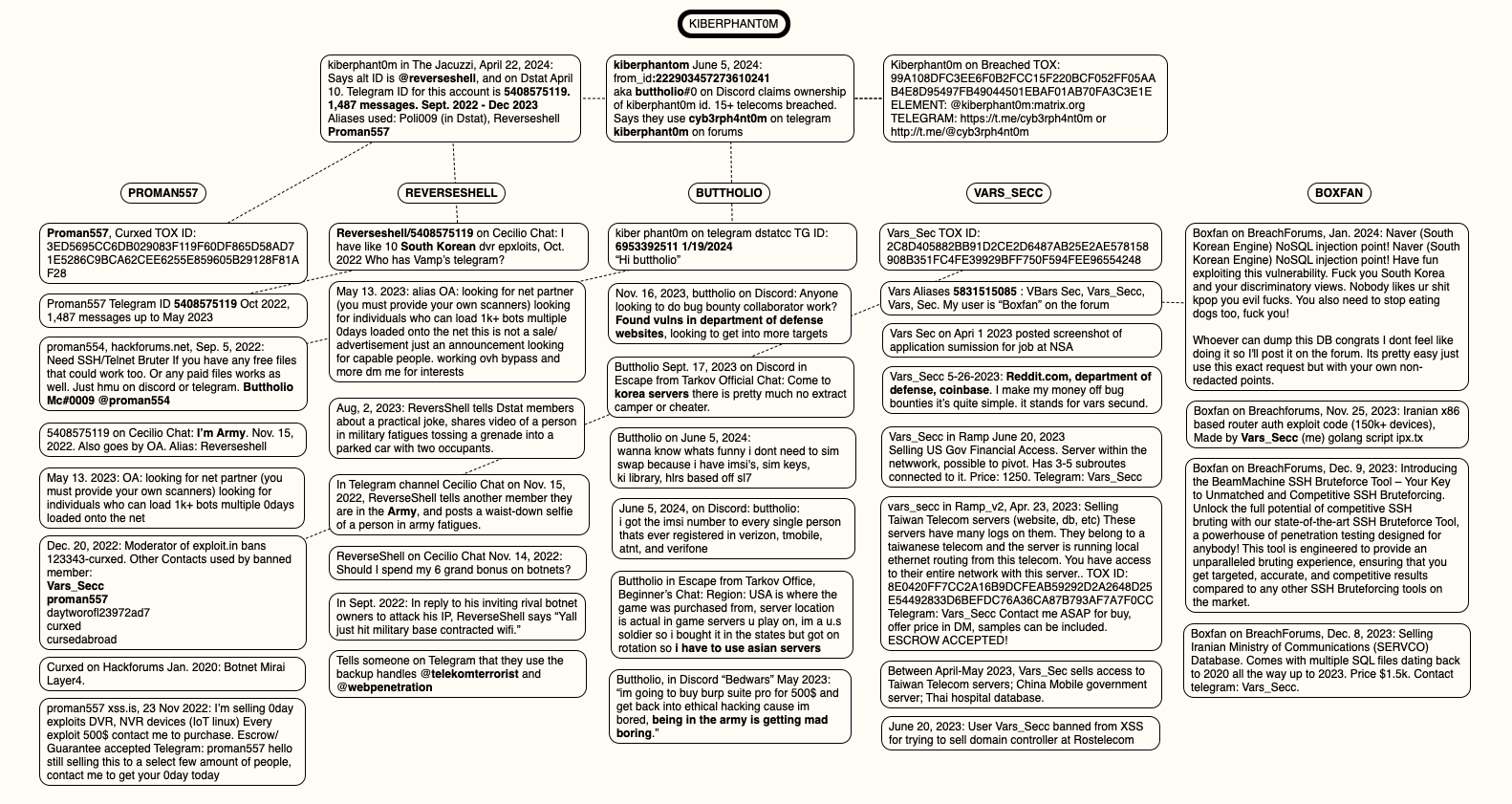
An anonymous reader quotes a report from KrebsOnSecurity: Two men have been arrested for allegedly stealing data from and extorting dozens of companies that used the cloud data storage company Snowflake, but a third suspect -- a prolific hacker known as Kiberphant0m -- remains at large and continues to publicly extort victims. However, this person's identity may not remain a secret for long: A careful review of Kiberphant0m's daily chats across multiple cybercrime personas suggests they are a U.S. Army soldier who is or was recently stationed in South Korea.

Kiberphant0m's identities on cybercrime forums and on Telegram and Discord chat channels have been selling data stolen from customers of the cloud data storage company Snowflake. At the end of 2023, malicious hackers discovered that many companies had uploaded huge volumes of sensitive customer data to Snowflake accounts that were protected with nothing more than a username and password (no multi-factor authentication required). After scouring darknet markets for stolen Snowflake account credentials, the hackers began raiding the data storage repositories for some of the world's largest corporations. Among those was AT&T, which disclosed in July that cybercriminals had stolen personal information, phone and text message records for roughly 110 million people. Wired.com reported in July that AT&T paid a hacker $370,000 to delete stolen phone records.

On October 30, Canadian authorities arrested Alexander Moucka, a.k.a. Connor Riley Moucka of Kitchener, Ontario, on a provisional arrest warrant from the United States, which has since indicted him on 20 criminal counts connected to the Snowflake breaches. Another suspect in the Snowflake hacks, John Erin Binns, is an American who is currently incarcerated in Turkey. Investigators say Moucka, who went by the handles Judische and Waifu, had tasked Kiberphant0m with selling data stolen from Snowflake customers who refused to pay a ransom to have their information deleted. Immediately after news broke of Moucka's arrest, Kiberphant0m was clearly furious, and posted on the hacker community BreachForums what they claimed were the AT&T call logs for President-elect Donald J. Trump and for Vice President Kamala Harris. [...] Also on Nov. 5, Kiberphant0m offered call logs stolen from Verizon's push-to-talk (PTT) customers -- mainly U.S. government agencies and emergency first responders.
Kiberphant0m denies being in the U.S. Army and said all these clues were "a lengthy ruse designed to create a fictitious persona," reports Krebs.

"I literally can't get caught," Kiberphant0m said, declining an invitation to explain why. "I don't even live in the USA Mr. Krebs." A mind map illustrates some of the connections between and among Kiberphant0m's apparent alter egos.
Crime

Is There New Evidence in the D.B. Cooper Case? (cowboystatedaily.com) 63

On November 24th, 1971 — 53 years ago today — a mysterious man jumped out of an airplane clutching $200,000 in ransom money. (He'd extorted it from the airline by claiming he had a bomb, and it's still "the only unsolved case of air piracy in the history of commercial aviation," according to Wikipedia.) Will modern technology finally let us solve the case — or just turn it into a miniseries on Netflix? And have online researchers finally discovered the definitive clue?

The FBI vetted more than 800 suspects, according to the Wyoming news site Cowboy State Daily, but in 2016 announced they were suspending their active investigation.

So it's newsworthy that the FBI now appears to be investigating new evidence, according to an amateur D.B. Cooper researcher on YouTube: the discovery of what's believed to be D.B. Cooper's uniquely-modified parachute: Retired pilot, skydiver and YouTuber, Dan Gryder told Cowboy State Daily that he may have found the missing link after uncovering the modified military surplus bailout rig he believes was used by D.B. Cooper in the heist. It belonged to Richard Floyd McCoy II, and was carefully stored in his deceased mother's storage stash until very recently... McCoy's children, Chanté and Richard III, or "Rick," agree with Gryder that they believe their father was D.B. Cooper, a secret that shrouded the family but wasn't overtly discussed. For years, they said, the family stayed mum out of fear of implicating their mother, Karen, whom they believe was complicit in both hijackings. Upon her death in 2020, they broke their silence to Gryder after being contacted by him off and on for years.

Gryder, who has been researching the case for more than 20 years, documented his investigation in a lengthy two-part series on his YouTube channel, "Probable Cause," in 2021 and 2022, where he connects the dots and shows actual footage of him finding the parachute in an outbuilding on the McCoy family property in North Carolina in July 2022. On Monday, Gryder released a third video, "D.B. Cooper: Deep FBI Update," where he announced the FBI's new and very recent efforts in his discoveries. After watching his first two videos, Gryder said FBI agents contacted Rick and Gryder to see the parachute. It was the first investigative move by the agency since issuing the 2016 public statement, declaring the case closed pending new evidence. Gryder and Rick McCoy traveled to Richmond, Virginia, in September 2023, where they met with FBI agents, who took the harness and parachute into evidence along with a skydiving logbook found by Chanté that aligned with the timeline for both hijackings, providing another vital piece in the puzzle, Gryder said....

During the meeting, Gryder said the agents called it a first step. If the evidence proved fruitless, they would have promptly returned the skydiving rig, he said, but that didn't happen. Instead, an FBI agent called Rick a month later to ask to search the family property in Cove City, North Carolina, which McCoy's mother owned and where Gryder had found the parachute and canopy... [Gryder says he watched] at least seven vehicles descend on the property with more than a dozen agents who scoured the property for about four hours... Rick said he has provided a DNA sample and was told by the FBI agents that the next step might be exhuming his father's body, but no formal terms and conditions for that process have been established thus far, he said.

A retired commercial airline pilot who was present in the Virginia FBI meeting said "It was clear they were taking it seriously" — noting it was the FBI who'd requested that meeting. The article cites two FBI agents who'd earlier already believed D.B. Cooper was McCoy. And the article points out that the FBI "has never ruled McCoy out, stating in a 2006 statement that he was 'still a favorite suspect among many.'"

A second article notes that Gryder supports the FBI's recent request to exhume McCoy's body. As he sees it, "The existing DNA marker comparisons studied so far only validate the need for this final extreme step and should close the mystery once and for all."

And the article adds that McCoy's children are "eager for closure and hope that the FBI finds the evidence agents need to close the D.B. Cooper case once and for all."

Slashdot Top Deals