Google

'Google Maps Has Become an Eyesore' (fastcompany.com) 170

After growing "increasingly frustrated" with the Google Maps experience, Fast Company's Michael Grothaus has highlighted five main reasons the app has "become a cluttered, frustrating mess" -- and why he finds himself turning to Apple Maps more often. An anonymous Slashdot reader shares an excerpt from the report: ENOUGH WITH THE HOTEL AND BAR PINS: Whenever I'm in a major metropolitan area, Google Maps seems to have an obsession with displaying as many hotels, bars, and clubs on the map as it can. This happens even when I haven't searched for a single hotel or bar. And it happens not only when I'm on vacation in a new city, but when I'm in my home city. Google knows my home address. So, why on Earth does it default to showing me as many hotels as possible in the city where I live? The same is true of clubs and bars. I see pins for more dance clubs and bars in one small area shown on my smartphone's display than I've ever actually been to in my life. Google knows I'm middle-aged and get up early to work. When I'm just browsing the map, can it really think I might care about the nearest club where patrons normally don't leave until well past midnight? By displaying all these irrelevant hotels and bars, Google makes it much harder to browse and navigate the map, since frequently the pins' labels overlap or obscure more important elements, such as the shape and layout of streets.

TOO MANY ADS CLUTTER THE MAP: The square pins you see in Google Maps are ad pins. They represent a place of business (a hotel, spa, etc.) that is paying Google to make sure it's displayed on the map, despite the business's irrelevance to me. Again, ad pins for hotels dominate, but right behind them are ad pins for restaurants with small text underneath them imploring me to "Order Delivery with Uber Eats," which just further clutters the map. Google is, of course, first and foremost an advertising company. Data compiled by Oberlo showed that 78.2% of its Q1 2023 total revenue of $69.8 billion came from ads. But its enthusiasm for placing ads in every corner of Google Maps just makes it all the more cluttered and increasingly hard to read. And that's before we even get to

PHOTO PINS SIGNIFY WHAT, EXACTLY?: Google Maps identifies points of interest primarily by pin color and glyph: Hotels are represented by a pink pin with an image of a person sleeping in a bed, restaurants get an orange pin with a fork and knife, and so forth. Regular pins, denoting businesses or other points of interest, are reverse teardrop-shaped, while ad pins are square-shaped. But, since last year, there is also now a third form: the photo pin. As best as I can tell, a photo pin is a pin for a business, but instead of a typical category glyph, it shows a large photo ostensibly related to the establishment. These pins don't appear to signify that the business is notable in any way. (I mean, I'm sure I've seen photo pins for muffler repair shops -- not exactly a tourist attraction.) The photo pin might be the ultimate map monopolizer. It's bigger, and the photo, seemingly pulled from a business's Google Maps listing, doesn't always even represent the business well. One photo pin I came across, oddly, seemed to show a photo of the dumpsters behind a restaurant. This just adds to user confusion and more clutter. It isn't helping the business, either.

I HAVE NO INTEREST IN SOMEONE'S WORK-FROM-HOME BUSINESS: Another major contributor to Google Maps being an eyesore these days is a holdover from the pandemic when so many people were stuck working from home -- or decided to begin offering their services from home. It is not uncommon to be browsing a residential area on Google Maps and be faced with a sea of work-from-home business pins. The number of "consultant" businesses I've seen in residential areas on Google Maps has been shocking. The same goes for web designers, app programmers, and handymen -- all of whom operate out of their residential homes. These may all be legitimate businesses run by self-employed people, but why on earth does Google Maps surface their listings on maps if they never have a single client enter their doors and, more important, if I've not searched for a provider of any of these services? Clutter, clutter, clutter.

WHY WON'T YOU SHOW ME THE STREET NAME?: Finally, Google Maps seems more intent today on showing bars, restaurants, ads, and work-from-home businesses than useful map-related features. Sometimes it doesn't even show the most basic information anymore, including street names. Many times I just want to see the name of the street I'm standing on. So, I open Google Maps and zoom in on my current location. Yet no matter how far in I zoom in, Google Maps doesn't always apply a label to the street I'm standing on. It just remains blank. Of course, business pins I have no interest in are still prominently displayed. A workaround I've stumbled upon whenever this happens is to select a business pin on the next street over. When Google Maps centers on that, it for some reason will label the street I'm standing on. Among all the gripes on this list, I think this one is my biggest. If my ad-hoc workaround doesn't work, I often have to open Apple Maps just to look up the name of the street I'm on.

IT

Zoom Demands Workers Return to Office Two Days a Week. Is The Remote-Working Revolution Dead? (msn.com) 176

Even Zoom is now telling its 8,400 employees to stop working remotely at least two days a week and return to the office. The policy applies to employees within 50 miles of a Zoom office ith a Zoom spokesperson calling this hybrid approach the "most effective".

Business Insider quips that Zoom making the move means "The remote work revolution is officially dead."

And earlier this week The Los Angeles Times argues that "After watching and waiting, some chaotic back-and-forth and a few false starts, the white-collar American workforce appears to be settling — for now — in a hybrid mode." Even as more corporations are moving to call workers back to the office, arguing it's better for preserving company culture and decision-making, few employers have required employees to work on-site five days a week. Most are like Meta and Los Angeles-based Farmers Group, which recently announced that most employees who had been working remotely will have to come in three days a week starting in September.

Some firms have backtracked in favor of a more flexible system, or put return-to-office plans on ice, because of worker resistance and other changes wrought by the pandemic... [M]any other companies have stayed silent on the issue of remote work, maintaining vague or largely unenforced policies as they wait to see where the struggle ends. More unions, including the guild at the Los Angeles Times, are wrestling with management over remote work, which has become a top labor issue. For all these reasons, the overall amount of work done from home has held remarkably steady this year at about 28%, according to monthly surveys of thousands of workers by WFH Research, a group including Stanford and the University of Chicago. That's way up from roughly 5% of work done at home before COVID-19.

And there are some signs that employers are giving workers greater flexibility in their work schedules and when they can work from home. In a nationwide survey conducted last month for The Times by polling firm Leger, 27% of full-time workers said their employers had become more lenient over the last year about working remotely. Only 15% said their employers got stricter. Most of the rest said there was no change. Leger's survey showed that 11% of full-time employees work 100% from home, and 31% work a hybrid schedule, with most saying they choose which days to come into the office. The remainder said that they work fully on company premises or that their jobs aren't compatible with at-home work. These results line up almost exactly with WFH data...

Rob Sadow, chief executive at Scoop Technologies, a firm specializing in flexible-work software and research, says the percentages of employers that are fully remote and fully in-office have both declined since the start of the year. What's grown in their place is a "structured" hybrid model in which employees and employers have essentially split the difference. "This two to three days a week is starting to feel like a pretty decent, happy medium," Sadow said. "Executives and employees are finding somewhat of a truce in terms of how much time is spent in the office and at home."

The article also points out that "Some employees have quit and moved to more remote-work friendly firms."
China

The US and Europe Are Growing Alarmed By China's Rush Into Legacy Chips (time.com) 159

An anonymous reader quotes a report from TIME: U.S. and European officials are growing increasingly concerned about China's accelerated push into the production of older-generation semiconductors and are debating new strategies to contain the country's expansion. President Joe Biden implemented broad controls over China's ability to secure the kind of advanced chips that power artificial-intelligence models and military applications. But Beijing responded by pouring billions into factories for the so-called legacy chips that haven't been banned. Such chips are still essential throughout the global economy, critical components for everything from smartphones and electric vehicles to military hardware. That's sparked fresh fears about China's potential influence and triggered talks of further reining in the Asian nation, according to people familiar with the matter, who asked not to be identified because the deliberations are private. The U.S. is determined to prevent chips from becoming a point of leverage for China, the people said.

Commerce Secretary Gina Raimondo alluded to the problem during a panel discussion last week at the American Enterprise Institute. "The amount of money that China is pouring into subsidizing what will be an excess capacity of mature chips and legacy chips -- that's a problem that we need to be thinking about and working with our allies to get ahead of," she said. While there's no timeline for action to be taken and information is still being gathered, all options are on the table, according to a senior Biden administration official. The most advanced semiconductors are those produced using the thinnest etching technology, with 3-nanometers state of the art today. Legacy chips are typically considered those made with 28-nm equipment or above, technology introduced more than a decade ago.

Senior E.U. and U.S. officials are concerned about Beijing's drive to dominate this market for both economic and security reasons, the people said. They worry Chinese companies could dump their legacy chips on global markets in the future, driving foreign rivals out of business like in the solar industry, they said. Western companies may then become dependent on China for these semiconductors, the people said. Buying such critical tech components from China may create national security risks, especially if the silicon is needed in defense equipment. "The United States and its partners should be on guard to mitigate nonmarket behavior by China's emerging semiconductor firms," researchers Robert Daly and Matthew Turpin wrote in a recent essay for the Hoover Institution think tank at Stanford University. "Over time, it could create new U.S. or partner dependencies on China-based supply chains that do not exist today, impinging on U.S. strategic autonomy."

GNU is Not Unix

Libreboot Creator Says After Coding a Fork for 'GNU Boot Project', FSF Sent a Cease-and-Desist Letter Over Its Name (libreboot.org) 105

Libreboot is a distribution of coreboot "aimed at replacing the proprietary BIOS firmware contained by most computers," according to Wikipedia. It was briefly part of the GNU project, until maintainer Leah Rowe and the GNU project agreed to part ways in 2017.

But here in 2023, the GNU project has created a fork of Libreboot named GNU Boot... The GNU Boot fork "currently does not have a website and does not have any releases of its own," points out Libreboot's Leah Rowe, adding "My intent is to help them, and they are free — encouraged — to re-use my work... " But things have gotten messy, writes Rowe: They forked Libreboot, due to disagreement with Libreboot's Binary Blob Reduction Policy. This is a pragmatic policy, enacted in November 2022, to increase the number of coreboot users by increasing the amount of hardware supported in Libreboot... I wish GNU Boot all the best success. Truly. Although I think their project is entirely misguided (for reasons explained by modern Libreboot policy), I do think there is value in it. It provides continuity for those who wish to use something resembling the old Libreboot project...

When GNU Boot first launched, as a failed hostile fork of Libreboot under the same name, I observed: their code repository was based on Libreboot from late 2022, and their website based on Libreboot in late 2021. Their same-named Libreboot site was announced during LibrePlanet 2023... [N]ow they are calling themselves GNU Boot, and it is indeed GNU, but it still has the same problem as of today: still based on very old Libreboot, and they don't even have a website. According to [the FSF's Savannah software repository], GNU Boot was created on 11 June 2023. Yet no real development, in over a month since then...

I've decided that I want to help them... I decided recently that I'd simply make a release for them, exactly to their specifications (GNU Free System Distribution Guidelines), talking favourably about FSF/GNU, and so on. I'm in a position to do it (thus scratching the itch), so why not? I did this release for them — it's designated non-GeNUine Boot 20230717, and I encourage them to re-use this in their project, to get off the ground. This completely leapfrogs their current development; it's months ahead. Months. It's 8 months ahead, since their current revision is based upon Libreboot from around ~October 2022...

The GNU Boot people actually sent me a cease and desist email, citing trademark infringement. Amazing...

I complied with their polite request and have renamed the project to non-GeNUine Boot. The release archive was re-compiled, under this new brand name and the website was re-written accordingly. Personally, I like the new name better.

Science

Many Physicists 'Skeptical' of Spectacular Superconductor Claims (science.org) 85

"This week, social media has been aflutter over a claim for a new superconductor that works not only well above room temperatures, but also at ambient pressure," writes Science magazine. If true, the discovery would be one of the biggest ever in condensed matter physics and could usher in all sorts of technological marvels, such as levitating vehicles and perfectly efficient electrical grids. However, the two related papers, posted to the arXiv preprint server by Sukbae Lee and Ji-Hoon Kim of South Korea's Quantum Energy Research Centre and colleagues on 22 July, are short on detail and have left many physicists skeptical... "They come off as real amateurs," says Michael Norman, a theorist at Argonne National Laboratory. "They don't know much about superconductivity and the way they've presented some of the data is fishy." On the other hand, he says, researchers at Argonne and elsewhere are already trying to replicate the experiment. "People here are taking it seriously and trying to grow this stuff." Nadya Mason, a condensed matter physicist at the University of Illinois, Urbana-Champaign says, "I appreciate that the authors took appropriate data and were clear about their fabrication techniques." Still, she cautions, "The data seems a bit sloppy...."

What are the reasons for skepticism? There are several, Norman says. First, the undoped material, lead apatite, isn't a metal but rather a nonconducting mineral. And that's an unpromising starting point for making a superconductor. What's more, lead and copper atoms have similar electronic structures, so substituting copper atoms for some of the lead atoms shouldn't greatly affect the electrical properties of the material, Norman says. "You have a rock, and you should still end up with a rock." On top of that, lead atoms are very heavy, which should suppress the vibrations and make it harder for electrons to pair, Norman explains.

The papers don't provide a solid explanation of the physics at play. But the researchers speculate that within their material, the doping slightly distorts long, naturally occurring chains of lead atoms... [Mason] notes that Lee and Kim also suggest that a kind of undulation of charge might exist in the chains and that similar charge patterns have been seen in high-temperature superconductors. "Maybe this material really just hits the sweet spot of a strongly interacting unconventional superconductor," she says.

The big question will be whether anybody can reproduce the observations...

Thanks to Slashdot reader sciencehabit for sharing the article.
Apple

Apple Cracking Down on 'Fingerprinting' With New App Store API Rules (engadget.com) 36

Apple will soon start cracking down on apps that collect data on users' devices in order to track them (aka "fingerprinting"), according to an article on its developer site. Engadget writes: Starting with the release of iOS 17, tvOS 17, watchOS 10 and macOS Sonoma, developers will be required to explain why they're using so-called required reason APIs. Apps failing to provide a valid reason will be rejected started in spring of 2024. "Some APIs... have the potential of being misused to access device signals to try to identify the device or user, also known as fingerprinting. Regardless of whether a user gives your app permission to track, fingerprinting is not allowed," Apple wrote.

"To prevent the misuse of certain APIs that can be used to collect data about users' devices through fingerprinting, you'll need to declare the reasons for using these APIs in your app's privacy manifest." The new rules could increase the rate of app rejections, some developers told 9to5Mac. For instance, an API called UserDefaults falls into the "required reason" category, but since it stores user preferences, it's used by a lot of apps.

Movies

Hollywood Movie Aside, Just How Good a Physicist Was Oppenheimer? (science.org) 91

sciencehabit shares a report from Science: This week, the much anticipated movie Oppenheimer hits theaters, giving famed filmmaker Christopher Nolan's take on the theoretical physicist who during World War II led the Manhattan Project to develop the first atomic bomb. J. Robert Oppenheimer, who died in 1967, is known as a charismatic leader, eloquent public intellectual, and Red Scare victim who in 1954 lost his security clearance in part because of his earlier associations with suspected Communists. To learn about Oppenheimer the scientist, Science spoke with David C. Cassidy, a physicist and historian emeritus at Hofstra University. Cassidy has authored or edited 10 books, including J. Robert Oppenheimer and the American Century. How did Oppenheimer compare to Einstein? Did he actually make any substantiative contributions to THE Bomb? And why did he eventually lose his security clearance?
Facebook

Meta Scales Back Ambitions for AR Glasses 19

An anonymous reader shares a report: In March 2020, as the Covid-19 pandemic began to transform the world, the company then known as Facebook struck a deal to buy all the augmented reality displays made by British firm Plessey. At the time, the deal appeared to be a savvy way of squeezing out Apple in the competition to develop AR glasses, as Plessey was one of the few makers of AR displays. Three years on, however, the deal has turned into a bust for Meta. Development of Plessey's technology has stalled, say people with direct knowledge of the effort. Facebook, now called Meta Platforms, has struggled to make Plessey's displays bright enough for use in its AR glasses under development and to reduce defects that crop up in the manufacturing process. Earlier this year, Meta decided to abandon Plessey's microLED tech in favor of an older display technology, liquid crystal on silicon or LCoS. The decision is one of several Meta has made, for either technological or cost-saving reasons, that will reduce the edge that the AR glasses have over existing AR headsets like Microsoft's HoloLens.

The episode highlights the twists and turns Meta is navigating as it tries to stay ahead of Apple and other rivals in the still-developing market for AR and virtual reality. Meta was early to the VR market with its Quest headsets and has been working on developing AR glasses to get ahead of rivals like Snap which are trying to develop similar products. Now it faces competition from Apple, which last month unveiled its mixed-reality headset, the Vision Pro, which will be available early next year. At the same time, Meta is under pressure from investors to curb the more than $10 billion it is spending annually at the Reality Labs division developing its AR and VR products. Technical setbacks have forced Meta to delay the timeline for releasing AR glasses multiple times, and it isn't anticipating releasing a pair of AR glasses to the public until at least 2027.
AI

Bill Gates Calls AI's Risks 'Real But Manageable' (gatesnotes.com) 57

This week Bill Gates said "there are more reasons than not to be optimistic that we can manage the risks of AI while maximizing their benefits." One thing that's clear from everything that has been written so far about the risks of AI — and a lot has been written — is that no one has all the answers. Another thing that's clear to me is that the future of AI is not as grim as some people think or as rosy as others think. The risks are real, but I am optimistic that they can be managed. As I go through each concern, I'll return to a few themes:

- Many of the problems caused by AI have a historical precedent. For example, it will have a big impact on education, but so did handheld calculators a few decades ago and, more recently, allowing computers in the classroom. We can learn from what's worked in the past.

— Many of the problems caused by AI can also be managed with the help of AI.

- We'll need to adapt old laws and adopt new ones — just as existing laws against fraud had to be tailored to the online world.

Later Gates adds that "we need to move fast. Governments need to build up expertise in artificial intelligence so they can make informed laws and regulations that respond to this new technology."

But Gates acknowledged and then addressed several specific threats:
  • He thinks AI can be taught to recognize its own hallucinations. "OpenAI, for example, is doing promising work on this front.
  • Gates also believes AI tools can be used to plug AI-identified security holes and other vulnerabilities — and does not see an international AI arms race. "Although the world's nuclear nonproliferation regime has its faults, it has prevented the all-out nuclear war that my generation was so afraid of when we were growing up. Governments should consider creating a global body for AI similar to the International Atomic Energy Agency."
  • He's "guardedly optimistic" about the dangers of deep fakes because "people are capable of learning not to take everything at face value" — and the possibility that AI "can help identify deepfakes as well as create them. Intel, for example, has developed a deepfake detector, and the government agency DARPA is working on technology to identify whether video or audio has been manipulated."
  • "It is true that some workers will need support and retraining as we make this transition into an AI-powered workplace. That's a role for governments and businesses, and they'll need to manage it well so that workers aren't left behind — to avoid the kind of disruption in people's lives that has happened during the decline of manufacturing jobs in the United States."

Gates ends with this final thought:

"I encourage everyone to follow developments in AI as much as possible. It's the most transformative innovation any of us will see in our lifetimes, and a healthy public debate will depend on everyone being knowledgeable about the technology, its benefits, and its risks.

"The benefits will be massive, and the best reason to believe that we can manage the risks is that we have done it before."


NASA

NASA Decides Not To Launch Two Already-Built Asteroid Probes 19

An anonymous reader quotes a report from Ars Technica: Two small spacecraft should have now been cruising through the Solar System on the way to study unexplored asteroids, but after several years of development and nearly $50 million in expenditures, NASA announced Tuesday the probes will remain locked inside a Lockheed Martin factory in Colorado. That's because the mission, called Janus, was supposed to launch last year as a piggyback payload on the same rocket with NASA's much larger Psyche spacecraft, which will fly to a 140-mile-wide (225-kilometer) metal-rich asteroid -- also named Psyche -- for more than two years of close-up observations. Problems with software testing on the Psyche spacecraft prompted NASA managers to delay the launch by more than a year. An independent review board set up to analyze the reasons for the Psyche launch delay identified issues with the spacecraft's software and weaknesses in the plan to test the software before Psyche's launch. Digging deeper, the review panel determined that NASA's Jet Propulsion Laboratory, which manages the Psyche mission, was encumbered by staffing and workforce problems exacerbated by the COVID-19 pandemic. Psyche is now back on track for liftoff in October on a SpaceX Falcon Heavy rocket, but Janus won't be aboard.

Janus was designed to fly to two binary asteroids -- consisting of two bodies near one another -- that orbit the Sun closer to Earth than the metallic asteroid Psyche. While the Psyche mission can still reach its asteroid destination and accomplish its science mission with a launch this year, the asteroids targeted by Janus will have changed positions in the Solar System by too much since last year. They are no longer accessible to the two Janus spacecraft without flying too far from the Sun for their solar arrays to generate sufficient power. When it became clear the two Janus target asteroids were no longer reachable, scientists on the Janus team and NASA management agreed last year to remove the twin spacecraft from the Psyche launch. Scientists considered other uses for the suitcase-size Janus spacecraft, which were already built and were weeks away from shipment to Florida to begin final launch preparations when NASA decided to delay the launch of Psyche.

One of the ideas to repurpose the Janus spacecraft was to send the probes to fly by asteroid Apophis, a space rock bigger than the Empire State Building that will encroach within 20,000 miles (32,000 kilometers) from our planet's surface in 2029. For a time soon after its discovery in 2004, scientists said there was a small chance Apophis could impact Earth in 2029 or later this century, but astronomers have now ruled out any risk of a collision for the next 100-plus years. In the end, Janus fell victim to the delay of the Psyche mission and tight budget constraints at NASA. The agency said Tuesday it has directed the Janus team to "prepare the spacecraft for long-term storage."
Microsoft

Microsoft Wins FTC Fight To Buy Activision Blizzard (theverge.com) 68

A California judge is allowing Microsoft to close its acquisition of Activision Blizzard after five days of grueling testimony. From a report: Microsoft still faces an ongoing antitrust case by the Federal Trade Commission, but Judge Jacqueline Scott Corley has listened to arguments from both the FTC and Microsoft and decided to deny the regulator's request for a preliminary injunction. In a ruling submitted today, Judge Corley said the following: Microsoft's acquisition of Activision has been described as the largest in tech history. It deserves scrutiny. That scrutiny has paid off: Microsoft has committed in writing, in public, and in court to keep Call of Duty on PlayStation for 10 years on parity with Xbox. It made an agreement with Nintendo to bring Call of Duty to Switch. And it entered several agreements to for the first time bring Activision's content to several cloud gaming services. This Court's responsibility in this case is narrow. It is to decide if, notwithstanding these current circumstances, the merger should be halted -- perhaps even terminated -- pending resolution of the FTC administrative action. For the reasons explained, the Court finds the FTC has not shown a likelihood it will prevail on its claim this particular vertical merger in this specific industry may substantially lessen competition. To the contrary, the record evidence points to more consumer access to Call of Duty and other Activision content. The motion for a preliminary injunction is therefore DENIED.
Businesses

Foxconn Dumps $19.5 Billion Chip Plan in Blow To India (reuters.com) 33

Taiwan's Foxconn has withdrawn from a $19.5 billion semiconductor joint venture with Indian metals-to-oil conglomerate Vedanta, it said on Monday in a setback to Prime Minister Narendra Modi's chipmaking plans for India. From a report: Foxconn, the world's largest contract electronics maker, and Vedanta signed a pact last year to set up semiconductor and display production plants in Modi's home state of Gujarat. "Foxconn has determined it will not move forward on the joint venture with Vedanta," a Foxconn statement said without elaborating on the reasons.

The company said it had worked with Vedanta for more than a year to bring "a great semiconductor idea to reality", but they had mutually decided to end the joint venture and it will remove its name from an entity that is now fully owned by Vedanta. Modi has made chipmaking a top priority for India's economic strategy in pursuit of a "new era" in electronics manufacturing and Foxconn's move represents a blow to his ambitions of luring foreign investors to make chips locally for the first time.

United Kingdom

UK Plans To Drop Flagship $14.7 Billion Climate Pledge (theguardian.com) 99

The government is drawing up plans to drop the UK's flagship $14.7bn climate and nature funding pledge, the Guardian can reveal, with the prime minster accused of betraying populations most vulnerable to global heating. From the report: The disclosure provoked fury from former ministers and representatives of vulnerable countries, who accused Rishi Sunak of making false promises. A leaked briefing note to ministers, given to the Foreign Office and seen by the Guardian, lays out reasons for dropping the UK's contribution to meeting the global $100bn a year commitment to developing countries.

It says: "Our commitment to double our international climate finance to $14.7bn was made in 2019, when we were still at 0.7 [% of GDP spent on international aid] and pre-Covid." It adds that to meet it by the deadline would be a "huge challenge" because of new pressures, including help for Ukraine being included in the aid budget. To meet the $14.7bn target by 2026, government officials have calculated that it would have to spend 83% of the Foreign Office's official development assistance budget on the international climate fund. Civil servants said in the leaked document that this "would squeeze out room for other commitments such as humanitarian and women and girls."

Television

Why Are So Many People Watching TV With Subtitles? (indiewire.com) 283

"In a 2022 survey of 1,200 people, language learning company Preply determined that 50% of Americans used subtitles and closed captions the vast majority of the time they watch content," writes IndieWire.

They delve into the reasons why so many people want to read dialogue: The first is that, for a lot of people, it's become a lot harder to understand dialogue on the TV. That's the top reason cited in the Preply survey, with nearly 72% of respondents who use closed captions marking that as one of the main reasons why.

The causes behind muddled dialogue are many, multifaceted, and might vary between person to person. For some, the problem is the design of modern televisions; the majority of which place internal speakers at the bottom of the set instead of facing towards the audience, causing significantly worse audio quality. Other issues are caused by sound designs optimized for theatrical experiences, which can result in compressed audio when translated to home. Whatever the reason, a lot of people struggle to hear dialogue now, so turning on closed captioning to decipher what people are saying has become a no brainer move...

Gen Z is, overwhelmingly, the generation most likely to be turning on subtitles according to Preply's numbers, with 70% of respondents in the generation saying they use closed captions "most of the time" compared to 53% of Millennials, 38% of Gen X, and 35% of Baby Boomers. As to why Gen Z likes to turn on text while watching their shows, part of it is that people in the generation grew up watching videos on social media, where subtitles are the algorithmically encouraged default.

Another reason is that Gen Z displays starkly different viewing habits than Baby Boomers in terms of where they're watching their movies and shows. According to Preply, 57% of all Americans watch shows or movies or videos in public on their mobile devices, but a very significant 74% of Gen Z do the same. Even if you're (hopefully) using headphones while in public, it's likely you're getting poor audio quality and hearing background noise if you're watching "The Irishman" on public transit.

The article also cites a three-month study in 2020 by Parrot Analytics (which studies trends in entertainment) which discovered non-U.S. shows accounted for nearly 30% of the demand from U.S. audiences. (And even English-language shows may still have characters speaking with difficult-to-understand accents...)
Earth

Ecological Doom Loops: Why Ecosystem Collapses May Occur Sooner Than Expected (phys.org) 150

An anonymous Slashdot reader writes: An article in Nature Sustainability suggests that models may have underestimated the impact of warming on ecosystems. Two main reasons for this are the difficulty in accounting for variability and combining climate change with other pressure factors: for instance, pollution, excessive exploitation of species, deforestation due to increased demographics growth and meat consumption, ecosystem fragmentation, also harm wildlife.
After using software to simulate over 70,000 ecosystem scenarios, the two professors and a postdoctoral researcher issued this warning in The Conversation: Around the world, rainforests are becoming savanna or farmland, savanna is drying out and turning into desert, and icy tundra is thawing. Indeed, scientific studies have now recorded "regime shifts" like these in more than 20 different types of ecosystem where tipping points have been passed. Around the world, more than 20% of ecosystems are in danger of shifting or collapsing into something different.

These collapses might happen sooner than you'd think. Humans are already putting ecosystems under pressure in many different ways — what we refer to as stresses. And when you combine these stresses with an increase in climate-driven extreme weather, the date these tipping points are crossed could be brought forward by as much as 80%. This means an ecosystem collapse that we might previously have expected to avoid until late this century could happen as soon as in the next few decades. That's the gloomy conclusion of our latest research, published in Nature Sustainability.

Human population growth, increased economic demands, and greenhouse gas concentrations put pressures on ecosystems and landscapes to supply food and maintain key services such as clean water. The number of extreme climate events is also increasing and will only get worse. What really worries us is that climate extremes could hit already stressed ecosystems, which in turn transfer new or heightened stresses to some other ecosystem, and so on. This means one collapsing ecosystem could have a knock-on effect on neighbouring ecosystems through successive feedback loops: an "ecological doom-loop" scenario, with catastrophic consequences...

There is no way to restore collapsed ecosystems within any reasonable timeframe. There are no ecological bailouts. In the financial vernacular, we will just have to take the hit.

Microsoft

Microsoft/Activision Blizzard Antitrust Hearings Reveal Internal Emails and Badly-Redacted Documents (venturebeat.com) 24

VentureBeat is enjoying "secrets that spilled out" in the Microsoft/Activision Blizzard antitrust hearings. "Whether the Federal Trade Commission wins its antitrust case or not, its attempt to stop Microsoft's $68.7 billion acquisition of Activision Blizzard has revealed a trove of new data for everyone." The FTC has argued in a federal court that the merger would harm competition in the game industry and be bad for consumers, as Microsoft could pull Activision Blizzard's games like Call of Duty away from the Sony PlayStation, despite Microsoft's stated intention of not doing so for at least 10 years. In this case, the FTC might not have had an obvious winning hand, as the industry has an odd situation. Microsoft has the highest value ($104 billion in cash alone, versus $13.4 billion for Sony) at $2.49 trillion as a company compared to $115 billion for Sony, and yet it is in third place behind Sony and Nintendo.

Hence, there's some significance to Microsoft's Xbox first-party head, Matt Booty, sending an ill-advised email in 2019 saying Microsoft "has the ability to spend Sony out of business." That was long before the deal was announced 17 months ago, but it could be used as a sign of intent. Microsoft said it never pursued this strategy. While competing fiercely is fine, using monopoly power to drive a rival out of business so you can raise prices later is a no-no...

Did the FTC prove its case? I can't say just yet. Microsoft makes a decent point in saying all the regulators of the world except the U.S. and the United Kingdom have approved the deal. But I hope to have more reasons to binge on popcorn.

In January Ars Technica noted Microsoft's contract set July 18th as the deadline for closing the deal — or else paying a $3 billion "breakup fee". The Verge spotted that some of Sony's documents were poorly redacted. While looking at the lines that were crossed out with black pens, they could see that The Last of Us Part 2 cost the company $220 million to make, with 200 people working on it, while Horizon Forbidden West cost $212 million to make, with 300 working on it for over five years. Both games made considerably more money... In the unSharpied documents, Sony also revealed that a million Call of Duty players spent 100% of their time playing Call of Duty in 2021. It also said that Call of Duty generated $800 million for PlayStation in 2021 alone in the U.S. and perhaps $1.5 billion globally. It also looks like Sony's exclusive marketing deal with Activision for Call of Duty will expire in late 2023. Sony went on to say half of PS5 owners also have a Nintendo Switch.

Microsoft also failed to redact some of its acquisition targets. Those were later marked up, but not before Axios noted that the list included Thunderful, Supergiant Games, Niantic, Playrix, Zynga, Bungie, Square Enix, Warner Bros., Sega, IO Interactive and Scopely... Among the secrets revealed among the companies Microsoft acquired: Microsoft bought Ninja Theory, maker of Hellblade: Senua's Sacrifice, for $117 million.

Thanks to Slashdot reader ole_timer for sharing the news.
Communications

Huawei Says Ready To Ship Entire 5.5G Networks - Whatever They Are - in 2024 26

Huawei has claimed it will offer everything a carrier needs to run a 5.5G network next year. Which sounds great -- even if 5.5G is a little mysterious. From a report: Huawei announced its future products at the Shanghai incarnation of Mobile World Congress on Thursday. The Chinese firm's director and president of ICT Products & Solutions, Yang Chaobin, proclaimed Huawei intends for its launch "to mark the beginning of the 5.5G era for the ICT industry." But as The Register has previously reported, 5.5G is a contested label.

The 3GPP, which oversees development of 5G and other standards, is yet to formally declare 5.5G is a thing. It is, however, continuing to evolve 5G and is currently steering work on Release 18 -- which it has styled "5G-Advanced." It includes some significant changes, such as the ability to offer 10Gbit/sec connections -- if carriers can use 800MHz of spectrum. Release 18 will also require mmWave frequencies. Huawei appears to be referring to Release 18 as 5.5G, for reasons that aren't entirely clear.

Yang sprinkled a little hype dust on his announcement -- claiming that Huawei has "been working on applying AI-native technologies to 5.5G core networks to continuously enhance network capabilities and availability." Doing so will apparently "allow AI capabilities to be delivered to the very ends of networks." Righto. Just keep saying "AI" a lot and people will love it.
Network

Brave Aims To Curb Practice of Websites That Port Scan Visitors (arstechnica.com) 49

An anonymous reader quotes a report from Ars Technica: The Brave browser will take action against websites that snoop on visitors by scanning their open Internet ports or accessing other network resources that can expose personal information. Starting in version 1.54, Brave will automatically block website port scanning, a practice that a surprisingly large number of sites were found engaging in a few years ago. According to this list compiled in 2021 by a researcher who goes by the handle G666g1e, 744 websites scanned visitors' ports, most or all without providing notice or seeking permission in advance. eBay, Chick-fil-A, Best Buy, Kroger, and Macy's were among the offending websites.

Some sites use similar tactics in an attempt to fingerprint visitors so they can be re-identified each time they return, even if they delete browser cookies. By running scripts that access local resources on the visiting devices, the sites can detect unique patterns in a visiting browser. Sometimes there are benign reasons a site will access local resources, such as detecting insecurities or allowing developers to test their websites. Often, however, there are more abusive or malicious motives involved.

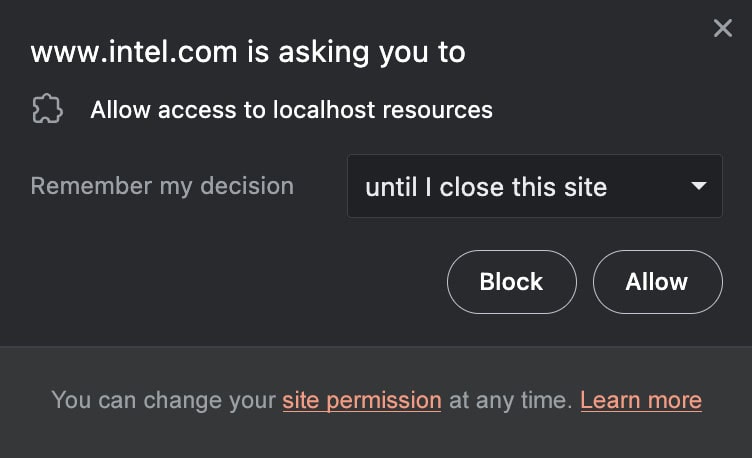
The new version of Brave will curb the practice. By default, no website will be able to access local resources. More advanced users who want a particular site to have such access can add it to an allow list. The interface will look something like the screenshot displayed [here]. Brave will continue to use filter list rules to block scripts and sites known to abuse localhost resources. Additionally, the browser will include an allow list that gives the green light to sites known to access localhost resources for user-benefiting reasons.
"Brave has chosen to implement the localhost permission in this multistep way for several reasons," developers of the browser wrote. "Most importantly, we expect that abuse of localhost resources is far more common than user-benefiting cases, and we want to avoid presenting users with permission dialogs for requests we expect will only cause harm."

"As far as we can tell, Brave is the only browser that will block requests to localhost resources from both secure and insecure public sites, while still maintaining a compatibility path for sites that users trust (in the form of the discussed localhost permission)" the Brave post said.
China

Indictment Details Plan To Steal Samsung Secrets For Foxconn China Project (reuters.com) 5

An anonymous reader quotes a report from Reuters: When former Samsung executive Choi Jinseog won a contract with Taiwan's Foxconn in 2018, he tapped his former employer's supplier network to steal secrets to help his new client set up a chip factory in China, a sealed indictment by South Korean prosecutors alleges. Prosecutors announced the indictment on June 12, saying the theft caused more than $200 million in damages to Samsung Electronics, based on the estimated costs Samsung spent to develop the stolen data. The announcement did not name Choi and gave only limited details, although some media subsequently identified Choi and his links with Foxconn. The unreleased 18-page indictment, reviewed by Reuters, provides details in the case against Choi, including how he is alleged to have stolen Samsung's trade secrets and details about the planned Foxconn plant.

Choi, who has been detained in jail since late May, denied all the charges through his lawyer, Kim Pilsung. Choi's Singapore-based consultancy Jin Semiconductor won the contract with Foxconn around August 2018, according to the indictment. Within months, Choi had poached "a large number" of employees from Samsung and its affiliates and illegally obtained secret information related to building a chip factory from two contractors, prosecutors allege. Jin Semiconductor illegally used confidential information involving semiconductor cleanroom management obtained from Cho Young-sik who worked at one of the contractors, Samoo Architects & Engineers, the indictment alleges. Clean rooms are manufacturing facilities where the enclosed environment is engineered to remove dust and other particles that can damage highly sensitive chips. Samoo had participated in the 2012 construction of Samsung's chip plant in Xian, China. Prosecutors allege Choi's company also illegally obtained blueprints of Samsung's China plant from Chung Chan-yup, an employee at HanmiGlobal, which supervised its construction and floor layouts involving the chip manufacturing process. They have yet to establish how the information on floor layout was obtained, according to the indictment.

Choi signed a preliminary consulting contract in around 2018 with Foxconn to build the chip factory potentially in Xian, his lawyer said. However, Foxconn ended the contract just a year later and only paid salaries related to the project, the lawyer said. He declined to comment on why Foxconn ended the contract or to provide further details, citing the sensitivity of the matter. The person with direct knowledge of the case said prosecutors found Foxconn had agreed to provide 8 trillion won ($6 billion) to build the factory, and Foxconn also paid several million dollars to Choi's company every month until it pulled out of the contract for reasons the indictment did not disclose. Jin Semiconductor's financial statement in 2018 said it entered into an arrangement with "a major customer" for the provision of qualified manpower in the next five years. The customer paid an advance of $17,994,217 to the company, according to the statement. Choi's lawyer said his client may be a scapegoat in a campaign by the South Korean government, caught in a rivalry between China and the United States, seeking seek to slow China's progress in chip manufacturing. [...] Choi is charged along with five other former and current Jin Semiconductor employees and a Samsung contractor employee. Trial is set to begin on July 12, court records show.

Android

Android's Emergency Call Shortcut Is Flooding Dispatchers With False Calls (arstechnica.com) 51

An anonymous reader quotes a report from Ars Technica: Police forces in the UK are seeing a "record number" of false calls to 999, the UK's emergency services number, and the culprit is apparently Android. As the BBC reports, Android 12 added an easy-access feature for emergency services: just press the power button five times, and your phone will dial emergency services for you. That's apparently pretty easy to do accidentally when a phone is sitting in your pocket, or if you have a wonky power button, resulting in a surge of totally silent accidental calls to emergency dispatch.

The National Police Chiefs Council tweeted earlier this month that "Nationally, all emergency services are currently experiencing record high 999 call volumes. There's a few reasons for this, but one we think is having a significant impact is an update to Android smartphones." The BBC report says one department "received 169 silent 999 calls between 00:00 and 19:00 BST on Sunday alone." In response to these most recent complaints, Google says it's working on a fix with Android OEMs.

The funny thing is, Android 12 -- and this easy emergency call feature -- came out a year and a half ago. Thanks to the unique (uniquely bad) way that Android is rolled out, the feature is only now hitting enough people to become a national problem. Google's Pixel devices get new Android updates immediately, but everyone else can take months or years to get new versions of Android because it's up to your device manufacturer to make new, bespoke Android builds for every device they have ever released. When this landed on Pixel devices in 2021, it was immediately flagged as a problem by some people, with one Reddit post calling it "dangerous." Since then, there has been a steady stream of posts warning people about it. Until a patch comes out, Google's current recommendation is to turn the feature off.
While Google developed the feature, it's up to the manufacturers to decide how and when the emergency SOS feature works. Google said in a statement: "To help these manufacturers prevent unintentional emergency calls on their devices, Android is providing them with additional guidance and resources. We anticipate device manufacturers will roll out updates to their users that address this issue shortly. Users that continue to experience this issue should switch Emergency SOS off for the next couple of days."

Slashdot Top Deals