EU

EU Lawmakers Launch Tips Hotline To Catch Big Tech's 'Shady' Lobbying (techcrunch.com) 6

An anonymous reader shares a report: 'Astroturfing' and other non-transparent lobbying tactics used to target digital policymakers in the European Union in recent years -- including during a blitz of spending aimed at influencing major new pan-EU rules like the Digital Services Act (DSA) -- have inspired a group of MEPs and NGOs to fight back by launching a hotline for reporting attempts at indirectly influencing the bloc's tech policy agenda. The new tips line, which was first reported by the Guardian, is being called LobbyLeaks.

The office of one of the MEPs co-leading the effort, Paul Tang of the S&D Group, said the idea is to gather data on underhand lobbying efforts that may be targeting the EU's digital policymaking -- such as the use of third party 'industry associations' or consultancies without clear disclosures, or even academics being quietly funded to author favorable research -- in order that they can be studied and called out. They also want to ensure EU lawmakers are better informed about the myriad ways tech giants may be seeking to influence them as they work on shaping the rules platform giants will have to play by.

Businesses

The Junkification of Amazon (nymag.com) 158

Why does it feel like Amazon is making itself worse? From a report: Efforts to find independent reviews of Amazon-exclusive products rarely turn up high-quality content; many sites just summarize Amazon reviews in an effort to collect search traffic from Google and eventually affiliate commissions from Amazon itself. You read a little feedback to quell your doubts or ease your mind, then eventually, or quickly, you pluck a spatula out of the cascade. There's a good chance, however, that it won't actually be sold by Amazon but rather by a third-party seller that has spent months or years and many thousands of dollars hustling for search placement on the platform -- its "store," to use Amazon's term, is where you will have technically bought this spatula. There's an even better chance you won't notice this before you order it. In any case, it'll be at your door in a couple of days.

The system worked. But what system? In your short journey, you interacted with a few. There was the '90s-retro e-commerce interface, which conceals a marketplace of literally millions of sellers, each scrapping for relevance, using Amazon as a sales channel for their own semi-independent businesses. It subjected you to the multibillion-dollar advertising network planted between Amazon users and the things they browse and buy. It was shipped to you through a sprawling, submerged logistics empire with nearly a million employees and contractors in the United States alone. You were guided almost entirely by an idiosyncratic and unreliable reputation system, initially designed to review books, that has used years of feedback from hundreds of millions of customers to help construct an alternative universe of sometimes large but often fleeting brands that have little identity or relevance outside of the platform. You found what you were looking for, sort of, through a process that didn't feel much like shopping at all.

This is all normal in that Amazon is so dominant that it sets norms. But its essential weirdness -- its drift from anything resembling shopping or informed consumption -- is becoming harder for Amazon's one-click magic trick to hide. Interacting with Amazon, for most of its customers, broadly produces the desired, expected, and generally unrivaled result: They order all sorts of things; the prices are usually reasonable, and they don't have to think about shipping costs; the things they order show up pretty quickly; returns are no big deal. But, at the core of that experience, something has become unignorably worse. Late last year, The Wall Street Journal reported that Amazon's customer satisfaction had fallen sharply in a range of recent surveys, which cited COVID-related delivery interruptions but also poor search results and "low-quality" items. More products are junk. The interface itself is full of junk. The various systems on which customers depend (reviews, search results, recommendations) feel like junk. This is the state of the art of American e-commerce, a dominant force in the future of buying things. Why does it feel like Amazon is making itself worse? Maybe it's slipping, showing its age, and settling into complacency. Or maybe -- hear me out -- everything is going according to plan.

Education

Students Lost One-Third of a School Year To Pandemic, Study Finds (nytimes.com) 71

Children experienced learning deficits during the Covid pandemic that amounted to about one-third of a school year's worth of knowledge and skills, according to a new global analysis, and had not recovered from those losses more than two years later. The New York Times reports: Learning delays and regressions were most severe in developing countries and among students from low-income backgrounds, researchers said, worsening existing disparities and threatening to follow children into higher education and the work force. The analysis, published Monday in the journal Nature Human Behavior and drawing on data from 15 countries, provided the most comprehensive account to date of the academic hardships wrought by the pandemic. The findings suggest that the challenges of remote learning -- coupled with other stressors that plagued children and families throughout the pandemic -- were not rectified when school doors reopened.

"In order to recover what was lost, we have to be doing more than just getting back to normal," said Bastian Betthauser, a researcher at the Center for Research on Social Inequalities at Sciences Po in Paris, who was a co-author on the review. He urged officials worldwide to provide intensive summer programs and tutoring initiatives that target poorer students who fell furthest behind. Thomas Kane, the faculty director of the Center for Education Policy Research at Harvard, who has studied school interruptions in the United States, reviewed the global analysis. Without immediate and aggressive intervention, he said, "learning loss will be the longest-lasting and most inequitable legacy of the pandemic."

[...] Because children have a finite capacity to absorb new material, Mr. Betthauser said, teachers cannot simply move faster or extend school hours, and traditional interventions like private tutoring rarely target the most disadvantaged groups. Without creative solutions, he said, the labor market ought to "brace for serious downstream effects." Children who were in school during the pandemic could lose about $70,000 in earnings over their lifetimes if the deficits aren't recovered, according to Eric Hanushek, an economist at the Hoover Institution at Stanford. In some states, pandemic-era students could ultimately earn almost 10 percent less than those who were educated just before the pandemic. The societal losses, he said, could amount to $28 trillion over the rest of the century.

United States

US Renewable Energy Farms Outstrip 99% of Coal Plants Economically (theguardian.com) 222

Coal in the US is now being economically outmatched by renewables to such an extent that it's more expensive for 99% of the country's coal-fired power plants to keep running than it is to build an entirely new solar or wind energy operation nearby, a new analysis has found. From a report: The plummeting cost of renewable energy, which has been supercharged by last year's Inflation Reduction Act, means that it is cheaper to build an array of solar panels or a cluster of new wind turbines and connect them to the grid than it is to keep operating all of the 210 coal plants in the contiguous US, bar one, according to the study.

"Coal is unequivocally more expensive than wind and solar resources, it's just no longer cost competitive with renewables," said Michelle Solomon, a policy analyst at Energy Innovation, which undertook the analysis. "This report certainly challenges the narrative that coal is here to stay." The new analysis, conducted in the wake of the $370bn in tax credits and other support for clean energy passed by Democrats in last summer's Inflation Reduction Act, compared the fuel, running and maintenance cost of America's coal fleet with the building of new solar or wind from scratch in the same utility region. On average, the marginal cost for the coal plants is $36 each megawatt hour, while new solar is about $24 each megawatt hour, or about a third cheaper. Only one coal plant -- Dry Fork in Wyoming -- is cost competitive with the new renewables. "It was a bit surprising to find this," said Solomon. "It shows that not only have renewables dropped in cost, the Inflation Reduction Act is accelerating this trend."

Sci-Fi

'Avatar: the Way of Water' Beats 'The Force Awakens', Becomes 4th Highest-Grossing Film Ever (variety.com) 112

Avatar: The Way of Water "has passed Star Wars: The Force Awakens as the fourth highest-grossing movie of all time," reports Variety: Director James Cameron's sci-fi epic has now earned $2.075 billion at the global box office. Star Wars: The Force Awakens, another sci-fi sequel released long after previous installments, finished its theatrical run with $2.064 billion after hitting theaters in December 2015.

With this latest box office milestone, Cameron now has three of the top four highest-grossing movies in history — the original Avatar is still the champion [with $2.92 billion], while Titanic sits in third place [with $2.2 billion].

[The second-highest grossing film of all time is Avengers: Endgame with $2.79 billion.] Avatar: The Way of Water has quickly moved up in the record books, surpassing Spider-Man: No Way Home ($1.92 billion) on Jan. 18 and Avengers: Infinity War ($2.05 billion) shortly after on Jan. 26....

A third "Avatar" entry has already been set for release in December 2024 and there are plans for a fourth and fifth to continue the intergenerational saga

Some context from The A.V. Club: The highlight of that big pile of planetary currency being a massive $229 million turnout in China, where it's one of the first Disney movies to play in the country's lucrative markets in some time.

As it happens, James Cameron told GQ back in November, ahead of his sequel's release, that his "fucking expensive" movie would have to post these kinds of numbers to be anything other than a loss for the studio. "You have to be the third or fourth highest-grossing film in history," he noted at the time. "That's your threshold. That's your break even."

Wikipedia points out that when box office figures are adjusted for inflation, the highest-grossing film of all time is still the 1939 Civil War drama Gone with the Wind. And the next top-grossing films of all-time?
  • The original Avatar
  • Titanic
  • The original Star Wars (1977)
  • Avengers: Endgame
  • The Sound of Music (1965)
  • E.T. the Extra Terrestrial (1982)
  • The Ten Commandments (1956)
  • Doctor Zhivago (1965)
  • Star Wars: the Force Awakens

Open Source

EU's Proposed CE Mark for Software Could Have Dire Impact on Open Source (devclass.com) 104

The EU's proposed Cyber Resilience Act (CRA), which aims to "bolster cybersecurity rules to ensure more secure hardware and software products," could have severe unintended consequences for open source software, according to leaders in the open source community. From a report: The proposed Act can be described as CE marking for software products and has four specific objectives. One is to require manufacturers to improve the security of products with digital elements "throughout the whole life cycle." Second is to offer a "coherent cybersecurity framework" by which to measure compliance. Third is to improve the transparency of digital security in products, and fourth is to enable customers to "use products with digital elements securely."

The draft legislation includes an impact assessment that says "for software developers and hardware manufacturers, it will increase the direct compliance costs for new cybersecurity requirements, conformity assessment, documentation and reporting obligations." This extra cost is part of a total cost of compliance, including the burden on businesses and public authorities, estimated at EUR 29 billion ($31.54 billion), and consequent higher prices for consumers. However, the legislators foresee a cost reduction from security incidents estimated at EUR 180 to 290 billion annually. The question is though: how can free software developers afford the cost of compliance, when lack of funding is already a critical issue for many projects? Mike Milinkovich, director of the Eclipse Foundation, said it is "deeply concerned that the CRA could fundamentally alter the social contract which underpins the entire open source ecosystem: open source software provided for free, for any purpose, which can be modified and further distributed for free, but without warranty or liability to the authors, contributors, or open source distributors. Legally altering this arrangement through legislation can reasonably be expected to cause unintended consequences to the innovation economy in Europe."

AI

Shutterstock Launches Generative AI Image Tool (gizmodo.com) 34

Shutterstock, one of the internet's biggest sources of stock photos and illustrations, is now offering its customers the option to generate their own AI images. Gizmodo reports: In October, the company announced a partnership with OpenAI, the creator of the wildly popular and controversial DALL-E AI tool. Now, the results of that deal are in beta testing and available to all paying Shutterstock users. The new platform is available in "every language the site offers," and comes included with customers' existing licensing packages, according to a press statement from the company. And, according to Gizmodo's own test, every text prompt you feed Shutterstock's machine results in four images, ostensibly tailored to your request. At the bottom of the page, the site also suggests "More AI-generated images from the Shutterstock library," which offer unrelated glimpses into the void.

In an attempt to pre-empt concerns about copyright law and artistic ethics, Shutterstock has said it uses "datasets licensed from Shutterstock" to train its DALL-E and LG EXAONE-powered AI. The company also claims it will pay artists whose work is used in its AI-generation. Shutterstock plans to do so through a "Contributor Fund." That fund "will directly compensate Shutterstock contributors if their IP was used in the development of AI-generative models, like the OpenAI model, through licensing of data from Shutterstock's library," the company explains in an FAQ section on its website. "Shutterstock will continue to compensate contributors for the future licensing of AI-generated content through the Shutterstock AI content generation tool," it further says.

Further, Shutterstock includes a clever caveat in their use guidelines for AI images. "You must not use the generated image to infringe, misappropriate, or violate the intellectual property or other rights of any third party, to generate spam, false, misleading, deceptive, harmful, or violent imagery," the company notes. And, though I am not a legal expert, it would seem this clause puts the onus on the customer to avoid ending up in trouble. If a generated image includes a recognizable bit of trademarked material, or spits out celebrity's likeness -- it's on the user of Shutterstock's tool to notice and avoid republishing the problem content.

Transportation

China Launches 100-MPH Hydrogen/Supercapacitor Train (newatlas.com) 67

The world's largest rail vehicle manufacturer has rolled out a zero-emissions train running on hydrogen fuel cells with a supercapacitor buffer. The four-car train is capable of 100 mph (160 km/h), making it the fastest hydrogen train to date. New Atlas reports: Jointly developed by state-owned industrial monolith CRRC and Chengdu Rail Transit, this is China's first hydrogen-powered passenger train, offering a range of 373 miles (600 km), and emitting nothing but water. It's capable of self-driving, with 5G communications, automatic wake-up, start and stop, and return to depot functionality. Germany is ahead on this kind of thing, with some 14 hydrogen-fueled Alstom trains already in service as of last year. The CRRC machine can beat the German trains for speed by around 20 km/h (12 mph), but the German trains currently offer a much greater range at ~620 miles (1,000 km). According to Information Trends, there are just over 1,000 hydrogen stations in the world -- one-third of them being in China.
Businesses

Banks Plan Payment Wallet To Compete With PayPal, Apple Pay (wsj.com) 65

Big banks are teaming up to launch a digital wallet that people can use to shop online. Wells Fargo, Bank of America, JPMorgan Chase and four other banks are working on a new product that will allow shoppers to pay at merchants' online checkout with a wallet that will be linked to their debit and credit cards. From a report: The digital wallet will be managed by Early Warning Services, the bank-owned company that operates money-transfer service Zelle. The wallet, which doesn't have a name yet, will operate separately from Zelle, EWS said. EWS, whose owners also include Capital One, PNC Financial, U.S. Bancorp and Truist Financial, plans to begin rolling out the new offering in the second half of the year.

One goal of the new service is to compete with third-party wallet operators such as PayPal and Apple's Apple Pay, according to people familiar with the matter. Banks are worried about losing control of their customer relationships. Apple, in particular, poses a big threat. The tech giant has moved further into financial services and is working on a savings account with Goldman Sachs and a buy now, pay later offering.

Businesses

Fake SSDs With Great Reviews Are Still Popping Up on Amazon (theverge.com) 93

An anonymous reader writes: If you've searched for external SSDs on Amazon.com recently, you may have noticed something weird: mixed in with the 1TB and 2TB drives from brands like Samsung and SanDisk are a bunch of listings for 16TB SSDs, mostly around $100, and with surprisingly high user ratings. Every single one is a scam, even if they're shipped by Amazon. Josh Hendrickson -- Editor-in-Chief of Review Geek -- bought one of the "16TB SSDs" and tore it down to reveal a generic 64GB microSD card on a USB 2.0 card reader. Adrian Kingsley-Huges, writing for ZDNet in May 2022, found the exact same thing. Different packaging and different case colors, but the same trick.

The Verge confirmed that several fake 16TB drives showed up on the first page of results for "external SSD," and over half the results for "16TB SSD" were fakes -- the rest were either 16TB enterprise hard drives, multi-drive enclosures, and one actual 16TB external drive, which costs $2,400 and contains two 8TB SSDs. While the top fake had a 3.6-star rating, the next two were 4.8 and 4.2, respectively. How are such obvious fakes getting such high ratings? It's the scam Hendrickson calls "review merging," and Consumer Reports calls "review hijacking." As Hendrickson explains, some third-party sellers take old listings and replace them with new items, leaving the reviews but changing everything else. A quick scan of one fake 16TB drive listing showed five-star reviews for laptop chargers, basketball backpacks, stickers, screen protectors, Mardi Gras beads, and mousepads. The sellers gather good reviews for cheap generic products, swap in a more expensive fake, and then take it down when bad reviews start piling up.

Microsoft

Bill Gates Discusses AI, Climate Change, and his Time at Microsoft (gatesnotes.com) 112

Bill Gates took his 11th turn answering questions in Reddit's "Ask My Anything" forum this week — and occasionally looked back on his time at Microsoft: Is technology only functional for you nowadays, or is there a still hobby aspect to it? Do you for instance still do nerdy or geeky things in your spare time; e.g. write code?

Yes. I like to play around and code. The last time my code shipped in a Microsoft product was 1985 — so a long time ago. I can no longer threaten when I think a schedule is too long that "I will come in and code it over the weekend."


Mr Gates, with the benefit of hindsight regarding your years of involvement with Microsoft, what is the single biggest thing you wish you had done differently?

I was CEO until 2000. I certainly know a lot now that I didn't back then. Two areas I would change would be our work in phone Operating systems (Android won) and trying to settle the antitrust lawsuit sooner.

Gates posted all of his responses on his personal web site Gates Notes — and there were also some discussion about AI's coming role in our future. Asked for his opinion about generative AI, and how it will impact the world, Gates said "I am quite impressed with the rate of improvement in these AIs" I think they will have a huge impact. Thinking of it in the Gates Foundation context we want to have tutors that help kids learn math and stay interested. We want medical help for people in Africa who can't access a doctor. I still work with Microsoft some, so I am following this very closely.

Do you think that using technology to push teachers and doctors out of jobs will have a positive impact on our world? What about, instead, we use AI to give equitable access to education and training for more human teachers and doctors, without the $500,000 price tag. Do you think that might have a more positive impact on, ya know, humans?

I think we need more teachers and doctors, not less. In the Foundation's work, the shortage of doctors means that most people never see a doctor and they suffer because of that. We want class sizes to be smaller. Digital tools can help although their impact so far has been modest.


[W]hat are your views on OpenAI's ChatGPT?

It gives a glimpse of what is to come. I am impressed with this whole approach and the rate of innovation....


Many years ago, I think around 2000, I heard you say something on TV like, "people are vastly overestimating what the internet will be like in 5 years, and vastly underestimating what it will be like in 10 years." Is any mammoth technology shift at a similar stage right now? Any tech shift — not necessarily the Internet

AI is the big one. I don't think Web3 was that big or that metaverse stuff alone was revolutionary, but AI is quite revolutionary....


What are you excited about in the year ahead?

First being a grandfather. Second being a good friend and father. Third progress in health and climate innovation. Fourth helping to shape the AI advances in a positive way.

Gates also offered an update on the Terrapower molten salt Thorium reactors, shared his thoughts on veganism, and made predictions about climate change. "I still believe we can avoid a terrible outcome. The pace of innovation is really picking up even though we won't make the current timelines or avoid going over 1.5.... The key on climate is making the clean products as cheap as the dirty products in every area of emission — planes, concrete, meat etc."

Gates also revealed what kind of smartphone he uses (a foldable Samsung Fold 4), what he thought of the latest Avatar ("good"), and that his favorite bands include U2. "I loved Bono's recent book and he is a good friend."

And he said he believes that the very rich "should pay a lot more in taxes." But in addition, Gates said, "they should give away their wealth over time. It has been very fulfilling for me and is my full-time job."
Python

JavaScript, Java, and Python are Most In-Demand Skills, Survey Finds (infoworld.com) 82

InfoWorld reports: JavaScript, Java, and Python skills are most in-demand by recruiters, according to a report published this week by tech hiring platforms CodinGame and CoderPad. But while the supply of those skills exceeds demand, the demand for TypeScript, Swift, Scala, Kotlin, and Go skills all exceed supply.

The State of Tech Hiring in 2023, a CodinGame-CoderPad report published January 10, draws on a survey of 14,000 professionals and offers insights into what 2023 may hold for tech industry recruiters and job seekers. The demand for JavaScript, Java, and Python skills is consistent with previous years, the report notes.

Among development frameworks, Node.js, React, and .NET Core proved to be the best-known and most in-demand.

InfoWorld summarizes some other interesting findings:
  • "59% of developers do not have a university degree in computer science. Nearly one-third consider themselves primarily self-taught."
  • "Developers' main challenges at work include unplanned changes to their schedule, unclear direction, and a lack of technical knowledge by team members."
  • "Most teams are now hybrid between remote and on-site work. Only 15% work onsite 100% of the time."

Earth

2022 Was One of Earth's Hottest Years (msn.com) 135

Planet earth "has now warmed at least 1.1 degrees Celsius (2 degrees Fahrenheit) compared with preindustrial levels," reports the Washington Post, "and nearly every year in the past decade ranks near the top."

"On Thursday, the National Oceanic and Atmospheric Administration ranked 2022 as the sixth-hottest year on record and reported that the 10 warmest have all occurred since 2010...." Twenty-eight countries set national record-high annual averages last year, including Britain, Spain, France, Germany, China and New Zealand. Despite 2022 being slightly cooler than other recent years, Berkeley Earth reported that 850 million people experienced their warmest year ever. Humans' emissions of carbon dioxide and other planet-warming gases have driven this rapid warming, scientists say.

"This is a big change for the planet. And that activity has increased the amount of carbon dioxide in the atmosphere by 50 percent compared to where it was for the last few million years," Zeke Hausfather, a research scientist at Berkeley Earth, said in an interview. "There's often a debate between adapting to climate change and mitigating climate change. We don't have the luxury of choosing anymore. We're going to have to do both...."

"Even if we get our act together and reduce our emissions dramatically, and get our emissions all the way down to zero, the world isn't going to cool back down for many centuries, it's just going to stop warming," he said. "For better or worse, this is normal and it's our job to keep something worse from becoming the new normal past this."

Hausfather also told the Post that without La Niña cooling the Pacific ocean, 2022 would have been the second-warmest year on record, behind 2020.

Other stats from the article about 2022:
  • Parts of Antarctica's ice sheet were as much as 70 degrees above normal.
  • China suffered its worst recorded drought ever.
  • Europe experienced its worst drought in 500 years.
  • America had its third-driest year, and in late October 63% of America was experiencing drought conditions — a 10-year high.
  • "Blistering temperatures in India and Pakistan spanning from March to May were so high that pavement buckled."

Television

DirecTV Lays Off Hundreds of Managers As Cord Cutting Accelerates (cnbc.com) 51

DirecTV is laying off hundreds of employees -- roughly 10% of its upper ranks -- as the company looks to reduce costs amid the heightened pain of cord cutting for pay-TV providers, according to people familiar with the matter. CNBC reports: Most of the job cuts will be at the manager level, the people said, citing an email to employees sent on Friday. Managers make up about half of DirecTV's fewer than 10,000 employees, one of the people said. The affected employees' last day will be Jan. 20. "The entire pay-TV industry is impacted by the secular decline and the increasing rates to secure and distribute programming," a DirecTV spokesperson said in a statement. "We're adjusting our operations costs to align with these changes and will continue to invest in new entertainment products and service enhancements."

DirecTV and its peers have long been under pressure as customers cut the cord and opt for streaming services. The rate of cord cutting accelerated in the third quarter, according to MoffettNathanson. [...] DirecTV reportedly lost around 500,000 customers in its most recent quarter, according to ratings agency Fitch. Although DirecTV's losses slowed during the height of the pandemic, they recently accelerated to nearly 17%, according to MoffettNathanson.

United States

Joe Biden: Republicans and Democrats, Unite Against Big Tech Abuses (wsj.com) 147

Congress can find common ground on the protection of privacy, competition and American children, says U.S. President Joe Biden. In an op-ed at Wall Street Journal, he shares why he has pushed for legislation to hold Big Tech accountable. From the start of his administration, says Biden, he has embraced three broad principles for reform: First, we need serious federal protections for Americans' privacy. That means clear limits on how companies can collect, use and share highly personal data -- your internet history, your personal communications, your location, and your health, genetic and biometric data. It's not enough for companies to disclose what data they're collecting. Much of that data shouldn't be collected in the first place. These protections should be even stronger for young people, who are especially vulnerable online. We should limit targeted advertising and ban it altogether for children.

Second, we need Big Tech companies to take responsibility for the content they spread and the algorithms they use. That's why I've long said we must fundamentally reform Section 230 of the Communications Decency Act, which protects tech companies from legal responsibility for content posted on their sites. We also need far more transparency about the algorithms Big Tech is using to stop them from discriminating, keeping opportunities away from equally qualified women and minorities, or pushing content to children that threatens their mental health and safety.

Third, we need to bring more competition back to the tech sector. My administration has made strong progress in promoting competition throughout the economy, consistent with my July 2021 executive order. But there is more we can do. When tech platforms get big enough, many find ways to promote their own products while excluding or disadvantaging competitors -- or charge competitors a fortune to sell on their platform. My vision for our economy is one in which everyone -- small and midsized businesses, mom-and-pop shops, entrepreneurs -- can compete on a level playing field with the biggest companies. To realize that vision, and to make sure American tech keeps leading the world in cutting-edge innovation, we need fairer rules of the road. The next generation of great American companies shouldn't be smothered by the dominant incumbents before they have a chance to get off the ground.

Crime

A $402K GoFundMe Scam Leads to a Three-Year Prison Term (cnn.com) 52

CNN reports that 32-year-old Katelyn McClure "has been sentenced to three years in state prison for her role in scamming more than $400,000 from GoFundMe donors, by claiming to be collecting money for a homeless man."
In 2017, McClure claimed she ran out of gas and was stranded on Interstate 95 in Philadelphia. The homeless man, Johnny Bobbitt Jr., supposedly saw her and gave her his last $20 for gas. McClure and her then-boyfriend, Mark D'Amico, posted about the "good deed" on social media, including a picture of her with Bobbitt on a highway ramp. They also started a GoFundMe campaign to raise money for the homeless veteran, saying they wanted to pay it forward to the good Samaritan and get him off the streets.

The story went viral and made national headlines, with more than 14,000 donors contributing. The scammers netted around $367,000 after fees, according to court documents.... Bobbitt, who received $75,000 from the fundraiser, according to prosecutors, took civil action against D'Amico and McClure and the scam soon became public.... D'Amico and Bobbitt were charged in 2018 alongside McClure for concocting the scheme, prosecutors said. McClure pleaded guilty to one count of theft by deception in the second degree in 2019, according to the Burlington County prosecutor.

Bobbitt pleaded guilty to conspiracy to commit theft by deception in 2019 and was sentenced to a five-year special probation period which includes drug treatment. D'Amico also pleaded guilty and agreed to a five-year term in New Jersey state prison, as well as restitution of GoFundMe and the donors, in 2019.

"The gas part is completely made up, but the guy isn't," McClure texted a friend (according to CNN). "I had to make something up to make people feel bad." So what happened to "the guy" from the highway ramp? Prosecutors note that if Bobbitt "fails to adhere to the tightly-structured regimen of treatment and recovery services, which includes frequent testing for drug use, he could be sentenced to five years in state prison."

And they add that the judge "also ruled that McClure, a former state Department of Transportation worker, is permanently barred from ever holding another position as a public employee."

Their statement points out that the 2017 campaign was at the time the largest fraud ever perpetrated through GoFundMe — which voluntarily reimbursed the 14,000-plus donors.
Windows

On Tuesday Windows 8.1 Gets Its Final Security Patches (ghacks.net) 49

"Windows 8.1 receives one more batch of security patches on the coming Tuesday," reports Ghacks, "before Microsoft lays the operating system to rest." Windows 8.1 does not get the same Extended Security Updates treatment that Windows 7 received for the past three years. Once the last patch has been released, it is game over for the operating system. Windows 8.1 users may continue using it, but the system's security issues will no longer be fixed by Microsoft or anyone else. Browsers and other programs will stop getting updates, and some websites will refuse to work as new technologies are no longer supported by the browsers.

Windows 7, which receives the last ESU patches on Tuesday as well, looks to be in a similar situation on first glance. Microsoft won't release updates for it anymore, even though there is still demand for that.

The article does note that 0patch, a third-party security platform from the Slovenia-based digital security lab ACROS Security, "will support Windows 7 with at least two additional years of critical security updates." (The cost: around $25 per year.)
Hardware

Lenovo's Yoga Book 9i Is an Unprecedented Laptop For People Who Hate Foldables (arstechnica.com) 17

An anonymous reader quotes a report from Ars Technica, written by Scharon Harding: Like it or not, companies are set on making foldable PCs a thing. Asus' Zenbook 17 Fold OLED turned out to be one of 2022's most adventurous laptops, and Lenovo is planning its second foldable, the 16-inch ThinkPad X1 Fold for this spring. Assuming an operating system and apps that play well with the form factor, foldables excite multitaskers, workers, and creatives who can benefit from larger, yet still portable, display options, especially those who don't need a keyboard and touchpad at all times. But foldable PCs are very new and have their faults, from durability and compatibility concerns to the crease that can visibly run down the display's middle. Lenovo's Yoga Book 9i announced today at CES in Las Vegas aims to boost pixel count in a way that feels both more and less obvious: replacing the keyboard and touchpad with another laptop-size screen. It's the dual-screen PC for people who want all the pixels but none of the fold.

Lenovo's press release calls the Yoga Book 9i the 'first full-size dual screen OLED laptop' among vendors selling at least 1 million units a year. Targeting creative consumers who also want a machine with strong productivity that's also fit for entertainment, the laptop has two 13.3-inch OLED panels connected by the soundbar hinge that Lenovo has been using in its Yoga convertible lineup for a while. Each OLED screen has 2880x1800 pixels in a 16:10 aspect ratio. That's 255.36 pixels per inch (ppi) for each panel and 10,368,000 pixels total. That's 12.5 to 25 percent more total pixels than a 4K screen, depending on whether it's 16:9 or 16:10. Each screen runs at a 60 Hz refresh rate and claims a max brightness of 400 nits. Each screen's brightness is individually adjustable. Lenovo also claims 100 percent DCI-P3 coverage, and each screen supports Dolby Vision HDR.

The Yoga Book 9i will come with a physical Bluetooth keyboard that you can use detached from the system or magnetically docked to the bottom two-thirds of the lower screen. Alternatively, you can use a virtual keyboard on the southern screen. With a physical or virtual keyboard docked, you can use the remaining top third of that display for Windows widgets, such as the Weather, News, and Sticky Notes. But if you don't use Windows widgets, the area is kind of useless because you can't use it for anything else, like a shrunken window. With the virtual keyboard on display, I was also able to quickly bring up a virtual touchpad by sliding the virtual keyboard up with my fingers. If this touchpad works well, it's a clever inclusion for times that you want more traditional navigation but don't have a mouse on hand. [...]
The Yoga Book 9i is designed for "users with large budgets seeking a premium system with a unique form factor that remains portable while providing more screen than the usual laptop," writes Harding in conclusion. The 2-in-1 will start at $2,100 and go on sale in June.
Piracy

Major Private Torrent Sites Have a Security Disaster to Fix Right Now 30

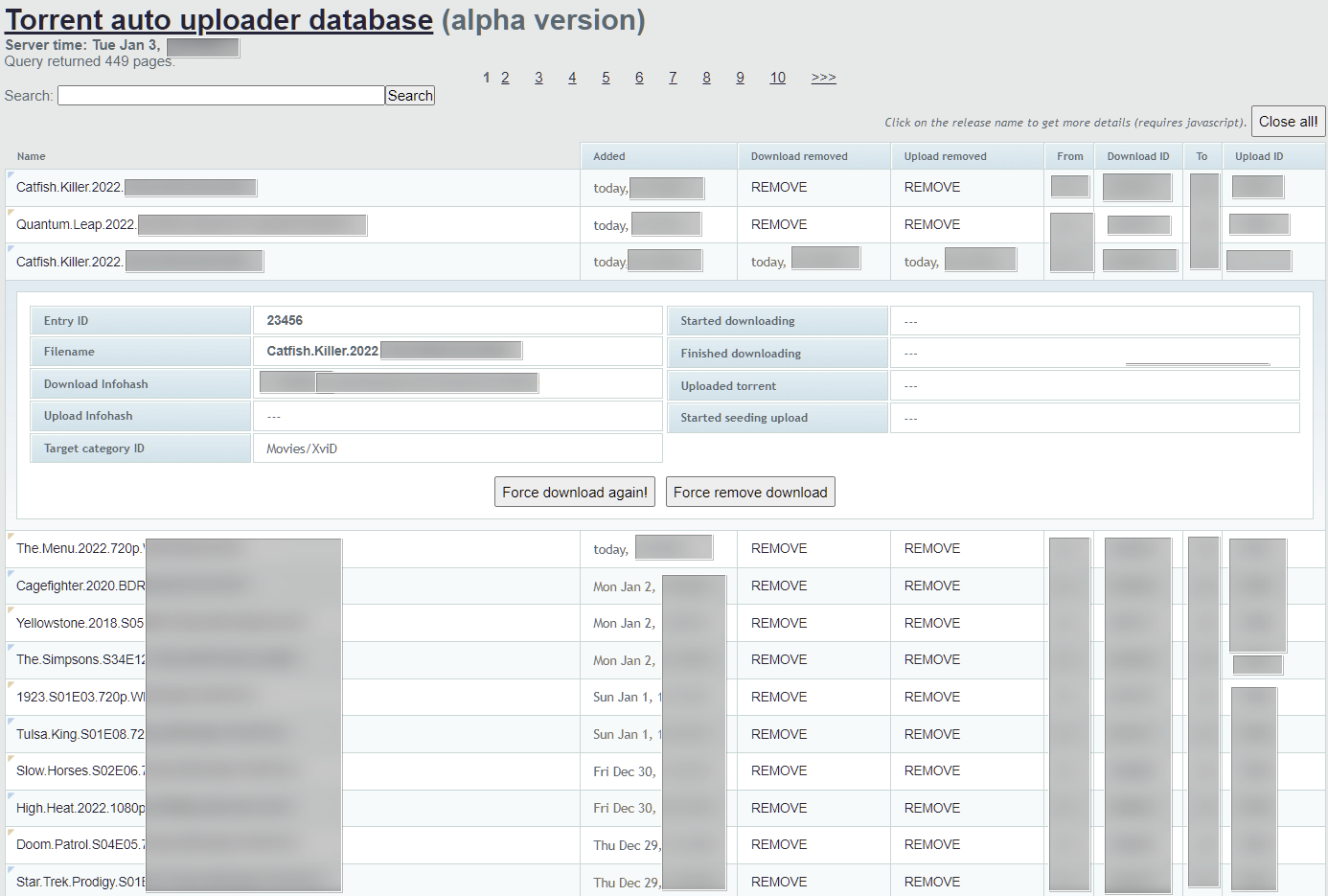
At least three major torrent sites are currently exposing intimate details of their operations to anyone with a web browser. TorrentFreak understands that the sites use a piece of software that grabs brand-new content from other sites before automatically uploading it to their own. A security researcher tried to raise the alarm but nobody will listen. From the report: To get their hands on the latest releases as quickly as possible, [private torrent sites, or private trackers as they're commonly known] often rely on outside sources that have access to so-called 0-Day content, i.e, content released today. The three affected sites seem to have little difficulty obtaining some of their content within minutes. At least in part, that's achieved via automation. When outside suppliers of content are other torrent sites, a piece of software called Torrent Auto Uploader steps in. It can automatically download torrents, descriptions, and associated NFO files from one site and upload them to another, complete with a new .torrent file containing the tracker's announce URL. The management page [here] has been heavily redacted because the content has the potential to identify at least one of the sites. It's a web interface, one that has no password protection and is readily accessible by anyone with a web browser. The same problem affects at least three different servers operated by the three sites in question.

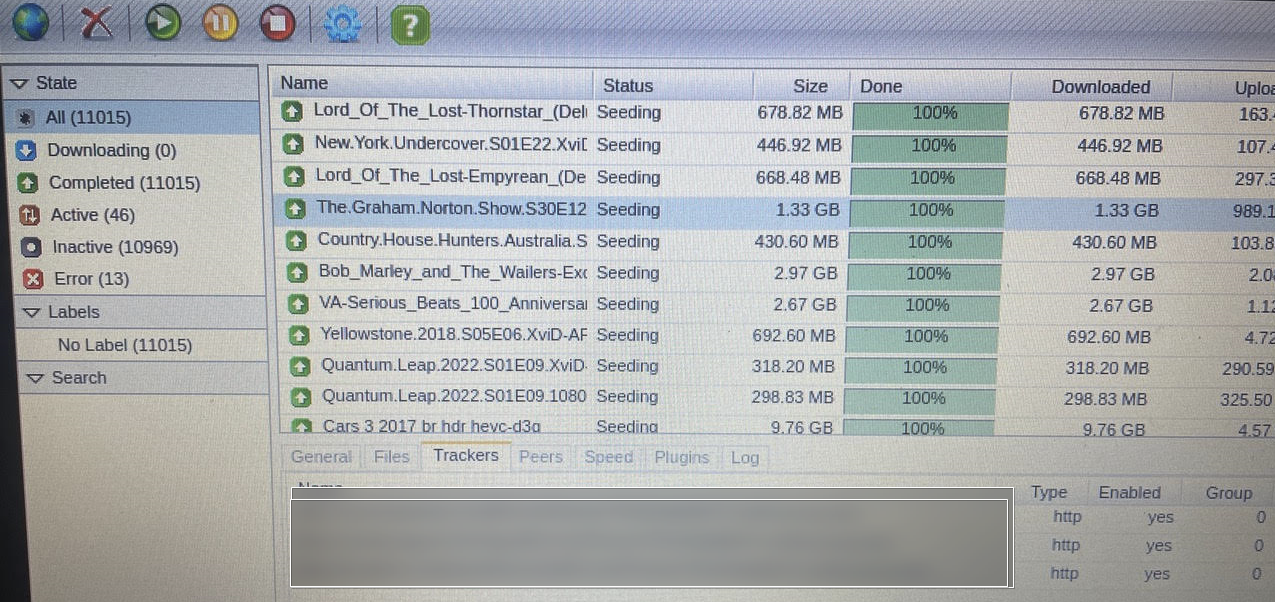
Torrent Auto Uploader relies on torrent clients to transfer content. The three sites in question all use rTorrent clients with a ruTorrent Web UI. We know this because the researcher sent over a whole bunch of screenshots and supporting information which confirms access to the torrent clients as well as the Torrent Auto Uploader software. The image [here] shows redactions on the tracker tab for good reason. In a regular setup, torrent users can see the names of the trackers coordinating their downloads. This setup is no different except that these URLs reference three different trackers supplying the content to one of the three compromised sites.

Rather than publish a sequence of completely redacted screenshots, we'll try to explain what they contain. One begins with a GET request to another tracker, which responds with a torrent file. It's then uploaded to the requesting site which updates its SQL database accordingly. From there the script starts checking for any new entries on a specific RSS feed which is hidden away on another site that has nothing to do with torrents. The feed is protected with a passkey but that's only useful when nobody knows what it is. The same security hole also grants direct access to one of the sites tracker 'bots' through the panel that controls it. Then there's access to 'Staff Tools' on the same page which connect to other pages allowing username changes, uploader application reviews, and a list of misbehaving users that need to be monitored. That's on top of user profiles, the number of torrents they have active, and everything else one could imagine. Another screenshot featuring a torrent related to a 2022 movie reveals the URL of yet another third-party supplier tracker. Some basic queries on that URL lead to even more torrent sites. And from there, more, and more, and more -- revealing torrent passkeys for every single one on the way.
Intel

Intel Announces Non-K 13th-Gen Core For Desktop: New 65 W and 35 W Processors (anandtech.com) 24

Intel has finally pulled the proverbial trigger on its non-K series SKUs, with sixteen new Raptor Lake-S series processors for desktops. AnandTech: Varied across a mixture of bare multiplier locked SKUs such as the Core i9-13900 and Core i7-13700 with a TDP of 65 W, Intel has also announced its T series models with a TDP of just 35 W for lower powered computing, including the Core i9-13900T. Furthermore, Intel has launched its Core i3 series family, offering decent performance levels, albeit with just performance (P) cores and no efficiency (E) cores, at a more affordable price starting from $109. Although the overclockable parts typically get consumers' attention when they launch, most of Intel's sales come through its regular non-K parts. Despite not being world record holders regarding performance or overclocking ability, the non-K series SKUs account for most system builders and OEM systems across the entry-level and mid-range offerings.

Intel's non-K launch offerings as part of its Raptor Lake-S architecture all come with a TDP of 65 W or lower, with variants representing the Core i9, Core i7, and Core i5; Intel has also now pulled the trigger on its 13th Gen Core i3 series. Intel has sixteen new desktop processors with varying performance, specification, and price levels, ranging from 24-core (8P+16E) to quad-core (4P+0E) options. Memory support on the Core i9 and Core i7 series includes both DDR5-5600 and DDR4-3200, while the new Core i5 and Core i3 series support DDR5-4800 and DDR4-3200 as per JEDEC specifications. There are three new Intel 13th Gen Core i9 series processors to select from, starting at $549 with the Core i9-13900. All Core i9 series non-K parts include 8P+16E cores for 32 threads, and 36 MB of Intel Smart L3 cache, with the Core i9-13900 ($549) and Core i9-13900F ($524) sharing the same 5.6 GHz turbo clock speed and a base frequency of 3.3 GHz on the performance (P) cores. Both models also include a base TDP of 65 W and a turbo TDP of 219 W, which is plenty of power budget for turbo clock speeds on both the P and E cores. The only caveat is that the Core i9-13900F doesn't include Intel's UHD 770 integrated graphics (32 EUs); consequently, it has a $25 lower MSRP.

The third of Intel's Core i9 non-K series chips is the Core i9-13900T, with the T signifying that it's a 35 W part. A lower power envelope means it sacrifices plenty of MHz to account for the drop in power. The Core i9-13900 has a P-core base frequency of 1.1 GHz, with a turbo clock speed of up to 5.3 GHz; the E-core specifications are similar, with a base frequency of 800 MHz and a turbo of 3.9 GHz. Even though the Core i9-13900T ($549) comes with a 35 W base TDP, it has a turbo TDP of 106 W. Moving onto the Core i5 family, Intel has three new Raptor Lake-S desktop processors, including two 65 W and one T series (35 W) part. All three include 30 MB of Intel The Core i7-13700 and Core i7-13700F both feature a P-core turbo clock speed of 5.2 GHz, while the restrictions in power mean that the P-core base frequency sits at just 2.1 GHz. For the efficiency (E) cores, this means that they have a base frequency of 1.5 GHz and a turbo clock speed of 4.1 GHz, while both conform to Intel's interpretation of 65 W; they both have a turbo TDP of 219 W. The Core i7-13700T, as per the specifications, has a base TDP of 35 W, but it has a turbo TDP of 106 W. As with other T-series family products, the lower TDP puts constraints on raw frequency, with a P-core base frequency of just 1.4 GHz, but the eight performance cores boost to 4.9 GHz, while the eight efficiency cores turbo up to 3.6 GHz. It shares the same level of 30 MB of L3 cache as the other Raptor Lake-S desktop Core i7 processors and includes Intel's UHD 770 integrated graphics chip.

Slashdot Top Deals