Facebook

Mark Zuckerberg's $71 Billion Wealth Wipeout Puts Focus On Meta's Woes (bloomberg.com) 83

An anonymous reader quotes a report from Bloomberg: Mark Zuckerberg's pivot into the metaverse has cost him dearly in the real world. Even in a rough year for just about every US tech titan, the wealth erased from the chief executive officer of Meta stands out. His fortune has been cut in half and then some, dropping by $71 billion so far this year, the most among the ultra-rich tracked by the Bloomberg Billionaires Index. At $55.9 billion, his net worth ranks 20th among global billionaires, his lowest spot since 2014 and behind three Waltons and two members of the Koch family.

It was less than two years ago when Zuckerberg, 38, was worth $106 billion and among an elite group of global billionaires, with only Jeff Bezos and Bill Gates commanding bigger fortunes. His wealth swelled to a peak of $142 billion in September 2021, when the company's shares reached as high as $382. The following month, Zuckerberg introduced Meta and changed the company's name from Facebook And it's been largely downhill from there as it struggles to find its footing in the tech universe.

Its recent earnings reports have been dismal. It started in February, when the company revealed no growth in monthly Facebook users, triggering a historic collapse in its stock price and slashing Zuckerberg's fortune by $31 billion, among the biggest one-day declines in wealth ever. Other issues include Instagram's bet on Reels -- its answer to TikTok's short-form video platform -- even though it's worth less in advertising revenue, while the industry overall has been affected by lower marketing spending due to concerns over an economic slowdown. The stock is also being dragged down by the company's investments in the metaverse, said Laura Martin, senior internet analyst at Needham & Co. Zuckerberg has said he expects the project will lose "significant" amounts of money in the next three to five years. In the meantime, Meta "has to get these users back from TikTok," said Martin. It's also hampered by "excessive regulatory scrutiny and intervention," she said.
Meta is "down about 57% this year, far more than the declines of 14% for Apple, 26% for Amazon and 29% for Google parent Alphabet," adds Bloomberg. "Meta is even narrowing the gap in 2022 losses with Netflix, which is down about 60%."
Communications

Elon Musk Enters In-Flight Wi-Fi Market With Small Satellites (bloomberg.com) 40

SpaceX wants to show the world its Starlink satellite system can deliver Netflix and YouTube at 30,000 feet. So it recently held a demo for the media aboard a jet operated by its first airline customer, regional carrier JSX. From a report: The short jaunt from Burbank to San Jose, California marks the start of Elon Musk's bid to seize in-flight business from satellite providers Intelsat and Viasat that already serve thousands of aircraft. It won't be easy, even for a serial market disrupter such as Musk.

"Are they a serious competitor? Yes," said Jeff Sare, president of commercial aviation for Intelsat, a leading provider of wireless service on airlines. Still, Sare said, "We don't believe there's anybody that can beat us." Starlink, part of Musk's Space Exploration Technologies, delivers broadband from a constellation of low-flying small satellites. Lower satellites circle the planet in 90 to 120 minutes. That's a departure from the established practice of using a few powerful spacecraft in higher and slower orbits. An upside for Starlink is its signals arrive sooner.

Movies

Adobe Thinks It Can Solve Netflix's Password 'Piracy' Problem 81

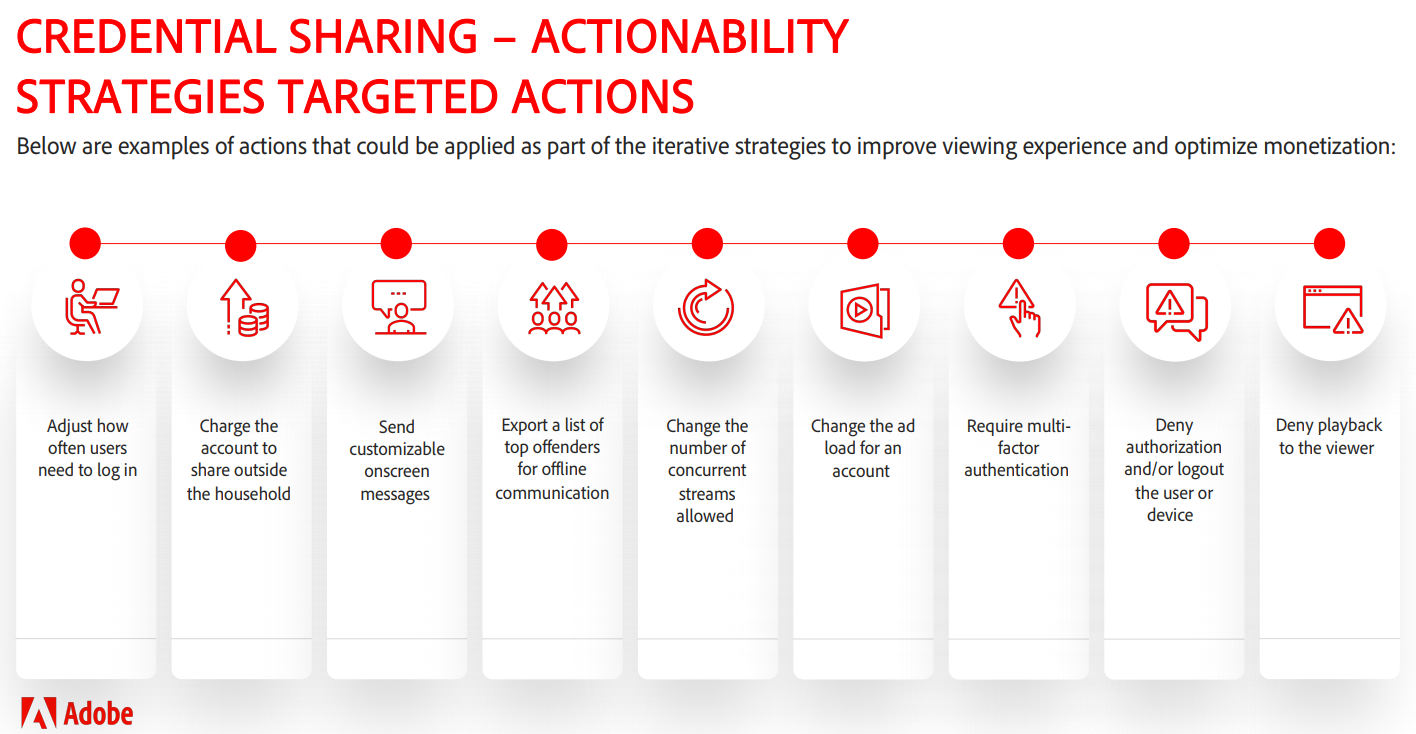
Adobe thinks it has the answer to Netflix's "password sharing" problem that involves up to 46 million people, according to a 2020 study. TorrentFreak reports: Adobe believes that since every user is different, any actions taken against an account should form part of a data-driven strategy designed to "measure, manage and monetize" password sharing. The company's vision is for platforms like Netflix to deploy machine learning models to extract behavioral patterns associated with an account, to determine how the account is being used. These insights can determine which measures should be taken against an account, and how success or otherwise can be determined by monitoring an account in the following weeks or months. Ignoring the obviously creepy factors for a moment, Adobe's approach does seem more sophisticated, even if the accompanying slide gives off a file-sharing-style "graduated response" vibe. That leads to the question of how much customer information Adobe would need to ensure that the right accounts are targeted, with the right actions, at the right time.

Adobe's Account IQ is powered by Adobe Sensei, which in turn acts as the intelligence layer for Adobe Experience Platform. In theory, Adobe will know more about a streaming account than those using it, so the company should be able to predict the most effective course of action to reduce password sharing and/or monetize it, without annoying the account holder. But of course, if you're monitoring customer accounts in such close detail, grabbing all available information is the obvious next step. Adobe envisions collecting data on how many devices are in use, how many individuals are active, and geographical locations -- including distinct locations and span. This will then lead to a "sharing probability" conclusion, along with a usage pattern classification that should identify travelers, commuters, close family and friends, even the existence of a second home.

Given that excessive sharing is likely to concern platforms like Netflix, Adobe's plan envisions a period of mass account monitoring followed by an on-screen "Excessive Sharing" warning in its dashboard. From there, legal streaming services can identify the accounts most responsible and begin preparing their "graduated response" towards changing behaviors. After monetizing those who can be monetized, those who refuse to pay can be identified and dumped. Or as Adobe puts it: "Return free-loaders to available market." Finally, Adobe also suggests that its system can be used to identify customers who display good behavior. These users can be rewarded by eliminating authentication requirements, concurrent stream limits, and device registrations.
Television

HBO Beats Netflix In Reversal Of Emmy Fortune (nytimes.com) 33

"Succession," HBO's portrait of a dysfunctional media dynasty, won best drama at the 74th Emmy Awards on Monday night, the second time the series has taken the prize. The New York Times: Jesse Armstrong, the show's creator, also took home the Emmy for best writing, the third time he's won in that category. And Matthew Macfadyen won best supporting actor in a drama for the first time for his performance on the show. It was the sixth time in eight years that HBO has taken the television industry's biggest prize for a recurring series, making it yet another triumphant night for the cable network. HBO, as well as its streaming service, HBO Max, won more Emmys (38) than any other outlet, besting its chief rival, Netflix (26).

"The White Lotus," the cable network's beloved upstairs-downstairs dramedy that took place at a Hawaiian resort, won best limited series, and tore through several other categories. The show won 10 Emmys altogether, more than any other series. Mike White, the show's creator and director, won a pair of Emmys for best directing and writing. And performers from the show, Murray Bartlett and Jennifer Coolidge, both received acting Emmys. "Mike White, my God, thank you for giving me one of the best experiences of my life," Bartlett, who played an off-the-wagon hotel manager, said from the Emmys stage. But HBO's chronicles of the rich were not the only winners on Monday night.

"Ted Lasso," the Apple TV+ sports series, won best comedy for a second consecutive year, as the tech giant continues on an awards show tear. Apple TV+, which had its debut in November 2019, won best picture at the Oscars ("CODA") earlier this year. And Jason Sudeikis repeated as best actor in a comedy as the fish-out-of-water soccer coach in "Ted Lasso." There were other big moments in the comedy awards. Quinta Brunson, the creator of the good-natured ABC workplace sitcom, "Abbott Elementary," about a group of elementary schoolteachers at an underfunded Philadelphia public school, won for best writing in a comedy. It was only the second time a Black woman won the award (Lena Waithe was the first, in 2017, for "Master of None").

Businesses

Peloton Founders Are Leaving the Company (bloomberg.com) 42

An anonymous reader quotes a report from Bloomberg: Peloton Executive Chairman and co-founder John Foley is stepping down from the fitness company as part of a leadership shake-up, extending the turbulence at a business trying to pull out of a deep slump. Foley, who helped start Peloton in 2012 and served as chief executive officer for 10 years, is resigning effective Monday, the company said in a statement. Foley took the executive chairman role in February when he handed the reins to CEO Barry McCarthy, a veteran of Spotify and Netflix.

Chief Legal Officer Hisao Kushi, another co-founder, is also headed for the exits. He'll be replaced in that role by Tammy Albarran, who Peloton recruited from Uber Technologies Inc. The chairman role, meanwhile, will be filled by Karen Boone, a former Restoration Hardware executive who currently serves as lead independent director. Peloton investors initially applauded the changes, sending the shares up as much as 5.3% to $11.64 in extended trading on Monday. But the rally soon evaporated, with the stock declining more than 2%. The reshuffling extends a year of upheaval at New York-based Peloton, which thrived in the early days of the pandemic but is now suffering from declining sales and mounting losses. Its shares are down about 90% over the past year, and the company has struggled to work through a glut of inventory.

Separately, Chief Commercial Officer Kevin Cornils is also leaving Peloton and won't be replaced. Some of Cornils's responsibilities will be assumed by Dion Sanders as he takes the role of chief emerging business officer, according to an internal memo from McCarthy reviewed by Bloomberg. Chief Content Officer Jen Cotter will assume control of apparel and accessories, showing that the company remains committed to that market. Albarran will take over Peloton's legal operations on Oct. 3. She helped oversee a corporate makeover at Uber, which set out to change its image in 2017 after its hard-charging style led to scandals and a strained relationship with drivers. Peloton looks to draw on the experience of Albarran and Boone to "help move the company forward into our next chapter of growth," McCarthy said.

Games

Netflix Partners With Ubisoft To Bolster Fledgling Gaming Division (ft.com) 18

An anonymous reader quotes a report from the Financial Times: Netflix has teamed up with Ubisoft (Warning: source may be paywalled; alternative source), one of Europe's biggest video game companies, as the streaming giant seeks to bolster its fledgling gaming business. The California-based streaming service will launch three new mobile games next year based on Ubisoft's games, including its most successful title Assassin's Creed. The move comes as Netflix attempts to accelerate growth of its new gaming arm amid a slowdown in the company's streaming business. The streaming group has lost more than half of its market value since April when it revealed its decade-long subscriber growth had ended.

The partnership will entail the French gaming group developing the mobile games for Netflix. This will also include a game based on Ubisoft's Mighty Quest, a castle-building and monster-looting game, and the historical puzzle adventure game called Valiant Hearts. The games will be made available exclusively to Netflix subscribers, with no ads or in-app purchases, allowing Ubisoft to tap into new audiences and experiment with fresh formats for existing titles. No details of the deal value have been announced.
"Netflix has launched 28 games and acquired three gaming studios, including Night School Studio, which makes the supernatural adventure game Oxenfree, and Texas-based Boss Fight Entertainment," notes the report. "The streaming giant plans to have a total of 50 games on its roster by the end of the year."
Television

Streaming TV is Having an Existential Crisis, and Viewers Can Tell (washingtonpost.com) 144

Streaming television is going through an existential crisis, involving the people who make it and the viewers who watch it. Its revolutionary zeal has naturally faded, as that initial wave of near limitless expansion, boundless creative opportunities and vast archival choices crashes ashore, after a spate of megamergers and a drop in new subscribers. From a report: Just when streaming has finally attracted more viewers than cable or broadcast TV, its major players are engaged in a long-predicted war for subscribers, who are becoming all too aware of rising subscription prices and, both subtly and directly, a change in what programs get made and how long they stick around. Commercials could soon become more common, and services may be bundled (for one low monthly price!), already triggering visions of a future that recalls the dark days of cable.

The list of seismic rumblings in recent weeks is long, as chronicled in the Hollywood Reporter, Variety and elsewhere: Warner Bros. Discovery is cutting shows from its archives and unfinished movies from HBO Max as it prepares to merge it with its sister streaming service Discovery Plus, having promised its shareholders a $3 billion cut in costs. Faced with a plunging stock price and worrisome subscriber loss, Netflix plans to add an advertising-supported model for a lower price and may crack down on password sharing. Disney Plus, Hulu and ESPN Plus, which can all be subscribed to in a cable-esque bundle, are raising prices after taking a more than $1 billion hit in the fiscal third quarter. [...] The fear of having your show or movie deleted on an executive's whim -- a growing reality for many, including Katai -- is compounded by the fact that in the post-DVD digital age, viewers may never be able to access the shows again. Showrunners might not even have physical copies of their own work. And that's not the only downside for creators.

Television

Netflix Ad Tier Launch Moved Up to November To Get Ahead of Disney+ (variety.com) 35

Netflix is moving up the timeline for the debut of its cheaper, ad-supported plan to November -- in order to get out before the Dec. 8 launch of the Disney+ tier with advertising. From a report: In July, Netflix told investors that it was targeting the launch of the ad-supported plan "around the early part of 2023." But now, Netflix's ad-supported is set to go live Nov. 1 in multiple countries, including the U.S., Canada, U.K., France and Germany, according to industry sources who have been briefed on the streamer's plans. That would be a little over a month before Disney+ Basic, priced at $7.99/month, hits the market in the U.S.

Netflix declined to comment. "We are still in the early days of deciding how to launch a lower-priced, ad-supported tier and no decisions have been made," a company rep said. Sources confirmed the new Nov. 1 launch date, which was previously reported by the Wall Street Journal. Netflix and its exclusive ad partner, Microsoft, have requested ad buyers submit initial bids next week, with a "soft $65 CPM" -- the cost per thousand views -- meaning that the company is open to negotiating the ad rates. That's well above industry CPMs of sub-$20. Sources speculate Netflix's request for proposals from ad buyers will function as a Dutch auction, with the company looking to see what the market will bear.

Chrome

Chrome Extensions With 1.4M Installs Covertly Track Visits and Inject Code (arstechnica.com) 7

Google has removed browser extensions with more than 1.4 million downloads from the Chrome Web Store after third-party researchers reported they were surreptitiously tracking users' browsing history and inserting tracking code into specific ecommerce sites they visited. ArsTechnica: The five extensions flagged by McAfee purport to offer various services, including the ability to stream Netflix videos to groups of people, take screenshots, and automatically find and apply coupon codes. Behind the scenes, company researchers said, the extensions kept a running list of each site a user visited and took additional actions when users landed on specific sites. The extensions sent the name of each site visited to the developer-designated site d.langhort.com, along with a unique identifier and the country, city, and zip code of the visiting device. If the site visited matched a list of ecommerce sites, the developer domain instructed the extensions to insert JavaScript into the visited page. The code modified the cookies for the site so that the extension authors receive affiliate payment for any items purchased. To help keep the activity covert, some of the extensions were programmed to wait 15 days after installation before beginning the data collection and code injection.
Businesses

Snap's Chief Business Officer Is Leaving To Run Ads On Netflix (theverge.com) 17

Netflix has found an executive to lead its plan for an ad-supported tier: Snap's chief business officer and top ad exec, Jeremi Gorman. The Verge reports: Gorman on Tuesday told colleagues at Snap that she was leaving to join Netflix along with Peter Naylor, Snap's vice president of ad sales for the Americas, according to two people familiar with the matter. Russ Caditz-Peck, a Snap spokesperson, confirmed the departures. Both Gorman and Naylor are leaving Snap amid a restructuring of its ads team and layoffs hitting the social media firm this week. Snap plans to cut roughly 20 percent of its workforce starting Wednesday, The Verge earlier reported.

Kumiko Hidaka, a Netflix spokesperson, confirmed that Gorman will be the company's President of Worldwide Advertising and that she'll report to COO Greg Peters. Naylor will lead Netflix's ad sales organization and report to Gorman. AdAge first reported on the hires. "Jeremi's deep experience in running ad businesses and Peter's background in leading ad sales teams together will be key as we expand membership options for consumers through a new ad-supported offering," Peters said in a statement.

Television

Big Budget Blockbusters Arrive Amid Fears of 'Peak TV' (ft.com) 79

Crop of expensive fantasy adaptations from Amazon and HBO Max served up at subsidised prices. Financial Times: Since 2016, the veteran US television executive John Landgraf has been predicting the arrival of "peak TV" -- the moment when the number of new scripted shows reaches an all-time high. The streaming boom has proved him wrong every time but he gamely made the prediction again this month, telling guests at the Television Critics Association press tour that 2022 would mark "the peak of the peak TV era." Landgraf, chair of Disney's FX network, conceded that he could be wrong this time too. But there is little doubt that this autumn will present audiences with a flood of some of the most expensive television ever produced. On September 2, Amazon Prime will release its adaptation of The Lord of the Rings, with an estimated budget of $465mn for the first season -- almost enough to make Top Gun: Maverick three times over.

HBO Max's House of the Dragon -- the prequel to Game of Thrones -- is reported to have cost $200mn for the season's 10 episodes. At Disney Plus, Star Wars: Andor will lead a large slate of new programmes that include a Pinocchio remake, She Hulk, and a spin-off of the Cars franchise. These shows are being served up to consumers at subsidised prices by streaming platforms making record losses. The only profitable exception is Netflix, but the industry pioneer's market value has plunged almost $200bn over the past year because of slowing subscriber growth. Its share price is languishing at a four-year low. The forthcoming crop of new programming was given the green light during a headier time, when Wall Street cheered as streaming services committed lavish sums to compete. But faith in the streaming business model -- and investor tolerance for profligate spending -- has waned as Netflix's once-blistering subscription growth has gone into reverse.

[...] On top of that, there are growing concerns that inflation will bite into discretionary spending, including on streaming services. "Everyone [in Hollywood] is throwing big dollars after big things," said Niels Juul, who was an executive producer of Martin Scorsese's Netflix film The Irishman. "But [subscribers] are inundated now to the point where they are looking at their monthly bills and saying, 'Something's got to go -- I've got $140 worth of subscriptions here!'" Even so, Tom Harrington at Enders Analysis said consumers were still getting a better deal than the streaming companies themselves. "People get through $100mn of TV in a day and say: 'what's next?' From a consumer point of view that is great. But for a video operator, it's clearly unsustainable."

Businesses

Amazon Is Looking To Buy Electronic Arts, Report Says (usatoday.com) 48

An anonymous reader shares a report: According to GLHF sources, Amazon will announce today that it has put in a formal offer to acquire Electronic Arts (EA), the publisher behind Apex Legends, FIFA, Madden, and more. Rumors have been circling online for a few weeks about a potential EA buyout, with Apple, Disney, and Amazon listed as potential buyers. As per our sources, Amazon has finally made an offer. It's a smart business move from Amazon, which is also making big moves in television. After the success of The Witcher and Arcane on Netflix -- both shows built around big video games -- Amazon could potentially use EA's franchises as settings for new shows. Mass Effect, Dragon Age, Dead Space -- there's plenty of potential in EA's library for transmedia opportunities.
Television

Streaming TV Viewing Passed Cable Last Month in Industry First (bloomberg.com) 32

The amount of time US audiences spent watching online TV surpassed cable for the first time ever. From a report: Subscribers to services like Netflix and Hulu accounted for 34.8% of all TV consumption in July, the research firm Nielsen said Thursday. That edged out cable TV at 34.4%. Broadcast was a distant 21.6%. Audiences watched an average of 190.9 billion minutes per week of streamed content in July, Nielsen said. That passed the tally for April 2020, when people were stuck at home because of the pandemic. While consumers spent almost 23% more time streaming, cable and broadcast viewing slumped.
Businesses

Netflix's Ad-Supported Plan Will Disable Ad Skipping and Block Downloads of Shows and Films (bloomberg.com) 53

Netflix isn't planning to let users of its new ad-supported tier download shows and movies to their devices for offline viewing, according to code found inside of the company's iPhone app, removing a feature that customers enjoy on its regular service. From a report: The move suggests Netflix is doing what it can to distinguish the upcoming service from its current offerings. The streaming giant, which eschewed advertising for years, is planning to roll out the ad-supported level by early next year. But hints about the new service are already reflected in code hidden within its iPhone app. "Downloads available on all plans except Netflix with ads," according to text in the app that was discovered by developer Steve Moser and shared with Bloomberg News. The code also suggests that users won't be able to skip ads -- a common move in the streaming world -- and playback controls won't be available during ad breaks.
Businesses

Streaming Services Deal With More Subscribers Who 'Watch, Cancel and Go' (wsj.com) 161

It is gradually getting tougher for streaming-video companies to hold on to their subscribers, as consumers who are flooded with options weed out services they don't need at any given time. From a report: Some 19% of subscribers to premium services -- a group that includes Netflix, Hulu, AppleTV+, HBO Max and Disney+, among others -- canceled three or more subscriptions in the two years up to June, according to new data from subscriber-measurement firm Antenna. That is up from 6% in the two-year stretch ended in June 2020.

The average rate of monthly customer defections among premium services in the U.S. was 5.46% in July, up from 4.46% a year ago and 4.05% in July 2020, according to Antenna. Many households signed up for multiple streaming services a few years ago as options in the marketplace proliferated, subscription prices were lower and the pandemic boosted demand for in-home entertainment. Slowly but surely, they have gotten more choosy and frugal. Some consumers cancel subscriptions when they finish a hit series on a service, then switch to another that has something else compelling.

Television

Disney's Streaming Services Now Have More Subscriptions Than Netflix (indiewire.com) 54

"Netflix now has a million fewer subscriptions than rival Disney..." reports the Independent. "But it does not necessarily mean that Netflix has fewer subscribers. If a person is subscribed to two of Disney's offerings, that will count as two subscriptions, and the company does not divulge how many individuals are signed up to its services." (Digital Trends notes that "Following its acquisition of 21st Century Fox, Disney also controls Hulu," as well as the streaming sports site ESPN+.)

If you just want a straight Netflix-to-Disney+ comparison, the Independent reports Netflix with 220.67 million total subscribers, while IndieWire reported that at the end of June, Disney+ had 152.1 million subscribers. (Disney's chief executive says between March and June, Disney+ added 14.4 million subscribers, according to the Independent.)

IndieWire goes on to say that ESPN+ reported 22.8 million subcribers earlier this year, while Hulu had reported 46.2 million subscribers, so, "combined the subscriptions for the individual services making up the Disney Bundle just surpassed Netflix's overall paid global subscriber count." Here, we'll point out that Hulu is still the only one of the Bundle that makes money. However, its operating income declined in Q3, while losses at both Disney+ and ESPN+ increased.

Disney+ is expected to reach profitability in 2024, executives said Wednesday on Disney's Q3 conference call.

Advertising

Apple Finds Its Next Big Business: Showing Ads on Your iPhone (theverge.com) 120

"Apple is set to expand ads to new areas of your iPhone and iPad in search of its next big revenue driver," reports Bloomberg.

The Verge writes that Apple "could eventually bring ads to more of the apps that come pre-installed on your iPhone and other Apple devices, including Maps, Books, and Podcasts." According to a report from Bloomberg's Mark Gurman, Apple has internally tested search ads in Maps, which could display recommendations when you search for restaurants, stores, or other nearby businesses. Apple already implements a similar advertising model on the App Store, as developers can pay to have their app promoted on a search page for a particular query, like "puzzle games" or "photo editor." As noted by Gurman, ads on Maps could work in the same way, with businesses paying to appear at the top of search results when users enter certain search terms.

Gurman believes that Apple could introduce ads to its native Podcasts and Books apps as well. [Gurman describes this as "likely".] This could potentially allow publishers to place ads in areas within each app, or pay to get their content placed higher in search results. Just like Maps, Podcasts and Books are currently ad-free.... Gurman mentions the potential for advertising on Apple TV Plus, too, and says the company could opt to create a lower-priced ad-supported tier, something both Netflix and Disney Plus plan on doing by the end of this year.

Bloomberg points out that Apple is already displaying ads inside its News app — where some of the money actually goes back to news publishers. ("Apple also lets publishers advertise within their stories and keep the vast majority of that money.")

And while you can disable ad personalization — which 78% of iOS users have done — Bloomberg notes that "Another ironic detail here is that the company's advertising system uses data from its other services and your Apple account to decide which ads to serve. That doesn't feel like a privacy-first policy."

Bloomberg's conclusion? "Now the only question is whether the customers of Apple — a champion of privacy and clean interfaces — are ready to live with a lot more ads."
Crime

Netflix Airs Episode on Kansas 'Swat' Perpetrator, While Victim's Family Sues Policeman (kwch.com) 44

In June Netflix launched Web of Make Believe: Death, Lies, and the Internet, a true-crime series. It began with an episode documenting the 2017 death of a 28-year-old Kansas man named Andrew Finch after California gamer Tyler Barriss faked an emergency call from Finch's home to the Wichita, Kansas police department.

So where are they now? Barriss is now serving a 20-year prison sentence, Bustle reports. "Barriss, a resident of Los Angeles, California, pled guilty to a total of 51 charges, all having to do with hoax emergency calls he'd made, including the call that resulted in Finch's murder." Barriss received as 12-and-a-half year sentence for the Kansas call, and then another 8-and-a-half-year sentence for all the other illegal calls placed between 2015 and 2017 to 17 different U.S. states. "He also received another five years of supervised release in Washington, D.C., for phoning in bomb threats to the FBI and Federal Communications Commission in 2017."

And the 19-year-old who'd hired Barriss "received a 15-month prison sentence in 2019 after pleading guilty to obstruction of justice."

Meanwhile, Andrew Finch's surviving family members filed legal actions against the police department responsible for Finch's death. And while police officers normally receive "qualified immunity" protecting them from lawsuits over the performance of their duties, there was an update last month: An officer with the Wichita Police Department will face a civil trial in connection with the December 2017 swatting incident... Justin Rapp was the officer who shot the unarmed man. A U.S. appeals court sided with the Kansas district court in denying Officer Rapp qualified immunity in Finch's death. The court said a reasonable jury could believe Finch was unarmed and unthreatening when Rapp fired the shot that killed him.

Finch's family brought the excessive force civil suit. Sedgwick County District Attorney Marc Bennett declined to prosecute Rapp for fatally shooting Finch. The Wichita Police Department conclude Rapp didn't violate department policy....

Along with its conclusion that the civil case against Rapp can move forward, the appellate court also affirmed the district court's summary judgment on liability claims against the City of Wichita. This decision essentially maintained the city and the WPD as a whole weren't liable in Finch's death. The court of appeals dismissed arguments saying, in sum, "[the lawsuit from Finch's family] has failed to show any deliberately indifferent policies or customs that caused Rapp to use excessive lethal force."

Sci-Fi

Gen Z Streaming Stars React to Classic Sci-Fi Movies of the '80s (nytimes.com) 103

The New York Times tried an experiment with four classic science fiction films from exactly 40 years ago: If you were a moviegoer in the 1980s, you were constantly presented with imaginative questions that seemed cosmic and existential. Would humanity someday settle its differences here on earth and learn to travel the stars as a unified species? Or were we destined for a dystopian future with little more to look at than smoggy skies and gargantuan billboards? Did our advancing technology have the ability to literally absorb us or replace us entirely? Might we someday encounter alien life that was intelligent and benevolent? Surely some of these questions would be answered by the far-off future year 2000.

"Blade Runner," "E.T. the Extra-Terrestrial," "Tron" and "Star Trek II: The Wrath of Khan," all released 40 years ago, in the summer of '82, have become foundational works, shaping the next several decades of fantasy franchises. But what if this wasn't the science-fiction cinema you grew up with? What if you came of age in a later generation, and knew these movies only as celebrated if somewhat distant influences? Would they still seem exciting, innovative and thought-provoking? Or — to confront another terrifying speculative scenario — would they just seem uncool?

To find out for ourselves, we enlisted four stars of the current day — all born in the 21st century — and asked them each to watch one of those seminal science-fiction films. They shared their reactions and reflections, didn't judge the special effects too harshly and still shed tears when they thought E.T. died.

They showed Star Trek II: The Wrath Of Khan to Celia Rose Gooding, who plays Uhura in the Paramount+ series Star Trek: Strange New Worlds. Gooding's response was "the machoism of the men in charge has not changed in the future... these are still two guys trying to see whose ship is bigger."

Meanwhile, the 22-year-old star of Netflix's Cobra Kai, Jacob Bertrand, was watching both Tron and its 2010 sequel Tron: Legacy. "I feel like the new one doesn't hold a candle to the old one.... I was trying to think of how they could have done this with the technology at the time, and everything that I could think of just sounds like so much work. I was like, dude, how are they pulling this off back then? Holy cow, these people were dedicated."

19-year-old Iman Vellani (star of Disney+ show Ms. Marvel) felt that Blade Runner "hit the mark... I feel like everyone of my generation is always searching for some higher purpose or trying to prove they're worthy enough or special enough for the spotlight, or just worthy of more life. I find myself sympathizing with the replicants a lot more, upon rewatch, in a way I did not expect."

And the 19-year-old star of Netflix's Stranger Things, Finn Wolfhard, described E.T. the Extra-Terrestrial as "incredibly sweet."
Cellphones

'Samsung Still Hasn't Given Us a Good Reason To Buy a Foldable Phone' (theverge.com) 73

Earlier this week, Samsung unveiled their new Z Fold 4 and Z Flip 4 -- two of the most refined and polished foldable smartphones on the market. However, what Samsung hasn't done (or any other phone manufacturer for that matter) "is make the case for why you'd actually want a foldable phone," writes David Pierce via The Verge. "And until it can explain why it's worth all the extra cost and tradeoffs, I'm having a hard time figuring out why you'd be willing to give up the phone you know and love to get one." From the report: What Samsung needs to do with the Galaxy Fold (and the rest of the industry will eventually need to do with their own foldables) is convince people that it's worth buying a phone that's more expensive, more fragile, and takes up more room in your pocket. Right now, the worst thing about foldables is that they force you to make significant sacrifices on the most important device you own: your smartphone. The new Fold 4 is a little shorter, about an ounce heavier, and about twice as thick as the Galaxy S22 Ultra. It's also $600 more expensive. The Ultra has a bigger battery, better camera specs, and a 6.8-inch screen that supports an S Pen. The Fold 4, when opened, is noticeably larger, but the candy bar phones still get plenty big. And Fold makes a lot of sacrifices for some more real estate.

It's not even clear to me that Samsung knows why you should make all of those sacrifices. On its website, one of the first selling points the company offers is that you can prop up the screen on a table by opening it halfway for watching or taking videos hands-free. Here in reality, we call that a kickstand, and this is an awfully expensive one. In this mode, you're also only using half the screen, which sort of defeats the whole purpose. So far, multitasking seems to be the foldable's one actual advantage. Open up your Galaxy Fold, and you can run two apps side by side or even three or four on the screen at once! This, I agree, is a delightful thing. Being able to use my browser and my notes app side by side or see my calendar and my email together is much better than constantly swiping between two full-screen apps. And seeing two pages at a time in the Kindle app is the best. And you know what? Big screens are just good -- good for games, good for reading, good for watching Netflix.

But these aren't just arguments for foldables; they're arguments for tablets. And so far, the arguments for Android tablets don't seem to be convincing many users. While Android has gotten better as a large-screen operating system, and the Fold 4's software being based on Android 12L is a good sign, too many apps that are "optimized" for foldables are actually just sticking a giant sidebar onto one side, which doesn't accomplish much. Others just streeeetch everything to fit the larger screen. Don't even get me started on how the vast majority of apps deal with Microsoft's approach of two separate screens attached with a hinge. Samsung has done an admirable job of wrangling all of Android's weirdness onto the Fold's screen, and in general, it's not that the Fold doesn't work; it's that there's nothing about the Fold that is dramatically better than the phone or tablet you might already be carrying around. And shoving them into a single device actually makes them both a little worse.

Slashdot Top Deals