Linux Business

Canonical Close To $30M Critical Mass; Should Microsoft Worry? 625

ruphus13 writes "Mark Shuttleworth, CEO of Canonical, claims that the company is very close to the $30M mark, at which point, they will be a self-sustaining company. While people feel that this should not worry Microsoft, the real question is whether a 10,000 person effort on a failure like Vista can actually be the paradigm of a long-term strategy. From the article: 'Microsoft had 10,000 people [the article is unclear whether these were all developers, or administrative and support staff were factored in] working on Vista for a five year period ... huge profits in any given year can mean relatively little five years on. Canonical's self-sustaining revenue may not be threatening — but it leaves one wondering how sustainable Microsoft's development process really is.'"
GNOME

Building Linux Applications With JavaScript 288

crankymonkey writes "The GNOME desktop environment could soon gain support for building and extending applications with JavaScript thanks to an experimental new project called Seed. Ars Technica has written a detailed tutorial about Seed with several code examples. The article demonstrates how to make a GTK+ application for Linux with JavaScript and explains how Seed could influence the future of GNOME development. In some ways, it's an evolution of the strategy that was pioneered long ago by GNU with embedded Scheme. Ars Technica concludes: 'The availability of a desktop-wide embeddable scripting language for application extension and plugin writing will enable users to add lots of rich new functionality to the environment. As this technology matures and it becomes more tightly integrated with other language frameworks such as Vala, it could change the way that GNOME programmers approach application development. JavaScript could be used as high-level glue for user interface manipulation and rapid prototyping while Vala or C are used for performance-sensitive tasks.'"
Handhelds

Second Prototype of the $200 Open Source Tablet 259

holy_calamity writes "TechCrunch blogger Mike Arrington decided last year to invent a new class of low-cost internet tablet using open source hardware and software. The second prototype has been unveiled, sporting a 12-inch touchscreen powered by a Via Nano processor, 1 GB of ram and a 4 GB flash drive. It runs a browser and nothing else on top of a custom Linux build. 'Resolution is 1024×768, which means the vast majority of websites are viewed in full width without scrolling. The device also has wifi, an accelerometer (so when you turn the screen on its side you can view more of a web page), a camera and a four cell battery.'"
Networking

Active Directory Comes To Linux With Samba 4 276

Da Massive writes in with another possible answer to a recent Ask Slashdot about FOSS replacements for Microsoft AD server. "Enterprise networks now have an alternative choice to Microsoft Active Directory (AD) servers, with the open source Samba project aiming for feature parity with the forthcoming release of version 4, according to Canberra-based Samba developer Andrew Bartlett. Speaking at this year's linux.conf.au Linux and open source conference in Hobart, Bartlett said Samba 4 is aiming to be a replacement for AD by providing a free software implementation of Microsoft's custom protocols. Because AD is 'far more than LDAP and Kerberos,' Bartlett said, Samba 4 is not only about developing with Microsoft's customization of those protocols, it is also about moving the project beyond just providing an NT 4 compatible domain manager."
Bug

Ubuntu's Laptop Killing Bug Fixed 271

jeevesbond writes "Back in October of 2007 we discussed a bug that would dramatically shorten the life of laptops using Ubuntu. Ubuntu users will be glad to know that a fix has finally been released for Ubuntu versions 9.04, 8.10 and 8.04 (LTS). However, as this fix is not yet in the update repositories, anyone wishing to test it should follow these instructions for enabling the 'proposed' repository. Report your results on the original bug report. Happy testing!"
Debian

The Secret Lives of Ubuntu and Debian Users 501

jammag points out a look at statistics from the Popularity Contest projects on Debian and Ubuntu. These projects track the download and upgrade habits of their respective distributions' users, revealing — no surprise here — that Ubuntu users are more likely to be newbies than Debian users. The numbers reveal, for instance, that 86 percent of Ubuntu machines use the proprietary NVidia driver, where only a mere sliver of Debian machines do. Likewise, Debian users are far more eclectic in their software choice, less likely to use any default options. The article concludes with a look at the limits of what conclusions can be drawn from statistics like these. "In general, Debian users seem more eclectic in their use of software than Ubuntu users, and less likely to use an application simply because it is included by default. Debian users also seem more likely to be concerned to maintain a free installation than Ubuntu users — a conclusion that is hardly surprising when you consider Debian's reputation for freedom, but is still interesting to see being supported by statistics. ... To what extent last week's figures are typical is uncertain. Very likely, studying the figures over a longer period would produce different results. Possibly, too, those who participate in the Popularity Contests are not typical users of either Ubuntu or Debian. "
Cellphones

Agora Android Phone Delayed By Glitches 84

An anonymous reader points out this report at News.com.au which says that "THE first Australian 'Google phone' set to go on sale within weeks has been delayed indefinitely, with the manufacturer Kogan forced to refund early buyers. In a statement released this afternoon, the company said the delay was 'due to future interoperability issues.'The Agora reached a very late stage of development, manufacturing had commenced and we were within days of shipping the product to customers,' company founder Ruslan Kogan said in a statement."
Handhelds

Debian For Android Installer Released 160

dooberrymctavish writes "You can now download an installer and bootloader for getting Debian running on your Android (G1 at the moment) device; the whole install process will take you about 10 minutes, and leaves you with access to the full plethora of programs available in Debian and lets you continue using your phone as it was intended to be: as an Android device with all the capabilities thereof. Here's a look at it running.
Networking

Ubuntu Download Speeds Beat Windows XP's 515

narramissic writes "Doing a download speed test of his Time Warner cable connection, James Gaskin discovered something odd, something that he is quick to note isn't a rigorous benchmarked lab test. The discovery: His Ubuntu machine 'returned a rating from the Bandwidth.com test of 22-25mbps over several tests' while the same test done from a Windows XP PC returned a rating of 12-14mbps. The two computers used in the test are 'almost identical: both off-lease Compaq small form factor D515s, part of the very popular corporate desktop D500 family. Both have Pentium 4 processors running at 2GHz. The Ubuntu machine has 768MB of RAM, while the XP box has only 512MB of RAM. Both run Firefox 3 as their browser.' Gaskin's question: Can a little extra RAM make that much difference in Internet download speeds or does Ubuntu handles networking that much faster than Windows XP?"
Image

Woman Claims Ubuntu Kept Her From Online Classes Screenshot-sm 1654

stonedcat writes "A Wisconsin woman has claimed that Dell computers and Ubuntu have kept her from going back to school via online classes. She says she has called Dell to request Windows instead however was talked out of it. Her current claim is that she was unaware that she couldn't install her Verizon online disk to access the Internet, nor could she use Microsoft Word to type up her papers."
Bug

Hope For Fixing Longstanding Linux I/O Wait Bug 180

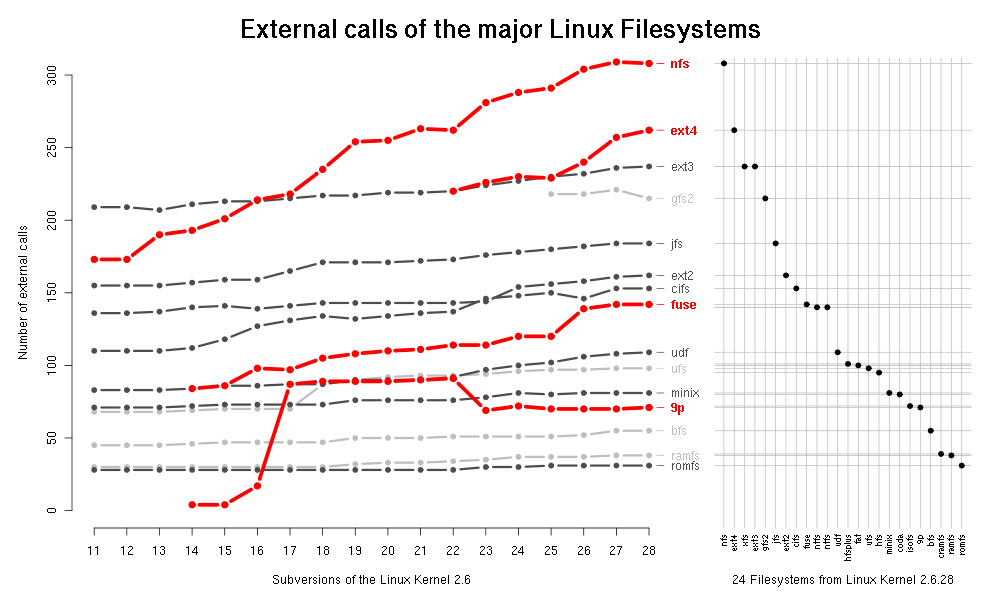
DaGoodBoy writes "There has been a long standing performance bug in Linux since 2.6.18 that has been responsible for lagging interactivity and poor system performance across all architectures. It has been notoriously difficult to qualify and isolate, but in the last few days someone has finally gotten a repeatable test case! Turns out the problem may not even be disk related, since the test case triggers the bug only by transferring data either between two processes or threads. The test results are very revealing. The developer ran regressions all the way back to version 2.6.15 that demonstrate this bug has more than doubled the time to run the test in 2.6.28. Many, many people working at improving the desktop performance of Linux will be very happy to see this bug die. I know that I, personally, will find a way to send the guy that found this test case his beverage of choice in thanks. Please spread the word and bring some attention to this issue so we can get it fixed!"
Debian

Ubuntu 9.04 Daily Build Boots In 21.4 Seconds 654

Pizzutz writes "Softpedia reports that Ubuntu 9.04 Boots in 21.4 Seconds using the current daily build and the newly supported EXT4 file system. From the article: 'There are only two days left until the third Alpha version of the upcoming Ubuntu 9.04 (Jaunty Jackalope) will be available (for testing), and... we couldn't resist the temptation to take the current daily build for a test drive, before our usual screenshot tour, and taste the "sweetness" of that evolutionary EXT4 Linux filesystem. Announced on Christmas Eve, the EXT4 filesystem is now declared stable and it is distributed with version 2.6.28 of the Linux kernel and later. However, the good news is that the EXT4 filesystem was implemented in the upcoming Ubuntu 9.04 Alpha 3 a couple of days ago and it will be available in the Ubuntu Installer, if you choose manual partitioning.' I guess it's finally time to reformat my /home partition..."
Hardware Hacking

A Sony Camera Running Linux 209

jonr writes "At the recently concluded Consumer Electronics Show, Sony presented the new camera from its Cyber-shot product line. The DSC-G3 comes with a Zeiss lens with 4x zoom, a large 3.5" touch display, and 4GB of internal memory. Most interesting is the camera's software that includes, among other things, face and scene recognition, based on Busybox and Kernel 2.6.11 for the Access Linux Platform. The camera also has built-in Wi-Fi."
Google

Chrome On the Way For Mac and Linux 308

TornCityVenz writes "I've seen many complaints in the feedback on Slashdot every time an article on Google's Chrome browser hits; the calls for true cross platform availability have struck me as a valid complaint. So now it seems Google is answering your calls, promising in this article on CNET a deadline for Mac and Linux support." I'd really like to not care about the name of the browser I'm using, but the mental cost of switching could be high for someone used to particular Firefox extensions, unless or until they can all be expected to work seamlessly with Chrome.
The Courts

SCO Proposes Sale of Assets To Continue Litigation 290

gzipped_tar sends in this excerpt from the Salt Lake Tribune: "The embattled SCO Group Inc. is proposing to auction off its core products and use proceeds to continue its controversial lawsuits over the alleged violations of its copyrights in Linux open-source software. The Lindon company has filed a new reorganization plan with the federal court in Delaware where it sought bankruptcy protection from creditors after an adverse ruling in the Linux litigation. If approved by a bankruptcy judge, the plan could mean SCO's server software and mobile products lines are owned by other parties while SCO itself remained largely to pursue the lawsuits under the leadership of CEO Darl McBride. 'One goal of this approach is to separate the legal defence of its intellectual property from its core product business,' McBride said in a letter to customers, partners and shareholders. Jeff Hunsaker, president and COO of The SCO Group, said the litigation had been distracting to the company's efforts to market its products. 'We believe there's value in these assets and in order for the business to move forward it's imperative we separate it from our legal claims and we allow our products business to move forward,' he said Friday."
Wireless Networking

Open Firmware Released For Broadcom Wireless 95

mcgrof writes "Linux developers have announced the release of a reverse-engineered open source firmware for Broadcom 4306 and 4318 wireless hardware, licensed under the GPLv2. 'Although the base firmware is not fully 802.11 compliant, e.g., it does not support RTS/CTS procedure or QoS, we believe that someone could be interested in testing it. The firmware does not require the kernel to be modified and it uses the same shared memory layout and global registers usage of the original stuff from broadcom to ease loading by the b43 driver.' You can go check out and download the firmware at the Italian Universita' Degli Studi Di Brescia Open FirmWare for WiFi networks project page. This is a good example of clean room reverse engineering design where one group worked on specifications while another worked on the the driver and the firmware. Kudos to the specification writers and bcm43xx development team for their hard work."
GUI

gOS Gadget Aims Ubuntu At Cloud Computing 36

DeviceGuru writes "The gOS project has released version 3.1 of its Ubuntu-based Google-centric distribution. The release draws its packages from the Ubuntu 8.04 (Hardy Heron) repositories, but adds a bright green theme and a few alterations in default applications, but more importantly adorns its desktop with numerous gadgets based on the Mozilla Prism project along with an animated application-launch icon set based on the wbar project."
Linux

The 2008 Linux and Free Software Timeline 133

diegocgteleline.es writes "Here is LWN's eleventh annual timeline of significant events in the Linux and free software world for the year. As always, 2008 proved to be an interesting year, with great progress in useful software that made our systems better. Of course, there were some of the usual conflicts — patent woes, project politics, and arguments over freedom — but overall, the pace of free software progress stayed on its upwardly increasing trend. 2008 was a year that saw the end of SCO — or not — the rise of Linux-based 'netbooks,' multiple excellent distribution releases, more phones and embedded devices based on Linux, as well as major releases of software we will be using for years (X.org, Python, KDE, ...)."
Linux Business

All of Vietnam's Government Computers To Use Linux, By Fiat 380

christian.einfeldt writes "The Vietnamese Ministry of Information and Communications has issued an administrative ruling increasing the use of Free Open Source Software products at state agencies, increasing the software's use both in the back office and on the desktop. According to the new rule, 100% of government servers must run Linux by June 30, 2009, and 70% of agencies must use OpenOffice.org, Mozilla Firefox, and Mozilla Thunderbird by the end of 2009. The regulation also sets benchmarks for training and proficiency in the software. Vietnam has a population of 86 million, 4 million larger than that of Germany, and is one of the world's fastest-growing economies."

Slashdot Top Deals