Desktops (Apple)

Next Beeper Mini Fix Requires Users To Have a Mac (macrumors.com) 64

Juli Clover reports via MacRumors: The developers behind Beeper Mini are continuing with their effort to make iMessage for Android function despite Apple's mitigations, and the latest "fix" requires Beeper Mini users to have access to a Mac. On Reddit, the Beeper Mini team says that the Mac-based fix coming on December 20 stabilizes iMessage for Beeper Cloud and Mini, and it "works well" and "is very reliable."

It is unclear how many Android users have a Mac or have a friend with a Mac to rely on, but the fix requires using a Mac to connect to iMessage on Beeper. According to Beeper Mini's developers, registration data from an actual Mac has to be sent to Apple to use iMessage on Beeper. Beeper has been using its own Mac servers to provide that information to Apple, but that resulted in thousands of Beeper users having the same registration info, which was an "easy target for Apple."

The Beeper update will instead generate unique registration data for each Mac, making it harder for Apple to tell which users are accessing iMessage through an Android device. The Beeper Mini team says that registration data is "only used to indicate that a Mac is available during registration" and that the Mac will not be given access to an account or messages: "If you do not have access to a Mac computer, but have a friend on Beeper with a Mac, you can ask them if you can use their registration data. In our testing, 10-20 iMessage users can safely use the same registration data." With the fix, Beeper Cloud and Beeper Mini users will once again be able to use iMessage on Android, but only with email addresses and not with phone numbers.

Bitcoin

Supply Chain Attack Targeting Ledger Crypto Wallet Leaves Users Hacked (techcrunch.com) 17

An anonymous reader quotes a report from TechCrunch: Hackers compromised the code behind a crypto protocol used by multiple web3 applications and services, the software maker Ledger said on Thursday. Ledger, a company that makes a widely used and popular crypto hardware and software wallet, among other products, announced on X (previously Twitter) that someone had pushed out a "malicious version" of its Ledger Connect Kit, a library that decentralized apps (dApps) made by other companies and projects use to connect to the Ledger wallet service.

"A genuine version is being pushed to replace the malicious file now. Do not interact with any dApps for the moment. We will keep you informed as the situation evolves," Ledger wrote. Soon after, Ledger posted an update saying that the hackers had replaced the genuine version of its software some six hours earlier, and that the company was investigating the incident and would "provide a comprehensive report as soon as it's ready." After this story was published, Ledger spokesperson Phillip Costigan shared more details about the hack with TechCrunch and on X.

Costigan said that a former Ledger employee was victim of a phishing attack on Thursday, which gave the hackers access to their former employee's NPMJS account, which is a software registry that was acquired by GitHub. From there, the hackers published a malicious version of the Ledger Connect Kit. "The malicious code used a rogue WalletConnect project to reroute funds to a hacker wallet," Costigan said. Then, Ledger deployed a fix within 40 minutes of the company becoming aware of the hack. The malicious file, however, was live for round 5 hours, but "the window where funds were drained was limited to a period of less than two hours," according to Costigan. Ledger also "coordinated" with WalletConnect which "quickly disabled the the rogue project," essentially stopping the attack, according to Costigan. Costigan also said Ledger pushed out a genuine software update that is "safe to use."
"We are actively talking with customers whose funds might have been affected, and working proactively to help those individuals at this time," the Ledger spokeperson said, adding that the company believes it has identified the hackers' wallet.
First Person Shooters (Games)

'Doom' at 30: What It Means, By the People Who Made It (theguardian.com) 29

UPDATE: John Romero released a new 9-map episode of Doom.

But it was 30 years ago today that Doom "invented the modern PC games industry, as a place dominated by technologically advanced action shooters," remembers the Guardian: In late August 1993, a young programmer named Dave Taylor walked into an office block... The carpets, he discovered, were stained with spilled soda, the ceiling tiles yellowed by water leaks from above. But it was here that a team of five coders, artists and designers were working on arguably the most influential action video game ever made. This was id Software. This was Doom... [W]hen Taylor met id's charismatic designer and coder John Romero, he was shown their next project... "There were no critters in it yet," recalls Taylor of that first demo. "There was no gaming stuff at all. It was really just a 3D engine. But you could move around it really fluidly and you got such a sense of immersion it was shocking. The renderer was kick ass and the textures were so gritty and cool. I thought I was looking at an in-game cinematic. And Romero is just the consummate demo man: he really feeds off of your energy. So as my jaw hit the floor, he got more and more animated. Doom was amazing, but John was at least half of that demo's impact on me." [...]

In late 1992, it had become clear that the 3D engine John Carmack was planning for Doom would speed up real-time rendering while also allowing the use of texture maps to add detail to environments. As a result, Romero's ambition was to set Doom in architecturally complex worlds with multiple storeys, curved walls, moving platforms. A hellish Escher-esque mall of death... "Doom was the first to combine huge rooms, stairways, dark areas and bright areas," says Romero, "and lava and all that stuff, creating a really elaborate abstract world. That was never possible before...."

[T]he way Doom combined fast-paced 3D action with elaborate, highly staged level design would prove hugely influential in the years to come. It's there in every first-person action game we play today... But Doom wasn't just a single-player game. Carmack consumed an entire library of books on computer networking before working on the code that would allow players to connect their PCs via modem to a local area network (LAN) and play in the game together... Doom brought fast-paced, real-time action, both competitive and cooperative, into the gaming mainstream. Seeing your friends battling imps and zombie space marines beside you in a virtual world was an exhilarating experience...

When Doom was launched on 10 December 1993, it became immediately clear that the game was all-consuming — id Software had chosen to make the abbreviated shareware version available via the FTP site of the University of Wisconsin-Madison, but that crashed almost immediately, bringing the institution's network to its knees... "We changed the rules of design," says Romero. "Getting rid of lives, which was an arcade holdover that every game had; getting rid of score because it was not the goal of the game. We wanted to make it so that, if the player died, they'd just start that level over — we were constantly pushing them forward. The game's attitude was, I want you to keep playing. We wanted to get people to the point where they always needed more."

It was a unique moment in time. In the article designer Sandy Petersen remembers that "I would sometimes get old dungeons I'd done for D&D and use them as the basis for making a map in Doom." Cheat codes had been included for debugging purposes — but were left in the game rs to discover. The article even includes a link to a half-hour video of a 1993 visit to Id software filmed by BBS owner Dan Linton.

And today on X, John Romero shared a link to the Guardian's article, along with some appreciative words for anyone who's ever played the game. "DOOM is still remembered because of the community that plays and mods it 30 years on. I'm grateful to be a part of that community and fortunate to have been there at its beginning."

The Guardian's article notes that now Romero "is currently working on Sigil 2, a spiritual successor to the original Doom series."
Television

Apple TV Receives First Big Native VPN App (theverge.com) 11

ExpressVPN is the biggest VPN company so far to take advantage of the VPN support available in tvOS 17. According to The Verge, ExpressVPN will let Apple TV users connect to servers "in any of 105 countries around the world" so they can watch geo-restricted content around the world. From the report: To download it, you'll need to make sure you're on tvOS 17 -- earlier versions don't support native VPN apps at all. Once set up, the app will route your traffic through faraway servers before forwarding them to whatever streaming service or other internet server the Apple TV contacts. ExpressVPN on the Apple TV uses the company's Lightway protocol. Reddit users reported spotting the app last week. Most said they could switch countries to get around region restrictions, though some had issues logging in or getting it to work with specific apps. It's also a basic experience that lacks advanced VPN features like split tunneling, which dynamically applies the VPN connection to certain services as needed, freeing users from managing it manually.
Power

Church In New Orleans Establishes its Own Solar-Powered Electricity Resilience Hub (theguardian.com) 58

Back in 2021 Hurricane Ida knocked out power lines in New Orleans, leaving parts of the city in darkness for 10 days.

So a coalition of community-based organizations (including some churches) decided to build "solar-powered disaster response hubs that could transform the city's approach to resilience," reports the Guardian. So far there's seven, but the group "has ambitions to build dozens more." On a bright, balmy autumn morning a couple of weeks ago [61-year-old pastor Antoine] Barriere climbed a long, steep ladder to show me the 460 solar panels that now cover a third or so of his church's flat roof. The solar panels were generating more than enough energy to power Household of Faith, a non-denominational megachurch with 4,000 mostly Black parishioners in New Orleans East. Downstairs, a cabinet was stacked with backup batteries that were fully charged in case of a power outage — a frequent occurrence thanks to the low-lying city's vulnerability to hurricanes, thunderstorms, high winds, extreme heat and flooding. In a worst-case scenario — no sun, thundery dark skies and power outage — the backup batteries could power essential appliances for a couple of days including the water heater, five commercial fridge freezers storing perishables for the weekly food pantry, and air conditioning for the vast main hall which could be converted into a dormitory-style shelter.

But on this brilliant cloudless morning, most of the solar-generated energy was going into the city's electric grid. New Orleans' one-for-one net metering scheme allows the church to offset its excess clean energy against the utility's dirty energy, and this should become a net zero facility within 12 months... The idea is that each community lighthouse should be an institution locals already know and trust — such as a place of worship, health clinic or community centre — that can be converted into a resilience hub where people can converge during a power outage to get cool, recharge phones, have a meal, connect to a medical device or store medication that requires refrigeration such as insulin. In addition, community lighthouses will be able to keep the services running that people rely on such as the food pantry and religious sermons, while also adding capacity to the city's wider emergency-response efforts as a distribution hub, shelter and possibly even house a makeshift clinic.

Thanks to Slashdot reader Bruce66423 for sharing the article.
AI

Amazon Announces Q, an AI Chatbot for Businesses (cnbc.com) 37

Amazon on Tuesday announced a new chatbot called Q for people to use at work. From a report: The product, announced at Amazon Web Services' Reinvent conference in Las Vegas, represents Amazon's latest effort to challenge Microsoft and Google in productivity software. It comes one year after Microsoft-backed startup OpenAI launched its ChatGPT chatbot, which has popularized generative artificial intelligence for crafting human-like text in response to a few lines of human input.

A tier for business users will cost $20 per person per month. A version with additional features for developers and IT workers will cost $25 per person per month. The Copilot for Microsoft 365 and Duet AI for Google Workspace for business workers both cost $30 per person per month. Initially, Q can help people understand the capabilities of AWS and trouble-shoot issues. People will be able to talk with it in communication apps such as Salesforce's Slack and software developers' text-editing applications, Adam Selipsky, CEO of AWS, said onstage at Reinvent. It will also appear in AWS' online Management Console. Q can provide citations of documents to back up its chat responses. The tool can automatically make changes to source code so developers have less work to do, Selipsky said. The service will be able to connect to more than 40 enterprise systems, he said.

Cloud

AWS Repurposes Fire TV Cubes Into $195 Thin Clients For Cloud Desktops (theregister.com) 25

Simon Sharwood reports via The Register: Amazon Web Services has announced the WorkSpaces Thin Client -- a device dedicated to connecting to its WorkSpaces desktop-as-a service offering and based on Amazon's own "Fire Cube" smart TV box. The $195 machine has the same hardware as the Fire Cube: the eight-core Arm-powered Amlogic POP1-G SoC, plus 2GB of LPDDR4 RAM, 10/100 ethernet, and a single USB-A 2.0 port. Bluetooth is included to connect other peripherals. A second HDMI output can be added by acquiring an $85 hub that also offers four more USB ports. Like the Fire TV Cube, the Thin Client also runs a modified cut of Android.

But there the similarities end. AWS created custom firmware and ripped out anything remotely related to running a consumer device, replacing it with software designed solely to create a secure connection between the device and desktops running in the Amazonian cloud. Amazon Business -- the B2B version of Jeff Bezos's digital souk -- will ship the device to your door, and charge it to your AWS bill. At least if you are in the USA. Europe will get the Thin Client in early 2024, and it'll eventually migrate elsewhere.

AWS decided to base the box on the Fire Cube because, according to a corporate blog post, AWS customers expressed a desire for cheaper and easier-to-maintain client devices. As AWS execs searched for a well-priced box, they considered the Fire TV Cube, found it fit the bill and noted it was already being made at scale. Keeping things in-house made sense, too. And so we find ourselves with AWS taking on established thin client providers. The cloudy concern is also keen to have a crack at the thick wedge of the enterprise PC market: call centers, payment processing centers, and other environments with lots of users and high staff turnover due to factors like seasonal demand for workers.

Security

USB Worm Unleashed By Russian State Hackers Spreads Worldwide (arstechnica.com) 34

An anonymous reader quotes a report from Ars Technica: A group of Russian-state hackers known for almost exclusively targeting Ukranian entities has branched out in recent months either accidentally or purposely by allowing USB-based espionage malware to infect a variety of organizations in other countries. The group -- known by many names, including Gamaredon, Primitive Bear, ACTINIUM, Armageddon, and Shuckworm -- has been active since at least 2014 and has been attributed to Russia's Federal Security Service by the Security Service of Ukraine. Most Kremlin-backed groups take pains to fly under the radar; Gamaredon doesn't care to. Its espionage-motivated campaigns targeting large numbers of Ukrainian organizations are easy to detect and tie back to the Russian government. The campaigns typically revolve around malware that aims to obtain as much information from targets as possible.

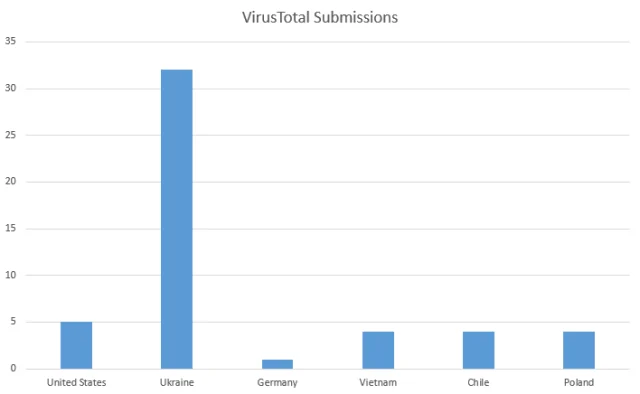
One of those tools is a computer worm designed to spread from computer to computer through USB drives. Tracked by researchers from Check Point Research as LitterDrifter, the malware is written in the Visual Basic Scripting language. LitterDrifter serves two purposes: to promiscuously spread from USB drive to USB drive and to permanently infect the devices that connect to such drives with malware that permanently communicates with Gamaredon-operated command and control servers. "Gamaredon continues to focus on [a] wide variety [of] Ukrainian targets, but due to the nature of the USB worm, we see indications of possible infection in various countries like USA, Vietnam, Chile, Poland and Germany," Check Point researchers reported recently. "In addition, we've observed evidence of infections in Hong Kong. All this might indicate that much like other USB worms, LitterDrifter [has] spread beyond its intended targets."

The image [here], tracking submissions of LitterDrifter to the Alphabet-owned VirusTotal service, indicates that the Gamaredon malware may be infecting targets well outside the borders of Ukraine. VirusTotal submissions usually come from people or organizations that encounter unfamiliar or suspicious-looking software on their networks and want to know if it's malicious. The data suggests that the number of infections in the US, Vietnam, Chile, Poland, and Germany combined may be roughly half of those hitting organizations inside Ukraine.

Social Networks

Omegle Shuts Down After 15 Years (techcrunch.com) 58

Omegle, a popular online chat service that allowed individuals to connect and chat with strangers, has shut down after 15 years citing growing misuse of the platform, including in committing "unspeakably heinous crimes." From a report: The site, founded in 2009 by a then 18-year-old programmer and high school student Leif K-Brooks, was bootstrapped throughout its existence. Though it waned in popularity over the years, it still pulled about 50 million visitors last month, according to analytics firm SimilarWeb.
The Almighty Buck

Mint Is Shutting Down, and It's Pushing Users Toward Credit Karma 41

Emma Roth reports via The Verge: Mint, the budgeting app owned by Intuit, is shutting down. Intuit announced on Tuesday that Mint will get absorbed into Intuit's other service, Credit Karma, when it officially goes away on January 1st, 2024 (via Bloomberg). But it's still not clear whether Credit Karma will get the budgeting features that Mint is known for. [...] Mint had 3.6 million monthly active users as of 2021, Bloomberg reports, but the app's development has slowed down considerably in recent years, with the last major updates being new categorization features and the ability to connect the Apple Card to Mint. [...]

Intuit first acquired Mint in 2009, an app that has offered a free way for users to track their budgets, manage expenses, negotiate bills, and keep tabs on subscriptions. Now, Intuit is inviting users to Credit Karma, a service that the company acquired in 2020. While Credit Karma offers similar features, like the ability to view transactions, track spending, aggregate financial accounts, and credit monitoring, it still doesn't come with the same budget tracking tool that many people specifically use Mint for, and it's not clear whether Credit Karma will ever adopt it. On a support page on Credit Karma's website, Intuit says "the new experience in Credit Karma does not offer the ability to set monthly and category budgets," adding that the app instead "offers a simplified way for you to build awareness of your spending, and track your savings."
Crime

Two Russian Nationals Charged For Hacking Taxi System At JFK Airport (theregister.com) 48

Thomas Claburn reports via The Register: For a period of two years between September 2019 and September 2021, two Americans and two Russians allegedly compromised the taxi dispatch system at John F. Kennedy International Airport in New York to sell cabbies a place at the front of the dispatch line. The two Russian nationals, Aleksandr Derebenetc and Kirill Shipulin, were indicted by a grand jury for conspiring to commit computer intrusions, the US Justice Department said on Tuesday. They remain at large. In early October, the two American nationals, Daniel Abayev and Peter Leyman, who were indicted last year, pleaded guilty, each to one count of conspiring to commit computer intrusions.

The scheme represented an attempt to monetize the demand among taxi drivers for lucrative airport fares -- the current flat rate for JFK to Manhattan is $70 plus additional charges. As described in the indictment (PDF), taxi drivers are required to wait in a holding lot at JFK, often for several hours, before being dispatched in the order of their arrival to airport terminals. And because time spent waiting in line is not paid, drivers have a financial incentive to avoid waiting in line. The conspirators allegedly developed a plan to hack the dispatch system around September 2019. The indictment describes several approaches that were tried, "including bribing someone to insert a flash drive containing malware into computers connected to the dispatch system, obtaining unauthorized access to the dispatch system via a Wi-Fi connect, and stealing computer tablets connected to the dispatch system."

The government's filing suggests that the group gained and lost access to the dispatch system several times. When they did have access, the alleged conspirators offered to move drivers to the front of the dispatch queue for a $10 fee, and waived the fee for those who found other drivers willing to pay to play. Many drivers took advantage of the service. According to the Justice Department, the group booked 2,463 queue cuts in a single week around December 2019. The scheme allegedly enabled as many as 1,000 trips per day that skipped the queue at JFK. The American conspirators are said to have collected the money from participating drivers and to have sent payments to the alleged Russian conspirators, describing the money transfers as "payment for software development" or "payment for services rendered." The indictment indicates that the Russians received more than $100,000 for their work. If apprehended -- which appears unlikely given current US relations with Russia -- the Russians face charges that carry a maximum sentence of ten years in prison. Abayev and Leyman each face up to five years in prison. They're scheduled to be sentenced early next year.

Biotech

Can Humans Have Babies In Space? SpaceBorn United Wants To Find Out (technologyreview.com) 105

An anonymous reader quotes a report from MIT Technology Review: Egbert Edelbroek was acting as a sperm donor when he first wondered whether it's possible to have babies in space. Curious about the various ways that donated sperm can be used, Edelbroek, a Dutch entrepreneur, began to speculate on whether in vitro fertilization technology was possible beyond Earth -- or could even be improved by the conditions found there. Could the weightlessness of space be better than a flat laboratory petri dish? Now Edelbroek is CEO of SpaceBorn United, a biotech startup seeking to pioneer the study of human reproduction away from Earth. Next year, he plans to send a mini lab on a rocket into low Earth orbit, where in vitro fertilization, or IVF, will take place. If it succeeds, Edelbroek hopes his work could pave the way for future space settlements.

"Humanity needs a backup plan," he says. "If you want to be a sustainable species, you want to be a multiplanetary species." Beyond future space colonies, there is also a more pressing need to understand the effects of space on the human reproductive system. No one has ever become pregnant in space -- yet. But with the rise of space tourism, it's likely that it will eventually happen one day. Edelbroek thinks we should be prepared. Despite the burgeoning interest in deep space exploration and settlement, prompted in part by billionaires such as Elon Musk and Jeff Bezos, we still know very little about what happens to our reproductive biology when we're in orbit. A report released in September by the US National Academies of Science, Engineering, and Medicine points out that almost no research has been done on human reproduction in space, adding that our understanding of how space affects reproduction is "vital to long-term space exploration, but largely unexplored to date."

Some studies on animals have suggested that the various stages of reproduction -- from mating and fertilization to embryo development, implantation, pregnancy, and birth -- can function normally in space. For example, in the very first such experiment, eight Japanese medaka fish developed from egg to hatchling aboard the space shuttle Columbia in 1994. All eight survived the return to Earth and seemed to behave normally.Yet other studies have found evidence that points to potential problems. Pregnant rats that spent much of their third trimester -- a total of five days -- on a Soviet satellite in 1983 experienced complications during labor and delivery. Like all astronauts returning to Earth, the rats were exhausted and weak. Their deliveries lasted longer than usual, likely because of atrophied uterine muscles. All the pups in one of the litters died during delivery, the result of an obstruction thought to be due in part to the mother's weakened state.

To Edelbroek, these inconclusive results point to a need to systematically isolate each step in the reproductive process in order to better understand how it is affected by conditions like lower gravity and higher radiation exposure. The mini lab his company developed is designed to do exactly that. It is about the size of a shoebox and uses microfluidics to connect a chamber containing sperm to a chamber containing an egg. It can also rotate at different speeds to replicate the gravitational environment of Earth, the moon, or Mars. It is small enough to fit inside a capsule that can be housed on top of a rocket and launched into space.After the egg has been fertilized in the device, it splits into two cells, each of which divides again to form four cells and so on. After five to six days, the embryo reaches a stage known as a blastocyst, which looks like a hollow ball. At this point, the embryos in the mini lab will be cryogenically frozen for their return to Earth.

Sony

New PS5's Optional Disc Drive Requires an Internet Connection To Connect (videogameschronicle.com) 69

The upcoming optional disc drive for the PlayStation 5 will require an internet connection to pair it to a console for the first time. From a report: As spotted on the back of the box for the upcoming Call of Duty Modern Warfare 3 PS5 slim bundle, small print confirms that players who purchase the new model with the optional drive will be required to connect to the internet when pairing it to a machine for the first time. It's likely that this is a security measure in order to ensure that the disc drive is a legitimate one and not a third party. However, it has raised some preservation concerns.
Earth

'Solar for Renters' Offers Americans Netflix-Style Subscriptions to Clean Energy (msn.com) 39

"No roof, no solar power. That has been the dispiriting equation shutting out roughly half of all Americans from plugging into the sun," writes the Washington Post's "Climate Coach" column.

"But signing up for solar soon might be as easy as subscribing to Netflix." Scores of new small solar farms that sell clean, local electricity directly to customers are popping up. The setup, dubbed "community solar," is designed to bring solar power to people who don't own their own homes or can't install panels — often at prices below retail electricity rates...

At least 22 states have passed legislation encouraging independent community solar projects, but developers are just beginning to expand. Most existing projects are booked. At the moment, community solar projects in the United States generate enough electricity to power about 918,000 homes — less than 1 percent of total households, according to the Solar Energy Industries Association, a nonprofit trade group. But as more states join, and the Environmental Protection Agency's "Solar for All" program pours billions into federal solar power grants, more Americans will get the chance...

While projects exist in most states, they are highly concentrated: More than half are in Massachusetts, Minnesota and New York. These might be on a condo roof, or on open land like the 10-MW Fresno community solar farm, on a city-owned plot surrounded by agricultural land. Most are small: 2 megawatts of capacity on average, about enough to power 200 to 400 homes... The renewable energy marketplace EnergySage and the nonprofit Solar United Neighbors connect customers to community solar projects in their region. People generally receive monthly credits for electricity produced by their share of solar panels. These are subtracted from their total electricity bill or credited on future bills... Subscribers on average save about 10 percent on their utility bill (the range is 5 percent to 15 percent).

These economics are propelling the industry to record heights. Between 2016 and 2019, community solar capacity more than quadrupled to 1.4 gigawatts. By the end of this year, energy research firm Wood Mackenzie estimates, there will be 6 GW of community solar. And the Energy Department wants to see community solar reach 5 million households by 2025. "The economics are strongly on the side of doing this," says Dan Kammen, an energy professor at the University of California at Berkeley. "It's now cheaper to build new solar than to operate old fossil [fuel plants]. ... We're at the takeoff point."

The article notes "solar for renters" saves about $100 per year for the average ratepayer (while rooftop solar arrays may save homeowners over $1,000 annually). But according to the article, the arrangement still "reflects a new reality...

"Solar energy prices are falling as private and public money, and new laws, are fueling a massive expansion of small-scale community solar projects."
Space

Next Year, SpaceX Aims To Average One Launch Every 2.5 Days (arstechnica.com) 27

Stephen Clark reports via Ars Technica: Earlier this week, SpaceX launched for the 75th time this year, continuing a flight cadence that should see the company come close to 100 missions by the end of December. SpaceX plans to kick its launch rate into a higher gear in 2024. This will be largely driven by launches of upgraded Starlink satellites with the ability to connect directly with consumer cell phones, a service SpaceX calls "Starlink Direct to Cell," a company official told Ars this week. The goal next year is 12 launches per month, for a total of 144 Falcon rocket flights. Like this year, most of those missions will be primarily devoted to launching Starlink broadband satellites. So far in 2023, more than 60 percent of SpaceX's launches have delivered the company's own Starlink satellites into orbit.

Here are some numbers. Last year, SpaceX launched 61 missions. In 2021, the number was 31. In the last 12 months, SpaceX has launched 88 Falcon rockets, plus one test flight of the company's much larger Starship rocket. SpaceX's success in recovering and reusing Falcon 9 boosters and payload fairings has been vital to making this possible. SpaceX has gone past the original goal of launching each Falcon 9 booster 10 times before a major overhaul, first to 15 flights, and then recently certifying boosters for up to 20 missions. Technicians can swap out parts like engines, fins, landing legs, and valves that malfunction in flight or show signs of wear. With so many launches planned next year, 20 flights is probably not a stopping point. "We might go a little higher," the SpaceX official said.
SpaceX may also see an uptick in missions for external customers, like NASA, the U.S. Space Force, and commercial companies. "External demand for Falcon 9 and Falcon Heavy launches is 'steady,' the official said, but some customers that had launches scheduled for this year encountered delays with their satellites, moving them into 2024."
Transportation

'World's First Off-Road Solar SUV' Just Drove Across Morocco (cnn.com) 82

An anonymous reader quotes a report from CNN: Zero-emission cars are soaring in popularity but running an electric vehicle is next to impossible in places with limited charging infrastructure. Stella Terra could change that. The khaki-green SUV uses solar panels on its sloping roof to charge its electric battery, meaning it can drive long distances powered entirely by the sun. Built by a team of students at Eindhoven University of Technology (TUE), "the world's first off-road solar-powered vehicle" could help connect remote areas "where roads are less developed and energy grids are not as reliable," and assist with emergency aid and deliveries, says Thieme Bosman, events manager for the team.

The team tested the vehicle in Morocco earlier this month, driving more than 1,000 kilometers (621 miles) between the country's northern coast and the Sahara Desert in the south. "Morocco has a huge variety of landscapes and different surfaces in quite a short distance," says Bosman, adding that the car was tested "on every type of surface that a car like this could encounter." The road-legal car has a top speed of 145 kilometers (90 miles) per hour. On a sunny day, its battery range is around 710 kilometers (441 miles) on roads, and around 550 kilometers (342 miles) off-road, depending on the surface. In cloudy conditions, the team estimates the range could be 50 kilometers less. Bosman noted that the vehicle had proved to be one-third more efficient than expected on the trip, and that its lightweight design made it less liable to get stuck on rugged terrain, and put less stress on its suspension.

"Where the SUV market currently innovates on the previous models, we really start from scratch and design everything ourselves," says Bosman. Minimizing the vehicle's weight was essential, and the team of 22 students focused on making every element ultra-efficient. At just 2,645 pounds (1,200 kilograms), Stella Terra weighs around 25% less than the average mid-sized SUV. The aerodynamic design also reduces drag and uses "lightweight and robust" composite materials to cut weight, says Bob van Ginkel, technical manager for Stella Terra. "(One of) the benefits of the solar panels on top is that we can have a much smaller battery because we are charging while driving," van Ginkel adds.
Bosman and his peers hope their concept SUV could be mass produced in the near future. "We aim to also inspire not only everyday people, but also the automotive industry, the Ford and Chryslers of the world, to think again about their designs and to innovate faster than they currently do," says Bosman.

"It's up to the market now, who have the resources and the power to make this change and the switch to more sustainable vehicles."
IT

Dropbox CEO Defends 90% Remote-Work Model, Says 'Future of Work' is Here (fortune.com) 103

An anonymous Slashdot reader shared this report from Fortune: What would Drew Houston, CEO of Silicon Valley software giant Dropbox, say to fellow CEOs — like Google's Sundar Pichai or Meta's Mark Zuckerberg — who seem to believe that three days a week in-person is crucial for company culture?

"I'd say, 'your employees have options,'" Houston told Fortune this past week. "They're not resources to control."

While Dropbox used to work near-entirely at its Bay Area headquarters, Houston has completely warmed to a distributed model since the pandemic — and is mystified as to why other leaders haven't joined him. (Houston founded Dropbox in 2007, the year after he graduated from MIT, and has been its CEO ever since.) "From a product design perspective, customers are our employees. We've stitched together this working model based on primary research," he told Fortune at Dropbox's WIP Conference — its first in-person event since 2019 — in New York on Tuesday. "We've just been handed the keys that unlock this whole future of work, which is actually here."

In April 2021, right when most of the country became eligible for vaccines and people began reconvening again across the globe, Dropbox encouraged the opposite. It officially announced its intent to go Virtual First, which meant employees were free to work remotely 90% of the time, only commuting in for the occasional meeting or happy hour... Granted, not everyone got to appreciate the perks. In April, Dropbox laid off 500 employees — 16% of its staff — due to "slowing growth" and "the A.I. era" requiring a reallocation of resources....

Houston and his team have found, in practice, a handful of two- or three-day offsites per quarter — 10% of the year — works best for their people. Crucially, it provides that oft-referenced cultural connect and brainstorming time that pro-office zealots insist upon, without exhausting workers out with a commute grind or needless hours in drab conference rooms.

Desktops (Apple)

LabView App Abandons the Mac After Four Decades (appleinsider.com) 74

An anonymous reader quotes a report from AppleInsider: Having been created on a Mac in the 1980s, LabView has now announced that its latest macOS update will be the final release for the platform. LabView is a visual programming language tool that lets users connect virtual measurement equipment together to input and process data. AppleInsider staffers have seen it used across a variety of industries and applications to help design a complex monitoring system, or automate a test sequence.

It's been 40 years since Dr James Truchard and Jeff Kodosky began work on it and founded their firm, National Instruments. The first release of the software was in October 1986 where it was a Mac exclusive. In a 2019 interview, Jeff Kodosky said this was because "it was the only computer that had a 32-bit operating system, and it had the graphics we needed." Now National Instruments has told all current users that they have released an updated Mac version -- but it will be the last.

National Instruments says it will cease selling licenses for the Mac version in March 2024, and will also stop support. LabView has also been sold as a subscription and National Instruments says it will switch users to a "perpetual licesse for your continued use," though seemingly only if specifically requested. As yet, there have been few reactions on the NI.com forums. However, one post says "This came as a shocker to us as the roadmap still indicates support."
National Instruments says LabVIEW "will continue to be available on Windows and Linux OSes."
Security

Cloud Gaming Firm Shadow Says Hackers Stole Customers' Personal Data (techcrunch.com) 7

French technology company Shadow has confirmed a data breach involving customers' personal information. TechCrunch: The Paris-headquartered startup, which offers gaming through its cloud-based PC service, said in an email to customers this week that hackers had accessed their personal information after a successful social engineering attack targeted the company. "At the end of September, we were the victim of a social engineering attack targeting one of our employees," Shadow CEO Eric Sele said in the email, seen by TechCrunch. "This highly sophisticated attack began on the Discord platform with the downloading of malware under cover of a game on the Steam platform, proposed by an acquaintance of our employee, himself a victim of the same attack."

Shadow said that though its security team took unspecified "immediate action," the hackers were able to connect to the management interface of one of the company's software-as-a-service (SaaS) providers to obtain customers' private data. That data includes full names, email addresses, dates of birth, billing addresses and credit card expiry dates. Shadow says no passwords or sensitive banking data were compromised.

Communications

New Starlink Webpage Highlights Upcoming 'Direct To Cell' Service (mobilesyrup.com) 21

SpaceX quietly published a new "Starlink Direct to Cell" webpage highlighting the company's forthcoming cell service for mobile phones. MobileSyrup reports: The new 'Starlink Direct to Cell' page boasts "seamless access to text, voice, and data for LTE phones across the globe" and notes that the company is targeting text capabilities in 2024, followed by voice and data capabilities in 2025. Internet of Things (IoT) support may also arrive in 2025. Starlink also advertises that the direct-to-cell system would work with "existing LTE phones wherever you can see the sky" and wouldn't require any changes to hardware, firmware, or special apps. The page also explains that Starlink Direct to Cell would use "an advanced eNodeB modem" that "acts like a cellphone tower in space." The system would allow network integration "similar to a standard roaming partner." Last year, SpaceX announced a partnership with T-Mobile, allowing users' mobile phones to connect directly with Starlink satellites in orbit. SpaceX said it was hoping to launch the service later this year but the company has been mum on the progress.

Slashdot Top Deals