Christmas Cheer

Slashdot Asks: What Are You Doing For Hallowe'en? 273

Hallowe'en is my favorite holiday: I like seeing costumes (and walking around in my own), and seeing what people do to decorate their houses, yards, etc. For the second year in a row though, I've failed to come up with a really good scheme for making my own place appropriately spooky. So, in hopes of loosing some inspiration for myself and others, I ask today what you're doing to spookify your surroundings (or your person) tomorrow, especially if it means using technology in interesting ways. Sensor-activated scary sounds or lights? An Arduino or Raspberry Pi-controlled costume? Elaborate trap-door? Infrasonic hackle-raising subwoofer install? Maybe one year Alek Komarnitsky will switch to Hallowe'en instead of Christmas, and offer a webcam-equipped remote-controllable haunt.
Businesses

Ask Slashdot: Where Are the Complete Hosting Providers? 178

Kludge writes "In 2000 there were thousands of email/web hosting businesses. In 2013 not much has changed. To get my email/web/webmail/domain/VOIP/public-key/XMPP/VPN hosting I have to deal with five different service providers. Where are the complete hosting providers? The absence of competition in this area drives many to Google, making data siphoning easy for the NSA. Why has hosting not advanced in the last 10 years? Where are the hosting providers that make end-to-end encrypted email/web/VOIP/XMPP easy and automatic for all my clients?"
Music

Ask Slashdot: Best Cross-Platform (Linux-Only) Audio Software? 223

blogologue writes "I have played the guitar for some years now, and these days I think it's good therapy to be creative with music, learning the piano and singing as well. So far I've been using Audacity as the tool to compose improvisations and demos. I haven't done much audio work before, but it is already becoming too limited for my needs. Being a Linux-fanboy since the mid-nineties, I'm now looking for a good audio processing/editing/enhancing setup that can run on different platforms, the most important being Linux. Are there any suggestions for Open Source or proprietary audio editing software that run on Linux?"
Cellphones

Ask Slashdot: Developer Responsibility When Apps Might Risk Lives? 100

First time accepted submitter bashaw writes "What ethical responsibilities do software developers have in determining the role that mobile devices take in our lives? As performance increases, size decreases, and the only limitation is the software available, mobile devices have expanded into new areas of our lives for which they were not designed. This raises the ethical question of who decides what software is available, and therefore what role these devices should take. I am a software developer at the Canadian Avalanche Centre. We recently issued a warning about mobile avalanche search applications that are marketed as avalanche rescue systems. Three smartphone applications are presenting themselves as economical alternatives to avalanche transceivers, the electronic device used by backcountry users to find buried companions in case of an avalanche. The applications are not an adequate replacement for an avalanche transceiver for many reasons, and we are concerned about the use of this software in lieu of a specifically-designed avalanche transceiver. When it is a question of public safety, does the onus fall on the developers, a government agency or the users themselves?"
Programming

Ask Slashdot: How Do You Choose Frameworks That Will Survive? 227

First time accepted submitter waslap writes "I have a leading role at a small software development company. I am responsible for giving guidance and making decisions on tool usage within the shop. I find the task of choosing frameworks to use within our team, and specifically UI frameworks, exceedingly difficult. A couple of years back my investigation of RIA frameworks lead me to eventually push for Adobe Flex [adobe.com] as the UI framework of choice for our future web development. This was long before anyone would have guessed that Adobe would abandon the Linux version of Flash. I chose Flex mainly for its maturity, wealth of documentation, commercial backing, and the superior abilities of Flash, at a time when HTML 5 was still in the early stages of planning. Conversely, about 15 years ago I made a switch to Qt for desktop applications and it is still around and thriving. I am trying to understand why it was the right choice and the others not. Perhaps Qt's design was done so well that it could not be improved. I'm not sure whether that assessment is accurate. I cannot find a sound decision-tree based on my experiences to assist me in making choices that have staying power. I hope the esteemed Slashdot readers can provide helpful input on the matter. We need a set of fail-safe axioms" Read on for more context.
Printer

Ask Slashdot: Best SOHO Printer Choices? 381

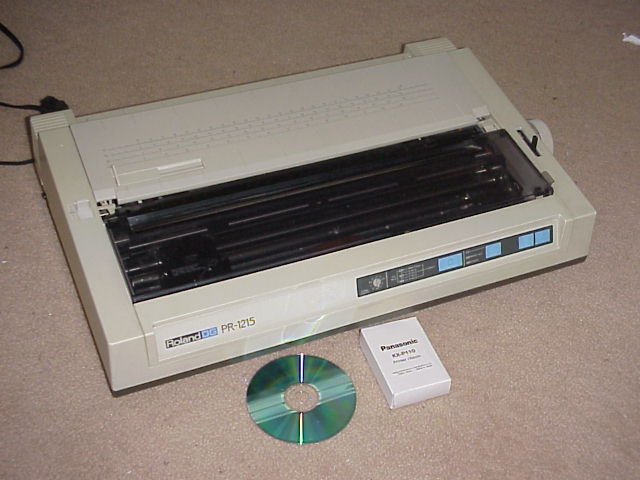
rueger writes "I can remember trading up from a daisy-wheel printer to dot matrix, and can remember when Jerry Pournelle used to say 'Buy the most expensive HP printer you can afford.' Mine was a 4P. Times have changed, though, and I'm looking for trustworthy advice before buying a couple of new printers. Specifically, a B&W Laser with sheet feed scanner, and a color inkjet with a solid flatbed scanner for copying music. We want solid, reliable machines that will give a few years of small office service, that have reasonably cheap consumables, and that will "just work" with Windows and Linux. Network ready of course. Let me expand. These days there seems to be no market leader in printers — they tend to be cheap disposable items. Part of the reason is that it is hard to find any real user reviews of these machines — most of the comments on Best Buy or other sites are full of fanboy enthusiasm, or extreme negativity — nothing that can be relied on. Between those, and the sock puppets, and the astroturfing, there's nothing I'd trust. I do trust Slashdot, though, for things like this. People here are able to offer realistic advice and experience that can usually tell the story. So, I ask: who's making good printers these days?"
Encryption

Ask Slashdot: Can Bruce Schneier Be Trusted? 330

An anonymous reader writes "Security guru Bruce Schneier is, among other things, a world renowned cryptography expert, author of several popular books, and a second-order internet meme. He is also an outspoken critic of the NSA, in particular the massive NSA surveillance programs disclosed over the summer by Edward Snowden. Schneier has been involved in reviewing the leaked documents and has put in effort to determine which cryptosystems should still be considered safe. I'm a big fan of Bruce Schneier, but just to play devil's advocate, let's say, hypothetically, that Schneier is actually in cahoots with the NSA. Who better to reinstate public trust in weakened cryptosystems? As an exercise in security that Schneier himself may find interesting, what methods are available for proving (or at least affirming) that we can trust Bruce Schneier?"
Space

Ask Slashdot: Legal Advice Or Loopholes Needed For Manned Space Program 201

Kristian vonBengtson writes "A DIY, manned space program like Copenhagen Suborbitals is kept alive by keeping total independence, cutting the red tape and simply just doing it all in a garage. We basically try to stay below the radar at all time and are reluctant in engagements leading to signing papers or do things (too much) by the books. But now there might be trouble ahead. (Saul Goodman! We need you...) During the last 5 years we have encountered many weird legal cases which does not make much sense and no one can explain their origin. If we were to fix up a batch of regular black gunpowder (which we use for igniters) we are entitled for serving time in jail. Even a few grams. But no one give a hoot about building a rocket fueled with 12 tonnes of liquid oxygen and alcohol. Thats is perfectly legal. If Copenhagen Suborbitals fly a rocket into space for the first time there are likely legal action that must be dealt with. At my time at the International Space University we had lectures and exams in space law and I remember the Outer Space Treaty which is the most ratified space treaty with over 100 countries including Denmark and U.S. And here is the matter – in which I seek some kind of advice or what you may call it: Outer Space Treaty, Article 6 states: 'the activities of non-governmental entities in outer space, including the Moon and other celestial bodies, shall require authorization and continuing supervision by the appropriate State Party to the Treaty.' Does this mean that Denmark (or any other country for that matter – if it was your project) suddenly have to approve what we are doing and will be kept responsible for our mission, if we launch into space?"
Programming

Ask Slashdot: Do You Use Markdown and Pandoc? 204

BartlebyScrivener writes "I am a author, screenwriter, law prof, and a hobbyist programmer. I love MacVim and write almost everything in it: Exams, novels, even screenplays now that Fountain is available. I use LaTeX and WordPress and so on, but several years ago I discovered Markdown and the wonderful Pandoc. I searched Slashdot expecting to find lively discussions of both Markdown and Pandoc, but found nothing. Do Slashdotters look down their noses at these tools and do their work in HTML and LaTeX? I can't imagine computer geeks using Word instead of their favorite text editors. If not Markdown and Pandoc, what tools do Slashdotters use when they create documents that probably need to be distributed in more than one format: HTML, PDF, EPUB or perhaps even docx?" And then there's DocBook, LyX, and a host of other markup languages. What do you use, in what context?
Programming

Ask Slashdot: What Are the Hardest Things Programmers Have To Do? 473

itwbennett writes "Software development isn't a cakewalk of a job, but to hear programmers tell it (or at least those willing to grouse about their jobs on Quora and Ubuntu Forums), what makes programming hard has little to do with writing code. In fact, if the list compiled by ITworld's Phil Johnson has it right, the single hardest thing developers do is name things. Are you a software developer? What's the hardest part of your job?"
Education

Ask Slashdot: Best Language To Learn For Scientific Computing? 465

New submitter longhunt writes "I just started my second year of grad school and I am working on a project that involves a computationally intensive data mining problem. I initially coded all of my routines in VBA because it 'was there'. They work, but run way too slow. I need to port to a faster language. I have acquired an older Xeon-based server and would like to be able to make use of all four CPU cores. I can load it with either Windows (XP) or Linux and am relatively comfortable with both. I did a fair amount of C and Octave programming as an undergrad. I also messed around with Fortran77 and several flavors of BASIC. Unfortunately, I haven't done ANY programming in about 12 years, so it would almost be like starting from scratch. I need a language I can pick up in a few weeks so I can get back to my research. I am not a CS major, so I care more about the answer than the code itself. What language suggestions or tips can you give me?"
Businesses

Ask Slashdot: As a Programmer/Geek, Should I Learn Business? 167

An anonymous reader writes "During my career I've always been focused on learning new technologies and trending programming languages. I've made good money at it, but I'm not sure what the next step is. I don't want to do this for the rest of my life. I'm not sure how to find a good way to transition from programmer to somebody with more responsibility. Should I learn business? It it more important to focus on personal networking? Do I step into the quagmire of marketing? I'm not sure what goals I should set, because I don't know what goals are realistic. Running my own business seems like something I'd like to do, but I'm unsure how to get from here to there. I'd appreciate advice from any fellow geeks who are making (or have made) that change."
Privacy

Ask Slashdot: Why Isn't There More Public Outrage About NSA Revelations? 610

Nerval's Lobster writes "This morning we discussed news that the National Security Agency (NSA) has siphoned up millions of online address books and contact lists. The Post drew its information from top-secret documents provided by government whistleblower Edward Snowden, who spent the summer feeding information about the NSA to a variety of news outlets. Snowden's documents (as outlined in The Guardian, Spiegel Online and other venues) have detailed a massive NSA program that's siphoning all sorts of personal information from a variety of sources — and yet the public seems to have greeted each new revelation with weakening outrage. Whereas the initial news reports about NSA splying in June kicked off a firestorm of controversy and discussion (aggravated by the drama of Snowden seeking asylum in pretty much any country that would have him), the unveiling of the NSA's Great Contact-List Caper has ranked below the news stories such as the government shutdown, negotiations over Iran's nuclear program, and invites for Apple's upcoming iPad event on aggregators such as Google News; it also didn't make much of a blip on Twitter and other online forums. There's the very real possibility that Americans, despite the assurances of government officials, are being monitored in a way that potentially violates their privacy. Surely that's an issue that concerns a great many individuals; and yet, as time goes by, it seems as if people are choosing to focus on other things. Are we suffering from 'surveillance fatigue?'"
Security

Ask Slashdot: Mitigating DoS Attacks On Home Network? 319

First time accepted submitter Gavrielkay writes "We seem to have attracted the attention of some less than savory types in online gaming and now find our home network relentlessly DoSed. We bought a new router that doesn't fall over quite so easily, but it still overwhelms our poor little DSL connection and prevents us web browsing and watching Netflix occasionally. What's worse is that it seems to find us even if we change the MAC address and IP address of the router. Often the router logs IPs from Russia or Korea in these attacks (no packet logging, just a blanket 'DoS attack from...' in the log. But more often lately I've noticed the IPs trace back to Microsoft or Amazon domains. Are they spoofing those IPs? Did they sign us up for something weird there? And how do they find us with a new MAC address and IP within minutes? We're looking for a way to hide from these idiots that doesn't involve going to the Feds, although that is what our ISP suggested. Piles of money for a commercial grade router is out of the question. We are running antivirus and anti-malware programs and haven't seen any evidence of hacked computers so far."
Wireless Networking

Ask Slashdot: Best Open Source Project For a Router/Wi-Fi Access Point? 193

An anonymous reader writes "My wireless router just died. I have an old netbook lying around that has a wired network interface and a wireless one. The wireless card is supported in master mode by Linux, FreeBSD, and OpenBSD. What does Slashdot recommend I use to turn it into a router/wireless access point? DD-WRT? pfSense? Smoothwall? Fedora/Ubuntu/OpenBSD with a manual configuration? I'm not afraid of getting my hands dirty and I know what I'm doing, but I want as close to zero maintenance as possible."
Technology

Ask Slashdot: Time To Regulate Domestic Drones? 190

Nerval's Lobster writes "Earlier this week, a small helicopter drone tumbled out of the sky over midtown Manhattan, crashing to the sidewalk near Grand Central Station. On the way down it almost hit a businessman, who plucked out the video card from the wreckage and handed it over to a local television-news station. In the video, the drone (a Phantom Quadcopter) lifts off from what looks like an apartment terrace and buzzes its merry way toward some nearby skyscrapers, pausing for a few panoramic surveys of the Manhattan skyline. But the operator is clearly inexperienced, crashing the vehicle against the side of a building, and the flight lasts a mere three minutes before a final collision sends it to the street. Drone enthusiasts and engineers blamed the Quadcopter's poor performance on the pilot's possible reliance on GPS mode; when flying in an area crowded with tall buildings (and they don't get much taller or more crowded than in Manhattan) that block GPS signals, a vehicle can quickly think it's off-target and attempt to correct, leading to crashes. In theory, the FAA forbids the operation of unmanned aerial vehicles over crowded areas such as Manhattan, but that hasn't stopped any number of hobbyists from launching drones. And hobbyists aside, the industry for commercial drones is picking up: over the summer, the FAA approved a pair of small, unmanned aircraft systems for flight, and Airware (which builds autopilot computers for drones) recently accepted funding from Google Ventures. That's led legislators to begin exploring ways to regulate domestic drone use (particularly with regard to use by law enforcement), and it begs the question: should drones be regulated? And if so, how?" A similar incident just happened in Australia, where a small drone operated by an unknown owner crashed into the Sydney Harbor Bridge. Counter-terrorism officials felt they had to investigate, of course.
Games

Ask Slashdot: Can Valve's Steam Machines Compete Against the Xbox One and PS4? 348

Nerval's Lobster writes "Valve has announced SteamOS, Steam Machines, and a Steam controller — the components necessary for it to create a viable living-room gaming experience. Valve's strategy with these releases seems pretty clear: create a platform based on openness (SteamOS is a Linux-based operating system), in contrast to the closed systems pushed by console rivals such as Sony and Microsoft. If Valve chooses to release Half-Life 3 in conjunction with its Steam Machines' rollout, it could help create further buzz for the system, given the years' worth of pent-up demand for the next chapter in the popular FPS saga. But can Valve's moves allow it to actually compete against Nintendo, Microsoft, and Sony on equal terms? What do you think?"
Cellphones

Ask Slashdot: Suitable Phone For a 4-Year Old? 682

blogologue writes "I have a kid that's turning 4-years old soon, and I'm not able to be with him as often as I want to. To remedy this, I'm looking into whether or not getting him a phone could be a good idea to keep in touch. Being able to have a video chat is important, and as it is rare that a 4-year old has a mobile phone, and because he's got other things to do, it would be good to be able to turn off for example games and so on during time in the kindergarten. So other kids don't go around asking their parents for a smartphone. The main reason for getting the phone is keeping in touch, and as a bonus it can function as a device for games and so on during allowed times. Are there any phones that are suitable for such use? I don't mind if it's Android, iOS or something else, as long as it can be used to make video calls to other Android/iOS phones, and if it features other applications such as games, have limited, pre-defined functionality during certain periods of the day."
Open Source

Ask Slashdot: Best Open Source CRM/ERP System For a Small Business? 163

An anonymous reader writes "One of my coworkers recently left the company, and I had to take over most of his responsibilities, including the maintenance and development of a homegrown CRM/ERP system. The system has evolved over more than a decade under the hands of at least four different developers and is based on Microsoft Access. Since I have been assigned this additional role, a day rarely passes without a user yelling for help because some part of the software is failing in strange and unpredictable ways, or some of the entered data has to be corrected manually in some obscure table in one of several database files. Without any exaggeration, some of the Visual Basic source code would be sufficient for several stories on The Daily WTF, and could make a grown man cry. Instead of spending further hours on optimizing this software i would rather like to start from scratch with some existing open-source CRM/ERP system that can be adapted to my companies needs. So far I have looked at and tested several CRM systems, including SugarCRM, vtiger, Feng Office (formerly known as opengoo), Zurmo and Fat Free CRM. Feng Office and Fat Free CRM look really nice and easy to use; the other ones could take a bit less bloat but are fine nevertheless. What software would you choose?"
Ubuntu

Ask Slashdot: Are We Witnessing the Decline of Ubuntu? 631

jammag writes "'When the history of free software is written, I am increasingly convinced that this last year will be noted as the start of the decline of Ubuntu,' opines Linux pundit Bruce Byfield. After great initial success, Ubuntu and Canonical began to isolate themselves from the mainstream of the free software community. Canonical, he says, has tried to control the open source community, and the company has floundered in many of its initiatives. Really, the mighty Ubuntu, in decline?"

Slashdot Top Deals