Businesses

Unroll.me Settles FTC Allegations That It Deceived Consumers About How it Accesses and Uses Emails (ftc.gov) 2

Unroll.me, a firm that helps people manage their email list subscriptions but also sells users' data for profit, has settled with the FTC after allegations of deceiving consumers, the agency said. In a press release, the agency wrote: In a complaint, the FTC alleges that Unrollme , falsely told consumers that it would not "touch" their personal emails, when in fact it was sharing the users' email receipts (e-receipts) with its parent company, Slice Technologies. E-receipts are emails sent to consumers following a completed transaction and can include, among other things, the user's name, billing and shipping addresses, and information about products or services purchased by the consumer. Slice uses anonymous purchase information from Unrollme users' e-receipts in the market research analytics products it sells. Unrollme helps users unsubscribe from unwanted subscription emails and consolidates wanted email subscriptions into one daily email called the Rollup. The service requires users to provide Unrollme with access to their email accounts.
Businesses

Uber Posts $5.2 Billion Loss and Slowest Ever Growth Rate (nytimes.com) 85

For the second quarter, Uber reported its largest-ever loss, totaling $5.2 billion, and its slowest-even revenue growth. "The double whammy immediately renewed questions about the prospects for the company, the world's biggest ride-hailing business," reports The New York Times. From the report: For the second quarter, Uber said it lost $5.2 billion, the largest loss since it began disclosing limited financial data in 2017. A majority of that -- about $3.9 billion -- was caused by stock-based compensation that Uber paid its employees after its I.P.O. Excluding that one-time expense, Uber lost $1.3 billion, or nearly twice the $878 million that it lost a year earlier. Revenue grew to $3.1 billion, up 14 percent from a year ago, the slowest quarterly growth rate the company has ever disclosed.

"We think that 2019 will be our peak investment year," Dara Khosrowshahi, Uber's chief executive, said in an interview, noting that he expected losses to decline over the next two years. "We want to make sure that the kind of growth we have is healthy growth." He added that there were other positives. Uber's bookings -- the money it gets from rides and deliveries before paying commissions to drivers -- rose 31 percent from a year ago. The company also added customers, totaling more than 100 million monthly active riders for the first time.
The report notes that it wasn't all bad. The company's food delivery business, Uber Eats, "more than doubled its number of monthly customers," and Uber's price war with Lyft has subsided, "which could lead to more revenue," reports The New York Times.
Cellphones

Americans Are Making Phone Farms To Scam Free Money From Advertisers (vice.com) 94

An anonymous reader quotes a report from Motherboard: Netflix thought I was four different people. I was being paid through an app to watch its trailers over and over again, racking up digital points I could eventually trade for Amazon gift cards or real cash. But rather than just use my own phone, I bought four Android devices to churn through the trailers simultaneously, bringing in more money. I made a small "phone farm," able to fabricate engagement with advertisements and programs from companies like Netflix, as well as video game trailers, celebrity gossip shows, and sports too. No one was really watching the trailers, but Netflix didn't need to know that. The goal was to passively run these phones 24/7, with each collecting a fraction of a penny for each ad they "watched."

Hobbyists and those looking to make a bit of money across the U.S. have been doing the same, buying dozens or hundreds of phones to generate revenue so they can afford some extra household goods, cover a bill, buy a case of beer, or earn more income without driving for Uber or delivering for Grubhub. The farms are similar to those found overseas, often in China, where rows and rows of phones click and scroll through social media or other apps to simulate the engagement of a real human. Every few months, a video of these Chinese farms goes viral, but in bedroom cupboards, stacks in corners of living rooms, or custom setups in their garage, American phone farmers are doing a similar thing, albeit on a smaller scale. Motherboard spoke to eight people who run farms of various sizes, most of whom are located in the U.S.

Businesses

Uber Lays Off 400 People On Its Marketing Team 117

Uber confirmed Monday that around 400 of the roughly 1,200 people in its marketing unit are being let go as part of a broader restructuring of the department. CNN reports: In an email sent by Uber CEO Dara Khosrowshahi to staff and seen by CNN Business, he says, "we are not making these changes because Marketing has become less important to Uber. The exact opposite is true: we are making these changes because presenting a powerful, unified, and dynamic vision to the world has never been more important." The news, first reported by the New York Times, comes as the company faces pressure to clean up its finances following a lackluster Wall Street debut in May. Uber has a history of steep loses and its revenue growth is slowing.

Uber lost $1.01 billion in the first three months of this year, according to the company's first earnings report as a public company. Revenue from its core ridesharing business grew just 9% from the year prior. The company is set to report its second quarter earnings results next week. The layoffs are just the latest turbulence inside Uber in the less than three months since it went public.
First Person Shooters (Games)

Teenagers Win Millions At Fortnite World Cup (ign.com) 127

$30 million in prizes were up for grabs, the largest ever for an esports event, and more than 40 million attempted to qualify for a spot. Now IGN reports: The grand champion of the Fortnite World Cup finals has been crowned. Kyle "Bugha" Giersdorf, a 16-year-old American boy, took home the trophy and a $3 million prize... "Words can't even explain [how I feel] right now," Giersdorf said from the Champion's circle. "I'm just so happy. Everything I've done, the grind, it's all paid off. It's just insane."
And the Guardian reports that a 15-year-old won $1.25 million (£1m) when his two-man team placed second in the duos competition. He told the BBC that his mother initially thought he was wasting his time. "Now I've proved to her that I can do stuff, I'm really happy," he said. With regard to spending the prize money, his mother said her son was not materialistic, and that she anticipated he would spend the prize money on a "lifetime of Uber Eats".
IGN also reported on another Fortnite drama: A pair of Fortnite World Cup competitors, formerly banned by Epic for cheating, were the target of much ire Saturday, as the crowd loudly booed one's appearance onscreen and subsequently cheered for their loss...

Epic Games previously banned XXiF and Ronaldo from Fortnite for 14 days, after an internal review found that the players had colluded with other players in order to acquire easy elimination points during week 3 of the Fortnite World Cup qualifiers, according to Dexerto. The pair were subsequently dropped from their team, Rise Nation. That initially sounded like the end of the whole matter, but then XXiF and Ronaldo qualified during the week 8 qualifier, finishing in third place and securing a spot during the finals.

XXiF and Ronaldo ended up placing 28th during the duos finals, securing them $50,000 each in prize money.

Fornite had to ban more than 1,200 Fortnite accounts for cheating in just the first week of the World Cup Open online.
United States

Delivery Apps Like DoorDash Are Using Your Tips To Pay Workers' Wages (theverge.com) 242

An anonymous reader quotes a report from The Verge: When you order food through an app and tip the worker who delivers it, you'd be forgiven for thinking that the money you give goes directly to that person. But in reality, some delivery apps use your tip to make up the worker's base pay -- essentially stealing the money you're trying to give someone to maximize their profits. This isn't a new practice by any means, but a recent report from The New York Times highlights how DoorDash, the most popular food delivery app in the U.S., enforces it.

Here's Times reporter Andy Newman: "DoorDash offers a guaranteed minimum for each job. For my first order, the guarantee was $6.85 and the customer, a woman in Boerum Hill who answered the door in a colorful bathrobe, tipped $3 via the app. But I still received only $6.85. Here's how it works: If the woman in the bathrobe had tipped zero, DoorDash would have paid me the whole $6.85. Because she tipped $3, DoorDash kicked in only $3.85. She was saving DoorDash $3, not tipping me."
"DoorDash's policy is the equivalent of a 'tipped wage,' a common practice in America where employers pay workers less than the minimum wage and rely on tips to make up the payments they owe," the report adds. "Apps like DoorDash are essentially just extending established bad labor practices into the world of tech."

Amazon Flex also uses tips to make up pay, even after being heavily criticized for it. Instacart was the same way, but it scrapped the policy and promised to retroactively compensate workers following outcry. Postmades, Grubhub, Seamless, and Uber Eats all confirmed to The Verge that customer tips are not used to subsidize workers' pay.
Facebook

Facebook Backpedals From Its Original Ambitious Vision for Libra (arstechnica.com) 77

An anonymous reader quotes Ars Technica: David Marcus, the head of Facebook's new Calibra payments division, appeared before two hostile congressional committees this week with a simple message: Facebook knows policymakers are concerned about Libra, and Facebook won't move forward with the project until their concerns are addressed. While he didn't say so explicitly, Marcus' comments at hearings on Tuesday and Wednesday represented a dramatic shift in Facebook's conception of Libra.

In Facebook's original vision, Libra would be an open and largely decentralized network, akin to Bitcoin. The core network would be beyond the reach of regulators. Regulatory compliance would be the responsibility of exchanges, wallets, and other services that are the "on ramps and off ramps" to the Libra ecosystem. Facebook now seems to recognize its original vision was a non-starter with regulators. So this week Marcus sketched out a new vision for Libra -- one in which the Libra Association will shoulder significant responsibility for ensuring compliance with laws relating to money laundering, terrorist financing, and other financial crimes...

[T]here's a pretty fundamental tradeoff between network openness and effective enforcement of regulations governing payment networks. If the Libra Association doesn't have a way to enforce compliance by wallet providers, criminals are likely to flock to wallet services that don't strictly enforce the rules -- or to download open source wallet software and use non-custodial accounts. But if the Libra Association does have a mechanism for forcing compliance, that inherently raises the bar for entering the market and makes the Libra network look more like conventional financial networks -- with all the red tape that entails. This could be particularly harmful for marginalized people in developing countries, since developers in those markets will have the fewest resources to jump through regulatory hoops.

Businesses

A California Bill Could Destroy Uber's Unsustainable Business Model (vice.com) 190

Last week, the California Senate's Labor, Public Employment and Retirement Committee held a hearing and passed Assembly Bill 5 (AB5), which promises to make it harder for companies to claim workers are independent contractors and increase the operating expenses of Uber, Lyft, and other on-demand companies that already find themselves unable to turn a profit. Motherboard reports: Written by Assemblywoman Lorena Gonzelez (D-San Diego), AB5 codifies the California Supreme Court's unanimous May 2018 ruling in Dynamex Operations West, Inc. v. Superior Court of Los Angeles where an "ABC test" was introduced to determine whether a worker was an employee or an independent contractor. Individuals with sufficient control over how and when they did their work are independent contractors, while workers without much control are employees. While AB5 easily passed in the Assembly this May, 53-11, it has a long and ugly fight ahead of as it must pass multiple votes in the Senate then be signed into law by Governor Gavin Newsom. Each step of the way is an opportunity for companies like Uber and Lyft to intervene and extract concessions.

Uber has never made a profit and has actually lost over $14 billion in the last four years alone. In the prospectus, Uber insists that these five major metropolitan markets are essential to its path to profitability. In reality, what Uber actually relies on is the $20 billion in funding raised over the past decade and the $8 billion in new investments after going public in May. This investor welfare covers the cost of low prices that render each rideshare trip unprofitable, of driver incentives to combat the high turnover rate of drivers, and of promotions used to drive up demand. Equity research analysts at Barclays project Uber is on track to lose $3.9 billion in 2019 and if AB5 were passed, it would cost the company upwards of an additional $500 million. A drop in the bucket. But if AB5 were to become law and other states follow California's example and pass similar laws, it could constrict these companies' already narrow paths to profitability.

IT

Uber Glitch Charges Passengers 100 Times the Advertised Price, Resulting in Crosstown Fares in the Thousands of Dollars (washingtonpost.com) 85

Uber passengers in multiple cities were startled Wednesday when they were charged 100 times the advertised fare for short trips, a glitch that sparked jokes about surge pricing gone wild. From a report: Riders in cities including Washington and San Diego took to social media to post about the sky-high rates, a problem that Uber confirmed, although it declined to say how widespread the issue was. Some who ordered food for quick delivery said they were also overcharged. One social media user reported that Uber maxed out her husband's card with a charge of $1,905, when it was supposed to be $19.05. "Not cool, especially on his birthday," she added. Another woman posted to social media that she was charged $1,308 for a $13.08 trip. The charge was so high it triggered a fraud alert, according to a screen shot the rider posted on Twitter.

Uber said the glitch has been fixed. The company said the fare would be corrected so riders are charged only the amount for their actual trip, though they may temporarily see an inaccurate trip fare on their credit or debit cards. Passengers won't need to dispute the charges with their banks.

Businesses

Need Customer Service For an App? Prepare To Lose Your Mind (wsj.com) 145

App-based services have made our lives easier in so many ways. But when things go awry, they offer few paths to real assistance [Editor's note: the link may be paywalled]. From a report: There's a trade-off between the speed of apps and their ability to provide timely help. Customer service isn't dead, it's just hiding very well, often under a maze of preset menu options that seem designed to make you want to chuck your phone out the window. I recently ordered a Lyft ride from the airport. As the driver loaded my bag into the trunk -- something he didn't seem happy about -- he started talking under his breath. I asked if he was talking to me. His eyes got wide, and he said no, he wasn't. Then he removed my bag and told me I had the wrong car. His license plate matched my app, but he said, "I'm not your ride, baby," before driving off.

Part of me was relieved. But to let Lyft know, I had to spend probably 20 minutes going through endless options for pre-written problems I didn't have. "Something happened during my ride" got me a drop-down menu with a bunch of inapt scenarios: "Demanding cash?" Nope. "Refusing my service animal?" Also no. Lyft can foresee these issues, but not "Acting unprofessional"? [...] Except for safety issues, there's no helpline to get a live person with Uber or Lyft. Ditto Spotify, Instagram and many other apps. Airbnb customer support has a phone number where actual humans answer. Instacart's app has an email address with a field to include details about your problem. It's also got a number you can ring 24/7.

Facebook

Facebook Co-founder Chris Hughes Says Libra Will Empower Corporations and Weaken Developing Countries, Urges Global Regulators To Act Now (ft.com) 97

In May, Facebook co-founder Chris Hughes shocked many when he expressed grave concerns about Facebook's CEO, its business and its impact on the world. He went as far as suggesting that Facebook should be broken up. Two months later, Hughes has another interesting remark to share. He has warned that Facebook's new planned digital currency Libra would shift monetary power to corporate giants. [Editor's note: the link may be paywalled; alternative source.] In an op-ed he wrote today: If even modestly successful, Libra would hand over much of the control of monetary policy from central banks to these private companies, which also include Visa, Uber, and Vodafone. If global regulators don't act now, it could very soon be too late. I've been a cryptocurrency sceptic, believing that the instability and regulatory challenges are just too sizeable. But Libra is different because it is a "stablecoin", with a value pegged to a basket of currencies and other assets. Anyone, whether they use Facebook or not, can buy in with a local currency and cash back out at any time. Vital decisions about Libra's administration, security and underlying assets will be made by the Switzerland-based Libra Association -- essentially Facebook and its largely corporate partners. To avoid complaints that setting up this coin would give a single company dangerous powers, Facebook has smartly limited itself to a single vote on the commission.

That doesn't make the prospect of Libra's success any less frightening. This currency would insert a powerful new corporate layer of monetary control between central banks and individuals. Inevitably, these companies will put their private interests -- profits and influence -- ahead of public ones. [...] The Libra Association's goals specifically say that ability will encourage "decentralised forms of governance." In other words, Libra will disrupt and weaken nation states by enabling people to move out of unstable local currencies and into a currency denominated in dollars and euros and managed by corporations. The Libra Association promises to choose stable currencies and assets unlikely to suffer inflationary crises. The sponsors are right that a liquid, stable currency would be attractive to many in emerging markets. So attractive, in fact, that if enough people trade out of their local currencies, they could threaten the ability of emerging market governments to control their monetary supply, the local means of exchange, and, in some cases, their ability to impose capital controls.

Businesses

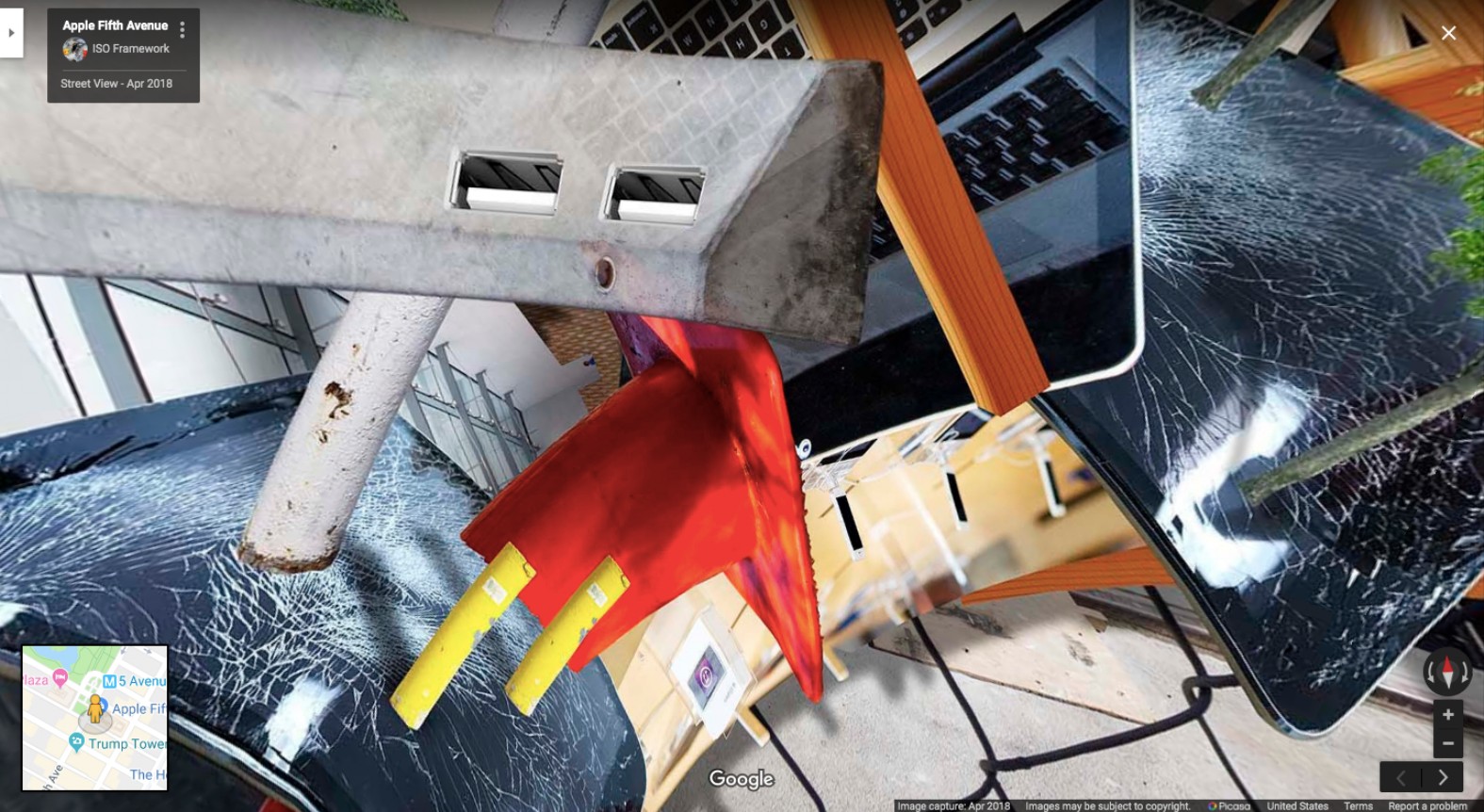
Brooklyn-Based Artist Jason Isolini Is Hacking Google To Create Surreal Street View Art (vice.com) 58

An anonymous reader shares a report from Motherboard: Brooklyn-based artist Jason Isolini worked as a contractor for Google Maps, capturing 360-images inside businesses and uploading them. Now, instead of capturing true-to-live panorama images, Isolini is uploading surreal collages that subvert the purpose of Google Maps: to be a tool that brings users from their current location to a business. "Since August 2017, Isolini has made 42 'contributions' to the Google Maps landscape and they've accumulated just shy of 200,000 views," the report says. "In some of his earlier works, Isolini inserted collages of photos -- like street signs, monopoly pieces, laundry detergent bottles -- into spaces around Brooklyn."

"More recently, in addition to his memorial at the site of the accident at Mill Avenue and Washington Street [in Temple, Arizona, where a self-driving car developed by Uber struck and killed Elaine Herzberg in March 2018], he's superimposed his work onto 360-degree views of art buildings like the Simon Lee Gallery and inserted a images of abandonment and destruction over the entrance to the Apple Store on Fifth Avenue in Manhattan. A cigarette, a broken glass screen, USB ports on a slab of stone, leading to nowhere."
Bitcoin

Facebook's Calibra Is a Secret Weapon For Monetizing Its New Cryptocurrency (theverge.com) 80

Earlier today, Facebook announced its cryptocurrency "Libra" and the nonprofit association that will oversee it. "But behind Facebook's ambitions to create a quasi-nation state ruled by mostly corporate interests is a secret weapon, one the company hopes it can use to create another platform used by billions of people -- and generate enormous new revenue streams along the way," reports The Verge. "It's called Calibra, and it's a new subsidiary of Facebook the company is launching to build financial services and software on top of the Libra blockchain." From the report: At first blush, Calibra resembles a fairly standard payments company -- but its tight integration with Facebook's enormous user base could give it a significant advantage over any rivals. Thanks to its proximity to the technical development of Libra, and its ability to leverage WhatsApp, Messenger, and Instagram, Calibra could very well become Facebook's next big thing. Calibra's immediate goal is to develop and launch its own digital cryptocurrency wallet, and integrate that wallet into other Facebook products. The company will become a member of the nonprofit Libra Association and have equal voting power the other partners as Facebook's official representative, which include Uber, Lyft, eBay, and PayPal, along with several other tech companies, financial service providers, venture capitalists, and fellow nonprofits. That way, Facebook can say it does not solely control the currency or the network by itself. It also gets the benefit of having twice the representation as other companies, at least for now.

Libra is the technology that underpins the network. But when it launches, Calibra will likely be how most people interact with the currency until competing wallets arise. In fact, it will likely be the first cryptocurrency wallet that hundreds of millions of people will have access to, by nature of being bundled with Facebook's massive ecosystem. With billions of users potentially interacting with Calibra, it will instantaneously have many hundreds of times the user base of the world's most popular existing wallets from Coinbase and others.
Kevin Weil, vice president of product at Calibra, says the primary business model isn't to make money off ads targeted using your purchase history or to charge people for using the Calibra app. The real goal, Weil says, is to boost adoption to the point where Libra can have a vibrant financial services economy built on top of it, not just by Facebook but by any other company in the world.

Weil says Libra becoming successful will have all sorts of positive ripple effects for all participants. "You suddenly have billions of new consumers for any online service. Businesses today that operate in cash only, if they have access to a digital currency they have access to advertising platforms, including Facebook," he says. "There are meaningful side effects on Facebook's business if Libra is successful."
Businesses

Uber's Plan To Deliver McDonald's Hamburgers By Drone (dailyherald.com) 111

An anonymous reader quotes the Washington Post: The company's new initiative -- a collaborative effort between its Uber Eats and Uber Elevate divisions -- began with tests in San Diego using fast food meals from McDonald's, but could expand to include a local fine-dining restaurant called Juniper and Ivy, the company said. Uber intends to roll out commercial food delivery using drones in the same city this summer, with a fee structure that mimics Uber Eats current pricing, according to Bloomberg Businessweek, which first reported the company's plan...

"We've been working closely with the FAA to ensure that we're meeting requirements and prioritizing safety," Uber Elevate's Luke Fischer, the company's head of flight operations, said in a statement. "From there, our goal is to expand Uber Eats drone delivery so we can provide more options to more people at the tap of a button. We believe that Uber is uniquely positioned to take on this challenge as we're able to leverage the Uber Eats network of restaurant partners and delivery partners as well as the aviation experience and technology of Uber Elevate."

How will Uber's drone delivery service work? After a restaurant loads a meal into a drone and the robot takes to the air, the company's technology will notify a nearby Uber Eats driver at a designated drop-off location, the company said. The driver will pick up and hand deliver the meal to the customer the same way the service currently operates. But in the future, Uber said, the company would like to land drones atop parked vehicles near delivery locations "through QR code correspondence." Once that happens, the last-mile leg of delivery would be completed by the Uber Eats driver who would hand-deliver the order.

Facebook

Facebook's New Cryptocurrency, Libra, Gets Big Backers (wsj.com) 127

Facebook has signed up more than a dozen companies including Visa, Mastercard, PayPal, and Uber to back a new cryptocurrency it plans to unveil next week and launch next year, according to a WSJ report. From the report: The financial and e-commerce companies, venture capitalists and telecommunications firms will invest around $10 million each in a consortium that will govern the digital coin, called Libra [Editor's note: the link may be paywalled; alternative source], according to people familiar with the matter. The money would be used to fund the creation of the coin, which will be pegged to a basket of government-issued currencies to avoid the wild swings that have dogged other cryptocurrencies, they said. The Wall Street Journal reported last month that Facebook was recruiting backers to help start the crypto-based payments system and was seeking to raise as much as around $1 billion for the effort. In the works for more than a year, the secretive project revolves around a digital coin that its users could send to each other and use to make purchases both on Facebook and across the internet. Talks with some of the partners are ongoing, and the group's eventual membership may change, the people added.
Businesses

Amazon To Shut Down Its Amazon Restaurants Business (geekwire.com) 32

According to GeekWire, Amazon is shutting down its Amazon Restaurants food delivery service in the U.S. The service, which was first launched in Seattle back in 2015, gave Prime members a way to get meals delivered to their door, using the dedicated website or via the Prime Now shopping app. From the report: Amazon ended the program in London this past November and will say goodbye to its U.S. service later this month. "As of June 24th, we will discontinue the Amazon Restaurants business in the U.S.," an Amazon spokesperson said in a statement shared with GeekWire. "Many of the small number of employees affected by this decision have already found new roles at Amazon, and others will be provided personalized support to find a new role within, or outside of, the company."

Amazon will also shut down Daily Dish, a workplace lunch delivery service that launched in 2016, on June 14. This move comes less than a month after Amazon led a $575 million funding round for Deliveroo, a U.K.-based food delivery company. It's unclear what, if any, moves are left in Amazon's restaurant delivery arsenal. The company still delivers groceries from Whole Foods via Prime Now in nearly 100 U.S. markets. The competition is fierce in the food delivery market, with companies such as Uber, Grubhub, and DoorDash seeing big growth in recent years. Those three companies combined hold more than 75 percent of the U.S. food delivery market share.

Transportation

Next Month Uber Will Start Offering Helicopter Rides in New York City (fortune.com) 35

An anonymous reader quotes Fortune: Uber Technologies Inc. is testing a helicopter service in New York City, according to documents outlining the program obtained by Bloomberg. Passengers will be able to use the Uber app to book a flight through the service, called Uber Copter, the documents show. Tests flights took off from a Manhattan heliport near Wall Street to John F. Kennedy International Airport.

After Bloomberg asked Uber for comment Wednesday, the New York Times published a story about the program. It says customers will be able to book flights starting July 9 in New York City and that the average ride will cost $200 to $225 a person. Eric Allison, the head of Uber's flight business, told the Times that the company plans to eventually offer helicopter rides in other cities... Each helicopter can accommodate five passengers, and like Uber car rides, prices will fluctuate based on demand and other factors.

Transportation

India Orders Uber and Rival Ola To Electrify 40% of Fleets By 2026 (techcrunch.com) 76

India is doubling down on its push to replace gasoline and diesel vehicles on its streets with environmentally friendly electric cars. From a report: The government plans to order ride-hailing firms such as Uber and Ola, that operate hundreds of thousands of cars in the nation, to convert 40% of their fleets to electric by April 2026, Reuters reported today. As part of the push, Uber, Ola and other companies would need to show signs of progress towards the goal by the end of next year, the report claimed. It stated that the ride-hailing giants must convert 2.5% of their fleet of cars by 2021, 5% by 2022, and 10% by 2023. A source familiar with the matter corroborated Reuters' findings to TechCrunch. The move comes as New Delhi looks to cut reliance on oil imports and bring down air pollution to abide by its commitment as part of the 2015 Paris climate change treaty. In recent years, China has also ramped up similar efforts with even tougher EV sales targets matched with generous state-funded subsidies for consumers buying green vehicles.
Businesses

Retired Georgia Tech Professor Is Suing Uber, Lyft For Patent Infringement (ajc.com) 109

McGruber shares a report from American City Business Journals: A retired Georgia Tech professor is suing ride-sharing giant Uber, claiming he invented the technology that "is absolutely core to the way in which Uber operates its business." In a complaint filed May 31 in federal court, Stephen Dickerson charges that Uber is infringing on a patent he won in 2004 for a "communications and computing based urban transit system." "The core of Uber's business and technical platforms for its rideshare, bikeshare, and scooter sharing services practice the transportation system of Professor Dickerson's invention; without that system, Uber literally cannot operate. Throughout its existence, Uber has egregiously infringed [Dickerson's] patent without paying any compensation for such use," Dickerson's lawsuit alleges. Last July, Dickerson sued Lyft in federal court in New York, making the same allegations he is making against Uber. In a court filing, Lyft denies it infringed on Dickerson's technology. The lawsuit is continuing. To clarify, Dickerson's company, RideApp, filed the suit because it "developed in 1999 the idea of bringing cell phones, the global positioning system and digital payments together to get people around congested Atlanta," reports the Atlanta Journal-Constitution.

The patent was apparently owned by Georgia Tech, but the college failed to act on it and reassigned the patent back to him in 2018.
Software

Uber Will Start Deactivating Riders With Low Ratings (techcrunch.com) 136

An anonymous reader quotes a report from TechCrunch: Uber is now requiring the same good behavior from riders that it has long expected from its drivers. Uber riders have always had ratings, but they were never really at risk of deactivation -- until now. Starting today, riders in the U.S. and Canada are now at risk of deactivation if their rating falls significantly below a city's average. For drivers, they face a risk of deactivation if they fall below 4.6, according to leaked documents from 2015. Though, average ratings are city-specific. Uber, however, is not disclosing the average rider rating, but says "any rider at risk of losing access will receive several notifications and opportunities to improve his or her rating," an Uber spokesperson told TechCrunch. For example, Uber will offer tips to riders around encouraging polite behavior and keeping the car clean. "Ultimately, we expect this to impact only a very small number of riders," the spokesperson said. "Respect is a two-way street, and so is accountability," Uber Head of Safety Brand and Initiatives Kate Parker wrote in a blog post. "Drivers have long been required to meet a minimum rating threshold which can vary city to city. While we expect only a small number of riders to ultimately be impacted by ratings-based deactivations, it's the right thing to do."

Slashdot Top Deals