Media

Redbox Enters the Free, Ad-Supported Streaming Market (techcrunch.com) 29

Redbox has entered the ad-supported streaming market with the launch of Redbox Free Live TV. "But despite its name, Redbox's new streaming service isn't offering 'live TV' similar to what you'd get on a TV streaming service like YouTube TV or Hulu with Live TV," reports TechCrunch. "Instead, the new service offers a curated set of ad-supported movies and TV shows, similar to The Roku Channel, IMDb TV or TiVo Plus, for example." The news was first reported by Cord Cutters News. From the report: The service, which began rolling out last week, expands on Redbox's earlier efforts in streaming, known as Redbox on Demand. Launched publicly in 2017, Redbox on Demand is the company's online marketplace for movies and TV for rental and purchase. Those titles can then be saved in your Redbox On Demand library and watched on a compatible smart TV, media streaming device, PC, tablet or phone. They also can be cast to a TV by way of AirPlay, Chromecast, Miracast or Screencast. Redbox Free Live TV, meanwhile, is currently available on iPhone, iPad and Android devices, in addition to the web. However, the company says the service is "only available to a select audience" at this time, but will soon be offered nationwide. (Perhaps as soon as this week.)

Like other free, ad-supported streaming services on the market, Redbox Free Live TV doesn't require users to subscribe, but instead runs commercial breaks as a means of generating revenue. On top of that, the content on Redbox Free Live TV is fairly niche -- news and entertainment, but limited to older shows and movies, for the most part, along with content from digital brands.

Android

Google Stadia Is Coming To Samsung, Asus, and Razer Phones On February 20th (theverge.com) 20

In a blog post today, Google announced that Stadia will work on some Android phones from Samsung, Asus, and Razer starting on February 20th. Up until this point, Stadia only worked on certain Pixel phones. The Verge reports: Here's the full list of the 19 newly supported phones, which includes the Samsung Galaxy S20 line that's releasing on March 6th: [Samsung Galaxy S8 --> Galaxy S20 Ultra, Razer Phone, Razer Phone 2, Asus ROG Phone, and Asus ROG Phone II.] These new additions -- combined with the current support for the Pixel 2, Pixel 2 XL, Pixel 3, Pixel 3 XL, Pixel 3A, Pixel 3A XL, and Pixel 4 -- mean that you can now play Stadia games on 26 different Android phones. Stadia's iOS app doesn't let you play games, though, so you will have to keep waiting if you want to play Stadia games on your iPhone or iPad.
Communications

We've Just Seen the First Use of Deepfakes In an Indian Election Campaign (vice.com) 39

The Delhi Bharatiya Janata Party (BJP) has partnered with political communications firm The Ideaz Factory to create "positive campaigns" using deepfakes to reach different linguistic voter bases, reports Nilesh Christopher reports via Motherboard. It marks the debut of deepfakes in election campaigns in India. From the report: On February 7, a day ahead of the Legislative Assembly elections in Delhi, two videos of the Bharatiya Janata Party (BJP) President Manoj Tiwari criticizing the incumbent Delhi government of Arvind Kejriwal went viral on WhatsApp. While one video had Tiwari speak in English, the other was him speaking in the Hindi dialect of Haryanvi. "[Kejriwal] cheated us on the basis of promises. But now Delhi has a chance to change it all. Press the lotus button on February 8 to form the Modi-led government," he said. One may think that this 44-second monologue might be a part of standard political outreach, but there is one thing that's not standard: These videos were not real. [The original video can be viewed here.]

"Deepfake technology has helped us scale campaign efforts like never before," Neelkant Bakshi, co-incharge of social media and IT for BJP Delhi, tells VICE. "The Haryanvi videos let us convincingly approach the target audience even if the candidate didn't speak the language of the voter." Tiwari's fabricated video was used widely to dissuade the large Haryanvi-speaking migrant worker population in Delhi from voting for the rival political party. According to Bakshi, these deepfakes were distributed across 5,800 WhatsApp groups in the Delhi and NCR region, reaching approximately 15 million people.

The Courts

ISPs Sue Maine, Claim Web-Privacy Law Violates Their Free-Speech Rights (arstechnica.com) 126

An anonymous reader quotes a report from Ars Technica: The broadband industry is suing Maine to stop a Web-browsing privacy law similar to the one killed by Congress and President Donald Trump in 2017. Industry groups claim the state law violates First Amendment protections on free speech and the Supremacy Clause of the US Constitution. The Maine law was signed by Democratic Gov. Janet Mills in June 2019 and is scheduled to take effect on July 1, 2020. It requires ISPs to get customers' opt-in consent before using or sharing sensitive data. As Mills' announcement in June said, the state law "prohibits a provider of broadband Internet access service from using, disclosing, selling, or permitting access to customer personal information unless the customer expressly consents to that use, disclosure, sale or access. The legislation also prohibits a provider from refusing to serve a customer, charging a customer a penalty or offering a customer a discount if the customer does or does not consent to the use, disclosure, sale or access of their personal information."

Customer data protected by this law includes Web-browsing history, application-usage history, precise geolocation data, the content of customers' communications, IP addresses, device identifiers, financial and health information, and personal details used for billing. Home Internet providers and wireless carriers don't want to seek customer permission before using Web-browsing histories and similar data for advertising or other purposes. On Friday, the four major lobby groups representing the cable, telco, and wireless industries sued the state in US District Court for the District of Maine, seeking an injunction that would prevent enforcement of the law.
In the lawsuit, the groups said the state law "imposes unprecedented and unduly burdensome restrictions on ISPs', and only ISPs', protected speech," while imposing no requirements on other companies that deliver services over the internet. The plaintiffs are America's Communications Association, CTIA, NCTA, and USTelecom.

The law allegedly violates the First Amendment because it "limits ISPs from advertising or marketing non-communications-related services to their customers; and prohibits ISPs from offering price discounts, rewards in loyalty programs, or other cost-saving benefits in exchange for a customer's consent to use their personal information," the lawsuit claims. As for how the Maine law violates the Supremacy Clause, the lawsuit says it's "because it allows consumers to dictate (by opting out or declining to opt in) when ISPs can use or disclose information that they must rely on to comply with federal law, rendering 'compliance with both' state and the foregoing federal laws 'impossible.'"
Businesses

20 Years After Dot-Com Peak, Tech Dominance Keeps Investors on Edge (reuters.com) 39

As Wall Street approaches the 20th anniversary of the piercing of the dot-com bubble, today's decade-old rally led by a few small players shows some similarities that cautious investors are keeping an eye on. From a report: March 11, 2000 marked the beginning of a crash of overly-inflated stocks that would last over two years, lead to the failure of investor favorites including Worldcom and Pets.com and take over 13 years for Wall Street to recover from. That bust ended a 1,000% decade-long Nasdaq .IXIC rally that had been fueled by low interest rates and a rush to invest in the emerging World Wide Web, often at any cost. Now, after hitting a record high on Feb. 13, the Nasdaq has reached over 9,700 points, almost double its high point in 2000 and about eight times the level of its trough in 2002. Among the so-called "Four Horsemen" of tech stocks that fueled much of the 1990s tech rally, only Microsoft's stock price has recovered from the dot-com bust. Intel and Cisco Systems remain below their 2000 highs, while Dell, the fourth member, has since been taken private and then relisted on the stock market.

Microsoft is dueling with Apple for the title of Wall Street's most valuable publicly listed company, with its stock quadrupling since CEO Satya Nadella took over as chief in 2014 and refocused the maker of Windows on cloud computing, a technology central to the current rally in Silicon Valley stocks. With a market capitalization of $1.4 trillion, Microsoft is now trading at over 30 times expected earnings, its highest valuation since 2002, but still less than half of the highest PE it reached during the dot-com era. Intel and Cisco, no longer among Wall Street's most-favored tech stocks after investors refocused on software, are trading at PEs in line with recent years.
Further reading: NYU Professor Scott Galloway adds: In the last 13 months Apple and Amazon have added Disney, AT&T/Time Warner, Fox, Netflix, Comcast, Viacom, MGM, Discovery, and Lionsgate to their market capitalization.
Businesses

The Messy, Secretive Reality Behind OpenAI's Bid To Save the World (technologyreview.com) 27

OpenAI has a glossy exterior. In the four short years of its existence, it has catapulted itself to a spot among the leading AI research labs in the world. Part of it is its consistency in producing headline-grabbing research. Part of it is its co-founders Elon Musk and legendary investor Sam Altman. But above all, OpenAI is lionized for its mission. Its goal is to be the first to create artificial general intelligence, or AGI -- a machine with the learning and reasoning powers of a human mind. The purpose is not world domination, but rather, to ensure that the technology is developed safely and its benefits distributed evenly to the world. The implication is that AGI could easily run amok if its development is left to follow the path of least resistance. Narrow intelligence, the kind of clumsy AI that surrounds us today, has already served as an example. We now know that algorithms are biased and fragile; they can perpetrate great abuse and great deception; and the expense of developing and running them tends to concentrate their power in the hands of a few. By extrapolation, AGI could be catastrophic without the careful guidance of a benevolent shepherd.

OpenAI wants to be that shepherd, and it has carefully crafted its image to fit the bill. In a field dominated by wealthy corporations, it was founded as a nonprofit. Its charter -- a document so sacred that employees' pay is tied to how well they adhere to it -- declares that OpenAI's "primary fiduciary duty is to humanity." This alluring narrative plays well with investors and the media, and in July Microsoft injected the lab with a fresh $1 billion. But a report on MIT Technology Review, for which it visited OpenAI's office -- and conducted nearly three dozen interviews with past and current employees, collaborators, friends, and other experts in the field -- suggest a different picture. There is a misalignment between what the company publicly espouses and how it operates behind closed doors, the report said. Over time, it has allowed a fierce competitiveness and mounting pressure for ever more funding to erode its founding ideals of transparency, openness, and collaboration. Employees' accounts suggest that OpenAI, for all its noble aspirations, is obsessed with maintaining secrecy, protecting its image, and retaining the loyalty of its employees.

Further reading: Elon Musk Says All Advanced AI Development Should Be Regulated.
Security

Five Years After the Equation Group HDD Hacks, Firmware Security Still Sucks (zdnet.com) 49

In a report published today, Eclypsium, a cyber-security firm specialized in firmware security, says that the issue of unsigned firmware is still a widespread problem among device and peripheral manufactures. From a report: According to researchers, many device makers still don't sign the firmware they ship for their components. Furthermore, even if they sign a device's firmware, they don't enforce checks for the firmware signature every time the driver/firmware is loaded, but only during installation. Researchers say this leaves the door open for malicious actors to tamper with local firmware after it's been installed in order to plant persistent and nearly invisible malware on user devices. To prove their point, in their report, the Eclypsium team disclosed vulnerabilities in four types of peripheral firmware -- for touchpads/trackpads, cameras, WiFi adapters, and USB hubs. "Apple performs signature verification on all files in a driver package, including firmware, each time before they are loaded into the device, to mitigate this type of attack," the Eclypsium team said. "In contrast, Windows and Linux only perform this type of verification when the package is initially installed." But while some might be quick to blame the operating systems for not enforcing a stricter firmware signing practice, the Eclypsium team is not on this boat.
Security

Israeli Soldiers Tricked Into Installing Malware By Hamas Agents Posing As Women (zdnet.com) 24

An anonymous reader quotes a report from ZDNet: Members of the Hamas Palestinian militant group have posed as young teenage girls to lure Israeli soldiers into installing malware-infected apps on their phones, a spokesperson for the Israeli Defence Force (IDF) said today. Some soldiers fell for the scam, but IDF said they detected the infections, tracked down the malware, and then took down Hamas' hacking infrastructure. IDF said Hamas operatives created Facebook, Instagram, and Telegram accounts and then approached IDF soldiers. According to IDF spokesperson Brigadier General Hild Silberman, Hamas agents posed as new Israeli immigrants in order to excuse their lacking knowledge of the Hebrew language.

Gen. Silberman said the apps would give the impression they can't run on soldiers' phones by showing a crash message. The apps would then delete their icons from the soldier's smartphone, tricking the user into thinking the app uninstalled itself. However, the app would keep running in the background. The malicious apps would then exfiltrate photos, SMS messages, contacts, and more. The apps could also install other malware on the device, track the phone's geo-location in real-time, and even take screenshots via the phone's camera.
Israeli cyber-security firm Check Point says the malware belongs to a group it's been tracking under the codename of APT-C-23, active since the summer of 2018.
Piracy

Don't Use the Word 'Did' Or a Dumb Anti-Piracy Company Will Delete You From Google (torrentfreak.com) 165

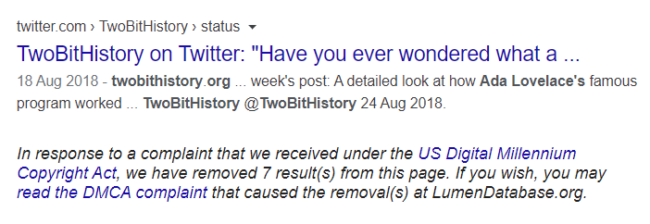
In 2018, the owner of Two-Bit History, a site dedicated to computer history, wrote a successful article about mathematician Ada Lovelace, who some credit as being the first computer programmer. Sadly, if you search Google for that article today you won't find it. Some idiotic anti-piracy company had it deleted because it dared to use the word "did." TorrentFreak reports: In 2018, [Sinclair Target, the owner of computing history blog, Two-Bit History] wrote an article about Ada Lovelace, the daughter of Lord Byron who some credit as being the world's first computer programmer, despite being born in 1815. Unfortunately, however, those who search for that article today using Google won't find it. As the image below shows, the original Tweet announcing the article is still present in Google's indexes but the article itself has been removed, thanks to a copyright infringement complaint that also claimed several other victims.

Sinclair's article was deleted because an anti-piracy company working on behalf of a TV company decided that since its title (What Did Ada Lovelace's Program Actually Do?) contained the word 'DID,' it must be illegal. This monumental screw-up was announced on Twitter by Sinclair himself, who complained that "Computers are stupid folks. Too bad Google has decided they are in charge." At risk of running counter to Sinclair's claim, in this case -- as Lovelace herself would've hopefully agreed -- it is people who are stupid, not computers. The proof for that can be found in the DMCA complaint sent to Google by RightsHero, an anti-piracy company working on behalf of Zee TV, an Indian pay-TV channel that airs Dance India Dance. Now in its seventh season, Dance India Dance is a dance competition reality show that is often referred to as DID. And now, of course, you can see where this is going. Because Target and at least 11 other sites dared to use the word in its original context, RightsHero flagged the pages as infringing and asked Google to deindex them.
In the complaint sent to Google, "the notice not only claims Target's article is infringing the copyrights of Dance India Dance (sorry, DID), but also no less than four online dictionaries explaining what the word 'did actually means," adds TorrentFreak. "Perhaps worse still, some of the other allegedly-infringing articles were published by some pretty serious information resources [including the U.S. Department of Education, Nature.com, and USGS Earthquake Hazards Program of the U.S. Geological Survey]."
United States

US Mulls Cutting Huawei Off From Global Chip Suppliers (reuters.com) 137

The Trump administration is considering changing U.S. regulations to allow it to block shipments of chips to Huawei from companies such as Taiwan's TSMC, the world's largest contract chipmaker. Reuters reports: New restrictions on commerce with China's Huawei are among several options to be considered at high-level U.S. meetings this week and next. The chip proposal has been drafted but its approval is far from certain, one of the sources said. The measure would be a blow to the world's no. 2 smartphone maker as well as to TSMC, a major producer of chips for Huawei's HiSilicon unit and mobile phone rivals Apple and Qualcomm.

"What they're trying to do is make sure that no chips go to Huawei that they can possibly control," the second source said. To target global chip sales to Huawei, U.S. authorities would alter the Foreign Direct Product Rule, which subjects some foreign-made goods based on U.S. technology or software to U.S. regulations. Under the draft proposal, the U.S. government would force foreign companies that use U.S. chipmaking equipment to seek a U.S. license before supplying Huawei -- a major expansion of export control authority that could anger U.S. allies worldwide.

Businesses

Pier 1 Files For Bankruptcy, Warns of Dangers In Handful of Online Vendors Dominating Retail Sales (wsj.com) 101

Pier 1 Imports filed for bankruptcy Monday (Warning: source paywalled; alternative source), "a victim of changing consumer tastes and an unforgiving retail environment," reports The Wall Street Journal. "Unlike many other retailers that have sought bankruptcy in recent years, the publicly traded Pier 1 -- with assets of $426.6 million and listed total debt of $258.3 million -- isn't weighed down with debt from an ill-timed leveraged buyout. Rather the company's struggles can be traced to increasing competition from online players, mass merchants and off-price retailers, such as Wayfair, TJX, HomeGoods, Bed Bath & Beyond, Cost Plus World Market and Amazon." From the report: Those rivals have increasingly moved into selling home furnishings and merchandise that were once virtually the exclusive domain of Pier 1, according to Hart Posen, a professor of management at the University of Wisconsin. "You'd see something in someone's house -- a wicker-rattan chair or an elephant-themed umbrella holder -- and know it came from Pier 1," Mr. Posen said. "You could buy it at Pier 1 or nowhere, but that's just not the case anymore."

The emergence of online operators such as Wayfair have rendered the backdrop for traditional chains all the more difficult, according to Oppenheimer & Co. analyst Brian Nagel. But there were also missteps that led Pier 1 to bankruptcy. The company was late to embrace e-commerce and was forced to build an online business from virtually nothing, said Mr. Nagel. Along the way, it had to absorb the costs of building distribution centers and other infrastructure, while also adjusting to the tighter margins from online sales. "When the company finally made its move online, it did so in a way that cannibalized the volumes and profitability of its physical stores," said Mr. Nagel.
The Fort Worth, Texas-based company tried to revitalize the business with a program dubbed "Pier 1 2021: A New Day," but that effort failed.

"The bankruptcy filing comes after the chain made it through the critical holiday shopping season," adds The Wall Street Journal. "In early January, Pier 1 said it planned to close nearly half of its nearly 940 stores and a number of distribution centers. It had already hired a liquidation company to help close the locations. Pier 1 said it intends to use the bankruptcy process to complete closure of some 450 stores, including closing all of its locations in Canada."
Security

New Email-Based Extortion Scheme Targets Website Owners Serving Ads Via Google AdSense (krebsonsecurity.com) 16

Brian Krebs sheds light upon a new email-based extortion scheme targeting website owners serving banner ads through Google's AdSense program. "In this scam, the fraudsters demand bitcoin in exchange for a promise not to flood the publisher's ads with so much bot and junk traffic that Google's automated anti-fraud systems suspend the user's AdSense account for suspicious traffic," writes Krebs. From his report: Earlier this month, KrebsOnSecurity heard from a reader who maintains several sites that receive a fair amount of traffic. The message this reader shared began by quoting from an automated email Google's systems might send if they detect your site is seeking to benefit from automated clicks. The message goes on to warn that while the targeted site's ad revenue will be briefly increased, "AdSense traffic assessment algorithms will detect very fast such a web traffic pattern as fraudulent."

The message demands $5,000 worth of bitcoin to forestall the attack. In this scam, the extortionists are likely betting that some publishers may see paying up as a cheaper alternative to having their main source of advertising revenue evaporate. The reader who shared this email said while he considered the message likely to be a baseless threat, a review of his recent AdSense traffic statistics showed that detections in his "AdSense invalid traffic report" from the past month had increased substantially.
"We hear a lot about the potential for sabotage, it's extremely rare in practice, and we have built some safeguards in place to prevent sabotage from succeeding," Google said in a statement. "For example, we have detection mechanisms in place to proactively detect potential sabotage and take it into account in our enforcement systems."

"We have a help center on our website with tips for AdSense publishers on sabotage," the statement continues. "There's also a form we provide for publishers to contact us if they believe they are the victims of sabotage. We encourage publishers to disengage from any communication or further action with parties that signal that they will drive invalid traffic to their web properties. If there are concerns about invalid traffic, they should communicate that to us, and our Ad Traffic Quality team will monitor and evaluate their accounts as needed."
Android

Google Confirms It Again Removed Alleged Spying Tool ToTok From Google Play (techcrunch.com) 3

Google has confirmed that the popular messaging app ToTok, which is actually a spying tool used by the United Arab Emirates to track the activities of those who download it, has again been removed from the Play Store. But this time they declined to comment as to why. TechCrunch reports: Reached for comment, Google confirmed to TechCrunch that it removed the app from Google Play. In addition, Google noted the enforcement was not done in response to any external direction or request. That means the U.S. government did not get involved here, rather that Google chose to remove the app itself -- likely for a policy violation. According to The NYT's original report, ToTok had been downloaded millions of times from both Apple and Google's app stores by customers across the Middle East, Europe, Asia, Africa and North America in the few months since its launch. Citing unnamed U.S. intelligence sources, the report claimed the app had been used to track its users' "every conversation, movement, relationship, appointment, sound, and image."

At the time of the app's removal, Google said the app had violated unspecified Google Play policies. The app had over 10 million installs by then, app intelligence firm Sensor Tower says. In January, ToTok's website announced the app was again available for download. The updated version submitted to Google Play included a new dialog that requested authorization to access and sync users' contact list, Vice reported. Oddly, this updated version of ToTok never ranked on Google Play's charts again.

Bug

Bug In WordPress Plugin Can Let Hackers Wipe Up To 200,000 Sites (zdnet.com) 6

An anonymous reader quotes a report from ZDNet: WordPress site owners who use commercial themes provided by ThemeGrill are advised to update one of the plugins that come installed with these themes in order to patch a critical bug that can let attackers wipe their sites. The vulnerability resides in ThemeGrill Demo Importer, a plugin that ships with themes sold by ThemeGrill, a web development company that sells commercial WordPress themes. The plugin, which is installed on more than 200,000 sites, allows site owners to import demo content inside their ThemeGrill themes so they'll have examples and a starting point on which they can build their own sites.

However, in a report published yesterday, WordPress security firm WebARX says that older versions of the ThemeGrill Demo Importer are vulnerable to remote attacks from unauthenticated attackers. Remote hackers can send a specially crafted payload to vulnerable sites and trigger a function inside the plugin. The vulnerable function resets the site's content to zero, effectively wiping the content of all WordPress sites where a ThemeGrill theme is active, and the vulnerable plugin is installed. Furthermore, if the site's database contains a user named "admin," then the attacker is granted access to that user with full administrator rights over the site.

Twitter

Twitter Locks WikiLeaks Official Account With 5.4 Million Followers, Days Before Julian Assange's Extradition Hearing 75

Days before Julian Assange's extradition hearings are set to continue, WikiLeaks' journalist Kristin Hrafnsson reports that the official WikiLeaks twitter account has been locked. "All attempts to get it reopened via regular channels have been unsuccessful," writes Hrafnsson in a tweet. "It has been impossible to reach a human at twitter to resolve the issue. Can someone fix this?" RT reports: The @wikileaks account's most recent posts date back to February 9 and concern the dire precedent set by extraditing a publisher to stand trial on espionage charges. Assange's extradition hearing in the UK, which a court ordered to be split into two parts, is set to begin next week, while the second half is scheduled for May. The publisher's lawyers have complained that access to their client is being restricted, and Assange was only recently moved from solitary confinement at Belmarsh prison after his fellow inmates staged a protest. The UN special rapporteur on torture Nils Melzer has accused the UK government of contributing to Assange's "psychological torture" after examining the activist last year. ZeroHedge also points out that this isn't the first time WikiLeaks' account was locked. In 2016, "Twitter lit up in late July with allegations that it tried to suppress news that secret-leaking website Wikileaks exposed thousands of emails obtained from the servers of the Democratic National Committee," reports ZeroHeads, citing The Washington Examiner. "Friday afternoon, users noted, '#DNCLeaks' was trending, with more than 250,000 tweets about it on the platform. By Friday evening, it vanished completely from the site's 'trending' bar for at least 20 minutes. It returned as '#DNCLeak' after users erupted, though it was too late to quell their rage."

For what it's worth, Twitter CEO Jack Dorsey at the time denied any attempt to intentionally silence the account.
Electronic Frontier Foundation

Did the Early Internet Activists Blow It? (slate.com) 128

Mike Godwin, the first staff counsel of the Electronic Frontier Foundation, writes in a column: Another thing we clearly got wrong is how large platforms would rise to dominate their markets -- even though they never received the kind of bespoke regulated-monopoly partnership with governments that, generations before, the telephone companies had received. In most of today's democracies, Google dominates search and Facebook dominates social media. In less-democratic nations, counterpart platforms -- like Baidu and Weibo in China or VK in Russia -- dominate their respective markets, but their relationships with the relevant governments are cozier, so their market-dominant status isn't surprising. We didn't see these monopolies and market-dominant players coming, although we should have. Back in the 1990s, we thought that a thousand website flowers would bloom and no single company would be dominant. We know better now, particularly because of the way social media and search engines can built large ecosystems that contain smaller communities -- Facebook's Groups is only the most prominent example. Market-dominant players face temptations that a gaggle of hungry, competitive startups and "long tail" services don't, and we'd have done better in the 1990s if we'd anticipated this kind of consolidation and thought about how we might respond to it as a matter of public policy. We should have -- the concern about monopolies, unfair competition, and market concentration is an old one in most developed countries -- but I have no reflexive reaction either for or against antitrust or other market-regulatory approaches to address this concern, so long as the remedies don't create more problems than they solve.

What's new and more troubling is the revival of the idea, after more than half a century of growing freedom-of-expression protections, that maybe there's just too much free speech. There's a lot to unpack here. In the 1990s, social conservatives wanted more censorship, particularly of sexual content. Progressive activists back then generally wanted less. Today, progressives frequently argue that social media platforms are too tolerant of vile, offensive, hurtful speech, while conservatives commonly insist that the platforms censor too much (or at least censor them too much). Both sides miss obvious points. Those who think there needs to be more top-down censorship from the tech companies imagine that when censorship efforts fail, it means the companies aren't trying hard enough to enforce their content policies. But the reality is that no matter how much money and manpower (plus less-than-perfect "artificial intelligence") Facebook throws at curating hateful or illegal content on its services, and no matter how well-meaning Facebook's intentions are, a user base edging toward 3 billion people is always going to generate hundreds of thousands, and perhaps millions, of false positives every year. On the flip side, those who want to restrict companies' ability to censor content haven't given adequate thought to the consequences of their demands. If Facebook or Twitter became what Sen. Ted Cruz calls a "neutral public forum," for example, they might become 8chan writ large. That's not very likely to make anyone happier with social media.

Communications

SpaceX Successfully Launches a New Batch of Its Starlink Satellites (cnet.com) 32

SpaceX on Monday successfully sent another batch of Starlink satellites into orbit but didn't quite stick the landing of its Falcon 9 rocket. From a report: Elon Musk's space company did achieve its primary objective of sending 60 more flying nodes for its nascent global broadband service into space, bringing the total number of Starlink satellites in low-Earth orbit to nearly 300. A secondary goal for the fifth Starlink mission, as with most SpaceX launches, was to recover the first stage of the Falcon 9 by landing it on a droneship stationed in the Atlantic Ocean. But this time the rocket missed the mark by a smidge. At the time it was expected to land, the live webcast from the droneship showed smoke or steam just off camera as the Falcon 9 made a "soft water landing." SpaceX reported during the webcast that the rocket appears to be intact and floating on the ocean, but it remains unclear whether it can be recovered. The booster had a useful life, having already launched three earlier SpaceX missions in 2019 before Monday's Starlink mission. Had it landed successfully, it would have been the 50th successful booster landing for the company. Now we may have to wait until the next planned Falcon 9 launch on March 2 to see that milestone.
Android

Samsung's Changes To Android Are Making Its Phones Less Secure, Says Google (inputmag.com) 42

Google scolded Samsung this week for an issue discovered on the Korean phone maker's Galaxy A50. From a report: Google says Samsung made "unnecessary changes to Android's core kernel," adding the changes Samsung made threaten rather than strengthen the phone's security. The tech giant has a vested interest in making sure Android is secure for OEMs and end users alike. Earlier this week Google announced it has made measurable efforts to limit malicious apps on its Google Play Store and it's clamping down on the permissions apps can request, resulting in a 98% reduction in requests for access to user's call history and text messages. It's also been tackling more worrying bugs, like self-reinstalling ones. But in this instance, it's a hardware partner that's causing the problems. In a detailed blog post from Google's Project Zero Team, researcher Jann Honn outlines the exact issue with Samsung's changes to the Android kernel on the A50. Samsung's changes included a security feature to restrict an attacker from reading or modifying user data, but Honn says the move is "futile" and rather than bolstering security, it introduces vulnerabilities that could increase an attacker's ability to arbitrarily execute code.
Technology

Tesla Teardown Finds Electronics 6 Years Ahead of Toyota and VW (nikkei.com) 259

Elon Musk's Tesla technology is far ahead of the industry giants, a new report has concluded. From the report: This is the takeaway from Nikkei Business Publications' teardown of the Model 3, the most affordable car in the U.S. automaker's all-electric lineup, starting at about $33,000. What stands out most is Tesla's integrated central control unit, or "full self-driving computer." Also known as Hardware 3, this little piece of tech is the company's biggest weapon in the burgeoning EV market. It could end the auto industry supply chain as we know it. One stunned engineer from a major Japanese automaker examined the computer and declared, "We cannot do it." The module -- released last spring and found in all new Model 3, Model S and Model X vehicles -- includes two custom, 260-sq.-millimeter AI chips. Tesla developed the chips on its own, along with special software designed to complement the hardware. The computer powers the cars' self-driving capabilities as well as their advanced in-car "infotainment" system.

This kind of electronic platform, with a powerful computer at its core, holds the key to handling heavy data loads in tomorrow's smarter, more autonomous cars. Industry insiders expect such technology to take hold around 2025 at the earliest. That means Tesla beat its rivals by six years. The implications for the broader auto industry are huge and -- for some -- frightening. Tesla built this digital nerve center through a series of upgrades to the original Autopilot system it introduced in 2014. What was also called Hardware 1 was a driver-assistance system that allowed the car to follow others, mostly on highways, and automatically steer in a lane. Every two or three years, the company pushed the envelope further, culminating in the full self-driving computer.

Google

Google Ends Its Free Wi-Fi Program, Station (techcrunch.com) 10

Google said on Monday that it is winding down Google Station, a program that rolled out free Wi-Fi in more than 400 railway stations in India and "thousands" of other public places in several additional pockets of the world. The company worked with a number of partners on the program. From a report: Caesar Sengupta, VP of Payments and Next Billion Users at Google, said the program, launched in 2015, helped millions of users surf the internet -- a first for many -- and not worry about the amount of data they consumed. But as mobile data prices got cheaper in many markets including India, Google Station was no longer as necessary, he said. The company plans to discontinue the program this year. Additionally, it had become difficult for Google to find a sustainable business model to scale the program, the company said, which in recent years expanded Station to Indonesia, Mexico, Thailand, Nigeria, Philippines, Brazil and Vietnam. The company launched the program in South Africa just three months ago.

Slashdot Top Deals