The Courts

Facebook Accuses NSO Group of Using US Servers for Spying (bloomberg.com) 18

Facebook has accused the Israeli surveillance technology company NSO Group of using servers located in the U.S. to infect hundreds of smartphones with spyware. From a report: The allegation comes as part of a lawsuit that Facebook initiated last year accusing the NSO Group of using WhatsApp accounts to hack into the phones. Facebook owns the popular messaging app. In a filing released on Thursday in federal court in Oakland, California, lawyers representing the social media giant alleged that NSO Group had used a network of remote servers in California to hack into phones and devices that were used by attorneys, journalists, human rights activists, government officials and others. NSO Group has argued that Facebook's case against it should be thrown out on the grounds that the court has no jurisdiction over its operations. In a 13 May legal document, lawyers representing NSO Group said that the company had no offices or employees in California and "do no business of any kind there." NSO has also argued that it has no role in operating the spyware and is limited to "providing advice and technical support to assist customers in setting up" the technology.
IT

Ventilator Companies Finally Make the Life Saving Devices Easier to Repair (vice.com) 32

America needs ventilators. The coronavirus has spread far enough that Donald Trump used the Defense Production Act on April 2 to make it easier to produce more. There's also broken ventilators on the market that could work with some repairs, but manufacturers spent weeks making it hard to get basic information needed for technicians to repair the machines. From a report: U.S. PIRG and other groups had been pressuring the manufacturers to release the ventilator information for weeks. On April 14, the States Treasurer of Pennsylvania, Delaware, Illinois, Rhode Island, and Colorado called on the manufacturers to release the documents in an open letter. Now, ventilator manufacturers GE, Fisher & Paykal, and Medtronic have made it easier to access the repair manuals and other service information hospitals need to repair broken ventilators. GE opened a web portal where people can download the repair information for its Carescape R860 and Engstrom ventilators. GE typically requires a 4-day in-person training class to learn to repair ventilators but is making the information available to the public "to help navigate this crisis and ensure ventilators are maintained as quickly as possible to get these vital systems back into patient care."

Medtronic, who makes a number of ventilators, has posted a portal to register for the design and repair information of its ventilators. Meaning that the savvy user could do more than repair a broken machine -- they may be able to build a whole new ventilator. But it's not enough, according to Kyle Wiens of iFixit, a company that advocates for the right-to-repair and teaches people how to fix their own stuff. "Medtronic only released the manual for the PB560, which they don't sell in the U.S," Wiens told Motherboard in a Twitter DM. "We don't have the manual for the PB980, their flagship model and the one used by our hospitals in San Luis Obispo."

Australia

Developers Observe Anzac Day, Commemorating Those Who Served, With a Data-Based 'Anzacathon' (anzacathon.com) 30

Today is Anzac Day, a national day of remembrance in Australia and New Zealand for those who served, marked on the anniversary of the 1915 campaign that led to the first major casualties for Australian and New Zealand Army Corp forces during World War One.

"More than 87,000 Turks died, along with an estimated 44,000 men from the British Empire and France, including 8,500 Australians and nearly 3,000 New Zealanders," remembers the BBC, "one in four of the Kiwis sent to Gallipoli."

Taking special note is free and open source software engineer Daniel, who is also a Debian developer, who writes: In 1981, the movie Gallipoli made the career of Mel Gibson. In 2018, The Guardian lamented that Australia had reached peak Anzac after committing $500 million to expand a war memorial.

At the other end of the spectrum, a group of students in Kosovo organized a very low-budget Remembrance Day hackathon in 2019 and it has now been used as the foundation for a data-driven online Anzacathon while traditional memorials will remain closed due to coronavirus.

The video helps us reflect not only on the legacy of the Anzacs but our own plight today.

Living in Europe, Pocock describes the origins of the project. "Last year I had asked myself: are there any sites where there is only one Australian casualty, where nobody has visited them for Anzac Day?"

The activities list on the Anzacathon page now suggests updating its list of lone Anzac graves around the world, by sharing your own information from the Anzac honour roll of your school, village, company, or club.
Communications

Long-Lost US Military Satellite Found By Amateur Radio Operator (npr.org) 79

Tilley, an amateur radio operator living in Canada, found a "zombie" military satellite that was supposed to shut down in 1972. NPR reports: Recently, Tilley got interested in a communications satellite he thought might still be alive -- or at least among the living dead. LES-5, built by the Massachusetts Institute of Technology's Lincoln Laboratory, was launched in 1967. Tilley was inspired by another amateur who in 2016 had found LES-1, an earlier satellite built by the same lab. What was intriguing to him about LES-5 was that if it was still working, it might be the oldest functioning satellite still in geostationary orbit. By scouring the Internet, he found a paper describing the radio frequency that LES-5, an experimental military UHF communications satellite, should be operating on -- if it was still alive. So he decided to have a look.

"This required the building of an antenna, erecting a new structure to support it. Pre-amps, filters, stuff that takes time to gather and put all together," he says. "When you have a family and a busy business, you don't really have a lot of time for that," he says. But then came the COVID-19 pandemic. British Columbia, where Tilley lives, was on lockdown. Like many of us, suddenly Tilley had time on his hands. He used it to look for LES-5, and on March 24, he hit the ham radio equivalent of pay dirt.
While Tilley thinks it may be possible to send commands to the satellite, the MIT lab that built LES-5 didn't comment on the matter when NPR inquired.
Privacy

Apple and Google Pledge To Shut Down Coronavirus Tracker When Pandemic Ends (theverge.com) 63

An anonymous reader quotes a report from The Verge: On Friday, Apple and Google revised their ambitious automatic contact-tracing proposal, just two weeks after the system was first announced. An Apple representative said the changes were the result of feedback both companies had received about the specifications and how they might be improved. The companies also released a "Frequently Asked Questions" page, which rehashes much of the information already made public. On a call accompanying the announcement, representatives from each company pledged for the first time to disable the service after the outbreak had been sufficiently contained. Such a decision would have to be made on a region-by-region basis, and it's unclear how public health authorities would reach such a determination. However, the engineers stated definitively that the APIs were not intended to be maintained indefinitely.

Under the new encryption specification, daily tracing keys will now be randomly generated rather than mathematically derived from a user's private key. Crucially, the daily tracing key is shared with the central database if a user decides to report their positive diagnosis. As part of the change, the daily key is now referred to as the "temporary tracing key," and the long-term tracing key included in the original specification is no longer present. The new encryption specification also establishes specific protections around the metadata associated with the system's Bluetooth transmissions. Along with the random codes, devices will also broadcast their base power level (used in calculating proximity) and which version of the tool they are running. The companies are also changing the language they use to describe the project. The protocols were initially announced as a contact-tracing system, it is now referred to as an "exposure notification" system. The companies say the name change reflects that the new system should be "in service of broader contact tracing efforts by public health authorities."

Data Storage

WD Sets the Record Straight: Lists All Drives That Use Slower SMR Tech (tomshardware.com) 138

News emerged last week that WD, Seagate and Toshiba are all shipping hard drives using Shingled Magnetic Recording (SMR), a slower form of HDD technology that can result in reduced performance in some types of workloads, but without disclosing that critical bit of information in marketing materials or specification sheets. The backlash has been swift, and now WD is striking a conciliatory tone with its customers in an update to its blog. The company also divulged that it is also shipping SMR technology in some of its WD Blue and WD Black hard drives for desktop PCs and laptops. Tom's Hardware reports: The new disclosure comes on the heels of WD's blog post yesterday that outlined its stance on using SMR drives. The company contends that SMR technology is adequate for the applications the drives are designed for, but that is certainly an open matter of debate with many users claiming the drives cause problems in RAID arrays. The issues purportedly stem from the slow random write speeds, which do cause a measurable reduction in performance, and background activities that are purportedly responsible for the drives dropping from RAID arrays. In either case, The WD blog advised users they should step up to more expensive models designed for heavier workloads if they have more demanding needs.

Today the company updated its blog with a more conciliatory tone, and also disclosed all of its drive models that are shipping with SMR tech. In addition to the WD Red NAS drives that the company previously admitted used SMR tech, WD is also shipping the tech into its 2.5"and 3.5" WD Blue and 2.5" WD Black lineups. Both models are designed for desktop PCs and laptops, with the former coming as a value drive while the latter is designed for high-performance users. WD acknowledged the recent brouhaha surrounding the fact it was shipping drives without disclosing they use the slower recording technology, stating: "The past week has been eventful, to say the least. As a team, it was important that we listened carefully and understood your feedback about our WD Red NAS drives, specifically how we communicated which recording technologies are used. Your concerns were heard loud and clear..." Importantly, the blog states, "...Thank you for letting us know how we can do better. We will update our marketing materials, as well as provide more information about SMR technology, including benchmarks and ideal use cases."
WD also said that they will share further data in the future, including benchmarks that might prove otherwise.
Communications

Telegram Hits 400M Monthly Active Users (techcrunch.com) 32

Instant messaging service Telegram has amassed 400 million monthly active users, it said today, up from 300 million active users the seven-year-old service disclosed to the SEC last October. From a report: The service -- founded by Pavel Durov, who also created Russian social networking site VK -- said it adds about 1.5 million users each day and is the most downloaded social media app in over 20 nations. Telegram is working on bringing a secure video call feature to its users this year in response to the growing popularity of Zoom and Houseparty, it said. The company, headquartered in Dubai, however, did not talk about the future of its Gram cryptocurrency wallet and TON Blockchain that it had revealed in 2018 but put on hold early this year. "As the gap in popularity between Telegram and its older competitors narrows, we find more and more validity in that original assumption," the firm said in a blog post.
Software

Google's Flutter: 2 Million Developers, Uptick In Enterprise Use, New Release Model Revealed (zdnet.com) 27

Liam Tung writing via ZDNet: Google says two million developers have used its Flutter user-interface (UI) framework for building apps targeting mobile, desktop, and the web since declaring it production ready at Google I/O 2018. Flutter is on the rise, according to Google's Tim Sneath, who said Flutter use grew 10% in March compared with February -- despite COVID-19 coronavirus pandemic impediments. He added that the UI framework now has "nearly half a million" developers who use it on a monthly basis. Most of them are also building on Windows, with 60% of Flutter users developing on Windows 10 PCs, 27% on macOS, and 13% on Linux. Google says over a third of Flutter users work at a startup, while 26% are developers working in the enterprise, 19% are self-employed, and 7% work for design agencies. There are also now 50,000 Flutter-built Android apps on the Google Play Store, and 10,000 of those were uploaded in the past month, according to Sneath.

Google is also updating the release process for Flutter to improve the stability and predictability of its releases. Google found that Flutter contributors and developers didn't understand when a release would be built and what code it would contain. Another issue is a lack of testing for branches, which means sporadic hotfix releases to address regressions or bugs, which also run the risk of introducing new bugs. Google is now moving to a branching model for Flutter, which commences with the April release and includes a "stabilization period" for the beta and stable releases to address key bugs that have been selected by reviewers. Google will also align the Flutter and Dart release processes and channels. This means Dart now has a beta channel, and it will be aligned with the Flutter beta channel.

The Internet

Malwarebytes Releases New VPN Service For Windows (bleepingcomputer.com) 24

The popular anti-malware software MalwareBytes is releasing a new Windows VPN service called Malwarebytes Privacy. The company says it plans on offering Mac, iOS, Android, and ChromeOS versions in the future. Bleeping Computer reports: During our tests yesterday, you could select from 10 states in the USA and 30 countries around the world. [...] Malwarebytes told BleepingComputer that this is not a white-label service, but rather one they developed themselves. A trusted-third party built the network infrastructure, and Malwarebytes developers created the app and other components. Malwarebytes Privacy is using the modern WireGuard VPN implementation that was recently integrated into the Linux kernel.

Unfortunately, not much is known about Malwarebytes Privacy's logging and data retention policies. According to Malwarebytes' product page, "Malwarebytes Privacy does not log your online activities, whether it's browsing or accessing any websites." This is what most people want, but it would be good to get more specific language in a dedicated data retention policy or language in their privacy policy.

The Internet

Internet Governance Body RIPE Opposes China's Internet Protocols Upgrade Plan (zdnet.com) 90

EU-based Internet governance body RIPE is opposing a proposal to remodel core internet protocols, a proposal backed by the Chinese government, Chinese telecoms, and Chinese networking equipment vendor Huawei. From a report: Named "New IP," this proposal consists of a revamped version of the TCP/IP standards to accommodate new technologies, a "shutoff protocol" to cut off misbehaving parts of the internet, and a new "top-to-bottom" governance model that decentralizes the internet and puts it into the hands of a few crucial node operators. The New IP proposal was submitted last year to the International Telecommunication Union (ITU) and brought to the public's attention following a Financial Times report last month. The proposal received immediate criticism from the general public and privacy advocates due to its obvious attempt to hide internet censorship features behind a technical redesign of the TCP/IP protocol stack.

The New IP proposal was described as the Chinese government's attempt to export and impose its autocratic views onto the rest of the internet and its infrastructure. Millions of eyebrows were raised when authoritarian countries like Iran, Russia, and Saudi Arabia expressed support for the proposal. In a blog post this week, RIPE NCC, the regional Internet registry for Europe, West Asia, and the former USSR, formally expressed a public opinion against China New IP proposal. "Do we need New IP? I don't think we do," said Marco Hogewoning, the current acting Manager Public Policy and Internet Governance at the RIPE NCC. "Although certain technical challenges exist with the current Internet model, I do not believe that we need a whole new architecture to address them."

Facebook

Facebook Gets Rid of 'Pseudoscience' Ad-Targeting Category (reuters.com) 46

Facebook has removed "pseudoscience" as an option for advertisers that want to target audiences, a category available until this week even as the world's largest social media network vowed to curb misinformation about the COVID-19 pandemic. Reuters reports: The company has also paused the availability of some other interest categories while it evaluates its list, a Facebook spokeswoman confirmed in an email after Reuters found "conspiracy theory" was no longer an ad-targeting option. The company eliminated the pseudoscience category from its "detailed targeting" list on Wednesday, the spokeswoman said by phone, after tech news site The Markup showed that it could advertise a post targeting people interested in pseudoscience. The Markup demonstrated that Facebook was allowing such ads after saying it would police COVID-19 misinformation on its platform. More than 78 million Facebook users were interested in "pseudoscience," it said, citing Facebook's ad portal.
Businesses

Instacart Plans To Hire 250,000 More Shoppers (cnn.com) 59

Instacart hired 300,000 workers in recent weeks to meet surging demand for grocery deliveries spurred by the pandemic. Now, the startup is seeking to hire another 250,000 workers over the next two months. CNN reports: The on-demand grocery delivery company said Thursday that it is seeking to hire the additional "full-service shoppers," who are treated as independent contractors, in areas with the highest demand with the aim to "get back to same-day delivery." Some customers have struggled in recent weeks to secure delivery slots due to the high demand. In a blog post, Instacart said it will reintroduce a waitlist for applicants in areas where it has enough workers to satisfy demand to ensure it is "thoughtfully balancing" how many workers it brings on.

In recent weeks, the company has made "safety kits," which include a face mask and hand sanitizer, available for its workers to order. Instacart said Thursday it will soon have an in-app wellness check for workers to help determine if they have any coronavirus-related symptoms. The company said Thursday it will extend its coronavirus financial assistance of up to 14 days of pay for workers diagnosed with the virus or placed into individual mandatory quarantine through the remainder of the pandemic.

Communications

Elon Musk Says Starlink Internet Private Beta To Begin In Roughly Three Months, Public Beta In Six (techcrunch.com) 55

SpaceX CEO Elon Musk said on Twitter that a private beta for the company's Starlink satellite internet service would begin in around three months, with a public beta to kick off roughly three months after that. TechCrunch reports: The initial beta test will apply to those located in "high latitudes," Musk added. To date, SpaceX has said that Starlink service will initially be made available to customers in Canada and in the northern United States in 2020, with additional service expansion to follow to other parts of the world throughout 2021. On Twitter in response to a question about whether Germany counts as "high latitude," Musk said that it does, indicating beta service at least may be available in more markets than the U.S. and Canada ahead of next year. Yesterday, SpaceX launched another big batch of Starlink satellites, bringing the total number of Starlink satellites in orbit to 422.
Communications

Scientists Explore Underwater Quantum Links For Submarines (ieee.org) 12

An anonymous reader quotes a report from IEEE Spectrum: Underwater quantum links are possible across 30 meters (100 feet) of turbulent water, scientists have shown. Such findings could help to one day secure quantum communications for submarines. [...] In the new study, researchers experimented with quantum communications in a "flume tank," a water tank in which scientists can generate waves to mimic the ocean. They also tried two different strategies for quantum communications -- one involving just the polarization of the light, and the other incorporating the polarization and the orbital angular momentum of the signals -- to analyze how quantum communication protocols might differ in maximum distances and data transfer rates.

The researchers achieved quantum communication at up to 72 kilobits per second across up to 30 meters of turbulent water, the longest distance yet reported for such links. Although turbulence did result in significant wandering and distortion of light signals, those error rates didn't prevent quantum links from successfully being established with either communication protocol. Unexpectedly, the researchers found they could keep quantum communication going even while the transmitter moved down the flume tank. "We had expected that this would not be possible without beam-tracking technology," says Felix Hufnagel, a lead author and quantum physicist at the University of Ottawa in Canada. After the scientists analyzed their data, they suggested the maximum distance for secure quantum communications might actually be 80 meters in turbulent water, although this would depend on factors such as the efficiency of the detectors used. Improving such factors might significantly boost the maximum communications distance, they say.
The findings have been detailed in a preprint article on April 9.
Robotics

Boston Dynamics Open-Sources Health Care Robotics Toolkit, Sends 'Spot' Robot To Help Hospitals Remotely Treat COVID-19 Patients (bostonglobe.com) 20

watha2020 writes: Spot, the four-legged robot made famous by its YouTube dance video, is being tested as a remote triage system at Boston's Brigham Women's Hospital. A Spot robot carrying an iPad allows doctors to interview possibly infected patients at a safe distance. [Spot is also carrying a pouch near the robot's "tail," which allows it to deliver small items such as bottled water to infected patients, without the need to send in a nurse. The report adds that an upgraded model will add cameras that can measure a patient's respiration rate and body temperature, with no need to make physical contact.] An anonymous Slashdot reader also shares news that Boston Dynamics today open-sourced its health care robotics toolkit on GitHub. "The company hopes that existing Boston Dynamics customers and other mobile robot providers can use the toolkit, which includes documentation and CAD files of enclosures and mounts, to help health care workers and essential personnel and ultimately save lives," reports VentureBeat. "The mobile robot provider outlined four use cases for its toolkit: telemedicine (which it has already deployed), remote vitals inspection, disinfection, and delivery."
Google

Google To Cut Marketing Budgets By as Much as Half, Directors Warned of Hiring Freezes (cnbc.com) 18

Google is slashing its marketing budgets by as much as half for the second half of the year, CNBC reported Thursday. From the report: One email about the cuts went out to marketing employees this week, noting the budget cuts and a new hiring freeze for full-time and contract employees. "There are budget cuts and hiring freezes happening across marketing and across Google," said one message from a global director sent to employees Wednesday. "We, along with the rest of marketing, have been asked to cut our budget by about half for H2." A company spokesperon confirmed that some areas' budgets are being cut by as much as half, but added that others may not be since it is still in the process of "recalibrating." "As we outlined last week, we are re-evaluating the pace of our investment plans for the remainder of 2020 and will focus on a select number of important marketing efforts," a company spokesperson said in an emailed statement to CNBC Thursday. "We continue to have a robust marketing budget, particularly in digital, in many business areas."
The Internet

Bing Disables 'Trending' Feature After Wildly Inappropriate Results (arstechnica.com) 57

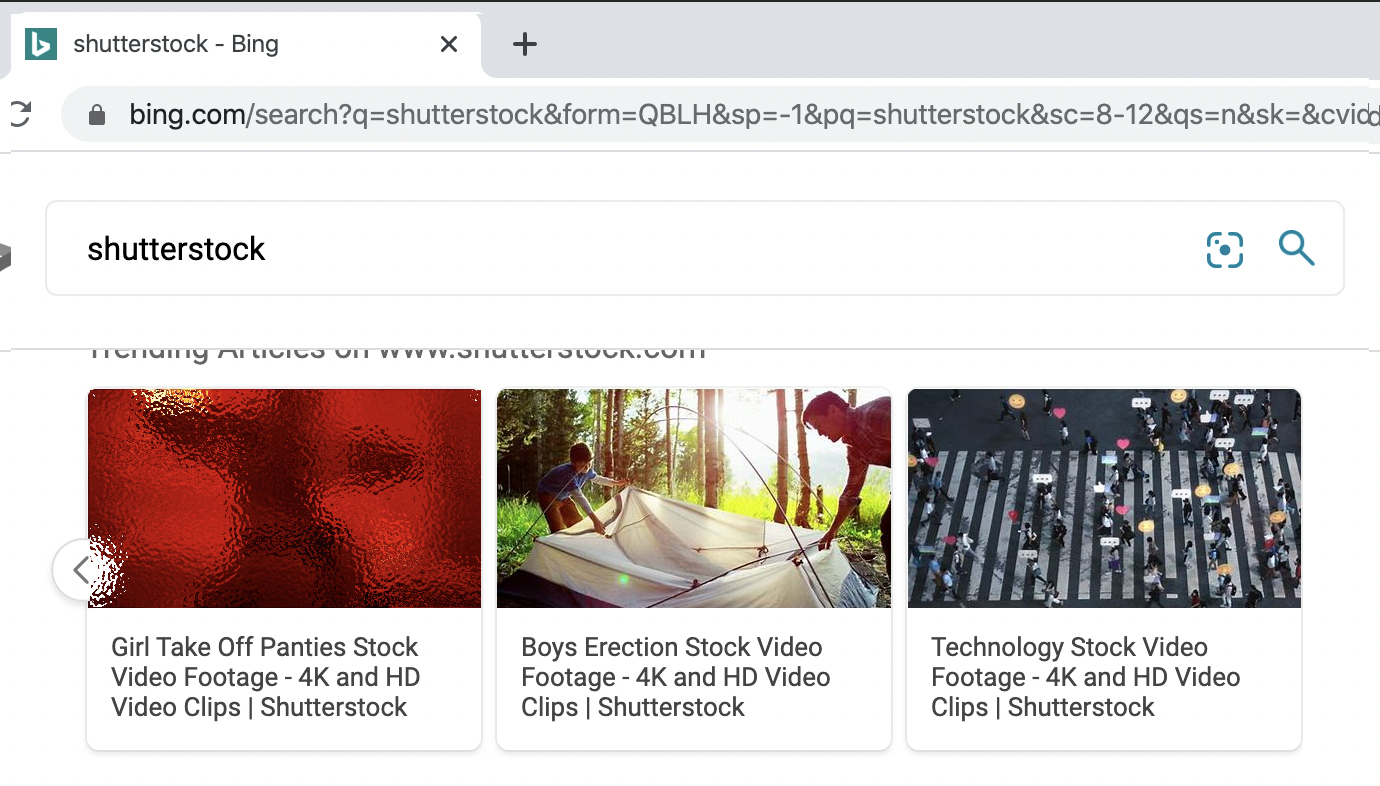
An anonymous reader quotes a report from Ars Technica: Microsoft has shut down a feature in its Bing search engine that shows popular articles from major websites after Ars Technica reported that the feature was showing wildly inappropriate results from the stock photo site Shutterstock. How inappropriate? Well, here are a couple of screenshots I took on Wednesday morning after a reader tipped me off to the problem.

"These search results were unacceptable, and we appreciate Ars Technica making us aware of them," Microsoft said in an emailed statement on Wednesday evening. "We've disabled the preview feature responsible for these results while we examine how they occurred and how we can prevent them in the future." As the name suggests, this "trending articles" carousel is supposed to highlight articles on a website (Shutterstock in this case) that are most popular at the moment. Microsoft didn't just shut it down for Shutterstock. It has disabled the feature for all websites. Microsoft says that its software attempts to filter out pornographic and racy content from results like this. But the company admitted that its filters failed in this case, and it vowed to improve them before re-enabling the feature.

Communications

FCC Widens Wi-Fi Airwaves Access in Win for Facebook, Google (bloomberg.com) 16

Regulators voted to let fast Wi-Fi devices use a broad swath of airwaves, delivering a win for tech companies such as Google and Facebook and a setback to utilities that use the frequencies to control pipelines and electric grids. From a report: The U.S. Federal Communications Commission decided to let the airwaves band known as 6 gigahertz be used by phones, tablets, wearables and other consumer electronics as well as industrial sensors for manufacturing. The agency said it anticipates new, high-speed uses will emerge that will help secure U.S. leadership in advanced 5G services. The agency approved the change in a 5-0 vote during its monthly meeting, which was held online. "This will be a huge benefit to consumers and innovators," said FCC Chairman Ajit Pai. The agency under his leadership has pushed to rearrange airwaves uses, finding places on the spectrum where assignments made years ago can be modified to accommodate the booming demand for mobile signals. Wi-Fi, which routes signals to wired networks, already carries the bulk of mobile-phone traffic. The newly available airwaves will expand frequencies available to Wi-Fi six-fold, and uses will expand substantially, said Edgar Figueroa, president of the Wi-Fi Alliance, with members including chipmakers Intel Corp. and Qualcomm.
Facebook

Want To Find a Misinformed Public? Facebook's Already Done It (themarkup.org) 145

Last week, Facebook CEO Mark Zuckerberg wrote a post pledging to combat misinformation about COVID-19 circulating on Facebook. "We've taken down hundreds of thousands of pieces of misinformation related to COVID-19, including theories like drinking bleach cures the virus or that physical distancing is ineffective at preventing the disease from spreading," Zuckerberg wrote. But at the very same time, The Markup found, Facebook was allowing advertisers to profit from ads targeting people that the company believes are interested in "pseudoscience." From the report: According to Facebook's ad portal, the pseudoscience interest category contained more than 78 million people. This week, The Markup paid to advertise a post targeting people interested in pseudoscience, and the ad was approved by Facebook. Using the same tool, The Markup boosted a post targeting people interested in pseudoscience on Instagram, the Facebook-owned platform that is incredibly popular with Americans under 30. The ad was approved in minutes.
Google

Google To Require All Advertisers To Pass Identity Verification Process (cnbc.com) 29

Google will soon require all advertisers to verify their identity, the company said in a blog post on Thursday. It's making the change to prevent advertisers from misrepresenting themselves and says it it should allow consumers to see who's running ads and which country they're located in. From a report: Consumers have seen a proliferation of ads for products from dubious advertisers, like fake vaccines, in recent months. Fake businesses have also been an issue. Existing advertisers will have 30 days to complete the verification process, according to a spokeswoman. If they don't submit the documents by then, Google said it will suspend the account and the advertiser's ability to serve ads until they provide it. The company said consumers will start seeing disclosures that list this information on the advertiser when they click "Why this ad?" on placements beginning this summer. Google will begin by verifying advertisers in the U.S. and will expand globally, expecting that the process will take a few years to complete. Google began requiring political advertisers to verify their identity back in 2018 before running election ads.

Slashdot Top Deals