Moon

Texas Astronomers Revive Idea For 'Ultimately Large Telescope' On the Moon (phys.org) 80

A group of astronomers from The University of Texas at Austin has revived an idea shelved by NASA to build a lunar liquid-mirror telescope on the moon to study the first stars in the universe. "The team, led by NASA Hubble Fellow Anna Schauer, will publish their results in an upcoming issue of The Astrophysical Journal," reports Phys.Org. From the report: These first stars formed about 13 billion years ago. They are unique, born out of a mix of hydrogen and helium gasses, and likely tens or 100 times larger than the Sun. New calculations by Schauer show that a previously proposed facility, a liquid mirror telescope that would operate from the surface of the Moon, could study these stars. Proposed in 2008 by a team led by Roger Angel of The University of Arizona, this facility was called the Lunar Liquid-Mirror Telescope (LLMT). NASA had done an analysis on this proposed facility a decade ago, but decided not to pursue the project. According to Niv Drory, a senior research scientist with UT Austin's McDonald Observatory, the supporting science on the earliest stars did not exist at that point. "This telescope is perfect for that problem," he said.

The proposed lunar liquid-mirror telescope, which Schauer has nicknamed the "Ultimately Large Telescope," would have a mirror 100 meters in diameter. It would operate autonomously from the lunar surface, receiving power from a solar power collection station on the Moon, and relaying data to satellite in lunar orbit. Rather than coated glass, the telescope's mirror would be made of liquid, as it's lighter, and thus cheaper, to transport to the Moon. The telescope's mirror would be a spinning vat of liquid, topped by a metallic -- and thus reflective -- liquid. (Previous liquid mirror telescopes have used mercury.) The vat would spin continuously, to keep the surface of the liquid in the correct paraboloid shape to work as a mirror. The telescope would be stationary, situated inside a crater at the Moon's north or south pole. To study the first stars, it would stare at the same patch of sky continuously, to collect as much light from them as possible. The team is proposing that the astronomical community revisit the shelved plan for a lunar liquid-mirror telescope, as a way to study these first stars in the universe.

Twitter

Twitter Launches Disappearing 'Fleets' Worldwide (reuters.com) 52

Twitter said on Tuesday it was globally launching tweets that disappear after 24 hours, similar to the stories feature that is popular on Snapchat and Facebook's photo-sharing app Instagram. Reuters reports: Twitter has previously announced its plan for these ephemeral tweets, dubbed "fleets," and tested the feature in Brazil, Italy, India, and South Korea. "Some of you tell us that Tweeting is uncomfortable because it feels so public, so permanent, and like there's so much pressure to rack up Retweets and Likes," design director Joshua Harris and product manager Sam Haveson said in a blog post. "Because they disappear from view after a day, Fleets helped people feel more comfortable sharing personal and casual thoughts, opinions, and feelings," they added.

Fleets, which include text, photos and videos, will be available at the top of users' home timelines on Twitter and on the sender's profile. Twitter also confirmed it was working on a live audio feature, dubbed 'Spaces,' that it aims to test later this year. The feature will allow users to talk in public, group conversations. It has similarities with Clubhouse, a social platform in which users are invited to talk in voice chat rooms. "Given all of the potential for abuse within audio spaces, we are going to be making it available first to women and historically marginalized communities," said Twitter's Kelley.

Transportation

China Built the First Electric Car Designed Exclusively For Ride-Hailing (theverge.com) 15

Two of China's top companies have joined forces to design, develop, and build an electric car for the express purpose of ride-hailing. The Verge reports: The vehicle is an adorable green hatchback called the D1, and it was developed by Didi Chuxing, the top ride-hailing company in China that notoriously defeated Uber in 2016, and BYD, one of the leading electric vehicle manufacturers. The D1 will have a range of 418 km (260 miles) as judged by NEDC (New European Driving Cycle). They also explained some of the more interesting design touches that make this vehicle particularly well-suited for app-based ride-hailing.

There is a medium-sized screen on the dashboard as well as two more touchscreens on the back of both headrests for passengers to access navigation and other information. There is one more smaller screen behind the steering wheel that serves as an instrument cluster. The car comes with sliding doors to prevent riders from accidentally hitting passengers or cyclists. The driver's seat is extra comfy for extended use, and there's added legroom in the back seat. The paint job is described as "avocado green," which is similar to Didi's shared bikes.

The D1 will come with a Level 2 driver assistance system that includes lane-departure warning, automatic braking, and pedestrian collision warning. There will also be a driver monitoring system to ensure that drivers keep their hands on the wheel and stay focused on the road. Didi says it used data gathered from its 550 million registered passengers and 31 million drivers to design the D1.

Desktops (Apple)

Apple's M1 Is Exceeding Expectations (extremetech.com) 274

Reviews are starting to pour in of Apple's MacBook Pro, MacBook Air and Mac Mini featuring the new M1 ARM-based processor -- and they're overwhelmingly positive. "As with the Air, the Pro's performance exceeds expectations," writes Nilay Patel via The Verge.

"Apple's next chapter offers strong performance gains, great battery and starts at $999," says Brian Heater via TechCrunch.

"When Apple said it would start producing Macs with its own system-on-chip processors, custom CPU and GPU silicon (and a bunch of other stuff) to replace parts from Intel and AMD, we figured it would be good. I never expected it would be this good," says Jason Cross in his review of the MacBook Air M1.

"The M1 is a serious, serious contender for one of the all-time most efficient and highest-performing architectures we've ever seen deploy," says ExtremeTech's Joel Hruska.

"Spending a few days with the 2020 Mac mini has shown me that it's a barnburner of a miniature desktop PC," writes Chris Welch via The Verge. "It outperforms most Intel Macs in several benchmarks, runs apps reliably, and offers a fantastic day-to-day experience whether you're using it for web browsing and email or for creative editing and professional work. That potential will only grow when Apple inevitably raises the RAM ceiling and (hopefully) brings back those missing USB ports..."

"Quibbling about massively parallel workloads -- which the M1 wasn't designed for -- aside, Apple has clearly broken the ice on high-performance ARM desktop and laptop designs," writes Jim Salter via Ars Technica. "Yes, you can build an ARM system that competes strongly with x86, even at very high performance levels."

"The M1-equipped MacBook Air now packs far better performance than its predecessors, rivaling at times the M1-based MacBook Pro. At $999, it's the best value among macOS laptops," concludes PCMag.

"For developers, the Apple Silicon Macs also represent the very first full-fledged Arm machines on the market that have few-to-no compromises. This is a massive boost not just for Apple, but for the larger Arm ecosystem and the growing Arm cloud-computing business," writes Andrei Frumusanu via AnandTech. "Overall, Apple hit it out of the park with the M1."

Android

Google Sued After Cellular Data Allowances Eaten by Hidden Transfers (theregister.com) 19

An anonymous reader shares a report: Google was sued last week for allegedly stealing Android users' cellular data allowances through unapproved, undisclosed transmissions to the web giant's servers. The lawsuit, Taylor et al v. Google, was filed in a US federal district court in San Jose on behalf of four plaintiffs based in Illinois, Iowa, and Wisconsin in the hope the case will be certified by a judge as a class action. The complaint contends that Google is using Android users' limited cellular data allowances without permission to transmit information about those individuals that's unrelated to their use of Google services. Data sent over Wi-Fi is not at issue, nor is data sent over a cellular connection in the absence of Wi-Fi when an Android user has chosen to use a network-connected application. What concerns the plaintiffs is data sent to Google's servers that isn't the result of deliberate interaction with a mobile device -- we're talking passive or background data transfers via cell network, here. "Google designed and implemented its Android operating system and apps to extract and transmit large volumes of information between Plaintiffs' cellular devices and Google using Plaintiffs' cellular data allowances," the complaint claims. "Google's misappropriation of Plaintiffs' cellular data allowances through passive transfers occurs in the background, does not result from Plaintiffs' direct engagement with Google's apps and properties on their devices, and happens without Plaintiffs' consent." The allegation: "The device, stationary, with all apps closed, transferred data to Google about 16 times an hour, or about 389 times in 24 hours. Assuming even half of that data is outgoing, Google would receive about 4.4MB per day or 130MB per month in this manner per device subject to the same test conditions."
Firefox

Firefox 83 Arrives With HTTPS-Only Mode and Faster Performance (venturebeat.com) 56

Mozilla today launched Firefox 83 for Windows, Mac, and Linux. An anonymous reader shares a report: Firefox 83's highlight feature is HTTPS-Only Mode, in which the browser attempts to establish fully secure connections to every website (just like the EFF's HTTPS Everywhere). If it can't, Firefox asks for your permission before connecting to a website that doesn't support secure connections. To enable HTTPS-Only Mode, click on Firefox's menu button, hit Preferences, then Privacy & Security, scroll down to HTTPS-Only Mode, and choose "Enable HTTPS-Only Mode in all windows." [...] Firefox 83 also brings performance improvements (improved page load performance by up to 15%, page responsiveness by up to 12%, and reduced memory usage by up to 8%). Firefox 83 is also the penultimate version of the web browser that will run Flash software; Firefox 85 will completely disable it when it arrives on Jan. 12, 2021.
Communications

Cable Failures Endanger Renowned Puerto Rico Radio Telescope (apnews.com) 58

The giant, aging cables that support one of the world's largest single-dish radio telescopes are slowly unraveling in this U.S. territory, pushing an observatory renowned for its key role in astronomical discoveries to the brink of collapse. The Associated Press reports: The Arecibo Observatory, which is tethered above a sinkhole in Puerto Rico's lush mountain region, boasts a 1,000-foot-wide (305-meter-wide) dish featured in the Jodie Foster film "Contact" and the James Bond movie "GoldenEye." The dish and a dome suspended above it have been used to track asteroids headed toward Earth, conduct research that led to a Nobel Prize and helped scientists trying to determine if a planet is habitable. Last week, one of the telescope's main steel cables that was capable of sustaining 1.2 million pounds (544,000 kilograms) snapped under only 624,000 pounds (283,000 kilograms). That failure further mangled the reflector dish after an auxiliary cable broke in August, tearing a 100-foot hole and damaging the dome above it.

Officials said they were surprised because they had evaluated the structure in August and believed it could handle the shift in weight based on previous inspections. It's a blow for the telescope that more than 250 scientists around the world were using. The facility is also one of Puerto Rico's main tourist attractions, drawing some 90,000 visitors a year. Research has been suspended since August, including a project aiding scientists in their search for nearby galaxies. Some new cables are scheduled to arrive next month, but officials said funding for repairs has not been worked out with federal agencies. Scientists warn that time is running out. Only a handful of cables now support the 900-ton platform. The observatory estimates the damage at more than $12 million and is seeking money from the National Science Foundation, an independent federal agency that owns the observatory.
The report notes that the observatory is considered crucial for the study of pulsars, which are the remains of stars that can be used to detect gravitational waves. It's also used to search for natural hydrogen, which can reveal how certain cosmic structures are formed.
Japan

Japan's ARM-Based Supercomputer Leads World In Top500 List; Exascale Expected In 2021 (techtarget.com) 25

dcblogs writes: Japan's Fugaku ARM-based supercomputer is the world's most powerful in the latest Top500 list, setting a world record of 442 petaflops. But this was otherwise an unremarkable year for supercomputers, with a "flattening performance curve," said Jack Dongarra, one of the academics behind the twice-a-year ranking and director of the Innovative Computing Laboratory at the University of Tennessee. This is a result of Moore's Law slowing down as well as a slowdown in the replacement of older systems, he said. But the U.S. is set to deliver an exascale system -- 1,000 petaflops -- next year and China as well. Meanwhile, the EU has a 550 petaflop system in development in Finland. "On the Top500 list, the second-ranked system was IBM Power Systems at nearly 149 petaflops using its Power9 CPUs and Nvidia Tesla GPUs. It is at the Oak Ridge National Lab in Tennessee," adds TechTarget.

"Third place went to Sierra supercomputer, which also uses Power9 and Nvidia GPUs, at about 95 petaflops. It is at Lawrence Livermore National Laboratory in Livermore, Calif."
Advertising

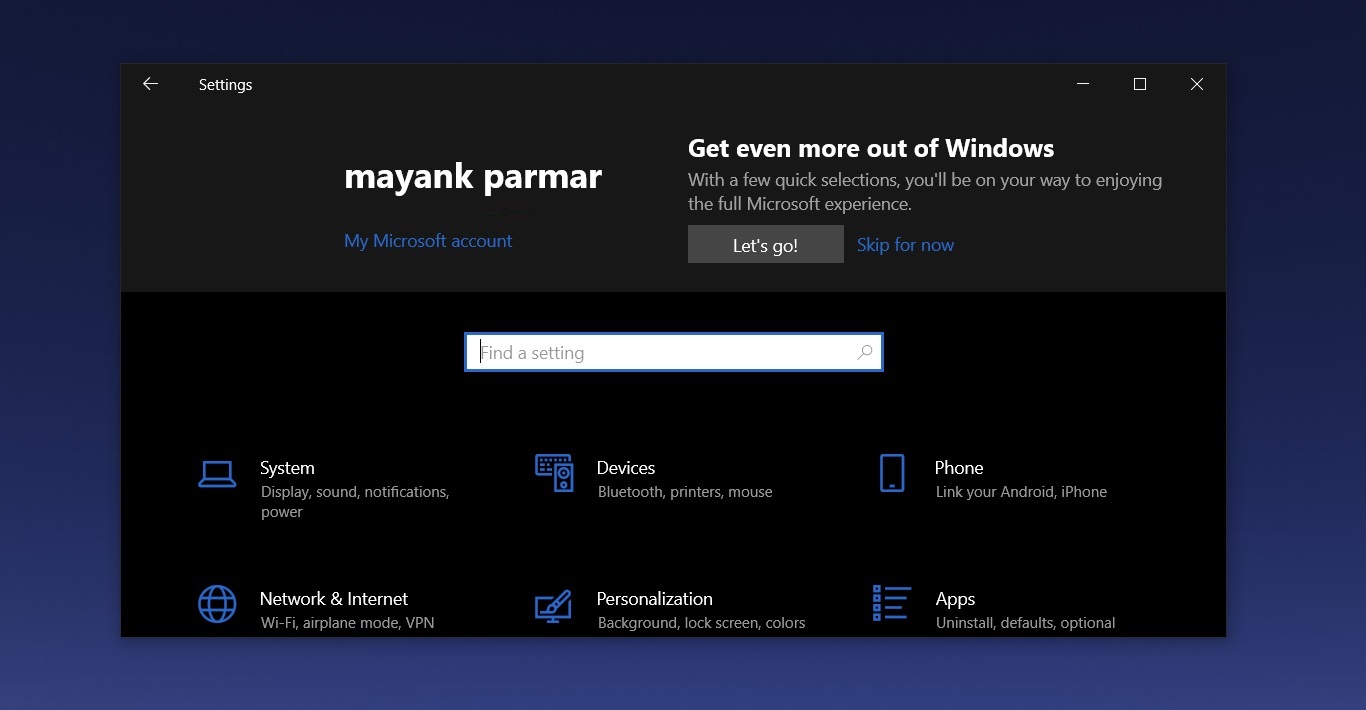
Microsoft Is Showing Windows 10 Users Full-Screen Ads For Its Edge Browser (windowslatest.com) 148

According to Windows Latest, "Microsoft is A/B testing a new feature that is designed to nag users with fullscreen window-less Microsoft Edge recommendations in the OOBE screen." From the report: The nag will appear when users set up their PC, sign in to their system after applying updates, or when they click on a new ad banner within the Settings. [...] Microsoft is trying to convince users of rival browsers who are visiting Windows Settings of the benefits of trying the Chromium Edge. In the Settings app, there's a new banner that appears to be rolling out to non-Insiders. As you can see in the above screenshot, the advert appears across the top of the Settings app window, just above the settings options.

The banner states that you can "get even more out of Windows" and it surprisingly launches the OOBE (out of the box experience) screen. [...] This ad appeared only when our devices were set to use Google Chrome and Firefox as the default web browser. The user can easily close the advert by clicking the second option "Don't update your browser settings." If you try to skip the setup, the pop-up will appear again in future. Unfortunately, you cannot permanently disable these recommendations in Windows 10.

Software

Demand For Employee Surveillance Increased As Workers Transitioned To Home Working (zdnet.com) 47

An anonymous reader quotes a report from ZDNet: A new study shows that the demand for employee surveillance software was up 55% in June 2020 compared to the pre-pandemic average. From webcam access to random screenshot monitoring, these surveillance software products can record almost everything an employee does on their computer. VPN review website Top10VPN used its global monitoring data to analyze over 200 terms related to employee surveillance software. It took into account both generic and brand-specific queries for its study which compared searches during March-May 2020 with internet searches in the preceding year. Global demand for employee monitoring software increased by 108% in April, and 70% in May 2020 compared with searches carried out the preceding year. Queries for "How to monitor employees working from home" increased by 1,705% in April and 652% in May 2020 compared with searches carried out the preceding year.

The surge in popularity of such an open-ended phrase like this reveals how unprepared many companies were for the abrupt shift to mass home-working. The most popular surveillance tools are Time Doctor, Hubstaff, and FlexiSPY. The tools with the biggest increase in demand include Teramind, DeskTime, Kickidler, and Time Doctor, with interest for the latter tripling compared to the pre-pandemic levels. The top three tools account for almost 60% of global demand in surveillance software because of the range of features offered. The radical shift away from office-working has clearly made employers nervous about a reduction in productivity and its potential impact on their business. Greater surveillance, however, may actually reduce long-term productivity. Your boss watching your every move may make you less productive in the long run and could significantly impact your feelings about the company itself.

Google

Google Will Make It Slightly Easier To Turn Off Smart Features (gizmodo.com) 15

"[I]n the coming weeks," Google will show a new blanket setting to "turn off smart features" which will disable features like Smart Compose, Smart Reply, in apps like Gmail; the second half of the same prompt will disable whether additional Google products -- like Maps or Assistant, for example -- are allowed to be personalized based on data from Gmail, Meet, and Chat. Gizmodo reports: Google writes in its blog post about the new-ish settings that humans are not looking at your emails to enable smart features, and Google ads are "not based on your personal data in Gmail," something CEO Sundar Pichai has likewise said time and again. Google claims to have stopped that practice in 2017, although the following year the Wall Street Journal reported that third-party app developers had freely perused inboxes with little oversight. (When asked whether this is still a problem, the spokesperson pointed us to Google's 2018 effort to tighten security.)

A Google spokesperson emphasized that the company only uses email contents for security purposes like filtering spam and phishing attempts. These personalization changes aren't so much about tightening security as they are another informed consent defense which Google can use to repel the current regulatory siege being waged against it by lawmakers. [...] Inquiries in the U.S. and EU have found that Google's privacy settings have historically presented the appearance of privacy, rather than privacy itself. [...] So this is nice, and also Google's announcement reads as a letter to regulators. "This new setting is designed to reduce the work of understanding and managing [a choice over how data is processed], in view of what we've learned from user experience research and regulators' emphasis on comprehensible, actionable user choices over data."

Twitter

Twitter Names Famed Hacker 'Mudge' as Head of Security (reuters.com) 14

Social media giant Twitter, under increased threat of regulation and plagued by serious security breaches, is appointing one of the world's best-regarded hackers to tackle everything from engineering missteps to misinformation. From a report: The company on Monday named Peiter Zatko, widely known by his hacker handle Mudge, to the new position of head of security, giving him a broad mandate to recommend changes in structure and practices. Zatko answers to CEO Jack Dorsey and is expected to take over management of key security functions after a 45- to 60-day review. In an exclusive interview, Zatko said he will examine "information security, site integrity, physical security, platform integrity -- which starts to touch on abuse and manipulation of the platform -- and engineering." Zatko most recently oversaw security at the electronic payments unicorn Stripe. Before that, he worked on special projects at Google and oversaw handing out grants for projects on cybersecurity at the Pentagon's famed Defense Advanced Research and Projects Agency (DARPA).
Google

Ok Google: Please Publish Your DKIM Secret Keys 108

Matthew Green, a cryptographer and professor at Johns Hopkins University, writes: The Internet is a dangerous place in the best of times. Sometimes Internet engineers find ways to mitigate the worst of these threats, and sometimes they fail. Every now and then, however, a major Internet company finds a solution that actually makes the situation worse for just about everyone. Today I want to talk about one of those cases, and how a big company like Google might be able to lead the way in fixing it. This post is about the situation with Domain Keys Identified Mail (DKIM), a harmless little spam protocol that has somehow become a monster. My request is simple and can be summarized as follows: Dear Google: would you mind rotating and publishing your DKIM secret keys on a periodic basis? This would make the entire Internet quite a bit more secure, by removing a strong incentive for criminals to steal and leak emails. The fix would cost you basically nothing, and would remove a powerful tool from hands of thieves.
Privacy

How the US Military Buys Location Data from Ordinary Apps (vice.com) 40

Joseph Cox, reporting for Motherboard at Vice: The U.S. military is buying the granular movement data of people around the world, harvested from innocuous-seeming apps, Motherboard has learned. The most popular app among a group Motherboard analyzed connected to this sort of data sale is a Muslim prayer and Quran app that has more than 98 million downloads worldwide. Others include a Muslim dating app, a popular Craigslist app, an app for following storms, and a "level" app that can be used to help, for example, install shelves in a bedroom. Through public records, interviews with developers, and technical analysis, Motherboard uncovered two separate, parallel data streams that the U.S. military uses, or has used, to obtain location data. One relies on a company called Babel Street, which creates a product called Locate X. U.S. Special Operations Command (USSOCOM), a branch of the military tasked with counterterrorism, counterinsurgency, and special reconnaissance, bought access to Locate X to assist on overseas special forces operations. The other stream is through a company called X-Mode, which obtains location data directly from apps, then sells that data to contractors, and by extension, the military.

The news highlights the opaque location data industry and the fact that the U.S. military, which has infamously used other location data to target drone strikes, is purchasing access to sensitive data. Many of the users of apps involved in the data supply chain are Muslim, which is notable considering that the United States has waged a decades-long war on predominantly Muslim terror groups in the Middle East, and has killed hundreds of thousands of civilians during its military operations in Pakistan, Afghanistan, and Iraq. Motherboard does not know of any specific operations in which this type of app-based location data has been used by the U.S. military. The apps sending data to X-Mode include Muslim Pro, an app that reminds users when to pray and what direction Mecca is in relation to the user's current location. The app has been downloaded over 50 million times on Android according to the Google Play Store, and over 98 million in total across other platforms including iOS, according to Muslim Pro's website.

Social Networks

Obama Says Social Media Companies 'Are Making Editorial Choices, Whether They've Buried Them in Algorithms or Not' (cnbc.com) 190

Former U.S. President Barack Obama said that the extent to which social media companies claim they "are more like a phone company than they are like The Atlantic" is not "tenable," he told the publication in an interview published Monday. From a report "They are making editorial choices, whether they've buried them in algorithms or not," the former president said in the interview. "The First Amendment doesn't require private companies to provide a platform for any view that is out there. At the end of the day, we're going to have to find a combination of government regulations and corporate practices that address this, because it's going to get worse. If you can perpetrate crazy lies and conspiracy theories just with texts, imagine what you can do when you can make it look like you or me saying anything on video. We're pretty close to that now." Obama's statement that social media platforms should be considered more like publishers than public utilities would have significant implications on how the companies are regulated.
China

Didi To Deliver First BYD Electric Cars to Drivers Within Months (bloomberg.com) 17

Didi Chuxing will begin rolling out an electric vehicle developed with BYD to its drivers in coming months, aiming to reduce costs throughout the world's largest ride-hailing network. From a report: The D1, the first model to have been built with ride-hailing in mind, will ship to the startup's leasing partners across several Chinese cities, according to Didi. Made by BYD, in which Warren Buffett's Berkshire Hathaway is the largest shareholder, the vehicle has power sliding doors and a driver-assistance system. Didi flagged as early as 2018 its intention to team up with car manufacturers to produce customized EVs for its ride-hailing service. The Chinese company that defeated Uber Technologies in China is hoping the EVs present a more efficient option than traditional fuel-guzzlers. It already hosts about a million electric vehicles, which can take advantage of a growing nationwide charging network, and operates as many as 60 million rides every day.
Transportation

BMW Demos a Powered Wingsuit That Can Fly 186 MPH (syfy.com) 90

Wingsuits normally create a wide surface area of fabric between a skydiver's legs and from their legs to their arms, substantially slowing their fall.

But to create a buzz for the unveiling of BMW's new iX3 electric SUV, the company's creative consultancy Designworks "has partnered up with Austrian stuntman Peter Salzmann to unveil a wicked-cool new electric powered wingsuit that can propel a brave human being up to speeds nearing 200 miles-per-hour," reports Syfy Wire: Over the years since non-powered wingsuits first hit the extreme sports scene, Salzmann had pondered over how to infuse wingsuits with sustainable propulsion and the ability to climb. He teamed up with engineers and creative consultants at BMW's Designworks studio to create a pair of chest-mounted electric impellers and a special wingsuit that would utilize them. Realizing that the optimum airflow would exist in front of the suit, and not behind, Salzmann and the BMW crew pivoted to this front-end arrangement employing two 5-inch, 25,000 rpm impellers inside an aerodynamic, economical air-inlet package that mirrors the legendary German automotive firm's aesthetic sensibilities. For safety measures, there is a dedicated on/off switch to fire it up, a two-finger throttle device, a minimal steering component, and an instant cutoff switch for emergency situations, like encountering a flock of wild geese leisurely flying south for the winter.

While not built for extended flights, but short hops instead, the suit's propellers pump out approximately 20 horsepower for roughly five minutes, far superior than a standard wingsuit, whose horizontal glide rate falls one meter for every three meters traveled horizontally. Non-powered wingsuits max out at about 62 mph, but when Salzmann punches the electric boost, he can attain speeds over 186 mph, in addition to gaining altitude instead of gradually losing it.

BMW has released a terrific video with footage showing a trio of stuntment flying in formation in their powered wingsuits over the Austrian Alps.
Social Networks

Kickstarter Mistakenly Emails Responses To Complaints From Seven Years Ago (bbc.com) 8

The BBC reports: Crowdfunding website Kickstarter has surprised some of its users by replying to complaints they made seven years ago.

Users who received responses to long-expired projects from 2013 took to Twitter to congratulate the company on its response times.

Kickstarter said the emails were "auto-generated in error... The emails folks received yesterday was due to an unfortunate human error while working on a clean-up task completely unrelated to the ticket from 2013," a company spokeswoman said.

"It's important to remember we are still a small team at Kickstarter and mistakes can happen."

Social Networks

MSNBC: Parler Does Censor, Removes Users, and Really Hates Trolling (msnbc.com) 187

For seekers of a right-leaning free-speech utopia, "Parler may turn out to be, in the end, a false refuge," warns Marc Ambinder at MSNBC: First — sorry, folks — Parler does censor. It removes users, regularly. It does not actually seem to tolerate hate speech, and because it's a much smaller platform, it might even be more efficient in finding and exorcising it than the social giants. Oh, and the founders really, really don't like trolling. This includes the sort of trolling that feeds the outrage cycles on Twitter, the trolling that includes scatology and expletives and "unrelated comments." [Parler also says they'll enforce their rules against obscene user names, any kind of pornography, and even the spamming of "people trying to speak" with "unrelated comments"] Also, dog poop. Parler doesn't like dog poop...

On Wednesday, [Parler CEO Dan Bongino], of all people, had to knock down what might have been Parler's first piece of conservative-on-conservative viral misinformation: a screenshot of a Fox News chyron alleging that George Soros was actually the owner of Parler. "Friends," Bongino wrote on Twitter (!), "This is a photoshopped image. THIS IS NOT REAL. There are people who are desperate to take down Parler who are spreading BS hoping you'll buy it. I OWN PARLER. This is the 4th or 5th time I've had to fight back against this stuff."

Sorry, Dan. It won't be the last.

Youtube

YouTube Criticized For Not Removing Post-Election Misinformation (nbcnews.com) 183

"YouTube is facing growing criticism for allowing election misinformation after it decided not to remove or individually fact-check videos that spread unfounded conspiracy theories alleging voter fraud," reports NBC News: While all internet platforms are struggling to contain the volume of misinformation since voting ended last week — and all have been criticized to some degree by researchers for their handling of the situation — YouTube has staked out a position that is less aggressive than its social media competitors, most notably Facebook and Twitter.

YouTube said before the election that it wouldn't allow videos that encourage "interference in the democratic process," but now, as state officials are working to certify vote tallies, the company said it wants to give users room for "discussion of election results," even when that discussion is based on debunked information. Somewhere in between those two policies it has decided to leave up videos challenging Joe Biden's election, and some have received millions of views.

"Is YouTube unable to contend with this material, meaning they lack resources? Or is it a lack of will?" asked Sarah Roberts, co-director of UCLA's Center for Critical Internet Inquiry and an associate professor of information studies. "I think one of those is probably more damning than the other, but they both have the same outcome of allowing propaganda material masquerading as news being distributed on their platform at a critical juncture for the American political cycle," Roberts said...

"There's a good chance YouTube's handling of this goes in the first sentence of every story about how social networks handled the 2020 election for the next several years," Casey Newton, a journalist who writes the technology newsletter Platformer, said in a tweet.

Slashdot Top Deals