Google

Google's Selfish Ledger is an Unsettling Vision of Silicon Valley Social Engineering (theverge.com) 254

An anonymous reader shares a report: Google has built a multibillion-dollar business out of knowing everything about its users. Now, a video produced within Google and obtained by The Verge offers a stunningly ambitious and unsettling look at how some at the company envision using that information in the future. The video was made in late 2016 by Nick Foster, the head of design at X (formerly Google X), and shared internally within Google. It imagines a future of total data collection, where Google helps nudge users into alignment with their goals, custom-prints personalized devices to collect more data, and even guides the behavior of entire populations to solve global problems like poverty and disease.
Music

YouTube Unveils New Streaming Service 'YouTube Music,' Rebrands YouTube Red (gizmodo.com) 107

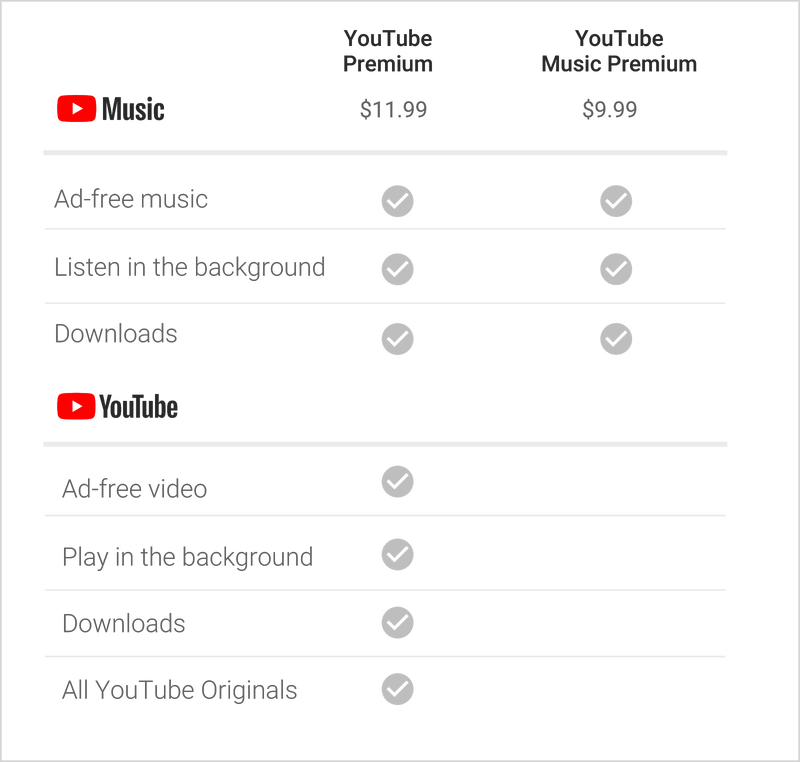
An anonymous reader quotes a report from Gizmodo: YouTube Music, a streaming music platform designed to compete with the likes of Spotify and Apple Music, officially has a launch date: May 22nd. Its existence will also shift around YouTube and Google's overall media strategy, which has thus far been quite the mess. YouTube Music will borrow the Spotify model and offer a free, ad-supported tier as well as a premium version. The paid tier, which will be called YouTube Music Premium, will be available for $9.99 per month. It will debut in the U.S., Australia, New Zealand, Mexico, and South Korea before expanding to 14 other countries.

One of the selling points for YouTube Music will be the ability to harness the endless amount of information Google knows about you, which it will use to try to create customized listening experiences. Pitchfork reported that the app, with the help of Google Assistant, will make listening recommendations based on the time of day, location, and listening patterns. It will also apparently offer "an audio experience and a video experience," suggesting perhaps an emphasis on music videos and other visual content. From here, Google seems to be focused on making its streaming strategy a little less wacky. Google Play Music, the company's previous music streaming service that is still inexplicably up and running despite teetering on the brink of extinction for years, will slowly be phased out according to USA Today.
Meanwhile, the paid streaming subscription service, known as YouTube Red, is being rebranded to YouTube Premium and will cost $11.99 per month instead of $9.99. (Pitchfork notes that existing YouTube Red subscribers will be able to keep their $9.99 rate.) YouTube Premium will include access to YouTube Music Premium. Here's a handy-dandy chart that helps show what is/isn't included in the two plans.
Earth

A Fleet of Sailing Robots Sets Out To Quantify the Oceans (bloomberg.com) 76

pacopico writes: A start-up in California called Saildrone has built a fleet of robotic sailboats that are gathering tons of data about the oceans. The saildrones rely on a hard, carbon-fiber sail to catch wind, and solar panels to power all of their electronics and sensors. "Each drone carries at least $100,000 of electronics, batteries, and related gear," reports Businessweek. "Devices near the tip of the sail measure wind speed and direction, sunlight, air temperature and pressure, and humidity. Across the top of the drone's body, other electronics track wave height and period, carbon dioxide levels, and the strength of the Earth's magnetic field. Underwater, sensors monitor currents, dissolved oxygen levels, and water temperature, acidity, and salinity. Sonars and other acoustic instruments try to identify animal life." So far they've been used to find sharks, monitor fisheries, check on climate change and provide weather forecasts. Saildrone just raised $90 million to build a fleet of 1,000 drones, which it thinks will be enough to measure all of the world's oceans.
Twitter

Twitter Will Start Hiding Tweets That 'Detract From the Conversation' (slate.com) 186

Yesterday, Twitter announced several new changes to quiet trolls and remove spam. According to Slate, the company "will begin hiding tweets from certain accounts in conversations and search results." In order to see them, you'll now have to scroll to the bottom of the conversation and click "Show more replies," or go into your search settings and choose "See everything." From the report: When Twitter's software decides that a certain user is "detract[ing] from the conversation," all of that user's tweets will be hidden from search results and public conversations until their reputation improves. And they won't know that they're being muted in this way; Twitter says it's still working on ways to notify people and help them get back into its good graces. In the meantime, their tweets will still be visible to their followers as usual and will still be able to be retweeted by others. They just won't show up in conversational threads or search results by default. The change will affect a very small fraction of users, explained Twitter's vice president of trust and safety, Del Harvey -- much less than 1 percent. Still, the company believes it could make a significant difference in the average user's experience. In early testing of the new feature, Twitter said it has seen a 4 percent drop in abuse reports in its search tool and an 8 percent drop in abuse reports in conversation threads.
Android

OnePlus 6 Launched With 6.28-inch Display, Snapdragon 845 CPU, and Headphone Jack (phonedog.com) 109

OnePlus has launched their newest flagship smartphone today at an event in London. The OnePlus 6, as it is called, features a 6.28-inch 2280x1080 display with 19:9 aspect ratio and notch, Snapdragon 845 octa-core processor with up to 8GB of RAM, 16- and 20-megapixel rear-facing cameras, 3,330mAh battery, 3.5mm headphone jack, and Android 8.1 Oreo running out of the box with support for Android P coming soon. Strangely, the phone features a glass build construction but no support for wireless charging. OnePlus claims the glass back will be better for transmitting radio waves, but it's likely included in preparation for the OnePlus 6T, which will likely launch several months later and include wireless charging. PhoneDog reports: Around on the back of the OnePlus 6 is a vertically stacked dual rear camera setup that's now in the center of the phone for symmetry. There's a 16MP camera with Sony IMX 519 sensor, f/1.7 aperture, and support for optical image stabilization and electronic image stabilization, as well as a 20MP camera with Sony IMD 376K sensor and f/1.7 aperture. Also included are portrait mode and slow-motion 480fps video capture features.

The body of the OnePlus 6 is made of Gorilla Glass 5, which OnePlus says will be better for transmitting radio waves. Rounding out the OP6's spec list is a 16MP front-facing camera, NFC, Bluetooth 5.0, USB-C, an alert slider, and a 3.5mm headphone jack. On the security side of things, there's a rear fingerprint reader and face unlock, and when it comes to wireless capabilities, the OnePlus 6 supports 40 global LTE bands as well as 4x4 MIMO for speeds up to 1Gbps.
The OnePlus 6 will be available on May 22 with the following prices: 6GB/64GB: $529; 8GB/128GB: $579; 8GB/256GB: $629.
Government

Cops Will Soon ID You Via Your Roof Rack (arstechnica.com) 98

An anonymous reader quotes a report from Ars Technica: On Tuesday, one of the largest license plate reader (LPR) manufacturers, ELSAG, announced a major upgrade to "allow investigators to search by color, seven body types, 34 makes, and nine visual descriptors in addition to the standard plate number, location, and time." Such a vast expansion of the tech now means that evading such scans will be even more difficult.

"Using advanced computer vision software, ELSAG ALPR data can now be processed to include the vehicle's make, type -- sedan, SUV, hatchback, pickup, minivan, van, box truck -- and general color -- red, blue, green, white and yellow," ELSAG continued. "The solution actively recognizes the 34 most-common vehicle brands on US roads." Plus, the company says, the software is now able to visually identity things like a "roof rack, spare tire, bumper sticker, or a ride-sharing company decal."

Google

Google Fixes Issue That Broke Millions of Web-Based Games in Chrome (bleepingcomputer.com) 37

Google this week rolled out an update to Chrome to patch a bug that had rendered millions of web-based games useless. From a report: The bug was introduced in mid-April when Google launched Chrome 66. One of this release's features was its ability to block web pages with auto-playing audio. [...] Not all games were affected the same. For some HTML5 games, users could re-enable audio by interacting with the game's canvas via a click-to-play interaction. Unfortunately, older games and those that weren't coded with such policy remained irrevocably broken, no matter what Chrome options users tried to modify in their settings sections. [...] With today's release of Chrome for Desktop v66.0.3359.181, Google has now fixed this issue, but only temporarily. John Pallett, a product manager at Google, admitted that Google "didn't do a good job of communicating the impact of the new autoplay policy to developers using the Web Audio API." He said, for this reason, the current version of Chrome, v66, will no longer automatically mute Web Audio objects.
Businesses

Senate Votes To Save Net Neutrality (gizmodo.com) 288

In a monumental decision that will resonate through election season, the U.S. Senate on Wednesday voted to reinstate the net neutrality protections the Federal Communications Commission decided to repeal late last year. From a report: For months, procedural red tape has delayed the full implementation of the FCC's decision to drop Title II protections that prevent internet service providers from blocking or throttling online content. Last week, FCC Chairman Ajit Pai confirmed that the repeal of the 2015 Open Internet Order would go into effect on June 11. But Democrats put forth a resolution to use its power under the Congressional Review Act (CRA) to review new regulations by federal agencies through an expedited legislative process. All 49 Democrats in the Senate supported the effort to undo the FCC's vote. Republicans, Sen. Susan Collins of Maine, John Kennedy of Louisiana and Lisa Murkowski of Alaska crossed party lines to support the measure. Further reading: ArsTechnica.
Windows

Rollout of Windows 10 April Update Halted For Devices With Intel and Toshiba SSDs (bleepingcomputer.com) 89

Catalin Cimpanu, writing for BleepingComputer: Microsoft has halted the deployment of the Windows 10 April 2018 Update for computers using certain types of Intel and Toshiba solid state drives (SSDs). The Redmond-based OS maker took this decision following multiple user reports about the Windows 10 April 2018 Update not working properly on devices using: Intel SSD 600p Series, Intel SSD Pro 6000p Series, Toshiba XG4 Series, Toshiba XG5 Series, and Toshiba BG3 Series.

The Intel and Toshiba issues appear to be different. More specifically, Windows PCs using Intel SSDs would often crash and enter a UEFI screen after reboot, while users of Toshiba SSDs reported lower battery life and SSD drives becoming very hot.

United States

Hacker Breaches Securus, the Company That Helps Cops Track Phones Across the US (vice.com) 68

Securus, the company which tracks nearly any phone across the US for cops with minimal oversight, has been hacked, Motherboard reported Wednesday. From the report: The hacker has provided some of the stolen data to Motherboard, including usernames and poorly secured passwords for thousands of Securus' law enforcement customers. Although it's not clear how many of these customers are using Securus's phone geolocation service, the news still signals the incredibly lax security of a company that is granting law enforcement exceptional power to surveill individuals. "Location aggregators are -- from the point of view of adversarial intelligence agencies -- one of the juiciest hacking targets imaginable," Thomas Rid, a professor of strategic studies at Johns Hopkins University, told Motherboard in an online chat.
Transportation

'Bird Scooters Are Ruining Venice' (latimes.com) 375

Nate Jackson, writing for LA Times: Although I would like to avoid them, I have no choice but to consider them because I live in Venice, which is where the first Bird (electric scooters) hatched and where the flock is thickest. Bird's founder and CEO, Travis VanderZanden, says, "We won"t be happy till there are more Birds than cars," so I guess I am supposed to get used to it. [...] Suddenly, almost daily, I have some near-collision with a Bird scooter rider -- he who sees nothing but the phone in his hand, thinks of nothing but the next text, and hears nothing but whatever music he has chosen to pump through the white inserts protruding from his wasted ears. He who, despite all that, is still traveling up to 15 mph on the street or sidewalk.

Aside from road safety, which has been discussed thoroughly in this and other papers, Bird is also tearing away at the fabric of our Westside society. In Venice and Santa Monica, where Bird is centralized, thousands of people live on the streets, which helps explain the scooter's popularity. With a press of a throttle button, one can be whizzing along, leaving it all in a blur. Bird calls this solving the "first/last mile" problem. Problem? Is it a problem for a twentysomething to walk a single mile? To most residents, Venice itself is the solution: The weather is perfect, the ocean is a stone's throw away and each block has something interesting to see. But to walk through Venice is to understand that human misery exists just outside the frame of your Instagram feed.

Microsoft

Microsoft To Launch a Line of Lower-Cost Surface Tablets With 10-inch Displays By Second Half of 2018, Report Says (bloomberg.com) 75

Microsoft plans to launch a line of lower-cost Surface tablets as soon as the second half of 2018, Bloomberg reported Wednesday. These devices should help Microsoft improve its market share in the iPad-led hybrid machines market, the outlet noted. From the report: Microsoft has tried this before. The software giant kicked off its consumer-oriented hardware push in 2012 with the launch of the original Surface RT. At the time, it was priced starting at $499. After the tablets didn't resonate with consumers and product reviewers, Microsoft pivoted to the more-expensive Surface Pro, a line which has gained steam and likely contributed to demand for a pro-oriented iPad, which Apple launched in 2015.

The new tablets will feature 10-inch screens -- around the same size as a standard iPad, but smaller than the 12-inch screens used on the Surface Pro laptop line. The new Surfaces, priced about $400, will have rounded edges like an iPad, differing from the squared off corners of current models. They'll also include USB-C connectivity, a first for Surface tablets, a new charging and syncing standard being used by some of the latest smartphones. The tablets are expected to be about 20 percent lighter than the high-end models, but will have around four hours fewer of battery life. (The current Surface Pro can last 13.5 hours on a single charge.)

Operating Systems

Fedora-Based Linux Distro Korora Halts Development (betanews.com) 68

Korora, a Fedora-based Linux distro, halted its development this month, BetaNews' Brian Fagioli spotted Wednesday. The announcement would irk many, as Korora consistently received positive feedback from critics and users alike. News outlet ZDNet once described Korora as "Fedora++", while Slashdot readers, too, spoke highly of the distro.

At the same time, the announcement should come as little surprise to anyone who has been tracking Korora's work. In a blog post, Korora team wrote: Korora for the forseeable future is not going to be able to march in cadence with the Fedora releases. In addition to that, for the immediate future there will be no updates to the Korora distribution. Our team is infinitesimal (currently 1 developer and 2 community managers) compared to many other distributions, we don't have the luxury of being able to dedicate the amount of time we would like to spend on the project and still satisfy our real life obligations. So we are taking a little sabbatical to avoid complete burn out and rejuvenate ourselves and our passion for Korora/Fedora and wider open source efforts. The team had expressed similar concerns earlier this year: For the past few years Korora has released a new version in line with each Fedora version. That means that approximately twice a year we prepare, test and create 5 different ISO versions. This is as well as, among other things, developing new projects, supporting existing releases and planning the future versions. As each team member has different skills some tasks, such as development, can only be done by one person. All this is done in our spare time along side our job, family and personal responsibilities. For a very small team, currently 3 people plus the occasional input from others, this is a lot of work. It means that often Korora has to take a back seat when real life intrudes. This isn't the first time Korora had to abruptly pause its development. In 2007, Christopher Smart, who kickstarted Korora (at the time based on Gentoo Linux), had discontinued the project -- only to revive it three years later.
Transportation

Tesla Model X Breaks Electric Towing Record By Pulling Boeing 787 (inverse.com) 235

A Tesla Model X has set the world record for heaviest tow by electric production passenger vehicle when it pulled a Boeing 787-9 Dreamliner at the Melbourne Airport in Australia. The video can be viewed on YouTube. Inverse reports: As probably expected, the plane far exceeds the Model X's recommended tow limit of around 5,000 pounds. In fact, the weight of the unloaded 787 with a minimal amount of fuel came closer to around 300,000 pounds. The airline pulled the Dreamliner around 1,000 feet down the tarmac. The stunt was part of a wider campaign around Qantas' new work with Tesla, which involves offering high-powered chargers at its Sydney, Melbourne, Brisbane and Adelaide facilities as well as offsetting miles for Tesla drivers that are also frequent flyer members.
Facebook

Justice Department, FBI Are Investigating Cambridge Analytica (cbsnews.com) 139

An anonymous reader quotes a report from CBS News: The Justice Department and FBI are investigating Cambridge Analytica, the now-shuttered political data firm that was once used by the Trump campaign and came under scrutiny for harvesting data of millions of users, The New York Times reported on Tuesday. The Times, citing a U.S. official and people familiar with the inquiry, reported federal investigators have looked to question former employees and banks connected to the firm.

The Times reports prosecutors have informed potential witnesses there is an open investigation into the firm, whose profiles of voters were intended to help with elections. One source tells CBS News correspondent Paula Reid prosecutors are investigating the firm for possible financial crimes. A company that has that much regulatory scrutiny is almost guaranteed to have federal prosecutors interested, Reid was told. Christopher Wylie, a former Cambridge Analytica employee who spoke out about the data sharing practices, told the Times federal investigators had contacted him. The American official told the Times investigators have also contacted Facebook as a part of the probe.

Power

Tesla Unveils New Large Powerpack Project For Grid Balancing In Europe (electrek.co) 99

Tesla has unveiled a new large Powerpack energy storage project to be used as a virtual power plant for grid balancing in Europe. It consists of 140 Powerpacks and several Tesla inverters for a total power output of 18.2 MW. Electrek reports: Tesla partnered with Restore, a demand response aggregator, to build the system and offer balancing services to European transmission system operators. Instead of using gas generators and steam turbines kicking to compensate for losses of power on the grid, Tesla's batteries are charged when there's excess power and then discharge when there's a need for more power.

Restore UK Vice President Louis Burford told The Energyst that they are bundling their assets like batteries as a "synthetic pool": "By creating synthetic pools or portfolios, you reduce the technical requirements on individual assets that otherwise would not be able to participate [in certain balancing services]. By doing so you create value where it does not ordinarily exist. That is only achievable through synthetic portfolios."
For those interested, Tesla has released promo video on YouTube about the project.
Youtube

YouTube Might Finally Get An Incognito Mode (androidpolice.com) 61

Currently, you can head to the "History and Privacy" settings in YouTube and toggle on the options to pause watch and search history if you don't want the site to track your searches and watched videos, but that can be a bit complicated each time you want to search for something weird. According to Android Police, "YouTube will make it a little easier to go into incognito without digging into many settings and without having to disable it later." A new "Incognito Mode" will appear when you tap your account avatar in the top right of the app. From the report: With "Incognito Mode" on, all your activity from the current session is not saved and subscriptions are hidden too. It's as if you were signed out without being so, and there's a neat incognito icon replacing your avatar. If you turn off Incognito or become inactive on YouTube, you'll be back to using your own account.
The Almighty Buck

Comcast Charges $90 Install Fee At Homes That Already Have Comcast Installed (arstechnica.com) 141

An anonymous reader quotes a report from Ars Technica: Based on our tests, signing up for standalone Internet or TV service on Comcast.com often requires payment of a $59.99 or $89.99 installation fee, depending on where you live. (The fee was $60 in two Massachusetts suburbs and $90 at homes in Houston, Texas, and Seattle, Washington.) In cases where the $60 or $90 fee is charged, the fee is required whether you purchase your own modem or rent one from Comcast for another $11 a month.

The installation fee might be charged even if the home you're buying service at has existing Comcast service, and even if you order Internet speeds lower than those purchased by the current occupant. That means the fee is charged even when Comcast doesn't have to make any upgrades at the house or apartment you're moving into. Internet speed makes no difference, as the fee may be charged whether you purchase 15Mbps downloads or gigabit service. You can avoid the installation fee by purchasing certain bundles that include both TV and Internet, but the fee is often mandatory if you buy only TV service or broadband individually. The $60 or $90 fee is also charged when you buy phone service only or a "double-play" package of phone service and broadband.

Security

Smarter People Don't Have Better Passwords, Study Finds (bleepingcomputer.com) 110

An anonymous reader shares a report: A study carried out at a college in the Philippines shows that students with better grades use bad passwords in the same proportion as students with bad ones. The study's focused around a new rule added to the National Institute of Standards and Technology (NIST) guideline for choosing secure passwords -- added in its 2017 edition. The NIST recommendation was that websites check if a user's supplied password was compromised before by verifying if the password is also listed in previous public breaches. If the password is included in previous breaches, the website is to consider the password insecure because all of these exposed passwords have most likely been added to even the most basic password-guessing brute-forcing tools.
Facebook

Facebook Deleted 583 Million Fake Accounts in the First Three Months of 2018 (cnet.com) 75

Facebook said Tuesday that it had removed more than half a billion fake accounts and millions of pieces of other violent, hateful or obscene content over the first three months of 2018. From a report: In a blog post on Facebook, Guy Rosen, Facebook's vice president of product management, said the social network disabled about 583 million fake accounts during the first three months of this year -- the majority of which, it said, were blocked within minutes of registration. That's an average of over 6.5 million attempts to create a fake account every day from Jan. 1 to March 31. Facebook boasts 2.2 billion monthly active users, and if Facebook's AI tools didn't catch these fake accounts flooding the social network, its population would have swelled immensely in just 89 days.

Slashdot Top Deals