Businesses

Quebec's Caisse Writes Off Celsius, Saying Bet Was 'Too Soon' (bloomberg.com) 63

Quebec's $303 billion pension manager has written off its stake in bankrupt cryptocurrency lender Celsius Network, with its chief executive officer conceding the fund invested "too soon" in the sector. From a report: Charles Emond, CEO of the Caisse de Depot et Placement du Quebec, spoke publicly for the first time Wednesday about the fund's decision last year to invest $150 million in Celsius. He described the crypto industry as a sector "in transition" but defended the work done by CDPQ's staff. "The due diligence was quite extensive with many experts and consultants involved. The team came in cautiously," Emond said at a news conference in Montreal. "We had a 4% equity stake. The conversations we had internally were pretty straightforward. The teams are accountable for that."

Celsius filed for Chapter 11 bankruptcy in July, saying liabilities exceeded assets by more than $1 billion after a crash in crypto prices. The company is trying to restructure and has received multiple offers of fresh cash, a lawyer for the crypto lender said Tuesday. "Due diligence is not a guarantee of success," Emond said, adding that he has "empathy" for the thousands of clients who've seen their funds frozen in the bankruptcy process.
The fund said the deal with Celsius marks the ends of its foray into crypto investments.
Space

Redwire To Launch First Commercial Space Greenhouse in 2023 (reuters.com) 12

Redwire says it would launch the first commercial space greenhouse in Spring next year to boost crop production research outside Earth and support exploration missions. From a report: The space infrastructure company's project will help deliver critical insights for NASA's Artemis missions and beyond, said Dave Reed, Redwire's manager for the greenhouse project. The Artemis program of the National Aeronautics and Space Administration (NASA) aims at sending astronauts to the moon and establishing a long-term lunar colony as a precursor to the eventual human exploration of Mars.
Windows

Windows 11's Next Big Update Arrives Next Month With Start Menu Folders, New Gestures (theverge.com) 84

Microsoft is planning to release its next big Windows 11 update, version 22H2, on September 20th. The Verge: Sources familiar with Microsoft's plans tell The Verge Microsoft will roll out Windows 11 22H2 through Windows Update on September 20th, a week after the company's regular Patch Tuesday fixes. Microsoft has been testing Windows 11 22H2 for months, and it will include a number of new improvements, like app folders in the Start menu, drag and drop on the taskbar, and new touch gestures and animations. Microsoft is also adding a new Live Captions accessibility feature with 22H2, which is ideal for people who are deaf, hard of hearing, or anyone who wants to caption audio automatically. Similarly, a new Voice Access tool that allows people to control their PCs by using voice commands is part of 22H2.

The Task Manager is also being overhauled in Windows 11 22H2, with a new dark mode and a far better layout that includes a new command bar and an efficiency mode to limit apps from consuming resources. Snap Layouts will also be greatly improved in 22H2, making it easier to drag and app to reveal all the layouts you can use to arrange apps. Microsoft is also working on tabs for File Explorer, which will arrive a little later than September 20th.

Iphone

Cellphone at Third Base: Baseball Player Mistakenly Runs the Bases with His iPhone (apnews.com) 38

Last year Rodolfo Castro made baseball history. Called up to the Major Leagues in April, the 22-year-old eventually recorded his first hit — a home run. But his next four recorded hits were all also home runs, something no player had done since 1901.

CBS News reports that this week, finally called back up to the Major Leagues, Castro again made history — of another sort: Modern technology has allowed people to take their phones, as well as the power of the internet, with them anywhere they go. Pittsburgh Pirates second baseman Rodolfo Castro took his around the bases against the Arizona Diamondbacks on Tuesday night.
Yep — an iPhone made a bizarre cameo in the 4th inning, reports the Associated Press: Castro and third base coach Mike Rabelo stood and stared, mortified.... Even third base umpire Adam Hamari had the perfect reaction, pointing at the phone that came flying out of Castro's back pocket during a head-first slide, trying not to giggle at the absurdity of the situation.

Those around the sport cringed along with them. "That's obviously not something that should happen," Yankees manager Aaron Boone said.... This faux pas just happened to be at a televised big league game, creating a video clip seen by millions.

"I just remember getting dressed, putting my pants on, getting something to eat, using the restroom," the 23-year-old Castro said through a translator Tuesday night after the Pirates lost 6-4 to Arizona. "Never did it ever cross my mind that I still had my cellphone on me...."

It's far from the first time a phone has made a cameo on a pro sports field. One of the most famous examples came nearly 20 years ago when New Orleans Saints receiver Joe Horn pulled out a flip phone — remember those? — that he had hidden in the padding around the goalpost and then acted like he was taking a call after scoring a touchdown.

Businesses

Layoffs Hit LinkedIn (businessinsider.com) 16

LinkedIn has laid off all the employees on the professional social network's global events marketing team amid continued economic uncertainty and layoffs at parent company Microsoft earlier this week. From a report: While a LinkedIn spokesperson did not disclose the exact number of employees affected, they confirmed the entire team was laid off. Affected employees are being encouraged to apply for roles on a new internal team focused on creating virtual, hybrid, and in-person experiences. "The events space has changed so much, and broadly speaking, this new team will focus on creating experiences across virtual, hybrid, and in-person to bring people together," the LinkedIn spokesperson told Insider. Chuck Jones, a senior event marketing manager on LinkedIn's global event marketing team, posted about the layoffs on LinkedIn on Wednesday.
Businesses

Robinhood Is Firing Nearly a Quarter of Its Staff (theverge.com) 29

Robinhood is letting go of nearly a quarter of its staff, CEO Vlad Tenev said in a message posted to the company's blog. The Verge reports: "As part of a broader company reorganization into a General Manager (GM) structure, I just announced that we are reducing our headcount by approximately 23%," Tenev wrote. "While employees from all functions will be impacted, the changes are particularly concentrated in our operations, marketing, and program management functions." Robinhood's chief product officer Aparna Chennapragada is also stepping down from her post as part of the restructuring, according to a filing (PDF) with the Securities and Exchange Commission, though she'll "remain employed in an advisory role to the CEO or his designee through January 2, 2023." Chennapragada joined the company from Google in March 2021.

The announcements came as Robinhood released its Q2 2022 earnings information a day earlier than scheduled, reporting total revenue of $318 million over the three months, which is 44 percent lower than the same period in 2021. In April, Robinhood said it planned to cut 9 percent of its full-time staff, but "this did not go far enough," Tenev said. The company had staffed up assuming that the increased trading after things like the GameStonk phenomenon and bullish crypto markets would carry into 2022 but has run into the headwinds of inflation and the so-called "crypto winter" that are affecting other companies. Those who are affected by the cuts will be able to stay at Robinhood through October 1st at their regular pay and benefits alongside a severance package, Tenev says.

Linux

What's New in Linux Mint 21 Cinnamon (linuxmint.com) 48

Today saw the release of Linux Mint 21 "Vanessa" Cinnamon Edition, a long term support release (supported until 2027).

Release notes at LinuxMint.com promise that it comes with "refinements and many new features to make your desktop experience more comfortable." Among the highlights: its Bluetooth manager is now Blueman (instead of Blueberry). Blueberry depended on gnome-bluetooth, which was developed exclusively for GNOME. In contrast, Blueman relies on the standard Bluez stack which works everywhere and can even be used or queried from the command line. The Blueman manager and tray icon provide many features that weren't available in Blueberry and a lot more information which can be used to monitor your connection or troubleshoot Bluetooth issues.

Out of the box Blueman features better connectivity, especially when it comes to headsets and audio profiles. In preparation for Linux Mint 21 the Blueman user interface was improved and received support for symbolic icons. Upstream, Blueman and Bluez are actively developed and used in many environments.

The lack of thumbnails for some common file types was identified as a usability issue. To address it a new Xapp project called xapp-thumbnailers was started and is now featured in Linux Mint 21. The project brings support for the following mimetypes:

- AppImage
- ePub
- MP3 (album cover)
- RAW pictures (most formats)
- Webp

Automated tasks are great to keep your computer safe but they can sometimes affect the system's performance while you're working on it. A little process monitor was added to Linux Mint to detect automated updates and automated system snapshots running in the background. Whenever an automated task is running the monitor places an icon in your system tray. Your computer might still become slow momentarily during an update or a snapshot, but with a quick look on the tray you'll immediately know what's going on....

Linux Mint 21 uses IPP, also known as Driverless Printing and Scanning (i.e. a standard protocol which communicates with printers/scanners without using drivers). For most printers and scanners no drivers are needed, and the device is detected automatically.

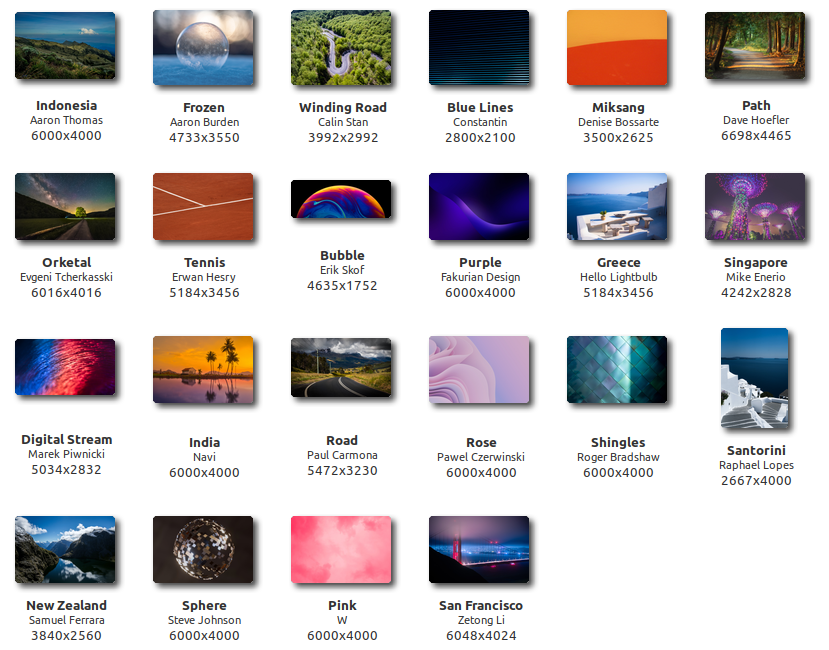
And there's also a fabulous collection of new backgrounds.
United States

Coinbase Faces SEC Probe on Crypto Listings (bloomberg.com) 37

Coinbase is facing a US probe into whether it improperly let Americans trade digital assets that should have been registered as securities, Bloomberg reported Tuesday, citing people familiar with the matter. From the report: The US Securities and Exchange Commission's scrutiny of Coinbase has increased since the platform expanded the number of tokens in which it offers trading, said two of the people, who asked not to be named because the inquiry hasn't been disclosed publicly. The probe by the SEC's enforcement unit predates the agency's investigation into an alleged insider trading scheme that led the regulator last week to sue a former Coinbase manager and two other people. "We are confident that our rigorous diligence process -- a process the SEC has already reviewed -- keeps securities off our platform, and we look forward to engaging with the SEC on the matter," Chief Legal Officer Paul Grewal said on Twitter.
Security

Source Code For Rust-Based Info-Stealer Released On Hacker Forums (bleepingcomputer.com) 22

The source code for an information-stealing malware coded in Rust has been released for free on hacking forums, with security analysts already reporting that the malware is actively used in attacks. BleepingComputer reports: The malware, which the author claims to have developed in just six hours, is quite stealthy, with VirusTotal returning a detection rate of around 22%. As the info-stealer is written in Rust, a cross-platform language, it allows threat actors to target multiple operating systems. However, in its current form, the new info-stealer only targets Windows operating systems.

Analysts at cybersecurity firm Cyble, who sampled the new info-stealer and named it "Luca Stealer," report that the malware comes with standard capabilities for this type of malware. When executed, the malware attempts to steal data from thirty Chromium-based web browsers, where it will steal stored credit cards, login credentials, and cookies. The stealer also targets a range of "cold" cryptocurrency and "hot" wallet browser addons, Steam accounts, Discord tokens, Ubisoft Play, and more. Where Luca Stealer stands out against other info-stealers is the focus on password manager browser addons, stealing the locally stored data for 17 applications of this kind. In addition to targeting applications, Luca also captures screenshots and saves them as a .png file, and performs a "whoami" to profile the host system and send the details to its operators.

Microsoft

Microsoft is Speeding Up Xbox Boot Times (theverge.com) 47

Microsoft is speeding up the boot time of its Xbox consoles. In the latest Xbox Insider test builds of the Xbox dashboard, the cold boot startup time has been reduced by around 5 seconds for Xbox Series X / S consoles. Microsoft was able to speed up the boot sequence by creating a shorter bootup animation. From a report: Xbox testers noticed a faster bootup time recently, and Microsoft confirmed the changes on Friday. Josh Munsee, director of Xbox integrated marketing, says the company created "a shorter boot up animation (~4s) from the original boot up animation (~9s), helping to reduce the overall startup time." The changes aren't limited to Xbox Series X / S consoles, either. "Xbox One generation consoles are booting noticeably faster with these changes," explains Jake Rosenberg, senior product manager lead at Xbox.
Space

'We Still Need Hubble': Why NASA's Revolutionary Space Telescope Isn't Dead Yet (cnet.com) 41

CNET spoke to the systems and deputy program manager for the Hubble Space Telescope at Lockheed Martin, who remembers the first 1995 "deep field" image from the Hubble Space Telescope — taken over 10 days and revealing 3,000 galaxies. But he also remembers just how revolutionary it was. "To look at a 'dark' sliver of the sky and see so many stars and galaxies really drives home how much we still have to learn about the universe."

Looking back, that was only from 340 miles above our atmosphere — not the million miles from Earth travelled by the Webb Space Telescope (which also scours the universe "for cosmic bits emanating luminescence elusive to human eyes, otherwise known as infrared light.")

Yet while this has been a glorious month for astronomy, "We will absolutely still need Hubble," said Cornell University astronomer Nikole Lewis. "In fact, I'm in the process of trying to put together a budget for a large treasury program on Hubble." Lewis is after something Hubble has but JWST lacks. She studies exoplanets and intends to use visible and ultraviolet light wavelengths to decode clouds and hazes of foreign worlds — the type of light JWST isn't sensitive to. "There's a lot of important information at those wavelengths."

Despite JWST's clout, Hubble is also still the top candidate for scrutinizing galaxies moving along the X or Y axis, rather than the Z axis. "While galactic motion 'toward' and 'away' from Earth is very easy to measure with redshift," a JWST specialty, "'side to side' motion is harder," Caplan said.

In truth, this unique Hubble power turns out to be how we realized a pretty massive detail about galaxies. Many of them are on a crash course right now. By staring at Andromeda over the years — the galaxy that Hubble's namesake used as evidence in 1923 to prove our universe extends beyond the Milky Way — and measuring how its light on individual pixels transferred from one to the next, JWST's predecessor showed us that this galaxy isn't just orbiting ours. "They really will collide," Caplan explained. Would JWST have caught that?

Nonetheless, all of this is to say that as JWST continues to flood the internet with colorful depictions of space's outer reaches, we should remember that it isn't Hubble's replacement. JWST is its successor. It'll work in tandem with Hubble and wouldn't exist in a world without it.... And though the James Webb Space Telescope's story began with a bang, we ought not to let Hubble's end with a whimper. "They're not shutting Hubble down," said Dave Meyer, a Northwestern University professor focused on Hubble discoveries.

"We still think that's about a decade away."

And that systems and deputy program manager for the Hubble Space Telescope at Lockheed Martin also shared another part of its legacy: inspiring the next generation of astronomers. "I grew up being fascinated by the Shuttle program and was mesmerized watching the astronauts service Hubble.

"That was definitely part of my inspiration to become an aerospace engineer."
Open Source

Can Google's New Programming Language 'Carbon' Replace C++ Better Than Rust? (thenewstack.io) 185

It's difficult for large projects to convert existing C++ codebases into Rust, argue Google engineers — so they've created a new "experimental" open source programming language called Carbon.

Google Principal Software Engineer Chandler Carruth introduced Carbon this week at the "CPP North" C++ conference in Toronto. TechRadar reports: The newly announced Carbon should be interoperable with the popular C++ code, however for users looking to make the full switch, the migration should be fairly easy. For those unsure about a full changeover, Carruth delved into more detail about some of the reasons why Carbon should be considered a powerful successor to the C++ language, including simpler grammar and smoother API imports.
Google's engineers are already building tools to translate C++ into this new language. "While Carbon began as a Google internal project, the development team ultimately wants to reduce contributions from Google, or any other single company, to less than 50% by the end of the year," reports The New Stack, adding that Google ultimately wants to hand off the project to an independent software foundation where development will be led by volunteers: Long the language of choice for building performance-critical applications, C++ is plagued with a number of issues that hamper modern developers, Carruth explained on a GitHub page. It has accumulated decades of technical debt, bringing with it many of the outdated practices that were part of the language's predecessor, C. The keepers of C++ prioritize backward compatibility, in order to continue to support widely-used projects such as Linux and its package management ecosystem, Carruth charged.

The language's evolution is also stymied by a bureaucratic committee process, oriented around standardization rather than design. Which can make it difficult to add new features. C++ has largely a sequestered development process, in which a select committee makes the important decisions, in a waterfall process that can take years. "The committee structure is designed to ensure representation of nations and companies, rather than building an inclusive and welcoming team and community of experts and people actively contributing to the language," Carruth wrote. "Access to the committee and standard is restricted and expensive, attendance is necessary to have a voice, and decisions are made by live votes of those present."

Carruth wants to build Carbon by a more open community-led environment. The project will be maintained on GitHub, and discussed on Discord.... The design team wants to release a core working version ("0.1") by the end of the year.

Carbon will boast modern features like generics and memory safety (including dynamic bounds checks), the article points out. And "The development team will also set out to create a built-in package manager, something that C++ sorely lacks."
Ubuntu

The Dell XPS Developer Edition Will Soon Arrive With Ubuntu Linux 22.04 (zdnet.com) 31

The Dell XPS 13 Plus Developer Edition with Ubuntu 22.04 Long Term Support (LTS) will arrive on August 23rd. "This means, of course, Canonical and Dell officially have been certified for Ubuntu 22.04 LTS," writes ZDNet's Steven Vaughan-Nichols. "So if you already have a current XPS 13 Plus, you can install Ubuntu 22.04 and automatically receive the same hardware-optimized experience that will ship with the new Developer Edition." From the report: What this certification means is that all of XPS's components have been tested to deliver the best possible experience out of the box. Ubuntu-certified devices are based on Long Term Support (LTS) releases and therefore receive updates for up to 10 years. So if you actually still have an XPS 13 that came with Ubuntu back in the day, it's still supported today. [...] Dell and Canonical have been at this for years. Today's Dell's Developer Editions are the official continuation of Project Sputnik. This initiative began 10 years ago to create high-end Dell systems with Ubuntu preinstalled. These were, and are, designed with programmer input and built for developers.

As Jaewook Woo, Dell's product manager, Linux, explained: "XPS is an innovation portal for Dell -- from its application of cutting-edge technology to experimentation of new user interfaces and experiential design. By bringing the enhanced performance and power management features of Ubuntu 22.04 LTS to our most advanced premium laptop, Dell and Canonical reinforce our joint commitment to continue delivering the best computing experience for developers using Ubuntu."

The forthcoming Dell XPS Plus Developer Edition's specifications are impressive. The base configuration is powered by a 12th-generation Intel i5 1240P processor that runs up to 4.4GHz. For graphics, it uses Intel Iris Xe Graphics. This backs up the 13.4-inch 1920x1200 60Hz display. For storage, it uses a 512GB SSD. The list price is $1,389.

Biotech

Sick Honeybees Find Lifeline In Covid Vaccine Technology (bloomberg.com) 48

An anonymous reader quotes a report from Bloomberg: Technology used to develop Covid-19 vaccines may also help combat a honeybee-killing pest. GreenLight Biosciences is developing an RNA-based syrup to attack varroa mites, a parasite that attaches itself to honeybees and feeds off them while spreading diseases. [Varroa mites are thought to be one of the reasons behind the staggeringly high death rates that have become so common among honeybees.] The RNA acts as an "off switch" that interferes with the mites, disrupting their ability to lay offspring that attach to bees, said Mark Singleton, chief commercial officer and general manager of plant health at the Boston-based firm. "We are really putting a dent in the ability of mites to reproduce," he said. Anecdotal feedback shows that hives using his company's treatment are healthier and have a higher survival rate, according to Singleton, whose biotech firm worked with large-scale US beekeepers to test the technology.

Moderna and Pfizer used experimental messenger RNA technology to develop Covid-19 vaccines that instruct the body to make the spike protein the coronavirus uses to enter cells, which in turn stimulates production of antibodies. GreenLight Biosciences acquired the RNA technology from Bayer in 2020 and it is the first RNA regulation that directly targets the mites, which reproduce in the same cells as bee larvae. Unlike chemical options that exist to control the mites, RNA is naturally occurring and degrades without causing any harm to the bees, Singleton said. The product is placed in an envelope with holes that beekeepers put in a hive. The bees do the rest -- ultimately delivering it to where mites produce. GreenLight plans to submit its product for approval to the US Environmental Protection Agency by year end and, if approved, it could be commercially available by 2024.

Cellphones

Are Lock Screens About to Change? (cnet.com) 75

"The lock screen is about to change," writes CNET — both for iOS and Android devices. Apple's iOS 16 update, which launched in public beta on Monday, will bring more customization options and new widgets to the iPhone's lock screen when it arrives this fall. You'll be able to see more information quickly and apply stylistic effects to lock screen photos similar to the iPhone's Portrait Mode photography feature.... Like the Apple Watch, the new lock screen should make it easier to see crucial pieces of information without having to dig into apps or even unlock your phone.
And for Android phones: Glance, a Google-backed subsidiary of mobile ad tech company InMobi, also reiterated its plans to bring its lock screen platform to the U.S. [though the company also says there's "no definitive timeline."] And Google is reportedly planning to incorporate more bits of information into its own lock screen widget for Pixel phones.... Glance's lock screen will appear in the form of what it calls "spaces," which are essentially curated lock screens designed to fit specific themes. A fitness-oriented lock screen, for example, would show statistics such as calories burned and exercise goals alongside a music player. A news "space" would show headlines and the weather, while a music version could surface live concerts....

The TechCrunch report about Glance's US arrival sparked concerns that advertisements would be coming to the lock screen, too. Glance's business page shows examples of advertisers that have used its platform to reach potential customers on the very first screen they see when picking up their phone. Intel, Zomato and Garnier are among the listed case studies. But Rohan Choudhary, vice president and general manager of the Glance feed, told CNET the US version would be ad-free. "We are very clear that in the US, we will not have ads on the lock screen at all," he said....

The company says it plans to monetize its service through news subscriptions and commerce links from shopping platforms that are surfaced through Glance.

Glance's motto? "Transforming lock screens into smart surfaces."
Microsoft

Microsoft Still Plans To Block Office Macros By Default After Temporary Rollback (theverge.com) 25

Microsoft is still planning to block Visual Basic for Applications (VBA) macros by default in Office apps. From a report: The software giant rolled back planned changes last week, surprising IT admins who had been preparing for Microsoft to prevent Office users from easily enabling macros in Office files downloaded from the internet. The change, designed to improve security in Office, was supposed to go live in June before Microsoft suddenly reverted the block on June 30th. "Following user feedback, we have rolled back this change temporarily while we make some additional changes to enhance usability," explains Kellie Eickmeyer, principal product manager at Microsoft, in a blog post update. "This is a temporary change, and we are fully committed to making the default change for all users."
Security

Experian, You Have Some Explaining To Do (krebsonsecurity.com) 60

Security reporter Brian Krebs: Twice in the past month KrebsOnSecurity has heard from readers who had their accounts at big-three credit bureau Experian hacked and updated with a new email address that wasn't theirs. In both cases the readers used password managers to select strong, unique passwords for their Experian accounts. Research suggests identity thieves were able to hijack the accounts simply by signing up for new accounts at Experian using the victim's personal information and a different email address.

John Turner is a software engineer based in Salt Lake City. Turner said he created the account at Experian in 2020 to place a security freeze on his credit file, and that he used a password manager to select and store a strong, unique password for his Experian account. Turner said that in early June 2022 he received an email from Experian saying the email address on his account had been changed. Experian's password reset process was useless at that point because any password reset links would be sent to the new (impostor's) email address. An Experian support person Turner reached via phone after a lengthy hold time asked for his Social Security Number (SSN) and date of birth, as well as his account PIN and answers to his secret questions. But the PIN and secret questions had already been changed by whoever re-signed up as him at Experian.

The Courts

The Three Reasons Why Elon Musk Called Off His Acquisition of Twitter (theregister.com) 359

Elon Musk just tweeted a picture of himself laughing — along with a caption he'd apparently added himself.

"They said I couldn't buy Twitter. Then they wouldn't disclose bot info. Now they want to force me to buy Twitter in court. Now they have to disclose bot info in court."

In fact, tonight The Register cited one of the documents Twitter filed in court after Musk's lawyer argued Twitter had "failed or refused" to provide info on spam accounts. But so far it's just a letter Musk's lawyer wrote to the court on Friday, explaining in more detail why Musk wants to call off the acquisition: One segment of the document claims that Musk and his team sought "a variety of board materials, including a working, bottom-up financial model for 2022, a budget for 2022, an updated draft plan or budget, and a working copy of Goldman Sachs' valuation model underlying its fairness opinion."

"Twitter has provided only a pdf copy of Goldman Sachs' final Board presentation."

Other disclosures, the document states, "come with strings attached, use limitations or other artificial formatting features, which has rendered some of the information minimally useful to Mr. Musk and his advisors.

"For example, when Twitter finally provided access to the eight developer 'APIs' first explicitly requested by Mr. Musk in the May 25 Letter, those APIs contained a rate limit lower than what Twitter provides to its largest enterprise customers. Twitter only offered to provide Mr. Musk with the same level of access as some of its customers after we explained that throttling the rate limit prevented Mr. Musk and his advisors from performing the analysis that he wished to conduct in any reasonable period of time.

"Additionally, those APIs contained an artificial 'cap' on the number of queries that Mr. Musk and his team can run regardless of the rate limit — an issue that initially prevented Mr. Musk and his advisors from completing an analysis of the data in any reasonable period of time," the document states.

Musk and his team raised the issue of query limits on June 29, but Twitter did not change the limit until July 6 — after Musk asked for its removal a second time.... Musk felt Twitter was in breach of the merger agreement. So he pulled the plug, leaving open the questions of why Twitter might have provided only limited access to its APIs, or why it could not offer more access given it operates at significant scale.

In fact, it's one of three reasons for ending the acquisition that Musk's lawyer makes in the letter. Materially-relevant figures on spam accounts were reason number one. ("Twitter has not provided information that Mr. Musk has requested for nearly two months notwithstanding his repeated, detailed clarifications intended to simplify Twitter's identification, collection, and disclosure of the most relevant information sought in Mr. Musk's original requests.")

But there's more... Musk's lawyer also argues Twitter is in breach of the merger agreement because of "materially inaccurate representations" — specifically their figures on monetizable daily active users. While Musk's analysis "remains ongoing, all indications suggest that several of Twitter's public disclosures...are either false or materially misleading." While Twitter has claimed they have a reasoned process for calculating monetizable daily active users (and the percentage of spam accounts), Musk's lawyer argues that instead the process "appears to be arbitrary and ad hoc," rendering Twitter's statements "false and misleading." And thus, "Mr. Musk has the right to seek rescission of the Merger Agreement in the event these material representations are determined to be false."

But finally Musk's lawyer provides a third reason for ending the acquisition. Twitter was required to "seek and obtain consent before deviating from its obligation to conduct its business in the ordinary course and 'preserve substantially intact the material components of its current business organization.'" The lawyer's letter argues that didn't happen: Twitter's conduct in firing two key, high-ranking employees, its Revenue Product Lead and the General Manager of Consumer, as well as announcing on July 7 that it was laying off a third of its talent acquisition team, implicates the ordinary course provision. Twitter has also instituted a general hiring freeze which extends even to reconsideration of outstanding job offers. Moreover, three executives have resigned from Twitter since the Merger Agreement was signed: the Head of Data Science, the Vice President of Twitter Service, and a Vice President of Product Management for Health, Conversation, and Growth.
But Twitter hadn't received "consent for changes in the conduct of its business, including for the specific changes listed above," according to Musk's lawyer, which "therefore constitute a material breach of Section 6.1 of the Merger Agreement."
Programming

Meet Bun, a Speedy New JavaScript Runtime (bun.sh) 121

Bun is "a modern JavaScript runtime like Node or Deno," according to its newly-launched web site, "built from scratch to focus on three main things."

- Start fast (it has the edge in mind).
- New levels of performance (extending JavaScriptCore, the engine).
- Being a great and complete tool (bundler, transpiler, package manager).

Bun is designed as a drop-in replacement for your current JavaScript & TypeScript apps or scripts — on your local computer, server or on the edge. Bun natively implements hundreds of Node.js and Web APIs, including ~90% of Node-API functions (native modules), fs, path, Buffer and more. [And Bun also implements Node.js' module resolution algorithm, so you can use npm packages in bun.js]

The goal of Bun is to run most of the world's JavaScript outside of browsers, bringing performance and complexity enhancements to your future infrastructure, as well as developer productivity through better, simpler tooling.... Why is Bun fast? An enormous amount of time spent profiling, benchmarking and optimizing things. The answer is different for every part of Bun, but one general theme: [it's written in Zig.] Zig's low-level control over memory and lack of hidden control flow makes it much simpler to write fast software.

An infographic on the site claims its server-side rendering of React is more than three times faster than Node or Deno. And Bun.js can even automatically load environment variables from .env files, according to the site. No more require("dotenv").load()
Hackaday describes it as "a performant all-in-one approach," including "bundling, transpiling, module resolution, and a fantastic foreign-function interface." Many Javascript projects have a bundling and transpiling step that takes the source and packages it together in a more standard format. Typescript needs to be packaged into javascript, and modules need to be resolved. Bun bakes all this in. Typescript and JSX "just work." This dramatically simplifies many projects as much of the build infrastructure is part of Bun itself, lowering cognitive load when trying to understand a project... Some web-specific APIs, such as fetch and Websockets, are also built-in.
"What's even wilder is that Bun is written by one person, Jared Sumner," the article points out — adding that the all the code is available on GitHub under the MIT License ("excluding dependencies which have various licenses.")
Microsoft

Will Microsoft Ban Commercial Open Source from Its App Store? (sfconservancy.org) 54

Microsoft has "delayed enforcement" of what could be a controversial policy change, according to the Software Freedom Conservancy: A few weeks ago, Microsoft quietly updated its Microsoft [app] Store Policies, adding new policies (which go into effect next week), that include this text:

all pricing ... must ... [n]ot attempt to profit from open-source or other software that is otherwise generally available for free [meaning, in price, not freedom].

Wednesday, a number of Microsoft Store users discovered this and started asking questions. Quickly, those of us (including our own organization) that provide Free and Open Source Software (FOSS) via the Microsoft Store started asking our own questions too.... Since all (legitimate) FOSS is already available (at least in source code form) somewhere "for free" (as in "free beer"), this term (when enacted) will apply to all FOSS...

Sadly, these days, companies like Microsoft have set up these app stores as gatekeepers of the software industry. The primary way that commercial software distributors reach their customers (or non-profit software distributors reach their donors) is via app stores. Microsoft has closed its iron grasp on the distribution chain of software (again) — to squeeze FOSS from the marketplace. If successful, even app store users will come to believe that the only legitimate FOSS is non-commercial FOSS. This is first and foremost an affront to all efforts to make a living writing open source software. This is not a merely hypothetical consideration. Already many developers support their FOSS development (legitimately so, at least under the FOSS licenses themselves) through app store deployments that Microsoft recently forbid in their Store....

Microsoft counter-argues that this is about curating content for customers and/or limiting FOSS selling to the (mythical) "One True Developer". But, even a redrafted policy (that Giorgio Sardo [General Manager of Apps at Microsoft] hinted at publicly early Thursday) will mandate only toxic business models for FOSS (such as demo-ware, less-featureful versions available as FOSS, while the full-featured proprietary version is available for a charge).

The Conservancy argues that FOSS "was designed specifically to allow both the original developers and downstream redistributors to profit fairly from the act of convenient redistribution (such as on app stores)." But it also speculates about the sincerity of Microsoft's intentions. "We're cognizant that Microsoft probably planned all this, anyway — including the community outrage followed by their usual political theater of feigned magnanimity."

The Conservancy's post Thursday received an update Friday about Microsoft's coming policy update: After we and others pointed out this problem, a Microsoft employee claimed via Twitter that they would "delay enforcement" of their new anti-FOSS regulation [giving as their reason that "it could be perceived differently than intended."]

We do hope Microsoft will ultimately rectify the matter, and look forward to the change they intend to enact later. Twitter is a reasonable place to promote such a change once it's made, but an indication of non-enforcement by one executive on their personal account is a suboptimal approach. This is a precarious situation for FOSS projects who currently raise funds on the Microsoft Store; they deserve a definitive answer.

Given the tight timetable (just five days!) until the problematic policy actually does go into effect, we call on Microsoft to officially publish a corrected policy now that addresses this point and move the roll-out date at least two months into the future. (We suggest September 16, 2022.) This will allow FOSS projects to digest the new policy with a reasonable amount of time, and give Microsoft time to receive feedback from the impacted projects and FOSS experts.

Slashdot Top Deals