Google

Google Will Roll Out New Updates To Reduce Low-Quality, Unoriginal Content In Search Results 51

Google announced today that it's rolling out new Search updates over the next few weeks that will aim to make it easier for people to find high-quality content. TechCrunch reports: The new ranking improvements will work to reduce the amount of low-quality or unoriginal content that ranks high in search results. Google says that the update will especially target content that has been created primarily for ranking on search engines, known as "SEO-first" content, rather than human-first content. The company's tests have shown that the update will improve the results users find when searching for content like online educational materials, as well as arts and entertainment, shopping and tech-related content.

The new updates should help reduce the number of low-quality results from websites that have learned to game the system with content that is optimized to rank high in search results. Google says users should start to see content that is actually useful rank more prominently in search results. The company plans to refine its systems and build on these improvements over time.
"If you search for information about a new movie, you might have previously encountered articles that aggregated reviews from other sites without adding perspectives beyond what's available elsewhere on the web," the company explained in a blog post. "This isn't very helpful if you're expecting to read something new. With this update, you'll see more results with unique information, so you're more likely to read something you haven't seen before."
Google

Is Google Dying? Or Did the Web Grow Up? (theatlantic.com) 106

Google is still useful for many, but the harder question is why its results feel more sterile than they did five years ago. From a report: SEO expert Marie Haynes's theory is that this is the result of Google trying to crack down on misinformation and low-quality content -- especially around consequential search topics. In 2017, the company started talking publicly about a Search initiative called EAT, which stands for "expertise, authoritativeness, and trustworthiness." The company has rolled out numerous quality rater guidelines, which help judge content to determine authenticity. One such effort, titled Your Money or Your Life, applies rigorous standards to any pages that show up when users search for medical or financial information.

"Take crypto," Haynes explained. "It's an area with a lot of fraud, so unless a site has a big presence around the web and Google gets the sense they're known for expertise on that topic, it'll be difficult to get them to rank." What this means, though, is that Google's results on any topic deemed sensitive enough will likely be from established sources. Medical queries are far more likely to return WebMD or Mayo Clinic pages, instead of personal testimonials. This, Haynes said, is especially challenging for people looking for homeopathic or alternative-medicine remedies.

There's a strange irony to all of this. For years, researchers, technologists, politicians, and journalists have agonized and cautioned against the wildness of the internet and its penchant for amplifying conspiracy theories, divisive subject matter, and flat-out false information. Many people, myself included, have argued for platforms to surface quality, authoritative information above all else, even at the expense of profit. And it's possible that Google has, in some sense, listened (albeit after far too much inaction) and, maybe, partly succeeded in showing higher-quality results in a number of contentious categories. But instead of ushering in an era of perfect information, the changes might be behind the complainers' sense that Google Search has stopped delivering interesting results.

Google

Google Is Remaking Search, Maps for the TikTok Generation (bloomberg.com) 51

Alphabet's Google unveiled a series of planned upgrades to its search and maps services revealing the company's augmented reality ambitions -- and its appeal to a generation of internet users drifting away from the company. From a report: The new features include ways for people to search for nearby items using images and identify physical objects with their smartphone cameras. On Google Maps, the company promised a way for people to explore detailed 3D digital models of landmarks and neighborhoods before setting foot in person. Google shared the plans on Wednesday for the first day of its annual I/O developer conference held near its Mountain View, California headquarters.

Google is working to keep its products relevant and growing as users' needs evolve beyond text. "Search should be something that you can do anywhere, in any way you want, using any of your senses," Prabhakar Raghavan, Google's senior vice president and product chief, said in an interview. Google's core search advertising business has continued to grow steadily during the pandemic, despite recent middling financial results. Yet the I/O announcements underscored nascent threats Google sees to its flagship services. People in emerging markets are more likely to search with voice features than typing, which has driven Google to invest more in its voice assistant feature.

Privacy

DuckDuckGo Just Finished a Banner Year 45

DuckDuckGo, a privacy-oriented search engine, netted more than 35 billion search queries in 2021, a 46.4% jump over 2020 (23.6 billion). From a report: That's big. Even so, the company, which bills itself as the "Internet privacy company," offering a search engine and other products designed to "empower you to seamlessly take control of your personal information online without any tradeoffs," remains a rounding error compared to Google in search. Whether it remains a highly successful (and profitable) rounding error, however, could depend on how serious we become about the privacy of our searches.
Google

Google Launches Interactive 3D Periodic Table To Teach Chemistry (somagnews.com) 74

Google has launched an interactive and 3D periodic table of chemical elements to help students learn chemistry. Somag News reports: The new functionality is being integrated into the Google Nest Hub device to encourage chemistry students, but it can now be accessed from any desktop or mobile phone via this link. As there are a multitude of periodic table models available on the internet, Google took care to make yours different, offering some extra features. In Google's interactive periodic table, in addition to searching everything that is known about any chemical element, such as atomic mass and melting point, it will be possible to observe the number of electrons in the last layer rotating around the atomic nucleus through a 3D rendering. Also on display are some trivia like "Lithium is a metal, but it's so soft it can be cut with a knife."

The periodic table is coming in a bundle of Google Assistant updates designed to make family tasks easier, including creating reminders for the Family Bell. This feature, currently only available on smart screens and speakers, will reach the screens of all Android devices in a few weeks.

Google

Inside Neeva, the Ad-Free, Privacy-First Search Engine From ex-Googlers (fastcompany.com) 70

Sridhar Ramaswamy and Vivek Raghunathan helped turn Google into an ad giant. Now they're starting over with a service whose only customers are its users. From a report: A new search engine? One that people have to pay to use? At first blush, it may seem like a textbook example of a startup idea destined never to get anywhere. By definition, any new search engine competes with Google, whose 90 percent-plus market share leaves little oxygen for other players. And we've been accustomed to getting our search for free since well before there was a Google -- which might make paying for it sound like being expected to purchase a phone book. But Neeva is indeed a new search engine, officially launching today, that carries a subscription fee.

Though it's extremely similar to Google in many respects -- with a few twists of its own -- it dumps the web giant's venerable ad-based business model in the interest of avoiding distractions, privacy quandaries, and other compromises. It's free for three months -- long enough for users to grow accustomed to it without obligation -- and $4.95 a month thereafter. Apps for iPhones and iPads, and browser extensions for Chrome, Firefox, Safari, Edge, and Brave, are part of the deal. Neeva may have a certain whiff of improbability about it, but its cofounders, Sridhar Ramaswamy and Vivek Raghunathan, are the furthest thing from naifs. Two long-time Google executives with more than a quarter-century of experience at the web giant between them, they have an insider's understanding of how it operates. Moreover, about 30 percent of the roughly 60-person staff they've assembled at Neeva consists of ex-Googlers, including Hall-of-Famers such as Udi Manber (a former head of Google search) and Darin Fisher (one of the inventors of Chrome). They've also secured $77.5 million in funding, including investments from venture-capital titans Greylock and Sequoia.

Privacy

Google Gets a New Rival as Brave Search Opens To the Public (cnet.com) 60

Brave, the maker of a popular ad blocking browser, opened on Tuesday a public beta of its privacy-focused search engine, a first step in creating a product that could compete with market titan Google. From a report: Unlike other new search engines, which generally repackage results from Google and Microsoft's Bing, Brave is building an independent index of the web. (Brave Search will rely on Bing in some areas, like images, where its own results aren't yet good enough.) Initially, Brave Search won't show ads -- the chief way that Google monetizes its search results. Later, it'll offer free, ad-supported search and a paid option with no ads.
Google

Language Models Like GPT-3 Could Herald a New Type of Search Engine (technologyreview.com) 13

An anonymous reader quotes a report from MIT Technology Review: In 1998 a couple of Stanford graduate students published a paper describing a new kind of search engine: "In this paper, we present Google, a prototype of a large-scale search engine which makes heavy use of the structure present in hypertext. Google is designed to crawl and index the Web efficiently and produce much more satisfying search results than existing systems." The key innovation was an algorithm called PageRank, which ranked search results by calculating how relevant they were to a user's query on the basis of their links to other pages on the web. On the back of PageRank, Google became the gateway to the internet, and Sergey Brin and Larry Page built one of the biggest companies in the world. Now a team of Google researchers has published a proposal for a radical redesign that throws out the ranking approach and replaces it with a single large AI language model, such as BERT or GPT-3 -- or a future version of them. The idea is that instead of searching for information in a vast list of web pages, users would ask questions and have a language model trained on those pages answer them directly. The approach could change not only how search engines work, but what they do -- and how we interact with them.

[Donald Metzler and his colleagues at Google Research] are interested in a search engine that behaves like a human expert. It should produce answers in natural language, synthesized from more than one document, and back up its answers with references to supporting evidence, as Wikipedia articles aim to do. Large language models get us part of the way there. Trained on most of the web and hundreds of books, GPT-3 draws information from multiple sources to answer questions in natural language. The problem is that it does not keep track of those sources and cannot provide evidence for its answers. There's no way to tell if GPT-3 is parroting trustworthy information or disinformation -- or simply spewing nonsense of its own making.

Metzler and his colleagues call language models dilettantes -- "They are perceived to know a lot but their knowledge is skin deep." The solution, they claim, is to build and train future BERTs and GPT-3s to retain records of where their words come from. No such models are yet able to do this, but it is possible in principle, and there is early work in that direction. There have been decades of progress on different areas of search, from answering queries to summarizing documents to structuring information, says Ziqi Zhang at the University of Sheffield, UK, who studies information retrieval on the web. But none of these technologies overhauled search because they each address specific problems and are not generalizable. The exciting premise of this paper is that large language models are able to do all these things at the same time, he says.

Medicine

Hospitals Hide Pricing Data From Search Results (beckershospitalreview.com) 158

According to a Wall Street Journal investigation, hospitals are blocking confidential prices from web searches with special coding embedded on their websites. It's problematic because pricing information for hospital services must be disclosed under a new federal price transparency rule that went into effect on Jan. 1. Becker's Hospital Review reports: The code prevents pages from appearing in searches, such as a hospital's name and prices, computer experts told the Journal. While the prices are still there, it requires clicking through multiple layers of pages to find them. "It's technically there, but good luck finding it," Chirag Shah, an associate computer professor at the University of Washington, told the Journal. "It's one thing not to optimize your site for searchability, it's another thing to tag it so it can't be searched. It's a clear indication of intentionality."

Hospitals burying their pricing data include those owned by HCA Healthcare and Universal Health Services as well as the University of Pennsylvania Health System, NYU Langone Health, Beaumont Health and Novant Health, according to the Journal. Penn Medicine, NYU Langone Health and Novant Health told the publication they used the blocking code to direct patients first to information they "considered more useful than raw pricing data," for which they included web links. UHS uses the blocking code to ensure consumers acknowledge a disclosure statement before viewing prices and is making no effort to hide information, a hospital spokesperson told the Journal.

After the Journal reached out to hospitals about its discovery, the search-blocking code was removed from sites including those of HCA, Penn Medicine, Beaumont, Avera Health, Ballad Health and Northern Light Health. An HCA spokesperson told the publication the search blocker was "a legacy code that we removed," and Avera, Ballad, Beaumont and Northern Light said the code had been left on their websites by mistake.

The Internet

Privacy-first Browser Brave Now Has Its Own Google Search Rival (wired.co.uk) 50

Two years after publicly launching a privacy-focussed browser, Brave, founded by former Mozilla executive Brendan Eich, is taking on Google's search business, too. From a report: The announcement of Brave Search puts the upstart in the rare position of taking on both Google's browser and search dominance. Eich says that Brave Search, which has opened a waitlist and will launch in the first half of this year, won't track or profile people who use it. "Brave already has a default anonymous user model with no data collection at all," he says adding this will continue in its search engine. No IP addresses will be collected and the company is exploring how it can create both a paid, ad-free search engine and one that comes with ads.

But building a search engine isn't straightforward. [...] Eich says Brave isn't starting its search engine or index from scratch and won't be using indexes from Bing or other tech firms. Instead Brave has purchased Tailcat, an offshoot of German search engine Cliqz, which was owned by Hubert Burda Media and closed down last year. The purchase includes an index of the web that's been created by Tailcat and the technology that powers it. Eich says that some users will be given the ability to opt-in to anonymous data collection to help fine-tune search results. "What Tailcat does is it looks at a query log and a click log anonymously," Eich says. "These allow it to build an index, which Tailcat has done and already did at Cliqz, and it's getting bigger." He admits that the index will not be anywhere near as deep as Google's but that the top results it surfaces are largely the same.

Google

As Antitrust Pressure Mounts, Google To Pull Back Benefit to News Sites That Adopted Its Preferred MobileTechnology (themarkup.org) 18

Four years after offering special placement in a "top stories carousel" in search results to entice publishers to use a format it created for mobile pages, called AMP, Google announced last week that it will end that preferential treatment in the spring. "We will prioritize pages with great page experience, whether implemented using AMP or any other web technology, as we rank the results," Google said in a blog post. From a report: The company had indicated in 2018 that it would drop the preference eventually. Last week's announcement of a concrete timeline comes less than a month after the Department of Justice called Google a "monopoly gatekeeper to the internet" in a lawsuit alleging antitrust violations and as pressure mounts on officials in the European Union, which has already fined Google more than $9 billion for antitrust violations. "I did always think AMP posed antitrust concerns," said Sally Hubbard, author of the book "Monopolies Suck" and an antitrust expert with the Open Markets Institute. "It's, 'If you want to show up on the top of the search results, you have to play by our rules, you have to use AMP.'" Google spokesperson Meghann Farnsworth did not address the timing of the change but said AMP is not dead, saying the company is "fully committed to AMP as a technology." She said AMP continues to be required for certain features that "are not technically possible" without it, such as "swipe to visit" in Google Images, and that it's "preferred" in the "for you" feed in Google's news reading app, Google Discover.
EU

Google Search Rivals Urge EU To Revisit Android Antitrust Case (venturebeat.com) 15

A group of search engines from around the world are banding together to demand European Union regulators address Google's dominance in the online search market. They are also urging the EU to take a closer look at Google's controversial auction process. From a report: The news comes hot on the heels of the U.S. Department of Justice's (DOJ) antitrust case, which formally launched last week. The suit alleges that Google violates anti-competition laws by crowding out rivals in the internet search and advertising markets. DuckDuckGo (U.S.), Ecosia (Germany), Lilo and Qwant (France), and Seznam (Czech Republic) have penned an open letter to European Commission executive VP Margrethe Vestager asking her to take a "renewed look" at the policing of Google's search market dominance. As an initial step, the companies are calling for a trilateral meeting between themselves, the European Commission (EC), and Google to look at the issue of search engine competition in Europe and elsewhere. More specifically, Google's smaller rivals want to establish a more "effective preference menu," giving Android users an easier way to choose a default search engine when setting up their device for the first time.
Google

Google Blocks Search Suggestions To Stop Election Misinformation (bloomberg.com) 83

Google said it will block some autocomplete search suggestions to stop misinformation spreading online during the U.S. presidential election in November. From a report The autocomplete feature of the world's largest search engine regularly recommends full queries once users begin typing words. The company said on Thursday it will remove predictions that could be interpreted as claims for or against any candidate or political party. In addition, Google said it will pull claims from the autocomplete feature about participation in the election, including statements about voting methods, requirements, the status of voting locations and election security. For instance, if you type in "you can vote" into Google's search engine, the system may have suggested a full query that includes misleading or incorrect information. Typing those three words into Google on Thursday produced the full phrase "You can vote yourself into socialism" as the top recommended query.
Google

The Blurred Lines and Closed Loops of Google Search (wired.com) 15

Early this year, Google pushed out a seemingly tiny tweak to how it displays search ads for desktop computers. From a report: Previously, the search engine had marked paid results with the word "Ad" in a green box, tucked beneath the headline next to a matching green display URL. Now, all of a sudden, the "Ad" and the URL shifted above the headline, and both were rendered in discreet black; the box disappeared. The organic search results underwent a similar makeover, only with a new favicon next to the URL instead of the word "Ad." The result was a general smoothing: Ads looked like not-ads. Not-ads looked like ads. This was not Google's first time fiddling with the search results interface. In fact, it had done so quite regularly over the last 13 years, as handily laid out in a timeline from the news site Search Engine Land. Each iteration whittled away the distinction between paid and unpaid content that much more. Most changes went relatively unnoticed, internet residents accepting the creep like the apocryphal frog in a slowly boiling pot.

But in January, amid rising antitrust drumbeats and general exhaustion with Big Tech, people noticed. Interface designers, marketers, and Google users alike decried the change, saying it made paid results practically indistinguishable from those that Google's search algorithm served up organically. The phrase that came up most often: "dark pattern," a blanket term coined by UX specialist Harry Brignull to describe manipulative design elements that benefit companies over their users. That a small design tweak could inspire so much backlash speaks to the profound influence Google and other ubiquitous platforms have -- and the responsibility that status confers to them. "Google and Facebook shape realities," says Kat Zhou, a product designer who has created a framework and toolkit to help promote ethical design. "Students and professors turn to Google for their research. Folks turn to Facebook for political news. Communities turn to Google for Covid-19 updates. In some sense, Google and Facebook have become arbiters of the truth. That's particularly scary when you factor in their business models, which often incentivize blurring the line between news and advertisements."

Google's not the only search engine to blur this line. If anything, Bing is even more opaque, sneaking the "Ad" disclosure under the header, with only a faint outline to draw attention. [...] But Google has around 92 percent of global search marketshare. It effectively is online search. Dark patterns are all too common online in general, and January wasn't the first time people accused Google of deploying them. In June of 2018, a blistering report from the Norwegian Consumer Council found that Google and Facebook both used specific interface choices to strip away user privacy at almost every turn. The study details how both platforms implemented the least privacy-friendly options by default, consistently "nudged" users toward giving away more of their data, and more. It paints a portrait of a system designed to befuddle users into complacency. [...] That confusion reached its apex a few months later, when an Associated Press investigation found that disabling Location History on your smartphone did not, in fact, stop Google from collecting your location in all instances.

Google

Apple Showing Signs It May Soon Launch a Search Engine To Compete Against Google Search (coywolf.news) 109

An anonymous reader shares a report from Coywolf News, written by Jon Henshaw: For several years, it's been reported that Google pays billions of dollars to Apple to remain the default search engine on Safari for iOS, iPadOS, and macOS. The deal ensures that iPhone, iPad, and Mac users search with Google when they use Safari. That is unless they manually change the default search engine in Safari's preferences. The deal between Apple and Google may be coming to an end soon. In July 2020, Reuters reported that the U.K. Competition and Markets Authority was taking aim at the deal. If the U.K. regulators take action, there may be a ripple effect from the European Union, which has a history of going after Google for anti-competitive behavior. Regulators in Europe may force Apple to remove Google as the default search engine and have users choose which search engine they want to use when they first launch Safari.

Regulatory pressure, a contentious relationship with Google, and the maturation of Apple's Siri and iCloud are presenting an opportunity for Apple to create and launch a search engine. There are several signs right now that indicate Apple may be doing just that:

- Apple doesn't need Google's money: Apple is now the world's most valuable company. They may want the money Google gives them, but they don't need it.
- Apple is pouring resources and money into search: Apple is investing heavily in search, as shown in their job postings for search engineers. The job listings reveal they incorporate AI, ML, NLP, and more into all of their services and apps.
- iOS and iPadOS 14 beta bypasses Google Search with Spotlight Search: It's not clear if Apple uses Bing anymore, as results are labeled only as Siri Suggestions. It is clear that Apple has started to return search results within Spotlight Search and is completely bypassing Google altogether.
- Apple recently updated its Applebot web crawler page: In July 2020, Apple published a significant update to its About Applebot support page. The additions are very similar to the details Google provides to webmasters and SEOs. Here are the changes they made to the Applebot support page: Added how to verify traffic from Applebot; Expanded details on the Applebot user agent, including differences between its desktop and mobile version; Expanded robots.txt rules; Added a section stating that they don't just crawl HTML, but also render pages similar to Google; and Added a section on search rankings and the factors that affect how it ranks web search results.
- Applebot has been busy crawling sites: Checking my server logs on WP Engine revealed that Applebot had been regularly crawling my sites daily, something I haven't noticed until now.

Mozilla

Mozilla Extends its Google Search Deal (zdnet.com) 100

Mozilla and Google have extended their search deal for another three years, news outlet ZDNet reported Wednesday, citing sources familiar with thee matter. Mozilla confirmed the news. From a report: The new search deal will ensure Google remains the default search engine provider inside the Firefox browser until 2023 at an estimated price tag of around $400 million to $450 million per year. Mozilla officials are expected to announce the search deal's extension later this fall, in November, when the organization is scheduled to disclose its 2019 financial figures. Terms of the new deal were leaked to this reporter after Mozilla announced plans to lay off more than 250 employees on Wednesday in a move that had many users fearing for the browser maker's future, as Mozilla's current Google search deal was scheduled to expire at the end of the year. However, several sources have confirmed that the organization is sound financially, and the layoffs were part of a restructuring of its core business, with Mozilla moving away from its current role of internet standards steward and experimental approach to its product catalog to more commercially-viable offerings that generate revenues on their own.
Businesses

Google Search Upgrades Make It Harder for Websites to Win Traffic (bloomberg.com) 55

Type a query into the Google search bar on a smartphone and there's a good chance the results will be dominated by advertising. From a report: That stems from a decision in 2015 to test a fourth ad, rather than three, at the top of search results. Some employees opposed the move at the time, saying it could reduce the quality of Google's responses, according to people familiar with the deliberations. But the company brushed aside those concerns because it was under pressure to meet Wall Street growth expectations, one of the people said. By 2016, the extra marketing slot was a regular feature. It's one of the many ways the search leader has altered how it presents results since its early days. Another example is the pre-packaged information Google often displays in a box at the top of a page, rather than sending users to other websites.

Phased in gradually over years, changes like these have gone largely unnoticed by legions of consumers who regularly turn to Google to call up information and hunt for bargains. The company says these changes support its mission to organize the world's information and make it useful and accessible to everyone. But to many web publishers and other businesses that have historically relied on the internet giant to send users to their sites, Google's subtle tweaks have siphoned off vital traffic and made it harder -- and costlier -- to reach customers online.

Businesses

How Google Ruined the Internet (superhighway98.com) 124

An anonymous reader shares a column: Remember that story about the Polish dentist who pulled out all of her ex-boyfriend's teeth in an act of revenge? It was complete and utter bullshit. 100% fabricated. No one knows who wrote it. Nevertheless, it was picked up by Fox News, the Los Angeles Times and many other publishers. That was eight years ago, yet when I search now for "dentist pulled ex boyfriends teeth," I get a featured snippet that quotes ABC News' original, uncorrected story. Who invented the fidget spinner? Ask Google Assistant and it will tell you that Catherine Hettinger did: a conclusion based on poorly-reported stories from The Guardian, The New York Times and other major news outlets. Bloomberg's Joshua Brustein clearly demonstrated that Ms. Hettinger did not invent the low friction toy. Nevertheless, ask Google Assistant "who really invented the fidget spinner?" and you'll get the same answer: Catherine Hettinger.

In 1998, the velocity of information was slow and the cost of publishing it was high (even on the web). Google leveraged those realities to make the best information retrieval system in the world. Today, information is free, plentiful and fast moving; somewhat by design, Google has become a card catalog that is constantly being reordered by an angry, misinformed mob. The web was supposed to forcefully challenge our opinions and push back, like a personal trainer who doesn't care how tired you say you are. Instead, Google has become like the pampering robots in WALL-E, giving us what we want at the expense of what we need. But, it's not our bodies that are turning into mush: It's our minds.

Piracy

Don't Use the Word 'Did' Or a Dumb Anti-Piracy Company Will Delete You From Google (torrentfreak.com) 165

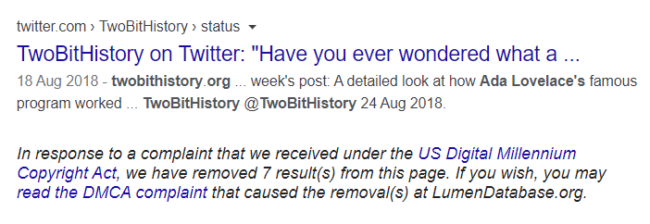
In 2018, the owner of Two-Bit History, a site dedicated to computer history, wrote a successful article about mathematician Ada Lovelace, who some credit as being the first computer programmer. Sadly, if you search Google for that article today you won't find it. Some idiotic anti-piracy company had it deleted because it dared to use the word "did." TorrentFreak reports: In 2018, [Sinclair Target, the owner of computing history blog, Two-Bit History] wrote an article about Ada Lovelace, the daughter of Lord Byron who some credit as being the world's first computer programmer, despite being born in 1815. Unfortunately, however, those who search for that article today using Google won't find it. As the image below shows, the original Tweet announcing the article is still present in Google's indexes but the article itself has been removed, thanks to a copyright infringement complaint that also claimed several other victims.

Sinclair's article was deleted because an anti-piracy company working on behalf of a TV company decided that since its title (What Did Ada Lovelace's Program Actually Do?) contained the word 'DID,' it must be illegal. This monumental screw-up was announced on Twitter by Sinclair himself, who complained that "Computers are stupid folks. Too bad Google has decided they are in charge." At risk of running counter to Sinclair's claim, in this case -- as Lovelace herself would've hopefully agreed -- it is people who are stupid, not computers. The proof for that can be found in the DMCA complaint sent to Google by RightsHero, an anti-piracy company working on behalf of Zee TV, an Indian pay-TV channel that airs Dance India Dance. Now in its seventh season, Dance India Dance is a dance competition reality show that is often referred to as DID. And now, of course, you can see where this is going. Because Target and at least 11 other sites dared to use the word in its original context, RightsHero flagged the pages as infringing and asked Google to deindex them.
In the complaint sent to Google, "the notice not only claims Target's article is infringing the copyrights of Dance India Dance (sorry, DID), but also no less than four online dictionaries explaining what the word 'did actually means," adds TorrentFreak. "Perhaps worse still, some of the other allegedly-infringing articles were published by some pretty serious information resources [including the U.S. Department of Education, Nature.com, and USGS Earthquake Hazards Program of the U.S. Geological Survey]."
Microsoft

Windows Search Went Down For Hours Because of a Microsoft Services Outage (theverge.com) 68

Microsoft's built-in Windows search went down for more than three hours today due to access and latency issues "with multiple Microsoft 365 services." While the issues have since been resolved, it comes just days after Microsoft's Teams service experienced a widespread outage after the company forgot to renew a SSL certificate. The Verge reports: Windows search is built into Microsoft's latest Windows 10 operating system, and it started presenting blank search results for apps or any other search queries at around 8AM ET today. Windows search uses the Bing backend to search for results across the web, and it appears that this was the source of the issue. Microsoft blames a "third-party networking fiber provider" for experiencing a network disruption resulting in multiple Microsoft 365 services issues. "This issue has been resolved for most users and in some cases you may need to reboot your machine," says a Microsoft spokesperson in a statement to The Verge.

Slashdot Top Deals