Microsoft

Microsoft Trims More CPUs From Windows 11 Compatibility List (theregister.com) 95

Microsoft has updated its CPU compatibility list for Windows 11 24H2, excluding pre-11th-generation Intel processors for OEMs building new PCs. The Register reports: Windows 11 24H2 has been available to customers for months, yet Microsoft felt compelled in its February update to confirm that builders, specifically, must use Intel's 11th-generation or later silicon when building brand new PCs to run its most recent OS iteration. "These processors meet the design principles around security, reliability, and the minimum system requirements for Windows 11," Microsoft says.

Intel's 11th-generation chips arrived in 2020 and were discontinued last year. It would be surprising, if not unheard of, for OEMs to build machines with unsupported chips. Intel has already transitioned many pre-11th generation chips to "a legacy software support model," so Microsoft's decision to omit the chips from the OEM list is understandable. However, this could be seen as a creeping problem. Chips made earlier than that were present very recently, in the list of supported Intel processors for Windows 11 22H2 and 23H2.

This new OEM list may add to worries of some users looking at the general hardware compatibility specs for Windows 11 and wondering if the latest information means that even the slightly newer hardware in their org's fleet will soon no longer meet the requirements of Microsoft's flagship operating system. It's a good question, and the answer -- currently -- appears to be that those "old" CPUs are still suitable. Microsoft has a list of hardware compatibility requirements that customers can check, and they have not changed much since the outcry when they were first published.

Hardware

PassMark Sees the First Yearly Drop In Average CPU Performance In Its 20 Years (tomshardware.com) 54

For the first time since 2004, PassMark's global CPU benchmark data shows a decline in average processor performance, with laptop CPUs dropping 3.4% and desktop CPUs falling 0.5% year-over-year. Tom's Hardware reports: We see the biggest drop in laptop CPU performance results. PassMark recorded an average result of 14,632 across 101,316 samples last year. But, in 2025, the average score sat at an average of 14,130 points between 25,541 samples, decreasing the average score by 3.4%. The average desktop PC result in 2024 netted 26,436 points for 186,053 samples. But for 2025, the average score currently sits at 26,311 points for over 47,810 samples -- a 0.5% drop from last year. While that drop is small, we should only see a continued progression of faster performance.

[...] Passmark itself mused on X (formerly Twitter) that it could be that people are switching to more affordable machines that deliver lower power and performance. Or maybe Windows 11 is depressing performance scores versus Windows 10, especially as people transition to it with the upcoming demise of the latter. We've certainly seen plenty of examples of reduced performance in gaming with some of the newer versions of Windows 11, particularly as Intel and AMD struggled to upstream needed updates into the OS. [...] PassMark also muses that bloatware could contribute to the sudden decline in performance, but that seems like a longshot.

Transportation

Lyft Eyes Robotaxi Launch in 2026 27

Lyft says it will launch a fleet of robotaxis, using self-driving technology from Intel's Mobileye, in Dallas in "as soon as 2026," with plans to scale to "thousands" of vehicles in additional markets in the months to follow. From a report: To signal its seriousness, the company tapped Marubeni, a Japanese conglomerate, to run fleet operations. Lyft's news comes after Uber dropped new details about its plan to feature Waymo's robotaxis on its platform in Austin and Atlanta later this year. And Tesla recently shared plans to launch a robotaxi service in Austin this summer.
Books

Bill Gates Remembers LSD Trips, Smoking Pot, and How the Smartphone OS Market 'Was Ours for the Taking' (independent.co.uk) 138

Fortune remembers that in 2011 Steve Jobs had told author Walter Isaacson that Microsoft co-founder Bill Gates would "be a broader guy if he had dropped acid once or gone off to an ashram when he was younger."

But The Indendepent notes that in his new memoir Gates does write about two acid trip experiences. (Gates mis-timed his first experiment with LSD, ending up still tripping during a previously-scheduled appointment for dental surgery...) "Later in the book, Gates recounts another experience with LSD with future Microsoft co-founder Paul Allen and some friends... Gates says in the book that it was the fear of damaging his memory that finally persuaded him never to take the drug again." He added: "I smoked pot in high school, but not because it did anything interesting. I thought maybe I would look cool and some girl would think that was interesting. It didn't succeed, so I gave it up."

Gates went on to say that former Apple CEO Steve Jobs, who didn't know about his past drug use, teased him on the subject. "Steve Jobs once said that he wished I'd take acid because then maybe I would have had more taste in my design of my products," recalled Gates. "My response to that was to say, 'Look, I got the wrong batch.' I got the coding batch, and this guy got the marketing-design batch, so good for him! Because his talents and mine, other than being kind of an energetic leader, and pushing the limits, they didn't overlap much. He wouldn't know what a line of code meant, and his ability to think about design and marketing and things like that... I envy those skills. I'm not in his league."

Gates added that he was a fan of Michael Pollan's book about psychedelic drugs, How To Change Your Mind, and is intrigued by the idea that they may have therapeutic uses. "The idea that some of these drugs that affect your mind might help with depression or OCD, I think that's fascinating," said Gates. "Of course, we have to be careful, and that's very different than recreational usage."

Touring the country, 69-year-old Gates shared more glimpses of his life story:
  • The Harvard Gazette notes that the university didn't offer computer science degrees when Gates attended in 1973. But since Gates already had years of code-writing experience, he "initially rebuffed any suggestion of taking computer-related coursework... 'It's too easy,' he remembered telling friends."
  • "The naiveté I had that free computing would just be this unadulterated good thing wasn't totally correct even before AI," Gates told an audience at the Harvard Book Store. "And now with AI, I can see that we could shape this in the wrong way."
  • Gates "expressed regret about how he treated another boyhood friend, Paul Allen, the other cofounder of Microsoft, who died in 2018," reports the Boston Globe. "Gates at first took 60 percent ownership of the new software company and then pressured his friend for another 4 percent. 'I feel bad about it in retrospect,' he said. 'That was always a little complicated, and I wish I hadn't pushed....'"
  • Benzinga writes that Gates has now "donated $100 billion to charitable causes... Had Gates retained the $100 billion he has donated, his total wealth would be around $264 billion, placing him second on the global wealth rankings behind Elon Musk and ahead of Jeff Bezos and Mark Zuckerberg."
  • Gates told the Associated Press "I am stunned that Intel basically lost its way," saying Intel is now "kind of behind" on both chip design and fabrication. "They missed the AI chip revolution, and with their fabrication capabilities, they don't even use standards that people like Nvidia and Qualcomm find easy... I hope Intel recovers, but it looks pretty tough for them at this stage."
  • Gates also told the Associated Press that fighting a three-year antitrust case had "distracted" Microsoft. "The area that Google did well in that would not have happened had I not been distracted is Android, where it was a natural thing for me. I was trying, although what I didn't do well enough is provide the operating system for the phone. That was ours for the taking."
  • The Dallas News reports that in an on-stage interview in Texas, Mark Cuban closed by asking Gates one question. "Is the American Dream alive?" Gates answered: "It was for me."

Businesses

AMD Outsells Intel In the Datacenter For the First Time (tomshardware.com) 21

During the fourth quarter of 2024, AMD surpassed Intel in datacenter sales for the first time in history -- despite weaker-than-expected sales of its datacenter GPUs. Tom's Hardware reports: AMD's revenue in Q4 2024 totaled $7.658 billion, up 24% year-over-year. The company's gross margin hit 51%, whereas net income was $482 million. On the year basis, 2024 was AMD's best year ever as the company's revenue reached $25.8 billion, up 14% year-over-year. The company earned net income of $1.641 billion as its gross margin hit 49%. But while the company's annual results are impressive, there is something about Q4 results that AMD should be proud of.

Datacenter business was the company's primary source of earnings, with net revenue reaching record $3.86 billion in Q4, marking a 69% year-over-year (YoY) increase and a 9% quarter-over-quarter (QoQ) rise. Operating income also saw substantial improvement, surging 74% YoY to $1.16 billion. By contrast, Intel's datacenter and AI business unit posted $3.4 billion revenue, while its operating income reached $200 million. But while the quarter marked a milestone for AMD, market analysts expected AMD to sell more of its Instinct MI300-series GPUs for AI and HPC.
You can view AMD's 2024 financial results here.
Open Source

RISC-V Mainboard For the Framework Laptop 13 Is Now Available (liliputing.com) 16

The DeepComputing RISC-V Mainboard that Framework announced last year for its 13-inch laptops is now available for $199. Liliputing reports: If you already have a Framework Laptop 13 with an Intel or AMD motherboard, the new board is a drop-in replacement. But if you don't have a Framework Laptop you can also use the mainboard as a standalone computer: Framework sells a $39 Cooler Master case that effectively turns its mainboards into mini desktop computers. The RISC-V Mainboard comes from a partnership between Framework and DeepComputing, the Chinese company behind the DC-ROMA laptops, which were some of the first notebook computers to ship with RISC-V processors.

The board features a StarFive JH7110 processor, which is a 1.5 GHz quad-core chip featuring SiFive U74 RISC-V CPU cores and Imagination BXE-4-32 graphics, 8GB of onboard RAM, and a a 64GB SD card for storage (there's also support for an optional eMMC module, but you'll need to bring your own). Since the board is designed to fit in existing laptop frames, it's the same size and shape as AMD or Intel models and has four USB ports in the same locations. But these ports are a little less versatile than the ones you might find on other Framework Laptop 13 Mainboards [...]. There's also a 3.5mm audio jack.
You can check out the new board via the Framework Marketplace.

Further reading: Late last year, Framework CEO Nirav Patel delivered one of the best live demos we've ever seen at a tech conference -- modifying a Framework Laptop from x86 to RISC-V live on stage.
Microsoft

Microsoft Slaps $400 Premium on Intel-powered Surface Lineup (theregister.com) 60

Microsoft is charging business customers a $400 premium for Surface devices equipped with Intel's latest Core Ultra processors compared to models using Qualcomm's Arm-based chips, the company has disclosed. The Intel-powered Surface Pro tablet and Surface Laptop, starting at $1,499, come with a second-generation Core Ultra 5 processor featuring eight cores, 16GB of memory and 256GB storage.

Comparable Qualcomm-based models begin at $1,099. The new Intel devices will be available to business customers from February 18, though versions with cellular connectivity will launch later. Consumer Surface devices will only be offered with Qualcomm processors. Microsoft also unveiled a USB 4 Dock supporting dual 4K displays and the Surface Hub 3, a conference room computer available in 50-inch or 85-inch touchscreen versions.
Intel

Intel Won't Bring Its Falcon Shores AI Chip To Market (techcrunch.com) 24

During the company's fourth-quarter earnings call Thursday, Intel co-CEO Michelle Johnston Holthaus announced that Intel has decided to cancel its Falcon Shores AI chip. Instead, it'll opt to use it as an internal test chip while shifting focus to Jaguar Shores for AI data center solutions. TechCrunch reports: "AI data center ... is an attractive market for us," Holthaus said during the call. "[B]ut I am not happy with where we are today. We're not yet participating in the cloud-based AI data center market in a meaningful way ... One of the immediate actions I have taken is to simplify our roadmap and concentrate our resources." The focus instead will be on Jaguar Shores, which Holthaus called Intel's opportunity to "develop a system-level solution at rack scale ... to address the AI data center more broadly."

Holthaus tempered expectations for Falcon Shores last month, when she implied that it was an "iterative" step over the company's previous dedicated AI data center chip, Gaudi 3. "One of the things that we've learned from Gaudi is, it's not enough to just deliver the silicon," Holthaus said during Thursday's earnings call. "Falcon Shores will help us in that process of working on the system, networking, memory -- all those component[s]. But what customers really want is that full-scale rack solution, and so we're able to get to that with Jaguar Shores."

"As I think about our AI opportunity, my focus is on the problems our customers are trying to solve, most notably the need to lower the cost and increase the efficiency of compute," Holthaus said. "As such, a one-size-fits-all approach will not work, and I can see clear opportunities to leverage our core assets in new ways to drive the most compelling total cost of ownership across the continuum."

Intel

Intel 'Did Not Know How To Be a Foundry,' Tim Cook Told TSMC Chief (tomshardware.com) 49

TSMC founder Morris Chang says Apple CEO Tim Cook rejected Intel as a chip manufacturer in 2011 because the company lacked foundry expertise, despite being Apple's main supplier for Mac processors at the time. During a pause in TSMC-Apple talks to evaluate Intel's proposal, Cook told Chang that "Intel just does not know how to be a foundry," leading Apple to eventually choose TSMC as its exclusive chip supplier, the TSMC founder revealed in an interview.
Linux

Linux 6.14 Brings Some Systems Faster Suspend and Resume (phoronix.com) 46

Amid the ongoing Linux 6.14 kernel development cycle, Phoronix spotted a pull request for ACPI updates which "will allow for faster suspend and resume cycles on some systems."

Wikipedia defines ACPI as "an open standard that operating systems can use to discover and configure computer hardware components" for things like power management and putting unused hardware components to sleep. Phoronix reports: The ACPI change worth highlighting for Linux 6.14 is switching from msleep() to usleep_range() within the acpi_os_sleep() call in the kernel. This reduces spurious sleep time due to timer inaccuracy. Linux ACPI/PM maintainer Rafael Wysocki of Intel who authored this change noted that it could "spectacularly" reduce the duration of system suspend and resume transitions on some systems...

Rafael explained in the patch making the sleep change:

"The extra delay added by msleep() to the sleep time value passed to it can be significant, roughly between 1.5 ns on systems with HZ = 1000 and as much as 15 ms on systems with HZ = 100, which is hardly acceptable, at least for small sleep time values."

One 2022 bug report complained a Dell XPS 13 using Thunderbolt took "a full 8 seconds to suspend and a full 8 seconds to resume even though no physical devices are connected." In November an Intel engineer posted on the kernel mailing list that the fix gave a Dell XPS 13 a 42% improvement in kernel resume time (from 1943ms to 1127ms).
Intel

Intel Pitches Modular PC Designs To Make Repairs Less Painful (theregister.com) 62

Intel is advocating for modular PC designs to improve repairability, reduce e-waste, and align with the right-to-repair movement. A trio of executives makes their case for such designs in a recent blog post. The Register reports: Intel's approach to the problem is to draft three proposals targeting different market segments, saying that a one-size-fits-all approach would not be able to address the nuanced demands of these varied segments. Those three segments comprise "Premium Modular PC" (actually a laptop design); "Entry/Mainstream Modular PC" (another laptop); and "Desktop Modular PC."

The first envisages a three-board system, comprising a core motherboard plus universal left and right I/O boards, the latter engineered to be common across fan-less Thin & Light designs with a 10W power envelope, and premium fanned designs for up to 20W or 30W. The Entry/Mainstream Modular PC is similar, with a core motherboard and left and right I/O boards, although in this segment, Intel says these can be redesigned to allow multiple SKUs of the design. The circuit boards are also cost-optimized here to cater to the mainstream segment, it says.

The Desktop Modular PC design appears from Intel's diagram to use a midplane that has the Platform Controller Hub (PCH) silicon, with other modules connecting to this. These include CPU, memory, and GPU modules, removable using slide rails, along with hot-swappable storage, all designed to fit inside a 5 liter desktop chassis. Intel also said it is introducing subsystem-level replaceable modules. In practice, this means something like a Type-C connector on a flexible printed circuit (FPC) or an M.2 circuit board. The idea is that the module can easily be swapped out if the port or connector is damaged.

Linux

Linux 6.13 Released (phoronix.com) 25

"Nothing horrible or unexpected happened last week," Linux Torvalds posted tonight on the Linux kernel mailing list, "so I've tagged and pushed out the final 6.13 release."

Phoronix says the release has "plenty of fine features": Linux 6.13 comes with the introduction of the AMD 3D V-Cache Optimizer driver for benefiting multi-CCD Ryzen X3D processors. The new AMD EPYC 9005 "Turin" server processors will now default to AMD P-State rather than ACPI CPUFreq for better power efficiency....

Linux 6.13 also brings more Rust programming language infrastructure and more.

Phoronix notes that Linux 6.13 also brings "the start of Intel Xe3 graphics bring-up, support for many older (pre-M1) Apple devices like numerous iPads and iPhones, NVMe 2.1 specification support, and AutoFDO and Propeller optimization support when compiling the Linux kernel with the LLVM Clang compiler."

And some lucky Linux kernel developers will also be getting a guitar pedal soldered by Linus Torvalds himself, thanks to a generous offer he announced a week ago: For _me_ a traditional holiday activity tends to be a LEGO build or two, since that's often part of the presents... But in addition to the LEGO builds, this year I also ended up doing a number of guitar pedal kit builds ("LEGO for grown-ups with a soldering iron"). Not because I play guitar, but because I enjoy the tinkering, and the guitar pedals actually do something and are the right kind of "not very complex, but not some 5-minute 555 LED blinking thing"...

[S]ince I don't actually have any _use_ for the resulting pedals (I've already foisted off a few only unsuspecting victims^Hfriends), I decided that I'm going to see if some hapless kernel developer would want one.... as an admittedly pretty weak excuse to keep buying and building kits...

"It may be worth noting that while I've had good success so far, I'm a software person with a soldering iron. You have been warned... [Y]ou should set your expectations along the lines of 'quality kit built by a SW person who doesn't know one end of a guitar from the other.'"
Intel

Intel Acquisition Target of Mystery Suitor, SemiAccurate Reports 105

Tech news and research site SemiAccurate is reporting that an unidentified company is seeking to acquire Intel in its entirety. The publication -- citing a confidential email that it reviewed and a subsequent confirmation from a second source -- said the prospective buyer has not publicly disclosed its interest but has sufficient resources to purchase Intel at current valuations (about $85 billion).
Linux

Will Nvidia Spark a New Generation of Linux PCs? (zdnet.com) 95

"I know, I know: 'Year of the Linux desktop ... yadda, yadda'," writes Steven Vaughan-Nichols, a ZDNet senior contributing editor. "You've heard it all before. But now there's a Linux-powered PC that many people will want..."

He's talking about Nvidia's newly-announced Project Digits, describing it as "a desktop with AI supercomputer power that runs DGX OS, a customized Ubuntu Linux 22.04 distro." Powered by MediaTek and Nvidia's Grace Blackwell Superchip, Project DIGITS is a $3,000 personal AI that combines Nvidia's Blackwell GPU with a 20-core Grace CPU built on the Arm architecture... At CES, Nvidia CEO Jensen Huang confirmed plans to make this technology available to everyone, not just AI developers. "We're going to make this a mainstream product," Huang said. His statement suggests that Nvidia and MediaTek are positioning themselves to challenge established players — including Intel and AMD — in the desktop CPU market. This move to the desktop and perhaps even laptops has been coming for a while. As early as 2023, Nvidia was hinting that a consumer desktop chip would be in its future... [W]hy not use native Linux as the primary operating system on this new chip family?

Linux, after all, already runs on the Grace Blackwell Superchip. Windows doesn't. It's that simple. Nowadays, Linux runs well with Nvidia chips. Recent benchmarks show that open-source Linux graphic drivers work with Nvidia GPUs as well as its proprietary drivers. Even Linus Torvalds thinks Nvidia has gotten its open-source and Linux act together. In August 2023, Torvalds said, "Nvidia got much more involved in the kernel. Nvidia went from being on my list of companies who are not good to my list of companies who are doing really good work." Canonical, Ubuntu Linux's parent company, has long worked closely with Nvidia. Ubuntu already provides Blackwell drivers.

The article strays into speculation, when it adds "maybe you wouldn't pay three grand for a Project DIGITS PC. But what about a $1,000 Blackwell PC from Acer, Asus, or Lenovo? All three of these companies are already selling MediaTek-powered Chromebooks...."

"The first consumer products featuring this technology are expected to hit the market later this year. I'm looking forward to running Linux on it. Come on in! The operating system's fine."
China

Chinese RISC-V Project Teases 2025 Debut of Freely Licensed Advanced Chip Design (theregister.com) 110

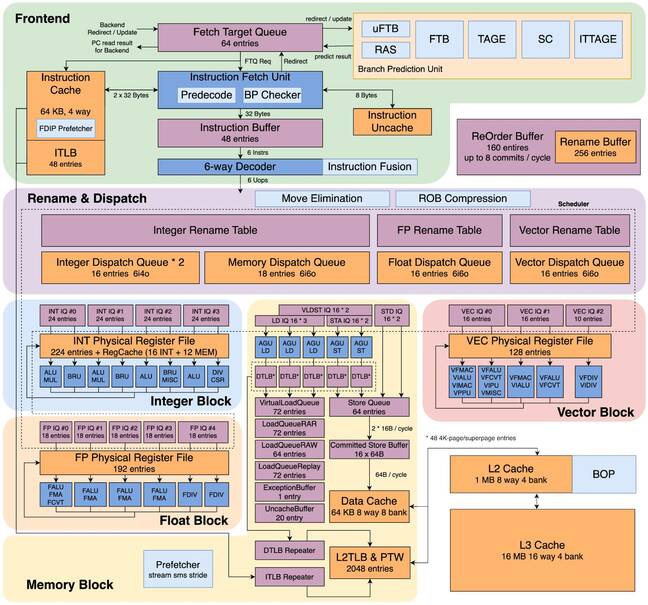
China's Xiangshan project aims to deliver a high-performance RISC-V processor by 2025. If it succeeds, it could be "enormously significant" for three reasons, writes The Register's Simon Sharwood. It would elevate RISC-V from low-end silicon to datacenter-level capabilities, leverage the open-source Mulan PSL-2.0 license to disrupt proprietary chip models like Arm and Intel, and reduce China's dependence on foreign technology, mitigating the impact of international sanctions on advanced processors. From the report: The prospect of a 2025 debut appeared on Sunday in a post to Chinese social media service Weibo, penned by Yungang Bao of the Institute of Computing Technology at the Chinese Academy of Sciences. The academy has created a project called Xiangshan that aims to use the permissively licensed RISC-V ISA to create a high-performance chip, with the Scala source code to the designs openly available.

Bao is a leader of the project, and has described the team's ambition to create a company that does for RISC-V what Red Hat did for Linux -- although he said that before Red Hat changed the way it made the source code of RHEL available to the public. The Xiangshan project has previously aspired to six-monthly releases, though it appears its latest design to be taped out was a second-gen chip named Nanhu that emerged in late 2023. That silicon ran at 2GHz and was built on a 14nm process node. The project has since worked on a third-gen design, named Kunminghu, and published the image [here] depicting an overview of its non-trivial micro-architecture.

Intel

Intel Says New Laptop Chips Will Extend Computer Battery Life (yahoo.com) 29

Intel, which has been fending off mounting competition in notebook processors, says a new range of chips will help enable the longest battery life available in laptops. From a report: New computers based on the latest version of its Core Ultra processors will go on sale starting this month, the company said Monday at CES, an annual consumer electronics show.

Intel was for decades the world's largest chipmaker thanks to its dominance of the computer processor market. Production technology stumbles and slow product introductions have opened the door to both long-time rivals and firms just entering the space. The company's board last month ousted its chief executive officer, citing the need to improve its offerings.

The new chips, intended for corporate PCs and high-end consumer devices, are aimed at boosting performance in two areas the company considers key selling points: battery life and the ability to run artificial intelligence functions. According to Intel, an HP laptop that uses one of the new processors can run Microsoft's Teams software for as long as 10.5 hours on a single charge. It can go 20.3 hours between charges when the user is running Microsoft's cloud-based 365 suite, Intel added. By comparison, Intel says a Dell device using a Qualcomm Snapdragon processor can last as long as 9.2 hours and 18.5 hours, respectively, under those conditions.

Stats

Steam On Linux Ends 2024 With Small Marketshare Boost, AMD Linux CPU Use Near 74% (techspot.com) 26

Phoronix reports on Valve's "Steam Survey" results for December 2024, saying the new numbers "reflect a nice upward trend for the Linux gaming statistics and a high point in recent times." In November the Steam Survey reflected a 2.03% marketshare for Linux... Roughly inline with what we have been seeing for Linux right at around the 2% threshold. With the just-published December survey numbers, there is a 0.29% increase to 2.29%...! When looking at the Linux numbers, SteamOS Holo accounts for around 36% of all Linux gamers... SteamOS Holo being the operating system of the Steam Deck and beginning to appear on other devices as well... Driven in large part by the Steam Deck relying on a custom AMD SoC/APU and AMD being popular with Linux gamers/enthusiasts for their open-source driver support, AMD CPU use on Linux commands a 73.6% marketshare.
In fact, December "saw AMD reach another record-high share among participants of Valve's survey," according to TechSpot — "up 3.02% last month, taking its total to 38.7% as Intel fell slightly to 63.4%..." Elsewhere, Windows 11 is now comfortably the most popular OS in the survey. It pulled ahead another 2% to an almost 55% share in December as Windows 10 dropped to 42.3%... However, it's a different story when looking at global users: Windows 10's share has increased two months in a row to 62.7% while Windows 11 has declined to 34.1%. Rounding up the rest of the survey, 16GB of RAM remains the most popular amount of system RAM but it's lead is declining as second-place 32GB grows; a trend that is mirrored in the VRAM category...
Phoronix adds that the Windows percent "pulled back by 0.51% to 96.1% while Apple macOS also gained 0.22% going up to a 1.61% marketshare."
IBM

IBM and GlobalFoundries Settle Multibillion-Dollar Trade Secret and Contract Lawsuits (theregister.com) 3

The Register's Jude Karabus reports: IBM and semiconductor maker GlobalFoundries have settled all of their litigation against each other, including breach of contract, patent, and trade secret suits, the pair say. The details of the settlement are confidential. All that both companies were prepared to say in yesterday's statements was that the deal they'd agreed would resolve "all litigation matters, inclusive of breach of contract, trade secrets, and intellectual property claims between the two companies." They added that the settlement would allow the companies to "explore new opportunities for collaboration in areas of mutual interest." In 2021, IBM sued GlobalFoundries for $2.5 billion, accusing it of failing to deliver on 10nm and 7nm chip production commitments, which disrupted IBM's hardware roadmap. GlobalFoundries poaching engineers countersued in 2023, alleging IBM misused trade secrets and poached engineers to support partnerships with Intel and Rapidus, potentially compromising proprietary technologies.
XBox (Games)

Russia Admits Its Homegrown Consoles Can't Match the PS5 or Xbox Series (techspot.com) 52

Earlier this year, Russia President Vladimir Putin called on the government to develop its own domestically produced gaming consoles with proprietary operating systems and cloud-based platforms. "With Russia heavily sanctioned and looking to promote its own products, one of its in-development consoles is powered by the Elbrus processor," notes TechSpot. However, the processor is "designed primarily for domestic applications in critical infrastructure, defense, and other sensitive areas" and "can't match high-end CPUs from Intel, AMD, and Arm." From the report: The Russian government admits that this device isn't going to be on the same level as current-gen machines. "I hope my colleagues will approach this task with full responsibility and come up with something truly groundbreaking," said Anton Gorelkin, Deputy Chairman of the State Duma Committee on Information Policy. "It is obvious to everyone: Elbrus processors are not yet at the level required to compete equally with the PS5 and Xbox, which means the solution must be unconventional." Gorelkin said that Russian consoles aren't being designed only to play ports of hundreds of old, less-demanding games. He added that they should primarily serve the purpose of promoting and popularizing domestic video game products.

Another organization following Putin's instructions is Russian telecommunications firm MTS. Its console (above) will use the company's cloud-based gaming platform, called Fog Play. It allows owners of high-end PCs to rent out their computing power to those with less-powerful equipment, charging an hourly price. Those with more powerful PCs can access games on the service and use their own hardware to play them. MTS' device is expected to cost no more than $45 and come with an Xbox-like controller, suggesting it's unlikely to appeal to those who enjoy current-gen console games.

Intel

Intel Suffers Worst Year Since 1971 IPO (cnbc.com) 34

Intel's market value plunged 61% in 2024, marking its worst performance since going public in 1971, while rival chipmaker Broadcom saw shares surge 111% on AI advances. Broadcom, now valued at $1.1 trillion, leverages its custom XPU chips and networking gear for major cloud providers including Google, helping companies build AI infrastructure at lower costs than Nvidia's GPUs.

Further reading: Intel Weighed $20 Billion Nvidia Takeover in 2005.

Slashdot Top Deals