LM-Kit.NET is an enterprise-grade toolkit designed for seamlessly integrating generative AI into your .NET applications, fully supporting Windows, Linux, and macOS. Empower your C# and VB.NET projects with a flexible platform that simplifies the creation and orchestration of dynamic AI agents.
Leverage efficient Small Language Models for on‑device inference, reducing computational load, minimizing latency, and enhancing security by processing data locally. Experience the power of Retrieval‑Augmented Generation (RAG) to boost accuracy and relevance, while advanced AI agents simplify complex workflows and accelerate development.
Native SDKs ensure smooth integration and high performance across diverse platforms. With robust support for custom AI agent development and multi‑agent orchestration, LM‑Kit.NET streamlines prototyping, deployment, and scalability—enabling you to build smarter, faster, and more secure solutions trusted by professionals worldwide.
Learn more

AlisQI is a cloud-based Quality Management platform built for process and batch manufacturers who want to move beyond reactive firefighting toward stable, predictable operations while maintaining full compliance control.
Rather than organizing quality around static documents and isolated events, AlisQI was designed as a data-first system. Quality, laboratory, and production data are structured and connected in a shared operational backbone. This gives cross-functional teams early visibility into deviations, faster response times, and greater confidence in product integrity and daily execution.
The platform combines configurable quality modules, including document control, training, deviations, CAPA, audits, risk management, supplier quality, SPC, and EHS, with targeted, ready-to-use Solvers. Solvers integrate forms, workflows, dashboards, and business logic to address specific operational problems without unnecessary scope.
Because the system is built on structured data, manufacturers can apply practical AI within workflows, from automated COA extraction to conversational access to quality data and pattern detection across incidents.
Solvers are production-ready from day one and evolve as processes, products, or plants change. This progression does not require custom development or disruptive IT projects.
Manufacturers use AlisQI to harmonize quality practices across sites, reduce waste and rework, strengthen audit readiness, accelerate root cause analysis, and connect shop-floor and lab data directly to quality decision-making across industries including chemicals, plastics, packaging, food and beverage, personal care, automotive, and industrial manufacturing.
Learn more
Unlambda
Unlambda is a unique programming language that may not initially seem extraordinary. However, its true innovation lies in its unconventional blend of two lesser-known types of languages. It draws heavily from functional programming languages, particularly exemplified by Scheme, a dialect of Lisp. In Unlambda, the primary focus is solely on functions, which serve as the only objects manipulated within the language. Essentially, every function in Unlambda takes another function as its input and yields a function as its output. Besides a binary “apply” operation, the language incorporates a few essential built-in functions, notably the K and S combinators. While users can create their own functions, they lack the ability to save or name them, as Unlambda operates without any variables. This distinctive characteristic sets Unlambda apart in the realm of programming languages. Consequently, the absence of traditional variable storage reinforces the purity of its functional programming paradigm.
Learn more
Racket
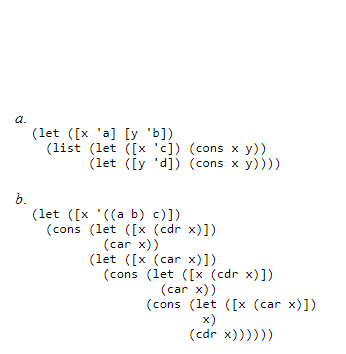
Racket is a versatile programming language that embodies a contemporary version of Lisp and has its roots in Scheme. It is specifically crafted as a foundation for both the design and implementation of programming languages, allowing programmers to develop a variety of specialized and general languages. Among its core features are macros, modules, lexical closures, tail call optimization, delimited continuations, fluid variables, software contracts, green threads, and operating system threads. Additionally, Racket includes essential primitives like event spaces and custodians that manage resources and allow the language to function similarly to an operating system, facilitating the loading and management of other applications. The language's robust macro system enables further extensions, which, combined with its module system and the ability to create custom parsers, offers extensive control over all aspects of language functionality. In fact, many of the constructs present in Racket are defined as macros within its foundational language, showcasing its unique approach to programming language design. This flexibility allows developers to explore innovative language features and paradigms, making Racket a powerful tool for both learners and experienced programmers alike.
Learn more